Lexical Chain Based Cohesion Models for
Document-Level Statistical Machine Translation
Deyi Xiong1, Yang Ding2, Min Zhang1∗ and Chew Lim Tan2
1School of Computer Science and Technology, Soochow University, Suzhou, China 215006
{dyxiong, minzhang}@suda.edu.cn
2School of Computing, National University of Singapore, Singapore 117417
{a0082379, tancl}@comp.nus.edu.sg
Abstract
Lexical chains provide a representation of the lexical cohesion structure of a text. In this pa-per, we propose two lexical chain based co-hesion models to incorporate lexical coco-hesion into document-level statistical machine trans-lation: 1) a count cohesion model that rewards a hypothesis whenever a chain word occurs in the hypothesis, 2) and a probability cohesion model that further takes chain word transla-tion probabilities into account. We compute lexical chains for each source document to be translated and generate target lexical chains based on the computed source chains via max-imum entropy classifiers. We then use the generated target chains to provide constraints for word selection in document-level machine translation through the two proposed lexical chain based cohesion models. We verify the effectiveness of the two models using a hier-archical phrase-based translation system. Ex-periments on large-scale training data show that they can substantially improve translation quality in terms of BLEU and that the prob-ability cohesion model outperforms previous models based on lexical cohesion devices.
1 Introduction
Given a source document, traditionally most statisti-cal machine translation (SMT) systems translate the document sentence by sentence. In such a transla-tion scheme, sentences are translated independent of any other sentences. However, a text is normally written cohesively, in which sentences are connected
∗
Corresponding author
to each other via syntactic and lexical devices. This linguistic phenomenon is called astextual cohesion
(Halliday and Hasan, 1976).
Cohesion is a surface-level property of well-formed texts. It deals with five categories of rela-tionships between text units, namely co-reference, ellipsis, substitution, conjunction and lexical cohe-sion that is realized via semantically related words. The former four cohesion relations can be grouped as grammatical cohesion. Generally speaking, grammatical cohesion is less common and harder to identify than lexical cohesion (Barzilay and El-hadad, 1997).
As most SMT systems translate a text in a sentence-by-sentence fashion, they tend to build less lexical cohesion than human translators (Wong and Kit, 2012). We therefore study lexical cohesion for document-level translation. We use lexical chains (Morris and Hirst, 1991) to capture lexical cohe-sion in a text. Lexical chains are connected graphs that represent the lexical cohesion structure of a text. They have been successfully used for information retrieval (Stairmand, 1996), document summariza-tion (Barzilay and Elhadad, 1997) and so on. In this paper, we investigate how lexical chains can be used to incorporate lexical cohesion into document-level translation.
Our basic assumption is that the lexical chains of a target document are direct correspondences of the lexical chains of its counterpart source document. This assumption is reasonable as the target docu-ment translation should be faithful to the source doc-ument in terms of both text meaning and structure. Based on this assumption, we propose a framework
to incorporate lexical cohesion into target document translation via lexical chains, which works as fol-lows.
• Compute lexical chains for each source docu-ment that is to be translated;
• Project the computed source lexical chains onto the corresponding target document by translat-ing source chain words into target chain words using maximum entropy classifiers;
• Incorporate lexical cohesion into the target doc-ument translation via cohesion models built on the projected target lexical chains .
We build two lexical chain based cohesion mod-els. The first model is a count model that rewards a hypothesis whenever a word in the projected target lexical chains occur in the hypothesis. As a source chain word may be translated into many different target words, we further extend the count model to a second cohesion model: a probability model that takes chain word translation probabilities into ac-count.
We test the two lexical chain based cohesion mod-els on a hierarchical phrase-based SMT system that is trained with large-scale Chinese-English bilin-gual data. Experiment results show that our lexi-cal chain based cohesion models can achieve sub-stantial improvements over the baseline. Further-more, the probability cohesion model is better than the count model and it also outperforms previous cohesion models based on lexical cohesion devices (Xiong et al., 2013).
To the best of our knowledge, this is the first at-tempt to explore lexical chains for statistical ma-chine translation. The remainder of this paper is or-ganized as follows. Section 2 discusses related work and highlights the differences between our method and previous work. Section 3 briefly introduces lexical chains and algorithms that compute lexical chains. Section 4 elaborates the proposed lexical chain based framework, including details on source lexical chain computation, target lexical chain gen-eration and the two lexical chain based cohesion models. Section 5 presents our large-scale experi-ments and results. Finally, we conclude with future directions in Section 6.
2 Related Work
Recent years have witnessed growing research in-terests in document-level statistical machine trans-lation. Such research efforts can be roughly di-vided into two groups: 1) general document-level machine translation that does not explore or ex-plores very little linguistic discourse information; 2) linguistically-motivated document-level machine translation that incorporates discourse information such as cohesion and coherence into SMT. Recent studies (Guillou, 2013; Beigman Klebanov and Flor, 2013) show that this discourse information is very important for document-level machine transla-tion.
General Document-Level Machine Translation Tiedemann (2010) propose cache-based language and translation models for document-level machine translation. These models are built on recently trans-lated sentences. Following this cache-based ap-proach, Gong et al. (2011) further introduce two additional caches. They use a static cache to store bilingual phrases extracted from documents in train-ing data that are similar to the document betrain-ing trans-lated. They also adopt a topic cache with target language topic words. Xiao et al. (2011) study the translation consistency issue in document-level machine translation. They use a hard constraint to consistently translate ambiguous source words into the most frequent translation options. Ture et al. (2012) soften this consistency constraint by integrat-ing three countintegrat-ing features into decoder.
Using Lexical Cohesion Devices in Document-Level SMT Lexical cohesion devices are seman-tically related words, including word repetition, synonyms/near-synonyms, hyponyms and so on. They are also the cohesion-building elements in lex-ical chains.
boundaries.
Most recently Xiong et al. (2013) integrate three categories of lexical cohesion devices into document-level machine translation. They define three cohesion models based on lexical cohesion de-vices: a direct reward model, a conditional probabil-ity model and a mutual information trigger model. The latter two models measure the strength of lexical cohesion relation between two lexical items. They are incorporated into SMT to calculate how appro-priately lexical cohesion devices are used in doc-ument translation. As lexical chains capture lexi-cal cohesion relations among sequences of related words rather than those only between two words, ex-periments in Section 5 show that our lexical chain based probability cohesion model is better than the lexical cohesion device based trigger model, which is the best among the three cohesion models pro-posed by Xiong et al. (2013).
Modeling Coherence in Document-Level SMT In discourse analysis, cohesion is often studied to-gether with coherencewhich is another dimension of the linguistic structure of a text (Barzilay and Elhadad, 1997). Cohesion is related to the sur-face structure of a text while coherence is concerned with the underlying meaning connectedness in a text (Vasconcellos, 1989). Compared with cohesion, co-herence is not easy to be detected. Even so, various models have been proposed to explore coherence for document summarization and generation (Barzilay and Lapata, 2008; Louis and Nenkova, 2012). Fol-lowing this line, Xiong and Zhang (2013) integrate a topic-based coherence model into document-level machine translation, where coherence is defined as a continuous sentence topic transition.
Our lexical chain based cohesion models are also related to previous work on using word and phrase sense disambiguation for lexical choice in SMT (Carpuat and Wu, 2007b; Carpuat and Wu, 2007a; Chan et al., 2007). The difference is that we use document-wide lexical chains to build our cohesion models rather than sentence-level context features. In our framework, lexical choice is performed to make the selected words consistent with the lexical cohesion structure of a document.
Carpuat (2009) explores the principle of one sense per discourse (Gale et al., 1992) in the context of SMT and imposes the constraint of one translation
per discourse on document translation. We also use the one sense per discourse principle to perform word sense disambiguation on the source side in our lexical chaining algorithm (See Section 4.1).
3 Background: Lexical Chain and Chain Computation
Lexical chains are sequences of semantically related words (Morris and Hirst, 1991). They represent the lexical cohesion structure of a text. Figure 2 displays six lexical chains computed from the Chinese news article shown in Figure 1. Words in these lexical chains have lexical cohesion relations such as rep-etition, synonym, which may range over the entire text. For example, in the lexical chainLC1 of Fig-ure 2, the same word “dWgu_” (Germany) repeats 9 times. In the lexical chain LC3, the two words “z`ngcSi” (president) and “zhdx[” (chairman) are synonym words. Generally, a text can have many different lexical chains, each of which represents a thread of cohesion through the text.
Several lexical chaining algorithms have been proposed to compute lexical chains from texts. Nor-mally they need an ontology to obtain semantic re-lations between words. Word sense disambiguation (WSD) is also used to determine the sense of each word in a text. Generally a lexical chain compu-tation algorithm completes the following three sub-tasks:
• Building a representation of a text with a set of candidate words and assigning semantic re-lations between the candidate words according to the ontology;
• Choosing the right sense for each candidate word via WSD;
• Building chains over the semantically related and disambiguated candidate words.
These three sub-tasks can be done separately or si-multaneously.
dWgu_diUnx]n g^ngsZz`ngcSi su`mac[zh[
dWgu_diUnx]n g^ngsZxuRnbe, qiSn jiRnsh]hu]zhdx[qZsh[Yr su]de xZlYXr jiRng dRnrYn gRi g^ngsZde l[nsh[z`ngcSi , wWiqZliegYyuY, zh[dUo su`made j]rYn rWnxuTn jiVrYn wWizh\" ( fTxZnshYb^ Sng diUn ) dWgu_ diUnx]n g^ngsZz`ngcSi su`majZntiRn c[qetR de zh[we, tR shu^, y_uyctRxiTnrSn bczUi shaudUo dWgu_diUnx]n g^ngsZjiRnsh]hu]de ch^ngfYn x]nrYn , c[zh[sh]tRwWiyZde xuTnzW"
t_uzZrWn huRny[ng zhYxiUng xuRnbe , dWgu_ diUnx]n g^ngsZ de gdpiUo yZnc\ zUi fTlSnkYfc gdpiUo jiRoy]sh]chTng shUng zhTng bTifYnzhZsh[yZy\shUng"
su`mazUi dWgu_diUnx]n g^ngsZb^ Sng z`ngbezhUokRi jiRnsh]hu]tYbiWhu]y]zh^ng fRbiTo yZxiUng shVngm[ng , tRshu^:7w`y\yUoqicjiRnsh]hu]jiXchcw`de zh[we" 8
y_uycliTng gYyuYhau jiRng jdx[ng dUxuTn , dUn liSnhWzhYngfdzUi m[n diUo zh^ng shVngwUng luahau , dWgu_z`ngl\shZruadWs]hbxZwUng zUi gdjiUxiUcuazh]xZn dZsh[, dWgu_diUnx]n g^ngsZshebTiwUn m[ng xiTo gdd^ng de zZjZn b]ng wYi xiRoshZ,Wr zhZch[tR"
dWgu_ diUnx]n gdjiU haulSi hu[ wXn , y\ sh[yZdiTnyZbR ^uyuSn zua sh^u , shUngzhTng bTifYnzhZbRdiTnwds]"
dWgu_cSizhYngbehuRny[ng su`mac[zh[de juWd]ng"
Figure 1: An example of a Chinese news article (written in pinyin).
LC1: {dWgu_, dWgu_, b^, dWgu_, dWgu_, dWgu_, dWgu_, b^, dWgu_, dWgu_, dWgu_}
LC2:{jiRnsh]hu], fTxZnshY, jiRnsh]hu], z`ngbe, jiRnsh]hu], jiRnsh]hu]}
LC3:{z`ngcSi, zhdx[, z`ngcSi, z`ngl\} LC4:{c[zh[, c[qe, c[zh[, c[zh[} LC5:{zhTng, xiUcua, shUngzhTng} LC6:{xuRnbe, xuRnbe, fRbiTo}
Figure 2: Six lexical chains from the example in Figure 1.
accuracy by processing all possible combinations of word senses in a text to disambiguate words. Un-fortunately, their algorithm runs slowly in quadratic time. Galley and Mckeown (2003) present an algo-rithm that are better than the former two algoalgo-rithms both in terms of running efficiency and WSD accu-racy. They separate the WSD sub-task from the task of lexical chain building and impose a “one sense per discourse” constraint in the WSD step.
4 Translating Documents Using Lexical Chains
In this section, we describe how we incorporate lex-ical cohesion into document-level machine transla-tion using lexical chains. We divide the lexical chain based document-level machine translation process
into three steps: (1) computing lexical chains for source documents with a source language ontology, (2) generating target lexical chains from the com-puted source lexical chains, and finally (3) incorpo-rating lexical cohesion encoded in the generated tar-get lexical chains into document-level translation via lexical chain based cohesion models. The remainder of this section will elaborate these three steps.
4.1 Source Lexical Chains Computation
We follow the chain computation algorithm intro-duced by Galley and McKeown (2003) to build lex-ical chains on source (Chinese) documents. In the algorithm, the chaining process includes three steps: choosing candidate words to build a disambiguation graph (Galley and McKeown, 2003) for each doc-ument, disambiguating the candidate words and fi-nally building lexical chains over the disambiguated candidate words.
The disambiguation graph can be considered as a representation of all possible interpretations of its corresponding text. In the graph, nodes are candi-date words with different senses and edges between word senses are weighted according to their seman-tic relations, such as synonym, hypernym and so on. We use an extended version of a Chinese thesaurus
ex-level 1
level 2
level 3
level 4
level 5
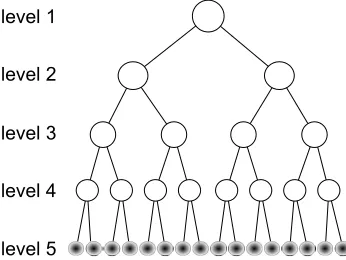
Figure 3: The architecture of the extended Cilin. For sim-plicity, we only draw a binary tree to represent the hier-archical structure of Cilin. This doesn’t mean that each semantic class at levelihas only two sub-classes at level
i+ 1. Actually, they have multiple sub-classes.
tended Cilin contains 77,343 Chinese words, which are organized in a hierarchical structure containing 5 levels as shown in Figure 3. In the 5th level, each node represents an atomic concept which consists of a set of synonyms. These atomic concepts are just like synsetsin WordNet. We use them to represent senses of words in the disambiguation graph.
We select nouns, verbs, abbreviations and idioms as candidate words for the disambiguation graph. These words are identified by a Chinese part-to-speech tagger LTP (Che et al., 2010) in a preprocess-ing step. In order to build the disambiguation graph, we first build an array indexed by the atomic con-cepts of Cilin, then insert a copy of each candidate word into its all concept (sense) entries in the array. After that, we create all semantic links among senses of different candidate words in the disambiguation graph following Galley and McKeown (2003).
In the second step, we use the principle of one sense per discourse to perform WSD for each can-didate word in the disambiguation graph. We sum the weights of all semantic links under the different senses of the candidate word in question. The sense with the highest sum of weights is considered as the most probable sense for this word. We then assign this sense to all occurrences of the word in the doc-ument by adopting the constraint of one sense per discourse.
Once all candidate words are disambiguated, we can build lexical chains over these words by remov-ing all semantic links that connect those unselected
[image:5.612.97.270.58.188.2]word senses. The six lexical chains shown in Fig-ure 2 are computed from the Chinese document in Figure 1 exactly following the algorithm of Galley and McKeown (2003). The only difference is that we use Cilin rather than WordNet as the ontology.
4.2 Target Lexical Chains Generation
Since a faithful target document translation should follow the same cohesion structure as that in its cor-responding source document, we generate target lex-ical chains from the computed source lexlex-ical chains. Given a source lexical chainLCs={sji}where the ith chain word sji is from the jth sentence of the source document Ds, we generate a target lexical chain LCt = {tji} using maximum entropy (Max-Ent) classifiers. Particularly, we translate a wordsji in the source lexical chain into a target word tji in the target lexical chain using a corresponding Max-Ent classifier as follows1.
P(tji|C(sji)) = exp(
P
kθkfk(tji,C(sji))) P
texp( P
kθkfk(t,C(sji))) (1)
wherefkare binary features,θkare weights of these features, and C(sji) is the surrounding context of chain wordsji.
We train one MaxEnt classifier per unique source chain word. For each classifier, we define two groups of binary features: 1) the preceding and succeeding two words of sji in the jth sentence ({w−2, w−1, sji, w+1, w+2}); 2) the preceding and succeeding one word ofsji in the lexical chainLCs ({spi−1, sji, sqi+1}). All features are in the following binary form.
f(tji,C(sji)) =
1, iftji =♣andC(sji).♥=♠
0, else
(2) where the symbol♣is a placeholder for a possible target word, the symbol♥indicates a contextual ele-ment for the chain wordsji (e.g., the preceding word in the jth sentence or the succeeding word in the lexical chainLCs), and the symbol♠represents the value of♥.
Given a source document Ds and its N lexical chains{LCsk}N
k=1 computed from the document as
1We collect training instances from word-aligned bilingual
described in Section 4.1, we can generate the N target lexical chains {LCtk}N
k=1 using our MaxEnt classifiers. Each target word tji in the target lexi-cal chainLCtkis the translation of its corresponding source wordsji in the source lexical chainLCskwith the highest probabilityP(tji|C(sji))according to Eq. (1).
As we know, the MaxEnt classifier can gen-erate multiple translations for each source word. In order to incorporate these multiple chain word translations, we can generate a super target lexi-cal chain LCt from a source lexical chain LCs, where is a pre-defined threshold used to se-lect multiple translations. For example, given a source lexical chain LCs = {a, b, c}, we can have the corresponding super target lexical chain
LCt = {{a1t, a2t...},{bt1, b2t...},{c1t, c2t...}}, where xitis the translation ofxwith a translation probabil-ityP(xit|C(x)) ≥ according to Eq. (1). Integrat-ing multiple translations for each source chain word, we can reduce the error propagation of the MaxEnt classifier to some extent. Our experiments also con-firm that the super target lexical chains with multi-ple translation options for each chain word are better than the target lexical chains with only one transla-tion per chain word. Therefore we build our cohe-sion models based on the super target lexical chains, which will be described in the next section.
4.3 Lexical Chain Based Cohesion Models
Once we generate the super target lexical chains {LCtk}N
k=1for the target documentDt, we can use them to provide constraints for the target document translation. Our key interest is to make the target document translation TDt as cohesive as possible.
We therefore propose lexical chain based cohesion models to measure the cohesion of the target docu-ment translation. The basic idea is to reward a trans-lation hypothesis if a word from the super target lexi-cal chains occurs in the hypothesis. According to the difference in the reward strategy, we have two cohe-sion models: acount cohesion model and a proba-bility cohesion model.
Count Cohesion Model Mc(TDt,{LC
k t}Nk=1): This model rewards a translation hypothesis of the jth sentence in the document whenever a lexical chain wordtji occurs in the hypothesis. The model
maintains a counter and accumulates the counter when necessary. It is factorized into the sentence cohesion metric Mc(Tj,{LCtk}Nk=1), where Tj is the translation of thejth sentence in the target docu-ment.Mc(Tj,{LCtk}Nk=1)is formulated as follows.
Mc(Tj,{LCtk}Nk=1) = Y
w∈Tj
Y
tji∈C
eδ(w,tji) (3)
whereCrepresents{LCtk}Nk=1, and theδfunction is defined as follows.
δ(w, tji) =
1, iftji =w
0, otherwise (4)
Probability Cohesion Model
Mp(TDt,{LC
k
t}Nk=1): This model rewards a translation hypothesis according to the translation probability of a chain word that occurs in the hypothesis. The translation probability is computed by Eq. (1). The model is also factorized into the sentence cohesion metric Mp(Tj,{LCtk}Nk=1) which is formulated as follows.
Mp(Tj,{LCtk}Mk=1) =
Y
w∈Tj
Y
tji∈C
eδ(w,tji)×P(tj
i|C(s j
i)) (5)
whereP(tji|C(sji)is the translation probability com-puted according to Eq. (1).
4.4 Decoding
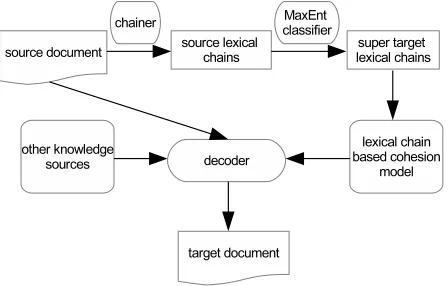
The proposed lexical chain based cohesion models are integrated into the log-linear translation frame-work of SMT as a cohesion feature. Before translat-ing a source document, we compute lexical chains for the source document as described in Section 4.1. We then generate the super target lexical chains. In order to efficiently calculate our lexical chain based cohesion models, we reorganize words in the super target lexical chains into vectors. We associate each source sentence Sj a vector to store target lexical chain words that are to occur in the corresponding target sentenceTj.
Figure 4: Architecture of an SMT system with the lexical chain based cohesion model.
5 Experiments
In this section, we conducted a series of experiments to validate the effectiveness of the proposed lexical chain based cohesion models for Chinese-to-English document-level machine translation. We used a hier-archical phrased-based SMT system (Chiang, 2007) trained on large-scale data. In particular, we aim at:
• Measuring the impact of the thresholdon the probability cohesion model and selecting the best threshold on a development test set.
• Investigating the effect of the two lexical-chain based cohesion models.
• Comparing our lexical chain based cohesion models against the previous lexical cohesion device based models (Xiong et al., 2013).
5.1 Setup
We collected our bilingual training data from LDC, which includes the corpus LDC2002E18, LDC2003E07, LDC2003E14, LDC2004E12, LDC2004T07, LDC2004T08 (Only Hong Kong News), LDC2005T06 and LDC2005T10. The collected bilingual training data contains 3.8M sentence pairs with 96.9M Chinese words and 109.5M English words. We trained a 4-gram language model on the Xinhua portion of the English Gigaword corpus (306 million words) via the SRILM toolkit (Stolcke, 2002) with Kneser-Ney smoothing.
Training MT05 MT06 MT08
#Doc 103,236 100 79 109
[image:7.612.74.298.59.202.2]#Sent 2.80M 1,082 1,664 1,357 #Chain 3.52M 1700 2172 1693 #AvgC 35.72 17 27.49 15.53 #AvgW 14.81 5.89 6.89 5.63
Table 1: Statistics of the training, development and test sets, which show the number of documents (#Doc) and sentences (#Sent), the number of lexical chains extracted from the source documents (#Chain), the average number of lexical chains per document (#AvgC) and the average number of words per lexical chain (#AvgW).
In order to build the lexical chain based cohesion models, we selected corpora with document bound-aries explicitly provided from the bilingual training data together with the whole Hong Kong parallel text corpus as the cohesion model training data2. We show the statistics of these selected corpora in Table 1. They contain 103,236 documents and 2.80M sen-tences. Averagely, each document consists of 28.4 sentences. From the source documents of the se-lected corpora, we extract 3.52M lexical chains. On average, there are 35.72 lexical chains per document and 14.81 words per lexical chain.
We used the off-the-shelf MaxEnt toolkit3to train one MaxEnt classifier per unique source lexical chain word (61,121 different source chain words in total). We performed 100 iterations of the L-BFGS algorithm implemented in the training toolkit for each chain word with both Gaussian prior and event cutoff set to 1 to avoid overfitting. After event cutoff, we have an average of 17.75 different classes (target translations) per source chain word.
We used the NIST MT05 as the tuning set for the minimum error rate training (MERT) [Och, 2003], the NIST MT06 as the development test set and the MT08 as the final test set. The numbers of doc-uments/sentences in the NIST MT05, MT06 and MT08 are 100/1082, 79/1664 and 109/1357 respec-tively. They contain 17, 27.49 and 15.53 lexical chains per document respectively.
We used the case-insensitive BLEU-4 (Papineni
2
The training data includes LDC2003E14, LDC2004T07, LDC2005T06, LDC2005T10 and LDC2004T08 (Hong Kong Hansards/Laws/News).
3Available at: http://homepages.inf.ed.ac.uk/lzhang10/
MT06 0.05 30.53 0.1 31.64 0.2 31.45 0.3 30.73 0.4 31.01
Table 2: BLEU scores of the probability cohesion model Mp(TDt,{LC
k
t}Nk=1) with different values for
the threshold.
et al., 2002) as our evaluation metric. As MERT is normally instable, we ran the tuning process three times for all our experiments and presented the av-erage BLEU scores on the three MERT runs as sug-gested by Clark et al (2011).
5.2 Setting the Threshold
As the two lexical chain based cohesion models are built on the super target lexical chains that are asso-ciated with a parameter, we need to tune the thresh-old parameter on the development test set NIST MT06. We conducted a group of experiments using the probability cohesion model defined in Eq. (5) to find the best threshold. Experiment results are shown in Table 2.
If we set the threshold too small (e.g., 0.05), the super target lexical chains may contain too many noisy words that are not the translations of source lexical chain words, which may jeopardise the qual-ity of the super target lexical chains. The cohesion model built on these noisy super target lexical chains may select incorrect words rather than the proper lexical chain words. On the other hand, if we set the threshold too large (e.g., 0.3 or 0.4), we may take the risk of not selecting the appropriate chain word translations into the super target lexical chains. It seems that the best threshold is 0.1 as we obtained the highest BLEU score 31.64 on the NIST MT06 with this threshold. Therefore we set the threshold to 0.1 in all experiments thereafter.
5.3 Effect of the Count and Probability Cohesion Model
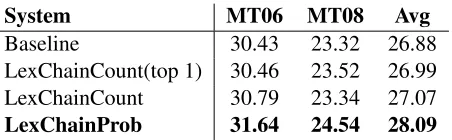
After we found the best threshold, we carried out ex-periments to test the effect of the two lexical chain based cohesion models: the count and probability cohesion model. We compared them against the
[image:8.612.317.543.56.126.2]System MT06 MT08 Avg Baseline 30.43 23.32 26.88 LexChainCount(top 1) 30.46 23.52 26.99 LexChainCount 30.79 23.34 27.07 LexChainProb 31.64 24.54 28.09
Table 3: Effects of the lexical chain based count and probability cohesion models. LexChainCount: the count model defined in Eq. (3). LexChainProb: the probability model defined in Eq. (5).
baseline system that does not integrate any lexical chain information. We also compared the count co-hesion model (LexChainCount(top1)) built on the target lexical chains where each target chain word is the best translation of its corresponding source lex-ical chain word according to Eq. (1). Experiment results are shown in Table 3.
From Table 3, we can observe that
• Our lexical chain based cohesion models are able to substantially improve the translation quality in terms of BLEU score. We achieve an average improvement of up to 1.21 BLEU points over the baseline on the two test sets MT06 and MT08.
• The count cohesion model built on the super target lexical chains is better than that based on the target lexical chains only with top one translations (27.07 vs. 26.99). This shows the advantage of the super target lexical chains {LCtk}Nk=1over the standard target lexical chi-ans{LCtk}N
k=1.
• Finally, the probability cohesion model is much better than the count cohesion model (28.09 vs. 27.07). This suggests that we should take into account chain word translation probabili-ties when we reward hypotheses where target lexical chain words occur.
5.4 Lexical Chains vs. Lexical Cohesion Devices
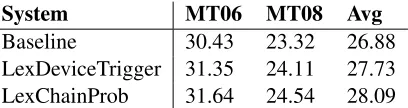
System MT06 MT08 Avg Baseline 30.43 23.32 26.88 LexDeviceTrigger 31.35 24.11 27.73 LexChainProb 31.64 24.54 28.09
Table 4: The lexical chain based probability cohesion model (LexChainProb) vs. the lexical cohesion device based trigger model (LexDeviceTrigger).
We re-implemented the mutual information trig-ger model that is the best lexical cohesion model based on lexical cohesion devices among the three models proposed by Xiong et al. (2013). The mu-tual information trigger model measures the associ-ation strength of two lexical cohesion itemsxandy in a lexical cohesion relationxRy. In the model, it is required thatxoccurs in a sentence preceding the sentence whereyoccurs and that the two items have a lexical cohesion relation such as word repetition, synonym. The model treatsxas the trigger andyas the triggered item. The mutual information between the triggerxand the triggered itemyestimates how possibleywill occur givenxis mentioned in a text. The comparison results are reported in Table 4. Our lexical chain based probability cohesion model outperforms the lexical cohesion device based trig-ger model by 0.36 BLEU points. The reason for this superiority of our cohesion model over the trigger model may be that the former model captures lex-ical cohesion relations among sequences of words through lexical chains while the latter model cap-tures lexical cohesion relations only between two re-lated words.
6 Conclusions
We have presented two lexical chain based cohesion models that incorporate the lexical cohesion struc-ture of a text into document-level machine transla-tion. We project the lexical chains of a source docu-ment to the corresponding target docudocu-ment by trans-lating each word in each source lexical chain into their counterparts via MaxEnt classifiers. The pro-jected target lexical chains provide a representation of the lexical cohesion structure of the target doc-ument that is to be generated. We build two co-hesion models based on the projected target lexi-cal chains: a count model that rewards a hypothesis according to the time of occurrence of target
lexi-cal chain words in the hypothesis and a probability model that further takes translation probabilities into account when rewarding hypotheses. These two co-hesion models are used to constrain word selection for document translation so that the generated doc-ument is consistent with the projected lexical cohe-sion structure.
We have integrated the two proposed cohesion models into a hierarchical phrase-based SMT sys-tem. Experiment results on large-scale data validate that
• The lexical chain based cohesion models are able to substantially improve translation qual-ity in terms of BLEU.
• The probability cohesion model is better than the count cohesion model.
• The lexical chain based probability cohesion model is better than the previous mutual infor-mation trigger model that adopts lexical cohe-sion devices to capture lexical cohecohe-sion rela-tions between two related words.
As we mentioned in Section 2, cohesion is closely connected to coherence. It provides a surface indi-cator for coherence identification (Barzilay and El-hadad, 1997). In the future, we would like to use lexical chains to identify coherence and incorporate both cohesion and coherence into document-level machine translation.
References
Regina Barzilay and Michael Elhadad. 1997. Using lex-ical chains for text summarization. InIn Proceedings of the ACL Workshop on Intelligent Scalable Text Sum-marization, pages 10–17.
Regina Barzilay and Mirella Lapata. 2008. Modeling local coherence: An entity-based approach. Computa-tional Linguistics, 34(1):1–34.
Beata Beigman Klebanov and Michael Flor. 2013. As-sociative texture is lost in translation. InProceedings of the Workshop on Discourse in Machine Translation, pages 27–32, Sofia, Bulgaria, August. Association for Computational Linguistics.
Methodological Issues in Machine Translation, pages 43–52.
Marine Carpuat and Dekai Wu. 2007b. Improving sta-tistical machine translation using word sense disam-biguation. InProceedings of the 2007 Joint Confer-ence on Empirical Methods in Natural Language Pro-cessing and Computational Natural Language Learn-ing (EMNLP-CoNLL), pages 61–72, Prague, Czech Republic, June. Association for Computational Lin-guistics.
Marine Carpuat. 2009. One translation per discourse. In Proceedings of the Workshop on Semantic Evalu-ations: Recent Achievements and Future Directions (SEW-2009), pages 19–27, Boulder, Colorado, June. Association for Computational Linguistics.
Yee Seng Chan, Hwee Tou Ng, and David Chiang. 2007. Word sense disambiguation improves statistical ma-chine translation. InProceedings of the 45th Annual Meeting of the Association of Computational Linguis-tics, pages 33–40, Prague, Czech Republic, June. As-sociation for Computational Linguistics.
Wanxiang Che, Zhenghua Li, and Ting Liu. 2010. Ltp: a chinese language technology platform. In Proceed-ings of the 23rd International Conference on Compu-tational Linguistics: Demonstrations, COLING ’10, pages 13–16, Stroudsburg, PA, USA. Association for Computational Linguistics.
David Chiang. 2007. Hierarchical phrase-based transla-tion. Computational Linguistics, 33(2):201–228. Jonathan H. Clark, Chris Dyer, Alon Lavie, and Noah A.
Smith. 2011. Better hypothesis testing for statisti-cal machine translation: Controlling for optimizer in-stability. In Proceedings of the 49th Annual Meet-ing of the Association for Computational LMeet-inguistics: Human Language Technologies, pages 176–181, Port-land, Oregon, USA, June.
William A. Gale, Kenneth W. Church, and David Yarowsky. 1992. One sense per discourse. In Pro-ceedings of the workshop on Speech and Natural Lan-guage, Harriman, NY, February.
Michel Galley and Kathleen McKeown. 2003. Improv-ing word sense disambiguation in lexical chainImprov-ing. In
Proceedings of the 18th international joint conference on Artificial intelligence, IJCAI’03, pages 1486–1488, San Francisco, CA, USA. Morgan Kaufmann Publish-ers Inc.
Zhengxian Gong, Min Zhang, and Guodong Zhou. 2011. Cache-based document-level statistical machine trans-lation. In Proceedings of the 2011 Conference on Empirical Methods in Natural Language Processing, pages 909–919, Edinburgh, Scotland, UK., July. Liane Guillou. 2013. Analysing lexical consistency in
translation. In Proceedings of the Workshop on Dis-course in Machine Translation, pages 10–18, Sofia,
Bulgaria, August. Association for Computational Lin-guistics.
M.A.K Halliday and Ruqayia Hasan. 1976. Cohesion in English. London: Longman.
Christian Hardmeier, Joakim Nivre, and J¨org Tiedemann. 2012. Document-wide decoding for phrase-based sta-tistical machine translation. In Proceedings of the 2012 Joint Conference on Empirical Methods in Nat-ural Language Processing and Computational Natu-ral Language Learning, pages 1179–1190, Jeju Island, Korea, July.
Annie Louis and Ani Nenkova. 2012. A coherence model based on syntactic patterns. In Proceedings of the 2012 Joint Conference on Empirical Methods in Natural Language Processing and Computational Natural Language Learning, pages 1157–1168, Jeju Island, Korea, July. Association for Computational Linguistics.
Jane Morris and Graeme Hirst. 1991. Lexical cohe-sion computed by thesaural relations as an indicator of the structure of text. Comput. Linguist., 17(1):21–48, March.
Kishore Papineni, Salim Roukos, Todd Ward, and Wei-Jing Zhu. 2002. Bleu: a method for automatic eval-uation of machine translation. InProceedings of 40th Annual Meeting of the Association for Computational Linguistics, pages 311–318, Philadelphia, Pennsylva-nia, USA, July.
M.A. Stairmand. 1996. A computational analysis of lexical cohesion with applications in information re-trieval. UMIST.
Andreas Stolcke. 2002. Srilm–an extensible language modeling toolkit. In Proceedings of the 7th Inter-national Conference on Spoken Language Processing, pages 901–904, Denver, Colorado, USA, September. J¨org Tiedemann. 2010. Context adaptation in statistical
machine translation using models with exponentially decaying cache. InProceedings of the 2010 Workshop on Domain Adaptation for Natural Language Process-ing, pages 8–15, Uppsala, Sweden, July.
Ferhan Ture, Douglas W. Oard, and Philip Resnik. 2012. Encouraging consistent translation choices. In Pro-ceedings of the 2012 Conference of the North Ameri-can Chapter of the Association for Computational Lin-guistics: Human Language Technologies, pages 417– 426, Montr´eal, Canada, June.
Muriel Vasconcellos. 1989. Cohesion and coherence in the presentation of machine translation products. In James E.Alatis, editor, Geogetown University Round Table on Languages and Linguistics 1989, pages 89– 105, Washington, D.C. Georgetown University Press. Billy T. M. Wong and Chunyu Kit. 2012.
2012 Joint Conference on Empirical Methods in Nat-ural Language Processing and Computational Natu-ral Language Learning, pages 1060–1068, Jeju Island, Korea, July.
Tong Xiao, Jingbo Zhu, Shujie Yao, and Hao Zhang. 2011. Document-level consistency verification in ma-chine translation. InProceedings of the 2011 MT sum-mit XIII, pages 131–138, Xiamen, China, September. Deyi Xiong and Min Zhang. 2013. A topic-based
co-herence model for statistical machine translation. In
Proceedings of the Twenty-Seventh AAAI Conference on Artificial Intelligence (AAAI-13), Bellevue, Wash-ington, USA, July.