Word Sense Disambiguation Using Sense Examples Automatically Acquired
from a Second Language
Xinglong Wang School of Informatics University of Edinburgh 2 Buccleuch Place, Edinburgh
EH8 9LW, UK
John Carroll Department of Informatics
University of Sussex Falmer, Brighton
BN1 9QH, UK
Abstract
We present a novel almost-unsupervised approach to the task of Word Sense Dis-ambiguation (WSD). We build sense ex-amples automatically, using large quanti-ties of Chinese text, and English-Chinese and Chinese-English bilingual dictionar-ies, taking advantage of the observation that mappings between words and mean-ings are often different in typologically distant languages. We train a classifier on the sense examples and test it on a gold standard English WSD dataset. The eval-uation gives results that exceed previous state-of-the-art results for comparable sys-tems. We also demonstrate that a little manual effort can improve the quality of sense examples, as measured by WSD ac-curacy. The performance of the classifier on WSD also improves as the number of training sense examples increases.
1 Introduction
The results of the recent Senseval-3 competition (Mihalcea et al., 2004) have shown that supervised
WSD methods can yield up to 72.9% accuracy1
on words for which manually sense-tagged data are available. However, supervised methods suffer from the so-called knowledge acquisition bottleneck: they need large quantities of high quality annotated data
1This figure refers to the highest accuracy achieved in the
Senseval-3 English Lexical Sample task with fine-grained scor-ing.
to produce reliable results. Unfortunately, very
few sense-tagged corpora are available and manual sense-tagging is extremely costly and labour inten-sive. One way to tackle this problem is trying to automate the sense-tagging process. For example, Agirre et al. (2001) proposed a method for building topic signatures automatically, where a topic signa-ture is a set of words, each associated with some weight, that tend to co-occur with a certain concept. Their system queries an Internet search engine with monosemous synonyms of words that have multiple senses in WordNet (Miller et al., 1990), and then ex-tracts topic signatures by processing text snippets re-turned by the search engine. They trained a classifier on the topic signatures and evaluated it on a WSD task, but the results were disappointing.
In recent years, WSD approaches that exploit differences between languages have shown great promise. Several trends are taking place simulta-neously under this multilingual paradigm. A clas-sic one is to acquire sense examples using bilin-gual parallel texts (Gale et al., 1992; Resnik and Yarowsky, 1997; Diab and Resnik, 2002; Ng et al., 2003): given a word-aligned parallel corpus, the dif-ferent translations in a target language serve as the “sense tags” of an ambiguous word in the source language. For example, Ng et al. (2003) acquired sense examples using English-Chinese parallel cor-pora, which were manually or automatically aligned at sentence level and then word-aligned using soft-ware. A manual selection of target translations was then performed, grouping together senses that share the same translation in Chinese. Finally, the occur-rences of the word on the English side of the parallel
texts were considered to have been disambiguated and “sense tagged” by the appropriate Chinese trans-lations. A classifier was trained on the extracted sense examples and then evaluated on the nouns in Senseval-2 English Lexical Sample dataset. The re-sults appear good numerically, but since the sense groups are not in the gold standard, comparison with other Senseval-2 results is difficult. As discussed by Ng et al., there are several problems with relying on bilingual parallel corpora for data collection. First, parallel corpora, especially accurately aligned par-allel corpora are rare, although attempts have been made to mine them from the Web (Resnik, 1999). Second, it is often not possible to distinguish all senses of a word in the source language, by merely relying on parallel corpora, especially when the cor-pora are relatively small. This is a common problem for bilingual approaches: useful data for some words cannot be collected because different senses of poly-semous words in one language often translate to the same word in the other. Using parallel corpora can aggravate this problem, because even if a word sense in the source language has a unique translation in the target language, the translation may not occur in the parallel corpora at all, due to the limited size of this resource.
To alleviate these problems, researchers seek other bilingual resources such as bilingual dictio-naries, together with monolingual resources that can be obtained easily. Dagan and Itai (1994) proposed an approach to WSD using monolingual corpora, a bilingual lexicon and a parser for the source lan-guage. One of the problems of this method is that for many languages, accurate parsers do not exist. With a small amount of classified data and a large amount of unclassified data in both the source and the tar-get languages, Li and Li (2004) proposed bilingual bootstrapping. This repeatedly constructs classifiers in the two languages in parallel and boosts the per-formance of the classifiers by classifying data in each of the languages and by exchanging informa-tion regarding the classified data between two lan-guages. With a certain amount of manual work, they reported promising results, but evaluated on rela-tively small datasets.
In previous work, we proposed to use Chinese monolingual corpora and Chinese-English bilin-gual dictionaries to acquire sense examples (Wang,
2004)2. We evaluated the sense examples using a
vector space WSD model on a small dataset con-taining words with binary senses, with promising results. This approach does not rely on scarce re-sources such as aligned parallel corpora or accurate parsers.
This paper describes further progress based on our proposal: we automatically build larger-scale sense examples and then train a Na¨ıve Bayes classifier on them. We have evaluated our system on the English Lexical Sample Dataset from Senseval-2 and the re-sults show conclusively that such sense examples can be used successfully in a full-scale fine-grained WSD task. We tried to analyse whether more sense examples acquired this way would improve WSD accuracy and also whether a little human effort on sense mapping could further improve WSD perfor-mance.
The reminder of the paper is organised as fol-lows. Section 2 outlines the acquisition algorithm for sense examples. Section 3 describes details of building this resource and demonstrates our appli-cation of sense examples to WSD. We also present results and analysis in this section. Finally, we con-clude in Section 4 and talk about future work.
2 Acquisition of Sense Examples
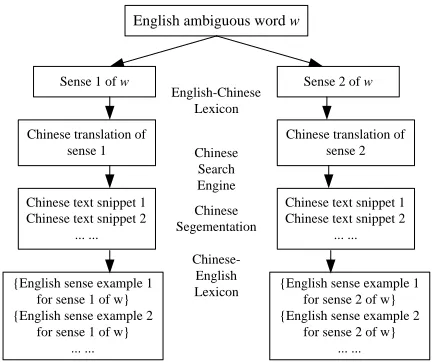
Following our previous proposal (Wang, 2004), we automatically acquire English sense examples using large quantities of Chinese text and English-Chinese and Chinese-English dictionaries. The Chinese lan-guage was chosen because it is a distant lanlan-guage from English and the more distant two languages are, the more likely that senses are lexicalised differ-ently (Resnik and Yarowsky, 1999). The underlying assumption of this approach is that in general each sense of an ambiguous English word corresponds to a distinct translation in Chinese. As shown in Fig-ure 1, firstly, the system translates senses of an En-glish word into Chinese words, using an EnEn-glish- English-Chinese dictionary, and then retrieves text snippets from a large amount of Chinese text, with the Chi-nese translations as queries. Then, the ChiChi-nese text snippets are segmented and then translated back to English word by word, using a Chinese-English
dic-2Sense examples were referred to as “topic signatures” in
English ambiguous word w
Sense 1 of w Sense 2 of w
Chinese translation of sense 2 Chinese translation of
sense 1
English-Chinese Lexicon
[image:3.612.77.293.54.235.2]Chinese text snippet 1 Chinese text snippet 2
... ... Chinese
Search Engine
Chinese-English Lexicon Chinese text snippet 1
Chinese text snippet 2 ... ...
{English sense example 1 for sense 1 of w} {English sense example 2
for sense 1 of w} ... ...
{English sense example 1 for sense 2 of w} {English sense example 2
for sense 2 of w} ... ... Chinese
Segementation
Figure 1. Process of automatic acquisition of sense examples. For simplicity, assumewhas two senses.
tionary. In this way, for each sense, a set of sense examples is produced. As an example, suppose one wants to retrieve sense examples for the financial sense of interest. One first looks up the Chinese translations of this sense in an English-Chinese
dic-tionary, and finds that |E is the right Chinese
translation corresponding to this particular sense. Then, the next stage is to automatically build a col-lection of Chinese text snippets by either searching
in a large Chinese corpus or on the Web, using|
E as query. Since Chinese is a language written
without spaces between words, one needs to use a segmentor to mark word boundaries before translat-ing the snippets word by word back to English. The result is a collection of sense examples for the
finan-cial sense of interest, each containing a bag of words
that tend to co-occur with that particular sense. For example,{interest rate, bank, annual, economy, ...} might be one of the sense examples extracted for the
financial sense of interest. Note that words in a sense
example are unordered.
Since this method acquires training data for WSD systems from raw monolingual Chinese text, it avoids the problem of the shortage of English sense-tagged corpora, and also of the shortage of aligned
bilingual corpora. Also, if existing corpora are
not big enough, one can always harvest more text
from the Web. However, like all methods based
on the cross-language translation assumption men-tioned above, there are potential problems. For
ex-ample, it is possible that a Chinese translation of an English sense is also ambiguous, and thus the con-tents of text snippets retrieved may be regarding a concept other than the one we want. In general, when the assumption does not hold, one could use the glosses defined in a dictionary as queries to re-trieve text snippets, as comprehensive bilingual dic-tionaries tend to include translations to all senses of a word, where multiword translations are used when one-to-one translation is not possible. Alternatively, a human annotator could map the senses and trans-lations by hand. As we will describe later in this paper, we chose the latter way in our experiments.
3 Experiments and Results
We firstly describe in detail how we prepared the sense examples and then describe a large scale WSD evaluation on the English Senseval-2 Lexical Sam-ple dataset (Kilgarriff, 2001). The results show that our system trained with the sense examples achieved significantly better accuracy than comparable sys-tems. We also show that when a little manual effort was invested in mapping the English word senses to Chinese monosemous translations, WSD perfor-mance improves accordingly. Based on further ex-periments on a standard binary WSD dataset, we also show that the technique scales up satisfacto-rily so that more sense examples help achieve better WSD accuracy.
3.1 Building Sense Examples
Following the approach described in Section 2,
we built sense examples for the 44 words in the
Senseval-2 dataset3. These 44 words have 223
senses in total to disambiguate. The first step was translating English senses to Chinese. We used the
Yahoo! Student English-Chinese On-line
Dictio-nary4, as well as a more comprehensive electronic
dictionary. This is because the Yahoo! dictionary is designed for English learners, and its sense granu-larity is rather coarse-grained. It is good enough for words with fewer or coarse-grained senses.
How-3
These 44 words cover all nouns and adjectives in the Senseval-2 dataset, but exclude verbs. We discuss this point in section 3.2.
ever, the Senseval-2 Lexical Sample task5 uses
WordNet1.7as gold standard, which has very fine
sense distinctions and translation granularity in the
Yahoo! dictionary does not conform to this standard. PowerWord 20026 was chosen as a supplementary dictionary because it integrates several comprehen-sive English-Chinese dictionaries in a single appli-cation. For each sense of an English word entry, both
Yahoo! and PowerWord 2002 dictionaries list not
only Chinese translations but also English glosses, which provides a bridge between WordNet synsets and Chinese translations in the dictionaries. In de-tail, to automatically find a Chinese translation for
sensesof an English wordw, our system looks up
win both dictionaries and determines whetherwhas
the same or greater number of senses as in Word-Net. If it does, in one of the bilingual dictionaries,
we locate the English gloss g which has the
max-imum number of overlapping words with the gloss
for sin the WordNet synset. The Chinese
transla-tion associated with g is then selected. Although
this simple method successfully identified Chinese translations for 23 out of the 44 words (52%), trans-lations for the remaining word senses remain un-known because the sense distinctions are different between our bilingual dictionaries and WordNet. In fact, unless an English-Chinese bilingual WordNet becomes available, this problem is inevitable. For our experiments, we solved the problem by manu-ally looking up dictionaries and identifying
transla-tions. For each one of the 44 words, PowerWord
2002 provides more Chinese translations than the
number of its synsets in WordNet1.7. Thus the
an-notator simply selects the Chinese translations that he considers a best match to the corresponding En-glish senses. This task took an hour for an annotator who speaks both languages fluently.
It is possible that the Chinese translations are also ambiguous, which can make the topic of a collection of text snippets deviate from what is expected. For example, the oral sense of mouth can be translated as
ornin Chinese. However, the first translation
5The task has two variations: one to disambiguate
fine-grained senses and the other to coarse-fine-grained ones. We evalu-ated our sense examples on the former variation, which is obvi-ously more difficult.
6A commercial electronic dictionary application. We used
the free on-line version at: http://cb.kingsoft.com.
() is a single-character word and is highly ambigu-ous: by combining with other characters, its
mean-ing varies. For example,Ñmeans “an exit” or “to
export”. On the other hand, the second translation
(n) is monosemous and should be used. To
as-sess the influence of such “ambiguous translations”, we carried out experiments involving more human labour to verify the translations. The same annotator manually eliminated those highly ambiguous Chi-nese translations and then replaced them with less ambiguous or ideally monosemous Chinese trans-lations. This process changed roughly half of the translations and took about five hours. We compared the basic system with this manually improved one. The results are presented in section 3.2.
Using translations as queries, the sense examples were automatically extracted from the Chinese
Gi-gaword Corpus (CGC), distributed by the LDC7,
which contains 2.7GB newswire text, of which
900MB are sourced from Xinhua News Agency of
Beijing, and 1.8GB are drawn from Central News from Taiwan. A small percentage of words have different meanings in these two Chinese dialects, and since the Chinese-English dictionary (LDC
Mandarin-English Translation Lexicon Version 3.0)
we use later is compiled with Mandarin usages in mind, we mainly retrieve data from Xinhua News.
We set a threshold of100, and only when the amount
of snippets retrieved from Xinhua News is smaller than100, do we turn to Central News to collect more data. Specifically, for48out of the223(22%) Chi-nese queries, the system retrieved less than 100 in-stances from Xinhua News so it extracted more data from Central News. In theory, if the training data is still not enough, one could always turn to other text resources, such as the Web.
To decide the optimal length of text snippets to retrieve, we carried out pilot experiments with two
length settings: 250 (≈ 110 English words) and
400(≈175English words) Chinese characters, and
found that more context words helped improve WSD performance (results not shown). Therefore, we re-trieve text snippets with a length of400characters.
We then segmented all text snippets, using an
ap-plication ICTCLAS8. After the segmentor marked
7
Available at: http://www.ldc.upenn.edu/Catalog/
8See: http://mtgroup.ict.ac.cn/∼
all word boundaries, the system automatically trans-lated the text snippets word by word using the elec-tronic LDC Mandarin-English Translation Lexicon
3.0. As expected, the lexicon does not cover all
Chinese words. We simply discarded those Chi-nese words that do not have an entry in this lexi-con. We also discarded those Chinese words with multiword English translations. Since the discarded words can be informative, one direction of our re-search in the future is to find an up-to-date wide cov-erage dictionary, and to see how much difference it will make. Finally, we filtered the sense examples with a stop-word list, to ensure only content words were included.
We ended up with 223 sets of sense examples
for all senses of the44 nouns and adjectives in the
test dataset. Each sense example contains a set of words that were translated from a Chinese text snip-pet, whose content should closely relate to the En-glish word sense in question. Words in a sense ex-ample are unordered, because in this work we only used bag-of-words information. Except for the very small amount of manual work described above to map WordNet glosses to those in English-Chinese dictionaries, the whole process is automatic.
3.2 WSD Experiments on Senseval-2 Lexical Sample dataset
The Senseval-2 English Lexical Sample Dataset consists of manually sense-tagged training and test instances for nouns, adjectives and verbs. We only tested our system on nouns and adjectives because verbs often have finer sense distinctions, which would mean more manual work would need to be done when mapping WordNet synsets to English-Chinese dictionary glosses. This would involve us in a rather different kind of enterprise since we would have moved from an almost-unsupervised to a more supervised setup.
We did not use the training data supplied with the dataset. Instead, we train a classifier on our auto-matically built sense examples and test it on the test data provided. In theory, any machine learning clas-sifier can be applied. We chose the Na¨ıve Bayes
al-gorithm with kernel estimation9(John and Langley,
1995) which outperformed a few other classifiers in
9We used the implementation in the Weka machine learning
package, available at: http://www.cs.waikato.ac.nz/∼ml/weka.
art-n(5) authority-n(7) bar-n(13) blind-a(3) bum-n(4) chair-n(4) channel-n(7) child-n(4) church-n(3) circuit-n(6) colourless-a(2) cool-a(6) day-n(9) detention-n(2) dyke-n(2) facility-n(5) faithful-a(3) fatigue-n(4) feeling-n(6) fine-a(9) fit-a(3) free-a(8) graceful-a(2) green-a(7) grip-n(7) hearth-n(3) holiday-n(2) lady-n(3) local-a(3) material-n(5) mouth-n(8) nation-n(3) natural-a(10) nature-n(5) oblique-a(2) post-n(8) restraint-n(6) sense-n(5) simple-a(7) solemn-a(2) spade-n(3) stress-n(5) vital-a(4) yew-n(2) Basic 39.8 21.5 44.7 74.5 64.4 80.0 32.4 56.3 59.4 48.8 66.7 50.9 32.4 60.6 82.8 27.1 66.7 77.3 50.0 34.3 44.8 37.3 70.0 53.2 35.3 48.5 64.5 71.7 38.5 47.8 38.3 39.5 14.6 27.7 72.4 34.7 17.4 25.9 49.3 73.1 67.6 45.0 41.0 82.8 Sys B MW 59.6 23.7 52.0 75.0 62.2 82.9 36.5 56.3 59.4 69.8 69.4 50.9 33.1 84.8 86.2 28.8 66.7 77.3 50.0 32.9 44.8 48.2 73.3 58.5 37.3 51.5 75.0 77.8 43.6 49.3 41.7 39.5 34.0 31.9 73.3 45.6 19.6 46.3 50.7 76.9 70.6 45.0 46.2 89.7 Lesk(U) 16.3 30.4 2.0 32.7 53.3 56.5 21.9 56.2 45.3 5.9 54.3 9.6 0 43.8 57.1 46.6 26.1 44.2 2.0 5.7 3.4 7.3 72.4 10.6 17.6 81.2 29.0 50.9 31.6 44.9 31.7 18.9 6.8 41.3 72.4 6.3 28.9 24.5 12.1 24.0 60.6 2.6 0 17.9 Word
46.1 52.0 24.6 Avg. Basic 29.9 20.7 41.1 74.5 60.0 81.2 31.5 56.3 53.1 48.2 45.7 26.9 32.2 62.5 85.7 20.7 69.6 76.7 11.7 8.6 44.8 29.3 58.6 53.2 35.3 46.9 64.5 69.2 36.8 39.1 38.3 35.1 14.6 23.9 72.4 34.7 6.7 20.7 45.5 64.0 66.7 37.5 42.1 21.4 Sys A MW 51.0 22.8 48.3 74.5 60.0 82.6 35.6 56.3 56.3 68.2 45.7 26.9 32.9 84.4 85.7 22.4 69.6 74.4 11.7 11.4 44.8 37.8 58.6 58.5 37.3 50.0 74.2 73.6 42.1 44.9 41.7 35.1 32.0 26.1 72.4 45.6 6.7 43.4 45.5 76.0 63.6 37.5 42.1 25.0 40.7 46.0 RB 16.3 10.0 3.3 40.0 15.6 23.2 12.3 18.8 29.7 10.6 42.9 13.5 7.6 43.8 28.6 13.8 21.7 25.6 9.8 7.1 31.0 15.9 62.1 21.3 19.6 31.2 38.7 28.3 26.3 10.1 11.7 21.6 6.8 15.2 44.8 10.1 11.1 24.5 13.6 32.0 18.2 12.8 21.1 57.1
[image:5.612.314.550.64.415.2]Baselines & A Senseval-2 Entry MFB 41.8 39.1 38.4 78.2 68.9 76.8 13.7 54.7 56.2 27.1 65.7 46.2 60.0 62.5 53.6 48.3 78.3 76.7 56.9 42.9 58.6 35.4 79.3 75.5 35.3 71.9 77.4 64.2 55.3 20.3 36.7 78.4 27.2 45.7 69.0 31.6 28.9 24.5 51.5 96.0 63.6 48.7 92.1 78.6 18.1 50.5 UNED 50.0 34.8 27.8 74.5 11.1 81.2 17.8 43.8 62.5 55.3 31.4 46.2 20.0 78.1 35.7 25.9 78.3 86.0 60.8 44.3 48.3 35.4 79.3 78.7 21.6 65.6 54.8 58.5 34.2 53.6 48.3 70.3 44.7 23.9 27.6 41.8 17.8 30.2 51.5 96.0 54.5 20.5 94.7 71.4 46.4
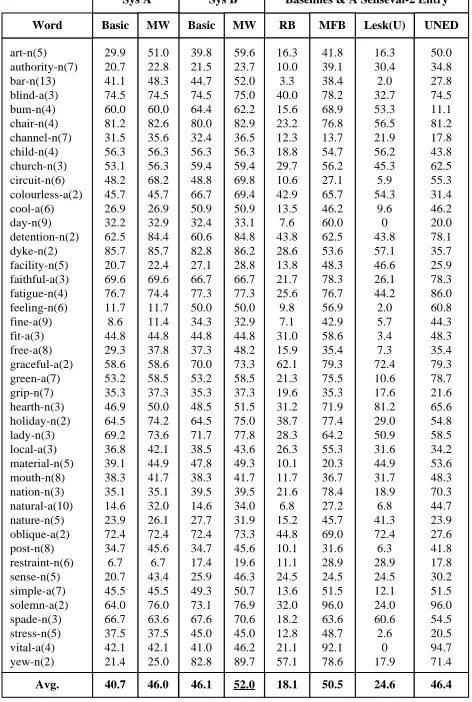
Table 1. WSD accuracy on words in the English Senseval-2 Lexical Sample dataset. The left most column shows words, their POS tags and how many senses they have. “Sys A” and “Sys B” are our systems, and “MW” denotes a multi-word de-tection module was used in conjunction with the “Basic” sys-tem. For comparison, it also shows two baselines: “RB” is the random baseline and “MFB” is the most-frequent-sense base-line. “UNED” is one of the best unsupervised participants in the Senseval-2 competition and “Lesk(U)” is the highest unsupervised-baseline set in the workshop. All accuracies are expressed as percentages.
our pilot experiments on other datasets (results not shown). The average length of a sense example is 35 words, which is much shorter than the length of the text snippets, which was set to400Chinese
char-acters (≈175English words). This is because
func-tion words and words that are not listed in the LDC
Mandarin-English lexicon were eliminated. We did
training sense examples to6000, for efficiency pur-poses. We attempted to tag every test data instance,
so our coverage (on nouns and adjectives) is100%.
To assess the influence of ambiguous Chinese translations, we prepared two sets of training data. As described in section 3.1: sense examples in the first set were prepared without taking ambiguity in Chinese text into consideration, while those in the second set were prepared with a little more human effort involved trying to reduce ambiguity by us-ing less ambiguous translations. We call the system trained on the first set “Sys A” and the one trained on the second “Sys B”.
In this lexical sample task, multiwords are ex-pected to be picked out by participating WSD sys-tems. For example, the answer art collection should be supplied when this multiword occurs in a test instance. It would be judged wrong if one tagged the art in art collection as the artworks sense, even though one could argue that this was also a cor-rect answer. To deal with multiwords, we imple-mented a very simple detection module, which tries to match multiword entries in WordNet to the am-biguous word and its left and right neighbours. For example, if the module finds art collection is an en-try in WordNet, it tags all occurrences of this multi-word in the test data, regardless of the prediction by the classifier.
The results are shown in Table 1. Our “Sys B” system, with and without the multiword detection module, outperformed “Sys A”, which shows that sense examples acquired with less ambiguous Chi-nese translations contain less noise and therefore boost WSD performance. For comparison, the ta-ble also shows various baseline performance figures and a system that participated in Senseval-210. Con-sidering that the manual work involved in our ap-proach is negligible compared with manual sense-tagging, we classify our systems as unsupervised and we should aim to beat the random baseline. This all four of our systems do easily. We also eas-ily beat another unsupervised baseline – the Lesk (1986) baseline, which disambiguates words using WordNet definitions. The MFB baseline is actu-ally a ‘supervised’ baseline, since an unsupervised
10Accuracies for each word and averages were calculated
by us, based on the information on Senseval-2 Website. See: http://www.sle.sharp.co.uk/senseval2/.
system does not have such prior knowledge before-hand. McCarthy et al. (2004) argue that this is a very tough baseline for an unsupervised WSD sys-tem to beat. Our “Sys B” with multiword detection exceeds it. “Sys B” also exceeds the performance of UNED (Fern´andez-Amor´os et al., 2001), which
was the second-best ranked11unsupervised systems
in the Senseval-2 competition.
There are a number of factors that can influence WSD performance. The distribution of training data for senses is one. In our experiments, we used all sense examples that we built for a sense (with an
upper bound of6000). However, the distribution of
senses in English text often does not match the dis-tribution of their corresponding Chinese translations in Chinese text. For example, suppose an English wordwhas two senses: s1 ands2, wheres1 rarely
occurs in English text, whereas senses2is used
fre-quently. Also suppose s1’s Chinese translation is
much more frequently used thans2’s translation in
Chinese text. Thus, the distribution of the two senses in English is different from that of the translations in Chinese. As a result, the numbers of sense exam-ples we would acquire for the two senses would be distributed as if they were in Chinese text. A clas-sifier trained on this data would then tend to predict unseen test instances in favour of the wrong distribu-tion. The word nation, for example, has three senses, of which the country sense is used more frequently in English. However, in Chinese, the country sense and the people sense are almost equally distributed, which might be the reason for its WSD accuracy be-ing lower with our systems than most of the other words. A possible way to alleviate this problem is to select training sense examples according to an esti-mated distribution in natural English text, which can be done by analysing available sense-tagged corpora with help of smoothing techniques, or with the un-supervised approach of (McCarthy et al., 2004).
Cultural differences can cause difficulty in retriev-ing sufficient trainretriev-ing data. For example, transla-tions of senses of church and hearth appear only in-frequently in Chinese text. Thus, it is hard to build sense examples for these words. Another problem,
11One system performed better but their answers were not
as mentioned above, is that translations of English senses can be ambiguous in Chinese. For exam-ple, Chinese translations of the words vital,
natu-ral, local etc. are also ambiguous to some extent,
and this might be a reason for their low perfor-mance. One way to solve this, as we described, is to manually check the translations. Another auto-matic way is that, before retrieving text snippets, we could segment or even parse the Chinese corpora, which should reduce the level of ambiguity and lead to better sense examples.
3.3 Further WSD Experiments
One of the strengths of our approach is that training data come cheaply and relatively easily. However, the sense examples are acquired automatically and they inevitably contain a certain amount of noise, which may cause problems for the classifier. To as-sess the relationship between accuracy and the size of training data, we carried out a series of experi-ments, feeding the classifier with different numbers of sense examples as training data.
For these experiments, we used another standard WSD dataset, the TWA dataset. This is a manu-ally sense-tagged corpus (Mihalcea, 2003), which contains 2-way sense-tagged text instances, drawn from the British National Corpus, for 6 nouns. We first built sense examples for all the12senses using the approach described above, then trained the same Na¨ıve Bayes algorithm (NB) on different numbers of sense examples.
In detail, for all of the 6 words, we did the
fol-lowing: given a word wi, we randomly selected n
sense examples for each of its senses si, from the
total amount of sense examples built for si. Then
the NB algorithm was trained on the 2∗ n
exam-ples and tested on wi’s test instances in TWA. We
recorded the accuracy and repeated this process200
times and calculated the mean and variance of the
200accuracies. Then we assigned another value to
nand iterated the above process untilntook all the
predefined values. In our experiments,nwas taken
from{50, 100, 150, 200, 400, 600, 800, 1000, 1200}
for words motion, plant and tank and from{50, 100,
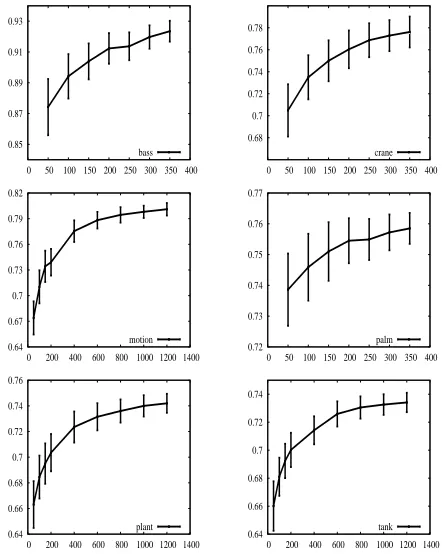
150, 200, 250, 300, 350}for bass, crane and palm, because there were less sense example data available for the latter three words. Finally, we used the t-test (p = 0.05) on pairwise sets of means and variances
to see if improvements were statistically significant.
0.93
0.91
0.89
0.87
0.85
0 50 100 150 200 250 300 350 400 bass
0.78 0.76 0.74 0.72 0.7 0.68
0 50 100 150 200 250 300 350 400 crane
0.82 0.79 0.76 0.73 0.7 0.67 0.64
0 200 400 600 800 1000 1200 1400 motion
0.77
0.76
0.75
0.74
0.73
0.72
0 50 100 150 200 250 300 350 400 palm
0.76 0.74 0.72 0.7 0.68 0.66 0.64
0 200 400 600 800 1000 1200 1400 plant
0.74
0.72
0.7
0.68
0.66
0.64
[image:7.612.325.546.84.361.2]0 200 400 600 800 1000 1200 1400 tank
Figure 2. Accuracy scores with increasing number of training sense examples. Each bar is a standard deviation.
The results are shown in Figure 212. 34 out of 42 t-scores are greater than the t-test critical values, so we are fairly confident that the more training sense examples used, the more accurate the NB classifier becomes on this disambiguation task.
4 Conclusions and Future Work
We have presented WSD systems that use sense ex-amples as training data. Sense exex-amples are ac-quired automatically from large quantities of Chi-nese text, with the help of ChiChi-nese-English and English-Chinese dictionaries. We have tested our WSD systems on the English Senseval-2 Lexical Sample dataset, and our best system outperformed comparable state-of-the-art unsupervised systems. Also, we found that increasing the number of the sense examples significantly improved WSD perfor-mance. Since sense examples can be obtained very cheaply from any large Chinese text collection,
in-12These experiments showed that our systems outperformed
cluding the Web, our approach is a way to tackle the knowledge acquisition bottleneck.
There are a number of future directions that we could investigate. Firstly, instead of using a bilin-gual dictionary to translate Chinese text snippets back to English, we could use machine translation software. Secondly, we could try this approach on other language pairs, Japanese-English, for exam-ple. This is also a possible solution to the problem that ambiguity may be preserved between Chinese and English. In other words, when a Chinese transla-tion of an English sense is still ambiguous, we could try to collect sense examples using translation in a third language, Japanese, for instance. Thirdly, it would be interesting to try to tackle the problem of Chinese WSD using sense examples built using En-glish, the reverse process to the one described in this paper.
Acknowledgements
This research was funded by EU IST-2001-34460 project MEANING: Developing Multilingual Web-Scale Language Technologies.
References
Eneko Agirre, Olatz Ansa, David Martinez, and Eduard Hovy. 2001. Enriching WordNet concepts with topic signatures. In Proceedings of the NAACL workshop on
WordNet and Other Lexical Resources: Applications, Extensions and Customizations. Pittsburgh, USA.
Ido Dagan and Alon Itai. 1994. Word sense disam-biguation using a second language monolingual cor-pus. Computational Linguistics, 20(4):563–596.
Mona Diab and Philip Resnik. 2002. An unsupervised method for word sense tagging using parallel corpora. In Proceedings of the40thAnniversary Meeting of the Association for Computational Linguistics (ACL-02).
Philadelphia, USA.
David Fern´andez-Amor´os, Julio Gonzalo, and Felisa Verdejo. 2001. The UNED systems at Senseval-2. In Poceedings of Second International Wordshop
on Evaluating Word Sense Disambiguation Systems (Senseval-2). Toulouse, France.
William A. Gale, Kenneth W. Church, and David Yarowsky. 1992. Using bilingual materials to de-velop word sense disambiguation methods. In
Pro-ceedings of the International Conference on Theoret-ical and MethodologTheoret-ical Issues in Machine Transla-tion, pages 101–112.
George H. John and Pat Langley. 1995. Estimating con-tinuous distributions in Bayesian classifiers. In
Pro-ceedings of the Eleventh Conference on Uncertainty in Artificial Intelligence, pages 338–345.
Adam Kilgarriff. 2001. English lexical sample task de-scription. In Proceedings of the Second International
Workshop on Evaluating Word Sense Disambiguation Systems (SENSEVAL-2). Toulouse, France.
Michael E. Lesk. 1986. Automated sense disambigua-tion using machine-readable dicdisambigua-tionaries: how to tell a pinecone from an ice cream cone. In Proceedings of
the SIGDOC Conference.
Hang Li and Cong Li. 2004. Word translation dis-ambiguation using bilingual bootstrapping.
Compu-tational Linguistics, 20(4):563–596.
Diana McCarthy, Rob Koeling, Julie Weeds, and John Carroll. 2004. Finding predominant word senses in untagged text. In Proceedings of the 42nd Annual
Meeting of the Association for Computational Linguis-tics. Barcelona, Spain.
Rada Mihalcea, Timothy Chklovski, and Adam Killgar-iff. 2004. The Senseval-3 English lexical sample task. In Proceedings of the Third International Workshop on
the Evaluation of Systems for the Semantic Analysis of Text (Senseval-3).
Rada Mihalcea. 2003. The role of non-ambiguous words in natural language disambiguation. In Proceedings of
the Conference on Recent Advances in Natural Lan-guage Processing, RANLP 2003. Borovetz, Bulgaria.
George A. Miller, Richard Beckwith, Christiane Fell-baum, Derek Gross, and Katherine J. Miller. 1990. Introduction to WordNet: An on-line lexical database.
Journal of Lexicography, 3(4):235–244.
Hwee Tou Ng, Bin Wang, and Yee Seng Chan. 2003. Ex-ploiting parallel texts for word sense disambiguation: an empirical study. In Proceedings of the 41st Annual
Meeting of the Association for Computational Linguis-tics.
Philip Resnik and David Yarowsky. 1997. A perspective on word sense disambiguation methods and their eval-uation. In Proceedings of the ACL SIGLEX Workshop
on Tagging Text with Lexical Semantics: Why, What and How?, pages 79–86.
Philip Resnik and David Yarowsky. 1999. Distinguish-ing systems and distDistinguish-inguishDistinguish-ing senses: New evaluation methods for word sense disambiguation. Natural
Lan-guage Engineering, 5(2):113–133.
Philip Resnik. 1999. Mining the Web for bilingual text. In Proceedings of the37thAnnual Meeting of the As-sociation for Computational Linguistics.
Xinglong Wang. 2004. Automatic acquisition of En-glish topic signatures based on a second language. In