Proceedings of the 12th Conference of the European Chapter of the ACL, pages 852–860,
Improving Grammaticality in Statistical Sentence Generation:
Introducing a Dependency Spanning Tree Algorithm with an Argument
Satisfaction Model
Stephen Wan†‡Mark Dras†Robert Dale† †Centre for Language Technology
Department of Computing Macquarie University
Sydney, NSW 2113
swan,madras,[email protected]
C´ecile Paris‡ ‡ICT Centre
CSIRO Sydney, Australia
Abstract
Abstract-like text summarisation requires a means of producing novel summary sen-tences. In order to improve the grammati-cality of the generated sentence, we model a global (sentence) level syntactic struc-ture. We couch statistical sentence genera-tion as a spanning tree problem in order to search for the best dependency tree span-ning a set of chosen words. We also intro-duce a new search algorithm for this task that models argument satisfaction to im-prove the linguistic validity of the gener-ated tree. We treat the allocation of modi-fiers to heads as a weighted bipartite graph matching (or assignment) problem, a well studied problem in graph theory. Using BLEU to measure performance on a string regeneration task, we found an improve-ment, illustrating the benefit of the span-ning tree approach armed with an argu-ment satisfaction model.
1 Introduction
Research in statistical novel sentence generation has the potential to extend the current capabili-ties of automatic text summarisation technology, moving from sentence extraction to abstract-like summarisation. In this paper, we describe a new algorithm that improves upon the grammaticality of statistically generated sentences, evaluated on a string regeneration task, which was first proposed as a surrogate for a grammaticality test by Ban-galore et al. (2000). In this task, a system must regenerate the original sentence which has had its word order scrambled.
As an evaluation task, string regeneration re-flects the issues that challenge the sentence gen-eration components of machine translation, para-phrase generation, and summarisation systems
(Soricut and Marcu, 2005). Our research in sum-marisation utilises the statistical generation algo-rithms described in this paper to generate novel summary sentences.
The goal of the string regeneration task is to re-cover a sentence once its words have been ran-domly ordered. Similarly, for a text-to-text gen-eration scenario, the goal is to generate a sen-tence given an unordered list of words, typically using an n-gram language model to select the best word ordering. N-gram language models appear to do well at a local level when examining word sequences smaller thann. However, beyond this window size, the sequence is often ungrammati-cal. This is not surprising as these methods are un-able to model grammaticality at the sentence level, unless the size ofnis sufficiently large. In prac-tice, the lack of sufficient training data means that
nis often smaller than the average sentence length. Even if data exists, increasing the size ofn corre-sponds to a higher degree polynomial complexity search for the best word sequence.
In response, we introduce an algorithm for searching for the best word sequence in a way that attempts to model grammaticality at the sen-tence level. Mirroring the use of spanning tree al-gorithms in parsing (McDonald et al., 2005), we present an approach to statistical sentence genera-tion. Given a set of scrambled words, the approach searches for the most probable dependency tree, as defined by some corpus, such that it contains each word of the input set. The tree is then traversed to obtain the final word ordering.
not always correspond with a linguistically valid dependency tree, primarily because it does not at-tempt to ensure that words in the tree have plausi-ble numbers of arguments.
We propose an alternative dependency-spanning tree algorithm which uses a more fine-grained argument model representing argu-ment positions. To find the best modifiers for argument positions, we treat the attachment of edges to the spanning tree as a weighted bipartite graph matching problem (or the assignment problem), a standard problem in graph theory.
The remainder of this paper is as follows. Sec-tion 2 outlines the graph representaSec-tion of the spanning tree problem. We describe a standard spanning tree algorithm in Section 3. Section 4 de-fines a finer-grained argument model and presents a new dependency spanning tree search algorithm. We experiment to determine whether a global de-pendency structure, as found by our algorithm, improves performance on the string regeneration problem, presenting results in Section 5. Related work is presented in Section 6. Section 7 con-cludes that an argument model improves the lin-guistic plausibility of the generated trees, thus im-proving grammaticality in text generation.
2 A Graph Representation of Dependencies
In couching statistical generation as a spanning tree problem, this work is the generation analog of the parsing work by McDonald et al. (2005). Given a bag of words with no additional con-straints, the aim is to produce a dependency tree containing the given words. Informally, as all de-pendency relations between each pair of words are possible, the set of all possible dependencies can be represented as a graph, as noted by McDon-ald et al. (2005). Our goal is to find the subset of these edges corresponding to a tree with maximum probability such that each vertex in the graph is visited once, thus including each word once. The resulting tree is a spanning tree, an acyclic graph which spans all vertices. The best tree is the one with an optimal overall score. We use negative log probabilities so that edge weights will correspond to costs. The overall score is the sum of the costs of the edges in the spanning tree, which we want to minimise. Hence, our problem is the minimum spanning tree (MST) problem.
We define a directed graph (digraph) in a
stan-dard way,G= (V, E)whereV is a set of vertices and E ⊆ {(u, v)|u, v ∈ V} is a set of directed edges. For each sentencew = w1. . . wn, we
de-fine the digraph Gw = (Vw, Ew) where Vw = {w0, w1, . . . , wn},withw0 a dummy root vertex,
andEw ={(u, v)|u∈Vw, v∈Vw\ {w0}}.
The graph is fully connected (except for the root vertexw0which is only fully connected outwards)
and is a representation of possible dependencies. For an edge(u, v), we refer touas the head andv
as the modifier.
We extend the original formulation of McDon-ald et al. (2005) by adding a notion of argument
positions for a word, providing points to attach
modifiers. Adopting an approach similar to John-son (2007), we look at the direction (left or right) of the head with respect to the modifier; we con-sequently define a set D = {l, r} to represent this. SetDrepresents the linear precedence of the words in the dependency relation; consequently, it partially approximates the distinction between syntactic roles like subject and object.
Each edge has a pair of associated weights, one for each direction, defined by the function s :
E× D →R, based on a probabilistic model of
de-pendency relations. To calculate the edge weights, we adapt the definition of Collins (1996) to use di-rection rather than relation type (represented in the original as triples of non-terminals). Given a cor-pus, for some edgee= (u, v) ∈ E and direction
d∈ D, we calculate the edge weight as:
s((u, v), d) =−logprobdep(u, v, d) (1) We define the set of part-of-speech (PoS) tags P
and a function pos:V → P, which maps vertices (representing words) to their PoS, to calculate the probability of a dependency relation, defined as:
probdep(u, v, d)
= cnt((u,pos(u)),(v,pos(v)), d)
3 Generation via Spanning Trees
3.1 The Chu-Liu Edmonds Algorithm
Given the graph Gw = (Vw, Ew), the Chu-Liu Edmonds (CLE) algorithm finds a rooted directed spanning tree, specified byTw, which is an acyclic
set of edges inEwminimisingP
e∈Tw,d∈Ds(e, d). The algorithm is presented as Algorithm 1.1
There are two stages to the algorithm. The first stage finds the best edge for each vertex, connect-ing it to another vertex. To do so, all outgoconnect-ing edges ofv, that is edges wherevis a modifier, are considered, and the one with the best edge weight is chosen, where best is defined as the smallest cost. This minimisation step is used to ensure that each modifier has only one head.
If the chosen edgesTw produce a strongly con-nected subgraphGm
w = (Vw, Tw), then this is the
MST. If not, a cycle amongst some subset of Vw
must be handled in the second stage. Essentially, one edge in the cycle is removed to produce a sub-tree. This is done by finding the best edge to join some vertex in the cycle to the main tree. This has the effect of finding an alternative head for some word in the cycle. The edge to the original head is discarded (to maintain one head per modifier), turning the cycle into a subtree. When all cycles have been handled, applying a greedy edge selec-tion once more will then yield the MST.
3.2 Generating a Word Sequence
Once the tree has been generated, all that remains is to obtain an ordering of words based upon it. Because dependency relations in the tree are either of leftward or rightward direction, it becomes rel-atively trivial to order child vertices with respect to a parent vertex. The only difficulty lies in find-ing a relative orderfind-ing for the leftward (to the par-ent) children, and similarly for the rightward (to the parent) children.
We traverseGm
w using a greedy algorithm to
or-der the siblings using an n-gram language model. Algorithm 2 describes the traversal in pseudo-code. The generated sentence is obtained by call-ing the algorithm with w0 andTw as parameters.
The algorithm operates recursively if called on an
1
Adapted from (McDonald et al., 2005) and
http://www.ce.rit.edu/˜sjyeec/dmst.html . The dif-ference concerns the direction of the edge and the edge weight function. We have also folded the function ‘contract’ in McDonald et al. (2005) into the main algorithm. Again following that work, we treat the function s as a data
structure permitting storage of updated edge weights.
/* initialisation */ Discard the edges exiting thew0if any.
1
/* Chu-Liu/Edmonds Algorithm */
begin 2
Tw←(u, v)∈E:∀v∈V,d∈Darg min (u,v)
s((u, v), d) 3
ifMw= (Vw, Tw)has no cycles then returnMw
4
forallC⊂Tw:Cis a cycle inMwdo
5
(e, d)←arg min
e∗,d∗ s(e
∗, d∗) :e∈C
6
forallc= (vh, vm,)∈Canddc∈ Ddo
7
foralle′
= (vi, vm)∈Eandd′∈ Ddo
8
s(e′, d′)←s(e′, d′)−s(c, dc)−s(e, d) 9
end 10
end 11
s(e, d)←s(e, d) + 1 12
end 13
Tw←(u, v)∈E:∀v∈V,d∈Darg min (u,v)
s((u, v), d) 14
returnMw
15 end 16
Algorithm 1: The pseudo-code for the Chu-Liu Edmonds algorithm with our adaptation to in-clude linear precedence.
inner node. If a vertexvis a leaf in the dependency tree, its string realisation realise(v)is returned.
We keep track of ordered siblings with two lists, one for each direction. If the sibling set is left-wards, the ordered list, Rl, is initialised to be the
singleton set containing a dummy start token with an empty realisation. If the sibling set is right-wards then the ordered list,Rris initialised to be the realisation of the parent.
For some sibling setC ⊆Vwto be ordered, the algorithm chooses the next vertex,v∈C, to insert into the appropriate ordered list, Rx, x ∈ D, by
maximising the probability of the string of words that would result if the realisation, realise(v), were concatenated withRx.
The probability of the concatenation is calcu-lated based on a window of words around the join. This window length is defined to be2×floor(n/2), for somen, in this case,4.
If the siblings are leftwards, the window con-sists of the last min(n−1,|Rl|) previously
cho-sen words concatenated with the first min(n −
1,|realise(v)|). If the siblings are rightwards, the window consists of the last min(n−1,|realise(v)|) previously chosen words concatenated with the first min(n−1,|Rr|). The probability of a win-dow of words,w0. . . wj, of lengthj+ 1is defined
by the following equation:
probLM O(w0. . . wj)
=
j−k−1 Y
i=0
probM LE(wi+k|wi. . . wi+k−1)
/* LMO Algorithm */
input :v, Twwherev∈Vw
output:R⊆Vw
begin 1
if isLeaf(v) then 2
return{realise(v)}
3 end 4
else 5
Cl←getLeftChildren(v, Tw) 6
Cr←getRightChildren(v, Tw)
7
Rl← {start}
8
Rr← {realise(v)}
9
whileCl6={}do
10
c←arg max
c∈Cl probngram
(LMO(c, Tw)∪Rl)
11
Rl←realise(c, Tw)∪Rl
12
Cl←Cl\ {c}
13
end 14
whileCr6={}do 15
c←arg max
c∈Cr probngram
(Rr∪LMO(c, Tw))
16
Rr←Rr∪realise(c, Tw)
17
Cr←Cr\ {c}
18
end 19
returnRl∪Rr
20 end 21
end 22
Algorithm 2: The Language Model Ordering al-gorithm for linearising anTw.
wherek=min(n−1, j−1), and,
probM LE(wi+k|wi. . . wi+k−1)
= cnt(wi. . . wi+k)
cnt(wi. . . wi+k−1)
(4)
where probM LE(wi+k|wi. . . wi+k−1)is the
max-imum likelihood estimate n-gram probability. We refer to this tree linearisation method as the
Lan-guage Model Ordering (LMO).
4 Using an Argument Satisfaction Model
4.1 Assigning Words to Argument Positions
One limitation of using the CLE algorithm for generation is that the resulting tree, though max-imal in probability, may not conform to basic lin-guistic properties of a dependency tree. In partic-ular, it may not have the correct number of argu-ments for each head word. That is, a word may have too few or too many modifiers.
To address this problem, we can take into ac-count the argument position when assigning a weight to an edge. When attaching an edge con-necting a modifier to a head to the spanning tree, we count how many modifiers the head already has. An edge is penalised if it is improbable that the head takes on yet another modifier, say in the example of an attachment to a preposition whose argument position has already been filled.
However, accounting for argument positions makes an edge weight dynamic and dependent on
surrounding tree context. This makes the search for an optimal tree an NP-hard problem (McDon-ald and Satta, 2007) as all possible trees must be considered to find an optimal solution.
Consequently, we must choose a heuristic search algorithm for finding the locally optimum spanning tree. By representing argument positions that can be filled only once, we allow modifiers to compete for argument positions and vice versa. The CLE algorithm only considers this competi-tion in one direccompeti-tion. In line 3 of Algorithm 1, only heads compete for modifiers, and thus the so-lution will be sub-optimal. In Wan et al. (2007), we showed that introducing a model of argument positions into a greedy spanning tree algorithm had little effect on performance. Thus, to consider both directions of competition, we design a new algorithm for constructing (dependency) spanning trees that casts edge selection as a weighted bipar-tite graph matching (or assignment) problem.
This problem is to find a weighted alignments between objects of two distinct sets, where an ject from one set is uniquely aligned to some ob-ject in the other set. The optimal alignment is one where the sum of alignment costs is minimal. The graph of all possible assignments is a weighted bi-partite graph. Here, to discuss bibi-partite graphs, we will extend our notation in a fairly standard way, to writeGp = (U, V, Ep), whereU, V are the
dis-joint sets of vertices andEpthe set of edges.
In our paper, we treat the assignment between attachment positions and words as an assignment problem. The standard polynomial-time solution to the assignment problem is the Kuhn-Munkres (or Hungarian) algorithm (Kuhn, 1955).2
4.2 A Dependency-Spanning Tree Algorithm
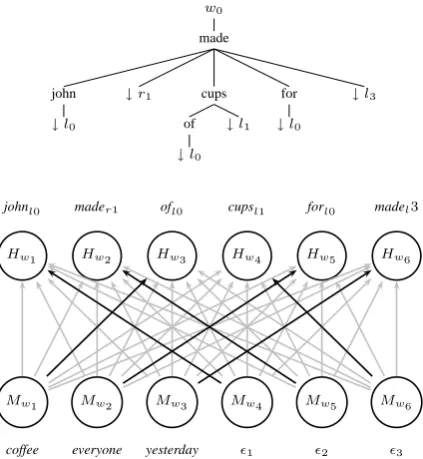
Our alternative dependency-spanning tree algo-rithm, presented as Algorithm 3, incrementally adds vertices to a growing spanning tree. At each iteration, the Kuhn-Munkres method assigns words that are as yet unattached to argument posi-tions already available in the tree. We focus on the bipartite graph in Section 4.3.
Let the sentence whave the dependency graph
Gw = (Vw, Ew). At some arbitrary iteration of the algorithm (see Figure 1), we have the following:
• Tw ⊆ Ew, the set of edges in the spanning tree constructed so far;
2GPL code:
Partially determined spanning tree: w0
made
john
↓l0
↓r1 cups
of
↓l0
↓l1 for
↓l0
↓l3
johnl0 mader1 ofl0 cupsl1 forl0 madel3
Hw1 Hw2 Hw3 Hw4 Hw5 Hw6
Mw1 Mw2 Mw3 Mw4 Mw5 Mw6
[image:5.595.74.286.89.319.2]coffee everyone yesterday ǫ1 ǫ2 ǫ3
Figure 1: A snapshot of the generation process. Each word in the tree has argument positions to which we can assign remaining words. Padding
Mwwithǫis described in Section 4.3.
• Hw = {u, v|(u, v) ∈ Tw}, the set of ver-tices inTw, or ‘attached vertices’, and
there-fore potential heads; and
• Mw = Vw\Hw, the set of ‘unattached
ver-tices’, and therefore potential modifiers. For the potential heads, we want to define the set of possible attachment positions available in the spanning tree where the potential modifiers can at-tach. To talk about these attachment positions, we define the set of labelsL = {(d, j)|d ∈ D, j ∈
N}, an element (d, j) representing an attachment
point in directiond, positionj. Valid attachment positions must be in sequential order and not miss-ing any intermediate positions (e.g. if position 2 on the right is specified, position 1 must be also): so we define for somei ∈ N, 0 ≤ i < N, a set
Ai ⊆ Lsuch that if the label(d, j) ∈Ai then the label(d, k)∈Ai for0≤k < j. Collecting these, we defineA={Ai|0≤i < N}.
To map a potential head onto the set of attach-ment positions, we define a functionq :Hw→A.
So, given some v ∈ Hw, q(v) = Ai for some 0≤i < N. In talking about an individual attach-ment point(d, j) ∈ q(v)for potential headv, we
/* initialisation */
Hw← {w0}
1
Mw←V′
2
Uw← {w0R1}
3
Uw′ ← {}
4
Tw← {}
5
/* The Assignment-based Algorithm */
begin 6
whileMw6={}andUw′ 6=Uwdo 7
U′
w←Uw
8
foreachhu,(d, j)), vi ∈Kuhn-Munkres(Gpw= 9
(Uw, Mwǫ, Epw))do
Tw←Tw∪ {(u, v)}
10
ifu∈Hwthen 11
Uw←Uw\ {u}
12
end 13
Uw←Uw∪next(q(u))
14
Uw←Uw∪next(q(m))
15
q(m)←q(m)\next(q(m)) 16
q(h)←q(h)\next(q(h)) 17
Mw←Mw\ {m}
18
Hw←Hw∪ {m}
19
end 20
end 21
end 22
Algorithm 3: The Assignment-based Depen-dency Tree Building algorithm.
use the notationvdj. For example, when referring
to the second argument position on the right with respect tov, we usevr2.
For the implementation of the algorithm, we have defined q, to specify attachment points, as follows, given somev∈Hw:
q(v) =
{vr1} ifv=w0, the root {vl1} if pos(v) is a preposition L if pos(v) is a verb
{vlj|j∈N} otherwise
Defining q allows one to optionally incorporate linguistic information if desired.
We define the function next : q(v) → A, v ∈ Hwthat returns the position(d, j)with the small-est value ofjfor directiond. Finally, we write the set of available attachment positions in the span-ning tree asU ⊆ {(v, l)|v∈Hw, l∈q(v)}. 4.3 Finding an Assignment
To construct the bipartite graph used for the as-signment problem at line 9 of Algorithm 3, given our original dependency graph Gw = (Vw, Ew), and the variables defined from it above in Sec-tion 4.2, we do the following. The first set of vertices, of possible heads and their attachment points, is the set Uw. The second set of ver-tices is the set of possible modifiers augmented by dummy vertices ǫi (indicating no modifica-tion) such that this set is at least as large asUw :
Mǫ
bi-partite graph is thenGpw = (Uw, Mwǫ, E p
w), where Ewp ={(u, v)|u∈Uw, v∈Mwǫ}.
The weights on the edges of this graph incor-porate a model of argument counts. The weight function is of the form sap : Ep → R. We
consider some e ∈ Ewp: e = (v′, v) for some v′ ∈ Uw, v ∈ Mwǫ; andv′ = (u,(d, j))for some u ∈Vw, d∈ D, j ∈N. s(u, Mwǫ)is defined to
re-turn the maximum cost so that the dummy leaves are only attached as a last resort. We then define:
sap(e)
= −log(probdep(u, v, d)×probarg(u, d, j)) (5) where probdep(u, v, d) is as in equation 2, using the original dependency graph defined in Section 2; and probarg(u, d, j), an estimate of the prob-ability that a word u with i arguments assigned already can take on more arguments, is defined as:
probarg(u, d, j)
=
P∞
i=j+1cntarg(u, d, i)
cnt(u, d) (6)
where cntarg(u, d, i)is the number of times word
u has been seen with i arguments in direction
d; and cnt(u, d) = P
i∈Ncntarg(u, d, i). As the
probability of argument positions beyond a certain value for iin a given direction will be extremely small, we approximate this sum by calculating the probability density up to a fixed maximum, in this case7argument positions, and assume zero prob-ability beyond that.
5 Evaluation
5.1 String Generation Task
The best-performing word ordering algorithm is one that makes fewest grammatical errors. As a surrogate measurement of grammaticality, we use the string regeneration task. Beginning with a human-authored sentence with its word order ran-domised, the goal is to regenerate the original sen-tence. Success is indicated by the proportion of the original sentence regenerated, as measured by any string comparison method: in our case, using the BLEU metric (Papineni et al., 2002). One benefit to this evaluation is that content selection, as a fac-tor, is held constant. Specifically, the probability of word selection is uniform for all words.
The string comparison task and its associated metrics like BLEU are not perfect.3 The evalu-ation can be seen as being overly strict. It as-sumes that the only grammatical order is that of the original human authored sentence, referred to as the ‘gold standard’ sentence. Should an approach chance upon an alternative grammatical ordering, it would penalised. However, all algorithms and baselines compared would suffer equally in this respect, and so this will be less problematic when averaging across multiple test cases.
5.2 Data Sets and Training Procedures
The Penn Treebank corpus (PTB) was used to pro-vide a model of dependency relations and argu-ment counts. It contains about 3 million words of text from the Wall Street Journal (WSJ) with human annotations of syntactic structures. Depen-dency events were sourced from the events file of the Collins parser package, which contains the de-pendency events found in training sections 2-22 of the corpus. Development was done on section 00 and testing was performed on section 23.
A 4-gram language model (LM) was also ob-tained from the PTB training data, referred to as PTB-LM. Additionally, a 4-gram language model was obtained from a subsection of the BLLIP’99 Corpus (LDC number: LDC2000T43) containing three years of WSJ data from 1987 to 1989 (Char-niak et al., 1999). As in Collins et al. (2004), the 1987 portion of the BLLIP corpus containing 20 million words was also used to create a lan-guage model, referred to here as BLLIP-LM. N-gram models were smoothed using Katz’s method, backing off to smaller values ofn.
For this evaluation, tokenisation was based on that provided by the PTB data set. This data set also delimits base noun phrases (noun phrases without nested constituents). Base noun phrases were treated as single tokens, and the rightmost word assumed to be the head. For the algorithms tested, the input set for any test case consisted of the single tokens identified by the PTB tokenisa-tion. Additionally, the heads of base noun phrases were included in this input set. That is, we do not regenerate the base noun phrases.4
3Alternative grammaticality measures have been
devel-oped recently (Mutton et al., 2007). We are currently explor-ing the use of this and other metrics.
4This would correspond to the use of a chunking
Algorithms PTB-LM BLLIP-LM Viterbi baseline 14.9 18.0
LMO baseline 24.3 26.0
CLE 26.4 26.8
AB 33.6 33.7
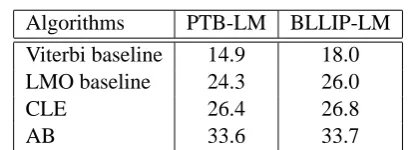
Figure 2: String regeneration as measured in BLEU points (maximum 100)
5.3 Algorithms and Baselines
We compare the baselines against the Chu-Liu Edmonds (CLE) algorithm to see if spanning tree algorithms do indeed improve upon conven-tional language modelling. We also compare the Assignment-based (AB) algorithm against the baselines and CLE to see if, additionally, mod-elling argument assignments improves the re-sulting tree and thus the generated word se-quence. Two baseline generators based on n -gram language-models were used, representing approaches that optimise word sequences based on the local context of then-grams.
The first baseline re-uses the LMO greedy se-quence algorithm on the same set of input words presented to the CLE and AB algorithms. We ap-ply LMO in a rightward manner beginning with a start-of-sentence token. Note that this baseline generator, like the two spanning tree algorithms, will score favourably using BLEU since, mini-mally, the word order of the base noun phrases will be correct when each is reinserted.
Since the LMO baseline reduces to bigram gen-eration when concatenating single words, we test a second language model baseline which always uses a 4-gram window size. A Viterbi-like gen-erator with a 4-gram model and a beam of 100 is used to generate a sequence. For this baseline, re-ferred to as the Viterbi baseline, base noun phrases were separated into their constituent words and in-cluded in the input word set.
5.4 Results
The results are presented in Table 2. Significance was measured using the sign test and the sampling method outlined in (Collins et al., 2005). We will examine the results in the PTB-LM column first. The gain of 10 BLEU points by the LMO baseline over the Viterbi baseline shows the performance improvement that can be gained when reinserting the base noun phrases.
AB: the dow at this point was down about 35 points CLE: was down about this point 35 points the dow at LMO: was this point about at down the down 35 points Viterbi: the down 35 points at was about this point down
[image:7.595.77.285.64.139.2]Original: at this point, the dow was down about 35 points
Figure 3: Example generated sentences using the BLLIP-LM.
The CLE algorithm significantly out-performed the LMO baseline by 2 BLEU points, from which we conclude that incorporating a model for global syntactic structure and treating the search for a dependency tree as a spanning problem helps for novel sentence generation. However, the real im-provement can be seen in the performance of the AB system which significantly out-performs all other methods, beating the CLE algorithm by 7 BLEU points, illustrating the benefits of a model for argument counts and of couching tree building as an iterative set of argument assignments.
One might reasonably ask if more n-gram data would narrow the gap between the tree algorithms and the baselines, which encode global and lo-cal information respectively. Examining results in the BLLIP-LM column, all approaches improve with the better language model. Unsurprisingly, the improvements are most evident in the base-lines which rely heavily on the language model. The margin narrows between the CLE algorithm and the LMO baseline. However, the AB algo-rithm still out-performs all other approaches by 7 BLEU points, highlighting the benefit in mod-elling dependency relations. Even with a language model that is one order of magnitude larger than the PTB-LM, the AB still maintains a sizeable lead in performance. Figure 3 presents sample gener-ated strings.
6 Related Work
6.1 Statistical Surface Realisers
The dependency model and the LMO lineari-sation algorithm are based heavily on word order statistics. As such, the utility of this approach is limited to human languages with minimal use of inflections, such as English. Approaches for other language types, for example German, have been explored (Filippova and Strube, 2007).
6.2 Text-to-Text Generation
As a text-to-text approach, our work is more sim-ilar to work on Information Fusion (Barzilay et al., 1999), a sub-problem in multi-document sum-marisation. In this work, sentences presenting the same information, for example multiple news arti-cles describing the same event, are merged to form a single summary by aligning repeated words and phrases across sentences.
Other text-to-text approaches for generating novel sentences also aim to recycle sentence frag-ments where possible, as we do. Work on phrase-based statistical machine translation has been applied to paraphrase generation (Bannard and Callison-Burch, 2005) and multi-sentence align-ment in summarisation (Daum´e III and Marcu, 2004). These approaches typically use n-gram models to find the best word sequence.
The WIDL formalism (Soricut and Marcu, 2005) was proposed to efficiently encode con-straints that restricted possible word sequences, for example dependency information. Though similar, our work here does not explicitly repre-sent the word lattice.
For these text-to-text systems, the order of ele-ments in the generated sentence is heavily based on the original order of words and phrases in the input sentences from which lattices are built. Our approach has the benefit of considering all possi-ble orderings of words, corresponding to a wider range of paraphrases, provided with a suitable de-pendency model is available.
6.3 Parsing and Semantic Role Labelling
This paper presents work closely related to parsing work by McDonald et al. (2005) which searches for the best parse tree. Our work can be thought of as generating projective dependency trees (that is, without crossing dependencies).
The key difference between parsing and gener-ation is that, in parsing, the word order is fixed, whereas for generation, this must be determined. In this paper, we search across all possible tree
structures whilst searching for the best word or-dering. As a result, an argument model is needed to identify linguistically plausible spanning trees.
We treated the alignment of modifiers to head words as a bipartite graph matching problem. This is similar to work in semantic role labelling by Pad´o and Lapata (2006). The alignment of an-swers to question types as a semantic role labelling task using similar methods was explored by Shen and Lapata (2007).
Our work is also strongly related to that of Wong and Mooney (2007) which constructs sym-bolic semantic structures via an assignment pro-cess in order to provide surface realisers with in-put. Our approach differs in that we do not be-gin with a fixed set of semantic labels. Addition-ally, our end goal is a dependency tree that encodes word precedence order, bypassing the surface re-alisation stage.
7 Conclusions
In this paper, we presented a new use of spanning tree algorithms for generating sentences from an input set of words, a task common to many text-to-text scenarios. The algorithm finds the best de-pendency trees in order to ensure that the result-ing strresult-ing has grammaticality modelled at a global (sentence) level. Our algorithm incorporates a model of argument satisfaction which is treated as an assignment problem, using the Kuhn-Munkres assignment algorithm. We found a significant im-provement using BLEU to measure imim-provements on the string regeneration task. We conclude that our new algorithm based on the assignment prob-lem and an argument model finds trees that are lin-guistically more plausible, thereby improving the grammaticality of the generated word sequence.
References
Srinivas Bangalore and Owen Rambow. 2000. Ex-ploiting a probabilistic hierarchical model for gen-eration. In Proceedings of the 18th Conference on Computational Linguistics, Saarbr¨ucken, Germany.
Srinivas Bangalore, Owen Rambow, and Steve Whit-taker. 2000. Evaluation metrics for generation. In Proceedings of the first international conference on Natural language generation, Morristown, NJ, USA.
Asso-ciation for Computational Linguistics, Ann Arbor, Michigan.
Regina Barzilay, Kathleen R. McKeown, and Michael Elhadad. 1999. Information fusion in the context of multi-document summarization. In Proceedings of the 37th conference on Association for Computa-tional Linguistics, Morristown, NJ, USA.
Eugene Charniak, Don Blaheta, Niyu Ge, Keith Hall, John Hale, and Mark Johnson. 1999. Bllip 1987-89 wsj corpus release 1. Technical report, Linguistic Data Consortium.
Y. J. Chu and T. H. Liu. 1965. On the shortest arborescence of a directed graph. Science Sinica, v.14:1396–1400.
Christopher Collins, Bob Carpenter, and Gerald Penn. 2004. Head-driven parsing for word lattices. In Pro-ceedings of the 42nd Annual Meeting on Associa-tion for ComputaAssocia-tional Linguistics, Morristown, NJ, USA.
Michael Collins, Philipp Koehn, and Ivona Kucerova. 2005. Clause restructuring for statistical machine translation. In Proceedings of the 43rd Annual Meeting on Association for Computational Linguis-tics, Morristown, NJ, USA.
Michael John Collins. 1996. A new statistical parser based on bigram lexical dependencies. In Proceed-ings of the Thirty-Fourth Annual Meeting of the As-sociation for Computational Linguistics, San Fran-cisco.
Hal Daum´e III and Daniel Marcu. 2004. A phrase-based hmm approach to document/abstract align-ment. In Proceedings of EMNLP 2004, Barcelona, Spain..
J. Edmonds. 1967. Optimum branchings. J. Research of the National Bureau of Standards, 71B:233–240.
Katja Filippova and Michael Strube. 2007. Generating constituent order in german clauses. In Proceedings of the 45th Annual Meeting on Association for Com-putational Linguistics. Prague, Czech Republic.
Katja Filippova and Michael Strube. 2008. Sentence fusion via dependency graph compression. In Con-ference on Empirical Methods in Natural Language Processing, Waikiki, Honolulu, Hawaii.
Mark Johnson. 2007. Transforming projective bilex-ical dependency grammars into efficiently-parsable cfgs with unfold-fold. In Proceedings of the 45th Annual Meeting on Association for Computational Linguistics. Prague, Czech Republic.
H.W. Kuhn. 1955. The hungarian method for the as-signment problem. Naval Research Logistics Quar-terly, 219552:83–97 83–97.
Irene Langkilde and Kevin Knight. 1998. The practi-cal value of N-grams in derivation. In Proceedings of the Ninth International Workshop on Natural Lan-guage Generation, New Brunswick, New Jersey.
Ryan McDonald and Giorgio Satta. 2007. On the com-plexity of non-projective data-driven dependency parsing. In Proceedings of the Tenth International Conference on Parsing Technologies, Prague, Czech Republic.
Ryan McDonald, Fernando Pereira, Kiril Ribarov, and Jan Hajic. 2005. Non-projective dependency pars-ing uspars-ing spannpars-ing tree algorithms. In Proceedpars-ings of the conference on Human Language Technology and Empirical Methods in Natural Language Pro-cessing, Morristown, NJ, USA.
Andrew Mutton, Mark Dras, Stephen Wan, and Robert Dale. 2007. Gleu: Automatic evaluation of sentence-level fluency. In Proceedings of the 45th Annual Meeting of the Association of Computational Linguistics, Prague, Czech Republic.
Sebastian Pad´o and Mirella Lapata. 2006. Optimal constituent alignment with edge covers for seman-tic projection. In Proceedings of the 21st Interna-tional Conference on ComputaInterna-tional Linguistics and the 44th annual meeting of the Association for Com-putational Linguistics, Morristown, NJ, USA.
Kishore Papineni, Salim Roukos, Todd Ward, and Wei-Jing Zhu. 2002. Bleu: a method for automatic eval-uation of machine translation. In Proceedings of the 40th Annual Meeting of the Association for Compu-tational Linguistics, Philadelphia, July.
Dan Shen and Mirella Lapata. 2007. Using seman-tic roles to improve question answering. In Pro-ceedings of the 2007 Joint Conference on Empiri-cal Methods in Natural Language Processing and Computational Natural Language Learning, Prague, Czech Republic.
Radu Soricut and Daniel Marcu. 2005. Towards devel-oping generation algorithms for text-to-text applica-tions. In Proceedings of the 43rd Annual Meeting of the Association for Computational Linguistics, Ann Arbor, Michigan.
Stephen Wan, Robert Dale, Mark Dras, and C´ecile Paris. 2007. Global revision in summarisation: Generating novel sentences with prim’s algorithm. In Proceedings of 10th Conference of the Pacific As-sociation for Computational Linguistic, Melbourne, Australia.