Proceedings of the 12th Conference of the European Chapter of the ACL, pages 772–780,
Sequential Labeling with Latent Variables:
An Exact Inference Algorithm and Its Efficient Approximation
Xu Sun† Jun’ichi Tsujii†‡§
†Department of Computer Science, University of Tokyo, Japan ‡School of Computer Science, University of Manchester, UK
§National Centre for Text Mining, Manchester, UK
{sunxu, tsujii}@is.s.u-tokyo.ac.jp
Abstract
Latent conditional models have become popular recently in both natural language processing and vision processing commu-nities. However, establishing an effective and efficient inference method on latent conditional models remains a question. In this paper, we describe the latent-dynamic inference (LDI), which is able to produce the optimal label sequence on latent con-ditional models by using efficient search strategy and dynamic programming. Fur-thermore, we describe a straightforward solution on approximating the LDI, and show that the approximated LDI performs as well as the exact LDI, while the speed is much faster. Our experiments demonstrate that the proposed inference algorithm out-performs existing inference methods on a variety of natural language processing tasks.
1 Introduction
When data have distinct sub-structures, mod-els exploiting latent variables are advantageous in learning (Matsuzaki et al., 2005; Petrov and Klein, 2007; Blunsom et al., 2008). Actu-ally, discriminative probabilistic latent variable models (DPLVMs) have recently become popu-lar choices for performing a variety of tasks with sub-structures, e.g., vision recognition (Morency et al., 2007), syntactic parsing (Petrov and Klein, 2008), and syntactic chunking (Sun et al., 2008). Morency et al. (2007) demonstrated that DPLVM models could efficiently learn sub-structures of natural problems, and outperform several widely-used conventional models, e.g., support vector ma-chines (SVMs), conditional random fields (CRFs)
and hidden Markov models (HMMs). Petrov and Klein (2008) reported on a syntactic parsing task that DPLVM models can learn more compact and accurate grammars than the conventional tech-niques without latent variables. The effectiveness of DPLVMs was also shown on a syntactic chunk-ing task by Sun et al. (2008).
DPLVMs outperform conventional learning models, as described in the aforementioned pub-lications. However, inferences on the latent condi-tional models are remaining problems. In conven-tional models such as CRFs, the optimal label path can be efficiently obtained by the dynamic pro-gramming. However, for latent conditional mod-els such as DPLVMs, the inference is not straight-forward because of the inclusion of latent vari-ables.
In this paper, we propose a new inference al-gorithm, latent dynamic inference (LDI), by sys-tematically combining an efficient search strategy with the dynamic programming. The LDI is an exact inference method producing the most prob-able label sequence. In addition, we also propose an approximated LDI algorithm for faster speed. We show that the approximated LDI performs as well as the exact one. We will also discuss a post-processing method for the LDI algorithm: the minimum bayesian risk reranking.
y1 y2 ym
xm
x2
x1
h1 h2 hm
xm
x2
x1
ym
y2
y1
[image:2.595.85.281.59.153.2]CRF DPLVM
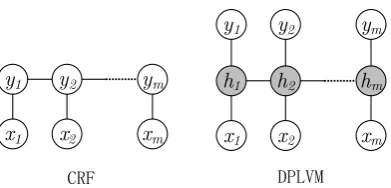
Figure 1: Comparison between CRF models and DPLVM models on the training stage.xrepresents the observation sequence,y represents labels and
hrepresents the latent variables assigned to the la-bels. Note that only the white circles are observed variables. Also, only the links with the current ob-servations are shown, but for both models, long range dependencies are possible.
2 Discriminative Probabilistic Latent Variable Models
Given the training data, the task is to learn a map-ping between a sequence of observations x =
x1, x2, . . . , xm and a sequence of labels y =
y1, y2, . . . , ym. Eachyjis a class label for thej’th token of a word sequence, and is a member of a setYof possible class labels. For each sequence, the model also assumes a sequence of latent vari-ablesh =h1, h2, . . . , hm, which is unobservable in training examples.
The DPLVM model is defined as follows (Morency et al., 2007):
P(y|x,Θ) =X h
P(y|h,x,Θ)P(h|x,Θ), (1)
where Θ represents the parameter vector of the model. DPLVM models can be seen as a natural extension of CRF models, and CRF models can be seen as a special case of DPLVMs that employ only one latent variable for each label.
To make the training and inference efficient, the model is restricted to have disjointed sets of latent variables associated with each class label. Each
hj is a member in a setHyjof possible latent vari-ables for the class labelyj.His defined as the set of all possible latent variables, i.e., the union of all
Hyj sets. Since sequences which have any hj ∈/
Hyj will by definition have P(y|hj,x,Θ) = 0, the model can be further defined as:
P(y|x,Θ) = X h∈Hy1×...×Hym
P(h|x,Θ), (2)
where P(h|x,Θ) is defined by the usual condi-tional random field formulation:
P(h|x,Θ) = PexpΘ·f(h,x)
∀hexpΘ·f(h,x)
, (3)
in whichf(h,x)is a feature vector. Given a train-ing set consisttrain-ing ofnlabeled sequences,(xi,yi), fori= 1. . . n, parameter estimation is performed by optimizing the objective function,
L(Θ) =
n
X
i=1
logP(yi|xi,Θ)−R(Θ). (4)
The first term of this equation represents a condi-tional log-likelihood of a training data. The sec-ond term is a regularizer that is used for reducing overfitting in parameter estimation.
3 Latent-Dynamic Inference
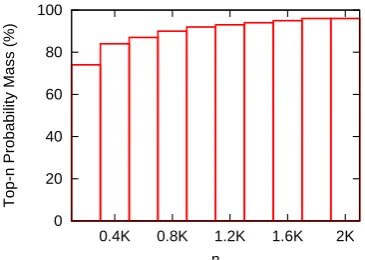
On latent conditional models, marginalizing tent paths exactly for producing the optimal la-bel path is a computationally expensive prob-lem. Nevertheless, we had an interesting observa-tion on DPLVM models that they normally had a highly concentrated probability mass, i.e., the ma-jor probability are distributed on top-n ranked la-tent paths.
Figure 2 shows the probability distribution of a DPLVM model using aL2 regularizer with the
varianceσ2 = 1.0. As can be seen, the
probabil-ity distribution is highly concentrated, e.g., 90% of the probability is distributed on top-800 latent paths.
Based on this observation, we propose an infer-ence algorithm for DPLVMs by efficiently com-bining search and dynamic programming.
3.1 LDI Inference
In the inference stage, given a test sequencex, we want to find the most probable label sequence,y∗:
y∗ = argmaxyP(y|x,Θ∗). (5)
For latent conditional models like DPLVMs, the
y∗ cannot directly be produced by the Viterbi algorithm because of the incorporation of latent variables.
0 20 40 60 80 100
0.4K 0.8K 1.2K 1.6K 2K
Top-n Probability Mass (%)
[image:3.595.86.269.67.197.2]n
Figure 2: The probability mass distribution of la-tent conditional models on a NP-chunking task. The horizontal line represents thenof top-nlatent paths. The vertical line represents the probability mass of the top-nlatent paths.
generates the best latent paths in the order of their probabilities. Then it maps each of these to its as-sociated label paths and uses a method to compute their exact probabilities. It can continue to gener-ate the next best lgener-atent path and the associgener-ated la-bel path until there is not enough probability mass left to beat the best label path.
In detail, anA∗ search algorithm1 (Hart et al., 1968) with a Viterbi heuristic function is adopted to produce top-n latent paths, h1,h2, . . .hn. In addition, a forward-backward-style algorithm is used to compute the exact probabilities of their corresponding label paths, y1,y2, . . .yn. The model then tries to determine the optimal label path based on the top-n statistics, without enumer-ating the remaining low-probability paths, which could be exponentially enormous.
The optimal label pathy∗is ready when the fol-lowing “exact-condition” is achieved:
P(y1|x,Θ)−(1− X
yk∈LPn
P(yk|x,Θ))≥0, (6)
where y1 is the most probable label sequence
in current stage. It is straightforward to prove thaty∗ = y
1, and further search is unnecessary.
This is because the remaining probability mass,
1−Py
k∈LPnP(yk|x,Θ), cannot beat the current optimal label path in this case.
1A∗search and its variants, like beam-search, are widely
used in statistical machine translation. Compared to other search techniques, an interesting point ofA∗search is that it
can produce top-nresults one-by-one in an efficient manner.
Definition:
Proj(h) =y⇐⇒hj ∈Hyj f or j = 1. . . m;
P(h) =P(h|x,Θ);
P(y) =P(y|x,Θ).
Input:
weight vectorΘ, and feature vectorF(h,x).
Initialization:
Gap =−1;n= 0;P(y∗) = 0;LP
0=∅. Algorithm:
whileGap<0do
n=n+ 1
hn= HeapPop[Θ, F(h,x)]
yn= Proj(hn)
ifyn∈/LPn−1then
P(yn) = DynamicProg
P
h:Proj(h)=ynP(h)
LPn=LPn−1∪ {yn}
ifP(yn)> P(y∗)then
y∗ =y n
Gap =P(y∗)−(1−P
yk∈LPnP(yk))
else
LPn=LPn−1 Output:
[image:3.595.318.525.79.381.2]the most probable label sequencey∗.
Figure 3: The exact LDI inference for latent condi-tional models. In the algorithm,HeapPopmeans popping the next hypothesis from theA∗heap; By the definition of theA∗search, this hypothesis (on the top of the heap) should be the latent path with maximum probability in current stage.
3.2 Implementation Issues
We have presented the framework of the LDI in-ference. Here, we describe the details on imple-menting its two important components: designing the heuristic function, and an efficient method to compute the probabilities of label path.
As described, theA∗ search can produce top-n results one-by-one using a heuristic function (the backward term). In the implementation, we use the Viterbi algorithm (Viterbi, 1967) to compute the admissible heuristic function for the forward-styleA∗search:
Heui(hj) = max
h0i=hj∧h0∈HP|ih|
P0(h0|x,Θ∗), (7)
position i to the ending position, |h|. As de-scribed in the Viterbi algorithm, the backward term, Heui(hj), can be efficiently computed by using dynamic programming to reuse the terms (e.g.,Heui+1(hj)) in previous steps. Because this Viterbi heuristic is quite good in practice, this way we can produce the exact top-n latent paths effi-ciently (see efficiency comparisons in Section 5), even though the original problem is NP-hard.
The probability of a label path, P(yn) in Fig-ure 3, can be efficiently computed by a forward-backward algorithm with a restriction on the target label path:
P(y|x,Θ) = X h∈Hy1×...×Hym
P(h|x,Θ). (8)
3.3 An Approximated Version of the LDI
By simply setting a threshold value on the search step, n, we can approximate the LDI, i.e., LDI-Approximation (LDI-A). This is a quite straight-forward method for approximating the LDI. In fact, we have also tried other methods for approx-imation. Intuitively, one alternative method is to design an approximated “exact condition” by us-ing a factor,α, to estimate the distribution of the remaining probability:
P(y1|x,Θ)−α(1− X
yk∈LPn
P(yk|x,Θ))≥0. (9)
For example, if we believe that at most 50% of the unknown probability,1−Py
k∈LPnP(yk|x,Θ), can be distributed on a single label path, we can setα = 0.5to make a loose condition to stop the inference. At first glance, this seems to be quite natural. However, when we compared this alter-native method with the aforementioned approxi-mation on search steps, we found that it worked worse than the latter, in terms of performance and speed. Therefore, we focus on the approximation on search steps in this paper.
3.4 Comparison with Existing Inference Methods
In Matsuzaki et al. (2005), the Best Hidden Path inference (BHP) was used:
yBHP = argmax
y P(hy|x,Θ
∗), (10)
where hy ∈ Hy1 ×. . .×Hym. In other words, the Best Hidden Path is the label sequence
which is directly projected from the optimal la-tent path h∗. The BHP inference can be seen as a special case of the LDI, which replaces the marginalization-operation over latent paths with the max-operation.
In Morency et al. (2007),y∗is estimated by the Best Point-wise Marginal Path (BMP) inference. To estimate the labelyj of token j, the marginal probabilities P(hj = a|x,Θ) are computed for all possible latent variables a ∈ H. Then the marginal probabilities are summed up according to the disjoint sets of latent variablesHyj and the optimal label is estimated by the marginal proba-bilities at each positioni:
yBM P(i) = argmax
yi∈Y
P(yi|x,Θ∗), (11)
where
P(yi =a|x,Θ) =
P
h∈HaP(h|x,Θ)
P
hP(h|x,Θ)
. (12)
Although the motivation is similar, the exact LDI (LDI-E) inference described in this paper is a different algorithm compared to the BLP inference (Sun et al., 2008). For example, during the search, the LDI-E is able to compute the exact probability of a label path by using a restricted version of the forward-backward algorithm, also, the exact con-dition is different accordingly. Moreover, in this paper, we more focus on how to approximate the LDI inference with high performance.
The LDI-E produces y∗ while the LDI-A, the BHP and the BMP perform estimation ony∗. We will compare them via experiments in Section 4.
4 Experiments
In this section, we choose Bio-NER and NP-chunking tasks for experiments. First, we describe the implementations and settings.
We implemented DPLVMs by extending the HCRF library developed by Morency et al. (2007). We added a Limited-Memory BFGS optimizer (L-BFGS) (Nocedal and Wright, 1999), and re-implemented the code on training and inference for higher efficiency. To reduce overfitting, we employed a Gaussian prior (Chen and Rosenfeld, 1999). We varied the the variance of the Gaussian prior (with values 10k, k from -3 to 3), and we found that σ2 = 1.0 is optimal for DPLVMs on
The training stage was kept the same as Morency et al. (2007). In other words, there is no need to change the conventional parameter estimation method on DPLVM models for adapt-ing the various inference algorithms in this paper. For more information on training DPLVMs, refer to Morency et al. (2007) and Petrov and Klein (2008).
Since the CRF model is one of the most success-ful models in sequential labeling tasks (Lafferty et al., 2001; Sha and Pereira, 2003), in this paper, we choosed CRFs as a baseline model for the compar-ison. Note that the feature sets were kept the same in DPLVMs and CRFs. Also, the optimizer and fine tuning strategy were kept the same.
4.1 BioNLP/NLPBA-2004 Shared Task (Bio-NER)
Our first experiment used the data from the BioNLP/NLPBA-2004 shared task. It is a biomed-ical named-entity recognition task on the GENIA corpus (Kim et al., 2004). Named entity recogni-tion aims to identify and classify technical terms in a given domain (here, molecular biology) that refer to concepts of interest to domain experts. The training set consists of 2,000 abstracts from MEDLINE; and the evaluation set consists of 404 abstracts from MEDLINE. We divided the origi-nal training set into 1,800 abstracts for the training data and 200 abstracts for the development data.
The task adopts theBIOencoding scheme, i.e.,
B-x for words beginning an entity x, I-x for words continuing an entityx, andOfor words be-ing outside of all entities. The Bio-NER task con-tains 5 different named entities with 11BIO en-coding labels.
The standard evaluation metrics for this task are precisionp(the fraction of output entities match-ing the reference entities), recall r (the fraction of reference entities returned), and the F-measure given byF = 2pr/(p+r).
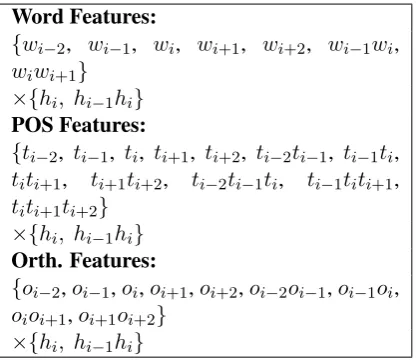
Following Okanohara et al. (2006), we used word features, POS features and orthography fea-tures (prefix, postfix, uppercase/lowercase, etc.), as listed in Table 1. However, their globally depen-dent features, like preceding-entity features, were not used in our system. Also, to speed up the training, features that appeared rarely in the train-ing data were removed. For DPLVM models, we tuned the number of latent variables per label from 2 to 5 on preliminary experiments, and used the
Word Features:
{wi−2, wi−1, wi, wi+1, wi+2, wi−1wi,
wiwi+1} ×{hi, hi−1hi}
POS Features:
{ti−2, ti−1, ti, ti+1, ti+2, ti−2ti−1, ti−1ti,
titi+1, ti+1ti+2, ti−2ti−1ti, ti−1titi+1,
titi+1ti+2} ×{hi, hi−1hi}
Orth. Features:
{oi−2,oi−1,oi,oi+1,oi+2,oi−2oi−1,oi−1oi,
oioi+1,oi+1oi+2} ×{hi, hi−1hi}
Table 1: Feature templates used in the Bio-NER experiments. wi is the current word,ti is the cur-rent POS tag, oi is the orthography mode of the current word, andhi is the current latent variable (for the case of latent models) or the current label (for the case of conventional models). No globally dependent features were used; also, no external re-sources were used.
Word Features:
{wi−2, wi−1, wi, wi+1, wi+2, wi−1wi,
wiwi+1} ×{hi, hi−1hi}
Table 2: Feature templates used in the NP-chunking experiments. wi andhi are defined fol-lowing Table 1.
number 4.
Two sets of experiments were performed. First, on the development data, the value ofn(the search step, see Figure 3 for its definition) was varied in the LDI inference; the corresponding F-measure, exactitude (the fraction of sentences that achieved
the exact condition, Eq. 6), #latent-path
(num-ber of latent paths that have been searched), and inference-time were measured. Second, the n
tuned on the development data was employed for the LDI on the test data, and experimental com-parisons with the existing inference methods, the BHP and the BMP, were made.
4.2 NP-Chunking Task
[image:5.595.314.524.62.242.2]Models S.A. Pre. Rec. F1 Time
LDI-A 40.64 68.34 66.50 67.41 0.4K s LDI-E 40.76 68.36 66.45 67.39 4K s BMP 39.10 65.85 66.49 66.16 0.3K s BHP 39.93 67.60 65.46 66.51 0.1K s CRF 37.44 63.69 64.66 64.17 0.1K s
Table 3: On the test data of the Bio-NER task, ex-perimental comparisons among various inference algorithms on DPLVMs, and the performance of CRFs. S.A. signifies sentence accuracy. As can be seen, at a much lower cost, the LDI-A (A
signi-fiesapproximation) performed slightly better than
the LDI-E (E signifiesexact).
[image:6.595.315.523.65.371.2]only poor features available. For example, in POS-tagging task and Chinese/Japanese word segmen-tation task, there are only word features available. For this reason, it is necessary to check the perfor-mance of the LDI on poor feature-set. We chose another popular task, the NP-chunking, for this study. Here, we used only poor feature-set, i.e., feature templates that depend only on words (see Table 2 for details), taking into account 200K fea-tures. No external resources were used.
The NP-chunking data was extracted from the training/test data of the CoNLL-2000 shallow-parsing shared task (Sang and Buchholz, 2000). In this task, the non-recursive cores of noun phrases called base NPs are identified. The training set consists of 8,936 sentences, and the test set con-sists of 2,012 sentences. Our preliminary exper-iments in this task suggested the use of 5 latent variables for each label on latent models.
5 Results and Discussions
5.1 Bio-NER
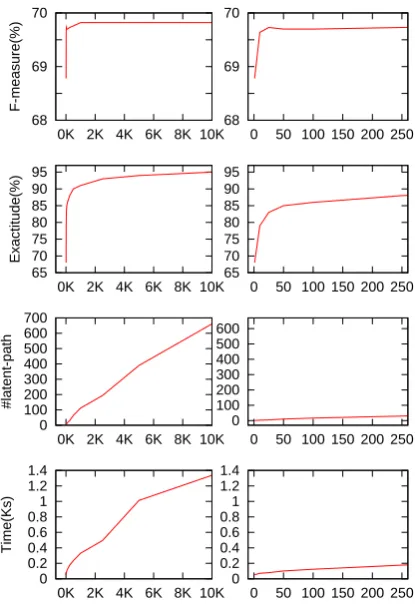
Figure 4 shows the F-measure, exactitude, #latent-path and inference inference time of the DPLVM-LDI model, against the parameter n (the search step, see Table 3), on the development dataset. As can be seen, there was a dramatic climbing curve on the F-measure, from 68.78% to 69.73%, when we increased the number of the search step from 1 to 30. When n = 30, the F-measure has al-ready reached its plateau, with the exactitude of 83.0%, and the inference time of 80 seconds. In other words, the F-measure approached its plateau when nwent to 30, with a high exactitude and a low inference time.
68 69 70
0K 2K 4K 6K 8K 10K
F-measure(%)
65 70 75 80 85 90 95
0K 2K 4K 6K 8K 10K
Exactitude(%)
0 100 200 300 400 500 600 700
0K 2K 4K 6K 8K 10K
#latent-path
0 0.2 0.4 0.6 0.8 1 1.2 1.4
0K 2K 4K 6K 8K 10K
Time(Ks)
n
68 69 70
0 50 100 150 200 250
65 70 75 80 85 90 95
0 50 100 150 200 250
0 100 200 300 400 500 600
0 50 100 150 200 250
0 0.2 0.4 0.6 0.8 1 1.2 1.4
0 50 100 150 200 250 n
Figure 4: (Left) F-measure, exactitude, #latent-path (averaged number of latent #latent-paths being searched), and inference time of the DPLVM-LDI model, against the parameter n, on the develop-ment dataset of the Bio-NER task. (Right) En-largement of the beginning portion of the left fig-ures. As can be seen, the curve of the F-measure approached its plateau whennwent to 30, with a high exactitude and a low inference time.
Our significance test based on McNemar’s test (Gillick and Cox, 1989) shows that the LDI with
n = 30 was significantly more accurate (P <
0.01) than the BHP inference, while the inference time was at a comparable level. Further growth of n after the beginning point of the plateau in-creases the inference time linearly (roughly), but achieved only very marginal improvement on F-measure. This suggests that the LDI inference can be approximated aggressively by stopping the in-ference within a small number of search steps,n. This can achieve high efficiency, without an obvi-ous degradation on the performance.
mod-Models S.A. Pre. Rec. F1 Time
[image:7.595.72.302.63.135.2]LDI-A 60.98 91.76 90.59 91.17 42 s LDI-E 60.88 91.72 90.61 91.16 1K s BHP 59.34 91.54 90.30 90.91 25 s CRF 58.37 90.92 90.33 90.63 18 s
Table 4: Experimental comparisons among differ-ent inference algorithms on DPLVMs, and the per-formance of CRFs using the same feature set on the word features.
els. The baseline was the CRF model with the same feature set. On the LDI-A, the parametern
tuned on the development data was employed, i.e.,
n= 30.
To our surprise, the LDI-A performed slightly better than the LDI-E even though the perfor-mance difference was marginal. We expected that LDI-A would perform worse than the LDI-E be-cause LDI-A uses the aggressive approximation for faster speed. We have not found the exact cause of this interesting phenomenon, but remov-ing latent paths with low probabilities may resem-ble the strategy of pruning features with low fre-quency in the training phase. Further analysis is required in the future.
The LDI-A significantly outperformed the BHP and the BMP, with a comparable inference time. Also, all models of DPLVMs significantly outper-formed CRFs.
5.2 NP-Chunking
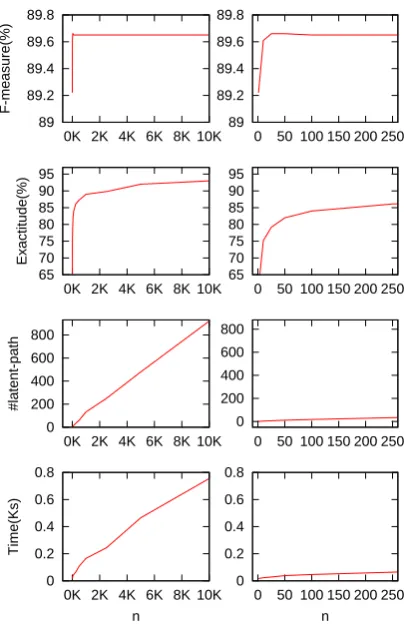
As can be seen in Figure 5, compared to Figure 4 of the Bio-NER task, very similar curves were ob-served in the NP-chunking task. It is interesting because the tasks are different, and their feature sets are very different.
The F-measure reached its plateau whennwas around 30, with a fast inference speed. This echoes the experimental results on the Bio-NER task. Moreover, as can be seen in Table 4, at a much lower cost on inference time, the LDI-A per-formed as well as the LDI-E. The LDI-A outper-forms the BHP inference. All the DPLVM mod-els outperformed CRFs. The experimental results demonstrate that the LDI also works well on poor feature-set.
89 89.2 89.4 89.6 89.8
0K 2K 4K 6K 8K 10K
F-measure(%)
65 70 75 80 85 90 95
0K 2K 4K 6K 8K 10K
Exactitude(%)
0 200 400 600 800
0K 2K 4K 6K 8K 10K
#latent-path
0 0.2 0.4 0.6 0.8
0K 2K 4K 6K 8K 10K
Time(Ks)
n
89 89.2 89.4 89.6 89.8
0 50 100 150 200 250
65 70 75 80 85 90 95
0 50 100 150 200 250
0 200 400 600 800
0 50 100 150 200 250
0 0.2 0.4 0.6 0.8
0 50 100 150 200 250 n
Figure 5: (Left) F-measure, exactitude, #latent-path, and inference time of the DPLVM-LDI model against the parameter n on the NP-chunking development dataset. (Right) Enlarge-ment of the beginning portion of the left figures. The curves echo the results on the Bio-NER task.
5.3 Post-Processing of the LDI: Minimum Bayesian Risk Reranking
Although the label sequence produced by the LDI inference is indeed the optimal label sequence by means of probability, in practice, it may be benefi-cial to use some post-processing methods to adapt the LDI towards factual evaluation metrics. For example, in practice, many natural language pro-cessing tasks are evaluated by F-measures based on chunks (e.g., named entities).
We further describe in this section the MBR reranking method for the LDI. Here MBR rerank-ing can be seen as a natural extension of the LDI for adapting it to various evaluation criterions,
EVAL:
yM BR= argmax
y X
y0∈LPn
P(y0)fEVAL(y|y0). (13)
[image:7.595.320.523.64.377.2]Models Pre. Rec. F1 Time
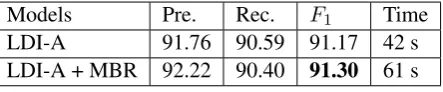
[image:8.595.75.297.63.109.2]LDI-A 91.76 90.59 91.17 42 s LDI-A + MBR 92.22 90.40 91.30 61 s
Table 5: The effect of MBR reranking on the NP-chunking task. As can be seen, MBR-reranking improved the performance of the LDI.
“voting” by those results (label paths) produced by the LDI inference. Each label path is a voter, and it gives another one a “score” (the score depend-ing on the reference y0 and the evaluation met-ricEVAL, i.e.,fEVAL(y|y0)) with a “confidence” (the probability of this voter, i.e.,P(y0)). Finally, the label path with the highest value, combining scores and confidences, will be the optimal result. For more details of the MBR technique, refer to Goel & Byrne (2000) and Kumar & Byrne (2002).
An advantage of the LDI over the BHP and the BMP is that the LDI can efficiently produce the probabilities of the label sequences inLPn. Such probabilities can be used directly for performing the MBR reranking. We will show that it is easy to employ the MBR reranking for the LDI, be-cause the necessary statistics (e.g., the probabili-ties of the label paths, y1,y2, . . .yn) are already produced. In other words, by using LDI infer-ence, a set of possible label sequences has been collected with associated probabilities. Although the cardinality of the set may be small, it accounts for most of the probability mass by the definition of the LDI. Eq.13 can be directly applied on this set to perform reranking.
In contrast, the BHP and the BMP inference are unable to provide such information for the rerank-ing. For this reason, we can only report the results of the reranking for the LDI.
As can be seen in Table 5, MBR-reranking im-proved the performance of the LDI on the NP-chunking task with a poor feature set. The pre-sented MBR reranking algorithm is a general so-lution for various evaluation criterions. We can see that the different evaluation criterion, EVAL, shares the common framework in Eq. 13. In prac-tice, it is only necessary to re-implement the com-ponent offEVAL(y,y0) for a different evaluation criterion. In this paper, the evaluation criterion is the F-measure.
6 Conclusions and Future Work
In this paper, we propose an inference method, the LDI, which is able to decode the optimal label se-quence on latent conditional models. We study the properties of the LDI, and showed that it can be approximated aggressively for high efficiency, with no loss in the performance. On the two NLP tasks, the LDI-A outperformed the existing infer-ence methods on latent conditional models, and its inference time was comparable to that of the exist-ing inference methods.
We also briefly present a post-processing method, i.e., MBR reranking, upon the LDI algorithm for various evaluation purposes. It demonstrates encouraging improvement on the NP-chunking tasks. In the future, we plan to per-form further experiments to make a more detailed study on combining the LDI inference and the MBR reranking.
The LDI inference algorithm is not necessarily limited in linear-chain structure. It could be ex-tended to other latent conditional models with tree structure (e.g., syntactic parsing with latent vari-ables), as long as it allows efficient combination of search and dynamic-programming. This could also be a future work.
Acknowledgments
We thank Xia Zhou, Yusuke Miyao, Takuya Mat-suzaki, Naoaki Okazaki and Galen Andrew for en-lightening discussions, as well as the anonymous reviewers who gave very helpful comments. The first author was partially supported by University of Tokyo Fellowship (UT-Fellowship). This work was partially supported by Grant-in-Aid for Spe-cially Promoted Research (MEXT, Japan).
References
Phillip Blunsom, Trevor Cohn, and Miles Osborne. 2008. A discriminative latent variable model for sta-tistical machine translation.Proceedings of ACL’08.
Stanley F. Chen and Ronald Rosenfeld. 1999. A gaus-sian prior for smoothing maximum entropy models.
Technical Report CMU-CS-99-108, CMU.
L. Gillick and S. Cox. 1989. Some statistical issues in the comparison of speech recognition algorithms.
International Conference on Acoustics Speech and Signal Processing, v1:532–535.
P.E. Hart, N.J. Nilsson, and B. Raphael. 1968. A formal basis for the heuristic determination of mini-mum cost path. IEEE Trans. On System Science and Cybernetics, SSC-4(2):100–107.
Jin-Dong Kim, Tomoko Ohta, Yoshimasa Tsuruoka, and Yuka Tateisi. 2004. Introduction to the bio-entity recognition task at JNLPBA. Proceedings of JNLPBA’04, pages 70–75.
S. Kumar and W. Byrne. 2002. Minimum bayes-risk alignment of bilingual texts. Proceedings of EMNLP’02.
John Lafferty, Andrew McCallum, and Fernando Pereira. 2001. Conditional random fields: Prob-abilistic models for segmenting and labeling se-quence data. Proceedings of ICML’01, pages 282– 289.
Takuya Matsuzaki, Yusuke Miyao, and Jun’ichi Tsu-jii. 2005. Probabilistic CFG with latent annotations.
Proceedings of ACL’05.
Louis-Philippe Morency, Ariadna Quattoni, and Trevor Darrell. 2007. Latent-dynamic discriminative mod-els for continuous gesture recognition. Proceedings of CVPR’07, pages 1–8.
Jorge Nocedal and Stephen J. Wright. 1999. Numeri-cal optimization. Springer.
Daisuke Okanohara, Yusuke Miyao, Yoshimasa Tsu-ruoka, and Jun’chi Tsujii. 2006. Improving the scal-ability of semi-markov conditional random fields for named entity recognition. Proceedings of ACL’06.
Slav Petrov and Dan Klein. 2007. Improved infer-ence for unlexicalized parsing. InHuman Language Technologies 2007: The Conference of the North American Chapter of the Association for Compu-tational Linguistics (HLT-NAACL’07), pages 404– 411, Rochester, New York, April. Association for Computational Linguistics.
Slav Petrov and Dan Klein. 2008. Discriminative log-linear grammars with latent variables. In J.C. Platt, D. Koller, Y. Singer, and S. Roweis, editors,
Advances in Neural Information Processing Systems 20 (NIPS), pages 1153–1160, Cambridge, MA. MIT Press.
Erik Tjong Kim Sang and Sabine Buchholz. 2000. In-troduction to the CoNLL-2000 shared task: Chunk-ing. Proceedings of CoNLL’00, pages 127–132.
Fei Sha and Fernando Pereira. 2003. Shallow pars-ing with conditional random fields. Proceedings of HLT/NAACL’03.
Xu Sun, Louis-Philippe Morency, Daisuke Okanohara, and Jun’ichi Tsujii. 2008. Modeling latent-dynamic in shallow parsing: A latent conditional model with improved inference. Proceedings of the 22nd Inter-national Conference on Computational Linguistics (COLING’08), pages 841–848.