Understanding Programming Language Semantics
For The Complex World
Trong Wu
Abstract — Computer is used virtually everywhere everyday in the world. Before 1990s computer systems are generally used for mathematics, engineering, and business computations. In this period, mainly use FOTRAN, COBOL, and PL/1 for computation on mainframe systems. In the last two decades scientists found that the natural world is complicated that has overwhelmed with data that required more sophisticated computation facilities and better languages for computation and that created new computing disciplines. This paper addresses the understanding of programming language semantics that will help user in selection of programming language features for various applications needs and that can help programmers in designing reliable, accurate, efficient, and user-friendly software systems for the complex world.
Index Terms: user-defined types, exception handling, multitasking, communication between program units, and user-defined precision
I. I
NTRODUCTIONIt is a chaotic world, it is a systematic world; it is a confused age, it is illuminate age; it is disordered society, it is organized society. Everyday we are struggling in a complex, intricate, and difficult environment for our life. Computer science can give one abilities to solve a category of complicated, obscure, and oppressive problems. We can take the advantage of computer speed and large volume of storage spaces to add our ability for solving complex problems in the world. This is a very challenge task and interesting assignment to youngsters. It attracts many of them to study computer science.
In October 1962, Purdue University established the first department of computer science in the United States [8]. Since then Computer Science education has become an integral discipline in colleges and universities across the country. Initially, students in physics, engineering, and mathematics were advised to take one course in the FORTRAN language while students in the school of business particularly in Management Information Systems ware required to take a course in the COBOL
language. Students who majored in Computer Science were required to enrolled in both FORTRAN, COBOL, and PL/1 courses. It was thought that this would prepare them potentially to work in industrial firms or business companies after completion of their degrees.
Since then, computer software and its use have spread to nearly every aspect of peoples’ lives from work to play. Today almost every one uses computer and software everywhere. Most of the equipment and devices, which use software are designed and manufactured by engineers. Some of this hardware is equipped with embedded computer systems, some are operated by a computer system, and some are connected to a computer and give output results to the computer. For these applications, users need not only robust hardware, but also reliable software.
Today, the most serious problems with software products are expense,
ease of use, and reliability [12]. Computer scientists not only need to study computer mechanisms and how to increase the productivity and efficiencies of a computer system, but also need to design computer systems, write programs, and execute them. The former is the state of the practice of
software engineering and the latter is the state of the art. Unfortunately, there exists a gap between the former and the latter. The task for computer scientists is to eliminate or narrow this gap. To do this, one may apply the principles of software engineering for software design that will make systems more efficient, robust, reliable, and friendlier to use. To implement this, one should thoroughly analyze system requirements, carefully design the system and programs, and then perform various tests including unit tests and system tests. Finally computer scientists need to deliver systems and make sure that they meet their requirements and fit in their environments [14].
However, computer scientists need a good language tool to implement these software engineering principles. Human languages such as English, Chinese, Spanish, Russian, etc. are all ambiguous languages. None of them can be used to communicate with a computer system. Therefore, mathematicians, computer scientists, and linguists must work hard to develop semantically unambiguous languages, starting by designing
grammar rules and then developing the sentential structures of the
language. A computer program uses such a language to communicate with a computer system to take a set of input data to the computer system, reorganize data objects in the computer system, construct new data objects, and then generate a useful output for the program.
Nevertheless, most engineers have had only one computing course in FORTRAN or in the C language or both while they were in college and perhaps they believe that FORTRAN or the C language is enough for their engineering application needs. In fact, the FORTRAN
language lacks user-defined types that limit its application domain. Moreover, both the FORTRAN and C languages do not have
predefined accuracy features, friendly concurrency facilities, and
effective exception handling methods. Today, neither FORTRAN
language nor the C language remains adequate to program in this complex and chaotic world for designing and implementing more sophisticated and reliable systems for biological, physical, and other natural related systems. Therefore, we need understand programming Language semantics thoroughly so that we can deal with natural world computation.
This paper describes some necessary elements in the understanding programming language semantics that is important for the computation of the natural world. It requires computation more accurate, more reliable,
more precise, more efficient, and friendlier. Therefore, we should consider the extends of application domain, the application of accuracy and efficient
facilities, the use of modularization and communication, the utilization of
parallelism or concurrency, and applying exception handling and for
reliability criticalprojects in this complex world.
II.
E
XTENDSION OF THE APPLICATIONS TO A COMPLEX WORLDA department store usually consists of tens’ of thousands merchandises; it is very difficult to manage them properly, efficiently, and
cost-effectively. One of the most effective ways to manage such department
stores is to partitioning all the merchandises into departments such as man’s ware, lady’s ware, house ware, juniors, sports, electronics, hardware,
store must belong to one and only one department, and department-to-department are discriminates to each other. No merchandises can belong to two distinct departments at the same time. If a piece of merchandise belongs to two departments that must have two stock numbers, that the item will have two entries on the computer printed list, and that will increase the operating overhead for department store. Each department consists of a set of similar or the same kind merchandises and a set of operation rules and policies for manage these merchandises. For example, hardware and
electronic departments have different return or refund policies; some
electronic items are not allowed customers to test or to tryout. Pharmacy
department has its operational procedures or rules; medications are
classified into prescription and non-prescription. For any prescription medication is strictly required a medical doctor’s signed prescription [26].
In a special season of the year, like Christmas time, most department stores want to make some additional business for this splendor season; they create a new department called “Santa;” it is for children to take pictures with the Santa. Likewise, in the springtime they create a new department called “Plants” by selling saplings, flowers, seedling, soils, seeds, fertilizer, rocks, and other goods for the garden [26].
Today real world projects can be very large and complicated for applications in newly developed domains. These projects can include
hardware projects, software projects, and firmware projects. Many
engineering projects need to take years or tens’ of years to complete them such as the Yangtze River Three Gorges Dam project that was launched in 1993 and the water level in the reservoir will reach to 175 meters in 2009, when the project is finally completed [7]; the Airbus A380 project that was started in 2000 for worldwide market campaign and made its maiden flight in 2005 [2]; and the Boeing 777 program was launched in October 1990 and the first 777-300 was delivered to Cathay Pacific Airways in June 1998 [5]. These projects involved thousands designers, hundreds subcontractors, and tens of thousands manufactures. To implement and manage these projects we need to use many large-scale computer systems to process a massive amount of data and programs.
A computer system commonly manages a large amount of data objects. In structure it is similar to a department store, with its thousands of items of merchandise, or a large engineering project, with hundreds of subcontractors. Therefore, we need to group data objects into types. Types
are discriminates to each other, unless a type conversion function is applied that can converts from one type to another. Data objects in a computer system are analogous to merchandise in a department store or devices,
parts, and equipment in an engineering project. The association rules used to manage merchandise, parts, devices, and equipments are similar to
respect operations of types in a computer system. To create a new
department in a department store is to expand its business; much like creating a new type in a computer systemenlarges its application domain [26] to multidisciplinary areas and to the control of more complex physical systems. These new types are called user-defined types.
Similarly, management of an engineering project requires subdividing the project into subprojects through subcontracting. In a computer system, we classify data objects into types. This is a granulation [27]. Therefore,
granulation is an essential feature in the design of programming languages.
It provides predefined basic types and user-defined types so that the language can extend its application domain to any desired area.
Programming language likes FORTRAN IV have only basic types and do not allow users to define their own types. Therefore, its application domain is so limited. However, the Ada and the C++ programming languages do provide user-defined type capability; and their application domain is not limited [26]. Today, these two languages are considered general purpose programming languages. Hence, user-defined types are vital for this complex and chaotic world in computing.
From an engineering viewpoint, we usually subdivide a complicated problem or system into several sub-problems or subsystems respectively; this method reduces the difficulty of solving the problem. In the next section, we will address subprograms and communications between program units for synchronization of the world.
III.
M
ODULARIZATION AND COMMUNICATION IN THE CHAOTIC WORLDModularity partitions a complicated problem into sub-problems, and we
implement them as sub-programs. A sub-program is a unit of a program declared out of line and invoked via calls. The purposes of a subprogram
are many folds:
(1) Result of modular design of program,
(2) Factoring of common logic that occurs several places in a program,
(3) Parameterized calls allow operating on different objects at different
times, and
(4) Simplifying and easing the complexity of the problem.
In general, there two distinct subprogram types exist in commonly used programming languages.
(1) Functions. It returns values of a designated type. These are used anywhere an expression is accepted.
(2) Procedures. It represents computational segments, and its results may be passed back via parameters or side effects. These are used wherever statements are permitted.
Communication between the main program and subprograms or from one subprogram to another occurs via parameter passing. Each programming language defines its own parameter passing mechanisms. There are five parameter-passing mechanisms in current commonly used programming languages such as parameter passing by value, by reference, by name, by value-result, and by copy rules that including copy- in, copy-out, and copy-in out rules [15, 16].
Among these five parameter-passing mechanisms, parameter passing
by value, parameter passing by reference, and parameter passing by name
can be defined mathematically below: For a parameter pass, in evaluating a variable name to get a value by finding the location associated with the
name and extracting the value from the location. Let names, locations, and
values be three sets, we define two mappings:
ρ
: names→
locations, andσ
: locations→
valuesDifferences in the parameter passing mechanism are defined by when
ρ
andσ
are applied. (1) Parameter passing by valueρ
andσ
both applied at point of call, argument completely evaluated at point of call.(2) Parameter passing by reference (location)
Location is determined at the point of call and location is bound as the value of parameter.
ρ
is applied at point of call andσ
is applied with every reference to the parameter.(3) Parameter passing by name
At time of call, neither
ρ
nor theσ
is applied.ρ
andσ
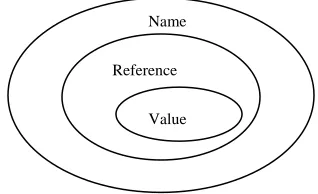
are applied with every reference to the parameter.These three parameter-passing mechanisms formed hierarchical structures; the diagram is given in Fig.3.1. For parameter passing by value, both
ρ
andσ
are applied at calling time; for parameter passing by reference,ρ
is applied at calling time andσ
is applied at reference time; for parameter passing by name bothρ
andσ
are applied with every reference to the parameter.Name
Reference
[image:2.612.347.506.595.692.2]Value
Fig. 3.1 Hierarchical structures of parameter passing
The ALGOL, C, C++, and Pascal languages provide parameter
for enforcing write protection. The ALGOL, C, C++, and Pascal languages also implement parameter passing by reference. This eliminates duplication of memory. But, there are disadvantages in the parameter passing by reference. First, it will likely be slower because one additional level memory addressing is needed compared to parameter passing by
value. Second, if only one-way communication to the called subprogram is required, unexpected and erroneous changes may occur in the actual parameter. Finally, parameter passing by reference can create aliases, which are harmful to readability and reliability. They also make program verification difficult.
The ALGOL programming language by default provides parameter
passing by name. When implementing parameter passing by name, the system will create a run-time subprogram to evaluate the expression in the calling unit of the program and return the result to the called unit of the program. Therefore, it requires some additional overhead to implement such a run-time subprogram. In the ALGOL programming language, if one wants parameter passing by value, he or she must declare with the word “value” for that variable in the actual parameter. ALGOL treats parameter passing by reference, as a special case of parameter passing by name; therefore, the programmer does not need to specify anything. We can define a hierarchical structure for parameter passing by value,reference, and name in the ALGOL language.
In the programming language PL/1, for actual parameters with a single variable, PL/1 uses parameter passing by value. However, for a constant or an expression as an argument in the calling statement, PL/1 refers to a dummy formal parameter in the called subprogram and it implements a default value or parameter passing by value.
In most FORTRAN implementations before FORTRAN 77, parameters were passed by reference. In later implementations parameter passing by value-result has been used commonly.
For the Ada language, parameter passing has three modes: mode in, mode out, and mode in out. These are different from parameter passing by value and by reference [3, 4, 17, 20]
Mode in
• This is the default mode (i.e., in may be omitted).
• The actual parameter is copied into a local variable. The actual parameter must have a defined value at the point of call.
• The actual parameter may be an expression of compatible type. Mode out
• The result is copied into the actual parameter upon exit.
• The actual parameter may be a variable of compatible type.
• The actual parameter need not have a value upon entry. Mode in out
• The value of the actual parameter is copied into a local variable upon entry.
• The value of local parameter is copied into the actual parameter upon exist.
• The actual parameter must be a variable with a defined value upon entry.
These parameter-passing mechanisms are serving communication facilities between main program and its subprograms or between one subprogram and another. The purpose of engineering computing is to solve problems in the complicated world by means of granulation [27, 28],
organization, and causation. Granulation subdivides the problem into a set of more manageable sub-problems. Granulation is an effective tool to modularize the original problem and to write it into subprograms. From a programmer viewpoint, communication between the main program and subprograms and the communication from one subprogram to another is the
causation within the program. The structural design and the logical flow
reflect the organization of the problem. Every parameter passing mechanism designed in current programming languages has its own purpose and application domain. For the granulation computing, we need to provide all of these features for selection so that we can solve problems most flexibly.
This paper emphasizes using features of programming languages for engineering computation. It is worth noting that the Ada programming language is designed for embedded systems, safety-critical software, and
large projects that require high portability, reliability, and maintainability.
For example, over 99 percent of the aviation software in the Boeing 777 airplane uses the Ada language [1]. Not surprisingly, the Ada language was the first object-oriented design programming language to be accepted as an International Standard.
Today, we design software systems to meet complex application requirements. Almost all the activities in human society, the biological world, physical systems, and engineering projects are concurrent or
parallel; and purely sequential activities are special cases. Therefore,
concurrency reflects the nature of designing software projects. In the next
section, we will address the multitasking features in the Ada programming language [6, 9].
IV.
P
ARALLEL OR CONCURRENCY IS THE NATURE OF THE WORLDAmong all commonly used programming languages, the Ada language has the most complete and best features for multitasking. Multitasking
permits a programmer to partition a big job into many parallel tasks [8, 20]. Other programming languages like the C and C++ programming languages can only apply some predefined functions. Thus, they are lack of flexibility and limit their applicability. For engineering applications, we should use these features and include them in the design of programming languages.
A task is a unit of computation that can be scheduled independently and in parallel with other such units. An ordinary Ada program can be thought of as a single task; in fact, it would be called the main task. Other tasks must be declared in the main task (as subtasks) or be defined in a
package [3, 5, 20, 21]. Several independent tasks are often to be executed
simultaneously in an application. Ada tasks can be executed in true
parallelism or with apparent concurrency simulated by interleaved
execution. Ada tasks can be assigned relative priorities and the underlying operating system can schedule them accordingly. A task is terminated when its execution ends. A task can be declared in packages, subprograms,
blocks, or other tasks. All tasks or sub-tasks must terminate before the declaring subprogram, block, or task can be terminated.
A task may want to communicate with other tasks. Because the execution speed of tasks cannot be guaranteed, a method for synchronization is needed. To do this, the Ada language requires the user to declare entry and accept statements in two respective tasks engaged in communication. This mechanism provides for task interaction and is called a rendezvous in the Ada language [21].
The Ada language also gives an optional scheduling called a priority
that is associated with a given task. A priority expresses relative urgency of the task execution. An expression of a priority is an integer in a given defined range. A numerically smaller value for priority indicates lower level of urgency. The priority of a task, if defined, must be static. If two
tasks with no priorities or two tasks of equal priority exist, they will be scheduled in an arbitrary order. If two tasks of different priorities are both eligible for execution, they could sensibly be executed on the same processor. A lower priority task cannot execute while a higher priority task
waits. The Ada language forbids time-sliced execution scheduling for tasks
with explicitly specified priorities. If two tasks of prescribed priorities are engaged in a rendezvous, the rendezvous is executed with the higher of the two priorities. If only one task has a defined priority, the rendezvous is executed at least at that priority.
A task may delay its own execution or put itself to sleep and not use
processing resources while waiting for an event to occur by a delay
statement. The delay statement is employed for this purpose. Zero or
negative values have no effect. The smallest delay time is 20 milliseconds
or 0.020 seconds. The maximum delay duration is up to 86400 seconds or
24 hours. The duration only specifies minimum delay; the task may be executed any time thereafter, if the processor is available at that time.
The Ada language also provides a select statement. There are three forms of select statements. Selective wait, conditional entry call, and
timed entry call. A selective wait may include (1) a terminate alternative, (2) one or more delay alternatives, or (3) an else part, but only one of these possibilities is legal. A task may designate a family (an array) of entries by a single name. They can be declared as:
Entry alarm (level); -- where type level
-- must be discrete An accept statement may name an indexed entry Accept request ( 0) (reqcode: integer) do …
Accept request (1) (reqcode: integer) do …
Accept alarm (level);
An entry family allows an accepting task to select entry calls to the same function deterministically.
Today’s compiler technology adequately supports all Ada features. In a real-time system, the response time for multitasking features may seem not fast enough. Therefore, speed is an important factor in choosing an Ada
compiler for general and real-time system applications. Among all
commonly used programming languages, the Ada language is the unique one that provides multitasking features at the programming level, and it is very important useful feature for modeling and simulating of real-time and
concurrent events in programming.
The goals of computing are reliability, efficiency, accuracy, and ease
of use. From the programming point of view, to provide reliable
computation is to prevent or eliminate overflow, underflow, and other
unexpected conditions so that a program can be executed safely, completely,
and efficiently. Efficient computation requires an effective computational algorithm for the given problem using proper programming language features for that computation. For accurate computation, one should consider problem solving capability, accuracy features, and parallel computation abilities in a given programming language. For ease of use, the software engineer should put himself in the situation of the user. A software engineer should remember that users have a job to be done, and they want the computer system to do the job with a minimum of effort. In the next section, we will discuss issues of accuracy and efficiency of the
Ada language in numerical computation capability [15].
V. A
CCURACY AND EFFICIENCY ARE REQUIRED BY THIS SOPHICIFICATE WORLDThe area of numerical computation is the backbone of computer science and all engineering disciplines. Numerical computation is critical to real world engineering applications. For example, on November 10, 1999, the U.S. National Aeronautics and Space Administration (NASA) reported that the
Mars Climate Orbiter Team found:
“The ‘root cause’ of the loss of the spacecraft was the failed
translation of English units into metric units in a segment of ground-based, navigation-related mission software as NASA
previously announced [11].”
This example indicates that numerical computation and software design are crucial tasks in an engineering project. The goal of numerical computation
is to reach to a sufficient level of accuracy for a particular application. Designing software for efficient computation is another challenge.
For engineering applications, we need to deal with many of numerical
computations. Among most commonly used programming languages, the
Ada language has the best numerical computation capability. From the
precision aspect, the Ada language allows a user to define his own accuracy requirement. This section will address the Ada language numerical computation capability [15]. To deal this, we should consider the following four criteria: problem solving capability, accuracy of computation, execution time for solving problems, and the capability of parallelism
(1) Problem solving capability: The Ada language provides user-defined types and separate compilation. The former supports programmers solving a wide range of engineering problems and the latter permits development of large software systems. The Ada language provides data abstraction and exception handling that support information hiding and encapsulation for writing a reliable program. In the real world, many engineering projects consist of concurrent or parallel activities in their physical entities. To properly simulate these systems with a programming
language, that language must provide for logical concurrency regardless of how the program is actually executed. Ada multitasking meets this requirement [13, 22]. In fact, multiprocessor computer systems are now available, thus simulating a truly parallel system becomes possible.
(2) Precision and accuracy: The Ada language’s real number types are subdivided into float-point types and fixed-point types. Float-point type
have values are numbers with the format,
±
.
dd
..
d
×
10
±dd.Fixed-point types have values with the formats
±
dd
.ddd
,
±
dddd
.
0
orddd
00
.
0
±
[4, 8, 20].For the float-point number types, model numbers other than zero, the numbers that can be represented exactly by a given computer, are of the form:
sign
×
mantissa×
(radix× ×
exponent)In this form, sign is either +1 or -1; mantissa is expressed in a number base given by radix and exponent is an integer. The Ada language allows the user to specify the number of significant decimal digits needed. A floating-point type declaration with or without the optional range constraint is shown:
typeTis digitD [rangeL .. R];
In addition, most Ada compilers provide the types long_float and
long_long_float (used in package standard) and f_float, d_float, g_float, and
h_float (used in package system) [22]. The size and the precision of each of
the Ada floating-point types are given as follows: Type Size(bits) Precision (digits)
f_float 32 6
d_float 64 9
g_float 64 15 h_float 128 33
The goal of computation is accuracy. Higher accuracy will provide more reliability in the real-time environment. Sometimes, a single precision or a double precision of floating point numbers in FORTRAN 77 [13] is not enough for solving some critical problems. In the Ada language one may use the floating point number type: long_long_float (h_float) by declaring digit 33 to use 128 bits for floating point numbers provided by Vax Ada
[18] to provide a precision of 33 decimal digits accuracy, and the range of exponent is about from
10
−134 to10
+134or −448 to +448 of base 2 [4, 8, 19, 20] for the range. The author has employed this special accuracy feature in the computation of hypergeometric distribution function [23, 24].For the fixed-point types, the model numbers are in this form: sign
×
mantissa×
smallThe sign is either +1 or −1; mantissa is a positive integer; small is a certain positive real number. Model numbers are defined by a fixed-point constraint, the number small is chosen as the largest power of two that is not greater than the delta of a fixed accuracy definition. The Ada language permits the user to determine a possible range and an error bound which is called delta for computational needs. Examples are the follows:
Overhead has a delta of 0.01; Overhead has a range −10E5 .. 1.0E5;
These indicate small is 0.0078125 which is
2
−7and model numbers are – 12800000×
small to +12800000×
small. The predetermined range provides a reliable programming environment. The user assigned error bound delta guarantees an accurate computation. These floating-point number and fixed-point number types not only provide good features for real-time critical computations, but also give extra reliability and accuracy for general numerical computations.(3) The Ada for parallel computation: The author has used exception
handlings and tasks [6, 21] for computation of a division of a product of
factorials and another product of factorials in the computation of the
hypergeometric distribution function [24, 25]. Exception handling is used
concurrently. In addition, tasks and exception handling working together can minimize the number of divisions and maximize the number of integer multiplications in both of the numerator and denominator, reduce round off errors, and obtain the maximum accuracy. In the actual implementation, we used three tasks: task one and task two are employed to perform the multiplications in the numerator and denominator parallels and task three is used to perform a division. When both products in the numerator and denominator have reached a maximum before an overflow occurs, both task
one and task two stop temporarily and invoke task three to perform a
division of the products that have been obtained in the numerator and denominator before an overflow occurs. After task three completes its job,
task one and task two resume their computation and repeat this procedure
until the final result is obtained. These tasks work together and guarantee that the result of this computation will be the most accurate and the time for the computation is reasonable. The author has performed these computations on a single processor machine, so the parallelism is a logical parallelism. If one has a multiprocessor machine, he can perform an actual parallelism, tasking and exception handling can easily be employed in the computation of the hypergeometric distribution function and some computation results and required time for this problem are given in [21], along with those for the computation of the multinomial distribution
function, multivariate hypergeometric distribution function, and other
comparable functions. We conclude here that it is not possible to carry out the computation without using these Ada special features.
(4) Execution time: In the 1990s, compiler technology was inadequate to support many Ada features. In a real-time system, the response time for
multitasking features was seemed not fast enough. Therefore, speed was an
important criterion for choosing an Ada compiler for real-time applications. However, the second generation of Ada compilers has doubled the speed of the first generation compilers. Today, compilers are fast enough to support all Ada features. Currently, Ada compilers are available for supercomputers, mainframe computers, minicomputers, and personal computers at reasonable prices.
In running an application, a program crash is a disaster. When the programmer designs his program, he must consider all such unexpected situations and find a means to prevent from happening. If it is not possible to prevent a crash from occurring, the programmer should provide some mechanisms to handle it, to eliminate it, or to minimize its damage. In the next section, we will address exception-handling features for these purposes.
VI.
E
XCEPTION HANDLING IS THE SAFE GUARD IN THE DANGEROUS WORLDAn exception is an out-of-the-ordinary condition, usually representing a fault state that can cause a program crash. The Ada language provides for
detection and handling of such conditions [4, 8, 23]. It is raised implicitly from an operation of integer overflow during the evaluation of an expression, or assigning a negative value to a type with positive data item. It is also raised explicitly as a result of checking when a determinant is found to be zero during matrix inversion or a stack is found to be empty during “pop” operation. It is not always possible or practical to avoid all exceptions. Allowing exceptions to occur without providing a means to handle the condition could lead to an unreliable program or a crash, however. Therefore, exception handling is very important in designing a programming language [17, 23]. The Ada language provides five predefined exceptions. They are:
Constraint_error
• It possibly the most frequently used exception in Ada programs.
• Constraint_error is raised when a range constraint is violated during assignment or a discriminant value is altered for a constrained type.
Numeric_error
• When an arithmetic operation cannot deliver the correct result.
• Overflow or underflow condition occurs.
Storage_error
• It is raised if out of memory during the elaboration of a data object.
• During a subprogram execution, creation of a new-access type object,
Tasking_error
• It is raised during inter-tasking communication.
Program_error
• A program attempts to enter an unelaborated procedure, e.g. a forward
is not declared.
The Ada language encourages its user to define and raise his exceptions in order to meet the specific purposes needed. The language allows the exception handling mechanism to be invoked for unusual conditions that are detected by the user’s program. An exception handler
is a segment of subprogram or block that is entered when the exception is raised. It is declared at the end of a block or subprogram body. If an
exception is raised and there is no handler for it in the unit, then the
execution of the unit is abandoned and the exception is propagated dynamically, as follows:
• If the unit is a block, the exception is raised at the end of the block in the containing unit.
• If the unit is a subprogram, the exception is raised at the point of call rather than the statically surrounding units; hence the term dynamic is applied to the propagation rule.
• If the unit is the main program, program execution is terminated with an appropriate (and nasty) diagnostic message from the run time support environment.
The Ada language strongly encourages its user to define and use his own exceptions even if they manifest in the form of predefined exceptions at the outset, rather than depend on predefined ones; it is generally difficult to be sure exactly what caused the original exception. The user should not depend on proper values for out or in out parameters from units that neither
propagate an exception nor assume a predefined exception occurs at some known point even if there is only one point where it could occur. The following is an example that shows the exception, handler, and propagation
working together for the computation of factorial function.
Function Power (n, k: natural) return natural is Function Power (n, k: natural) return natural is
begin -- inner
if k < 1 then return 1;
else
return n * Power(n, k-1);
end if;
end Power; -- inner
begin -- outer
return Power(n, k);
Exception
when numeric_error =>
return natural'last;
end Power; -- outer The advantage of this segment of code is that when an overflow condition occurs, the inner Power function will exit. Once the outer function returns the natural’last, it is not possible to get back to the exact point of the exception.
Function Power (n, k: natural) return natural is
begin
if k < 1 then return 1;
else
return n * Power(n, k-1);
end if;
Exception
when numeric_error =>
return natural'last;
end Power;
Designing a programming language for application to all human activities and their needs is not an easy task. However, the language we want for engineering computation must be a reliable one. The Ada
language is a language that provides complete exception-handling
facilities. For a program to be considered reliable, it must be operate sensibly even when presented with improper input data as well as a software or hardware malfunction. A wide range of issues pertains to the design and implementation of software, which will operate successfully within specifications during specified time periods. Of cause a greater precaution is to avoid possible errors in the program itself. To do this, we must take account of such possible errors in the program design. A truly reliable program must monitor itself during execution and take some appropriate actions when a computation is entering an unexpected state. This is the purpose of an exception handler.
VII. CONCLUSION
In this paper we have discussed the goal of engineering computing as
accuracy, efficiency, reliability, and ease ofuse. To accomplish the goals of engineering computation is not easy; it involves human intelligence, knowledge of variety of programming languages, and various programming facilities. In this paper, we have examined many programming language features that are critically important for engineering applications. Some of these features such as subprograms, user-defined types, and basic numerical
computation facilities are provided by most commonly used languages like
FORTRAN 90, the C, the C++,Pascal, and Ada languages. This paper has
highlighted the use of the Ada programming language's strong typed
feature, predefined exception handling, user defined exception handling,
and user-defined types for developing reliable programs. All of these good
features in the Ada programming languages are unique among all commonly used programming languages. In particular, the use of the Ada
language's delta, digits, and model numbers for designing engineering projects, which require accurate critical numerical computation, are very important. For the Ada language, most of their compilers allow users to have a 128-bit floating-point number or 33 significant digits for numerical computation. Programmers may specify required accuracies through digits
and delta clauses for floating-point numbers and fixed-point numbers, respectively. In addition, Ada’sexception handling can prevent overflow or
underflow during the execution of programs and multitasking can perform
parallel computations. Therefore, from the software reliability point of
view, the Ada language is better than FORTRAN, the C, the C++ and languages in numerical computation for engineering applications.
Today, most engineers have only FORTRAN or the C/C++
programming languages for computing. Perhaps some of them have used
Mathematica, Mathlab, or Maple for computation. All these mathematical packages have one or more of following drawbacks. Each mathematical software package has its own input and output formats; these formats might not compatible with an engineering project. Each of these software packages has its predefined accuracy, which might not meet the needs of engineering projects. All of these mathematical packages are designed for classroom teaching or laboratory research computations;
efficiency is not critically important for these purposes. Moreover, these
mathematical packages are not for real-time or embedded systems
applications; they lack exception-handling capabilities. Therefore, engineers need to learn how to build their own computational capabilities.
To do this, each engineering student needs to take at least two courses in computing, one is to learn the basic computation capabilities, a
FORTRAN or the C/C++ course will serve for this purpose, the other is to
study how to build efficient, accurate, reliable, and ease of use software systems to satisfy all engineering domain needs. However, the instructor must have knowledge about engineering experiences in real world, and backgrounds in inter-disciplinary applications in order to qualify for this purpose and lead students to design, implement, and handle engineering projects for the challenges of the complex world.
R
EFERENCES 1. Ada information clearance house, the web site:www.adaic.org/atwork/boeing.html
2. The Aviation Book, A visual encycilopedia of the history of aircraft,
www. ChronicaleBooks.com.
3. Barnes, J. G. P. Programming in Ada, Third edition, Addison-Wesley Publishing, Reading Massachusetts, 1989.
4. Barnes, J. Programming in Ada 95, Addison-Wesley Publishing, Reading Massachusetts, 1995.
5. Boeing 777,
globalsecurity.org/military/systems/ aircraft/b777.html.
6. Booch, G. Software engineering with Ada, Second edition, Benjamin/Cummings Publishing, Reading Massachusetts,
1987.
7. China Daily, CHINAdaily.com.cn, October 28, 2006.
8. Demillo, R. and Rice, J. eds, Studies in Computer Science: In Honor
of Samuel D. Conte, Plenum Publishing, 1994.
9. Habermann, A. N. and Perry D. E. Ada for Experienced
Programmers, Addison-Wesley Publishing, Reading, Massachusetts,
1983.
10. Joint Task Force for Computing Curricula 2004, Overview Report.
ACM and IEEE-CS. 2004. 11. Mas project http://mars.jpl.nasa.
12. Myers, G. J., Software Reliability, John Wiley & Sons, 1976. 13. Parnas, D. L. Is Ada Too Big?'' (letter) Communications of ACM 29,
pp. 1155-1155, 1984.
14. Pfleeger, S. L. Software Engineering, the Production of Quality Software, 2nd edition, Macmillam, 1991.
15. Pratt, T. W., Zelkowitz, M.V. Programming Languages, Design and
implementation, third edition, Prentice-Hall, Englewood Cliffs, New
Jersey, 1996.
16. Sebesta, R. W. Concepts of Programming Languages, sixth edition, Addison-Wesley Publishing, Reading Massachusetts, 2003.
17. Smedema, C. H., et al., The Programming languages Pascal, Modula,
Chill, and Ada, Prentice-Hall, Englewood Cliffs, New Jersey,1983.
18. Struble, G. Assembler Language Programming, The IBM System/370 Family, ٛAddison-Wesley Publishing, Reading, Massachusetts 1984.
19. Vax Ada Language Reference Manual, Digital Equipment
Corporation, Maynard, Mass., 1985.
20. Watt, D. A., et al. Ada Language and Methodology, Prentice-Hall, Englewood Cliffs, New Jersey, 1987.
21. Welsh, J. and Lister, A. A Comparative Study of Task Communication in Ada, Software Practice and Experience. 11, pp. 257-290, 1981.
22. Wichmann, B. A. Is Ada Too Big? A Designer Answers the Critics,
Communications of ACM, 29, pp. 1155-1156, 1984.
23. Wu, T. Built-in reliability in the Ada programming language, Proc. of
IEEE 1990 National Aerospace and Electronics Conference, pp.
599-602, 1990.
24. Wu, T. An Accurate Computation of the Hypergeometric Distribution Function, ACM Transactions on Mathematical Software, V.19, No. 1, pp. 33-43, 1993.
25. Wu, T Ada programming language for Numerical Computation, Proc.
of IEEE 1995 National Aerospace and Electronics Conference, pp.
853-859, 1995
26. Wu, T. Some tips in computer science, a talk given at University of Illinois at Springfield, Dec. 2, 2004.
27. Zadeh, L. A. Fuzzy sets and information granularity, In M. M. Gupta, P. K. Ragade, R. R.Yager, eds, Advances in Fuzzy Set Theory and
Applications, North Holland, Amsterdam, pp. 3-18, 1979.
28. Zadeh, L. A. Towards a theory of fuzzy information granulation and its centrality in human reasoning and fuzzy logic, Fuzzy Sets and
Systems V. 19, pp.111-117, 1997.