Evaluating Neural Word Representations in
Tensor-Based Compositional Settings
Dmitrijs Milajevs1 Dimitri Kartsaklis2 Mehrnoosh Sadrzadeh1 Matthew Purver1 1Queen Mary University of London
School of Electronic Engineering and Computer Science Mile End Road, London, UK
{d.milajevs,m.sadrzadeh,m.purver}@qmul.ac.uk
2University of Oxford
Department of Computer Science Parks Road, Oxford, UK
Abstract
We provide a comparative study be-tween neural word representations and traditional vector spaces based on co-occurrence counts, in a number of com-positional tasks. We use three differ-ent semantic spaces and implemdiffer-ent seven tensor-based compositional models, which we then test (together with simpler ad-ditive and multiplicative approaches) in tasks involving verb disambiguation and sentence similarity. To check their scala-bility, we additionally evaluate the spaces using simple compositional methods on larger-scale tasks with less constrained language: paraphrase detection and di-alogue act tagging. In the more con-strained tasks, co-occurrence vectors are competitive, although choice of composi-tional method is important; on the larger-scale tasks, they are outperformed by neu-ral word embeddings, which show robust, stable performance across the tasks. 1 Introduction
Neural word embeddings (Bengio et al., 2006; Collobert and Weston, 2008; Mikolov et al., 2013a) have received much attention in the dis-tributional semantics community, and have shown state-of-the-art performance in many natural lan-guage processing tasks. While they have been compared with co-occurrence based models in simple similarity tasks at the word level (Levy et al., 2014; Baroni et al., 2014), we are aware of only one work that attempts a comparison of the two approaches in compositional settings (Blacoe and Lapata, 2012), and this is limited to additive and multiplicative composition, compared against composition via a neural autoencoder.
The purpose of this paper is to provide a more complete picture regarding the potential of
neu-ral word embeddings in compositional tasks, and meaningfully compare them with the traditional distributional approach based on co-occurrence counts. We are especially interested in investi-gating the performance of neural word vectors in compositional models involving general mathe-matical composition operators, rather than in the more task- or domain-specific deep-learning com-positional settings they have generally been used with so far (for example, by Socher et al. (2012), Kalchbrenner and Blunsom (2013) and many oth-ers).
In particular, this is the first large-scale study to date that applies neural word representations in tensor-based compositional distributional models of meaning similar to those formalized by Coecke et al. (2010). We test a range of implementations based on this framework, together with additive and multiplicative approaches (Mitchell and Lap-ata, 2008), in a variety of different tasks. Specif-ically, we use the verb disambiguation task of Grefenstette and Sadrzadeh (2011a) and the tran-sitive sentence similarity task of Kartsaklis and Sadrzadeh (2014) as small-scale focused experi-ments on pre-defined sentence structures. Addi-tionally, we evaluate our vector spaces on para-phrase detection (using the Microsoft Research Paraphrase Corpus of Dolan et al. (2005)) and di-alogue act tagging using the Switchboard Corpus (see e.g. (Stolcke et al., 2000)).
In all of the above tasks, we compare the neural word embeddings of Mikolov et al. (2013a) with two vector spaces both based on co-occurrence counts and produced by standard distributional techniques, as described in detail below. The gen-eral picture we get from the results is that in almost all cases the neural vectors are more effective than the traditional approaches.
We proceed as follows: Section 2 provides a concise introduction to distributional word repre-sentations in natural language processing. Section
3 takes a closer look to the subject of composi-tionality in vector space models of meaning and describes the range of compositional operators ex-amined here. In Section 4 we provide details about the vector spaces used in the experiments. Our ex-perimental work is described in detail in Section 5, and the results are discussed in Section 6. Finally, Section 7 provides conclusions.
2 Meaning representation
There are several approaches to the representation of word, phrase and sentence meaning. As nat-ural languages are highly creative and it is very rare to see the same sentence twice, any practical approach dealing with large text segments must be compositional, constructing the meaning of phrases and sentences from their constituent parts. The ideal method would therefore express not only the similarity in meaning between those con-stituent parts, but also between the results of their composition, and do this in ways which fit with linguistic structure and generalisations thereof. Formal semantics Formal approaches to the semantics of natural language have long built upon the classical idea of compositionality – that the meaning of a sentence is a function of the meanings of its parts (Frege, 1892). In compositional type-logical approaches, predicate-argument structures representing phrases and sen-tences are built from their constituent parts byβ -reduction within the lambda calculus framework (Montague, 1970): for example, given a represen-tation ofJohnasjohn0andsleepsasλx.sleep0(x), the meaning of the sentence “John sleeps” can be constructed as λx.sleep0(x)(john0) =
sleep0(john0). Given a suitable pairing between words and semantic representations of them, this method can produce structured sentential repre-sentations with broad coverage and good gener-alisability (see e.g. (Bos, 2008)). The above logi-cal approach is extremely powerful because it can capture complex aspects of meaning such as quan-tifiers and their interaction (see e.g. (Copestake et al., 2005)), and enables inference using well stud-ied and developed logical methods (see e.g. (Bos and Gabsdil, 2000)).
Distributional hypothesis However, such for-mal approaches are less able to express similar-ity in meaning. We would like to capture the intuition that while John and Mary are distinct,
they are rather similar to each other (both of them are humans) and dissimilar to words such asdog, pavementoridea. The same applies at the phrase and sentence level: “dogs chase cats” is similar in meaning to “hounds pursue kittens”, but less so to “cats chase dogs” (despite the lexical overlap).
Distributional methods provide a way to address this problem. By representing words and phrases as vectors or tensors in a (usually highly dimen-sional) vector space, one can express similarity in meaning via a suitable distance metric within that space (usually cosine distance); furthermore, composition can be modelled via suitable linear-algebraic operations.
Co-occurrence-based word representations One way to produce such vectorial representa-tions is to directly exploit Harris (1954)’s intuition that semantically similar words tend to appear in similar contexts. We can construct a vector space in which the dimensions correspond to contexts, usually taken to be words as well. The word vector components can then be calculated from the frequency with which a word has co-occurred with the corresponding contexts in a window of words, with a predefined length.
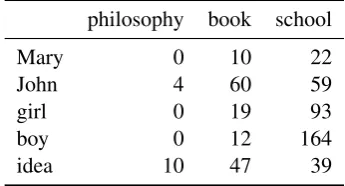
Table 1 shows 5 3-dimensional vectors for the wordsMary,John,girl,boyandidea. The words philosophy,bookandschool signify vector space dimensions. As the vector for John is closer to Marythan it is to ideain the vector space—a di-rect consequence of the fact that John’s contexts are similar toMary’s and dissimilar toidea’s—we can infer thatJohnis semantically more similar to Marythan toidea.
Many variants of this approach exist: perfor-mance on word similarity tasks has been shown to be improved by replacing raw counts with weighted values (e.g. mutual information)—see (Turney et al., 2010) and below for discussion, and (Kiela and Clark, 2014) for a detailed comparison.
philosophy book school
Mary 0 10 22
John 4 60 59
girl 0 19 93
boy 0 12 164
idea 10 47 39
[image:2.595.329.502.636.729.2]Neural word embeddings Deep learning tech-niques exploit the distributional hypothesis dif-ferently. Instead of relying on observed co-occurrence frequencies, a neural language model is trained to maximise some objective function re-lated to e.g. the probability of observing the sur-rounding words in some context (Mikolov et al., 2013b):
1
T T X
t=1
X
−c≤j≤c,j6=0
logp(wt+j|wt) (1)
Optimizing the above function, for example, pro-duces vectors which maximise the conditional probability of observing words in a context around the target word wt, where c is the size of the training window, andw1w2,· · ·wT a sequence of words forming a training instance. Therefore, the resulting vectors will capture the distributional in-tuition and can express degrees of lexical similar-ity.
This method has an obvious advantage com-pared to co-occurrence method: since now the context is predicted, the model in principle can be much more robust in data sparsity prob-lems, which is always an important issue for co-occurrence word spaces. Additionally, neural vec-tors have also proven successful in other tasks (Mikolov et al., 2013c), since they seem to en-code not only attributional similarity (the degree to which similar words are close to each other), but also relational similarity (Turney, 2006). For ex-ample, it is possible to extract the singular:plural relation (apple:apples,car:cars) using vector sub-traction:
−−−→
apple−−−−−→apples ≈ −→car − −−→cars
Perhaps even more importantly, semantic relation-ships are preserved in a very intuitive way:
−−→
king− −−→man ≈ −−−→queen− −−−−→woman
allowing the formation of analogy queries similar to−−→king− −−→man+−−−−→woman = ?, obtaining−−−→queenas the result.1
Both neural and co-occurrence-based ap-proaches have advantages over classical formal approaches in their ability to capture lexical se-mantics and degrees of similarity; their success at
1Levy et al. (2014) improved Mikolov et al. (2013c)’s method of retrieving relational similarities by changing the underlying objective function.
extending this to the sentence level and to more complex semantic phenomena, though, depends on their applicability within compositional mod-els, which is the subject of the next section. 3 Compositional models
Compositional distributional models represent meaning of a sequence of words by a vector, ob-tained by combining meaning vectors of the words within the sequence using some vector composi-tion operacomposi-tion. In a general classificacomposi-tion of these models, one can distinguish between three broad cases: simplistic models which combine word vectors irrespective of their order or relation to one another, models which exploit linear word order, and models which use grammatical structure.
The first approach combines word vectors by vector addition or point-wise multiplication (Mitchell and Lapata, 2008)—as this is indepen-dent of word order, it cannot capture the differ-ence between the two sentdiffer-ences “dogs chase cats” and “cats chase dogs”. The second approach has generally been implemented using some form of deep learning, and captures word order, but not by necessarily caring about the grammatical structure of the sentence. Here, one works by recursively building and combining vectors for subsequences of words within the sentence using e.g. autoen-coders (Socher et al., 2012) or convolutional fil-ters (Kalchbrenner et al., 2014). We do not con-sider this approach in this paper. This is because, as mentioned in the introduction, their vectors and composition operators are task-specific. These are trained directly to achieve specific objectives in certain pre-determined tasks. We are interested in vector and composition operators that work for any compositional task, and which can be com-bined with results in linguistics and formal se-mantics to provide generalisable models that can canonically extend to complex semantic phenom-ena. The third (i.e. the grammatical) approach promises a way to achieve this, and has been in-stantiated in various ways in the work of Baroni and Zamparelli (2010),Grefenstette and Sadrzadeh (2011a), and Kartsaklis et al. (2012).
In the simplest compositional models (the first approach described above), ?is +or, e.g. see (Mitchell and Lapata, 2008). Grammar-based compositional models (the third approach) are based on a generalisation of the notion of vectors, known astensors. Whereas a vector−→v is an ele-ment of an atomic vector spaceV, a tensorzis an element of a tensor spaceV ⊗W ⊗ · · · ⊗Z. The number of tensored spaces is referred to by the or-derof the space. Using a general duality theorem from multi-linear algebra (Bourbaki, 1989), it fol-lows that tensors are in one-one correspondence with multi-linear maps, that is we have:
z∈V⊗W⊗· · ·⊗Z =∼ fz:V →W → · · · →Z In such a tensor-based formalism, meanings of nouns are vectors and meanings of predicates such as adjectives and verbs are tensors. Meaning of a string of words is obtained by applying the compo-sitions of multi-linear map duals of the tensors to the vectors. For the sake of demonstration, take the case of an intransitive sentence “Sbj Verb”; the meaning of the subject is a vector −→Sbj ∈ V and the meaning of the intransitive verb is a ten-sor Verb ∈ V ⊗W. Meaning of the sentence is obtained by applyingfV erbto−→Sbj, as follows:
−−−−−→
Sbj Verb=fV erb(−→Sbj)
By tensor-map duality, the above becomes equivalent to the following, where composition has now become the familiar notion of matrix mul-tiplication, that is?is×:
Verb×−→Sbj
In general and for words with tensors of order higher than two,?becomes a generalisation of×, referred to bytensor contraction, see e.g. Kartsak-lis and Sadrzadeh (2013). Since the creation and manipulation of tensors of order higher than 2 is difficult, one can work with simplified versions of tensors, faithful to their underlying mathematical basis; these have found intuitive interpretations, e.g. see Grefenstette and Sadrzadeh (2011a), Kart-saklis and Sadrzadeh (2014). In such cases,? be-comes a combination of a range of operations such as×,⊗,, and+.
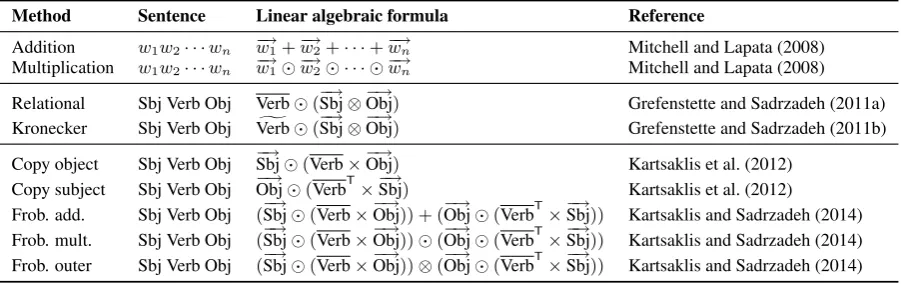
Specific models In the current paper we will ex-periment with a variety of models. In Table 2, we present these models in terms of their composi-tion operators and a reference to the main paper in
which each model was introduced. For the sim-ple compositional models the sentence is a string of any number of words; for the grammar-based models, we consider simple transitive sentences “Sbj Verb Obj” and introduce the following abbre-viations for the concrete method used to build a tensor for the verb:
1. Verb is a verb matrix computed using the for-mulaPi−−→Sbji⊗−−→Obji, where−−→Sbjiand−−→Objiare the subjects and objects of the verb across the corpus. These models are referred to by rela-tional (Grefenstette and Sadrzadeh, 2011a); they are generalisations of predicate seman-tics of transitive verbs, from pairs of individ-uals to pairs of vectors. The models reduce the order 3 tensor of a transitive verb to an order 2 tensor (i.e. a matrix).
2. Verb is a verb matrix computed using the for-g mula−−→Verb⊗−−→Verb, where−−→Verb is the distri-butional vector of the verb. These models are referred to by Kronecker, which is the term sometimes used to denote the outer prod-uct of tensors (Grefenstette and Sadrzadeh, 2011b). This models also reduces the order 3 tensor of a transitive verb to an order 2 ten-sor.
3. The models of the last five lines of the table use the so-called Frobenius operators from categorical compositional distributional se-mantics (Kartsaklis et al., 2012) to expand the relational matrices of verbs from order 2 to order 3. The expansion is obtained by ei-ther copying the dimension of the subject into the space provided by the third tensor, hence referred to by Copy-Sbj, or copying the di-mension of the object in that space, hence re-ferred to byCopy-Obj; furthermore, we can take addition, multiplication, or outer product of these, which are referred to by Frobenius-Add, Frobenius-Mult, and Frobenius-Outer (Kartsaklis and Sadrzadeh, 2014).
4 Semantic word spaces
Method Sentence Linear algebraic formula Reference
Addition w1w2· · ·wn −→w1+−→w2+· · ·+−→wn Mitchell and Lapata (2008) Multiplication w1w2· · ·wn w−→1 −→w2 · · · −→wn Mitchell and Lapata (2008) Relational Sbj Verb Obj Verb(−→Sbj⊗−→Obj) Grefenstette and Sadrzadeh (2011a) Kronecker Sbj Verb Obj Verbg (
−→
Sbj⊗−→Obj) Grefenstette and Sadrzadeh (2011b) Copy object Sbj Verb Obj −→Sbj(Verb×−→Obj) Kartsaklis et al. (2012)
Copy subject Sbj Verb Obj −→Obj(VerbT×−→Sbj) Kartsaklis et al. (2012)
[image:5.595.74.525.63.205.2]Frob. add. Sbj Verb Obj (−→Sbj(Verb×−→Obj)) + (−→Obj(VerbT×−→Sbj)) Kartsaklis and Sadrzadeh (2014) Frob. mult. Sbj Verb Obj (−→Sbj(Verb×−→Obj))(−→Obj(VerbT×−→Sbj)) Kartsaklis and Sadrzadeh (2014) Frob. outer Sbj Verb Obj (−→Sbj(Verb×−→Obj))⊗(−→Obj(VerbT×−→Sbj)) Kartsaklis and Sadrzadeh (2014)
Table 2: Compositional methods.
GS11 Our first word space is based on a typ-ical configuration that has been used in the past extensively for compositional distributional mod-els (see below for details), so it will serve as a useful baseline for the current work. In this vec-tor space, the co-occurrence counts are extracted from the British National Corpus (BNC) (Leech et al., 1994). As basis words, we use the most fre-quent nouns, verbs, adjectives and adverbs (POS
tags SUBST, VERB, ADJ and ADV in the BNC
XML distribution2). The vector space is
lemma-tized, that is, it contains only “canonical” forms of words.
In order to weight the raw co-occurrence counts, we use positive point-wise mutual information (PPMI). The component value for a target word tand a context wordcis given by:
PPMI(t, c) = max
0,logpp((cc|t))
where p(c|t) is the probability of word cgivent in a symmetric window of length 5 andp(c)is the probability ofcoverall.
Vector spaces based on point-wise mutual in-formation (or variants thereof) have been success-fully applied in various distributional and compo-sitional tasks; see e.g. Grefenstette and Sadrzadeh (2011a), Mitchell and Lapata (2008), Levy et al. (2014) for details. PPMI has been shown to achieve state-of-the-art results (Levy et al., 2014) and is suggested by the review of Kiela and Clark (2014). Our use here of the BNC as a corpus and the window length of 5 is based on previ-ous use and better performance of these param-eters in a number of compositional experiments (Grefenstette and Sadrzadeh, 2011a; Grefenstette
2http://www.natcorp.ox.ac.uk/
and Sadrzadeh, 2011b; Mitchell and Lapata, 2008; Kartsaklis et al., 2012).
KS14 In this variation, we train a vector space from the ukWaC corpus3 (Ferraresi et al., 2008),
originally using as a basis the 2,000 content words with the highest frequency (but excluding a list of stop words as well as the 50 most frequent content words since they exhibit low information content). The vector space is again lemmatized. As context we consider a 5-word window from either side of the target word, while as our weighting scheme we use local mutual information (i.e. point-wise mu-tual information multiplied by raw counts). In a further step, the vector space was normalized and projected onto a 300-dimensional space using sin-gular value decomposition (SVD).
In general, dimensionality reduction produces more compact word representations that are robust against potential noise in the corpus (Landauer and Dumais, 1997; Sch¨utze, 1997). SVD has been shown to perform well on a variety of tasks similar to ours (Baroni and Zamparelli, 2010; Kartsaklis and Sadrzadeh, 2014).
Neural word embeddings (NWE) For our neu-ral setting, we used the skip-gram model of Mikolov et al. (2013b) trained with negative sam-pling. The specific implementation that was tested in our experiments was a 300-dimensional vec-tor space learned from the Google News corpus and provided by the word2vec4 toolkit.
Fur-thermore, the gensimlibrary ( ˇReh˚uˇrek and So-jka, 2010) was used for accessing the vectors. On the contrary with the previously described
co-3http://wacky.sslmit.unibo.it/
occurrence vector spaces, this version isnot lem-matized.
The negative sampling method improves the ob-jective function of Equation 1 by introducing neg-ative examples to the training algorithm. Assume that the probability of a specific(c, t)pair of words (where t is a target word and c another word in the same context witht), coming from the training data, is denoted as p(D = 1|c, t). The objective function is then expressed as follows:
Y
(c,t)∈D
p(D= 1|c, t) (2)
That is, the goal is to set the model parameters in a way that maximizes the probability of all obser-vations coming from the training data. Assume now thatD0is a set of randomly selected incorrect (c0, t0)pairs that do not occur inD, then Equation
2 above can be recasted in the following way: Y
(c,t)∈D
p(D= 1|c, t) Y
(c0,t0)∈D0
p(D= 0|c0, t0)
(3) In other words, the model tries to distinguish a tar-get wordtfrom random draws that come from a noise distribution. In the implementation we used for our experiments, c is always selected from a 5-word window around t. More details about the negative sampling approach can be found in (Mikolov et al., 2013b); the note of Goldberg and Levy (2014) also provides an intuitive explanation of the underlying setting.
5 Experiments
Our experiments explore the use of the vector spaces above, together with the compositional op-erators described in Section 3, in a range of tasks all of which require semantic composition: verb sense disambiguation; sentence similarity; para-phrasing; and dialogue act tagging.
5.1 Disambiguation
We use the transitive verb disambiguation dataset described in Grefenstette and Sadrzadeh (2011a)5.
This dataset consists of ambiguous transitive verbs together with their arguments, landmark verbs that identify one of the verb senses, and human judgements that specify how similar is the disam-biguated sense of the verb in the given context to
5This and the sentence similarity dataset are avail-able at http://www.cs.ox.ac.uk/activities/ compdistmeaning/
one of the landmarks. This is similar to the in-transitive dataset described in (Mitchell and Lap-ata, 2008). Consider the sentence “system meets specification”; here,meetsis the ambiguous tran-sitive verb, andsystemandspecificationare its ar-guments in this context. Possible landmarks for meet are satisfy and visit; for this sentence, the human judgements show that the disambiguated meaning of the verb is more similar to the land-marksatisfyand less similar tovisit.
The task is to estimate the similarity of the sense of a verb in a context with a given landmark. To get our similarity measures, we compose the verb with its arguments using one of our compositional models; we do the same for the landmark and then compute the cosine similarity of the two vectors. We evaluate the performance by averaging the hu-man judgements for the same verb, argument and landmark entries, and calculating the Spearman’s correlation between the average values and the co-sine scores. As a baseline, we compare this with the correlation produced by using only the verb vector, without composing it with its arguments.
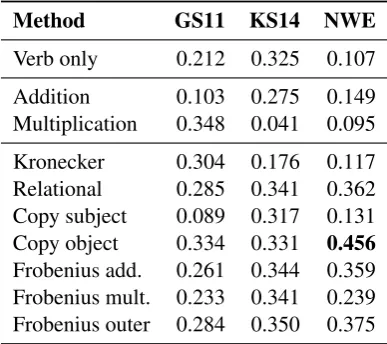
Table 3 shows the results of the experiment. NWEcopy-objectcomposition yields the best cor-relation with the human judgements, and top per-formance across all vector spaces and models with a Spearmanρ of 0.456. For the KS14 space, the best result comes from Frobenius outer (0.350),
[image:6.595.319.513.502.674.2]Method GS11 KS14 NWE Verb only 0.212 0.325 0.107 Addition 0.103 0.275 0.149 Multiplication 0.348 0.041 0.095 Kronecker 0.304 0.176 0.117 Relational 0.285 0.341 0.362 Copy subject 0.089 0.317 0.131 Copy object 0.334 0.331 0.456 Frobenius add. 0.261 0.344 0.359 Frobenius mult. 0.233 0.341 0.239 Frobenius outer 0.284 0.350 0.375
while the best operator for the GS11 space is point-wise multiplication(0.348).
For simple point-wise composition, only mul-tiplicative GS11 and additive NWE improve over their corresponding verb-only baselines (but both perform worse than the KS14 baseline). With tensor-based composition in co-occurrence based spaces, copy subject yields lower results than the corresponding baselines. Other composition methods, except Kronecker for KS14, improve over the verb-only baselines. Finally we should note that, despite the small training corpus, the GS11 vector space performs comparatively well: for instance, Kronecker model improves the pre-viously reported score of 0.28 (Grefenstette and Sadrzadeh, 2011b).
5.2 Sentence similarity
In this experiment we use the transitive sen-tence similarity dataset described in Kartsaklis and Sadrzadeh (2014). The dataset consists of transi-tive sentence pairs and a human similarity judge-ment6. The task is to estimate a similarity measure
between two sentences. As in the disambiguation task, we first compose word vectors to obtain sen-tence vectors, then compute cosine similarity of them. We average the human judgements for iden-tical sentence pairs to compute a correlation with cosine scores.
Table 4 shows the results. Again, the best performing vector space is KS14, but this time with addition: the Spearman ρ correlation score with averaged human judgements is 0.732. Addi-tion was the means for the other vector spaces to achieve top performance as well: GS11 and NWE got 0.682 and 0.689 respectively.
None of the models in tensor-based composi-tion outperformed addicomposi-tion. KS14 performs worse with tensor-based methods here than in the other vector spaces. However, GS11 and NWE, except copy subjectfor both of them andFrobenius multi-plicationfor NWE, improved over their verb-only baselines.
5.3 Paraphrasing
In this experiment we evaluate our vector spaces on a mainstream paraphrase detection task.
6The textual content of this dataset is the same as that of (Kartsaklis and Sadrzadeh, 2013), the difference is that the dataset of (Kartsaklis and Sadrzadeh, 2014) has updated hu-man judgements whereas the previous dataset used the orig-inal annotations of the intransitive dataset of (Mitchell and Lapata, 2010).
[image:7.595.320.515.68.234.2]Method GS11 KS14 NWE Verb only 0.491 0.602 0.561 Addition 0.682 0.732 0.689 Multiplication 0.597 0.321 0.341 Kronecker 0.581 0.408 0.561 Relational 0.558 0.437 0.618 Copy subject 0.370 0.448 0.405 Copy object 0.571 0.306 0.655 Frobenius add. 0.566 0.460 0.585 Frobenius mult. 0.525 0.226 0.387 Frobenius outer 0.560 0.439 0.622
Table 4: Results for sentence similarity. There is no statistically significant difference between KS14 addition and NWE addition (the second best result).
Specifically, we get classification results on the Microsoft Research Paraphrase Corpus paraphrase corpus (Dolan et al., 2005) working in the follow-ing way: we construct vectors for the sentences of each pair; if the cosine similarity between the two sentence vectors exceeds a certain threshold, the pair is classified as a paraphrase, otherwise as not a paraphrase. For this experiment and that of Section 5.4 below, we investigate only the addi-tion and point-wise multiplicaaddi-tion composiaddi-tional models, since at their current stage of development tensor-based models can only efficiently handle sentences of fixed structure. Nevertheless, the simple point-wise compositional models still al-low for a direct comparison of the vector spaces, which is the main goal of this paper.
For each vector space and model, a number of different thresholds were tested on the first 2000 pairs of the training set, which we used as a de-velopment set; in each case, the best-performed threshold was selected for a single run of our “classifier” on the test set (1726 pairs). Addition-ally, we evaluate the NWE model with a lemma-tized version of the corpus, so that the experimen-tal setup is maximally similar for all vector spaces. The results are shown in the first part of Table 5.
Co-occurrence Neural word embeddings
Baseline GS11 KS14 Unlemmatized Lemmatized
Model Accuracy F-Score Accuracy F-Score Accuracy F-Score Accuracy F-Score Accuracy F-Score MSR addition 0.65 0.75 0.62 0.79 0.70 0.80 0.73 0.82 0.72 0.81 MSR multiplication 0.52 0.58 0.66 0.80 0.42 0.34 0.41 0.36 SWDA addition 0.60 0.58 0.35 0.35 0.40 0.35 0.63 0.60 0.44 0.40 SWDA multiplication 0.32 0.16 0.39 0.33 0.58 0.53 0.43 0.38
Table 5: Results for paraphrase detection (MSR) and dialog act tagging (SWDA) tasks. All top results significantly outperform corresponding nearest competitors (for accuracy):p <0.05,χ2 test.
and 0.84 F-score7) by the time of this writing has
been obtained using 8 machine translation metrics and three constituent classifiers (Madnani et al., 2012).
The multiplicative model gives lower results than the additive model across all vector spaces. The KS14 vector space shows the steadiest per-formance, with a drop in accuracy of only 0.04 and no drop in F-score, while for the GS11 and NWE spaces both accuracy and F-score experi-enced drops by more than 0.20.
5.4 Dialogue act tagging
As our last experiment, we evaluate the word spaces on a dialogue act tagging task (Stolcke et al., 2000) over the Switchboard corpus (Godfrey et al., 1992). Switchboard is a collection of ap-proximately 2500 dialogs over a telephone line by 500 speakers from the U.S. on predefined topics.8
The experiment pipeline follows (Milajevs and Purver, 2014). The input utterances are prepro-cessed so that the parts of interrupted utterances are concatenated (Webb et al., 2005). Disfluency markers and commas are removed from the utter-ance raw texts. For GS11 and KS14 the utterutter-ance tokens are POS-tagged and lemmatized; for NWE, we test the vectors in both a lemmatized and an un-lemmatized version of the corpus.9 We split
the training and testing utterances as suggested by Stolcke et al. (2000). Utterance vectors are then obtained as in the previous experiments; they are reduced to 50 dimensions using SVD and a k -nearest-neighbour classifier is trained on these re-duced utterance vectors (the 5 closest neighbours by Euclidean distance are retrieved to make a
clas-7F-scores use the standard definitionF = 2(precision∗
recall)/(precision+recall).
8The dataset and a Python interface to it are available
at http://compprag.christopherpotts.net/
swda.html
9We use WordNetLemmatizerof the NLTK library (Bird, 2006).
sification decision). The results are shown in the second part of Table 5.
Un-lemmatized NWEadditiongave the best ac-curacy (0.63) and F-score (0.60) (averaged over tag classes), i.e. similar results to (Milajevs and Purver, 2014)—although note that the dimension-ality of our NWE vectors is 10 times lower than theirs. MultiplicativeNWE outperformed the cor-responding model in (Milajevs and Purver, 2014). In general, addition consistently outperforms mul-tiplication for all the models. Lemmatization dramatically lowers tagging accuracy: the lem-matized GS11, KS14 and NWE models perform much worse than un-lemmatized NWE, suggest-ing that morphological features are important for this task.
6 Discussion
Previous comparisons of co-occurrence-based and neural word vector representations vary widely in their conclusions. While Baroni et al. (2014) conclude that “context-predicting models obtain a thorough and resounding victory against their count-based counterparts”, this seems to contra-dict, at least at the first consideration, the more conservative conclusion of Levy et al. (2014) that “analogy recovery is not restricted to neural word embeddings [. . . ] a similar amount of relational similarities can be recovered from traditional dis-tributional word representations” and the findings of Blacoe and Lapata (2012) that “shallow ap-proaches are as good as more computationally in-tensive alternatives” on phrase similarity and para-phrase detection tasks.
an-swer this question, we can compare model be-haviour against the baselines inisolation.
For the disambiguation and sentence similarity tasks the baseline is the similarity between verbs only, ignoring the context—see above. For the paraphrase task, we take the global vector-based similarity reported in (Mihalcea et al., 2006): 0.65 accuracy and 0.75 F-score. For the dialogue act tagging task the baseline is the accuracy of the bag-of-unigrams model in (Milajevs and Purver, 2014): 0.60.
Sections 5.1 and 5.2 show that although the best choice of vector representation might vary, for small-scale tasks all methods give fairly compet-itive results. The choice of compositional oper-ator seems to be more important and more task-specific: while a tensor-based operation (Frobe-nius copy-object) performs best for verb disam-biguation, the best result for sentence similarity is achieved by a simple additive model, with all other compositional methods behaving worse than the verb-only baseline in the KS14 case. GS11 and NWE, on the other hand, outperform their base-lines with a number of compositional methods, al-though both of them achieve lower performance than KS14 overall.
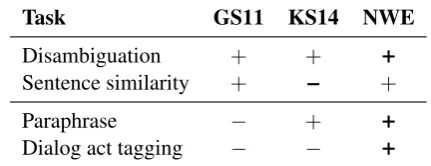
Based on only small-scale experiment results, one could conclude that there is little significant difference between the two ways of obtaining vec-tors. GS11 and NWE show similar behaviour in comparison to their baselines, while it is possible to tune a co-occurrence based vector space (KS14) and obtain the best result. Large scale tasks reveal another pattern: the GS11 vector space, which be-haves stably on the small scale, drags behind the KS14 and NWE spaces in the paraphrase detec-tion task. In addidetec-tion, NWE consistently yields best results. Finally, only the NWE space was able to provide adequate results on the dialogue act tag-ging task. Table 6 summarizes model performance with regard to baselines.
7 Conclusion
In this work we compared the performance of two co-occurrence-based semantic spaces with vectors learned by a neural network in compositional set-tings. We carried out two small-scale tasks (word sense disambiguation and sentence similarity) and two large-scale tasks (paraphrase detection and di-alogue act tagging).
Task GS11 KS14 NWE
Disambiguation + + +
Sentence similarity + – +
Paraphrase − + +
[image:9.595.307.523.64.147.2]Dialog act tagging − − +
Table 6: Summary of vector space performance against baselines. General improvement (cases where more than a half of the models perform bet-ter) and decrease with regard to a corresponding baseline is respectively marked by + and−. A bold value means that the model gave the best re-sult in the task.
On small-scale tasks, where the sentence struc-tures are predefined and relatively constrained, NWE gives better or similar results to count-based vectors. Tensor-based composition does not al-ways outperform simple compositional operators, but for most of the cases gives results within the same range.
On large-scale tasks, neural vectors are more successful than the co-occurrence based alterna-tives. However, this study does not reveal whether this is because of their neural nature, or just be-cause they are trained on a larger amount of data.
The question of whether neural vectors outper-form co-occurrence vectors therefore requires fur-ther detailed comparison to be entirely resolved; our experiments suggest that this is indeed the case in large-scale tasks, but the difference in size and nature of the original corpora may be a confound-ing factor. In any case, it is clear that the neural vectors of word2vec package perform steadily off-the-shelf across a large variety of tasks. The size of the vector space (3 million words) and the available code-base that simplifies the access to the vectors, makes this set a good and safe choice for experiments in the future. Of course, even bet-ter performances can be achieved by training neu-ral language models specifically for a given task (see e.g. Kalchbrenner et al. (2014)).
composition proved best for both co-occurrence-based and neural vectors; in the sentence similar-ity task, where point-wise operators proved best, this was again true across vector spaces.
Acknowledgements
We would like to thank the three anonymous reviewers for their fruitful comments. Sup-port by EPSRC grant EP/F042728/1 is grate-fully acknowledged by Milajevs, Kartsaklis and Sadrzadeh. Purver is partly supported by Con-CreTe: the project ConCreTe acknowledges the fi-nancial support of the Future and Emerging Tech-nologies (FET) programme within the Seventh Framework Programme for Research of the Eu-ropean Commission, under FET grant number 611733.
References
Marco Baroni and Roberto Zamparelli. 2010. Nouns are vectors, adjectives are matrices: Representing adjective-noun constructions in semantic space. In Proceedings of the 2010 Conference on Empirical Methods in Natural Language Processing, pages 1183–1193. Association for Computational Linguis-tics.
Marco Baroni, Georgiana Dinu, and Germ´an Kruszewski. 2014. Don’t count, predict! a systematic comparison of context-counting vs. context-predicting semantic vectors. InProceedings of the 52nd Annual Meeting of the Association for Computational Linguistics, volume 1.
Yoshua Bengio, Holger Schwenk, Jean-S´ebastien Sen´ecal, Fr´ederic Morin, and Jean-Luc Gauvain. 2006. Neural probabilistic language models. In Innovations in Machine Learning, pages 137–186. Springer.
Steven Bird. 2006. NLTK: the natural language toolkit. InProceedings of the COLING/ACL on In-teractive presentation sessions, pages 69–72. Asso-ciation for Computational Linguistics.
William Blacoe and Mirella Lapata. 2012. A com-parison of vector-based representations for semantic composition. InProceedings of the 2012 Joint Con-ference on Empirical Methods in Natural Language Processing and Computational Natural Language Learning, pages 546–556. Association for Compu-tational Linguistics.
Johan Bos and Malte Gabsdil. 2000. First-order infer-ence and the interpretation of questions and answers. Proceedings of Gotelog, pages 43–50.
Johan Bos. 2008. Wide-coverage semantic analy-sis with boxer. In Johan Bos and Rodolfo Del-monte, editors,Semantics in Text Processing. STEP 2008 Conference Proceedings, Research in Compu-tational Semantics, pages 277–286. College Publi-cations.
N. Bourbaki. 1989. Commutative Algebra: Chapters 1-7. Srpinger Verlag, Berlin/New York.
Bob Coecke, Mehrnoosh Sadrzadeh, and Stephen Clark. 2010. Mathematical foundations for a com-positional distributional model of meaning. CoRR, abs/1003.4394.
Ronan Collobert and Jason Weston. 2008. A unified architecture for natural language processing: Deep neural networks with multitask learning. In Pro-ceedings of the 25th international conference on Machine learning, pages 160–167. ACM.
Ann Copestake, Dan Flickinger, Carl Pollard, and Ivan A Sag. 2005. Minimal recursion semantics: An introduction. Research on Language and Com-putation, 3(2-3):281–332.
Bill Dolan, Chris Brockett, and Chris Quirk. 2005. Mi-crosoft research paraphrase corpus. Retrieved May, 29:2013.
Adriano Ferraresi, Eros Zanchetta, Marco Baroni, and Silvia Bernardini. 2008. Introducing and evaluating ukWaC, a very large web-derived corpus of English.
InProceedings of the 4th Web as Corpus Workshop
(WAC-4) Can we beat Google, pages 47–54. Gottlob Frege. 1892. On sense and reference. Ludlow
(1997), pages 563–584.
John J Godfrey, Edward C Holliman, and Jane Mc-Daniel. 1992. Switchboard: Telephone speech cor-pus for research and development. In Acoustics, Speech, and Signal Processing, 1992. ICASSP-92., 1992 IEEE International Conference on, volume 1, pages 517–520. IEEE.
Yoav Goldberg and Omer Levy. 2014. word2vec Explained: deriving Mikolov et al.’s negative-sampling word-embedding method. arXiv preprint arXiv:1402.3722.
Edward Grefenstette and Mehrnoosh Sadrzadeh. 2011a. Experimental support for a categorical com-positional distributional model of meaning. In Pro-ceedings of the Conference on Empirical Methods in Natural Language Processing, pages 1394–1404. Association for Computational Linguistics.
Edward Grefenstette and Mehrnoosh Sadrzadeh. 2011b. Experimenting with transitive verbs in a Dis-CoCat. In Proceedings of the GEMS 2011 Work-shop on GEometrical Models of Natural Language Semantics, pages 62–66, Edinburgh, UK, July. As-sociation for Computational Linguistics.
Nal Kalchbrenner and Phil Blunsom. 2013. Recurrent convolutional neural networks for discourse compo-sitionality. InProceedings of the Workshop on Con-tinuous Vector Space Models and their Composition-ality, pages 119–126, Sofia, Bulgaria, August. Asso-ciation for Computational Linguistics.
Nal Kalchbrenner, Edward Grefenstette, and Phil Blun-som. 2014. A convolutional neural network for modelling sentences. Proceedings of the 52nd An-nual Meeting of the Association for Computational Linguistics, June.
Dimitri Kartsaklis and Mehrnoosh Sadrzadeh. 2013. Prior disambiguation of word tensors for construct-ing sentence vectors. In Proceedings of the 2013 Conference on Empirical Methods in Natural Lan-guage Processing (EMNL), pages 1590–1601, Seat-tle, USA, October. Association for Computational Linguistics.
Dimitri Kartsaklis and Mehrnoosh Sadrzadeh. 2014. A study of entanglement in a categorical framework of natural language. InProceedings of the 11th Work-shop on Quantum Physics and Logic (QPL), Kyoto, Japan, June.
Dimitri Kartsaklis, Mehrnoosh Sadrzadeh, and Stephen Pulman. 2012. A unified sentence space for categorical distributional-compositional semantics: Theory and experiments. In Proceedings of COL-ING 2012: Posters, pages 549–558, Mumbai, India, December. The COLING 2012 Organizing Commit-tee.
Douwe Kiela and Stephen Clark. 2014. A systematic study of semantic vector space model parameters.
In Proceedings of the 2nd Workshop on
Continu-ous Vector Space Models and their Compositionality (CVSC), pages 21–30, Gothenburg, Sweden, April. Association for Computational Linguistics.
T. Landauer and S. Dumais. 1997. A Solution to Plato’s Problem: The Latent Semantic Analysis Theory of Acquision, Induction, and Representation of Knowledge. Psychological Review.
Geoffrey Leech, Roger Garside, and Michael Bryant. 1994. Claws4: the tagging of the british national corpus. In Proceedings of the 15th conference on Computational linguistics-Volume 1, pages 622– 628. Association for Computational Linguistics.
Omer Levy, Yoav Goldberg, and Israel Ramat-Gan. 2014. Linguistic regularities in sparse and explicit word representations. InProceedings of the Eigh-teenth Conference on Computational Natural Lan-guage Learning, Baltimore, Maryland, USA, June. Association for Computational Linguistics.
Nitin Madnani, Joel Tetreault, and Martin Chodorow. 2012. Re-examining machine translation metrics for paraphrase identification. InProceedings of the 2012 Conference of the North American Chapter of
the Association for Computational Linguistics: Hu-man Language Technologies, pages 182–190. Asso-ciation for Computational Linguistics.
Rada Mihalcea, Courtney Corley, and Carlo Strappa-rava. 2006. Corpus-based and knowledge-based measures of text semantic similarity. InAAAI, vol-ume 6, pages 775–780.
Tomas Mikolov, Kai Chen, Greg Corrado, and Jef-frey Dean. 2013a. Efficient estimation of word representations in vector space. arXiv preprint arXiv:1301.3781.
Tomas Mikolov, Ilya Sutskever, Kai Chen, Greg S Cor-rado, and Jeff Dean. 2013b. Distributed representa-tions of words and phrases and their compositional-ity. InAdvances in Neural Information Processing Systems, pages 3111–3119.
Tomas Mikolov, Wen-tau Yih, and Geoffrey Zweig. 2013c. Linguistic regularities in continuous space word representations. In Proceedings of NAACL-HLT, pages 746–751.
Dmitrijs Milajevs and Matthew Purver. 2014. Inves-tigating the contribution of distributional semantic information for dialogue act classification. In Pro-ceedings of the 2nd Workshop on Continuous Vector Space Models and their Compositionality (CVSC), pages 40–47, Gothenburg, Sweden, April. Associa-tion for ComputaAssocia-tional Linguistics.
Jeff Mitchell and Mirella Lapata. 2008. Vector-based models of semantic composition. In Proceedings of ACL-08: HLT, pages 236–244. Association for Computational Linguistics.
Jeff Mitchell and Mirella Lapata. 2010. Composition in distributional models of semantics. Cognitive Sci-ence, 34(8):1388–1439.
Richard Montague. 1970. Universal grammar. Theo-ria, 36(3):373–398.
Tamara Polajnar and Stephen Clark. 2014. Improv-ing distributional semantic vectors through context selection and normalisation. InProceedings of the 14th Conference of the European Chapter of the As-sociation for Computational Linguistics, pages 230– 238, Gothenburg, Sweden, April. Association for Computational Linguistics.
Radim ˇReh˚uˇrek and Petr Sojka. 2010. Software Framework for Topic Modelling with Large Cor-pora. InProceedings of the LREC 2010 Workshop on New Challenges for NLP Frameworks, pages 45– 50, Valletta, Malta, May. ELRA. http://is. muni.cz/publication/884893/en.
Richard Socher, Brody Huval, Christopher D Manning, and Andrew Y Ng. 2012. Semantic compositional-ity through recursive matrix-vector spaces. In Pro-ceedings of the 2012 Joint Conference on Empiri-cal Methods in Natural Language Processing and Computational Natural Language Learning, pages 1201–1211. Association for Computational Linguis-tics.
Andreas Stolcke, Klaus Ries, Noah Coccaro, Eliza-beth Shriberg, Rebecca Bates, Daniel Jurafsky, Paul Taylor, Carol Van Ess-Dykema, Rachel Martin, and Marie Meteer. 2000. Dialogue act modeling for automatic tagging and recognition of conversational speech. Computational Linguistics, 26(3):339–373. Peter D Turney, Patrick Pantel, et al. 2010. From frequency to meaning: Vector space models of se-mantics. Journal of artificial intelligence research, 37(1):141–188.
Peter D Turney. 2006. Similarity of semantic relations. Computational Linguistics, 32(3):379–416.