An Unsupervised Model for Instance Level Subcategorization Acquisition
Simon Baker Computer Laboratory University of Cambridge
Roi Reichart Technion, IIT Haifa, Israel
Anna Korhonen Computer Laboratory University of Cambridge
Abstract
Most existing systems for subcategoriza-tion frame (SCF) acquisisubcategoriza-tion rely on su-pervised parsing and infer SCF distribu-tions at type, rather than instance level. These systems suffer from poor portability across domains and their benefit for NLP tasks that involve sentence-level process-ing is limited. We propose a new unsuper-vised, Markov Random Field-based model for SCF acquisition which is designed to address these problems. The system relies on supervised POS tagging rather than parsing, and is capable of learning SCFs at instance level. We perform eval-uation against gold standard data which shows that our system outperforms several supervised and type-level SCF baselines. We also conduct task-based evaluation in the context of verb similarity prediction, demonstrating that a vector space model based on our SCFs substantially outper-forms a lexical model and a model based on a supervised parser1.
1 Introduction
Subcategorization frame (SCF) acquisition in-volves identifying the arguments of a predicate and generalizing about its syntactic frames, where each frame specifies the syntactic type and number of arguments permitted by the predicate. For example, in sentences (1)-(3) the verb distin-guish takes three different frames, the difference between which is not evident when considering the phrase structure categorization:
(1) Direct Transitive: [They]NP [distin-guished]VP [the mast]NP [of [ships on the horizon ]NP ]PP .
1The verb similarity dataset used for the evaluation of our model is publicly available at ie.technion.ac.il/∼roiri/.
(2) Indirect Transitive: [They]NP [distin-guished]VP [between [me and you]ADVP ]PP . (3) Ditransitive: [They]NP [distinguished]VP [him]NP [from [the other boys]NP ]PP.
As SCFs describe the syntactic realization of the verbal predicate-argument structure, they are highly valuable for a variety of NLP tasks. For example, verb subcategorization information has proven useful for tasks such as parsing (Carroll and Fang, 2004; Arun and Keller, 2005; Cholakov and van Noord, 2010), semantic role labeling (Bharati et al., 2005; Moschitti and Basili, 2005), verb clustering, (Schulte im Walde, 2006; Sun and Korhonen, 2011) and machine translation (hye Han et al., 2000; Hajiˇc et al., 2002; Weller et al., 2013).
SCF induction is challenging. The argument-adjunct distinction is difficult even for humans, and is further complicated by the fact that both ar-guments and adjuncts can appear frequently in po-tential argument head positions (Korhonen et al., 2000). SCFs are also highly sensitive to domain variation so that both the frames themselves and their probabilities vary depending on the meaning and behavior of predicates in the domain in ques-tion (e.g. (Roland and Jurafsky, 1998; Lippincott et al., 2010; Rimell et al., 2013), Section 4).
Because of the strong impact of domain vari-ation, SCF information is best acquired automat-ically. Existing data-driven SCF induction sys-tems, however, do not port well between do-mains. Most existing systems rely on hand-written rules (Briscoe and Carroll, 1997; Korho-nen, 2002; Preiss et al., 2007) or simple co-occurrence statistics (O’Donovan et al., 2005; Chesley and Salmon-Alt, 2006; Ienco et al., 2008; Messiant et al., 2008; Lenci et al., 2008; Al-tamirano and Alonso i Alemany, 2010; Kawa-hara and Kurohashi, 2010) applied to the gram-matical dependency output of supervised statisti-cal parsers. Even the handful of recent systems
that use modern machine learning techniques (De-bowski, 2009; Lippincott et al., 2012; Van de Cruys et al., 2012; Reichart and Korhonen, 2013) use supervised parsers to pre-process the data2.
Supervised parsers are notoriously sensitive to domain variation (Lease and Charniak, 2005). As annotation of data for each new domain is un-realistic, current SCF systems suffer from poor portability. This problem is compounded for the many systems that employ manually devel-oped SCF rules because rules are inherently ig-norant to domain-specific preferences. The few SCF studies that focused on specific domains (e.g. biomedicine) have reported poor performance due to these reasons (Rimell et al., 2013).
Another limitation of most current SCF systems is that they produce atype-level SCF lexicon (i.e. a lexicon which lists, for a given predicate, dif-ferent SCF types with their relative frequencies). Such a lexicon provides a useful high-level pro-file of the syntactic behavior of the predicate in question, but is less useful for downstream NLP tasks (e.g. information extraction, parsing, ma-chine translation) that involve sentence processing and can therefore benefit from SCF information at instance level. Sentences (1)-(3) demonstrate this limitation - a prior distribution over the pos-sible syntactic frames ofdistinguishprovides only a weak signal to a sentence level NLP application that needs to infer the verbal argument structure of its input sentences.
We propose a new unsupervised model for SCF induction which addresses these problems with existing systems. Our model does not use a parser or hand-written rules, only a part-of-speech (POS) tagger is utilizes in order to produce features for machine learning. While POS taggers are also sensitive to domain variation, they can be adapted to domains more easily than parsers because they require much smaller amounts of annotated data (Lease and Charniak, 2005; Ringger et al., 2007). However, as we demonstrate in our experiments, domain adaptation of POS tagging may not even be necessary to obtain good results on the SCF ac-quisition task.
Our model, based on the Markov Random Field (MRF) framework, performs instance-based SCF learning. It encodes syntactic similarities among verb instances across different verb types (derived
2(Lippincott et al., 2012) does not use a parser, but the syntactic frames induced by the system do not capturesets of arguments for verbs, so are not SCFs in a traditional sense.
from a lexical and POS-based feature representa-tion of verb instances) as well as prior beliefs on the tendencies of specific instances of the same verb type to take the same SCF.
We evaluate our model against corpora anno-tated with verb instance SCFs (Quochi et al., 2012). In addition, following the Levin verb clustering tradition (Levin, 1993) which ties verb meanings with their syntactic properties, we eval-uate the semantic predictive power of our clusters. In the former evaluation, our model outperforms a number of strong baselines, including supervised and type-level ones, achieving an accuracy of up to 69.2%. In the latter evaluation a vector space model that utilized our induced SCFs substantially outperforms the output of a type-level SCF system that uses the fully trained Stanford parser.
2 Previous Work
Several SCF acquisition systems are available for English (O’Donovan et al., 2005; Preiss et al., 2007; Lippincott et al., 2012; Van de Cruys et al., 2012; Reichart and Korhonen, 2013) and other languages, including French (Messiant, 2008), Italian (Lenci et al., 2008), Turkish (Uzun et al., 2008), Japanese (Kawahara and Kurohashi, 2010) and Chinese (Han et al., 2008). The promi-nent input to these systems are grammatical re-lations (GRs) which express binary dependen-cies between words (e.g. direct and indirect ob-jects, various types of complements and conjunc-tions). These are generated by some parsers (e.g. (Briscoe et al., 2006)) and can be extracted from the output of others (De-Marneffe et al., 2006).
Two representative systems for English are the Cambridge system (Preiss et al., 2007) and the BioLexicon system which was used to acquire a substantial lexicon for biomedicine (Venturi et al., 2009). These systems extract GRs at the verb in-stance level from the output of a parser: the RASP general-language unlexicalized parser3(Briscoe et al., 2006) and the lexicalized Enju parser tuned to the biomedical domain (Miyao and Tsujii, 2005), respectively. They generate potential SCFs by mapping GRs to a predefined SCF inventory us-ing a set of manually developed rules (the Cam-bridge system) or by simply considering the sets of GRs including verbs in question as potential SCFs (BioLexicon). Finally, a type level lexicon
is built through noisy frame filtering (based on frequencies or on external resources and annota-tions), which aims to remove errors from parsing and argument-adjunct distinction. Clearly, these systems require extensive manual work: a-priori definition of an SCF inventory and rules, manu-ally annotated sentences for training a supervised parser, SCF annotations for parser lexicalization, and manually developed resources for optimal fil-tering.
A number of recent works have applied mod-ern machine learning techniques to SCF induc-tion, including point-wise co-occurrence of ar-guments (Debowski, 2009), a Bayesian network model (Lippincott et al., 2012), multi-way tensor factorization (Van de Cruys et al., 2012) and De-terminantal Point Processes (DPPs) -based clus-tering (Reichart and Korhonen, 2013). However, all of these systems induce type-level SCF lexi-cons and, except from the system of (Lippincott et al., 2012) that is not capable of learning traditional SCFs, they all rely on supervised parsers.
Our new system differs from previous ones in a number of respects. First, in contrast to most previous systems, our system provides SCF anal-ysis for each verb instance in its sentential con-text, yielding more precise SCF information for systems benefiting from instance-based analysis. Secondly, it addresses SCF induction as an unsu-pervised clustering problem, avoiding the use of supervised parsing or any of the sources of man-ual supervision used in previous works. Our sys-tem relies on POS tags - however, we show that it is not necessary to train a tagger with in-domain data to obtain good performance on this task, and therefore our approach provides a more domain-independent solution to SCF acquisition.
We employ POS-tagging instead of unsuper-vised parsing for two main reasons. First, while a major progress has been made on unsupervised parsing (e.g. (Cohen and Smith, 2009; Berg-Kirkpatrick et al., 2010)), the performance is still considerably behind that of supervised parsing. For example, the state-of-the-art discriminative model of (Berg-Kirkpatrick et al., 2010) achieves only 63% directed arc accuracy for WSJ sentences of up to 10 words, compared to more than 95% obtained with supervised parsers. Second, current unsupervised parsers produce unlabeled structures which are substantially less useful for SCF acqui-sition than labeled structures produced by
super-vised parsers (e.g. grammatical relations).
Finally, a number of recent works addressed re-lated tasks such as argument role clustering for SRL (Lang and Lapata, 2011a; Lang and Lapata, 2011b; Titvo and Klementiev, 2012) in an unsu-pervised manner. While these works differ from ours in the task (clustering arguments rather than verbs) and the level of supervision (applying a su-pervised parser), like us they analyze the verb ar-gument structure at the instance level.
3 Model
We address SCF induction as an unsupervised verb instance clustering problem. Given a set of plain sentences, our algorithm aims to cluster the verb instances in its input into syntactic clusters that strongly correlate with SCFs. In this sec-tion we introduce a Markov Random Field (MRF) model for this task: Section 3.1 describes our model’s structure, components and objective; Sec-tion 3.2 describes the model potentials and the knowledge they encode; and Section 3.3 describes how clusters are induced from the model.
3.1 Model Structure
We implement our model in the MRF framework (Koller and Friedman, 2009). This enables us to encode the two main sources of information that govern SCF selection in verb instances: (1) At the sentential context, the verbal syntactic frame is encoded through syntactic features. Verb in-stances with similar feature representations should therefore take the same syntactic frame; and (2) At the global context, per verb type SCF distribu-tions tend to be Zipfian (Korhonen et al., 2000). Instances of the same verb type should therefore be biased to take the same syntactic frame.
We encode information in the model through three main sets of potentials: one set of single-ton potentials- defined over individual model ver-texes, and two sets ofpairwise potentials- defined between pairs of vertexes. The first set consists of a singleton potential for each vertex in the model. Reflecting the Zipfian distribution of SCFs across the instances of the same verb type, these poten-tials encourage the model to assign such verb in-stances to the same frame (cluster). The infor-mation encoded in these potentials is induced via a pre-processing clustering step. The second set consists of a pairwise potential for each pair of ver-texesxi, xj ∈ X - that is, for each verb instance pair in the input, across verb types. These poten-tials encode the belief, computed as feature-based similarity (see below), that their verb instance ar-guments implement the same SCF.
Finally, potentials from the last set bias the model to assign the same SCF to high cardinal-ity sets of cross-type verb instances based on their syntactic context. While these are pairwise poten-tials defined between verb instance vertexes (X) and EC vertexes (C), they are designed so that they bias the assignment of all verb instance ver-texes that are connected to the same EC vertex to-wards the same frame assignment (l ∈ L). The two types of pairwise potentials complement each other by modeling syntactic similarities among verb instance pairs, as well as among higher cardi-nality verb instance sets.
The resulted maximum aposteriori problem (MAP) takes the following form:
MAP(V) = arg max
x,c∈V n
X
i=1
θi(xi) + n
X
i=1
n
X
j=1
θi,j(xi, xj)+
n
X
i=1
K
X
j=1
φi,j(xi, cj)·I(xi∈ECj) + K
X
i=1
K
X
j=1
ξi,j(ci, cj)
where the predicate I(xi ∈ ECj) returns 1 if thei-th verb instance belongs thej-th equivalence class and 0 otherwise. The ξ pairwise potentials defined between EC vertexes are very simple po-tentials designed to promise different assignments for each pair of EC vertexes. They do so by assign-ing a−∞score to assignments where their argu-ment vertexes take the same frame and a 0 other-wise. In the rest of this section we do not get back to this simple set of potentials.
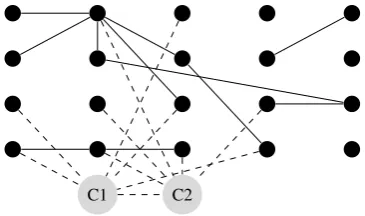
A graphical illustration of the model is given in Figure 1. Note that we could have selected a richer model structure, for example, by defining
a similarity potential over all verb instance ver-texes that share an equivalence class. However, as the figure demonstrates, even the structure of the pruned version of our model (see Section 3.3) usu-ally contains cycles, which makes inference NP-hard (Shimony, 1994). Our design choices aim to balance between the expressivity of the model and the complexity of inference. In Section 3.3 we de-scribe the LP relaxation algorithm we use for in-ference.
[image:4.595.325.508.205.313.2]C1 C2
Figure 1: A graphical illustration of our model (after pruning, see Sec. 3.3) for twenty verb in-stances (|X|= 20), each represented with a black vertex, and two equivalence classes (ECs), each represented with a gray vertex (|C| = 2). Solid lines represent edges (andθi,jpairwise potentials) between verb instance vertexes. Dashed lines rep-resent edges between verb instance vertexes and EC vertexes (φi,j pairwise potentials) or between EC vertexes (ξi,j pairwise potentials) .
3.2 Potentials and Encoded Knowledge Pairwise Syntactic Similarity Potentials. The pairwise syntactic similarity potentials are defined for each pair of verb instance vertexes,xi, xj ∈X. They are designed to encourage the model to as-sign verb instances with similar fine-grained fea-ture representations to the same frame (l ∈ L) and verb instances with dissimilar representations to different frames. For this aim, for every verb pair i, j with feature representation vectors vi, vj and verb instance vertexesxi, xj ∈X, we define the following potential function:
θi,j(xi=l1, xj=l2) =
λ(vi, vj) ifl1 =l2
0 otherwise
Wherel1, l2 ∈ Lare label pairs and λis a verb
instance similarity function. Below we describe the feature representation and theλfunction.
word instance in the input sentences we first build a basic feature representation (see below). Then, for each verb instance we construct a final fea-ture representation defined to be the concatena-tion of that verb’s basic feature representaconcatena-tion with the basic representations of the words in a size 2 window around the represented verb. The fi-nal feature representation for the i-th verb in-stance in our dataset is therefore defined to be
vi = [w−2, w−1, vbi, w+1, w+2], wherew−k and
w+k are the basic feature representations of the words in distance−kor+kfrom thei-th verb in-stance in its sentence, andvbi is the basic feature representation of that verb instance.
Our basic feature representation is inspired from the feature representation of the MST parser (McDonald et al., 2005) except that in the parser the features represent a directed edge in the com-plete directed graph defined over the words in a sentence that is to be parsed, while our features are generated for word n-grams. Particularly, our fea-ture set is a concatenation of two sets derived from the MST set described in Table 1 of (McDonald et al., 2005) in the following way: (1) In both sets the parent word in the parser’s set is replaced with the represented word; (2) In one set every child word in the parser’s set is replaced by the word to the left of the represented word and in the other set it is replaced by the word to its right. This choice of features allows us to take advantage of a provably useful syntactic feature representation without the application of any parse tree annotation or parser.
We compute the similarity between the syntac-tic environments of two verb instances,i, j, using the following equation:
λ(vi, vj) =W ·cos(vi, vj)−S
Where W is a hyperparameter designed to bias verb instances of the same verb type towards the same frame. Practically,W was tuned to be 3 for instances of the same type, and 1 otherwise4.
While the cosine function is the standard mea-sure of similarity between two vectors, its val-ues are in the[0,1]range. In the MRF modeling framework, however, we must encode a negative pairwise potential value between two vertexes in order to encourage the model to assign different labels (frames) to them. We therefore added the positive hyperparameterSwhich was tuned,
with-4All hyperparameters that require gold-standard annota-tion for tuning, were tuned using held-out data (Secannota-tion 4).
out access to gold standard manual annotations, so that there is an even number of negative and pos-itive pairwise syntactic similarity potentials after the model is pruned (see Section 3.3)5.
Type Level Singleton Potentials. The goal of these potentials is to bias verb instances of the same type to be assigned to the same syntactic frame while still keeping the instance based nature of our algorithm. For this aim, we applied Algo-rithm 1 for pre-clustering of the verb instances and encoded the induced clusters into the local poten-tials of the corresponding x ∈ X vertexes. For everyx ∈ X the singleton potential is therefore defined to be:
θi(xi=l) =
F·maxλ iflis induced by Algorithm 1
0 otherwise
wheremaxλis the maximumλscore across all verb instance pairs in the model andF = 0.2is a hyperparamter.
Algorithm 1 has two hyperparameters: T and
M, the first is a similarity cut-off value used to de-termine the initial set of clusters, while the second is used to determine whether two clusters are simi-lar enough to be merged. We tuned these hyperpa-rameters, without manually annotated data, so that the number of clusters induced by this algorithm will be equal to the number of gold standard SCFs.
T was tuned so that the first part of the algorithm generates an excessive number of clusters, andM
was then tuned so that these clusters are merged to the desired number of clusters.
The λ function, used to measure the similar-ity between two verbs, is designed to bias the in-stances of the same verb type to have a higher sim-ilarity score. Algorithm 1 therefore tends to assign such instances to the same cluster. In our experi-ments that was always the case for this algorithm.
High Cardinality Verb Sets Potentials. This set of potentials aims to bias larger sets of verb instances to share the same SCF. It is inspired by (Rush et al., 2012) who demonstrated, that syn-tactic structures that appear at the same syntac-tic context, in terms of the surrounding POS tags, tend to manifest similar syntactic behavior. While they demonstrated the usefulness of their method for dependency parsing and POS tagging, we im-plement it for higher level SCFs.
We identified syntactic contexts that imply simi-lar SCFs for verb instances appearing inside them.
Algorithm 1 Verb instance pre-clustering algo-rithm.λˆis the averageλscore between the mem-bers of its cluster arguments. T andM are hyper-parametes tuned without access to gold standard data.
Require: K=∅
for allx∈Xdo for allk∈Kdo
for allu∈kdo ifλ(vx, vu)> Tthen
k=k∪ {x} Go to nextx end if
end for end for k1 ={x}
K=K∪k1 end for
for allk1, k2∈K:k16=k2do
ifλˆ(k1, k2)> Mthen Merge (k1,k2)
end if end for
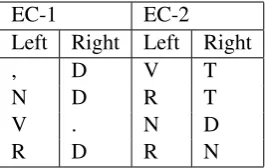
Contexts are characterized by the coarse POS tag to the left and to the right of the verb instance. While the number of context sets is bounded only by the number of frames our model is designed to induce, in practice we found that defining two equivalence sets led to the best performance gain, and the sets we used are presented in Table 1.
In order to encode this information into our MRF, each set of syntactic contexts is associated with an equivalence class (EC) vertexc ∈ C and the verb instance vertexes of all verbs that appear in a context from that set are connected with an edge toc. The pairwise potential between a vertex
x∈Xand its equivalence class is defined to be:
φi,j(xi=l1, cj =l2) =
U ifl1 =l2 0 otherwise
U = 10is a hyperparameter that strongly biasesx
vertexes to get the same SCF as their EC vertex.
3.3 Verb Cluster Induction
In this section we describe how we induce verb instance clusters from our model. This process is based on the following three steps: (1) Graph pruning; (2) Induction of an Ensemble of approx-imate MAP inference solutions in the resulted graphical model; and, (3) Induction of a final clus-tering solution based on the ensemble created at step 2. Below we explain the necessity of each of these steps and provide the algorithmic details.
EC-1 EC-2
Left Right Left Right
, D V T
N D R T
V . N D
[image:6.595.349.482.62.146.2]R D R N
Table 1: POS contexts indicative for the syntactic frame of the verb instance they surround. D: de-terminer, N:noun, V:verb, T: the preposition’to’ (which has its own POS tag in the WSJ POS tag set which we use), R:adverb. EC-1 and EC-2 stand for the first and second equivalence class respec-tively. In addition, the following contexts where associated with both ECs:(T, D),(T, N),(N, N)
and(V, I)where I stands for a preposition.
Graph Pruning. The edge set of our model consists of an edge for every pair of verb in-stance vertexes and of the edges that connect verb instance vertexes and equivalence class vertexes. This results in a large tree-width graph which sub-stantially complicates MRF inference. To alleviate this we prune all edges with a positive score lower thanp+and all edges with a negative score higher
thanp−, wherep+andp−are manually tuned
hy-perparametes6.
MAP Inference. For most reasonable values of
p+andp−our graph still contains cycles even
af-ter it is pruned, which makes inference NP-hard (Shimony, 1994). Yet, thanks to our choice of an edge-factorized model, there are various approxi-mate inference algorithms suitable for our case.
We applied the message passing algorithm for linear-programming (LP) relaxation of the MAP assignment (MPLP, (Sontag et al., 2008)). LP re-laxation algorithms for the MAP problem define an upper bound on the original objective which takes the form of a linear program. Consequently, a minimum of this upper bound can be found us-ing standard LP solvers or, more efficiently, usus-ing specialized message passing algorithms (Yanover et al., 2006). The MPLP algorithm described in (Sontag et al., 2008) is appealing in that it itera-tively computes tighter upper bounds on the MAP objective (for details see their paper).
Cluster Ensemble Generation and a Final Solution. As our MAP objective is non-convex,
6The values used in practice arep
the convergent point of an optimization algorithm applied to it is highly sensitive to its initializa-tion. To avoid convergence to arbitrary local max-ima which may be of poor quality, we turn to a perturbation protocol where we repeatedly intro-duce random noise to the MRF’s potential func-tions and then compute the approximate MAP so-lution of the resulted model using the MPLP algo-rithm. Noising was done by adding anterm to thelambdavalues described in section 3.27. This protocol results in a set of cluster (label) assign-ments for the involved verb instances, which we treat as an ensemble of experts from which a final, high quality, solution is to be induced.
The basic idea in ensemble learning is that if several experts independently cluster together two verb instances, our belief that these verbs belong in the same cluster should increase. (Reichart et al., 2012) implemented this idea through the k-way normalized cut clustering algorithm (Yu and Shi, 2003). Its input is an undirected graphGˆ = ( ˆV ,E,ˆ Wˆ) where Vˆ is the set of vertexes, Eˆ is the set of edges andWˆ is a non-negative and sym-metric edge weight matrix. To apply this model to our task, we construct the input graphGˆ from the labelings (frame assignments) contained in the ensemble. The graph vertexesVˆ correspond to the verb instances and the(i, j)-th entry of the matrix
ˆ
W is the number of ensemble members that assign the same label to thei-th andj-th verb instances.
ForA, B⊆Vˆ define:
links(A, B) = X
i∈A,j∈B
ˆ W(i, j)
Using this definition, the normalized link ratio ofAandBis defined to be:
NormLinkRatio(A, B) = links(A, B) links(A,Vˆ)
The k-way normalized cut problem is to mini-mize the links that leave a cluster relative to the total weight of the cluster. Denote the set of clus-terings of Vˆ that consist of k clusters by Cˆ =
{cˆ1, . . .cˆt}and thej-th cluster of thei-th
cluster-7was accepted by first sampling a number in the[0,1] range using the Java psuodorandom generator and then scal-ing it to 1% ofcos(vi, vj). This value was tuned, without access to gold standard manual annotations, so that there is an even number of negative and positive pairwise syntactic similarity potentials after the model is pruned (Section 3.3).
ing bycˆij. Then
c∗ = argmin ˆ
ci∈Cˆ k
X
j=1
NormLinkRatio( ˆcij,Vˆ −cˆij)
The algorithm of (Yu and Shi, 2003) solves this problem very efficiently as it avoids the heavy eigenvalues and eigenvectors computations re-quired by traditional approaches.
4 Experiments and Results
Our model is unique compared to existing systems in two respects. First, it does not utilize supervi-sion in the form of either a supervised syntactic parser and/or manually crafted SCF rules. Conse-quently, it induces unnamed frames (clusters) that are not directly comparable to the named frames induced by previous systems. Second, it induces syntactic frames at the verb instance, rather than type, level. Evaluation, and especially comparison to previous work, is therefore challenging.
We therefore evaluate our system in two ways. First, we compare its output, as well as the output of a number of clustering baselines, to the gold standard annotation of corpora from two differ-ent domains (the only publicly available ones with instance level SCF annotation, to the best of our knowledge). Second, in order to compare the out-put of our system to a rule-based SCF system that utilizes a supervised syntactic parser, we turn to a task-based evaluation. We aim to predict the degree of similarity between verb pairs and, fol-lowing (Pado and Lapata, 2007) , we do so using asyntactic-basedvector space model (VSM). We construct three VSMs - (a) one that derives fea-tures from our clusters; (b) one whose feafea-tures come from the output of a state-of-the-art verb type level, rule based, SCF system (Reichart and Korhonen, 2013) that uses a modern parser (Klein and Manning, 2003); and (c) a standard lexical VSM. Below we show that our system compares favorably in both evaluations.
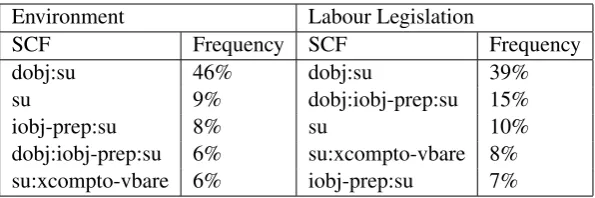
sentences) of 117 types, and the environmental domain dataset contains 4503 annotated verb in-stances of 116 types. In both datasets no verb type accounts for more than 4% of the instances and only up to 35 verb types account for 1% of the instances or more. The lexical difference between the corpora is substantial: they share only 42 anno-tated verb types in total, of which only 2 verb types (responsible for 4.1% and 5.2% of the instances in the environment and labor legislation domains re-spectively) belong to the 20 most frequent types (responsible for 37.9% and 46.85% of the verb in-stances in the respective domains) of each corpus. The 29 members of the SCF inventory are de-tailed in (Quochi et al., 2012). Table 2, presenting the distribution of the 5 highest frequency frames in each corpus, demonstrates that, in addition to the significant lexical difference, the corpora differ to some extent in their syntactic properties. This is reflected by the substantially different frequencies of the ”dobj:iobj-prep:su” and ”dobj:su” frames.
As a pre-processing step we first POS tagged the datasets with the Stanford tagger (Toutanova et al., 2003) trained on the standard POS training sections of the WSJ PennTreebank corpus.
4.1 Evaluation Against SCF Gold Standard Experimental ProtocolThe computational com-plexity of our algorithm does not allow us to run it on thousands of verb instances in a feasible time. We therefore repeatedly sampled 5% of the sen-tences from each dataset, ran our algorithm as well as the baselines (see below) and report the average performance of each method. The number of rep-etitions was 40 and samples were drawn from a uniform distribution while still promising that the distribution of gold standard SCFs in each sam-ple is identical to their distribution in the entire dataset. Before running this protocol, 5% of each corpus was kept as held-out data on which hyper-parameter tuning was performed.
Evaluation Measures and Baselines.We com-pare our system’s output to instance-level gold standard annotation. We use standard measures for clustering evaluation, one measure from each of the two leading measure types: the V measure (Rosenberg and Hirschberg, 2007), which is an in-formation theoretic measure, and greedy many-to-one accuracy, which is a mapping-based measure. For the latter, each induced cluster is first mapped to the gold SCF frame that annotates the highest
number of verb instances this induced cluster also annotates and then a standard instance-level accu-racy score is computed (see, e.g., (Reichart and Rappoport, 2009)). Both measures scale from 100 (perfect match with gold standard) to 0 (no match). As mentioned above, comparing the perfor-mance of our system with respect to a gold stan-dard to the performance of previous type-level systems that used hand-crafted rules and/or su-pervised syntactic parsers would be challenging. We therefore compare our model to the follow-ing baselines: (a) Themost frequent class (MFC) baseline which assigns all verb instances with the SCF that is the most frequent one in thegold stan-dard annotationof the data; (b) TheRandom base-line which simply assigns every verb instance with a randomly selected SCF; (c) Algorithm 1 of sec-tion 3.2 which generates unsupervised verb in-stance clustering such that verb inin-stances of the same type are assigned to the same cluster; and (d) Finally, we also compare our model against versions where everything is kept fixed, except a subset of potentials which is omitted. This enables us to study the intricacies of our model and the rel-ative importance of its components. For all mod-els, the number of induced clusters is equal to the number of SCFs in the gold standard.
Results Table 3 presents the results, demon-strating that our full model substantially outper-forms all baselines. For the first two simple heuris-tic baselines (MFC and Random) the margin is higher than 20% for both the greedy M-1 mapping measure and the V measure. Note tat the V score of the MFC baseline is 0 by definition, as it as-signs all items to the same cluster. The poor per-formance of these simple baselines is an indication of the difficulty of our task.
Recall that the type level clustering induced by Algorithm 1 is the main source of type level in-formation our model utilizes (through its single-ton potentials). The comparison to the output of this algorithm (the Type Pre-clustering baseline) therefore shows the quality of the instance level refinement our model provides. As seen in table 3, our model outperforms this baseline by 6.9% for the M-1 measure and 5.2% for the V measure.
In order to compare our model to its compo-nents we exclude either the EC potentials (φand
Environment Labour Legislation
SCF Frequency SCF Frequency
dobj:su 46% dobj:su 39%
su 9% dobj:iobj-prep:su 15%
iobj-prep:su 8% su 10%
dobj:iobj-prep:su 6% su:xcompto-vbare 8% su:xcompto-vbare 6% iobj-prep:su 7%
Table 2: Top 5 most frequent SCFs for the Environment and Labour Legislation datasets used in our experiments.
Environment Labour Legislation
M-1 V M-1 V
Full Model 66.4 57.3 69.2 55.6
Baselines
MFC 46.2 0 39.4 0
Random 34.6 28.1 36.5 27.8
Type Pre-clustering 60.1 52.1 62.3 51.4 Model Components
[image:9.595.149.447.61.160.2]Model - EC 64.9 56.2 67.4 54.6 Model - EC - Type pre-clustering 48.3 48.9 45.7 44.7
Table 3: Results for our full model, the baselines (Type Pre-clustering: the pre-clustering algorithm (Algorithm 1 of section 3.2),MFC: the most frequent class (SCF) in the gold standard annotation and Random: random SCF assignment) and the model components. The full model outperforms all other models across measures and datasets.
from the type level information encoded through the singleton potentials than from the EC poten-tials. Yet, EC potentials do lead to an improvement of up to 1.5% in M-1 and up to 1.1% in V and are therefore responsible for up to 26.1% and 21.2% of the improvement over the type pre-clustering baseline in terms of M-1 and V, respectively.
4.2 Task Based Evaluation
We next evaluate our model in the context of vec-tor space modeling for verb similarity prediction (Turney and Pantel, 2010). Since most previous word similarity works used noun datasets, we con-structed a new verb pair dataset, following the pro-tocol used in the collection of the wordSimilarity-353 dataset (Finkelstein et al., 2002).
Our dataset consists of 143 verb pairs, con-structed from 122 unique verb lemma types. The participating verbs appear≥ 10times in the con-catenation of the labour legislation and the envi-ronment datasets. Only pairs of verbs that were considered at least remotely similar by human judges (independent of those that provided the similarity scores) were included. A similarity score between 1 and 10 was assigned to each pair
by 10 native English speaking annotators and were then averaged in order to get a unique pair score.
Our first baseline is a standard VSM based on lexical collocations. In this model features corre-spond to the number of collocations inside a size 2 window of the represented verb with each of the 5000 most frequent nouns in the Google n-gram corpus (Goldberg and Orwant, 2013). Since our corpora are limited in size, we use the collocation counts from the Google corpus.
runs. Instead we concatenated the output of all these runs into one feature representation that fa-cilitates similarity prediction. For our model we estimated the verb pair similarity using the Tani-mato similarity score for binary vectors:
T(X, Y) =
P
iXi∧Yi
P
ixi∨Yi
For the baseline model, where the features are collocation counts, we used the standard cosine similarity.
Our second baseline is identical to our model, except that: (a) the data is parsed with the Stan-ford parser (version 3.3.0, (Klein and Manning, 2003)) which was trained with sections 2-21 of the WSJ corpus; (b) the phrase structure output of the parser is transformed to the CoNLL dependency format using the official CoNLL 2007 conversion script (Johansson and Nugues, 2007); and then (c) the SCF of each verb instance is inferred using the rule-based system used by (Reichart and Korho-nen, 2013). The vector space representation for each verb is then created using the process we de-scribed for our model and the same holds for vec-tor comparison. This baseline allows direct com-parison of frames induced by our SCF model with those derived from a supervised parser’s output.
We computed the Pearson correlation between the scores of each of the models and the human scores. The results demonstrate the superiority of our model in predicting verb similarity: the correlation of our model with the human scores is 0.642 while the correlation of the lexical col-location baseline is 0.522 and that of the super-vised parser baseline is only 0.266. The results indicate that in addition to their good alignment with SCFs, our clusters are also highly useful for verb meaning representation. This is in line with the verb clustering theory of the Levin tradition (Levin, 1993) which ties verb meaning with their syntactic properties. We consider this an intrigu-ing direction of future work.
5 Conclusions
We presented an MRF-based unsupervised model for SCF acquisition which produces verb instance level SCFs as output. As opposed to previous sys-tems for the task, our model uses only a POS tag-ger, avoiding the need for a statistical parser or manually crafted rules. The model is particularly valuable for NLP tasks benefiting from SCFs that
are applied across text domains, and for the many tasks that involve sentence-level processing.
Our results show that the accuracy of the model is promising, both when compared against gold standard annotations and when evaluated in the context of a task. In the future we intend to im-prove our model by encoding additional informa-tion in it. We will also adapt it to a multilingual setup, aiming to model a wide range of languages.
Acknowledgments
The first author is supported by the Common-wealth Scholarship Commission (CSC) and the Cambridge Trust.
References
Ivana Romina Altamirano and Laura Alonso i Ale-many. 2010. IRASubcat, a highly customizable, language independent tool for the acquisition of ver-bal subcategorization information from corpus. In Proceedings of the NAACL 2010 Workshop on Com-putational Approaches to Languages of the Ameri-cas.
Abhishek Arun and Frank Keller. 2005. Lexicalization in crosslinguistic probabilistic parsing: The case of
french. InProceedings of ACL-05.
Taylor Berg-Kirkpatrick, Alexander Bouchard-Cote, John DeNero, and Dan Klein. 2010. Painless un-supervised learning with features. InProceedings of NAACL-HLT-10.
Akshar Bharati, Sriram Venkatapathy, and Prashanth Reddy. 2005. Inferring semantic roles using sub-categorization frames and maximum entropy model. InProceedings of CoNLL-05.
Ted Briscoe and John Carroll. 1997. Automatic ex-traction of subcategorization from corpora. In Pro-ceedings of ANLP-97.
Ted Briscoe, John Carroll, and Rebecca Watson. 2006.
The second release of the rasp system. In
Proceed-ings of ACL-COLING-06.
John Carroll and Alex Fang. 2004. The automatic ac-quisition of verb subcategorisations and their impact
on the performance of an HPSG parser. In
Proceed-ings of IJCNLP-04.
Paula Chesley and Susanne Salmon-Alt. 2006. Au-tomatic extraction of subcategorization frames for
french. InProceedings of LREC-06.
Shay Cohen and Noah Smith. 2009. Shared logistic normal distributions for soft parameter tying in
un-supervised grammar induction. In Proceedings of
NAACL-HLT-09.
Marie-Catherine De-Marneffe, Bill Maccartney, and Christopher Manning. 2006. Generating typed de-pendency parses from phrase structure parses. In Proceedings of LREC-06.
Lukasz Debowski. 2009. Valence extraction using EM selection and co-occurrence matrices. Proceedins of LREC-09.
Lev Finkelstein, Evgeniy Gabrilovich, Yossi Matias, Ehud Rivlin, Zach Solan, Gadi Wolfman, and Ei-tan Ruppin. 2002. Placing search in context: The
concept revisited. ACM Transactions on
Informa-tion Systems, 20:116–131.
Yoav Goldberg and Jon Orwant. 2013. A dataset of syntactic-ngrams over time from a very large corpus
of english books. InProceedings of (*SEM)-13.
As-sociation for Computational Linguistics.
Jan Hajiˇc, Martin mejrek, Bonnie Dorr, Yuan Ding, Ja-son Eisner, Daniel Gildea, Terry Koo, Kristen Par-ton, Gerald Penn, Dragomir Radev, and Owen Ram-bow. 2002. Natural language generation in the con-text of machine translation. Technical report, Cen-ter for Language and Speech Processing, Johns Hop-kins University, Baltimore. Summer Workshop Final Report.
Chung hye Han, Benoit Lavoie, Martha Palmer, Owen Rambow, Richard Kittredge, Tanya Korelsky, and Myunghee Kim. 2000. Handling structural diver-gences and recovering dropped arguments in a
ko-rean/english machine translation system. In
Pro-ceedings of the AMTA-00.
Dino Ienco, Serena Villata, and Cristina Bosco. 2008. Automatic extraction of subcategorization frames for italian. InProceedings of LREC-08.
Richard Johansson and Pierre Nugues. 2007. Ex-tended constituent-to-dependency conversion for
en-glish. InProceedings of NODALIDA-07.
Daisuke Kawahara and Sadao Kurohashi. 2010. Ac-quiring reliable predicate-argument structures from raw corpora for case frame compilation. In Proceed-ings of LREC-10.
Dan Klein and Christopher Manning. 2003. Accurate
unlexicalized parsing. InProceedings of ACL-03.
Daphne Koller and Nir Friedman. 2009. Probabilistic
graphical models: principles and techniques. The MIT Press.
Anna Korhonen, Genevieve Gorrell, and Diana Mc-Carthy. 2000. Statistical filtering and
subcate-gorization frame acquisition. In Proceedings of
EMNLP-00.
Anna Korhonen. 2002. Semantically motivated
sub-categorization acquisition. In Proceedings of the
ACL-02 workshop on Unsupervised lexical acquisi-tion.
Joel Lang and Mirella Lapata. 2011a. Unsupervised semantic role induction via split-merge clustering. InProceedings of ACL-11.
Joel Lang and Mirella Lapata. 2011b. Unsupervised semantic role induction with graph partitioning. In Proceedings of EMNLP-11.
Matthew Lease and Eugene Charniak. 2005. Parsing
biomedical literature. In Proceedings of
IJCNLP-05.
Alessandro Lenci, Barbara Mcgillivray, Simonetta Montemagni, and Vito Pirrelli. 2008. Unsupervised acquisition of verb subcategorization frames from
shallow-parsed corpora. InProceedings of
LREC-08.
Beth Levin. 1993. English verb classes and
alterna-tions: A preliminary investigation. Chicago, IL.
Tom Lippincott, Anna Korhonen, and Diarmuid Os-eaghdha. 2010. Exploring subdomain variation in
biomedical language.BMC Bioinformatics.
Tom Lippincott, Aanna Korhonen, and Diarmuid Os-eaghdha. 2012. Learning syntactic verb frames
us-ing graphical models. InProceedings of ACL-12.
Ryan McDonald, Koby Crammer, and Fernando Pereira. 2005. Online large-margin training of
de-pendency parsers. InProceedings of ACL-05.
Cedric Messiant, Anna Korhonen, and Thierry Poibeau. 2008. LexSchem: A large
subcategoriza-tion lexicon for French verbs. In Proceedings of
LREC-08.
Cedric Messiant. 2008. A subcategorization
acquis-tion system for french verbs. In Proceedings of
ACL08-SRW.
Yusuke Miyao and Junichi Tsujii. 2005. Probabilistic disambiguaton models for wide-coverage hpsg
pars-ing. InProceedings of ACL-05.
Alessandro Moschitti and Roberto Basili. 2005. Verb subcategorization kernels for automatic semantic
la-beling. InProceedings of the ACL-SIGLEX
Work-shop on Deep Lexical Acquisition.
Ruth O’Donovan, Michael Burke, Aoife Cahill, Josef van Genabith, and Andy Way. 2005. Large-scale induction and evaluation of lexical resources from
the penn-ii and penn-iii treebanks. Computational
Linguistics, 31:328–365.
Sebastian Pado and Mirella Lapata. 2007.
Dependency-based construction of semantic space
Judita Preiss, Ted Briscoe, and Anna Korhonen. 2007. A system for large-scale acquisition of verbal, nom-inal and adjectival subcategorization frames from
corpora. InProceedings of ACL-07.
Valeria Quochi, Francesca Frontini, Roberto Bartolini, Olivier Hamon, Marc Poch, Muntsa Padr, Nuria Bel, Gregor Thurmair, Antonio Toral, and Amir Kam-ram. 2012. Third evaluation report. evaluation of panacea v3 and produced resources. Technical re-port.
Roi Reichart and Anna Korhonen. 2013. Improved lexical acquisition through dpp-based verb
cluster-ing. InProceedings of ACL-13.
Roi Reichart and Ari Rappoport. 2009. The nvi
clustering evaluation measure. In Proceedings of
CoNLL-09.
Roi Reichart, Gal Elidan, and Ari Rappoport. 2012. A diverse dirichlet process ensemble for unsupervised induction of syntactic categories. InProceedings of COLING-12.
Laura Rimell, Thomas Lippincott, Karin Verspoor, He-len Johnson, and Anna Korhonen. 2013. Acqui-sition and evaluation of verb subcategorization
re-sources for biomedicine. Journal of Biomedical
In-formatics, 46:228–237.
Eric Ringger, Peter McClanahan, Robbie Haertel, George Busby, Marc Carmen, James Carroll, Kevin Seppi, and Deryle Lonsdale. 2007. Active learning for part-of-speech tagging: Accelerating corpus
an-notation. InProceedings of the ACL-07 Linguistic
Annotation Workshop.
Douglas Roland and Daniel Jurafsky. 1998. subcate-gorization frequencies are affected by corpus choice. InProceedings of ACL-98.
Andrew Rosenberg and Julia Hirschberg. 2007. V measure: a conditional entropybased external cluster
evaluation measure. InProceedings of EMNLP-07.
Alexander Rush, Roi Reichart, Michael Collins, and Amir Globerson. 2012. Improved parsing and pos tagging using inter-sentence consistency constraints. InProceedings of EMNLP-12.
Sabine Schulte im Walde. 2006. Experiments on the automatic induction of german semantic verb
classes. Computational Linguistics, 32(2):159–194.
Solomon Shimony. 1994. Finding the maps for belief networks is np-hard. Artificial Intelligence, 68:399– 310.
David Sontag, Talya Meltzer, Amir Globerson, Tommi Jaakkola, and Yair Weiss. 2008. Tightening lp
re-laxations for map using message passing. In
Pro-ceedings of UAI-08.
Lin Sun and Anna Korhonen. 2011. Hierarchical verb clustering using graph factorization. InProceedings of EMNLP-11.
Ivan Titvo and Alexandre Klementiev. 2012. A bayesian approach to unsupervised semantic role
in-duction. InProceedings of EMNLP-12.
Kristina Toutanova, Dan Klein, Christopher Manning, and Yoram Singer. 2003. Feature-rich part-of-speech tagging with a cyclic dependency network. InProceedings of NAACL-03.
Peter Turney and Patrick Pantel. 2010. From fre-quency to meaning: Vector space models of se-mantics. Journal of artificial intelligence research, 37:141–188.
Tim Van de Cruys, Laura Rimell, Thierry Poibeau, and Anna Korhonen. 2012. Multi-way tensor factor-ization for unsupervised lexical acquisition. In Pro-ceedings of COLING-12.
Giulia Venturi, Simonetta Montemagni, Simone Marchi, Yutaka Sasaki, Paul Thompson, John Mc-Naught, and Sophia Ananiadou. 2009. Bootstrap-ping a verb lexicon for biomedical information ex-traction. Computational Linguistics and Intelligent Text Processing, 5449:137–148.
Marion Weller, Alexander Fraser, and Sabine Schulte im Walde. 2013. Using subcategorization knowl-edge to improve case prediction for translation to
german. InProceedings of ACL-13.
Chen Yanover, Talya Meltzer, and Yair Weiss. 2006. Linear programming relazations and belief
pro-pogataion an empitical study. JMLR Special Issue
on Machine Learning and Large Scale Optimization. Stella Yu and Jianbo Shi. 2003. Multiclass spectral