Multiple Alignment of Citation Sentences with
Conditional Random Fields and Posterior Decoding
Ariel S. Schwartz∗
EECS, Computer Science Division UC Berkeley
Berkeley, CA 94720-1776 [email protected]
Anna Divoli, Marti A. Hearst
School of Information UC Berkeley Berkeley, CA 94720-4600 {hearst,divoli}@ischool.berkeley.edu
Abstract
In scientific literature, sentences that cite re-lated work can be a valuable resource for applications such as summarization, syn-onym identification, and entity extraction. In order to determine which equivalent en-tities are discussed in the various citation sentences, we propose aligning the words within these sentences according to semantic similarity. This problem is partly analogous to the problem of multiple sequence align-ment in the biosciences, and is also closely related to the word alignment problem in sta-tistical machine translation. In this paper we address the problem of multiple citation concept alignment by combining and mod-ifying the CRF based pairwise word align-ment system of Blunsom & Cohn (2006) and a posterior decoding based multiple se-quence alignment algorithm of Schwartz & Pachter (2007). We evaluate the algorithm on hand-labeled data, achieving results that improve on a baseline.
1 Introduction
The scientific literature of biomedicine, genomics, and other biosciences is a rich, complex, and con-tinually growing resource. With appropriate infor-mation extraction and retrieval tools, bioscience re-searchers can use the contents of the literature to further their research goals. With online full text
∗
Current address: Department of Bioengineering, Univer-sity of California, San Diego, La Jolla, CA 92093-0412. Email: [email protected].
of journal articles finally becoming the norm, new forms of citation analysis become possible.
Nearly every statement in biology articles is backed up by at least one citation, and, conversely, it is quite common for papers in the bioscience do-main to be cited by 30–100 other papers. The cited facts are typically stated in a more concise way in the citing papers than in the original papers. Since the same facts are repeatedly stated in different ways in different papers, statistical models can be trained on existing citation sentences to identify similar facts in unseen text. Citation sentences also have the poten-tial to be useful for text summarization and database curation. Figure 1 shows an example of three differ-ent citation sdiffer-entences to the same target paper.
Most citation analysis work focuses on the cita-tion network structure, to determine which papers are most central, or uses co-citation analysis to de-termine which papers are similar to one another in content (White, 2004; Liu, 1993; Garfield, 1955; Lipetz, 1965; Giles et al., 1998). In this paper we focus instead on analyzing the sentences that sur-round the citations to related work, which we termed citances in Nakov et al. (2004). In that paper we note that one subproblem for using citances for au-tomated analysis is to identify the different concepts mentioned; a given paper may be cited for more than one fact or relation.
Citances often state similar information using varying words and phrases. In order to build con-cise summaries, those entities and relations that are expressed in different ways should be matched up, oraligned, so that subsequent processing steps will know what the core concepts are. In this paper we
Example of unaligned citances
“In response to genotoxic stress, Chk1 and Chk2 phosphorylate Cdc25A on N-terminal sites and target it rapidly for ubiquitin-dependent degradation (Mailandet al, 2000, 2002;
Molinariet al, 2000; Falcket al, 2001; Shimutaet al, 2002; Businoet al, 2003), which is thought to be central to the S and G2 cell cycle checkpoints (Bartek and Lukas, 2003;
Donzelli and Draetta, 2003).”
“Given that Chk1 promotes Cdc25A turnover in response to DNA damage in vivo (Falck et al. 2001; Sorensen et al. 2003) and that Chk1 is required for Cdc25A ubiquitination by SCFβ-TRCP in vitro, we explored the role of Cdc25A
phosphorylation in the ubiquitination process.”
“Since activated phosphorylated Chk2-T68is involved in phosphorylation and
degradation of Cdc25A (Falck et al., 2001, Falck et al.,2002; Bartek and Lukas, 2003), we also examined the levels of Cdc25A in 2fTGH and U3A cells exposed to γ-IR.”
Figure 1:Example of three unaligned citances.
Alignment after normalization
responsegenotoxic stressChk1 Chk2phosphorylateCdc25AN terminal sites target rapidly ubiquitindependentdegradationthought central S G2 cell cycle checkpoints Given Chk1promotes Cdc25AturnoverresponseDNA damagevivo Chk1required Cdc25AubiquitinationSCF beta TRCP vitro exploredrole Cdc25Aphosphorylation
ubiquitination process
activated phosphorylatedChk2 T68involved phosphorylationdegradationCdc25A examinedlevels Cdc25A2fTGH U3A cells exposed gamma IR
Figure 2:Example of three normalized aligned ci-tances. Homologous entities are colored the same. Unaligned entities are black.
build on the work of Nakov et al. (2004) by tackling the entity normalization step.
The citance alignment problem is partially anal-ogous to the problem of multiple alignment of bi-ological sequences (Durbin et al., 1998). In both cases the goal is to align homologous entities that are derived from the same ancestral entity. While in biology homology is well-defined in the molecular level, in the citances case it is defined in the seman-tic level, which is much more subjective. Given a group of citances that cite the same target paper, we loosely define semantic homology as a symmetric, transitive, and reflexive relation between two enti-ties (words or phrases) in the same or different ci-tance that have similar semantics in the context of the cited paper.
Figure 1 shows an example of three citances that cite the same target paper (Falck et al., 2001). A multiple alignment of the entities in the same ci-tances (after removal of stopwords) is shown in Fig-ure 2. Homologous entities are colored the same. This small example illustrates some of the main challenges of multiple citance alignment (MCA).
While orthographic similarity can help to identify semantic homology (e.g., phosphorylateand phos-phorylation), it can also be misleading (e.g.,cell cy-cleandU3A cells). In addition, semantic homology might not include any orthographic clues (e.g., geno-toxic stressandDNA damage).
Unlike global multiple sequence alignment (MSA) in genomics, where each character can be aligned to at most one character in every other se-quence, in multiple citance alignment, each word can be aligned to any number of words in other sen-tences. Another major difference between the two problems is the fact that while the sequential order-ing of characters must be maintained in multiple se-quence alignment, this is not the case for multiple citance alignment.
MCA is also related to the problem of word align-ment in statistical machine translation (SMT) (Och and Ney, 2003). However, unlike SMT alignment, MCA aligns multiple citances in the same language rather than a pair of sentences in different languages. In this paper we present an MCA algorithm that is based on an extension to the posterior decoding algorithm for MSA called AMAP (Schwartz et al., 2006; Schwartz and Pachter, 2007), with an under-lying pairwise alignment model based on the CRF SMT alignment of Blunsom & Cohn (2006).
2 Multiple citance alignments
Let G , {C1, C2, . . . , CK} be a group of K
ci-tances that cite the same target paper, where theith citance is a sequence of wordsCi , C1iC2i· · ·Cnii,
andci ,{ci1, ci2, . . . , cini}is the set of word indices
ofCi. Apairwise citance alignment ofCi andCj is an equivalence (symmetric, reflexive, and transi-tive) relation ∼ij on the set ci ∪cj. The
expres-sioncik ∼ij cjl means that according to the pairwise
alignment∼ijwordkin citanceCiand wordlin ci-tanceCj are aligned. Amultiple citance alignment (MCA) is an equivalence relation∼, S
ij ∼ij
+
on the set S
ici, which is the transitive closure of
the union of all pairwise alignments of citance pairs in G. Taking the transitive closure and not only the union of all pairwise alignments ensures that the MCA is an equivalence relation.
An MCA ∼ defines a partition of the set of all word indices c , S
|c| = P
ini. Therefore, the number of distinct
MCAs of G is the number of partitions of a set of size n. This number is called thenth Bell number (Rota, 1964)
Bn, 1
e
∞ X
k=0 kn
k!. (1)
Asymptotically,Bngrows faster than an exponential
but slower than a factorial. For example B100 ≈
10116. Obviously, enumerating all possible MCAs is impractical even for small problems.
3 Probabilistic model for MCA
Unlike biological sequences, for which pair-HMMs are a natural choice for modeling evolutionary pro-cesses between two sequences, there is no simple generative model that can be used for modeling pairwise citance alignment. Most of the work on pairwise alignment of sentences at the word level has been done in the statistical machine translation (SMT) community.
Och & Ney (2003) present an overview and com-parison of the most common models used for SMT word alignments. Out of the models they describe, the HMM models are the most expressive mod-els that can compute posterior probabilities using the forward-backward algorithm. However, unlike sequence alignments, there are no ordering con-straints in word alignments, and the alignments are many-to-many as opposed to one-to-one. Therefore, the SMT HMM models cannot be based on pair-HMMs, which generate two sentences simultane-ously. Rather, they are directional models that model the probability of generating a target sentence given a source sentence. In other words they only model one alignments, recovering the many-to-many alignments in a preprocessing step. Therefore, SMT HMMs can only compute the posterior proba-bilitiesP(cik ;cjl|Ci, Cj)andP(cjl ;cik|Ci, Cj), where the relation ; represents the (directional) event that a source word is translated into a target word. Nevertheless, recently such posterior proba-bilities have been used in SMT word alignment sys-tem as an alternative to Viterbi decoding, and helped to improve the performance of such systems (Ma-tusov et al., 2004; Liang et al., 2006).
Generative models like HMMs have several lim-itations. First, they require relatively large
train-ing data, which is difficult to attain in case of SMT word alignment, and even more so in the case of MCA. Second, generative models explicitly model the inter-dependence of different features, which re-duces the ability to incorporate multiple arbitrary features into the model. Since orthographic similar-ity is not a strong enough indication for semantic ho-mology in MCA, we would like to be able to incor-porate multiple inter-dependent features into a single model, including orthographic, contextual, ontolog-ical, and lexical features.
Recently, several authors have described dis-criminative SMT alignment models (Moore, 2005; Lacoste-Julien et al., 2006; Blunsom and Cohn, 2006). However, to the best of our knowledge only the model of Blunsom & Cohn (2006), which is based on a Conditional Random Field (CRF) (Laf-ferty et al., 2001), can compute word indices pairs’ directional posterior probabilities, like those com-puted by the HMM models. Therefore, we decided to adopt the CRF-based model to the MCA problem.
3.1 Conditional random fields for word alignment
The model of Blunsom & Cohn (2006) is based on a linear chain CRF, which can be viewed as the undirected version of an HMM. The CRF models a many-to-one pairwise alignment, in which every source word can get aligned to zero or one target words, but every word in the target sentence can be the target of multiple source words. CRFs define a conditional distribution over a latent labeling se-quence given observation sese-quence(s). In the case of CRF for word alignment, the observed sequences are the source and target sentences (citances), and the latent labeling sequence is the mapping of source words to target word-indices. Given a source citance Ciof lengthni, and a target citanceCj of lengthnj, the many-to-one alignment ofCi toCj is the rela-tion ;. Since this is a many-to-one alignment, ; can be represented by a vectoraof lengthni. The CRF models the probability of the alignmenta con-ditioned onCiandCjas follows:
PΛ(a|Ci, Cj) =
exp P
t P
kλkfk(t, at−1, at, Ci, Cj)
wheref ,{fk}are the model’s features,Λ,{λk}
are the features’ weights, andZΛ(Ci, Cj)is the par-tition (normalization) function which is defined as:
ZΛ(Ci, Cj),
X
a
exp X
t X
k
λkfk(t, at−1, at, Ci, Cj) !
.
(3)
Parameters are estimated from fully observed data (manually aligned citances) using a maximum a pos-teriori estimate. The parameter estimation proce-dure is described in more details in the original pa-per. Blunsom & Cohn (2006) use Viterbi decoding to find an alignment of two sentences given a trained CRF model, a∗ , argmaxaPΛ(a|Ci, Cj). How-ever, the posterior probabilities of the labels at each position can be calculated as well using the forward-backward algorithm:
PΛ(cil ;cjk|Ci, Cj) =PΛ(al=cjk|Ci, Cj) =
αl(cjk|Ci, Cj)βl(cjk|Ci, Cj)
ZΛ(Ci, Cj)
(4)
whereαlandβlare the forward and backward
vec-tors that are computed with the forward-backward algorithm (Lafferty et al., 2001).
3.2 The posterior decoding algorithm for MCA
Ultimately, the success of an MCA algorithm should be judged by its effect on the success of the citance analysis systems that use MCAs as their input. How-ever, measuring this effect directly is difficult, since high-level tasks such as summarization are difficult to evaluate objectively. More to the point, it is dif-ficult to quantify the contribution of the MCA ac-curacy to the acac-curacy of the high-level system that uses it. A more practical alternative is to measure the accuracy of MCAs directly using a meaningful ac-curacy measure, under the simplifying assumption that there is a strong correlation between the mea-sured MCA accuracy and the performance of the high-level application.
We argue that a useful utility function should be correlated (or even identical) to the accuracy mea-sure used to evaluate the performance of an algo-rithm. In addition, the utility function should be easily decomposable, to enable direct optimization
using posterior-decoding. Although any accuracy measure that is acceptable as a single performance measure can be used to guide the design of the util-ity function, metric-based accuracy measures have several noticeable advantages. First, a metric for-malizes the intuitive notion of distance. Hence, an accuracy measure which is based on a metric fol-lows the intuition that reducing the distance to the correct answer should increase the accuracy of the predicted answer. Therefore, defining a metric space for the objects of a given problem leads to a nat-ural definition of accuracy. Another advantage of using a metric-based accuracy measure is the abil-ity to provide bounds in the search space using the triangle inequality. For example, while searching for the answer with the optimal (metric-based) expected utility, a step of length x can only change the ex-pected utility as well as the actual utility by at most
±x units. Examples of more complex bounds us-ing metric loss functions are described in (Schl¨uter et al., 2005) and (Domingos, 2000).
Schwartz et al. (2006) define thealignment met-ric accuracy(AMA), which is a utility function for one-to-one MSA. Intuitively, AMA measures the fraction of characters that are aligned correctly ac-cording to the reference alignment, either to another character or to a gap (null). We extend the definition of AMA to the case of many-to-many MCA.
A good utility function for MCA should give par-tial credit to word positions that align to some of the correct word positions while penalizing for aligning to wrong word positions. To help define such a util-ity function we define the following. Letmij∼(cjl), {cik ∈ ci|cik ∼ cjl}be the set of all word positions in citanceCi that align to word positionlin citance Cj according to MCA ∼. We can then define the following utility function for the MCA∼pof the
ci-tance groupGgiven a reference MCA∼r:
UAM A(∼r,∼p),
P
ijl|i6=jUset agreement
mij∼r(cjl), mij∼p(cjl)
n(K−1) , (5)
wherenis the number of word indices in G,K , |G| is the number of citances in the group, and Uset agreement is any utility function for agreement
Uset agreement can be viewed as a “score” assigned
to each word position based on the agreement be-tween the two alignments with regards to the other word positions that align to it. Using a 0–1 loss as the set agreement score is equivalent to the original AMA. Other utility functions, such as Dice, Jaccard and Hamming can be used asUset agreement.
How-ever, only metric-based utility functions will result in a metric-basedUAM Autility function. It is easy
to see that1−UAM Asatisfies all the requirements
of a metric, i.e., it is non-negative, equals zero if and only if∼r=∼p, symmetric, and obeys the
trian-gle inequality, since if the triantrian-gle inequality holds for 1 −Uset agreement, it must hold for a sum of 1−Uset agreement values. (We refer the reader to
Schwartz (2007) for a longer discussion of the prop-erties of the different utility functions.) We define the AMA for MCA by setting theUset agreementto
be the Braun-Blanquet coefficient (Braun-Blanquet, 1932), which is defined as:
UBraun−Blanquet
mij∼r(cjl), mij∼p(cjl)
,
1 ifmij∼r(cjl) =∅
andmij∼p(cjl) =∅ |mij∼r(cjl)∩mij∼p(cjl)|
max{|mij∼r(cjl)|,|m ij
∼p(cjl)|}
otherwise
.
(6)
Caillez & Kuntz (1996) show that the Braun-Blanquet coefficient is based on a metric.
As with the MSA case, a family of utility func-tions can be defined to enable control of the re-call/precision trade-off. Unlike MSA, in the case of MCA two free parameters are needed, in order to have better control of the trade-off using posterior-decoding. In addition to a gap-factorthat controls the threshold at which unaligned words start to get aligned, amatch-factoris added to enable control of the number of word-positions each word aligns to. The result is the following utility function:
Uµ,γ(∼r,∼p), 1
n(K−1) X
ijl|i6=j
µ|mij∼p(cjl)| |m
ij
∼r(cjl)∩mij∼p(cjl)|
max n
|mij∼r(cjl)|,|mij∼p(cjl)|,1
o+
γ1{mij∼r(cjl) =mij∼p(cjl) =∅}
, (7)
whereγ ∈[0,∞)is a gap-factor, andµ∈(0,∞)is a match factor. The neutral value for both parame-ters is 1. Increasingγ results in increased utility to sparser MCAs, while reducingγ increases the util-ity of denser alignments. However, in the case of MCA, the gap-factor only affects the first aligned word position, but it cannot affect the number of word positions each word is aligned to. The match-factor adds this functionality by rewarding MCAs that align words to multiple word positions when µ >1, and penalizing such MCAs whenµ <1.
Given a group of K citances G and a trained CRF model, the goal of the MCA algorithm is to find the MCA ∼∗, argmax
∼pE∼tUµ,γ(∼t,∼p)
that maximizes the expected utility. Since search-ing the space of possible MCAs exhaustively is in-feasible, we resort to a simple heuristic for predict-ing an MCA. Instead of searchpredict-ing for a global opti-mum, the predicted MCA is defined as the equiva-lence (symmetric transitive) closure of the union of multiple local optima. For each target word posi-tion cjl and every source citance Ci the combina-tion of source word posicombina-tionsci◦ that maximize the
expected set-agreement score of cjl is added to the predicted MCA. Formally, letP(ci) be the power-set of ci, then we define the predicted MCA as
∼p, ;p∪(;p)−1+
, where;p is defined as:
;p, [ ijl|i6=j
{cjl} ×argmax ci
◦∈P(ci) Emij
∼t(c j l)
µ
|ci◦| |m
ij
∼t(c
j l)∩ci◦|
maxn|mij∼t(c
j
l)|,|ci◦|,1
o+
γ1{mij∼t(c
j l) =c
i
◦ =∅} !
. (8)
The value of ;p can be computed from the CRF directional posterior probabilities as follows:
;p= [
ijl|i6=j
{cjl} ×argmax ci
◦∈P(ci)
X
ci
∗∈P(ci) P
mij∼t(c
j l) =c
i
∗
µ|ci◦| |c
i
∗∩ci◦| max{|ci
∗|,|ci◦|,1}
+γ1{ci∗ =ci◦ =∅}
,
and using an independence assumption we get:
;p≈ [ ijl|i6=j
{cjl} ×argmax ci
◦∈P(ci)
X
ci
∗∈P(ci)
Y
ci k
PΛ(cik ;c j l|C
i, Cj)1{ci
k ∈ci∗}+
(1−PΛ(cik;c j l|C
i, Cj))1{ci k ∈/ ci∗}
!
µ|ci◦| |c
i
∗∩ci◦| max{|ci
∗|,|ci◦|,1}
+γ1{ci∗ =ci◦ =∅}
.
(10)
Note that although the directional posterior prob-abilities are used to generate the predicted MCA, the result is a many-to-many alignment, since the union is done over all pairs of sequences in both directions. The calculation in Equation (10) can be computationally intensive in practice, as it re-quires |P(ci)|2 = 22ni
operations for each word position cjl and citance Ci. This can be over-come by restricting the combinations of source word positions (ci∗ and ci◦) to include only the the top
MAX SOURCES source words with a minimum posterior probability of MIN PROB to align to cjl (PΛ(cik ; c
j l|C
i, Cj) ≥ MIN PROB). In our
im-plementation we set MAX SOURCES to 8 and MIN PROB to0.01. Additionally, the probabilities of each combinationci∗can be calculated only once, since it is independent of ci◦. This reduces the
to-tal computational complexity of calculating ∼p to
O 216(K2−K) maxni
ni .
4 Data sets
Since citance alignment is a new task, we had to create our own evaluation and training sets. We re-stricted the domain of the target papers to molec-ular interactions, a domain which is actively re-searched in the biosciences text mining community (Hirschman et al., 2002). The biologist in our group annotated citances to 6 target papers. The training set consisted of 40 citances to 4 different target pa-pers (10 citances each; we wanted to have variety in the training set). The development set consisted of 51 citances to the fifth target paper, and the test set contained 45 citances to the sixth target paper.
For each target paper we downloaded the full text of those papers citing it that were available in HTML format. The link structure of the cited references in the HTML documents allowed us to automatically extract citances to a given target paper. We defined a citance to be the full sentence that contains a citation to the target paper. Each citance was then tokenized, and normalized by removing all stopwords from a predefined list.
One goal of the annotation was to cover as much of the content of the citances as possible. Another goal was consistency; our biologist manually fol-lowed a small number of rules to determine seman-tic similarity. Distinct semantic units (words or phrases) were identified and given an annotation ID. Within each group of citances, words or phrases that share semantic similarity were annotated with the same ID.
Using the manually annotated citance groups, pairwise word alignments were generated for every source-target pair of citances from every group. That resulted in a training, development, and test sets of 180, 1275, and 990 pairwise alignments respec-tively.
Alignments that were used for development and testing were generated as many-to-many alignments. However, many-to-many alignments are not suit-able for the training the many-to-one CRF align-ment model. When a given source wordcik aligns to multiple words in the target citance, the CRF model chooses only one target word as a true pos-itive, while incorrectly treating the other true posi-tive target words as true negaposi-tives. To alleviate this problem, in such cases we replaced all true-positive target words other than the first with ’*’, thus forcing them to act as real true negatives for the purpose of training. This adjustment does not solve the inher-ent limitation of the CRF’s many-to-one modeling of a many-to-many alignment, but it prevents learning incorrect weights for good features.
5 Feature engineering
that were part of the original system of Blunsom & Cohn (2006), and also designed new features that are specific to the problem of MCA.
Orthographic features
We used the following orthographic features from the original system of Blunsom & Cohn (2006) (be-low all features are either Boolean indicator func-tions (b) or real valued (r)):
(b) exact string similarity of source-target words; (b) every possible source-target pair of length 3 prefixes; (b) exact string match of length 3 prefixes;
(b) exact string match of length 3 suffixes; (r) absolute difference in word lengths; (b) both words are shorter than 4 characters.
In addition, the following orthographic features were added: indicator that both words include capi-tal letters, and normalized edit-similarity of the two words (1−edit distance(cik,c
j l)
max{|cik|,|cjl|} ).
Markov features
We used the following Markov features from the original system:
(r) absolute jump width (abs(at−at−1−1), which measures the distance between the target words of adjacent source words;
(r) positive jump width (max{at−at−1−1,0}); (r) negative jump width (max{at−1+ 1−at,0}); (b) transition from null aligned source-word to non-null
aligned source-word;
(b) transition from non-null aligned source-word to null aligned source-word;
(b) transition from null aligned source-word to null aligned source-word.
In addition we added the following Markov fea-tures in order to model the tendency of certain words to be part of longer phrases:
(b) source-word aligns to the same target-word as the previ-ous source-word;
(b) source-word aligns to the same target-word as the next source-word;
(b) transition from non-null aligned source-word to non-null aligned source-word.
Sentence position: We included the relative sen-tence position feature from the original system, which is defined asabs(at
|cj|− cti). Although it was
not expected to be relevant for MCA, since the ci-tances are not expected to align along the diagonal,
this feature slightly improved the performance of the development set.
Null: An indicator function for leaving a source-word unaligned was retained from the original sys-tem. This is an essential feature since without it the CRF tends to over-align words, and produces mean-ingless posterior probabilities.
Ontological features: Orthographic and posi-tional features alone do not cover all cases of se-mantic homology. We therefore included features that are based on domain specific ontologies.
Using an automated script we mapped specific words and phrases in every citance to MeSH1terms, Gene identifiers from Entrez Gene,2 UniProt,3 and
OMIM.4 We then added features indicating when the source and target words are annotated with the same MeSH term or the same gene identifier. We tried numerous features that compare MeSH terms based on their distance in the ontology, and other features that indicate whether a word is part of a longer term. However, none of these feature were selected for the final system.
In addition to biological ontologies we added a feature for semantic word similarity between the source and target words, based on the Lin (1998) WordNet similarity measure.
6 Results
We modified the CRF alignment system of Blun-som & Cohn (2006) to support MCA by incorpo-rating the posterior decoding algorithm from Sec-tion 3.2 into the existing system. The CRF model was trained using the features that were selected us-ing the development set, on a dataset that included the training and development MCAs. All the perfor-mance results in this section are reported on the test set, which includes 990 pairs of citances (45×44/2), with a total of 34188 words (8547×44). On aver-age,20%of the source words are aligned to at least one other target word in a given reference pairwise alignment. Since the union of all the pairwise align-ments results in only a single test MCA, it is hard to make strong arguments about the performance
1
http://www.nlm.nih.gov/mesh/
2http://www.ncbi.nlm.nih.gov/entrez/query.fcgi?db=gene 3
http://www.pir.uniprot.org/ 4
0 0.1 0.2 0.3 0.4 0.5 0.6 0.7 0.8 0.9 1
0.3 0.4 0.5 0.6 0.7 0.8
Recall
Precision
[image:8.612.72.304.60.206.2]Viterbi_Intersection Viterbi_Union Posterior decoding
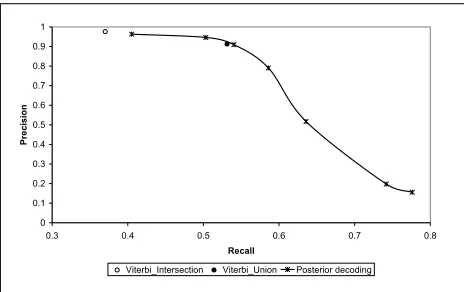
Figure 3: Recall/Precision curve of pairwise ci-tance alignments comparing Viterbi to posterior decoding.
of the system in general. Therefore, we concen-trate our discussion on general trends, and do not claim that the specific performance numbers we re-port here are statistically significant. As a point of comparison, the SMT community has been evalu-ating performance of word-alignment systems on an even smaller dataset of 447 pairs of non-overlapping sentences (Mihalcea and Pedersen, 2003).
We first analyze the performance of the system on pairwise citance alignments. Instead of tak-ing the equivalence closure of ;p we take only the symmetric closure. The result is 990 many-to-many pairwise alignments. In order to evalu-ate the effectiveness of the posterior-decoding al-gorithm, we generate the Viterbi alignments using the same CRF model. The Viterbi many-to-many pairwise alignments are then generated by combin-ing equivalent pairs of many-to-one alignments us-ing three different standard symmetrization methods for word-alignment—union, intersection, and the re-fined method of Och & Ney (2003).
Figure 3 shows the recall/precision trade-off of the pairwise posterior-decoding and Viterbi ments. The curve for the posterior-decoding align-ments was produced by varying the gap and match factors. For the Viterbi alignments, only three re-sults could be generated (one for each symmetriza-tion method). However, since the refined method produced a very similar result to the union, only the union is displayed in the figure. The impor-tant observation is that while posterior-decoding
en-ables refined control over the recall/precision trade-off, the Viterbi decoding generates only three align-ments, which cover only a small fraction of the curve at its high precision range. The union of Viterbi alignments achieves 0.531 recall at 0.913 preci-sion, which is similar result to the 0.540recall at
0.909 precision achieved using posterior-decoding with gap-factor and match-factor set to 1. However, unlike Viterbi, posterior-decoding produces align-ments with much higher recall levels, by increas-ing the match-factor and decreasincreas-ing the gap-factor. For example setting the gap-factor to0.1and match-factor to1.2results in alignments with0.636recall at0.517precision, and setting them to0.05and1.5
results in0.742recall at0.198precision. Generally, the gap and match factor affect the accuracy of the alignments as expected. In particular, the alignments with the best AMA (0.889) and the best F1-measure (0.678) are generated when the gap match factor are set to their natural values (1,1), which theoretically should maximize the expected AMA.
The performance of the pairwise alignments validates the underlying probabilistic model, showing it behaves as theoretically expected. However, the union of all pairwise alignments is not a valid MCA. To evaluate the MCA posterior decoding algorithm, we compared it to baseline MCAs. The baseline MCAs are constructed by using only the normalized-edit-distance edit distance(c
i k,c
j l)
max{|ci k|,|c
j l|}
, and defining cik ;δ
cjl if and only ifnormalized edit distance(cik, cjl)≤
δ, where δ is a distance threshold. The fi-nal baseline MCA is constructed by taking the equivalence closure of all pairwise alignments,
∼δ, ;δ ∪(;δ)−1)+
. The δ parameter can be used to control the recall/precision trade-off, since increasing it adds more position-pairs to the alignment, thus increasing recall, while decreasing it increases precision.
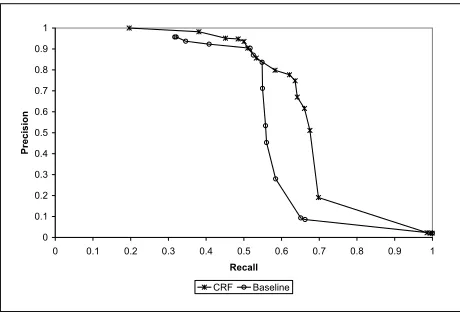
Figures 4 compares the performance of the CRF posterior-decoding MCAs with the baseline MCAs. The different MCAs were produced by varying the gap and match factors in the case of the posterior-decoding, andδ for the baseline MCAs. The CRF curve clearly dominates the baseline curve. How-ever, they do overlap in range between 0.52 and
prob-0 0.1 0.2 0.3 0.4 0.5 0.6 0.7 0.8 0.9 1
0 0.1 0.2 0.3 0.4 0.5 0.6 0.7 0.8 0.9 1
Recall
Pr
eci
si
on
[image:9.612.72.302.60.216.2]CRF Baseline
Figure 4: Recall/Precision curve of MCAs comparing CRF with posterior decoding to normalized-edit-distance baseline.
ably a range in which for this particular MCA the orthographic similarity is the most dominant fea-ture. While the baseline curve drops sharply after that range, the posterior-decoding curve keeps im-proving recall up to 0.636 at 0.748 precision, be-fore a major drop in precision. The additional recall is due to the ability of the CRF model to incorpo-rate multiple overlapping features. In particular, the domain-specific features are important for aligning words and phrases that have little or no orthographic similarity. At the other end of the overlap range, the posterior-decoding achieves better precision than the baseline for the same recall levels. For example, the posterior decoding gets0.381recall at0.982 preci-sion compared with0.346at0.937for the baseline.
Unlike the pairwise alignment case, the neutral settings of the gap and match factors did not result in the best AMA score. This is due to the equivalence closure heuristic that results in MCAs that are too dense, since a single link between two equivalence classes causes them to merge. The best AMA score (0.886) is obtained by reducing the gap-factor to0.5
and match-factor to0.45, in order to compensate for the effect of the equivalence closure heuristic. For comparison, the best F1-measure (0.690) is achieved by setting the gap and match factors to0.75.
An error analysis on the latter MCA shows that out of 1400 unique errors, 1194 (85.3%) are false negatives (FN) and 206 (14.7%) false positives (FP). Most errors (more than 600) are due to misalign-ment of subtypes (e.g., cdc, cdc6, cdc25A),
oppo-sites (e.g., phosphorylated and unphosphorylated) and complex entities (e.g.,cell cycle v.s. cell line). In addition, a large portion of FN errors are due to not aligning entities that belong to just four equiva-lence classes (e.g., 97 FN errors caused by terms in the class ofmotif,siteanddomain). Other types of errors include not aligning plural and singular forms of the same entities, aligning only part of multi-word entities, and incorrectly aligning orthographi-cally similar entities that belong to different classes.
7 Conclusions
We have shown how to derive a posterior-decoding algorithm that aims at maximizing the expected util-ity for the MCA problem, as a substitute for the sequence-annealing algorithm for MSA. Adding a gap and match factor to the utility function allows control over the recall/precision trade-off when us-ing posterior-decodus-ing. Another advantage of opti-mizing the expected utility with posterior-decoding methods is the decoupling from the probabilistic model that generated the posterior probabilities. This allows the use of CRFs instead of HMMs with a similar posterior decoding algorithm.
Our experiments were limited by the size of the labeled data. However, the results support the the-oretical predictions, and demonstrate the advantage of posterior-decoding over Viterbi decoding.
Since citances are still a relatively unexplored re-source, it is still unclear whether the formulation we presented here for citance alignment is the most use-ful for applications that use citances for compara-tive analysis of bioscience text. Unlike biological sequence alignment, citance alignments are much more subjective, as they depend on a loose defini-tion of semantic homology between entities. Even the definition of the basic entities can vary, since in many cases noun-compounds and other multi-word entities seem to be a more natural choice for basic el-ements of semantic homology and alignment. How-ever, automatic segmentation and entity recognition are still difficult tasks in the bioscience text domain and so new methods are worth investigating.
References
Phil Blunsom and Trevor Cohn. 2006.
Discrimina-tive word alignment with conditional random fields.
In Proceedings of the 21st International Conference
on Computational Linguistics and 44th Annual Meet-ing of the Association for Computational LMeet-inguistics, pages 65–72, Sydney, Australia, July. Association for Computational Linguistics.
Josias Braun-Blanquet. 1932. Plant sociology: the study
of plant communities. McGraw-Hill, New York.
Francis Caillez and Pascale Kuntz. 1996. A contribution to the study of the metric and euclidean structures of
dissimilarities.Psychometrika, 61(2):241–253.
Pedros Domingos. 2000. A unified bias-variance
de-composition and its applications. In Proceedings
of the Seventeenth International Conference on
Ma-chine Learning, pages 231–238, Stanford, CA.
Mor-gan Kaufmann.
Richard Durbin, Sean R. Eddy, Anders Krogh, and
Graeme Mitchison. 1998. Biological sequence
analy-sis. Probablistic models of proteins and nucleic acids. Cambridge University Press.
Jacob Falck, Niels Mailand, Randi G. Syljuasen, Jiri
Bartek, and Jiri Lukas. 2001. The
ATM-Chk2-Cdc25A checkpoint pathway guards against
radiore-sistant DNA synthesis. Nature, 410(6830):842–847.
Eugene Garfield. 1955. Citation indexes for science: A new dimension in documentation through association
of ideas.Science, 122(3159):108–111.
C. Lee Giles, Kurt D. Bollacker, and Steve Lawrence. 1998. Citeseer: an automatic citation indexing
sys-tem. InProceedings of the third ACM conference on
Digital libraries, pages 89–98. ACM Press.
Lynette Hirschman, Jong C. Park, Junichi Tsujii, Lim-soon Wong, and Cathy H. Wu. 2002. Accomplish-ments and challenges in literature data mining for
bi-ology. Bioinformatics, 18(12):1553–1561.
Simon Lacoste-Julien, Ben Taskar, Dan Klein, and
Michael I. Jordan. 2006. Word alignment via
quadratic assignment. InProceedings of the Human
Language Technology Conference of the NAACL, Main
Conference, pages 112–119, New York City, USA,
June. Association for Computational Linguistics.
John Lafferty, Andrew McCallum, and Fernando Pereira. 2001. Conditional random fields: Probabilistic models
for segmenting and labeling sequence data. InProc.
18th International Conf. on Machine Learning, pages
282–289. Morgan Kaufmann, San Francisco, CA.
Percy Liang, Ben Taskar, and Dan Klein. 2006.
Align-ment by agreeAlign-ment. In Proceedings of the Human
Language Technology Conference of the NAACL, Main
Conference, pages 104–111, New York City, USA,
June. Association for Computational Linguistics.
Dekang Lin. 1998. An information-theoretic definition
of similarity. InProc. 15th International Conf. on
Ma-chine Learning, pages 296–304. Morgan Kaufmann,
San Francisco, CA.
Ben-Ami Lipetz. 1965. Improvements of the selectiv-ity of citation indexes to science literature through
in-clusion of citation relationship indicators. American
Documentation, 16:81–90.
Mengxiong Liu. 1993. Progress in documentation. the complexities of citation practice: A review of citation
studies. Journal of Documentation, 49(4):370–408.
Evgeny Matusov, Richard Zens, and Hermann Ney. 2004. Symmetric word alignments for statistical
ma-chine translation. InCOLING ’04: Proceedings of the
20th international conference on Computational Lin-guistics, page 219, Morristown, NJ, USA. Association for Computational Linguistics.
Rada Mihalcea and Ted Pedersen. 2003. An evaluation exercise for word alignment. In Rada Mihalcea and
Ted Pedersen, editors, HLT-NAACL 2003 Workshop:
Building and Using Parallel Texts: Data Driven
Ma-chine Translation and Beyond, pages 1–10, Edmonton,
Alberta, Canada, May 31. Association for Computa-tional Linguistics.
Robert C. Moore. 2005. A discriminative framework for
bilingual word alignment. InHLT/EMNLP, pages 81–
88.
Preslav I. Nakov, Ariel S. Schwartz, and Marti A. Hearst. 2004. Citances: Citation sentences for semantic
anal-ysis of bioscience text. In SIGIR’04 Workshop on
Search and Discovery in Bioinformatics.
Franz Josef Och and Hermann Ney. 2003. A system-atic comparison of various statistical alignment mod-els. Computational Linguistics, 29(1):19–51.
Gian-Carlo Rota. 1964. The number of partitions of a
set. The American Mathematical Monthly, 71(5):498–
504, may.
Ralf Schl¨uter, Thomas Scharrenbach, Volker Steinbiss, and Hermann Ney. 2005. Bayes risk minimization
using metric loss functions. In Proceedings of the
European Conference on Speech Communication and
Technology, Interspeech, pages 1449–1452, Portugal,
September.
Ariel S. Schwartz and Lior Pachter. 2007. Multiple
alignment by sequence annealing. Bioinformatics,
Ariel S. Schwartz, Eugene W. Myers, and Lior Pachter.
2006. Alignment metric accuracy.
arXiv:q-bio.QM/0510052.
Ariel S. Schwartz. 2007. Posterior Decoding
Meth-ods for Optimization and Accuracy Control of Multiple
Alignments. Ph.D. thesis, EECS Department,
Univer-sity of California, Berkeley.
Howard D. White. 2004. Citation analysis and discourse