B
ESTC
UT: A Graph Algorithm for Coreference Resolution
Cristina Nicolae and Gabriel Nicolae Human Language Technology Research Institute
Department of Computer Science University of Texas at Dallas Richardson, TX 75083-0688
{cristina, gabriel}@hlt.utdallas.edu
Abstract
In this paper we describe a coreference resolution method that employs a classi-fication and a clusterization phase. In a novel way, the clusterization is produced as a graph cutting algorithm, in which nodes of the graph correspond to the men-tions of the text, whereas the edges of the graph constitute the confidences derived from the coreference classification. In ex-periments, the graph cutting algorithm for coreference resolution, called BESTCUT, achieves state-of-the-art performance.
1 Introduction
Recent coreference resolution algorithms tackle the problem of identifying coreferent mentions of the same entity in text as a two step procedure: (1) a classification phase that decides whether pairs of noun phrases corefer or not; and (2) a clusteriza-tion phase that groups together all menclusteriza-tions that refer to the same entity. An entity is an object or a set of objects in the real world, while a men-tion is a textual reference to an entity1. Most of the previous coreference resolution methods have similar classification phases, implemented either as decision trees (Soon et al., 2001) or as maxi-mum entropy classifiers (Luo et al., 2004). More-over, these methods employ similar feature sets. The clusterization phase is different across current approaches. For example, there are several linking decisions for clusterization. (Soon et al., 2001) ad-vocate the link-first decision, which links a men-tion to its closest candidate referent, while (Ng and Cardie, 2002) consider instead the link-best deci-sion, which links a mention to its most confident
1
This definition was introduced in (NIST, 2003).
candidate referent. Both these clustering decisions are locally optimized. In contrast, globally opti-mized clustering decisions were reported in (Luo et al., 2004) and (DaumeIII and Marcu, 2005a), where all clustering possibilities are considered by searching on a Bell tree representation or by us-ing the Learnus-ing as Search Optimization (LaSO) framework (DaumeIII and Marcu, 2005b) respec-tively, but the first search is partial and driven by heuristics and the second one only looks back in text. We argue that a more adequate clusterization phase for coreference resolution can be obtained by using a graph representation.
In this paper we describe a novel representa-tion of the coreference space as an undirected edge-weighted graph in which the nodes repre-sent all the mentions from a text, whereas the edges between nodes constitute the confidence values derived from the coreference classification phase. In order to detect the entities referred in the text, we need to partition the graph such that all nodes in each subgraph refer to the same entity. We have devised a graph partitioning method for coreference resolution, called BESTCUT, which is inspired from the well-known graph-partitioning algorithm Min-Cut (Stoer and Wagner, 1994). BESTCUT has a different way of computing the cut weight than Min-Cut and a different way of stopping the cut2. Moreover, we have slightly modified the Min-Cut procedures. BESTCUT re-places the bottom-up search in a tree representa-tion (as it was performed in (Luo et al., 2004)) with the top-down problem of obtaining the best partitioning of a graph. We start by assuming that all mentions refer to a single entity; the graph cut splits the mentions into subgraphs and the
split-2Whenever a graph is split in two subgraphs, as defined in
(Cormen et al., 2001), a cut of the graph is produced.
ting continues until each subgraph corresponds to one of the entities. The cut stopping decision has been implemented as anSVM-based classification (Cortes and Vapnik, 1995).
The classification and clusterization phases as-sume that all mentions are detected. In order to evaluate our coreference resolution method, we have (1) implemented a mention detection proce-dure that has the novelty of employing information derived from the word senses of common nouns as well as selected lexico-syntactic information; and (2) used a maximum entropy model for corefer-ence classification. The experiments conducted on
MUCandACEdata indicate state-of-the-art results when compared with the methods reported in (Ng and Cardie, 2002) and (Luo et al., 2004).
The remainder of the paper is organized as fol-lows. In Section 2 we describe the coreference resolution method that uses the BESTCUT cluster-ization; Section 3 describes the approach we have implemented for detecting mentions in texts; Sec-tion 4 reports on the experimental results; SecSec-tion 5 discusses related work; finally, Section 6 sum-marizes the conclusions.
2 BESTCUT Coreference Resolution
For each entity type (PERSON, ORGANIZATION, LOCATION, FACILITYorGPE3) we create a graph in which the nodes represent all the mentions of that type in the text, the edges correspond to all pairwise coreference relations, and the edge weights are the confidences of the coreference re-lations. We will divide this graph repeatedly by cutting the links between subgraphs until a stop model previously learned tells us that we should stop the cutting. The end result will be a partition that approximates the correct division of the text into entities.
We consider this graph approach to clustering a more accurate representation of the relations be-tween mentions than a tree-based approach that treats only anaphora resolution, trying to connect mentions with candidate referents that appear in text before them. We believe that a correct reso-lution has to tackle cataphora resoreso-lution as well, by taking into account referents that appear in the text after the anaphors. Furthermore, we believe that a graph representation of mentions in a text is more adequate than a tree representation because the coreference relation is symmetrical in
addi-3
Entity types as defined by (NIST, 2003).
tion to being transitive. A greedy bottom-up ap-proach does not make full use of this property. A graph-based clusterization starts with a complete overall view of all the connections between men-tions, therefore local errors are much less proba-ble to influence the correctness of the outcome. If two mentions are strongly connected, and one of them is strongly connected with the third, all three of them will most probably be clustered together even if the third edge is not strong enough, and that works for any order in which the mentions might appear in the text.
2.1 Learning Algorithm
The coreference confidence values that become the weights in the starting graphs are provided by a maximum entropy model, trained on the train-ing datasets of the corpora used in our experi-ments. For maximum entropy classification we used a maxent4 tool. Based on the data seen, a maximum entropy model (Berger et al., 1996) of-fers an expression (1) for the probability that there exists coreferenceC between a mentionmiand a
mentionmj.
P(C|mi, mj) =
e(Pkλkgk(mi,mj,C)) Z(mi, mj)
(1)
where gk(mi, mj, C) is a feature and λk is its
weight;Z(mi, mj)is a normalizing factor.
We created the training examples in the same way as (Luo et al., 2004), by pairing all men-tions of the same type, obtaining their feature vectors and taking the outcome (coreferent/non-coreferent) from the key files.
2.2 Feature Representation
We duplicated the statistical model used by (Luo et al., 2004), with three differences. First, no fea-ture combination was used, to prevent long run-ning times on the large amount ofACE data. Sec-ond, through an analysis of the validation data, we implemented seven new features, presented in Ta-ble 1. Third, as opposed to (Luo et al., 2004), who represented all numerical features quantized, we translated each numerical feature into a set of bi-nary features that express whether the value is in certain intervals. This transformation was neces-sary because our maximum entropy tool performs better on binary features. (Luo et al., 2004)’s fea-tures were not reproduced here from lack of space; please refer to the relevant paper for details.
4
Category Feature name Feature description
lexical head-match true if the two heads are identical
type-pair for each mention: name→its type, noun→ NOUN , pronoun→its spelling
name-alias true if a mention is an alias of the other one
syntactic same-governing-category true if both mentions are covered by the same type of node, e.g. NP, VP, PP
path the parse tree path fromm2tom1
[image:3.595.316.499.233.363.2]coll-comm true if either mention collocates with a communication verb grammatical gn-agree true if the two mentions agree in gender and number
Table 1: The added features for the coreference model.
2.3 Clusterization Method: BESTCUT
We start with five initial graphs, one for each en-tity type, each containing all the mentions of that type and their weighted connections. This initial division is correct because no mentions of differ-ent differ-entity types will corefer. Furthermore, by do-ing this division we avoid unnecessary confusion in the program’s decisions and we decrease its run-ning time. Each of these initial graphs will be cut repeatedly until the resulting partition is satisfac-tory. In each cut, we eliminate from the graph the edges between subgraphs that have a very weak connection, and whose mentions are most likely not part of the same entity.
Formally, the graph model can be defined as fol-lows. LetM ={mi : 1..n}be n mentions in the
document andE ={ej : 1..m}be m entities. Let
g :M →E be the map from a mentionmi ∈M
to an entityej ∈E. Letc:MxM →[0,1]be the
confidence the learning algorithm attaches to the coreference between two mentionsmi, mj ∈ M.
Let T = {tk : 1..p} be the set of entity types
or classes. Then we attach to each entity classtk
an undirected, edge-weighted graph Gk(Vk, Ek),
where Vk = {mi|g(mi).type = tk} and Ek =
{(mi, mj, c(mi, mj))|mi, mj ∈Vk}.
The partitioning of the graph is based at each step on the cut weight. As a starting point, we used the Min-Cut algorithm, presented and proved correct in (Stoer and Wagner, 1994). In this simple and efficient method, the weight of the cut of a graph into two subgraphs is the sum of the weights of the edges crossing the cut. The partition that minimizes the cut weight is the one chosen. The main procedure of the algorithm computes cuts-of-the-phase repeatedly and selects the one with the minimum cut value (cut weight). We adapted this algorithm to our coreference situation.
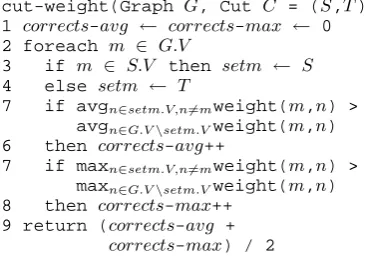
To decide the minimum cut (from here on called the BESTCUT), we use as cut weight the number
of mentions that are correctly placed in their set. The method for calculating the correctness score is
presented in Figure 1. The BESTCUTat one stage is the cut-of-the-phase with the highest correctness score.
cut-weight(Graph G, Cut C = (S,T)) 1 corrects-avg ← corrects-max ← 0 2 foreach m ∈ G.V
3 if m ∈ S.V then setm ← S
4 else setm ← T
7 if avgn∈setm.V,n6=mweight(m,n) >
avgn∈G.V\setm.Vweight(m,n)
6 then corrects-avg++
7 if maxn∈setm.V,n6=mweight(m,n) >
maxn∈G.V\setm.Vweight(m,n)
8 then corrects-max++ 9 return (corrects-avg +
corrects-max) / 2
Figure 1: Computing the cut-weight.
An additional learning model was trained to de-cide if cutting a set of mentions is better or worse than keeping the mentions together. The model was optimized to maximize theECM-Fscore5. We
will denote by S the larger part of the cut and T
the smaller one. C.E is the set of edges crossing the cut, andGis the current graph before the cut.
S.V and T.V are the set of vertexes in S and in
T, respectively. S.E is the set of edges fromS, whileT.Eis the set of edges fromT. The features for stopping the cut are presented in Table 2. The model was trained using 10-fold cross-validation on the training set. In order to learn when to stop the cut, we generated a list of positive and nega-tive examples from the training files. Each train-ing example is associated with a certain cut(S, T). Since we want to learn a stop function, the positive examples must be examples that describe when the cut must not be done, and the negative examples are examples that present situations when the cut must be performed. Let us consider that the list of entities from a text is E = {ej : 1..m} with
ej = {mi1, mi2, ...mik}the list of mentions that
refer toej. We generated a negative example for
each pair (S = {ei}, T = {ej}) with i 6= j –
each entity must be separated from any other
en-5
Feature name Feature description
st-ratio |S.V|/|T.V|– the ratio between the cut parts
ce-ratio |C.E|/|G.E|– the proportion of the cut from the entire graph
c-min min(C.E)– the smallest edge crossing the cut
c-max max(C.E)– the largest edge crossing the cut
c-avg avg(C.E) – the average of the edges crossing the cut
c-hmean hmean(C.E)– the harmonic mean of the edges crossing the cut
c-hmeax hmeax(C.E) – a variant of the har-monic mean. hmeax(C.E) = 1−
hmean(C.E′) where each edge from
E′has the weight equal to 1 minus the
corresponding edge fromE
lt-c-avg-ratio how many edges from the cut are less than the average of the cut (as a ratio)
lt-c-hmean-ratio
how many edges from the cut are less than the harmonic mean of the cut (as a ratio)
st-avg avg(S.E+T.E) – the average of the edges from the graph when the edges from the cut are not considered
g-avg avg(G.E) – the average of the edges from the graph
st-wrong-avg-ratio
how many vertexes are in the wrong part of the cut using the average measure for the ‘wrong’ (as a ratio)
st-wrong-max-ratio
how many vertexes are in the wrong part of the cut using the max measure for the ‘wrong’ (as a ratio)
lt-c-avg-ratio
< st-lt-c-avg-ratio
1 ifr1< r2, 0 otherwise;r1is the ratio
of the edges fromC.Ethat are smaller than the average of the cut;r2is the ratio
of the edges fromS.E +T.Ethat are smaller than the average of the cut
g-avg > st-avg
[image:4.595.72.292.57.477.2]1 if theavg(G.E)> avg(S.E+T.E), and 0 otherwise
Table 2: The features for stopping the cut.
tity. We also generated negative examples for all pairs(S = {ei}, T = E\S)– each entity must
be separated from all the other entities considered together. To generate positive examples, we simu-lated the cut on a graph corresponding to a single entity ej. Every partial cut of the mentions ofej
was considered as a positive example for our stop model.
We chose not to include pronouns in the BEST
-CUT initial graphs, because, since most features are oriented towards Named Entities and common nouns, the learning algorithm (maxent) links pro-nouns with very high probability to many possi-ble antecedents, of which not all are in the same chain. Thus, in the clusterization phase the pro-nouns would act as a bridge between different en-tities that should not be linked. To prevent this, we solved the pronouns separately (at the end of
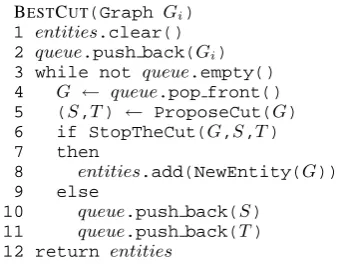
BESTCUT(Graph Gi)
1 entities.clear() 2 queue.push back(Gi)
3 while not queue.empty() 4 G ← queue.pop front() 5 (S,T) ← ProposeCut(G) 6 if StopTheCut(G,S,T) 7 then
8 entities.add(NewEntity(G)) 9 else
[image:4.595.318.490.61.193.2]10 queue.push back(S) 11 queue.push back(T) 12 return entities
Figure 2: The general algorithm for BESTCUT.
the BESTCUTalgorithm) by linking them to their
antecedent with the best coreference confidence. Figure 2 details the main procedure of the BESTCUT algorithm. The algorithm receives as input a weighted graph having a vertex for each mention considered and outputs the list of entities created. In each stage, a cut is proposed for all subgraphs in the queue. In case StopTheCut de-cides that the cut must be performed on the sub-graph, the two sides of the cut are added to the queue (lines 10-11); if the graph is well connected and breaking the graph in two parts would be a bad thing, the current graph will be used to cre-ate a single entity (line 8). The algorithm ends when the queue becomes empty. ProposeCut
[image:4.595.72.291.67.481.2](Fig-ProposeCut(Graph G) 1 while |G.V| > 1
2 (S,T) ← ProposeCutPhase(G) 3 if the cut-of-the-phase (S,T)
is-lighter than the current best cut (Sb, Tb)
4 then store the cut-of-the-phase as (Sb, Tb)
5 return (Sb, Tb)
Figure 3: The algorithm for ProposeCut.
ure 3) returns a cut of the graph obtained with an algorithm similar to the Min-Cut algorithm’s procedure called MinimumCut. The differences between our algorithm and the Min-Cut proce-dure are that the most tightly connected vertex in each step of the ProposeCutPhase procedure,z, is found using expression 2:
z=argmaxy6∈Awa(A, y) (2)
wherewa(A, y) = |A1|Px∈Aw(x, y), and the
ProposeCutPhase(Graph G) 1 A ← {G.V.f irst}
2 while |A| < |G.V|
3 last ← the most tightly connected vertex 4 add last to A
5 store the cut-of-the-phase and shrink G by merging the two vertexes added last
6 return (G.V \ {last}, last)
Figure 4: The algorithm for ProposeCutPhase.
2.4 An Example
Let us consider an example of how the BESTCUT
algorithm works on two simple sentences (Fig-ure 5). The entities present in this example are: {Mary1, the girl5} and {a brother2, John3, The
boy4}. Since they are all PERSONs, the algorithm
Mary1has a brother2, John3. The boy4is older than
the girl5.
Figure 5: An example.
will be applied on a single graph, corresponding to the class PERSONand composed of all these men-tions.
The initial graph is illustrated in Figure 6, with the coreference relation marked through a differ-ent coloring of the nodes. Each node number cor-responds to the mention with the same index in Figure 5. 00000 00000 00000 00000 00000 11111 11111 11111 11111 11111
2
1
00000 00000 00000 00000 00000 11111 11111 11111 11111 111114
5
00000 00000 00000 00000 00000 11111 11111 11111 11111 111113
0.2 0.1 0.6 0.5 0.1 0.7 0.5Figure 6: The initial graph
The strongest confidence score is between a
brother2 and John3, because they are connected through an apposition relation. The graph was simplified by eliminating the edges that have an insignificant weight, e.g. the edges between John3 and the girl5 or between Mary1 and a brother2.
Function BESTCUTstarts with the whole graph.
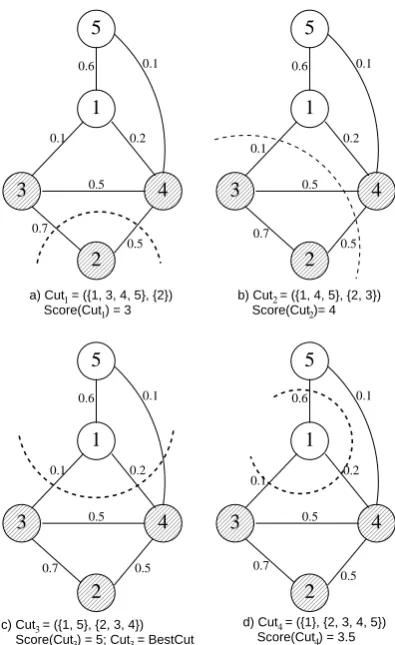
The first cut of the phase, obtained by function ProposeCutPhase, is the one in Figure 7.a. This
00000 00000 00000 00000 00000 11111 11111 11111 11111 11111 2 1 000000 000000 000000 000000 000000 111111 111111 111111 111111 111111 4 5 00000 00000 00000 00000 00000 11111 11111 11111 11111 11111 3 2
b) Cut = ({1, 4, 5}, {2, 3}) Score(Cut )= 42
0.2 0.7 0.6 0.5 0.1 0.5 0.1 00000 00000 00000 00000 00000 11111 11111 11111 11111 11111 2 1 00000 00000 00000 00000 00000 11111 11111 11111 11111 11111 4 5 00000 00000 00000 00000 00000 11111 11111 11111 11111 11111 3
c) Cut = ({1, 5}, {2, 3, 4})3 Score(Cut ) = 5; Cut = BestCut3 3
0.2 0.1 0.6 0.5 0.1 0.7 0.5 00000 00000 00000 00000 00000 11111 11111 11111 11111 11111 2 1 000000 000000 000000 000000 000000 111111 111111 111111 111111 111111 4 5 00000 00000 00000 00000 00000 11111 11111 11111 11111 11111 3 4
d) Cut = ({1}, {2, 3, 4, 5}) Score(Cut ) = 3.54
0.2 0.7 0.6 0.5 0.1 0.5 0.1 00000 00000 00000 00000 00000 11111 11111 11111 11111 11111 2 1 00000 00000 00000 00000 00000 11111 11111 11111 11111 11111 4 5 00000 00000 00000 00000 00000 11111 11111 11111 11111 11111 3 1 Score(Cut ) = 3 a) Cut = ({1, 3, 4, 5}, {2})
1 0.2 0.1 0.6 0.5 0.1 0.5 0.7
Figure 7: Cuts-of-the-phase
cut separates node 2 from the rest of the graph. In calculating the score of the cut (using the algo-rithm from Figure 1), we obtain an average num-ber of three correctly placed mentions. This can be verified intuitively on the drawing: mentions 1, 2 and 5 are correctly placed, while 3 and 4 are not. The score of this cut is therefore 3. The sec-ond, the third and the fourth cuts of the phase, in Figures 7.b, 7.c and 7.d, have the scores 4, 5 and 3.5 respectively. An interesting thing to note at the fourth cut is that the score is no longer an in-teger. This happens because it is calculated as an average between avg = 4 and
corrects-max = 3. The methods disagree about the
place-ment of place-mention 1. The average of the outgo-ing weights of mention 1 is 0.225, less than 0.5 (the default weight assigned to a single mention) therefore the first method declares it is correctly placed. The second considers only the maximum; 0.6 is greater than 0.5, so the mention appears to be more strongly connected with the outside than the inside. As we can see, the contradiction is be-cause of the uneven distribution of the weights of the outgoing edges.
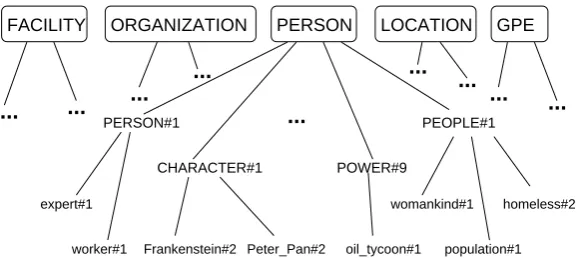
great-FACILITY ORGANIZATION PERSON LOCATION GPE
POWER#9
PERSON#1 PEOPLE#1
CHARACTER#1
...
expert#1
Peter_Pan#2
womankind#1
population#1 homeless#2
... ...
...
... ... ... ... ...
[image:6.595.155.445.60.189.2]Frankenstein#2 oil_tycoon#1 worker#1
Figure 8: Part of the hierarchy containing 42 WordNet equivalent concepts for the five entity types, with all their synonyms and hyponyms. The hierarchy has 31,512 word-sense pairs in total
est score, which is Cut3(Figure 7.c). Because this is also the correct cut, all cuts proposed after this one will be ignored– the machine learning algo-rithm that was trained when to stop a cut will al-ways declare against further cuts. In the end, the cut returned by function BESTCUT is the correct one: it divides mentions Mary1 and the girl5 from mentions a brother2, John3 and The boy4.
3 Mention Detection
Because our BESTCUT algorithm relies heavily
on knowing entity types, we developed a method for recognizing entity types for nominal mentions. Our statistical approach uses maximum entropy classification with a few simple lexical and syn-tactic features, making extensive use of WordNet (Fellbaum, 1998) hierarchy information. We used the ACE corpus, which is annotated with men-tion and entity informamen-tion, as data in a super-vised machine learning method to detect nominal mentions and their entity types. We assigned six entity types: PERSON, ORGANIZATION, LOCA
-TION, FACILITY,GPEandUNK(for those who are in neither of the former categories) and two gener-icity outcomes: GENERIC and SPECIFIC. We only considered the intended value of the mentions from the corpus. This was motivated by the fact that we need to classify mentions according to the context in which they appear, and not in a general way. Only contextual information is useful further in coreference resolution. We have experimentally discovered that the use of word sense disambigua-tion improves the performance tremendously (a boost in score of 10%), therefore all the features use the word senses from a previously-applied word sense disambiguation program, taken from (Mihalcea and Csomai, 2005).
For creating training instances, we associated
an outcome to each markable (NP) detected in the training files: the markables that were present in the key files took their outcome from the key file annotation, while all the other markables were as-sociated with outcome UNK. We then created a
training example for each of the markables, with the feature vector described below and as target function the outcome. The aforementioned out-come can be of three different types. The first type of outcome that we tried was the entity type (one member of the set PERSON, ORGANIZATION, LO -CATION, FACILITY, GPE and UNK); the second type was the genericity information (GENERIC or SPECIFIC), whereas the third type was a
combi-nation between the two (pairwise combicombi-nations of the entity types set and the genericity set, e.g. PERSON SPECIFIC).
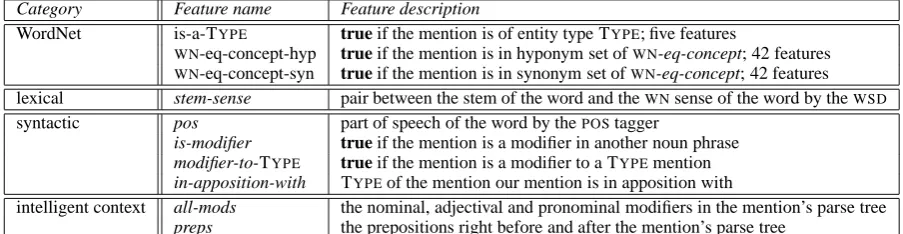
The feature set consists of WordNet features, lexical features, syntactic features and intelligent context features, briefly described in Table 3. With the WordNet features we introduce the WordNet
equivalent concept. A WordNet equivalent
is-a-Category Feature name Feature description
WordNet is-a-TYPE true if the mention is of entity type TYPE; five features
WN-eq-concept-hyp true if the mention is in hyponym set ofWN-eq-concept; 42 features
WN-eq-concept-syn true if the mention is in synonym set ofWN-eq-concept; 42 features
lexical stem-sense pair between the stem of the word and theWNsense of the word by theWSD syntactic pos part of speech of the word by thePOStagger
is-modifier true if the mention is a modifier in another noun phrase
modifier-to-TYPE true if the mention is a modifier to a TYPEmention
in-apposition-with TYPEof the mention our mention is in apposition with
intelligent context all-mods the nominal, adjectival and pronominal modifiers in the mention’s parse tree
[image:7.595.70.522.63.180.2]preps the prepositions right before and after the mention’s parse tree
Table 3: The features for the mention detection system.
PERSON∼in-apposition-with(PERSON).
All these features apply to the “true head” of a noun phrase, i.e. if the noun phrase is a parti-tive construction (“five students”, “a lot of
com-panies”, “a part of the country”), we extract the
“true head”, the whole entity that the part was taken out of (“students”, “companies”,
“coun-try”), and apply the features to that “true head”
instead of the partitive head.
For combining the mention detection module with the BESTCUT coreference resolver, we also generated classifications for Named Entities and pronouns by using the same set of features minus the WordNet ones (which only apply to nominal mentions). For the Named Entity classifier, we added the feature Named-Entity-type as obtained by the Named Entity Recognizer. We generated a list of all the markable mentions and their en-tity types and presented it as input to the BEST -CUT resolver instead of the list of perfect men-tions. Note that this mention detection does not contain complete anaphoricity information. Only the mentions that are a part of the five consid-ered classes are treated as anaphoric and clus-tered, while the UNK mentions are ignored, even if an outside anaphoricity classifier might catego-rize some of them as anaphoric.
4 Experimental Results
The clusterization algorithms that we imple-mented to evaluate in comparison with our method are (Luo et al., 2004)’s Belltree and Link-Best (best-first clusterization) from (Ng and Cardie, 2002). The features used were described in section 2.2. We experimented on the ACEPhase 2 (NIST,
2003) and MUC6 (MUC-6, 1995) corpora. Since we aimed to measure the performance of corefer-ence, the metrics used for evaluation are theECM -F(Luo et al., 2004) and theMUC P,RandFscores (Vilain et al., 1995).
In our first experiment, we tested the three coreference clusterization algorithms on the development-test set of the ACE Phase 2 corpus, first on true mentions (i.e. the mentions annotated in the key files), then on detected mentions (i.e. the mentions output by our mention detection sys-tem presented in section 3) and finally without any prior knowledge of the mention types. The results obtained are tabulated in Table 4. As can be ob-served, when it has prior knowledge of the men-tion types BESTCUT performs significantly bet-ter than the other two systems in theECM-F score and slightly better in theMUC metrics. The more
knowledge it has about the mentions, the better it performs. This is consistent with the fact that the first stage of the algorithm divides the graph into subgraphs corresponding to the five entity types. If BESTCUThas no information about the mentions, its performance ranks significantly under the Link-Best and Belltree algorithms in ECM-F and MUC R. Surprisingly enough, the Belltree algorithm, a globally optimized algorithm, performs similarly to Link-Best in most of the scores.
Despite not being as dramatically affected as BESTCUT, the other two algorithms also decrease in performance with the decrease of the mention information available, which empirically proves that mention detection is a very important module for coreference resolution. Even with an F-score of 77.2% for detecting entity types, our mention detection system boosts the scores of all three al-gorithms when compared to the case where no in-formation is available.
It is apparent that theMUCscore does not vary
significantly between systems. This only shows that none of them is particularly poor, but it is not a relevant way of comparing methods– the MUC
metric has been found too indulgent by researchers ((Luo et al., 2004), (Baldwin et al., 1998)). The
MUCscore
Clusterization algorithm Mentions ECM-F% MUC P% MUC R% MUC F%
BESTCUT key 82.7 91.1 88.2 89.63
detected 73.0 88.3 75.1 81.17
undetected 41.2 52.0 82.4 63.76
Belltree (Luo et al., 2004) key 77.9 88.5 89.3 88.90
detected 70.8 86.0 76.6 81.03
undetected 52.6 40.3 87.1 55.10
Link-Best (Ng and Cardie, 2002) key 77.9 88.0 90.0 88.99
detected 70.7 85.1 77.3 81.01
[image:8.595.74.526.64.181.2]undetected 51.6 39.6 88.5 54.72
Table 4: Comparison of results between three clusterization algorithms on ACE Phase 2. The learning algorithms are maxent for coreference and SVMfor stopping the cut in BESTCUT. In turn, we obtain the mentions from the key files, detect them with our mention detection algorithm or do not use any information about them.
annotation keys and the system output, while the
ECM-F metric aligns the detected entities with the key entities so that the number of common men-tions is maximized. TheECM-Fscorer overcomes two shortcomings of the MUC scorer: not consid-ering single mentions and treating every error as equally important (Baldwin et al., 1998), which makes the ECM-F a more adequate measure of
coreference.
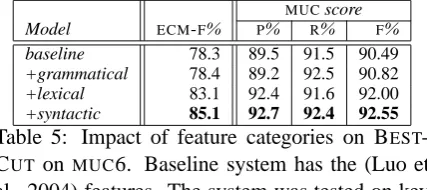
Our second experiment evaluates the impact that the different categories of our added features have on the performance of the BESTCUT sys-tem. The experiment was performed with a max-ent classifier on theMUC6 corpus, which was pri-orly converted into ACE format, and employed mention information from the key annotations.
MUCscore
Model ECM-F% P% R% F%
baseline 78.3 89.5 91.5 90.49
+grammatical 78.4 89.2 92.5 90.82
+lexical 83.1 92.4 91.6 92.00
+syntactic 85.1 92.7 92.4 92.55
Table 5: Impact of feature categories on BEST -CUT on MUC6. Baseline system has the (Luo et al., 2004) features. The system was tested on key mentions.
From Table 5 we can observe that the lexi-cal features (head-match, type-pair, name-alias) have the most influence on the ECM-F and MUC
scores, succeeded by the syntactic features
(same-governing-category, path, coll-comm). Despite what intuition suggests, the improvement the grammatical feature gn-agree brings to the system is very small.
5 Related Work
It is of interest to discuss why our implementa-tion of the Belltree system (Luo et al., 2004) is comparable in performance to Link-Best (Ng and Cardie, 2002). (Luo et al., 2004) do the clus-terization through a beam-search in the Bell tree using either a mention-pair or an entity-mention model, the first one performing better in their ex-periments. Despite the fact that the Bell tree is a complete representation of the search space, the search in it is optimized for size and time, while potentially losing optimal solutions– similarly to a Greedy search. Moreover, the fact that the two implementations are comparable is not inconceiv-able once we consider that (Luo et al., 2004) never compared their system to another coreference re-solver and reported their competitive results on true mentions only.
(Ng, 2005) treats coreference resolution as a problem of ranking candidate partitions generated by a set of coreference systems. The overall per-formance of the system is limited by the perfor-mance of its best component. The main differ-ence between this approach and ours is that (Ng, 2005)’s approach takes coreference resolution one step further, by comparing the results of multiple systems, while our system is a single resolver; fur-thermore, he emphasizes the global optimization of ranking clusters obtained locally, whereas our focus is on globally optimizing the clusterization method inside the resolver.
(DaumeIII and Marcu, 2005a) use the Learning
as Search Optimization framework to take into
[image:8.595.75.289.505.600.2]do. By doing so, it may be easier to detect the entity type of a mention once we have additional clues (expressed in terms of coreference features) about its possible antecedents. For example, label-ing Washlabel-ington as a PERSONis more probable af-ter encounaf-tering George Washington previously in the text. However, the coreference problem does not immediately benefit from the joining.
6 Conclusions
We have proposed a novel coreference clusteri-zation method that takes advantage of the effi-ciency and simplicity of graph algorithms. The approach is top-down and globally optimized, and takes into account cataphora resolution in addition to anaphora resolution. Our system compares fa-vorably to two other implemented coreference sys-tems and achieves state-of-the-art performance on theACEPhase 2 corpus on true and detected men-tions. We have also briefly described our mention detection system whose output we used in con-junction with the BESTCUTcoreference system to achieve better results than when no mention infor-mation was available.
Acknowledgments
We would like to thank the three anonymous re-viewers for their very helpful suggestions and comments on the early draft of our paper.
References
B. Baldwin, T. Morton, A. Bagga, J. Baldridge, R. Chandraseker, A. Dimitriadis, K. Snyder, and M. Wolska. 1998. Description of the university of pennsylvania camp system as used for coreference. In Proceedings of the 7th Message Understanding
Conference (MUC-7).
A. L. Berger, S. A. D. Pietra, and V. J. D. Pietra. 1996. A maximum entropy approach to natural language processing. Computational Linguistics, 1(22):39– 71.
T. H. Cormen, C. E. Leiserson, R. L. Rivest, and C. Stein. 2001. Introduction to Algorithms, Second
Edition. MIT.
C. Cortes and V. Vapnik. 1995. Support-vector net-works. Machine Learning, 20(3):273–297.
H. DaumeIII and D. Marcu. 2005a. A large-scale ex-ploration of effective global features for a joint en-tity detection and tracking model. pages 97–104, Vancouver.
H. DaumeIII and D. Marcu. 2005b. Learning as search optimization: Approximate large margin methods for structured prediction. In The International
Con-ference on Machine Learning (ICML).
C. Fellbaum, editor. 1998. WordNet: An Electronic
Lexical Database and Some of its Applications. MIT
Press.
X. Luo, A. Ittycheriah, H. Jing, N. Kambhatla, and S. Roukos. 2004. A mention-synchronous corefer-ence resolution algorithm based on the bell tree. In
Proceedings of the 42nd Meeting of the Association for Computational Linguistics, Barcelona, Spain.
R. Mihalcea and A. Csomai. 2005. Senselearner: Word sense disambiguation for all words in unre-stricted text. In Proceedings of the 43rd Meeting of
the Association for Computational Linguistics, Ann
Arbor, MI.
MUC-6. 1995. Coreference task definition.
V. Ng and C. Cardie. 2002. Improving machine learn-ing approaches to coreference resolution. In
Pro-ceedings of the 4Oth Meeting of the Association for Computational Linguistics, Philadelphia,
Pennsyl-vania.
V. Ng. 2004. Learning noun phrase anaphoricity to improve conference resolution: Issues in representa-tion and optimizarepresenta-tion. In Proceedings of the 42nd
Meeting of the Association for Computational Lin-guistics, Barcelona, Spain.
V. Ng. 2005. Machine learning for coreference resolu-tion: From local classification to global ranking. In
Proceedings of the 43rd Meeting of the Association for Computational Linguistics, pages 157–164, Ann
Arbor, MI.
NIST. 2003. Entity detection and tracking - phase 1; edt and metonymy annotation guidelines. version 2.5.1 20030502.
M. Pasca and S. Harabagiu. 2001. High performance question/answering. In Proceedings of the 24th
An-nual International ACM SIGIR Conference on Re-search and Development in Information Retrieval,
pages 366–374, New Orleans, LA.
W. M. Soon, H. T. Ng, and D. C. Y. Lim. 2001. A machine learning approach to coreference resolu-tion of noun phrases. Computaresolu-tional Linguistics, 4(27):521–544.
M. Stoer and F. Wagner. 1994. A simple min cut al-gorithm. In Jan van Leeuwen, editor, Proceedings of
the 1994 European Symposium on Algorithms, pages
141–147, New York. Springer-Verlag.
M. Vilain, J.Burger, J. Aberdeen, D. Connolly, and L. Hirschman. 1995. A model-theoretic coreference scoring scheme. In Proceedings of the Sixth
Mes-sage Understanding Conference (MUC-6), pages