Detecting Parser Errors Using Web-based Semantic Filters
Alexander Yates Stefan Schoenmackers
University of Washington Computer Science and Engineering
Box 352350 Seattle, WA 98195-2350
{ayates,stef,etzioni}@cs.washington.edu
Oren Etzioni
Abstract
NLP systems for tasks such as question answering and information extraction typ-ically rely on statistical parsers. But the ef-ficacy of such parsers can be surprisingly low, particularly for sentences drawn from heterogeneous corpora such as the Web. We have observed that incorrect parses of-ten result in wildly implausible semantic interpretations of sentences, which can be detected automatically using semantic in-formation obtained from the Web.
Based on this observation, we introduce
Web-based semantic filtering—a novel,
domain-independent method for automat-ically detecting and discarding incorrect parses. We measure the effectiveness of our filtering system, called WOODWARD, on two test collections. On a set of TREC questions, it reduces error by 67%. On a set of more complex Penn Treebank sentences, the reduction in error rate was 20%.
1 Introduction
Semantic processing of text in applications such as question answering or information extraction frequently relies on statistical parsers. Unfortu-nately, the efficacy of state-of-the-art parsers can be disappointingly low. For example, we found that the Collins parser correctly parsed just 42% of the list and factoid questions from TREC 2004 (that is, 42% of the parses had 100% precision and 100% recall on labeled constituents). Similarly, this parser produced 45% correct parses on a sub-set of 100 sentences from section 23 of the Penn Treebank.
Although statistical parsers continue to improve their efficacy over time, progress is slow, par-ticularly for Web applications where training the parsers on a “representative” corpus of hand-tagged sentences is not an option. Because of the heterogeneous nature of text on the Web, such a corpus would be exceedingly difficult to generate. In response, this paper investigates the possibil-ity of detecting parser errors by using semantic in-formation obtained from the Web. Our fundamen-tal hypothesis is that incorrect parses often result
in wildly implausible semantic interpretations of sentences, which can be detected automatically in certain circumstances. Consider, for example, the
following sentence from the Wall Street Journal: “That compares with per-share earnings from con-tinuing operations of 69 cents.” The Collins parser yields a parse that attaches “of 69 cents” to “op-erations,” rather than “earnings.” By computing the mutual information between “operations” and “cents” on the Web, we can detect that this attach-ment is unlikely to be correct.
Our WOODWARD system detects parser errors as follows. First, it maps the tree produced by a parser to a relational conjunction (RC), a logic-based representation language that we describe in Section 2.1. Second, WOODWARD employs four distinct methods for analyzing whether a conjunct in the RC is likely to be “reasonable” as described in Section 2.
Our approach makes several assumptions. First, if the sentence is absurd to begin with, then a cor-rect parse could be deemed incorcor-rect. Second, we require a corpus whose content overlaps at least in part with the content of the sentences to be parsed. Otherwise, much of our semantic analysis is im-possible.
In applications such as Web-based question an-swering, these assumptions are quite natural. The
questions are about topics that are covered exten-sively on the Web, and we can assume that most questions link verbs to nouns in reasonable com-binations. Likewise, when using parsing for infor-mation extraction, we would expect our assump-tions to hold as well.
Our contributions are as follows:
1. We introduce Web-based semantic filtering— a novel, domain-independent method for de-tecting and discarding incorrect parses.
2. We describe four techniques for analyzing relational conjuncts using semantic informa-tion obtained from the Web, and assess their efficacy both separately and in combination.
3. We find that WOODWARD can filter good parses from bad on TREC 2004 questions for a reduction of 67% in error rate. On a harder set of sentences from the Penn Treebank, the reduction in error rate is 20%.
The remainder of this paper is organized as fol-lows. We give an overview of related work in Sec-tion 1.1. SecSec-tion 2 describes semantic filtering, in-cluding our RC representation and the four Web-based filters that constitute the WOODWARD sys-tem. Section 3 presents our experiments and re-sults, and section 4 concludes and gives ideas for future work.
1.1 Related Work
The problem of detecting parse errors is most sim-ilar to the idea of parse reranking. Collins (2000) describes statistical techniques for reranking alter-native parses for a sentence. Implicitly, a rerank-ing method detects parser errors, in that if the reranking method picks a new parse over the orig-inal one, it is classifying the origorig-inal one as less likely to be correct. Collins uses syntactic and lex-ical features and trains on the Penn Treebank; in contrast, WOODWARD uses semantic features de-rived from the web. See section 3 for a comparison of our results with Collins’.
Several systems produce a semantic interpreta-tion of a sentence on top of a parser. For example, Bos et al. (2004) build semantic representations from the parse derivations of a CCG parser, and the English Resource Grammar (ERG) (Toutanova et al., 2005) provides a semantic representation us-ing minimal recursion semantics. Toutanova et al. also include semantic features in their parse se-lection mechanism, although it is mostly syntax-driven. The ERG is a hand-built grammar and thus
does not have the same coverage as the grammar we use. We also use the semantic interpretations in a novel way, checking them against semantic information on the Web to decide if they are plau-sible.
NLP literature is replete with examples of sys-tems that produce semantic interpretations and use semantics to improve understanding. Sev-eral systems in the 1970s and 1980s used hand-built augmented transition networks or semantic networks to prune bad semantic interpretations. More recently, people have tried incorporating large lexical and semantic resources like WordNet, FrameNet, and PropBank into the disambiguation process. Allen (1995) provides an overview of some of this work and contains many references. Our work focuses on using statistical techniques over large corpora, reducing the need for hand-built resources and making the system more robust to changes in domain.
Numerous systems, including Question-Answering systems like MULDER (Kwok et al., 2001), PiQASso (Attardi et al., 2001), and Moldovan et al.’s QA system (2003), use parsing technology as a key component in their analysis of sentences. In part to overcome incorrect parses, Moldovan et al.’s QA system requires a complex set of relaxation techniques. These systems would greatly benefit from knowing when parses are correct or incorrect. Our system is the first to suggest using the output of a QA system to classify the input parse as good or bad.
Several researchers have used pointwise mu-tual information (PMI) over the Web to help make syntactic and semantic judgments in NLP tasks. Volk (2001) uses PMI to resolve preposition at-tachments in German. Lapata and Keller (2005) use web counts to resolve preposition attachments, compound noun interpretation, and noun count-ability detection, among other things. And Mark-ert et al. (2003) use PMI to resolve cMark-ertain types of anaphora. We use PMI as just one of several tech-niques for acquiring information from the Web.
2 Semantic Filtering
This section describes semantic filtering as imple-mented in the WOODWARDsystem. WOODWARD
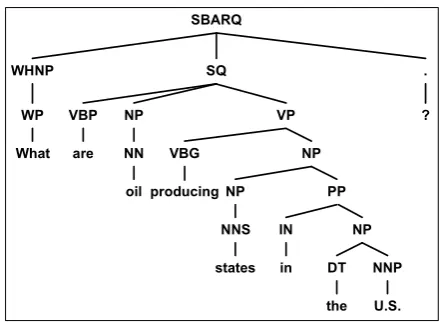
1. What(NP1)∧are(VP1, NP1, NP2)∧states(NP2)∧producing(VP2, NP2, NP3)∧ oil(NP3)∧in(PP1, NP2, U.S.) 2. What(NP1)∧ states(NP2)∧producing(VP1, NP3, NP2, NP1)∧oil(NP3)∧in(PP1, NP2, U.S.)
Figure 2: Example relational conjunctions. The first RC is the correct one for the sentence “What are oil producing states in the U.S.?” The second is the RC derived from the Collins parse in Figure 1. Differences between the two RCs appear in bold.
Figure 1: An incorrect Collins Parse of a TREC ques-tion. The parser treats “producing” as the main verb in the clause, rather than “are”.
2.1 Semantic Interpreter
The semantic interpreter aims to make explicit the relations that a sentence introduces, and the argu-ments to each of those relations. More specifically, the interpreter identifies the main verb relations, preposition relations, and semantic type relations in a sentence; identifies the number of arguments to each relation; and ensures that for every ar-gument that two relations share in the sentence, they share a variable in the logical representation. Given a sentence and a Penn-Treebank-style parse of that sentence, the interpreter outputs a conjunc-tion of First-Order Logic predicates. We call this representation a relational conjunction (RC). Each relation in an RC consists of a relation name and a tuple of variables and string constants represent-ing the arguments of the relation. As an example, Figure 1 contains a sentence taken from the TREC 2003 corpus, parsed by the Collins parser. Fig-ure 2 shows the correct RC for this sentence and the RC derived automatically from the incorrect parse.
Due to space constraints, we omit details about the algorithm for converting a parse into an RC, but Moldovan et al. (2003) describe a method sim-ilar to ours.
2.2 Semantic Filters
Given the RC representation of a parsed sentence as supplied by the Semantic Interpreter, we test the parse using four web-based methods. Fundamen-tally, the methods all share the underlying princi-ple that some form of co-occurrence of terms in the vast Web corpus can help decide whether a proposed relationship is semantically plausible.
Traditional statistical parsers also use co-occurrence of lexical heads as features for making parse decisions. We expand on this idea in two ways: first, we use a corpus several orders of mag-nitude larger than the tagged corpora traditionally used to train statistical parses, so that the funda-mental problem of data sparseness is ameliorated. Second, we search for targeted patterns of words to help judge specific properties, like the number of complements to a verb. We now describe each of our techniques in more detail.
2.3 A PMI-Based Filter
A number of authors have demonstrated important ways in which search engines can be used to un-cover semantic relationships, especially Turney’s notion of pointwise mutual information (PMI) based on search-engine hits counts (Turney, 2001). WOODWARD’s PMI-Based Filter (PBF) uses PMI scores as features in a learned filter for predicates. Following Turney, we use the formula below for the PMI between two termst1andt2:
P M I(t1, t2) =log
P(t1∧t2)
P(t1)P(t2)
(1)
We use PMI scores to judge the semantic plau-sibility of an RC conjunct as follows. We con-struct a number of different phrases, which we call
discriminator phrases, from the name of the
Given a set of such PMI scores for a single rela-tion, we apply a learned classifier to decide if the PMI scores justify calling the relation implausible. This classifier (as well as all of our other ones) is trained on a set of sentences from TREC and the Penn Treebank; our training and test sets are described in more detail in section 3. We parsed each sentence automatically using Daniel Bikel’s implementation of the Collins parsing model,1 trained on sections 2–21 of the Penn Treebank, and then applied our semantic interpreter algo-rithm to come up with a set of relations. We la-beled each relation by hand for correctness. Cor-rect relations are positive examples for our clas-sifier, incorrect relations are negative examples (and likewise for all of our other classifiers). We used the LIBSVM software package2 to learn a Gaussian-kernel support vector machine model from the PMI scores collected for these relations. We can then use the classifier to predict if a rela-tion is correct or not depending on the various PMI scores we have collected.
Because we require different discriminator phrases for preposition relations and verb rela-tions, we actually learn two different models. After extensive experimentation, optimizing for training set accuracy using leave-one-out cross-validation, we ended up using only two patterns for verbs: “noun verb” (“verb noun” for non-subjects) and “noun*verb” (“verb*noun” for non-subjects). We use the PMI scores from the argument whose PMI values add up to the lowest value as the features for a verb relation, with the intuition being that the relation is correct only if every argument to it is valid.
For prepositions, we use a larger set of patterns. Letting arg1 and arg2denote the head words of the two arguments to a preposition, and letting
prepdenote the preposition itself, we used the pat-terns “arg1 prep”, “arg1 prep * arg2”, “arg1 prepthearg2”, ”arg1 *arg2”, and, for verb at-tachments, “arg1 it prep arg2” and “arg1them
prep arg2”. These last two patterns are helpful for preposition attachments to strictly transitive verbs.
2.4 The Verb Arity Sampling Test
In our training set from the Penn Treebank, 13% of the time the Collins parser chooses too many or too few arguments to a verb. In this case, checking the PMI between the verb and each argument in-dependently is insufficient, and there is not enough
1
http://www.cis.upenn.edu/∼dbikel/software.html
2
http://www.csie.ntu.edu.tw/∼cjlin/libsvm/
data to find hitcounts for the verb and all of its ar-guments at once. We therefore use a different type of filter in order to detect these errors, which we call the Verb Arity Sampling Test (VAST).
Instead of testing a verb to see if it can take a
particular argument, we test if it can take a certain number of arguments. The verb predicate produc-ing(VP1, NP3, NP2, NP1) in interpretation 2 of
Figure 2, for example, has too many arguments. To check if this predicate can actually take three noun phrase arguments, we can construct a com-mon phrase containing the verb, with the property that if the verb can take three NP arguments, the
phrase will often be followed by a NP in text, and vice versa. An example of such a phrase is “which
it is producing.” Since “which” and “it” are so common, this phrase will appear many times on the Web. Furthermore, for verbs like “produc-ing,” there will be very few sentences in which this phrase is followed by a NP (mostly temporal noun phrases like “next week”). But for verbs like “give” or “name,” which can accept three noun phrase arguments, there will be significantly more sentences where the phrase is followed by a NP.
The VAST algorithm is built upon this obser-vation. For a given verb phrase, VAST first counts the number of noun phrase arguments. The Collins parser also marks clause arguments as being es-sential by annotating them differently. VAST counts these as well, and considers the sum of the noun and clause arguments as the number of
es-sential arguments. If the verb is passive and the
number of essential arguments is one, or if the verb is active and the number of essential arguments is two, VAST performs no check. We call these
strictly transitive verb relations. If the verb is
pas-sive and there are two essential arguments, or if the verb is active and there are three, it performs the ditransitive check below. If the verb is active and there is one essential argument, it does the intran-sitive check described below. We call these two cases collectively nontransitive verb relations. In both cases, the checks produce a single real-valued score, and we use a linear kernel SVM to iden-tify an appropriate threshold such that predicates above the threshold have the correct arity.
sen-tences for which the word “which” is preceded by a preposition. Finally, if there are enough sen-tences remaining (more than ten), it counts the number of sentences in which the verb is directly followed by a noun phrase chunk, which we call an extraction. It then calculates the ditransitive score for verbvas the ratio of the number of extractions
Eto the number of filtered sentencesF:
ditransitiveScore(v) = E
F (2)
The intransitive check performs a very similar set of operations. It fetches up to two hundred sentences matching the phrases “but it verb” or “but they verb”, tags and chunks them, and ex-tracts noun phrases that directly follow the verb. It calculates the intransitive score for verbvusing the number of extractionsEand sentencesSas:
intransitiveScore(v) = 1−E
S (3)
2.5 TextRunner Filter
TextRunner is a new kind of web search engine. Its design is described in detail elsewhere (Ca-farella et al., 2006), but we utilize its capabil-ities in WOODWARD. TextRunner provides a search interface to a set of over a billion triples of the form (object string, predicate string,
ob-ject string) that have been extracted automatically
from approximately 90 million documents to date. The search interface takes queries of the form
(string1, string2, string3), and returns all tu-ples for which each of the three tuple strings con-tains the corresponding query string as a substring. TextRunner’s object strings are very similar to the standard notion of a noun phrase chunk. The notion of a predicate string, on the other hand, is loose in TextRunner; a variety of POS sequences will match the patterns for an extracted relation. For example, a search for tuples with a predicate containing the word ‘with’ will yield the tuple
(risks, associated with dealing with, waste wood),
among thousands of others.
TextRunner embodies a trade-off with the PMI method for checking the validity of a relation. Its structure provides a much more natural search for the purpose of verifying a semantic relationship, since it has already arranged Web text into pred-icates and arguments. It is also much faster than querying a search engine like Google, both be-cause we have local access to it and bebe-cause com-mercial search engines tightly limit the number of queries an application may issue per day. On the other hand, the TextRunner index is at present
still about two orders of magnitude smaller than Google’s search index, due to limited hardware.
The TextRunner semantic filter checks the va-lidity of an RC conjunct in a natural way: it asks TextRunner for the number of tuples that match the argument heads and relation name of the con-junct being checked. Since TextRunner predicates only have two arguments, we break the conjunct into trigrams and bigrams of head words, and av-erage over the hitcounts for each. For predicate
P(A1, . . . , An)withn≥2, the score becomes
T extRunnerScore=
1 n−1
n X
i=2
hits(A1, P, Ai)
+ 1
n(hits(A1, P,) + n X
i=2
hits(, P, Ai))
As with PBF, we learn a threshold for good predi-cates using the LIBSVM package.
2.6 Question Answering Filter
When parsing questions, an additional method of detecting incorrect parses becomes available: use a question answering (QA) system to find answers. If a QA system using the parse can find an answer to the question, then the question was probably parsed correctly.
To test this theory, we implemented a lightweight, simple, and fast QA system that di-rectly mirrors the semantic interpretation. It re-lies on TextRunner and KnowItNow (Cafarella et al., 2005) to quickly find possible answers, given the relational conjunction (RC) of the question. KnowItNow is a state of the art Information Ex-traction system that uses a set of domain inde-pendent patterns to efficiently find hyponyms of a class.
We formalize the process as follows: define a question as a set of variablesXi corresponding to
noun phrases, a set of noun type predicatesTi(Xi), and a set of relational predicates Pi(Xi1, ..., Xik)
which relate one or more variables and constants. The conjunction of type and relational predicates is precisely the RC.
We define an answer as a set of values for each variable that satisfies all types and predicates
ans(x1, ..., xn) = ^
i
Ti(xi)∧^
j
Pj(xj1, ..., xjk)
The algorithm is as follows:
2. ∀ifind instances of the classTi for possible
values forXi, using KnowItNow.
3. ∀j find instances of the relation predicate
Pj(xj1, ..., xjk). We use TextRunner to
ef-ficiently find objects that are related by the predicatePj.
4. Return all tuples that satisfyans(x1, ..., xn)
The QA semantic filter runs the Question An-swering algorithm described above. If the number of returned answers is above a threshold (1 in our case), it indicates the question has been parsed cor-rectly. Otherwise, it indicates an incorrect parse. This differs from the TextRunner semantic filter in that it tries to find subclasses and instances, rather than just argument heads.
2.7 The WOODWARDFilter
Each of the above semantic filters has its strengths and weaknesses. On our training data, TextRunner had the most success of any of the methods on classifying verb relations that did not have arity er-rors. Because of sparse data problems, however, it was less successful than PMI on preposition rela-tions. The QA system had the interesting property that when it predicted an interpretation was cor-rect, it was always right; however, when it made a negative prediction, its results were mixed.
WOODWARDcombines the four semantic filters in a way that draws on each of their strengths. First, it checks if the sentence is a question that does not contain prepositions. If so, it runs the QA module, and returns true if that module does.
After trying the QA module, WOODWARD
checks each predicate in turn. If the predicate is a preposition relation, it uses PBF to classify it. For nontransitive verb relations, it uses VAST. For strictly transitive verb relations, it uses Text-Runner. WOODWARD accepts the RC if every lation is predicted to be correct; otherwise, it re-jects it.
3 Experiments
In our experiments we tested the ability of WOOD -WARDto detect bad parses. Our experiments pro-ceeded as follows: we parsed a set of sentences, ran the semantic interpreter on them, and labeled each parse and each relation in the resulting RCs for correctness. We then extracted all of the nec-essary information from the Web and TextRunner. We divided the sentences into a training and test set, and trained the filters on the labeled RCs from
the training sentences. Finally, we ran each of the filters and WOODWARD on the test set to predict which parses were correct. We report the results below, but first we describe our datasets and tools in more detail.
3.1 Datasets and Tools
Because question-answering is a key application, we began with data from the TREC question-answering track. We split the data into a train-ing set of 61 questions (all of the TREC 2002 and TREC 2003 questions), and a test set of 55 ques-tions (all list and factoid quesques-tions from TREC 2004). We preprocessed the questions to remove parentheticals (this affected 3 training questions and 1 test question). We removed 12 test questions because the Collins parser did not parse them as questions,3 and that error was too easy to detect. 25 training questions had the same error, but we left them in to provide more training data.
We used the Penn Treebank as our second data set. Training sentences were taken from section 22, and test sentences from section 23. Because PBF is time-consuming, we took a subset of 100 sentences from each section to expedite our exper-iments. We extracted from each section the first 100 sentences that did not contain conjunctions, and for which all of the errors, if any, were con-tained in preposition and verb relations.
For our parser, we used Bikel’s implementation of the Collins parsing model, trained on sections 2-21 of the Penn Treebank. We only use the top-ranked parse for each sentence. For the TREC data only, we first POS-tagged each question using Ratnaparkhi’s MXPOST tagger. We judged each of the TREC parses manually for correctness, but scored the Treebank parses automatically.
3.2 Results and Discussion
Our semantic interpreter was able to produce the appropriate RC for every parsed sentence in our data sets, except for a few minor cases. Two id-iomatic expressions in the WSJ caused the seman-tic interpreter to find noun phrases outside of a clause to fill gaps that were not actually there. And in several sentences with infinitive phrases, the se-mantic interpreter did not find the extracted sub-ject of the infinitive expression. It turned out that none of these mistakes caused the filters to reject correct parses, so we were satisfied that our results mainly reflect the performance of the filters, rather than the interpreter.
3
Relation Type num. correct num. incorrect PBF acc. VAST acc. TextRunner acc.
Nontrans. Verb 41 35 0.54 0.66 0.52
Other Verb 126 68 0.72 N/A 0.73
Preposition 183 58 0.73 N/A 0.76
Table 1:Accuracy of the filters on three relation types in the TREC 2004 questions and WSJ data.
Baseline WOODWARD
sents. parser eff. filter prec. filter rec. F1 filter prec. filter rec. F1 red. err.
trec 43 54% 0.54 1.0 0.70 0.82 1.0 0.90 67%
wsj 100 45% 0.45 1.0 0.62 0.58 0.88 0.70 20%
Table 2: Performance of WOODWARDon different data sets. Parser efficacy reports the percentage of sentences that the Collins parser parsed correctly. See the text for a discussion of our baseline and the precision and recall metrics. We weight precision and recall equally in calculating F1. Reduction in error rate (red. err.) reports the relative decrease in error (error calculated as 1−F1) over baseline.
In Table 1 we report the accuracy of our first three filters on the task of predicting whether a re-lation in an RC is correct. We break these results down into three categories for the three types of relations we built filters for: strictly transitive verb relations, nontransitive verb relations, and prepo-sition relations. Since the QA filter works at the level of an entire RC, rather than a single relation, it does not apply here. These results show that the trends on the training data mostly held true: VAST was quite effective at verb arity errors, and Text-Runner narrowly beat PBF on the remaining verb errors. However, on our training data PBF nar-rowly beat TextRunner on preposition errors, and the reverse was true on our test data.
Our QA filter predicts whether a full parse is correct with an accuracy of 0.76 on the 17 TREC 2004 questions that had no prepositions. The Collins parser achieves the same level of accuracy on these sentences, so the main benefit of the QA filter for WOODWARD is that it never misclassi-fies an incorrect parse as a correct one, as was ob-served on the training set. This property allows WOODWARDto correctly predict a parse is correct whenever it passes the QA filter.
Classification accuracy is important for good performance, and we report it to show how effec-tive each of WOODWARD’s components is.
How-ever, it fails to capture the whole story of a filter’s performance. Consider a filter that simply predicts that every sentence is incorrectly parsed: it would have an overall accuracy of 55% on our WSJ cor-pus, not too much worse than WOODWARD’s clas-sification accuracy of 66% on this data. However, such a filter would be useless because it filters out every correctly parsed sentence.
Let the filtered set be the set of sentences that a
filter predicts to be correctly parsed. The perfor-mance of a filter is better captured by two quanti-ties related to the filtered set: first, how “pure” the filtered set is, or how many good parses it contains compared to bad parses; and second, how waste-ful the filter is in terms of losing good parses from the original set. We measure these two quantities using metrics we call filter precision and filter
re-call. Filter precision is defined as the ratio of
cor-rectly parsed sentences in the filtered set to total sentences in the filtered set. Filter recall is defined as the ratio of correctly parsed sentences in the fil-tered set to correctly parsed sentences in the un-filtered set. Note that these metrics are quite dif-ferent from the labeled constituent precision/recall metrics that are typically used to measure statisti-cal parser performance.
Table 2 shows our overall results for filtering parses using WOODWARD. We compare against a baseline model that predicts every sentence is parsed correctly. WOODWARD outperforms this baseline in precision and F1 measure on both of our data sets.
re-duced by throwing out bad parses, rather than try-ing to fix them. The 17% difference between the two decreases in error rate is probably due to the fact that WOODWARDis more likely to detect the
worse parses in the original set, which contribute a proportionally larger share of error in labeled con-stituent precision/recall in the original test set.
WOODWARD performs significantly better on the TREC questions than on the Penn Treebank data. One major reason is that there are far more clause adjuncts in the Treebank data, and adjunct errors are intrinsically harder to detect. Con-sider the Treebank sentence: “The S&P pit stayed locked at its 30-point trading limit as the Dow av-erage ground to its final 190.58 point loss Friday.” The parser incorrectly attaches the clause begin-ning “as the Dow . . . ” to “locked”, rather than to “stayed.” Our current methods aim to use key words in the clause to determine if the attachment is correct. However, with such clauses there is no single key word that can allow us to make that de-termination. We anticipate that as the paradigm matures we and others will design filters that can use more of the information in the clause to help make these decisions.
4 Conclusions and Future Work
Given a parse of a sentence, WOODWARD con-structs a representation that identifies the key se-mantic relationships implicit in the parse. It then uses a set of Web-based sampling techniques to check whether these relationships are plausible. If any of the relationships is highly implausible, WOODWARDconcludes that the parse is incorrect.
WOODWARDsuccessfully detects common errors in the output of the Collins parser including verb arity errors as well as preposition and verb attach-ment errors. While more extensive experiattach-ments are clearly necessary, our results suggest that the paradigm of Web-based semantic filtering could substantially improve the performance of statisti-cal parsers.
In future work, we hope to further validate this paradigm by constructing additional semantic fil-ters that detect other types of errors. We also plan to use semantic filters such as WOODWARD to build a large-scale corpus of automatically-parsed sentences that has higher accuracy than can be achieved today. Such a corpus could be used to re-train a statistical parser to improve its perfor-mance. Beyond that, we plan to embed semantic filtering into the parser itself. If semantic filters become sufficiently accurate, they could rule out
enough erroneous parses that the parser is left with just the correct one.
Acknowledgements
This research was supported in part by NSF grant IIS-0312988, DARPA contract NBCHD030010, ONR grant N00014-02-1-0324 as well as gifts from Google, and carried out at the University of Washington’s Turing Center.
References
J. Allen. 1995. Natural Language Understand-ing. Benjamin/Cummings Publishing, Redwood City, CA, 2nd edition.
G. Attardi, A. Cisternino, F. Formica, M. Simi, and A. Tommasi. 2001. PiQASso: Pisa Question An-swering System. In TREC.
J. Bos, S. Clark, M. Steedman, J. R. Curran, and J. Hockenmaier. 2004. Wide-coverage semantic representations from a CCG parser. In COLING.
Michael J. Cafarella, Doug Downey, Stephen Soder-land, and Oren Etzioni. 2005. KnowItNow: Fast, scalable information extraction from the web. In
HLT-EMNLP.
M. J. Cafarella, M. Banko, and O. Etzioni. 2006. Re-lational web search. UW Tech Report 06-04-02.
M. Collins. 2000. Discriminative reranking for natural language parsing. In ICML, pages 175–182.
C. C. T. Kwok, O. Etzioni, and D. S. Weld. 2001. Scal-ing question answerScal-ing to the web. In WWW.
M. Lapata and F. Keller. 2005. Web-based models for natural language processing. ACM Transactions on
Speech and Language Processing, 2:1–31.
K. Markert, N. Modjeska, and M. Nissim. 2003. Us-ing the web for nominal anaphora resolution. In
EACL Workshop on the Computational Treatment of Anaphora.
D. Moldovan, C. Clark, S. Harabagiu, and S. Maiorano. 2003. Cogex: A logic prover for question answer-ing. In HLT.
K. Toutanova, C. D. Manning, D. Flickinger, and S. Oepen. 2005. Stochastic HPSG parse disam-biguation using the Redwoods Corpus. Journal of
Logic and Computation.
P.D. Turney. 2001. Mining the Web for Synonyms: PMI–IR versus LSA on TOEFL. Lecture Notes in
Computer Science, 2167:491–502.
M. Volk. 2001. Exploiting the WWW as a corpus to resolve PP attachment ambiguities. In Corpus