Learning with Probabilistic Features for Improved Pipeline Models
Razvan C. Bunescu School of EECS Ohio University Athens, OH 45701 [email protected]
Abstract
We present a novel learning framework for pipeline models aimed at improving the com-munication between consecutive stages in a pipeline. Our method exploits the confidence scores associated with outputs at any given stage in a pipeline in order to compute prob-abilistic features used at other stages down-stream. We describe a simple method of in-tegrating probabilistic features into the linear scoring functions used by state of the art ma-chine learning algorithms. Experimental eval-uation on dependency parsing and named en-tity recognition demonstrate the superiority of our approach over the baseline pipeline mod-els, especially when upstream stages in the pipeline exhibit low accuracy.
1 Introduction
Machine learning algorithms are used extensively in natural language processing. Applications range from fundamental language tasks such as part of speech (POS) tagging or syntactic parsing, to higher level applications such as information extraction (IE), semantic role labeling (SRL), or question an-swering (QA). Learning a model for a particular lan-guage processing problem often requires the output from other natural language tasks. Syntactic pars-ing and dependency parspars-ing usually start with a tex-tual input that is tokenized, split in sentences and POS tagged. In information extraction, named en-tity recognition (NER), coreference resolution, and relation extraction (RE) have been shown to benefit from features that use POS tags and syntactic depen-dencies. Similarly, most SRL approaches assume
a parse tree representation of the input sentences. The common practice in modeling such dependen-cies is to use a pipeline organization, in which the output of one task is fed as input to the next task in the sequence. One advantage of this model is that it is very simple to implement; it also allows for a modular approach to natural language process-ing. The key disadvantage is that errors propagate between stages in the pipeline, significantly affect-ing the quality of the final results. One solution is to solve the tasks jointly, using the principled framework of probabilistic graphical models. Sut-ton et al. (2004) use factorial Conditional Random Fields (CRFs) (Lafferty et al., 2001) to jointly pre-dict POS tags and segment noun phrases, improving on the cascaded models that perform the two tasks in sequence. Wellner et al. (2004) describe a CRF model that integrates the tasks of citation segmen-tation and cisegmen-tation matching. Their empirical results show the superiority of the integrated model over the pipeline approach. While more accurate than their pipeline analogues, probabilistic graphical models that jointly solve multiple natural language tasks are generally more demanding in terms of finding the right representations, the associated inference algo-rithms and their computational complexity. Recent negative results on the integration of syntactic pars-ing with SRL (Sutton and McCallum, 2005) provide additional evidence for the difficulty of this general approach. When dependencies between the tasks can be formulated in terms of constraints between their outputs, a simpler approach is to solve the tasks separately and integrate the constraints in a linear programming formulation, as proposed by Roth and
Yih (2004) for the simultaneous learning of named entities and relations between them. More recently, Finkel et al. (2006) model the linguistic pipelines as Bayesian networks on which they perform Monte Carlo inference in order to find the most likely out-put for the final stage in the pipeline.
In this paper, we present a new learning method for pipeline models that mitigates the problem of er-ror propagation between the tasks. Our method ex-ploits the probabilities output by any given stage in the pipeline as weights for the features used at other stages downstream. We show a simple method of integrating probabilistic features into linear scoring functions, which makes our approach applicable to state of the art machine learning algorithms such as CRFs and Support Vector Machines (Vapnik, 1998; Sch¨olkopf and Smola, 2002). Experimental results on dependency parsing and named entity recogni-tion show useful improvements over the baseline pipeline models, especially when the basic pipeline components exhibit low accuracy.
2 Learning with Probabilistic Features
We consider that the task is to learn a mapping from inputs x ∈ X to outputs y ∈ Y(x). Each input x is also associated with a different set of outputs z ∈ Z(x) for which we are given a probabilistic confidence measurep(z|x). In a pipeline model, z would correspond to the annotations performed on the input x by all stages in the pipeline other than the stage that producesy. For example, in the case of dependency parsing,xis a sequence of words,y is a set of word-word dependencies,zis a sequence of POS tags, and p(z|x)is a measure of the confi-dence that the POS tagger has in the outputz. Let φbe a representation function that maps an exam-ple(x, y, z)to a feature vectorφ(x, y, z)∈Rd, and w ∈ Rda parameter vector. Equations (1) and (2) below show the traditional method for computing the optimal outputyˆin a pipeline model, assuming a linear scoring function defined bywandφ.
ˆ
y(x) = argmax
y∈Y(x)
w·φ(x, y,zˆ(x)) (1)
ˆ
z(x) = argmax
z∈Z(x)
p(z|x) (2)
The weight vectorwis learned by optimizing a pre-defined objective function on a training dataset.
In the model above, only the best annotation zˆ produced by upstream stages is used for determining the optimal outputyˆ. However,zˆmay be an incor-rect annotation, while the corincor-rect annotation may be ignored because it was assigned a lower confidence value. We propose exploiting all possible annota-tions and their probabilities as illustrated in the new model below:
ˆ
y(x) = argmax
y∈Y(x)
w·ψ(x, y) (3)
ψ(x, y) = X
z∈Z(x)
p(z|x)·φ(x, y, z) (4)
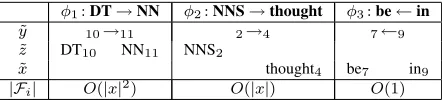
In most cases, directly computingψ(x, y)is unfeasi-ble, due to a large number of annotations inZ(x). In our dependency parsing example,Z(x)contains all possible POS taggings of sentencex; consequently its cardinality is exponential in the length of the sen-tence. A more efficient way of computing ψ(x, y) can be designed based on the observation that most componentsφiof the original feature vectorφutilize only a limited amount of evidence from the example (x, y, z). We define (˜x,y,˜ z˜) ∈ Fi(x, y, z) to cap-ture the actual evidence from(x, y, z)that is used by one instance of feature functionφi. We call(˜x,y,˜ z˜) a feature instance of φi in the example (x, y, z). Correspondingly, Fi(x, y, z) is the set of all fea-ture instances of φi in example (x, y, z). Usually, φi(x, y, z)is set to be equal with the number of in-stances ofφi in example(x, y, z), i.e. φi(x, y, z) =
|Fi(x, y, z)|. Table 1 illustrates three feature in-stances (˜x,y,˜ z˜) generated by three typical depen-dency parsing features in the example from Figure 1. Because the same feature may be instantiated
multi-φ1:DT→NN φ2:NNS→thought φ3:be←in
˜
y 10→11 2→4 7←9
˜
z DT10 NN11 NNS2
˜
x thought4 be7 in9
[image:2.612.316.537.563.616.2]|Fi| O(|x|2) O(|x|) O(1)
Table 1: Feature instances.
Figure 1: Dependency Parsing Example.
rewritten in a component-wise manner as follows:
ψ(x, y) = [ψ1(x, y). . . ψd(x, y)] (5)
ψi(x, y) = X
z∈Z(x)
p(z|x)·φi(x, y, z)
= X
z∈Z(x)
p(z|x)· |Fi(x, y, z)|
= X
z∈Z(x)
p(z|x) X
(˜x,y,˜˜z)∈Fi(x,y,z)
1
= X
z∈Z(x)
X
(˜x,y,˜z˜)∈Fi(x,y,z)
p(z|x)
= X
(˜x,y,˜z˜)∈Fi(x,y,Z(x))
X
z∈Z(x),z⊇z˜ p(z|x)
whereFi(x, y,Z(x))stands for:
Fi(x, y,Z(x)) =
[
z∈Z(x)
Fi(x, y, z)
We introducep(˜z|x)to denote the expectation:
p(˜z|x) = X
z∈Z(x),z⊇z˜ p(z|x)
Thenψi(x, y)can be written compactly as:
ψi(x, y) =
X
(˜x,y,˜˜z)∈Fi(x,y,Z(x))
p(˜z|x) (6)
The total number of terms in (6) is equal with the number of instantiations of featureφi in the exam-ple(x, y)across all possible annotationsz ∈ Z(x), i.e. |Fi(x, y,Z(x))|. Usually this is significantly smaller than the exponential number of terms in (4). The actual number of terms depends on the particu-lar feature used to generate them, as illustrated in the last row of Table 1 for the three features used in de-pendency parsing. The overall time complexity for calculating ψ(x, y) also depends on the time com-plexity needed to compute the expectationsp(˜z|x).
Whenzis a sequence,p(˜z|x) can be computed ef-ficiently using a constrained version of the forward-backward algorithm (to be described in Section 3). Whenz is a tree,p(˜z|x) will be computed using a constrained version of the CYK algorithm (to be de-scribed in Section 4).
The time complexity can be further reduced if in-stead of ψ(x, y) we use its subcomponent ψˆ(x, y) that is calculated based only on instances that appear in the optimal annotationzˆ:
ˆ
ψ(x, y) = [ ˆψ1(x, y). . .ψˆd(x, y)] (7)
ˆ
ψi(x, y) =
X
(˜x,y,˜˜z)∈Fi(x,y,zˆ)
p(˜z|x) (8)
The three models are summarized in Table 2 below. In the next two sections we illustrate their
applica-ˆ
y(x) = argmax
y∈Y(x)
w·φ(x, y)
M1 φ(x, y) = φ(x, y,zˆ(x))
ˆ
z(x) = argmax
z∈Z(x)
p(z|x)
ˆ
y(x) = argmax
y∈Y(x)
w·ψ(x, y)
M2 ψ(x, y) = [ψ1(x, y). . . ψd(x, y)]
ψi(x, y) = X
(˜x,y,˜˜z)∈Fi(x,y,Z(x))
p(˜z|x)
ˆ
y(x) = argmax
y∈Y(x)
w·ψˆ(x, y)
M3 ψˆ(x, y) = [ ˆψ1(x, y). . .ψdˆ (x, y)]
ˆ
ψi(x, y) =
X
(˜x,y,˜˜z)∈Fi(x,y,zˆ)
[image:3.612.81.295.192.363.2]p(˜z|x)
Table 2: Three Pipeline Models.
tion to two common tasks in language processing: dependency parsing and named entity recognition.
3 Dependency Parsing Pipeline
aug-mented with a POS tagging zˆ(x), and then pro-cessed by a dependency parser in order to obtain a dependency structure yˆ(x). To evaluate the new pipeline models we use MSTPARSER1, a linearly scored dependency parser developed by McDonald et al. (2005). Following the edge based factorization method of Eisner (1996), the score of a dependency tree in the first order version is defined as the sum of the scores of all edges in the tree. Equivalently, the feature vector of a dependency tree is defined as the sum of the feature vectors of all edges in the tree:
M1: φ(x, y) =
X
u→v∈y
φ(x, u→v,zˆ(x))
M2: ψ(x, y) =
X
u→v∈y
ψ(x, u→v)
M3: ψˆ(x, y) =
X
u→v∈y
ˆ
ψ(x, u→v)
For each edgeu→v ∈ y, MSTPARSER generates
features based on a set of feature templates that take into account the words and POS tags at positionsu, v, and their left and right neighborsu±1,v±1. For example, a particular feature templateT used inside MSTPARSER generates the following POS bigram features:
φi(x, u→v, z) =
1, ifhzu, zvi=ht1, t2i 0, otherwise
where t1, t2 ∈ P are the two POS tags associated
with feature indexi. By replacingy withu→vin the feature expressions from Table 2, we obtain the following formulations:
M1:φi(x, u→v) =
1, ifhzˆu,zˆvi=ht1, t2i 0, otherwise
M2:ψi(x, u→v) =p(˜z=ht1, t2i|x)
M3: ˆψi(x, u→v) =
p(˜z=ht1, t2i|x),ifhzˆu,zˆvi=ht1, t2i 0, otherwise
where, following the notation from Section 2, ˜
z = hzu, zvi is the actual evidence from z that is used by featurei, andzˆis the top scoring annotation produced by the POS tagger. The implementation in MSTPARSERcorresponds to the traditional pipeline modelM1. Given a method for computing feature
1URL: http://sourceforge.net/projects/mstparser
probabilitiesp(˜z=ht1, t2i|x), it is straightforward
to modify MSTPARSER to implement models M2
andM3 – we simply replace the feature vectors φ
with ψ and ψˆ respectively. As mentioned in Sec-tion 2, the time complexity of computing the fea-ture vectors ψ in model M2 depends on the
com-plexity of the actual evidence z˜ used by the fea-tures. For example, the feature template T used above is based on the POS tags at both ends of a de-pendency edge, consequently it would generate|P|2
features in model M2 for any given edge u → v.
There are however feature templates used in MST-PARSER that are based on the POS tags of up to 4 tokens in the input sentence, which means that for each edge they would generate|P|4 ≈ 4.5M
fea-tures. Whether using all these probabilistic features is computationally feasible or not also depends on the time complexity of computing the confidence measurep(˜z|x)associated with each feature.
3.1 Probabilistic POS features
The new pipeline models M2 and M3 require an
annotation model that, at a minimum, facilitates the computation of probabilistic confidence values for each output. We chose to use linear chain CRFs (Lafferty et al., 2001) since CRFs can be eas-ily modified to compute expectations of the type p(˜z|x), as needed byM2andM3.
The CRF tagger was implemented in MAL
-LET (McCallum, 2002) using the original feature
templates from (Ratnaparkhi, 1996). The model was trained on sections 2–21 from the English Penn Treebank (Marcus et al., 1993). When tested on sec-tion 23, the CRF tagger obtains 96.25% accuracy, which is competitive with more finely tuned systems such as Ratnaparkhi’s MaxEnt tagger.
We have also implemented in MALLET a con-strained version of the forward-backward procedure that allows computing feature probabilities p(˜z|x). Ifz˜= hti1ti2...tiki specifies the tags atkpositions
proce-dure requires(ik −i1)|P|2 = O(N|P|2)
multipli-cations in an order 1 Markov model, whereN is the length of the sentence. Because MSTPARSER uses an edge based factorization of the scoring function, the constrained forward procedure will need to be run for each feature template, for each pair of tokens in the input sentencex. If the evidencez˜required by the feature templateT constrains the tags atk posi-tions, then the total time complexity for computing the probabilistic featuresp(˜z|x)generated byT is:
O(N3|P|k+2) =O(N|P|2)·O(N2)·O(|P|k) (9)
As mentioned earlier, some feature templates used in the dependency parser constrain the POS tags at 4 positions, leading to aO(N3|P|6)time complexity
for a lengthN sentence. Experimental runs on the same machine that was used for CRF training show that such a time complexity is not yet feasible, espe-cially because of the large size ofP (46 POS tags). In order to speed up the computation of probabilis-tic features, we made the following two approxima-tions:
1. Instead of using the constrained forward-backward procedure, we enforce an indepen-dence assumption between tags at different po-sitions and rewritep(˜z=hti1ti2...tiki|x)as:
p(ti1ti2...tik|x)≈
k
Y
j=1
p(tij|x)
The marginal probabilities p(tij|x) are easily
computed using the original forward and back-ward parameters as:
p(tij|x) =
αij(tij|x)βij(tij|x)
Z(x)
This approximation eliminates the factor O(N|P|2)from the time complexity in (9).
2. If any of the marginal probabilitiesp(tij|x)is
less than a predefined threshold (τ|P|)−1, we set p(˜z|x) to 0. When τ ≥ 1, the method is guaranteed to consider at least the most proba-ble state when computing the probabilistic fea-tures. Looking back at Equation (4), this is equivalent with summing feature vectors only over the most probable annotationsz ∈ Z(x).
The approximation effectively replaces the fac-torO(|P|k)in (9) with a quasi-constant factor.
The two approximations lead to an overall time com-plexity of O(N2) for computing the probabilistic features associated with any feature templateT, plus O(N|P|2)for the unconstrained forward-backward
procedure. We will use M2′ to refer to the model M2 that incorporates the two approximations. The
independence assumption from the first approxima-tion can be relaxed without increasing the asymp-totic time complexity by considering as independent only chunks of contiguous POS tags that are at least a certain number of tokens apart. Consequently, the probability of the tag sequence will be approxi-mated with the product of the probabilities of the tag chunks, where the exact probability of each chunk is computed in constant time with the constrained forward-backward procedure. We will use M2′′ to refer to the resulting model.
3.2 Experimental Results
MSTPARSERwas trained on sections 2–21 from the
WSJ Penn Treebank, using the gold standard POS tagging. The parser was then evaluated on section 23, using the POS tagging output by the CRF tagger. For model M1 we need only the best output from
the POS tagger. For modelsM2′ andM2′′ we com-pute the probability associated with each feature us-ing the correspondus-ing approximations, as described in the previous section. In modelM2′′ we consider as independent only chunks of POS tags that are 4 tokens or more apart. If the distance between the chunks is less than 4 tokens, the probability for the entire tag sequence in the feature is computed ex-actly using the constrained forward-backward pro-cedure. Table 3 shows the accuracy obtained by models M1, M2′(τ) and M2′′(τ) for various values
of the threshold parameterτ. The accuracy is
com-M1 M2′(1) M2′(2) M2′(4) M2′′(4)
88.51 88.66 88.67 88.67 88.70
Table 3: Dependency parsing results.
Figure 2: Named Entity Recognition Example.
model M2′ that uses probabilistic features outper-forms the traditional pipeline model M1. As
ex-pected, M2′′ performs slightly better than M2′, due to a more exact computation of feature probabilities. Overall, only by using the probabilities associated with the POS features, we achieve an absolute er-ror reduction of 0.19%, in a context where the POS stage in the pipeline already has a very high accu-racy of 96.25%. We expect probabilistic features to yield a more substantial improvement in cases where the pipeline model contains less accurate upstream stages. Such a case is that of NER based on a com-bination of POS and dependency parsing features.
4 Named Entity Recognition Pipeline
In Named Entity Recognition (NER), the task is to identify textual mentions of predefined types of en-tities. Traditionally, NER is modeled as a sequence classification problem: each token in the input sen-tence is tagged as being either inside (I) or outside (O) of an entity mention. Most sequence tagging approaches use the words and the POS tags in a limited neighborhood of the current sentence posi-tion in order to compute the corresponding features. We augment these flat features with a set of tree featuresthat are computed based on the words and POS tags found in the proximity of the current to-ken in the dependency tree of the sentence. We argue that such dependency tree features are better at capturing predicate-argument relationships, espe-cially when they span long stretches of text. Figure 2 shows a sentencextogether with its POS taggingz1,
dependency linksz2, and an output taggingy.
As-suming the task is to recognize mentions of people, the wordsailorsneeds to be tagged as inside. If we extracted only flat features using a symmetric win-dow of size 3, the relationship betweensailors and
thoughtwould be missed. This relationship is
use-ful, since an agent of the predicatethoughtis likely to be a person entity. On the other hand, the nodes
sailorsandthought are adjacent in the dependency tree of the sentence. Therefore, their relationship can be easily captured as a dependency tree feature using the same window size.
For every token position, we generate flat features by considering all unigrams, bigrams and trigrams that start with the current token and extend either to the left or to the right. Similarly, we generate tree features by considering all unigrams, bigrams and trigrams that start with the current token and extend in any direction in the undirected version of the de-pendency tree. The tree features are also augmented with the actual direction of the dependency arcs be-tween the tokens. If we use only words to create n-gram features, the tokensailorswill be associated with the following features:
• Flat: sailors, the sailors, hSi the sailors,
sailors mistakenly,sailors mistakenly thought.
• Tree: sailors, sailors ← the, sailors → thought,sailors→thought←must,sailors→ thought←mistakenly.
We also allow n-grams to use word classes such as POS tags and any of the following five categories:
h1Cifor tokens consisting of one capital letter,hACi
for tokens containing only capital letters, hFCi for tokens that start with a capital letter, followed by small letters,hCDifor tokens containing at least one digit, andhCRTifor the current token.
The set of features can then be defined as a Carte-sian product over word classes, as illustrated in Fig-ure 3 for the original tree featFig-uresailors→thought ← mistakenly. In this case, instead of one com-pletely lexicalized feature, the model will consider 12 different features such assailors→VBD←RB,
hCRTi NNS sailors
×[→]×
VBD thought
×[←]×
RB mistakenly
Figure 3: Dependency tree features.
The pipeline modelM2 uses features that appear
in all possible annotations z = hz1, z2i, wherez1
and z2 are the POS tagging and the dependency
parse respectively. If the corresponding evidence is ˜
z=h˜z1,z˜2i, then:
p(˜z|x) =p(˜z2|z˜1, x)p(˜z1|x)
For example,NNS2 →thought4 ←RB3 is a feature instance for the tokensailorsin the annotations from Figure 2. This can be construed as having been gen-erated by a feature templateT that outputs the POS tagti at the current position, the wordxj that is the parent ofxiin the dependency tree, and the POS tag tkof another dependent ofxj (i.e. ti → xj ← tk). The probabilityp(˜z|x) for this type of features can then be written as:
p(˜z|x) =p(i→j←k|ti, tk, x)·p(ti, tk|x)
The two probability factors can be computed exactly as follows:
1. The M2 model for dependency parsing from
Section 3 is used to compute the probabilistic featuresψ(x, u→v|ti, tk)by constraining the POS annotations to pass through tagsti andtk at positionsiandk. The total time complexity for this step isO(N3|P|k+2).
2. Having access toψ(x, u→v|ti, tk), the factor p(i→j←k|ti, tk, x)can be computed inO(N3) time using a constrained version of Eisner’s al-gorithm, as will be explained in Section 4.1.
3. As described in Section 3.1, computing the expectation p(ti, tk|x) takes O(N|P2|) time using the constrained forward-backward algo-rithm.
The current token position ican have a total of N values, while j and k can be any positions other than i. Also, ti and tk can be any POS tag from
P. Consequently, the feature template T induces O(N3|P|2) feature instances. Overall, the time complexity for computing the feature instances gen-erated byT isO(N6|P|k+4), as results from:
O(N3|P|2
)·(O(N3|P|k+2
) +O(N3) +O(N|P|2 ))
While still polynomial, this time complexity is fea-sible only for small values ofN. In general, the time complexity for computing probabilistic features in the full modelM2 increases with both the number
of stages in the pipeline and the complexity of the features.
Motivated by efficiency, we decided to use the pipeline modelM3 in which probabilities are
com-puted only over features that appear in the top scor-ing annotationzˆ=hzˆ1,ˆz2i, wherezˆ1andzˆ2
repre-sent the best POS tagging, and the best dependency parse respectively. In order to further speed up the computation of probabilistic features, we made the following approximations:
1. We consider the POS tagging and the depen-dency parse independent and rewritep(˜z|x)as:
p(˜z|x) =p(˜z1,z˜2|x)≈p(˜z1|x)p(˜z2|x)
2. We enforce an independence assumption be-tween POS tags. Thus, if z˜1 = hti1ti2...tiki
specifies the tags atkpositions in the sentence, thenp(˜z1|x)is rewritten as:
p(ti1ti2...tik|x)≈
k
Y
j=1
p(tij|x)
3. We also enforce a similar independence as-sumption between dependency links. Thus, if ˜
z2 = hu1→v1...uk→vkispecifies k depen-dency links, thenp(˜z2|x)is rewritten as:
p(u1→v1...uk→vk|x)≈ k
Y
l=1
p(ul→vl|x)
For example, the probability p(˜z|x) of the feature instanceNNS2 →thought4 ←RB3 is approximated
as:
p(˜z|x) ≈ p(˜z1|x)·p(˜z2|x)
p(˜z1|x) ≈ p(t2=NNS|x)·p(t3=RB|x)
p(˜z2|x) ≈ p(2→4|x)·p(3→4|x)
4.1 Probabilistic Dependency Features
The probabilistic POS featuresp(ti|x)are computed using the forward-backward procedure in CRFs, as described in Section 3.1. To completely specify the pipeline model for NER, we also need an efficient method for computing the probabilistic dependency featuresp(u→v|x), where u→v is a dependency edge between positions u andv in the sentence x. MSTPARSER is a large-margin method that com-putes an unbounded scores(x, y)for any given sen-tencex and dependency structure y ∈ Y(x) using the following edge-based factorization:
s(x, y) = X
u→v∈y
s(x, u→v) =w X u→v∈y
φ(x, u→v)
The following three steps describe a general method for associating probabilities with output subtures. The method can be applied whenever a struc-tured output is associated a score value that is un-bounded inR, assuming that the score of the entire output structure can be computed efficiently based on a factorization into smaller substructures.
S1. Map the unbounded score s(x, y) from R into[0,1]using thesoftmaxfunction (Bishop, 1995):
n(x, y) = e
s(x,y)
P
y∈Y(x)es(x,y)
The normalized scoren(x, y)preserves the ranking given by the original scores(x, y). The normaliza-tion constant at the denominator can be computed in O(N3)time by replacing themaxoperator with the
sumoperator inside Eisner’s chart parsing algorithm.
S2. Compute a normalized score for the sub-structure by summing up the normalized scores of all the complete structures that contain it. In our model, dependency edges are substructures, while dependency trees are complete structures. The nor-malized score will then be computed as:
n(x, u→v) = X
y∈Y(x),u→v∈y
n(x, y)
The sum can be computed in O(N3) time using a constrained version of the algorithm that computes the normalization constant in step S1. This con-strained version of Eisner’s algorithm works in a
similar manner with the constrained forward back-ward algorithm by restricting the dependency struc-tures to contain a predefined edge or set of edges.
S3. Use the isotonic regression method of Zadrozny and Elkan (2002) to map the normalized scoresn(x, u→v)into probabilitiesp(u→v|x). A potential problem with the softmax function is that, depending on the distribution of scores, the expo-nential transform could dramatically overinflate the higher scores. Isotonic regression, by redistributing the normalized scores inside[0,1], can alleviate this problem.
4.2 Experimental Results
We test the pipeline modelM3′ versus the traditional modelM1 on the task of detecting mentions of
per-son entities in the ACE dataset2. We use the standard training – testing split of the ACE 2002 dataset in which the training dataset is also augmented with the documents from the ACE 2003 dataset. The com-bined dataset contains 674 documents for training and 97 for testing. We implemented the CRF model in MALLET using three different sets of features:
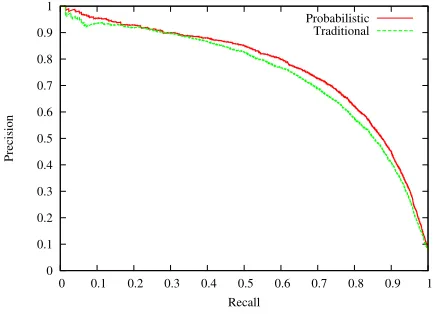
Tree, Flat, and Fullcorresponding to the union of all flat and tree features. The POS tagger and the de-pendency parser were trained on sections 2-21 of the Penn Treebank, followed by an isotonic regression step on section 23 for the dependency parser. We compute precision recall (PR) graphs by varying a threshold on the token level confidence output by the CRF tagger, and summarize the tagger performance using the area under the curve. Table 4 shows the re-sults obtained by the two models under the three ture settings. The model based on probabilistic
fea-Model Tree Flat Full
M3′ 76.78 77.02 77.96
M1 74.38 76.53 77.02
Table 4: Mention detection results.
tures consistently outperforms the traditional model, especially when only tree features are used. Depen-dency parsing is significantly less accurate than POS tagging. Consequently, the improvement for the tree based model is more substantial than for the flat
0 0.1 0.2 0.3 0.4 0.5 0.6 0.7 0.8 0.9 1
0 0.1 0.2 0.3 0.4 0.5 0.6 0.7 0.8 0.9 1
Precision
Recall
[image:9.612.74.293.62.219.2]Probabilistic Traditional
Figure 4: PR graphs for tree features.
model, confirming our expectation that probabilis-tic features are more useful when upstream stages in the pipeline are less accurate. Figure 4 shows the PR curves obtained for the tree-based models, on which we see a significant 5% improvement in precision over a wide range of recall values.
5 Related Work
In terms of the target task – improving the perfor-mance of linguistic pipelines – our research is most related to the work of Finkel et al. (2006). In their approach, output samples are drawn at each stage in the pipeline conditioned on the samples drawn at previous stages, and the final output is deter-mined by a majority vote over the samples from the final stage. The method needs very few sam-ples for tasks such as textual entailment, where the final outcome is binary, in agreement with a theo-retical result on the rate of convergence of the vot-ing Gibbs classifier due to Ng and Jordan (2001). While their sampling method is inherently approx-imate, our full pipeline model M2 is exact in the
sense that feature expectations are computed exactly in polynomial time whenever the inference step at each stage can be done in polynomial time, irrespec-tive of the cardinality of the final output space. Also, the pipeline modelsM2andM3and their more
effi-cient alternatives propagate uncertainty during both training and testing through the vector of probabilis-tic features, whereas the sampling method takes ad-vantage of the probabilistic nature of the outputs only during testing. Overall, the two approaches
can be seen as complementary. In order to be ap-plicable with minimal engineering effort, the sam-pling method needs NLP researchers to write pack-ages that can generate samples from the posterior. Similarly, the new pipeline models could be easily applied in a diverse range of applications, assum-ing researchers develop packages that can efficiently compute marginals over output substructures.
6 Conclusions and Future Work
We have presented a new, general method for im-proving the communication between consecutive stages in pipeline models. The method relies on the computation of probabilities for count features, which translates in adding a polynomial factor to the overall time complexity of the pipeline whenever the inference step at each stage is done in polynomial time, which is the case for the vast majority of infer-ence algorithms used in practical NLP applications. We have also shown that additional independence assumptions can make the approach more practical by significantly reducing the time complexity. Ex-isting learning based models can implement the new method by replacing the original feature vector with a more dense vector of probabilistic features3. It is essential that every stage in the pipeline produces probabilistic features, and to this end we have de-scribed an effective method for associating proba-bilities with output substructures.
We have shown for NER that simply using the probabilities associated with features that appear only in the top annotation can lead to useful im-provements in performance, with minimal engineer-ing effort. In future work we plan to empirically evaluate NER with an approximate version of the full model M2 which, while more demanding in
terms of time complexity, could lead to even more significant gains in accuracy. We also intend to prehensively evaluate the proposed scheme for com-puting probabilities by experimenting with alterna-tive normalization functions.
Acknowledgements
We would like to thank Rada Mihalcea and the anonymous reviewers for their insightful comments and suggestions.
References
Christopher M. Bishop. 1995. Neural Networks for Pat-tern Recogntion. Oxford University Press.
Aron Culotta and Andrew McCallum. 2004. Confidence estimation for information extraction. In Proceed-ings of Human Language Technology Conference and North American Chapter of the Association for Com-putational Linguistics (HLT-NAACL), Boston, MA.
Jason M. Eisner. 1996. Three new probabilistic models for dependency parsing: An exploration. In Proceed-ings of the 16th Conference on Computational linguis-tics, pages 340–345, Copenhagen, Denmark.
Jenny R. Finkel, Christopher D. Manning, and Andrew Y. Ng. 2006. Solving the problem of cascading errors: Approximate Bayesian inference for linguistic annota-tion pipelines. InProceedings of the 2006 Conference on Empirical Methods in Natural Language Process-ing, pages 618–626, Sydney, Australia.
John Lafferty, Andrew McCallum, and Fernando Pereira. 2001. Conditional random fields: Probabilistic mod-els for segmenting and labeling sequence data. In Proceedings of 18th International Conference on Machine Learning (ICML-2001), pages 282–289, Williamstown, MA.
M. Marcus, B. Santorini, and M. A. Marcinkiewicz. 1993. Building a large annotated corpus of En-glish: The Penn treebank. Computational Linguistics, 19(2):313–330.
Andrew Kachites McCallum. 2002.
Mal-let: A machine learning for language toolkit. http://mallet.cs.umass.edu.
Ryan McDonald, Koby Crammer, and Fernando Pereira. 2005. Online large-margin training of dependency parsers. InProceedings of the 43rd Annual Meeting on Association for Computational Linguistics (ACL-05), pages 91–98, Ann Arbor, Michigan.
Andrew Y. Ng and Michael I. Jordan. 2001. Conver-gence rates of the Voting Gibbs classifier, with appli-cation to bayesian feature selection. InProceedings of 18th International Conference on Machine Learning (ICML-2001), pages 377–384, Williamstown, MA.
Adwait Ratnaparkhi. 1996. A maximum entropy model for part of speech tagging. InProceedings of the Con-ference on Empirical Methods in Natural Language Processing (EMNLP-96), pages 133–141, Philadel-phia, PA.
D. Roth and W. Yih. 2004. A linear programming formu-lation for global inference in natural language tasks. In Proceedings of the Eighth Conference on Compu-tational Natural Language Learning (CoNLL-2004), pages 1–8, Boston, MA.
Bernhard Sch¨olkopf and Alexander J. Smola. 2002. Learning with kernels - support vector machines, regu-larization, optimization and beyond. MIT Press, Cam-bridge, MA.
Charles Sutton and Andrew McCallum. 2005. Joint pars-ing and semantic role labelpars-ing. InCoNLL-05 Shared Task.
Charles Sutton, Khashayar Rohanimanesh, and Andrew McCallum. 2004. Dynamic conditional random fields: Factorized probabilistic models for labeling and segmenting sequence data. InProceedings of 21st In-ternational Conference on Machine Learning (ICML-2004), pages 783–790, Banff, Canada, July.
Vladimir N. Vapnik. 1998. Statistical Learning Theory. John Wiley & Sons.
Ben Wellner, Andrew McCallum, Fuchun Peng, and Michael Hay. 2004. An integrated, conditional model of information extraction and coreference with appli-cation to citation matching. In Proceedings of 20th Conference on Uncertainty in Artificial Intelligence (UAI-2004), Banff, Canada, July.