Graph-based Analysis of Semantic Drift in Espresso-like
Bootstrapping Algorithms
Mamoru Komachi NAIST, Japan [email protected]
Taku Kudo Google Inc. [email protected]
Masashi Shimbo NAIST, Japan [email protected]
Yuji Matsumoto NAIST, Japan [email protected]
Abstract
Bootstrapping has a tendency, called seman-tic drift, to select instances unrelated to the seed instances as the iteration proceeds. We demonstrate the semantic drift of bootstrap-ping has the same root as the topic drift of Kleinberg’s HITS, using a simplified graph-based reformulation of bootstrapping. We confirm that two graph-based algorithms, the von Neumann kernels and the regularized Laplacian, can reduce semantic drift in the task of word sense disambiguation (WSD) on Senseval-3 English Lexical Sample Task. Proposed algorithms achieve superior perfor-mance toEspresso and previous graph-based WSD methods, even though the proposed al-gorithms have less parameters and are easy to calibrate.
1 Introduction
In recent years machine learning techniques be-come widely used in natural language processing (NLP). These techniques offer various ways to ex-ploit large corpora and are known to perform well in many tasks. However, these techniques often re-quire tagged corpora, which are not readily available to many languages. So far, reducing the cost of hu-man annotation is one of the important problems for building NLP systems.
To mitigate the problem of hand-tagging re-sources, semi(or minimally)-supervised and unsu-pervised techniques have been actively studied. Hearst (1992) first presented a bootstrapping method which requires only a small amount of instances
(seed instances) to start with, but can easily mul-tiply the number of tagged instances with mini-mal human annotation cost, by iteratively apply-ing the followapply-ing phases: pattern induction, pattern ranking/selection, and instance extraction. Boot-strapping has been widely adopted in NLP applica-tions such as word sense disambiguation (Yarowsky, 1995), named entity recognition (Collins and Singer, 1999) and relation extraction (Riloff and Jones, 1999; Pantel and Pennacchiotti, 2006).
However, it is known that bootstrapping often ac-quires instances not related to seed instances. For example, consider the task of collecting the names of common tourist sites from web corpora. Given words like “Geneva” and “Bali” as seed instances, bootstrapping would eventually learn generic pat-terns such as “pictures” and “photos,” which also co-occur with many other unrelated instances. The subsequent iterations would likely acquire frequent words that co-occur with these generic patterns, such as “Britney Spears.” This phenomenon is calledsemantic drift(Curran et al., 2007).
A straightforward approach to avoid semantic drift is to terminate iterations before hitting generic patterns, but the optimal number of iterations is task dependent and is hard to come by. The recently pro-posedEspresso(Pantel and Pennacchiotti, 2006) al-gorithm incorporates sophisticated scoring functions to cope with generic patterns, but as Komachi and Suzuki (2008) pointed out, Espresso still shows se-mantic drift unless iterations are terminated appro-priately.
Another deficiency in bootstrapping is its sensi-tivity to many parameters such as the number of
seed instances, the stopping criterion of iteration, the number of instances and patterns selected on each it-eration, and so forth. These parameters also need to be calibrated for each task.
In this paper, we present a graph-theoretic anal-ysis of Espresso-like bootstrapping algorithms. We argue that semantic drift is inherent in these rithms, and propose to use two graph-based algo-rithms that are theoretically less prone to semantic drift, as an alternative to bootstrapping.
After a brief review of related work in Section 2, we analyze in Section 3 a bootstrapping algorithm (Simplified Espresso) which can be thought of as a degenerate version of Espresso. Simplified Espresso is simple enough to allow an algebraic treatment, and its equivalence to Kleinberg’s HITS algorithm (Kleinberg, 1999) is shown. An implication of this equivalence is that semantic drift in this bootstrap-ping algorithm is essentially the same phenomenon as topic drift observed in link analysis. Another im-plication is that semantic drift is inevitable in Sim-plified Espresso as it converges to the same score vector regardless of seed instances.
The original Espresso also suffers from the same problem as its simplified version does. It incorpo-rates heuristics not present in Simplified Espresso to reduce semantic drift, but these heuristics have lim-ited effect as we demonstrate in Section 3.3.
In Section 4, we propose two graph-based algo-rithms to reduce semantic drift. These algoalgo-rithms are used in link analysis community to reduce the effect of topic drift. In Section 5 we apply them to the task of word sense disambiguation on Senseval-3 Lexical Sample Task and verify that they indeed re-duce semantic drift. Finally, we conclude our work in Section 6.
2 Related Work
2.1 Overview of Bootstrapping
Bootstrapping (or self-training) is a general frame-work for reducing the requirement of manual an-notation. Hearst (1992) described a bootstrapping procedure for extracting words in hyponym (is-a) relation, starting with three manually given lexico-syntactic patterns.
The idea of learning with a bootstrapping method was adopted for many tasks. Yarowsky (1995)
pre-sented an unsupervised WSD system which rivals supervised techniques. Abney (2004) presented a thorough discussion on the Yarowsky algorithm. He extended the original Yarowsky algorithm to a new family of bootstrapping algorithms that are mathe-matically well understood.
Li and Li (2004) proposed a method called Bilin-gual Bootstrapping. It makes use of a translation dictionary and a comparable corpus to help disam-biguate word senses in the source language, by ex-ploiting the asymmetric many-to-many sense map-ping relationship between words in two languages.
Curran et al. (2007) presented an algorithm called Mutual Exclusion Bootstrapping, which minimizes semantic drift using mutual exclusion between se-mantic classes of learned instances. They prepared a list of so-calledstop classessimilar to a stop word list used in information retrieval to help bound the semantic classes. Stop classes are sets of terms known to cause semantic drift in particular seman-tic classes. However, stop classes vary from task to task and domain to domain, and human intervention is essential to create an effective list of stop classes.
A major drawback of bootstrapping is the lack of principled method for selecting optimal param-eter values (Ng and Cardie, 2003; Banko and Brill, 2001). Also, there is an issue of generic patterns which deteriorates the quality of acquired instances. Previously proposed bootstrapping algorithms differ in how they deal with the problem of semantic drift. We will take recently proposed Espresso algorithm as the example to explain common configuration for bootstrapping in detail.
2.2 The Espresso Algorithm
rι(i), are given as follows:
rπ(p) =
∑
i∈I
pmi(i,p) max pmirι(i)
|I| (1)
rι(i) =
∑
p∈P
pmi(i,p) max pmirπ(p)
|P| (2)
where
pmi(i, p) = log2 |i, p|
|i,∗||∗, p| (3)
is pointwise mutual information betweeniandp,P andIare sets of patterns and instances, and|P|and
|I|are the numbers of patterns and instances, respec-tively. |i,∗|and|∗, p|are the frequencies of pattern pand instanceiin a given corpus, respectively, and
|i, p|is the frequency of patternpwhich co-occurs with instance i. max pmi is a maximum value of the pointwise mutual information over all instances and patterns. The intuition behind these definitions is that a reliable pattern co-occurs with many reli-able instances, and a relireli-able instance co-occurs with many reliable patterns.
Espresso and other bootstrapping methods iterate the following three phases: pattern induction, pat-tern ranking/selection, and instance extraction.
We describe these phases below, along with the parameters that controls each phase.
Phase 1. Pattern Induction Induce patterns from a corpus given seed instances. Patterns may be sur-face text patterns, lexico-syntactic patterns, and/or just features.
Phase 2. Pattern Ranking/Selection Create a pattern ranker from a corpus using instances as fea-tures and select patterns which co-occur with seed instances for the next instance extraction phase. The main issue here is to avoid ranking generic patterns high and to choose patterns with high relatedness to the seed instances. Parameters and configurations: (a)a pattern scoring metricsand (b)the number of patterns to use for extraction of instances.
Phase 3. Instance Extraction Select high-confidence instances to the seed instance set. It is desirable to keep only high-confidence instances at this phase, as they are used as seed instances for the
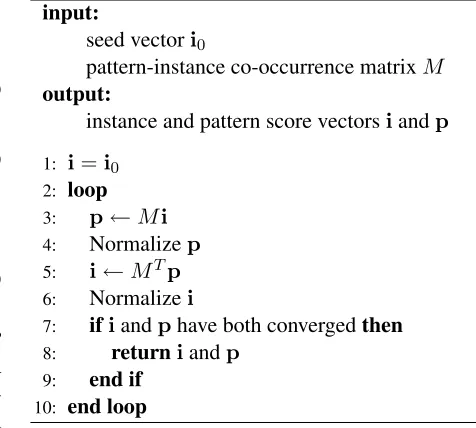
input:
seed vectori0
pattern-instance co-occurrence matrixM
output:
instance and pattern score vectorsiandp
1: i=i0 2: loop
3: p←Mi 4: Normalizep
5: i←MTp
6: Normalizei
7: ifiandphave both convergedthen
8: returniandp
9: end if
[image:3.612.298.536.58.272.2]10: end loop
Figure 1: A simple bootstrapping algorithm
next iteration. Optionally, instances can be cumula-tively obtained on each iteration to retain highly rel-evant instances learned in early iterations. Parame-ters and configurations: (c)instance scoring metrics, (d)whether to retain extracted instances on each it-eration or not, and (e)the number of instances to pass to the next iteration.
Bootstrapping iterates the above three phases sev-eral times until stopping criteria are met. Acquired instances tend to become noisy as the iteration pro-ceeds, so it is important to terminate before semantic drift occurs. Thus, we have another configuration: (f)stopping criterion.
Espresso uses Equations (1) for (a) and (2) for (c) respectively, whereas other parameters rely on the tasks and need calibration. Even though Espresso greatly improves recall while keeping high precision by using these pattern and instance scoring metrics, Komachi and Suzuki (2008) observed that extracted instances matched against generic patterns may be-come erroneous after tens of iterations, showing the difficulty of applying bootstrapping methods to dif-ferent domains.
3 Analysis of an Espresso-like Bootstrapping Algorithm
3.1 Simplified Espresso
of semantic drift.
As before, let |I| and |P| be the numbers of instances and patterns, respectively. The algo-rithm takes a seed vectori0, and a pattern-instance co-occurrence matrix M as input. i0 is a |I| -dimensional vector with 1 at the position of seed in-stances, and 0 elsewhere. M is a |P| × |I|-matrix whose (p, i)-element [M]pi holds the (possibly re-weighted) number of co-occurrence of patternpand instanceiin the corpus. If bothi andphave con-verged, the algorithm returns the pair ofiandp as output.
This algorithm, though simple, can encode Espresso’s update formulae (1) and (2) as Steps 3 through 6 if we pose
[M]pi= pmi(i, p)
maxpmi, (4)
and normalizepandiin Steps 4 and 6 by
p←p/|I| and i←i/|P|, (5)
respectively.
This specific instance of the algorithm of Fig-ure 1, obtained by specialization through Equations (4) and (5), will be henceforth referred to as Simpli-fied Espresso. Indeed, it is an instance of the origi-nal Espresso in which the iteration is not terminated until convergence, all instances are carried over to the next iteration, and instances are not cumulatively learned.
3.2 Simplified Espresso as Link Analysis
Let n denote the number of times Steps 2–10 are iterated. Plugging (4) and (5) into Steps 3–6, we see that the score vector of instances after the nth iteration is
in=Ani0 (6)
where
A= 1
|I||P|M
TM. (7)
Suppose matrix A is irreducible; i.e., the graph induced by takingAas the adjacency matrix is con-nected. If n is increased and in is normalized on
each iteration, in tends to the principal
eigenvec-tor ofA. This implies that no matter what seed in-stances are input, the algorithm will end up with the
same ranking of instances, if it is run until conver-gence. Because A = M|I||TPM|, the principal eigen-vector of A is identical to the authority vector of HITS (Kleinberg, 1999) algorithm run on the graph induced byM. 1 This similarity of Equations (1), (2) and HITS is not discussed in (Pantel and Pen-nacchiotti, 2006).
As a consequence of the above discussion, se-mantic drift in simplified Espresso seems to be in-evitable as the iteration proceeds, since the principal eigenvector ofA need not resemble seed vectori0. A similar phenomenon is reported for HITS and is known astopic drift, in which pages of the dominant topic are ranked high regardless of the given query. (Bharat and Henzinger, 1998)
Unlike HITS and Simplified Espresso, how-ever, Espresso and other bootstrapping algo-rithms (Yarowsky, 1995; Riloff and Jones, 1999), incorporate heuristics so that only patterns and in-stances with high confidence score are carried over to the next iteration.
3.3 Convergence Process of Espresso
To investigate the effect of semantic drift on Espresso with and without the heuristics of selecting the most confident instances on each iteration (i.e., the original Espresso and Simplified Espresso of Section 3.2), we apply them to the task of word sense disambiguation of word “bank” in the Senseval-3 Lexical Sample (S3LS) Task data.2 There are 394 instances of word “bank” and their occurring con-text in this dataset, and each of them is annotated with its true sense. Of the ten senses of bank, the most frequent is the bank as in “bank of the river.” We use the standard training-test split provided with the data set.
We henceforth denote Espresso with the follow-ing filterfollow-ing strategy as Filtered Espresso to stress the distinction from Simplified Espresso. For Fil-tered Espresso, we cleared all but the 100 top-scoring instances in the instance vector on each iter-ation, and the number of non-zeroed instance scores
1
As long as the relative magnitude of the components of vec-torinis preserved, the vector can be normalized in any way on each iteration. Hence HITS and Simplified Espresso use differ-ent normalization but both converge to the principal eigenvector ofA.
2
grows by 100 on each iteration. On the other hand, we cleared all but the 20 top-scoring patterns in the pattern vector on each iteration, and the number of non-zeroed pattern scores grows by 1 on each iter-ation following (Pantel and Pennacchiotti, 2006).3 The values of other parameters (b), (d), (e) and (f) remains the same as those for simplified Espresso in Section 3.1.
The task of WSD is to correctly predict the senses of test instances whose true sense is hidden from the system, using training data and their true senses. To predict the sense of a given instancei, we apply k-nearest neighbor algorithm.
Given a test instancei, its sense is predicted with the following procedure:
1. Compute the instance-pattern matrix M from the entire set of instances. We defer the details of this step to Section 5.2.
2. Run Simplified- and Filtered Espresso using the given instanceias the only seed instance.
3. After the termination of the algorithm, selectk training instances with the highest scores in the score vectorioutput by the algorithm.
4. Since the selected k instances are training instances, their true senses are accessible. Choose the majority senses from these k in-stances, and outputsas the prediction for the given instancei. When there is a tie, output the sense of the instance with the highest score in
i. Note that only Step 4 uses sense information.
Figure 2 shows the convergence process of Simplified- and Filtered Espresso. X-axis indicates the number of bootstrapping iterations and Y-axis indicates the recall, which in this case equals pre-cision, as the coverage is 100% in all cases.
3
We conducted preliminary experiment to find these param-eters to maximize the performance of Filtered Espresso. (These numbers are different from the original Espresso (Pantel and Pennacchiotti, 2006).) The number of initial patterns is rel-atively large because of a data sparseness problem in WSD, unlike relation extraction and named entity recognition. Also, WSD basically uses more features than relation extraction and thus it is hard to determine the stopping criterion based on the number and scores of patterns, as (Pantel and Pennacchiotti, 2006) does.
0.4 0.5 0.6 0.7 0.8 0.9 1
5 10 15 20 25 30
recall of "bank"
iteration
[image:5.612.317.539.61.223.2]Simplified Espresso Filtered Espresso most frequent sense (baseline)
Figure 2: Recall of Simplified- and Filtered Espresso
Simplified Espresso tends to select the most fre-quent sense as the iteration proceeds, and after nine iterations it selects the most frequent sense (“the bank of the river”) regardless of the seed instances. As expected from the discussion in Section 3.2, generic patterns gradually got more weight and se-mantic drift occurred in later iterations. Indeed, the ranking of the instances after convergence was iden-tical to the HITS authority ranking computed from instance-pattern matrixM (i.e., the ranking induced by the dominant eigenvector ofMTM).
On the other hand, Filtered Espresso suffers less from semantic drift. The final recall achieved was 0.773 after convergence on the 20th iteration, outperforming the most-frequent sense baseline by 0.10. However, a closer look reveals that the filter-ing heuristics is limited in effectiveness.
0.3 0.4 0.5 0.6 0.7 0.8 0.9 1
5 10 15 20 25 30
recall
iteration
[image:6.612.77.297.63.222.2]most frequent sense other senses
Figure 3: Recall of Filtered Espresso on the instances having “bank of the river” and other senses
4 Two Graph-based Algorithms for Exploiting Generic Patterns
We explore two graph-based methods which have the advantage of Espresso to harness the property of generic patterns by the mutual recursive definition of instance and pattern scores. They also have less parameters than bootstrapping, and are less prone to semantic drift.
4.1 Von Neumann Kernel
Kandola et al. (2002) proposed the von Neumann kernels for measuring similarity of documents us-ing words. If we apply the von Neumann kernels to the pattern-instance co-occurrence matrix instead of the document-word matrix, the relative importance of an instance to seed instances can be estimated.
LetA=MTM be the instance similarity matrix obtained from pattern-instance matrixM, andλbe the principal eigenvalue of A. Thevon Neumann kernel matrixKβ with diffusion factorβ (0≤β <
λ−1)is defined as follows:
Kβ = A ∞
∑
n=0
βnAn=A(I−βA)−1. (8)
The similarity between two instancesi, jis given by the (i, j) element of Kβ. Hence, the i-th column
vector can be used as the score vector for seed in-stancei.
Ito et al. (2005) showed that the von Neumann kernels represent a mixture of the co-citation re-latedness and Kleinberg’s HITS importance. They
compute the weighted sum of all paths between two nodes in the co-citation graph induced by A =
MTM. The (MTM)n term of smaller n
corre-sponds to the relatedness to the seed instances, and the(MTM)nterm of largerncorresponds to HITS importance. The von Neumann kernels calculate the weighted sum of(MTM)nfromn = 1 to∞, and therefore smaller diffusion factorβ results in rank-ing by relatedness, and largerβ returns ranking by HITS importance.
In NLP literature, Sch¨utze (1998) introduced the notion of first- and second-order co-occurrence. First-order co-occurrence is a context which directly occurs with a word, whereas second-order co-occurrence is a context which occurs with the (con-textual) words that co-occur with a word. Higher-order co-occurrence information is less sparse and more robust than lower-order co-occurrence, and thus is useful for a proximity measure.
Given these definitions, we see that the(MTM)n
term of smaller n corresponds to lower-order co-occurrence, which is accurate but sparse, and the
(MTM)n term of larger n corresponds to higher-order co-occurrence, which is dense but possibly giving too much weight on unrelated instances ex-tracted by generic patterns.
As a result, it is expected that setting diffusion factorβto a small value prevents semantic drift and also takes higher order pattern vectors into account. We verify this claim in Section 5.3.
4.2 Regularized Laplacian Kernel
The von Neumann kernels can be regarded as a mix-ture of relatedness and importance, and diffusion factor β controls the trade-off between relatedness and importance. In practice, however, setting the right parameter value becomes an issue. We solve this problem by the regularized Laplacian (Smola and Kondor, 2003; Chebotarev and Shamis, 1998), which are stable across diffusion factors and can safely benefit from generic patterns.
LetGbe a weighted undirected graph whose adja-cency (weight) matrix is a symmetric matrixA. The (combinatorial) graph Laplacian Lof a graph Gis defined as follows:
L=D−A (9)
Table 1: Recall of predicted labels ofbank
algorithm MFS others
Simplified Espresso 100.0 0.0
Filtered Espresso 100.0 30.2
Filtered Espresso (optimal stopping) 94.4 67.4
von Neumann kernels 92.1 65.1
regularized Laplacian 92.1 62.8
element[D]iiis given by
[D]ii=
∑
j
[A]ij. (10)
Here,[A]ij stands for the(i, j)element ofA. By
re-placingAwith−Lin Equation (8) and deleting the firstA, we obtain aregularized Laplacian kernel4.
Rβ = ∞
∑
n=0
βn(−L)n= (I+βL)−1 (11)
Again,β(≥0)is called the diffusion factor.
Both the regularized Laplacian and the von Neu-mann kernels compute all the possible paths in a graph, and consequently they can calculate influence between nodes in a long distance in the graph. Also, Equations (9) and (10) show that the negative Lapla-cian −L can be regarded as a modification to the graph G with the weight of self-loops re-weighted to negative values. In this modified graph, if an in-stance co-occurs with a pattern which also co-occurs with a large number of other instances, a self-loop of a node in the instance similarity graph induced by MTM will receive a higher negative weight. In other words, instances co-occurring with generic patterns will get less weight in the regularized Lapla-cian than in the von Neumann kernels.
5 Experiments and Results
5.1 Experiment 1: Reducing Semantic Drift
We test the von Neumann kernels and the regular-ized Laplacian on the same task as we used in Sec-tion 3.3; i.e., word sense disambiguaSec-tion of word
4
It has been reported that normalization ofAimproves per-formance in application (Johnson and Zhang, 2007), so we nor-malizeLbyL=I−D−12AD−
1 2.
“bank.” During the training phase, a pattern-instance matrix M was constructed using the training and testing data from Senseval-3 Lexical Sample (S3LS) Task. The(i, j)element ofM of both kernels is set to pointwise mutual information of a patterniand an instancej, just the same as in Espresso. Recall is used in evaluation.5 The diffusion parameterβis set to10−5 and10−2for the von Neumann kernels and the regularized Laplacian, respectively.
Table 1 illustrates how well the proposed meth-ods reduce semantic drift, just the same as the ex-periment of Figure 3 in Section 3.3. We evalu-ate the recall on predicting the most frequent sense (MFS) and the recall on predicting other less fre-quent senses (others). For Filtered Espresso, two results are shown: the result on the seventh iter-ation, which maximizes the performance (Filtered Espresso (optimal stopping)), and the one after con-vergence. As in Section 3.3, if semantic drift oc-curs, recall of prediction on the most frequent sense increases while recall of prediction on other senses declines. Even Filtered Espresso was affected by se-mantic drift, which is again a consequence of the inherent graphical nature of Espresso-like bootstrap-ping algorithms. On the other hand, both proposed methods succeeded to balance the most frequent sense and other senses. Filtered Espresso at the op-timal number of iterations achieved the best perfor-mance. Nevertheless, the number of iterations has to be estimated separately.
5.2 Experiment 2: WSD Benchmark Data
We conducted experiments on the task of word sense disambiguation of S3LS data, this time not just on the word “bank” but on all target nouns in the data, following (Agirre et al., 2006). We used two types of patterns.
Unordered single words (bag-of-words) We used all single words (unigrams) in the provided context from S3LS data sets. Each word in the con-text constructs one pattern. The pattern correspond-ing to a wordwis set to 1 if it appears in the con-text of instancei. Words were lowercased and pre-processed with the Porter Stemmer6.
5Again, recall equals precision in this case as the coverage
is 100% in all cases.
6
Table 2: Comparison of WSD algorithms
algorithm Recall
most frequent sense 54.5
HyperLex (V´eronis, 2004) 64.6
PageRank (Agirre et al., 2006) 64.5
Simplified Espresso 44.1
Filtered Espresso 46.9
Filtered Espresso (optimal stopping) 66.5 von Neumann kernels (β = 10−5) 67.2 regularized Laplacian (β = 10−2) 67.1
Local collocations A local collocation refers to the ordered sequence of tokens in the local, narrow context of the target word. We allowed a pattern to have wildcard expressions like “sale of *interestin * *” for the target wordinterest. We set the window size to±3by a preliminary experiment.
We report the results of Filtered Espresso both af-ter convergence, and with its optimal number of iaf-ter- iter-ations to show the upper bound of its performance.
Table 2 compares proposed methods with Espresso with various configurations. The proposed methods outperform by a large margin the most fre-quent sense baseline and both Simplified- and Fil-tered Espresso. This means that the proposed meth-ods effectively prevent semantic drift.
Also, Filtered Espresso without early stopping shows more or less identical performance to Sim-plified Espresso. It is implied that the heuristics of filtering and early stopping is a crucial step not to select generic patterns in Espresso, and the result is consistent with the experiment of convergence pro-cess of Espresso in Section 3.3.
Filtered Espresso halted after the seventh itera-tion (Filtered Espresso (optimal stopping)) is com-parable to the proposed methods. However, in boot-strapping, not only the number of iterations but also a large number of parameters must be adjusted for each task and domain. This shortcoming makes it hard to adapt bootstrapping in practical cases. One of the main advantages of the proposed methods is that they have only one parameter β and are much easier to tune.
It is suggested in Sections 3.3 and 4.1 that Espresso and the von Neumann kernel with largeβ
40 45 50 55 60 65 70 75
1e-07 1e-06 1e-05 0.0001 0.001
recall
diffusion factor von Neumann kernel
[image:8.612.88.283.81.215.2]Simplified Espresso most frequent sense
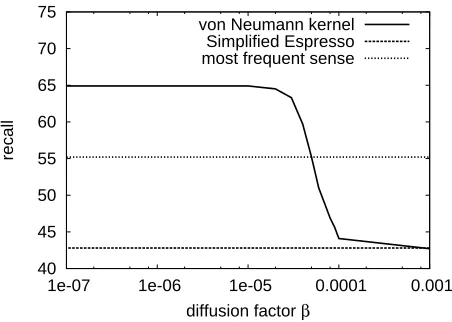
Figure 4: Recall of the von Neumann kernels with a dif-ferent diffusion factorβon S3LS WSD task
converge to the principal eigenvector ofA, though the result does not seem to support this claim (both Simplified- and Filtered Espresso are 10 points lower than the most frequent sense baseline). The reason seems to be because Espresso and the von Neumann kernels use pointwise mutual information as a weighting factor so that the principal eigenvec-tor ofAmay not always represent the most frequent sense.7
We also show the results of previous graph-based methods (Agirre et al., 2006), based on Hyper-Lex (V´eronis, 2004) and PageRank (Brin and Page, 1998). The experimental set-up is the same as ours in that they do not use the sense tags of training cor-pus to construct a co-occurrence graph, and they use the sense tags of all the S3LS training corpus for mapping senses to clusters. However, these meth-ods have seven parameters to tune in order to achieve the best performance, and hence are difficult to opti-mize.
[image:8.612.84.284.81.214.2]5.3 Experiment 3: Sensitivity to a Different Diffusion Factor
Figure 4 shows the performance of the von Neu-mann kernels with a diffusion factor β. As ex-pected, smaller β leads to relatedness to seed in-stances, and largerβasymptotically converges to the HITS authority ranking (or equivalently, Simplified
7
40 45 50 55 60 65 70 75
0.001 0.01 0.1 1 10 100 1000
recall
diffusion factor regularized Laplacian
[image:9.612.77.300.63.224.2]most frequent sense
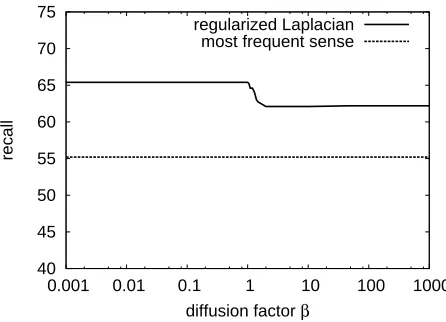
Figure 5: Recall of the regularized Laplacian with a dif-ferent diffusion factorβon S3LS WSD task
Espresso).
One of the disadvantages of the von Neumann kernels over the regularized Laplacian is their sen-sitivity to parameterβ. Figure 5 illustrates the per-formance of the regularized Laplacian with a diffu-sion factorβ. The regularized Laplacian is stable for various values ofβ, while the von Neumann kernels change their behavior drastically depending on the value ofβ. However,βin the von Neumann kernels is upper-bounded by the reciprocal1/λof the prin-cipal eigenvalue ofA, and the derivatives of kernel matrices with respect toβcan be used to guide sys-tematic calibration of β (see (Ito et al., 2005) for detail).
6 Conclusion and Future Work
This paper gives a graph-based analysis of seman-tic drift in Espresso-like bootstrapping algorithms. We indicate that semantic drift in bootstrapping is a parallel to topic drift in HITS. We confirm that the von Neumann kernels and the regularized Laplacian reduce semantic drift in the Senseval-3 Lexical Sam-ple task. Our proposed methods have only one pa-rameters and are easy to calibrate.
Beside the regularized Laplacian, many other ker-nels based on the eigenvalue regularization of the Laplacian matrix have been proposed in machine learning community (Kondor and Lafferty, 2002; Nadler et al., 2006; Saerens et al., 2004). One such kernel is the commute-time kernel (Saerens et al., 2004) defined as the pseudo-inverse of Laplacian.
Despite having no parameters at all, it has been re-ported to perform well in many collaborative filter-ing tasks (Fouss et al., 2007). We plan to test these kernels in our task as well.
Another research topic is to investigate other semi-supervised learning techniques such as co-training (Blum and Mitchell, 1998). As we have described in this paper, self-training can be thought of a graph-based algorithm. It is also interesting to analyze how co-training is related to the proposed algorithm.
Bootstrapping algorithms have been used in many NLP applications. Two major tasks of bootstrap-ping are word sense disambiguation and named en-tity recognition. In named enen-tity recognition task, instances are usually retained on each iteration and added to seed instance set. This seems to be be-cause named entity recognition suffers from seman-tic drift more severely than word sense disambigua-tion. Even though this problem setting is different from ours, it needs to be verified that the graph-based approaches presented in this paper are also ef-fective in named entity recognition.
Acknowledgements
We thank anonymous reviewers for helpful com-ments and for making us aware of Abney’s work. The first author is partially supported by the Japan Society for Promotion of Science (JSPS), Grant-in-Aid for JSPS Fellows.
References
Steven Abney. 2004. Understanding the Yarowsky Al-gorithm. Computational Linguistics, 30(3):365–395. Eneko Agirre, David Mart´ınez, Oier L´opez de Lacalle,
and Aitor Soroa. 2006. Two graph-based algorithms for state-of-the-art WSD. InProceedings of the 2006 Conference on Empirical Methods in Natural Lan-guage Processing, pages 585–593.
Michele Banko and Eric Brill. 2001. Scaling to Very Very Large Corpora for Natural Language Disam-biguation. InProceedings of the 39th Annual Meeting on Association for Computational Linguistics, pages 26–33.
Avrim Blum and Tom Mitchell. 1998. Combining La-beled and UnlaLa-beled Data with Co-Training. In Pro-ceedings of the Workshop on Computational Learning Theory (COLT), pages 92–100. Morgan Kaufmann. Sergey Brin and Lawrence Page. 1998. The anatomy of
a large-scale hypertextual Web search engine. Com-puter Networks and ISDN Systems, 30(1–7):107–117. Pavel Yu Chebotarev and Elena V. Shamis. 1998. On
proximity measures for graph vertices. Automation and Remote Control, 59(10):1443–1459.
Michael Collins and Yoram Singer. 1999. Unsuper-vised Models for Named Entity Classification. In Pro-ceedings of the Joint SIGDAT Conference on Empiri-cal Methods in Natural Language Processing and Very Large Corpora, pages 100–110.
James R. Curran, Tara Murphy, and Bernhard Scholz. 2007. Minimising semantic drift with Mutual Exclu-sion Bootstrapping. In Proceedings of the 10th Con-ference of the Pacific Association for Computational Linguistics, pages 172–180.
Franc¸ois Fouss, Luh Yen, Pierr Dupont, and Marco Saerens. 2007. Random-walk computation of simi-larities between nodes of a graph with application to collaborative recommendation. IEEE Transactions on Knowledge and Data Engineering, 19(3):355–369. Marti Hearst. 1992. Automatic Acquisition of
Hy-ponyms from Large Text Corpora. InProceedings of the Fourteenth International Conference on Computa-tional Linguistics, pages 539–545.
Takahiko Ito, Masashi Shimbo, Taku Kudo, and Yuji Matsumoto. 2005. Application of Kernels to Link Analysis. In Proceedings of the Eleventh ACM SIGKDD International Conference on Knowl-edge Discovery and Data Mining, pages 586–592. Rie Johnson and Tong Zhang. 2007. On the
Effec-tiveness of Laplacian Normalization for Graph Semi-supervised Learning. Journal of Machine Learning Research, 8:1489–1517.
Jaz Kandola, John Shawe-Taylor, and Nello Cristianini. 2002. Learning Semantic Similarity. In Advances in Neural Information Processing Systems 15, pages 657–664.
Jon Kleinberg. 1999. Authoritative Sources in a Hyper-linked Environment. Journal of the ACM, 46(5):604– 632.
Mamoru Komachi and Hisami Suzuki. 2008. Mini-mally Supervised Learning of Semantic Knowledge from Query Logs. In Proceedings of the 3rd Inter-national Joint Conference on Natural Language Pro-cessing, pages 358–365.
Risi Imre Kondor and John Lafferty. 2002. Diffusion kernels on graphs and other discrete input spaces. In
Proceedings of the 19th International Conference on Machine Learning (ICML-2002).
Hang Li and Cong Li. 2004. Word Translation Disam-biguation Using Bilingual Bootstrapping. Computa-tional Linguistics, 30(1):1–22.
Boaz Nadler, Stephane Lafon, Ronald Coifman, and Ioannis Kevrekidis. 2006. Diffusion maps, spectral clustering and eigenfunctions of fokker-planck opera-tors. Advances in Neural Information Processing Sys-tems 18, pages 955–962.
Vincent Ng and Claire Cardie. 2003. Weakly Su-pervised Natural Language Learning Without Redun-dant Views. InProceedings of the HLT-NAACL 2003, pages 94–101.
Patrick Pantel and Marco Pennacchiotti. 2006. Espresso: Leveraging Generic Patterns for Automatically Har-vesting Semantic Relations. InProceedings of the 21st International Conference on Computational Linguis-tics and the 44th annual meeting of the ACL, pages 113–120.
Ellen Riloff and Rosie Jones. 1999. Learning Dic-tionaries for Information Extraction by Multi-Level Bootstrapping. In Proceedings of the Sixteenth Na-tional Conference on Artificial Intellligence (AAAI-99), pages 474–479.
Marco Saerens, Franc¸ois Fouss, Luh Yen, and Pierre Dupont. 2004. The principal component analysis of a graph, and its relationship to spectral clustering. In Proceedings of European Conference on Machine Learning (ECML 2004), pages 371–383. Springer. Heinrich Sch¨utze. 1998. Automatic Word Sense
Dis-crimination. Computational Linguistics, 24(1):97– 123.
Alex J. Smola and Risi Imre Kondor. 2003. Kernels and Regularization of Graphs. InProceedings of the 16th Annual Conference on Learning Theory, pages 144– 158.
Jean V´eronis. 2004. HyperLex: Lexical Cartography for Information Retrieval. Computer Speech & Language, 18(3):223–252.