Proceedings of the 9th Workshop on Computational Approaches to Subjectivity, Sentiment and Social Media Analysis, pages 149–155 149
Measuring Issue Ownership using Word Embeddings
∗Amaru Cuba Gyllensten RISE AI
Magnus Sahlgren RISE AI
Abstract
Sentiment and topic analysis are common methods used for social media monitoring. Essentially, these methods answers questions such as, “what is being talked about, regarding
X”, and “what do people feel, regarding X”. In this paper, we investigate another venue for social media monitoring, namelyissue owner-shipand agenda setting, which are concepts from political science that have been used to explain voter choice and electoral outcomes. We argue that issue alignment and agenda set-ting can be seen as a kind of semantic source similarity of the kind “how similar is source
A to issue owner P, when talking about is-sue X”, and as such can be measured using word/document embedding techniques. We present work in progress towards measuring that kind of conditioned similarity, and intro-duce a new notion of similarity for predic-tive embeddings. We then test this method by measuring the similarity between politi-cally aligned media and political parties, con-ditioned on bloc-specific issues.
1 Introduction
Social Media Monitoring (SMM; i.e. monitoring of online discussions in social media) has be-come an established application domain with a large body of scientific literature, and consider-able commercial interest. The subfields of Topic Detection and Tracking(Allan et al., 1998; Srid-har,2015) andSentiment Analysis(Turney,2002;
Pang and Lee,2008;Liu,2012;Pozzi et al.,2016) are both scientific topics spawned entirely within the SMM domain. In its most basic form, SMM entails nothing more than counting occurrences of terms in data; producing frequency lists of com-monly used vocabulary, and matching of term sets
∗
This research was supported by the Swedish Research Council under contract 2017-02429
related to various topics and sentiments. More so-phisticated approaches use various forms of prob-abilistic topic detection (such as Latent Dirichlet Allocation) and sentiment analysis based on su-pervised machine learning.
The central questions SMM seeks to answer are
“what do users talk about?”and“how do they feel about it?”. Answers to these questions may pro-vide useful insight for market research and com-munications departments. It is apparent how prod-uct and service companies may use such analysis to gain an understanding of their target audience. It is also apparent how such analysis may be used in the context of elections for providing an indi-cation of citizens’ opinions as manifested in what they write in social media. There are numerous studies attempting to use various forms of social media monitoring techniques to predict the out-come of elections, with varying success ( Berming-ham and Smeaton,2011;Ceron et al.,2015).
Most notably, the recent examples of the inade-quacy of standard opinion measuring techniques to forecast the most recent US election and the Brexit demonstrate that for certain questions re-lated to measuring mass opinion, standard SMM techniques may be inadequate. Political scientists have used the concepts ofagenda setting and is-sue ownership to explain voter choice and elec-tion outcomes (Kl¨uver and naki Sagarzazu,2016;
cer-tain keywords, since most parties tend to use the same vocabulary to discuss issues, and sentiment analysis does not touch upon the issue ownership and agenda setting questions. What is needed for measuring issue ownership and agenda setting is a way to measurelanguage use, i.e. when talking about an issue, to which extent does the language used align with issue ownerAvs. issue ownerB.
We argue that issue alignment can be seen as a kind of semantic source similarity of the kind “how similar is source A to issue owner P, when talking about issueX”, and as such can be measured using word/document embedding tech-niques. To measure that kind of conditioned sim-ilarity we introduce a new notion of simsim-ilarity for predictive word embeddings. This method enables us to manipulate the similarity measure by weight-ing the set of entities we account for in the pre-dictive scoring function. The proposed method is applied to measure similarity between party pro-grams and various subsets of online text sources, conditioned on bloc specific issues. The results indicate that this conditioning disentangles simi-larity. We can, for example, observe that while the Left Party representation is, overall, similar to that of nativist media, it differs significantly on nativist issue, while this effect is not seen to the same ex-tent on more mainstream left wing or right wing media.
2 Vector Similarity
Vector similarity has been a foundational concept in natural language processing ever sine the intro-duction of thevector space modelfor information retrieval bySalton(1971). In this model, queries and document are represented as vectors in term space, and similarity is expressed using cosine similarity. The main reason for using cosine sim-ilarity in the vector space model is that it normal-izes for vector length; the fact that a document (or query) contains a certain word is more important than how many times it occurs in the document.
The vector space model was the main source of inspiration for early work onvector semantics, such as Latent Semantic Analysis (Deerwester et al.,1990;Landauer and Dumais,1997) and the works on word space models by Sch¨utze (1992,
1993). These works continued to embrace co-sine similarity as the similarity metric of choice, since length normalization is equally desired when words are represented by vectors whose elements
encode (some function of) co-occurrences with other words. Contemporary research on distribu-tional semantics (Sahlgren, 2006; Bullinaria and Levy,2007;Turney and Pantel,2010;Pennington et al.,2014) still use largely the same mathemati-cal machinery as the vector space model, and co-sine similarity is still the preferred similarity met-ric due to its simplicity and use of length normal-ization. Even neural language models, which orig-inate from the neural network community, employ cosine similarity to quantify similarity between learned representations (Mikolov et al.,2013; Bo-janowski et al.,2017).
Word embeddings, as these techniques are nowadays referred to, have been used extensively in SMM, both for topic detection (Sridhar,2015) and for sentiment analysis (Severyn and Moschitti,
2015). To the best of our knowledge, only one previous study (Dahlberg and Sahlgren,2014) has used word embeddings to analyze issue owner-ship. However, that study relied on simple nearest neighbor analysis using cosine similarity to study language use in the Swedish blogosphere.
We believe that prediction-based word embed-dings such as Word2Vec are amenable to another notion of similarity, which we call predictive sim-ilarity.
2.1 Predictive Similarity
Given a functionf :A×B → R, we define the predictive similarity of two itemsx, y ∈ Aas the correlation off(x,b), and f(y,b), whereb is a random variable of typeB:
psim(x, y) = pcov(f(x,b), f(y,b))
var(f(x,b))var(f(y,b))
(1) At a very general level, prediction based word embeddings such as Word2Vec or FastText con-sists of a scoring functions:C×T →Rwith an objective function taking the following form:
X
t×C∈D
X
c∈C
l(s(c, t)) + X
n∈Nt,c
l(−s(n, t))
(2)
wherelis the logistic loss functionl(x) = log(1+
orange
paint juice county
1 deep-red cranberry siskiyou 2 fuschia lime calaveras 3 lime-green caraway ventura 4 hand-woven fanta osceola
5 blue clove yolo
[image:3.595.74.287.65.234.2] [image:3.595.86.291.456.590.2]6 yellow zests mendocino 7 ocher coconut bernardino 8 linoleum peppercorns okanogan 9 duck-egg lemons okfuskee 10 rust-colored peach tuolumne
Table 1: Examples of predictive similarity neigh-borhoods of “orange” conditioned on “paint”, “juice”, and “county”, respectively.2
product between a vector representation of the tar-get wordt, and a vector representation of the con-text wordc.
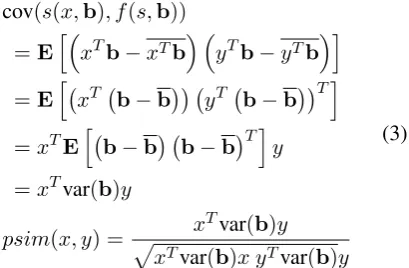
The predictive similarity has several interpreta-tions for the Skipgram model, but the simplest one is the one where we letf =s, i.e. we say that the similarity of two wordsxandyis the correlation between the scores they assign to target wordsb, i.e. corr(s(x,b), s(y,b)). Since sis linear, this correlation takes a fairly simple form:1
cov(s(x,b), f(s,b))
=EhxTb−xTb yTb−yTbi
=E h
xT b−b yT b−bT i
=xTEh b−b b−bTiy
=xTvar(b)y
psim(x, y) = x
Tvar(b)y
p
xTvar(b)x yTvar(b)y
(3)
We argue that we can get a a notion of condi-tioned similarity by estimating aweighted correla-tion, where the weighting acts as the conditioning. Table 1 shows a small example where we queried the neighborhood of the word “orange”, conditioned such that a single word (“paint”, “juice”, and “county”, respectively) accounts for half the weight in var(b), with all other words in the vocabulary having equal weights.
1It might be interesting to note that this coincides with cosine similarity if var(b) is a scalar multiple of the iden-tity, i.e. if there is no correlation between dimensions and all dimensions have the same variance.
Predictive similarity can easily be extended to similar models, and for the purpose of this pa-per in particular, we extend it to Doc2Vec (Le and Mikolov,2014), a model where the notion of con-text is enriched by the source3 of the utterance. The scoring function s then takes the following form:s(t, c, d) =tT(c+d), withdbeing a vector representation of the source in question.
We argue that by using conditioned predictive similarity on document embeddings we can an-swer questions such as: “how similar isThe BBC
to The Daily Mail, when talking about Climate Change”. The end goal is to measure aggregate similarity in specific issues: “when talking about
health policy, to which extent does the general lan-guage use align with Source A,Source B,Source C, et.c.”.
3 Experiments
To answer the language similarity question posed by issue ownership we measure aggregate predic-tive similarity between party platforms and var-ious subsets of online text data, conditioned on words pertaining to left wing issues, right wing is-sues, nativist isis-sues, and general political topics.
We built Doc2Vec embeddings (Le and Mikolov, 2014) on Swedish online data from 2018 crawled by Trendiction and manually scraped party platforms from the eight parties in parliament and Feministiskt Initiativ (Feminist Initiative).4 Doc2Vec requires us to define a notion of source. For the data crawled by Trendic-tion, we take the source to be the domain name of the document, e.g.www.wikipedia.se, whereas for the manually scraped party platforms, we assign it the appropriate party identifier. The model was trained using the Gensim package (Reh˚uˇrek andˇ Sojka,2010) with embedding dimension 100 and a context window of size 8.
In collaboration with the Political Science de-partment at Gothenburg University we also ex-tracted keywords for each party from their party platform. We use these party specific keywords as a crude proxy for issues: we let left wing issues be defined by the union of left bloc party keywords, right wing issues be defined by right bloc party keywords, and nativist issues be defined by the
3By source we can mean a paragraph, document, or in our case: domain name from which the utterance originates.
4A complete list of parties, their abbreviations, their En-glish translations, and bloc affiliation can be found in Table
Abbr. Name Translation Word count Bloc V V¨ansterpartiet The Left Party 15,383
Left S Socialdemokraterna The Social Democrats 27,899
MP Milj¨opartiet The Green Party 19,471 C Centern The Centre Party 68,136
Right L Liberalerna The Liberals 64,276
KD Kristdemokraterna The Christian Democrats 16,494 M Moderaterna The Moderates 12,807
[image:4.595.70.480.64.205.2]SD Sverigedemokraterna The Swedish Democrats 3,430 N/A (Nativist) FI Feministiskt Initiativ Feminist Initiative 84,424 N/A
Table 2: Party abbreviations, names, translated names, word count, and bloc allegiance.
keywords of Sverigedemokraterna (The Swedish Democrats), we also let the union of all keywords be representative for general political discourse. The parties’ bloc alignment and the size of the data used to generate representations for them can be seen in Table2.
We let the conditioned predictive similarity be-tween sources twox andy be defined by the fol-lowing equation (Equation4), i.e. a weighted vari-ant of equation 3, where only words among the given issues keywords are accounted for, as de-scribed by Equation5.
psim(x, y) = x
Tvar(t;w)y
p
xTvar(t;w)x yTvar(t;w)y
(4)
wt=
(
1, t∈Issue keywords
0, t6∈Issue keywords (5) Above, x and y are document vectors and var(t;wt)is the weighted covariance matrix of the
target word vectors. This is the equivalent of let-ting s(d, c, t) = dTt, i.e. the case we ignore the effect of context words.
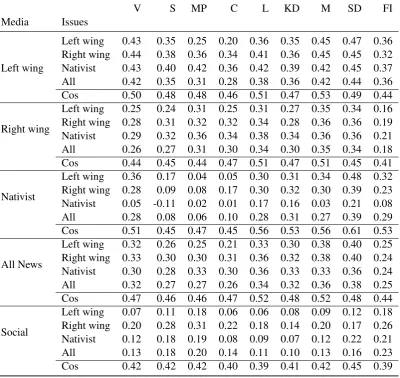
Table3(next side) shows the average predictive similarity between the political party platforms and various online data sources, conditioned on left wing party issues, right wing party issues, na-tivist party issues, and general political discourse. Average cosine similarity between the sources and parties is also shown as a comparison.
4 Discussion
As can be seen in Table3, there is a marked dif-ference when conditioning on issues versus using regular document — i.e. cosine — similarity. Fur-thermore, we observe that conditioned similarity
seems to align left wing media with left wing par-ties, nativist media with the Swedish Democrats, but not align right wing media with right wing par-ties. This effect can be made more apparent by grouping the parties into blocs and fitting a simple additive model for the similarities along all dimen-sions (i.e. Media, Issues, and Bloc), as a way to normalize for general Media, Issue, and Bloc sim-ilarity. The results of this normalization, i.e. the residuals, can be observed in Table4. From this one can see a small trend where left wing media is similar to left wing parties, nativist media being similar to the Swedish Democrats, and both left wing media and right wing media being dissimilar to the Swedish Democrats.
Furthermore, we see a strong dissimilarity be-tween nativist media and all parties regarding na-tivist issues. This is particularly true for parties promoting liberal immigration policy: The Left Party, The Social Democrats, The Green Party, The Centre Party, and The Moderates are all cur-rently or historically promoting liberal immigra-tion policy at odds with nativist sentiment.
A shortcoming of the method used here is the rather limited amount of party specific data: the quality and the quantity of the text data used varies drastically between parties, as can be seen in Ta-ble2. Using, for example, parliamentary debates, opinion pieces, and other official party communi-cation might improve data coverage.
5 Conclusion
V S MP C L KD M SD FI Media Issues
Left wing
Left wing 0.43 0.35 0.25 0.20 0.36 0.35 0.45 0.47 0.36 Right wing 0.44 0.38 0.36 0.34 0.41 0.36 0.45 0.45 0.32 Nativist 0.43 0.40 0.42 0.36 0.42 0.39 0.42 0.45 0.37 All 0.42 0.35 0.31 0.28 0.38 0.36 0.42 0.44 0.36 Cos 0.50 0.48 0.48 0.46 0.51 0.47 0.53 0.49 0.44
Right wing
Left wing 0.25 0.24 0.31 0.25 0.31 0.27 0.35 0.34 0.16 Right wing 0.28 0.31 0.32 0.32 0.34 0.28 0.36 0.36 0.19 Nativist 0.29 0.32 0.36 0.34 0.38 0.34 0.36 0.36 0.21 All 0.26 0.27 0.31 0.30 0.34 0.30 0.35 0.34 0.18 Cos 0.44 0.45 0.44 0.47 0.51 0.47 0.51 0.45 0.41
Nativist
Left wing 0.36 0.17 0.04 0.05 0.30 0.31 0.34 0.48 0.32 Right wing 0.28 0.09 0.08 0.17 0.30 0.32 0.30 0.39 0.23 Nativist 0.05 -0.11 0.02 0.01 0.17 0.16 0.03 0.21 0.08 All 0.28 0.08 0.06 0.10 0.28 0.31 0.27 0.39 0.29 Cos 0.51 0.45 0.47 0.45 0.56 0.53 0.56 0.61 0.53
All News
Left wing 0.32 0.26 0.25 0.21 0.33 0.30 0.38 0.40 0.25 Right wing 0.33 0.30 0.30 0.31 0.36 0.32 0.38 0.40 0.24 Nativist 0.30 0.28 0.33 0.30 0.36 0.33 0.33 0.36 0.24 All 0.32 0.27 0.27 0.26 0.34 0.32 0.36 0.38 0.25 Cos 0.47 0.46 0.46 0.47 0.52 0.48 0.52 0.48 0.44
Social
[image:5.595.77.478.207.585.2]Left wing 0.07 0.11 0.18 0.06 0.06 0.08 0.09 0.12 0.18 Right wing 0.20 0.28 0.31 0.22 0.18 0.14 0.20 0.17 0.26 Nativist 0.12 0.18 0.19 0.08 0.09 0.07 0.12 0.22 0.21 All 0.13 0.18 0.20 0.14 0.11 0.10 0.13 0.16 0.23 Cos 0.42 0.42 0.42 0.40 0.39 0.41 0.42 0.45 0.39
Bloc Left Nativist Right Media Issues
Left wing
Left wing -0.02 -0.02 -0.06 Nativist 0.09 -0.00 0.03 Right wing 0.02 -0.05 -0.02
Nativist
Left wing 0.02 0.18 0.04 Nativist -0.15 -0.06 -0.08 Right wing -0.03 0.08 0.05
Right wing
Left wing -0.02 -0.06 -0.02 Nativist 0.07 -0.02 0.07 Right wing 0.01 -0.06 -0.01
Table 4: Grouped and normalized predictive simi-larity.
measure aggregate similarity in specific issues, an-swering questions such as “when talking about
health policy, to which extent does the general lan-guage use align withSource A,Source B, etc.”, and use such an aggregate measure to study issue own-ership at scale.
We believe that issue ownership and agenda set-ting can be explored through the lens of language use and similarity, but deem it necessary to con-dition similarity to the specific issue at hand. The reason for this is the need to distinguish between level of engagement in an issue and agreement in an issue: two sources that talk a lot about an issue — e.g. health insurance — but in very different ways should not be considered similar. Dually, if a source very rarely talks about an issue, but consistently does so in a way that is very similar to the way some political party talks about it, we consider it reasonable to believe that that source’s opinion aligns with the political party in question on that specific issue.
While we have not found a satisfactory, direct, evaluation of this task, we do believe that the ex-amples we put forward show some face validity of the proposed method at measuring ideological alignment.
6 Appendix
6.1 Left wing news sources
• Aftonbladet
• Arbetarbladet
• Dala-Demokraten
• Folkbladet
• ETC
• Arbetaren
• Flamman
• Bang
• Offensiv
• Prolet¨aren
6.2 Right wing news sources
• Dagens Industri
• Dalabygden
• Hallands Nyheter
• Axess
• Svensk Tidskrift
• Hemmets V¨an
• Dagens Nyheter
• G¨oteborgs-Posten
• Helsingborgs Dagblad
• Nerikes Allehanda
• Sydsvenskan
• Upsala Nya Tidning
• Expressen
• Svenska Dagbladet
• Sm˚alandsposten
• Norrbottens Kuriren
6.3 Nativist news sources
• Nordfront
• Samh¨allsnytt
• Fria Tider
• Nya Tider
• Samtiden
References
James Allan, Jaime Carbonell, George Doddington, Jonathan Yamron, Yiming Yang, et al. 1998. Topic detection and tracking pilot study: Final report. In Proceedings of the DARPA broadcast news transcription and understanding workshop, volume 1998, pages 194–218. Citeseer.
´
Eric B´elanger and Bonnie M. Meguid. 2008. Is-sue salience, isIs-sue ownership, and isIs-sue-based vote choice.Electoral Studies, 27(3):477 – 491.
Adam Bermingham and Alan Smeaton. 2011. On us-ing twitter to monitor political sentiment and predict election results. In Proceedings of the Workshop on Sentiment Analysis where AI meets Psychology (SAAIP 2011), pages 2–10.
Piotr Bojanowski, Edouard Grave, Armand Joulin, and Tomas Mikolov. 2017. Enriching word vectors with subword information. Transactions of the Associa-tion for ComputaAssocia-tional Linguistics, 5:135–146.
Andrea Ceron, Luigi Curini, and Stefano M Iacus. 2015. Using sentiment analysis to monitor elec-toral campaigns: Method mattersevidence from the united states and italy. Social Science Computer Re-view, 33(1):3–20.
Ciprian Chelba, Tomas Mikolov, Mike Schuster, Qi Ge, Thorsten Brants, Phillipp Koehn, and Tony Robin-son. 2013. One billion word benchmark for measur-ing progress in statistical language modelmeasur-ing. arXiv preprint arXiv:1312.3005.
Stefan Dahlberg and Magnus Sahlgren. 2014. Issue framing and language use in the swedish blogo-sphere: Changing notions of the outsider concept. In Bertie Kaal, Isa Maks, and Annemarie van El-frinkhof, editors, From Text to Political Positions: Text Analysis across Disciplines, pages 71–92. John Benjamins.
Scott Deerwester, Susan T. Dumais, George W. Fur-nas, Thomas K. Landauer, and Richard Harshman. 1990. Indexing by latent semantic analysis. Jour-nal of the American Society for Information Science, 41(6):391–407.
Spiro Kiousis, Jesper Str¨omb¨ack, and Michael McDe-vitt. 2015. Influence of issue decision salience on vote choice: Linking agenda setting, priming, and issue ownership. International Journal of Commu-nication, 9(0).
Heike Kl¨uver and I˜naki Sagarzazu. 2016. Setting the agenda or responding to voters? political parties, voters and issue attention. West European Politics, 39(2):380–398.
Thomas K Landauer and Susan T Dumais. 1997. A solution to plato’s problem: The latent semantic analysis theory of acquisition, induction, and rep-resentation of knowledge. Psychological review, 104(2):211–240.
Quoc Le and Tomas Mikolov. 2014. Distributed rep-resentations of sentences and documents. In Inter-national Conference on Machine Learning, pages 1188–1196.
Bing Liu. 2012. Sentiment Analysis and Opinion Min-ing. Morgan & Claypool Publishers.
Maxwell Mccombs and Amy Reynolds. 2002. News influence on our pictures of the world. In Jen-nings Bryant and Dolf Zillmann, editors,Media Ef-fects. Advances in Theory and Research, pages 1– 18. Lawrence Erlbaum Associates.
Tomas Mikolov, Ilya Sutskever, Kai Chen, Greg S Cor-rado, and Jeff Dean. 2013. Distributed representa-tions of words and phrases and their composition-ality. In C. J. C. Burges, L. Bottou, M. Welling, Z. Ghahramani, and K. Q. Weinberger, editors, Ad-vances in Neural Information Processing Systems 26, pages 3111–3119. Curran Associates, Inc.
Bo Pang and Lillian Lee. 2008. Opinion mining and sentiment analysis. Foundations and Trends in In-formation Retrieval, 2(1-2):1–135.
Jeffrey Pennington, Richard Socher, and Christopher D Manning. 2014. Glove: Global vectors for word representation. InEMNLP, volume 14, pages 1532– 1543.
Federico Alberto Pozzi, Elisabetta Fersini, Enza Messina, and Bing Liu. 2016. Sentiment Analysis in Social Networks, 1st edition. Morgan Kaufmann Publishers Inc., San Francisco, CA, USA.
Radim ˇReh˚uˇrek and Petr Sojka. 2010. Software Frame-work for Topic Modelling with Large Corpora. In
Proceedings of the LREC 2010 Workshop on New Challenges for NLP Frameworks, pages 45–50, Val-letta, Malta. ELRA. http://is.muni.cz/
publication/884893/en.
Magnus Sahlgren. 2006. The Word-space model. Ph.D. thesis, University of Stockholm (Sweden). Gerard Salton. 1971. The SMART Retrieval System—
Experiments in Automatic Document Processing. Prentice-Hall, Inc., Upper Saddle River, NJ, USA. Hinrich Sch¨utze. 1992. Dimensions of meaning. In
Proceedings of the 1992 ACM/IEEE Conference on Supercomputing, Supercomputing ’92, pages 787– 796, Los Alamitos, CA, USA. IEEE Computer So-ciety Press.
Hinrich Sch¨utze. 1993. Word space. In Advances in Neural Information Processing Systems 5, pages 895–902. Morgan Kaufmann.
Aliaksei Severyn and Alessandro Moschitti. 2015. Twitter sentiment analysis with deep convolutional neural networks. InProceedings of the 38th Inter-national ACM SIGIR Conference on Research and Development in Information Retrieval, pages 959– 962. ACM.
Vivek Kumar Rangarajan Sridhar. 2015. Unsupervised topic modeling for short texts using distributed rep-resentations of words. In Proceedings of the 1st workshop on vector space modeling for natural lan-guage processing, pages 192–200.
Rune Stubager. 2018. What is issue ownership and how should we measure it? Political Behavior, 40(2):345–370.
Peter D. Turney. 2002. Thumbs up or thumbs down?: Semantic orientation applied to unsupervised classi-fication of reviews. InProceedings of the 40th An-nual Meeting on Association for Computational Lin-guistics, ACL ’02, pages 417–424, Stroudsburg, PA, USA. Association for Computational Linguistics. Peter D. Turney and Patrick Pantel. 2010. From