Proceedings of the Third Conference on Machine Translation (WMT), Volume 2: Shared Task Papers, pages 726–739
Findings of the WMT 2018 Shared Task on Parallel Corpus Filtering
Philipp Koehn
Computer Science Department Johns Hopkins University Baltimore, Maryland, United States
Huda Khayrallah Computer Science Department
Johns Hopkins University Baltimore, Maryland, United States
Kenneth Heafield School of Informatics University of Edinburgh Edinburgh, Scotland, European Union
Mikel L. Forcada
Departament de Llenguatges i Sistemes Inform`atics Universitat d’Alacant
03690 St. Vicent del Raspeig, Spain [email protected]
Abstract
We posed the shared task of assigning sen-tence-level quality scores for a very noisy cor-pus of sentence pairs crawled from the web, with the goal of sub-selecting 1% and 10% of high-quality data to be used to train ma-chine translation systems. Seventeen partici-pants from companies, national research labs, and universities participated in this task.
1 Introduction
Training corpora for machine translation come in varying degrees of quality. On the one ex-treme end they are carefully professionally trans-lated specifically for this purpose which may have done under the instruction to provide fairly lit-eral translations and adherence to sentence-by-sentence correspondences. The other extreme are sentence pairs extracted with fully automatic pro-cesses from indiscriminate crawling of the World Wide Web.
The Shared Task on Parallel Corpus Filtering targets the second extreme, although the methods developed for this data condition should also carry over to less noisy parallel corpora. In setting this task, we were motivated by our ongoing efforts to create large publicly available parallel corpora from web sources and the recognition that noisy parallel data is especially a concern for neural ma-chine translation (Khayrallah and Koehn,2018).
This paper gives an overview of the task, presents its results and provides some analysis.
2 Related Work
Although the idea of crawling the web indiscrimi-nately for parallel data goes back to the 20th cen-tury (Resnik, 1999), work in the academic
com-munity on extraction of parallel corpora from the web has so far mostly focused on large stashes of multilingual content in homogeneous form, such as the Canadian Hansards, Europarl (Koehn,
2005), the United Nations (Rafalovitch and Dale,
2009;Ziemski et al., 2015), or European Patents (T¨ager,2011). A nice collection of the products of these efforts is the OPUS web site1(Skadin¸ˇs et al.,
2014).
We are currently engaged in a large-scale effort to crawl text from the web. This work has been funded by Google Faculty Awards and is also cur-rently funded by the European Union via the Con-necting Europe Facility.2 In 2016, we organized a
shared task on document alignment as part of this effort (Buck and Koehn,2016).
Acquiring parallel corpora from the web typi-cally goes through the stages of identifying web sites with parallel text, downloading the pages of the web site, aligning document pairs, and align-ing sentence pairs. A final stage of the processalign-ing pipeline filters out bad sentence pairs. These exist either because the original web site did not have any actual parallel data (garbage in, garbage out), or due to failures of earlier processing steps.
In 2016, a shared task on sentence pair filter-ing3was organized, albeit in the context of
clean-ing translation memories which tend to be cleaner that the data at the end of a pipeline that starts with web crawls.
There is a robust body of work on filtering out noise in parallel data. For example: Taghipour et al. (2011) use an outlier detection algorithm
1http://opus.lingfil.uu.se/ 2http://www.paracrawl.eu/ 3NLP4TM 2016: Shared task
http://rgcl.wlv.ac.uk/nlp4tm2016/shared-task/
to filter a parallel corpus; Xu and Koehn (2017) generate synthetic noisy data (inadequate and non-fluent translations) and use this data to train a clas-sifier to identify good sentence pairs from a noisy corpus; and Cui et al. (2013) use a graph-based random walk algorithm and extract phrase pair scores to weight the phrase translation probabili-ties to bias towards more trustworthy ones.
Most of this work was done in the context of sta-tistical machine translation, but more recent work targets neural models. Carpuat et al. (2017) fo-cus on identifying semantic differences in trans-lation pairs using cross-lingual textual entailment and additional length-based features, and demon-strates that removing such sentences improves neural machine translation performance.
As Rarrick et al. (2011) point out, one type of noise in parallel corpora extracted from the web are translations that have been created by machine translation. Venugopal et al. (2011) propose a method to watermark the output of machine trans-lation systems to aid this distinction. Antonova and Misyurev (2011) report that rule-based ma-chine translation output can be detected due to cer-tain word choices, and statistical machine transla-tion output can be detected due to lack of reorder-ing.
Belinkov and Bisk(2017) investigate the impact of noise on neural machine translation. They focus on creating systems that cantranslatethe kinds of orthographic errors (typos, misspellings, etc.) that humans can comprehend. In contrast,Khayrallah and Koehn(2018) address noisytrainingdata and focus on types of noise occurring in web-crawled corpora. They carried out a study how noise that occurs in crawled parallel text impacts statistical and neural machine translation.
There is a rich literature on data selection which aims at sub-sampling parallel data relevant for a task-specific machine translation system (Axelrod et al.,2011). van der Wees et al.(2017) find that the existing data selection methods developed for statistical machine translation are less effective for neural machine translation. This is different from our goals of handling noise since those methods tend to discard perfectly fine sentence pairs (say, about cooking recipes) that are just not relevant for the targeted domain (say, software manuals). Our task is focused on data quality that is relevant for all domains.
3 Task
The shared task tackled the problem of filtering parallel corpora. Given a noisy parallel corpus (crawled from the web), participants developed methods to filter it to a smaller size of high quality sentence pairs.
Specifically, we provided a very noisy 1 bil-lion word (English token count) German–English corpus crawled from the web by the Paracrawl project. We asked participants to subselect sen-tence pairs that amount to (a) 10 million words, and (b) 100 million words, counted on the En-glish side. The quality of the resulting subsets was determined by the quality of a statistical ma-chine translation (Moses, phrase-based) and a neu-ral machine translation system (Marian) trained on this data. The quality of the machine translation system was measured by BLEU score on the (a) official WMT 2018 news translation test set and (b) other undisclosed test sets.
Note that the task addressed the challenge of data quality and not domain-relatedness of the data for a particular use case. Hence, we discouraged participants from subsampling the corpus for rel-evance to the news domain. Thus, we place more emphasis on the undisclosed test sets, although we report both scores.
Participants in the shared task submitted a file with quality scores, one per line, corresponding to the sentence pairs. The scores do not have to be meaningful, except that higher scores indicate bet-ter quality. The scores were uploaded to a Google Drive folder which remains publicly accessible.4
Evaluation of the quality scores was done by subsampling 10 million and 100 million word cor-pora based on these scores, training statistical and neural machine translation systems with the sub-sampled corpora, and evaluation translation qual-ity on blind test sets using the BLEU score.
For development purposes, we released config-uration files and scripts that mirror the official test-ing procedure with a development test set. The de-velopment pack consists of
• a script to subsample corpora based on qual-ity scores
• a Moses configuration file to train and test a statistical machine translation system
• Marian scripts to train and test a neural ma-chine translation system
4https://drive.google.com/drive/folders/
Type of Noise Count
Okay 23%
Misaligned sentences 41%
Third language 3%
Both English 10%
Both German 10%
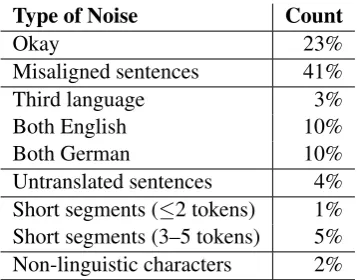
[image:3.595.92.271.61.201.2]Untranslated sentences 4% Short segments (≤2 tokens) 1% Short segments (3–5 tokens) 5% Non-linguistic characters 2%
Table 1: Noise in the raw Paracrawl corpus.
• the test set from the WMT 2016 Shared Task on Machine Translation of News as develop-ment set
• the test set from the WMT 2017 Shared Task on Machine Translation of News as develop-ment test set
The web site for the shared task5 provided
de-tailed instructions on how to use these tools to replicate the official testing environment.
4 Data
4.1 Training Data
The provided raw parallel corpus is the outcome of a processing pipeline that aimed at high recall at the cost of precision, so it is very noisy. It exhibits noise of all kinds (wrong language in source and target, sentence pairs that are not translations of each other, bad language, incomplete of bad trans-lations, etc.).
A cursory inspection of the corpus is given in Table1. According to analysis byKhayrallah and Koehn(2018), only about 23% of the data isokay, but even that fraction may be flawed in some way. Consider the following sentence pairs that we did count asokayeven though they contain mostly un-translated names and numbers.
DE: Anonym 2 24.03.2010 um 20:55 314 Kom-mentare
EN: Anonymous 2 2010-03-24 at 20:55 314 Comments
DE:<<erste<zur¨uck Seite 3 mehr letzte>>
EN:<<first<prev. page 3 next last>>
It is an open question if such data is also harm-ful, merely irrelevant, or maybe even beneficial.
5http://www.statmt.org/wmt18/parallel-corpus
-filtering.html
The raw corpus consists of a billion words of English, paired with German on the sentence level. It was deduplicated from a subset of the raw Paracrawl Release 1.
4.2 Provided Meta Information
The provided corpus file contains three items per line, separated by a TAB character:
• English sentence • German sentence
• Hunalign score
The Hunalign scores were obtained from the sentence aligner (Varga et al., 2005). They may be a useful feature for sentence filtering, but they do not by themselves correlate strongly with sen-tence pair quality. None of the participants gener-ally used this score.
Participant’s systems may take the source of the data into account, e.g., by discounting sentence pairs that come from a web domain with gener-ally low quality scores. To this end, we released the URL sources for each sentence pair as addi-tional data set. Note that due to de-duplication a single sentence pair may have several URL pairs associated it, since it may appear on multiple web pages.
Participants were also allowed to use existing tools and external training data to build their fil-tering methods. Specifically, they were permitted to use the WMT 2018 news translation task data for German-English (without the Paracrawl paral-lel corpus) to train components of their method.
4.3 Test Sets
The goal of the task is to filter down to high-quality sentence pairs, but not to sentence pairs that are most fitting to a specific domain. Dur-ing the submission period of the task, we only an-nounced that we will use the official new transla-tion test set from the WMT 2018 Shared Task of Machine Translation of News,6which was not
re-leased at that time yet.
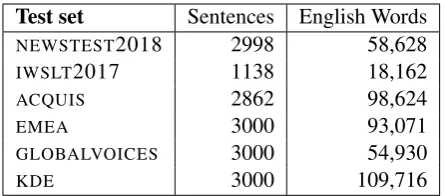
In total, we used six test sets. For statistics see Table 2. Two of them were taken from existing evaluation campaigns, four were created for this shared task.
News. It contains news stories that were ei-ther translated from German to English or from English to German.
IWSLT2017 The test set from the IWSLT 2017 evaluation campaign. It consists of tran-scripts of talks given at the TED conference. They cover generally accessible topics in the area of technology, entertainment, and de-sign.
ACQUIS This test set was extracted from the Ac-quis Communtaire corpus, which is avail-able on OPUS7 (Tiedemann, 2012) (which
was the source to create the subsequent 3 test sets). The test set consists of laws of the European Union that have to be incorpo-rated into the national laws of the EU mem-ber countries. We only used sentences with 15 to 80 words, and removed any duplicate sentence pairs.
EMEA This test set was extracted from documents European Medicines Agency, which consist of public health announcements and descrip-tions of medicadescrip-tions. We only used sentences with 20 to 80 words, and removed any dupli-cate sentence pairs.
GLOBALVOICES This test set was extracted from news stories posted and translated on Global Voices, an international and multilingual community of bloggers, journalists, transla-tors, academics, and human rights activists. We selected several complete stories from this corpus.
KDE This test set was extracted from KDE4 local-ization files, which is open source software for Linux. We only used sentences with 15 to 80 words, and removed any duplicate sen-tence pairs.
For all the test sets, we checked for overlap with the training data, to prevent the possibility of hav-ing the test set behav-ing contained in the released noisy parallel data. We originally considered a test set based on the PHP documentation but removed it because that was contained in Paracrawl.
The official scoring of machine translation sys-tems generated from the subsampled data sources is the average of the individual BLEU scores for each test set.
7http://opus.nlpl.eu/
Test set Sentences English Words
NEWSTEST2018 2998 58,628
IWSLT2017 1138 18,162
ACQUIS 2862 98,624
EMEA 3000 93,071
GLOBALVOICES 3000 54,930
[image:4.595.306.529.61.159.2]KDE 3000 109,716
Table 2: Statistics for the test sets used to evalu-ate the machine translation systems trained on the subsampled data sets. Word counts are obtained withwcon untokenized text.
5 Evaluation Protocol
The testing setup mirrors the development envi-ronment that we provided to the participants.
5.1 Particpants
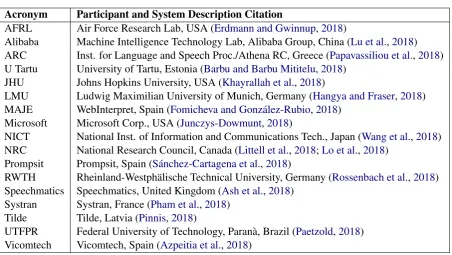
We received submissions from 17 different orga-nizations. See Table 3 for the complete list of participants. The participant’s organizations are quite diverse, with 3 participants from Spain, 3 participants from the United States, 2 participants from Germany, 1 participant each from Canada, Greece, China, Japan, France, Latvia, Estonia, United Kingdom, and Brazil. 9 of the participants are companies, 3 are national research organiza-tions, and 5 were universities.
Each participant submitted up to 5 different sets of scores, resulting in a total of 44 different sub-missions that we scored.
5.2 Subset Selection
We provided to the participants a file containing one sentence pair per line. A submission to the shared task consists of a file with the same number of lines, with one score per line corresponding to the quality of the corresponding sentence pair.
Using the score file, we selected subsets of a pre-defined size, defined by the number of English words. We chose the number of English words instead of German words, since the latter would allow selection of sentence pairs with very few German words and many English words which are beneficial for language model training but do not count much towards the German word total.
num-Acronym Participant and System Description Citation
AFRL Air Force Research Lab, USA (Erdmann and Gwinnup,2018)
Alibaba Machine Intelligence Technology Lab, Alibaba Group, China (Lu et al.,2018) ARC Inst. for Language and Speech Proc./Athena RC, Greece (Papavassiliou et al.,2018) U Tartu University of Tartu, Estonia (Barbu and Barbu Mititelu,2018)
JHU Johns Hopkins University, USA (Khayrallah et al.,2018)
LMU Ludwig Maximilian University of Munich, Germany (Hangya and Fraser,2018) MAJE WebInterpret, Spain (Fomicheva and Gonz´alez-Rubio,2018)
Microsoft Microsoft Corp., USA (Junczys-Dowmunt,2018)
NICT National Inst. of Information and Communications Tech., Japan (Wang et al.,2018) NRC National Research Council, Canada (Littell et al.,2018;Lo et al.,2018)
Prompsit Prompsit, Spain (S´anchez-Cartagena et al.,2018)
RWTH Rheinland-Westph¨alische Technical University, Germany (Rossenbach et al.,2018) Speechmatics Speechmatics, United Kingdom (Ash et al.,2018)
Systran Systran, France (Pham et al.,2018) Tilde Tilde, Latvia (Pinnis,2018)
[image:5.595.74.527.55.310.2]UTFPR Federal University of Technology, Paran`a, Brazil (Paetzold,2018) Vicomtech Vicomtech, Spain (Azpeitia et al.,2018)
Table 3: Participants in the shared task.
ber of sentence pairs. Including all of them would yield a too large subset, excluding them yields a too small subset. Hence, we randomly included some of the sentence pairs to get the desired size in this case.
5.3 System Training
Given a selected subset of given size for a system submission, we built statistical (SMT) and neu-ral machine translation (NMT) systems to evaluate the quality of the selected sentence pairs.
SMT For statistical machine translation, we used Moses (Koehn et al., 2007) with fairly ba-sic settings, such as Good-Turing smoothing of phrase table probabilities, maximum phrase length of 5, maximum sentence length of 80, lexical-ized reordering (hier-mslr-bidirectional-fe), fast-align for word fast-alignment withgrow-diag-final-and symmetrization, tuning with batch-MIRA, no op-eration sequence model, 5-gram language model trained on the English side of the subset with no additional data, and decoder beam size of 5,000.
NMT For neural machine translation, we used Marian (Junczys-Dowmunt et al., 2018). It uses the default settings of version 1.5, with 50,000 BPE operations, maximum sentence length of 100, layer normalization, dropout of 0.2 for RNN states, 0.1 for source embeddings and 0.1 for tar-get embeddings, exponential smoothing, and
de-coding with beam size 12 and length normaliza-tion (1). Training a system for the 10 million word subset was limited to 20 epochs and took about 10 hours. Training a system for the 100 million word subset was limited to 10 epochs and took about 2 days.
Scores on the test sets were computed with multi-bleu-detok.perl included in Moses. We report case-insensitive scores.
6 Results 6.1 Core Results
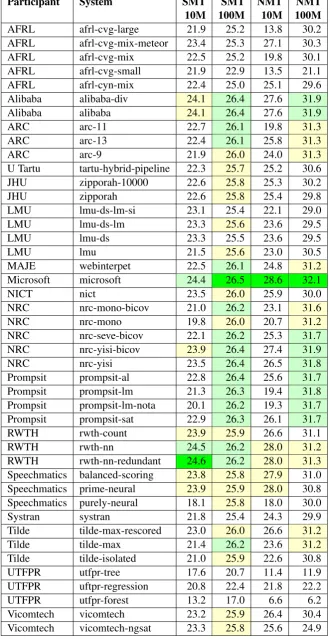
The official results are reported in Table 4. The table contains the average BLEU score over all the 6 test sets for the 4 different setups
• statistical machine translation for 10 million word corpus
• statistical machine translation for 100 million word corpus
• neural machine translation for 10 million
word corpus
• neural machine translation for 100 million
word corpus
In the table, we highlight cells for the best scores for each of these settings, as well as scores that are close to it.
Participant System SMT SMT NMT NMT 10M 100M 10M 100M
AFRL afrl-cvg-large 21.9 25.2 13.8 30.2
AFRL afrl-cvg-mix-meteor 23.4 25.3 27.1 30.3
AFRL afrl-cvg-mix 22.5 25.2 19.8 30.1
AFRL afrl-cvg-small 21.9 22.9 13.5 21.1
AFRL afrl-cyn-mix 22.4 25.0 25.1 29.6
Alibaba alibaba-div 24.1 26.4 27.6 31.9
Alibaba alibaba 24.1 26.4 27.6 31.9
ARC arc-11 22.7 26.1 19.8 31.3
ARC arc-13 22.4 26.1 25.8 31.3
ARC arc-9 21.9 26.0 24.0 31.3
U Tartu tartu-hybrid-pipeline 22.3 25.7 25.2 30.6
JHU zipporah-10000 22.6 25.8 25.3 30.2
JHU zipporah 22.6 25.8 25.4 29.8
LMU lmu-ds-lm-si 23.1 25.4 22.1 29.0
LMU lmu-ds-lm 23.3 25.6 23.6 29.5
LMU lmu-ds 23.3 25.5 23.6 29.5
LMU lmu 21.5 25.6 23.0 30.5
MAJE webinterpet 22.5 26.1 24.8 31.2
Microsoft microsoft 24.4 26.5 28.6 32.1
NICT nict 23.5 26.0 25.9 30.0
NRC nrc-mono-bicov 21.0 26.2 23.1 31.6
NRC nrc-mono 19.8 26.0 20.7 31.2
NRC nrc-seve-bicov 22.1 26.2 25.3 31.7
NRC nrc-yisi-bicov 23.9 26.4 27.4 31.9
NRC nrc-yisi 23.5 26.4 26.5 31.8
Prompsit prompsit-al 22.8 26.4 25.6 31.7
Prompsit prompsit-lm 21.3 26.3 19.4 31.8
Prompsit prompsit-lm-nota 20.1 26.2 19.3 31.7
Prompsit prompsit-sat 22.9 26.3 26.1 31.7
RWTH rwth-count 23.9 25.9 26.6 31.1
RWTH rwth-nn 24.5 26.2 28.0 31.2
RWTH rwth-nn-redundant 24.6 26.2 28.0 31.3
Speechmatics balanced-scoring 23.8 25.8 27.9 31.0 Speechmatics prime-neural 23.9 25.9 28.0 30.8 Speechmatics purely-neural 18.1 25.8 18.0 30.0
Systran systran 21.8 25.4 24.3 29.9
Tilde tilde-max-rescored 23.0 26.0 26.6 31.2
Tilde tilde-max 21.4 26.2 23.6 31.2
Tilde tilde-isolated 21.0 25.9 22.6 30.8
UTFPR utfpr-tree 17.6 20.7 11.4 11.9
UTFPR uftpr-regression 20.8 22.4 21.8 22.2
UTFPR utfpr-forest 13.2 17.0 6.6 6.2
Vicomtech vicomtech 23.2 25.9 26.4 30.4
[image:6.595.134.465.69.709.2]Vicomtech vicomtech-ngsat 23.3 25.8 25.6 24.9
the 100 million word subset. Scores also differ more for neural machine translation systems than for statistical machine translation systems.
For the 10 million word subset, there are only 2 submissions within 0.5 BLEU of the best sys-tem for statistical machine translation, and 0 for neural machine translation. For the 100 million word subset, there are 15 submissions within 0.5 BLEU of the best system for statistical machine translation, and 9 submissions within 0.5 for neu-ral machine translation. Note that many of these submissions come from the same participants.
For both data sets, scores for neural machine translation are significantly higher. For the 10 mil-lion word subsets, the best NMT score is 28.6, while the best SMT score is 24.6. For the 100 million word subsets, the best NMT score is 32.1, while the best SMT score is 26.5. To be fair, statis-tical machine translation is typically trained with large monolingual corpora for language modelling that are essential for good performance.
6.2 Results by Test Set
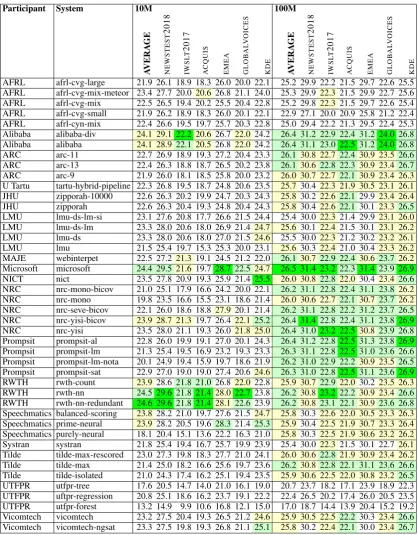
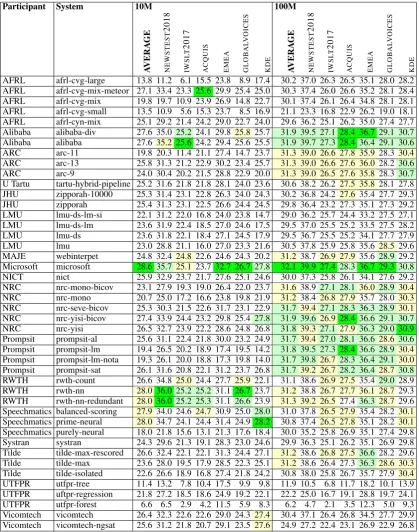
Table 5 and 6 break out the results by each of the test sets, for statistical machine translation and neural machine translation, respectively.
The use of multiple test sets was motivated by the objective to discourage participants to filter sentence pairs for a specific domain, instead of fil-tering for general quality. Some participants used domain-specific data for training some elements of their filtering systems, such as monolingual news data sets to train language models but argued that these are broad domains that do not lead to domain over-fitting.
The results do not evoke the impression that some systems are doing better on some domains than others, at least not more than random vari-ance would lead to expect. The closest test sets to the development sets areNEWSTEST2018,GLOB -ALVOICES, and maybe IWSLT2018. Only the 10 million word submissions rwth-nn and rwth-nn-redundant seem to do much better on these sets than others, relative to other submissions.
6.3 Additional Subset Sizes
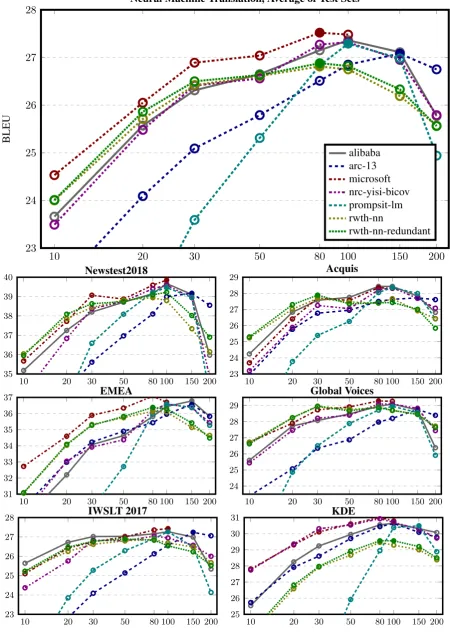
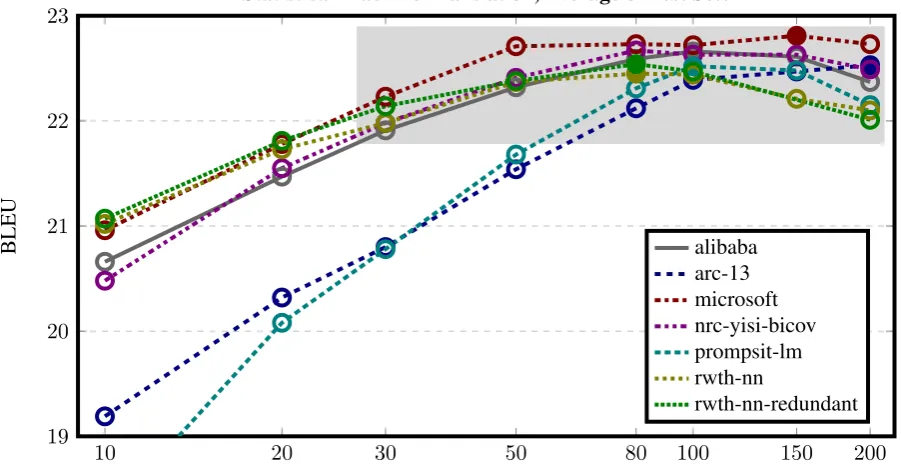
Since we were interested in the shape of the curve of how different corpus sizes impact ma-chine translation performance, we subselected ad-ditional subset size. Specifically, in addition to the 10 and 100 million word corpora, we also subse-lected 20, 30, 50, 80, 150, and 200 million words.
See Figure 1 for results for neural machine translation systems (also broken down by each in-dividual test set) and Figure 2 for statistical ma-chine translation systems. We only computed re-sults for six systems due to the computational cost involved.
The scoring on additional subset sizes was not announced before the submission deadline for the shared task, so none of the participants optimized for these. In fact, some participants assigned the same low value for almost all sentence pairs that would be ignored when subselecting the 100 mil-lion word corpus. So, when subsampling larger corpora (150 and 200 million words, as we have done), the resulting system scores collapse.
The curves for neural machine translation sys-tem scores peak almost always at 100 million words, although also occasionally at 80 or 150 million words. Since we did not plot these curves when setting up the shared task, we cannot say if 100 million words is just a optimal value for this corpus or if participants overfitted their system to this value, although we would guess the first.
The performance between the submissions are quite similar on the different test sets. None of the submissions we show in the figures has overly optimized on the news test set.
7 Methods used by Participants
Not surprising due to the large number of submis-sions, many different approaches were explored for this task. However, most participants used a system using three components: (1) pre-filtering rules, (2) scoring functions for sentence pairs, and (3) a classifier that learned weights for feature functions.
Pre-filtering rules. Some of the training data can be discarded based on simple deterministic fil-tering rules. These may include rules to remove
• too short or too long sentences
• sentences that have too few words (tokens with letters instead of just special characters), either absolute or relative to the total number of tokens
• sentences whose average token length is too short or too long
Participant System 10M 100M
AVERA
GE
N
E
W
S
T
E
S
T
20
18
IW
S
LT
20
17
A
C
Q
U
IS
E
M
E
A
G
L
O
B
A
LV
O
IC
E
S
K
D
E
AVERA
GE
N
E
W
S
T
E
S
T
20
18
IW
S
LT
20
17
A
C
Q
U
IS
E
M
E
A
G
L
O
B
A
LV
O
IC
E
S
K
D
E
[image:8.595.90.509.116.652.2]AFRL afrl-cvg-large 21.9 26.1 18.9 18.3 26.0 20.0 22.1 25.2 29.9 22.2 21.5 29.7 22.6 25.5 AFRL afrl-cvg-mix-meteor 23.4 27.7 20.0 20.6 26.8 21.1 24.0 25.3 29.9 22.3 21.5 29.9 22.7 25.6 AFRL afrl-cvg-mix 22.5 26.5 19.4 20.2 25.5 20.4 22.8 25.2 29.8 22.3 21.5 29.7 22.6 25.4 AFRL afrl-cvg-small 21.9 26.2 18.9 18.3 26.0 20.1 22.1 22.9 27.1 20.0 20.9 25.8 21.2 22.4 AFRL afrl-cyn-mix 22.4 26.6 19.5 19.7 25.7 20.3 22.8 25.0 29.4 22.2 21.3 29.5 22.4 25.3 Alibaba alibaba-div 24.1 29.1 22.2 20.6 26.7 22.0 24.2 26.4 31.2 22.9 22.4 31.2 24.0 26.8 Alibaba alibaba 24.1 28.9 22.1 20.5 26.8 22.0 24.2 26.4 31.1 23.0 22.5 31.2 24.0 26.8 ARC arc-11 22.7 26.9 18.9 19.3 27.2 20.4 23.3 26.1 30.8 22.7 22.4 30.9 23.5 26.6 ARC arc-13 22.4 26.3 18.8 18.7 26.5 20.2 23.8 26.1 30.6 22.8 22.3 30.9 23.4 26.7 ARC arc-9 21.9 26.0 18.1 18.5 25.8 20.0 23.2 26.0 30.7 22.7 22.1 30.9 23.4 26.3 U Tartu tartu-hybrid-pipeline 22.3 26.8 19.5 18.7 24.8 20.6 23.5 25.7 30.4 22.3 21.9 30.5 23.1 26.1 JHU zipporah-10000 22.6 26.3 20.2 19.9 24.7 20.3 24.3 25.8 30.2 22.6 22.1 29.9 23.4 26.4 JHU zipporah 22.6 26.3 20.4 19.3 24.8 20.4 24.3 25.8 30.4 22.6 22.1 30.1 23.3 26.5 LMU lmu-ds-lm-si 23.1 27.6 20.8 17.7 26.6 21.5 24.4 25.4 30.0 22.3 21.4 29.9 23.1 26.0 LMU lmu-ds-lm 23.3 28.0 20.6 18.0 26.9 21.4 24.7 25.6 30.1 22.4 21.5 30.1 23.1 26.2 LMU lmu-ds 23.3 28.0 20.6 18.0 27.0 21.5 24.6 25.5 30.0 22.3 21.2 30.2 23.2 26.1 LMU lmu 21.5 25.4 19.7 15.3 25.3 20.0 23.1 25.6 30.3 22.4 21.0 30.4 23.3 26.2 MAJE webinterpet 22.5 27.2 21.3 19.1 24.5 21.2 22.0 26.1 30.7 22.9 22.4 30.6 23.7 26.2 Microsoft microsoft 24.4 29.5 21.6 19.7 28.7 22.5 24.7 26.5 31.4 23.2 22.3 31.4 23.9 26.9 NICT nict 23.5 27.8 20.9 19.3 25.9 21.4 25.5 26.0 30.8 22.8 22.0 30.4 23.4 26.6 NRC nrc-mono-bicov 21.0 25.1 17.9 16.6 24.2 20.0 22.1 26.2 31.1 22.8 22.4 31.1 23.8 26.2 NRC nrc-mono 19.8 23.5 16.6 15.5 23.1 18.6 21.4 26.0 30.6 22.7 22.1 30.7 23.7 26.2 NRC nrc-seve-bicov 22.1 26.0 18.6 18.8 27.9 20.1 21.4 26.2 31.1 22.8 22.2 31.2 23.7 26.5 NRC nrc-yisi-bicov 23.9 28.7 21.3 19.7 26.4 22.1 25.2 26.4 31.4 22.8 22.4 31.1 23.8 26.9 NRC nrc-yisi 23.5 28.0 21.1 19.3 26.0 21.8 25.0 26.4 31.0 23.2 22.5 30.8 23.9 26.8 Prompsit prompsit-al 22.8 26.0 19.9 19.1 27.0 20.1 24.3 26.4 31.2 22.8 22.5 31.3 23.8 26.9 Prompsit prompsit-lm 21.3 25.4 19.5 16.9 23.2 19.3 23.3 26.3 31.1 22.8 22.5 31.0 23.6 26.6 Prompsit prompsit-lm-nota 20.1 24.9 19.4 15.9 19.7 18.6 21.9 26.2 31.0 22.9 22.2 30.9 23.5 26.5 Prompsit prompsit-sat 22.9 27.0 19.0 19.0 27.4 20.6 24.6 26.3 31.0 22.8 22.5 31.1 23.6 26.9 RWTH rwth-count 23.9 28.6 21.8 21.0 26.8 22.0 22.8 25.9 30.7 22.9 22.0 30.2 23.5 26.3 RWTH rwth-nn 24.5 29.6 21.8 21.4 28.0 22.7 23.8 26.2 30.8 23.2 22.2 30.9 23.4 26.6 RWTH rwth-nn-redundant 24.6 29.6 21.8 21.4 28.1 22.6 23.9 26.2 30.8 23.1 22.1 30.9 23.6 26.8 Speechmatics balanced-scoring 23.8 28.2 21.0 19.7 27.6 21.5 24.7 25.8 30.3 22.6 22.0 30.5 23.3 26.3 Speechmatics prime-neural 23.9 28.2 20.5 19.6 28.3 21.4 25.3 25.9 30.4 22.5 21.9 30.7 23.3 26.4 Speechmatics purely-neural 18.1 20.4 15.1 13.6 22.2 16.3 21.0 25.8 30.3 22.5 21.9 30.6 23.2 26.2 Systran systran 21.8 25.4 19.4 16.7 25.7 19.9 23.9 25.4 30.0 22.3 21.5 30.1 22.7 26.1 Tilde tilde-max-rescored 23.0 27.3 19.8 18.3 27.7 21.0 24.1 26.0 30.6 22.8 21.9 30.9 23.4 26.2 Tilde tilde-max 21.4 25.0 18.2 16.6 25.6 19.7 23.6 26.2 30.8 22.8 22.1 31.1 23.6 26.6 Tilde tilde-isolated 21.0 24.3 17.4 16.2 25.1 19.4 23.5 25.9 30.6 22.5 22.0 30.8 23.2 26.5 UTFPR utfpr-tree 17.6 20.5 14.7 14.0 21.0 16.1 19.0 20.7 23.7 18.2 17.1 23.9 18.9 22.3 UTFPR uftpr-regression 20.8 25.1 18.6 16.2 23.7 19.1 22.2 22.4 26.5 20.2 17.4 26.0 20.5 23.5 UTFPR utfpr-forest 13.2 14.9 9.9 10.6 16.8 12.1 15.0 17.0 18.7 14.4 13.9 20.4 15.2 19.2 Vicomtech vicomtech 23.2 27.5 20.4 19.3 26.5 21.2 24.6 25.9 30.5 22.5 22.2 30.3 23.4 26.6 Vicomtech vicomtech-ngsat 23.3 27.5 19.8 19.3 26.8 21.1 25.1 25.8 30.2 22.4 22.1 30.0 23.4 26.7
Participant System 10M 100M
AVERA
GE
N
E
W
S
T
E
S
T
20
18
IW
S
LT
20
17
A
C
Q
U
IS
E
M
E
A
G
L
O
B
A
LV
O
IC
E
S
K
D
E
AVERA
GE
N
E
W
S
T
E
S
T
20
18
IW
S
LT
20
17
A
C
Q
U
IS
E
M
E
A
G
L
O
B
A
LV
O
IC
E
S
K
D
E
[image:9.595.90.510.118.651.2]AFRL afrl-cvg-large 13.8 11.2 6.1 15.5 23.8 8.9 17.4 30.2 37.0 26.3 26.5 35.1 28.0 28.2 AFRL afrl-cvg-mix-meteor 27.1 33.4 23.3 25.6 29.9 25.4 25.0 30.3 37.4 26.0 26.6 35.2 28.1 28.4 AFRL afrl-cvg-mix 19.8 19.7 10.9 23.9 26.9 14.8 22.7 30.1 37.4 26.1 26.4 34.8 28.1 28.1 AFRL afrl-cvg-small 13.5 10.9 5.6 15.3 23.7 8.5 16.9 21.1 23.3 16.8 22.9 26.2 19.0 18.1 AFRL afrl-cyn-mix 25.1 29.2 21.4 24.2 29.0 22.7 24.0 29.6 36.2 25.1 26.2 35.0 27.4 27.7 Alibaba alibaba-div 27.6 35.0 25.2 24.1 29.8 25.8 25.7 31.9 39.5 27.1 28.4 36.7 29.1 30.7 Alibaba alibaba 27.6 35.2 25.6 24.2 29.4 25.6 25.5 31.9 39.7 27.3 28.4 36.4 29.1 30.6 ARC arc-11 19.8 20.3 11.4 21.1 27.4 14.7 23.7 31.3 39.0 26.6 27.8 35.9 28.3 30.4 ARC arc-13 25.8 31.3 21.2 22.9 30.2 23.4 25.7 31.3 39.0 26.6 27.6 36.0 28.2 30.6 ARC arc-9 24.0 30.4 20.2 21.5 28.8 22.9 20.0 31.3 39.0 26.5 27.6 35.8 28.3 30.7 U Tartu tartu-hybrid-pipeline 25.2 31.6 21.8 21.8 28.1 24.0 23.6 30.6 38.2 26.2 27.5 35.8 28.1 27.8 JHU zipporah-10000 25.3 31.4 23.1 22.8 26.3 24.0 24.3 30.2 36.8 24.2 27.6 35.4 27.7 29.3 JHU zipporah 25.4 31.3 23.1 22.5 26.6 24.4 24.5 29.8 36.4 23.2 27.3 35.1 27.3 29.2 LMU lmu-ds-lm-si 22.1 31.2 22.0 16.8 24.0 23.8 14.7 29.0 36.2 25.7 24.4 33.2 27.5 27.1 LMU lmu-ds-lm 23.6 31.9 22.4 18.5 27.0 24.6 17.5 29.5 37.0 25.5 25.2 33.5 27.5 28.2 LMU lmu-ds 23.6 31.8 22.1 18.4 27.1 24.5 17.9 29.5 36.7 25.5 25.2 34.1 27.7 27.9 LMU lmu 23.0 28.8 21.1 16.0 27.0 23.3 21.6 30.5 37.8 25.9 25.8 35.6 28.5 29.6 MAJE webinterpet 24.8 32.4 24.8 22.6 24.6 24.3 20.2 31.2 38.7 26.9 27.9 35.6 28.9 29.2 Microsoft microsoft 28.6 35.7 25.1 23.7 32.7 26.7 27.8 32.1 39.9 27.4 28.3 36.7 29.3 30.8 NICT nict 25.9 32.9 23.7 21.7 27.6 25.1 24.6 30.0 37.3 25.8 26.1 34.1 27.6 29.2 NRC nrc-mono-bicov 23.1 27.9 19.3 19.0 26.4 22.0 23.7 31.6 38.9 27.1 28.1 36.0 28.9 30.4 NRC nrc-mono 20.7 25.0 17.2 16.6 23.8 19.8 21.9 31.2 38.4 26.8 27.9 35.7 28.0 30.3 NRC nrc-seve-bicov 25.3 30.3 21.5 22.6 31.7 23.1 22.9 31.7 39.4 27.1 28.3 36.3 28.9 30.1 NRC nrc-yisi-bicov 27.4 33.9 24.4 23.2 29.8 25.4 27.8 31.9 39.6 26.9 28.4 36.6 29.1 30.7 NRC nrc-yisi 26.5 32.7 23.9 22.2 28.6 24.8 26.8 31.8 39.3 27.1 27.9 36.3 29.0 30.9 Prompsit prompsit-al 25.6 31.1 22.4 21.8 30.0 23.2 24.9 31.7 39.4 27.0 28.1 36.6 28.6 30.6 Prompsit prompsit-lm 19.4 26.5 20.2 18.9 17.4 19.5 14.2 31.8 39.5 27.3 28.4 36.6 28.9 30.4 Prompsit prompsit-lm-nota 19.3 26.1 20.0 18.8 17.3 19.8 14.0 31.7 39.8 26.7 28.3 36.4 29.1 30.0 Prompsit prompsit-sat 26.1 31.6 20.8 22.1 31.2 23.7 26.8 31.7 39.2 26.7 28.2 36.4 28.7 30.8 RWTH rwth-count 26.6 34.8 25.0 24.4 27.7 25.9 22.1 31.1 38.6 26.9 27.5 35.4 29.0 28.9 RWTH rwth-nn 28.0 36.0 25.2 25.2 31.1 26.7 23.7 31.2 38.8 26.7 27.7 36.1 28.7 29.3 RWTH rwth-nn-redundant 28.0 36.0 25.2 25.3 31.1 26.6 23.9 31.3 39.2 26.5 27.4 36.3 28.7 29.6 Speechmatics balanced-scoring 27.9 34.0 24.6 24.7 30.9 25.0 28.0 31.0 37.8 26.5 27.9 35.4 28.2 30.1 Speechmatics prime-neural 28.0 34.7 24.1 24.4 31.4 24.9 28.2 30.8 37.4 26.5 27.8 35.1 28.2 30.1 Speechmatics purely-neural 18.0 21.8 15.6 13.1 21.3 17.6 18.4 30.0 35.2 25.8 26.9 35.1 27.4 29.8 Systran systran 24.3 29.6 21.3 19.1 28.3 23.0 24.6 29.9 36.3 25.1 26.2 35.1 26.9 29.8 Tilde tilde-max-rescored 26.6 32.4 22.1 22.1 31.3 24.4 27.1 31.2 38.6 26.8 27.5 36.6 28.2 29.6 Tilde tilde-max 23.6 28.0 19.5 17.9 28.5 22.3 25.1 31.2 38.6 26.4 27.3 36.3 28.6 30.3 Tilde tilde-isolated 22.6 26.6 18.9 16.8 27.4 21.8 24.2 30.8 38.0 25.8 26.7 35.7 27.9 30.4 UTFPR utfpr-tree 11.4 13.2 7.8 10.4 17.5 9.9 9.8 11.9 10.5 6.8 11.7 18.2 10.1 13.9 UTFPR uftpr-regression 21.8 27.2 18.5 18.6 24.9 19.2 22.1 22.2 25.0 16.7 19.1 28.8 19.7 24.1 UTFPR utfpr-forest 6.6 6.5 2.9 4.2 11.5 5.9 8.3 6.2 4.7 2.1 3.5 12.3 5.0 9.3 Vicomtech vicomtech 26.4 32.3 22.6 22.6 29.0 24.3 27.4 30.4 37.1 26.4 26.8 34.5 27.7 29.9 Vicomtech vicomtech-ngsat 25.6 31.2 21.8 20.7 29.1 23.5 27.6 24.9 27.2 22.4 23.1 26.9 22.9 26.8
10 20 30 50 80 100 150 200 23
24 25 26 27 28
BLEU
Neural Machine Translation, Average of Test Sets
alibaba arc-13 microsoft nrc-yisi-bicov prompsit-lm rwth-nn
rwth-nn-redundant
10 20 30 50 80 100 150 200
35 36 37 38 39
40 Newstest2018
10 20 30 50 80 100 150 200
23 24 25 26 27 28
29 Acquis
10 20 30 50 80 100 150 200
31 32 33 34 35 36
37 EMEA
10 20 30 50 80 100 150 200
24 25 26 27 28 29
Global Voices
10 20 30 50 80 100 150 200
23 24 25 26 27
28 IWSLT 2017
10 20 30 50 80 100 150 200
25 26 27 28 29 30
[image:10.595.74.525.78.713.2]31 KDE
10 20 30 50 80 100 150 200 19
20 21 22 23
BLEU
Statistical Machine Translation, Average of Test Sets
alibaba arc-13 microsoft nrc-yisi-bicov prompsit-lm rwth-nn
[image:11.595.76.527.74.306.2]rwth-nn-redundant
Figure 2: Version of Figure1for statistical machine translation systems built from the subselected data. Note that the curves are flatter, and the several systems score in a narrow band of 1 BLEU point across a wide range of corpus sizes (30-200 million words), indicated in grey.
• sentence pairs where names, numbers, email addresses, URLs do not match between both sides
• sentence pairs that are too similar, indicating
simple copying instead of translating
• sentences where language identifier do not
detect the required language
Scoring functions. Sentence pairs that pass the pre-filtering stage are assessed with scoring func-tions which provide scores that hopefully correlate with quality of sentence pairs. Participants used a variety of such scoring functions, including
• n-gram or neural language models on clean
data
• language models trained on the provided raw
data as contrast
• neural translation models
• bag-of-words lexical translation probabilities
Note that the raw scores provided by these mod-els may be also refined in several ways. For in-stance, we may desire that the language model per-plexities of a German sentence and its paired En-glish sentence are similar. Or, we may contrast the translation model score for a sentence and its given paired sentence with the translation model
score for the sentence and its best translation ac-cording to the model.
Learning weights for scoring functions. Given a large number of scoring functions, simply av-eraging their resulting scores may be inadequate. Learning weights to optimize machine translation system quality is computationally intractable due to the high cost of training these systems to eval-uate different weight settings. A few participants used instead a classifier that learns how to distin-guish between good and bad sentence pairs. Good sentence pairs are selected from existing high-quality parallel corpora, while bad sentence pairs are either synthesized by scrambling good sen-tence pairs or by using the raw crawled data.
Some participants made a distinction between unsupervised methods that did not use existing parallel corpora to train parts of the system, and supervise methods that did. Unsupervised meth-ods have the advantage that they can be readily deployed for language pairs for which no seed par-allel corpora exist.
Acknowledgements
Web-Scale Parallel Corpora for Official European Lan-guages(Paracrawl).
References
Antonova, A. and Misyurev, A. (2011). Building a web-based parallel corpus and filtering out machine-translated text. InProceedings of the 4th Workshop on Building and Using Comparable Corpora: Com-parable Corpora and the Web, pages 136–144, Port-land, Oregon. Association for Computational Lin-guistics.
Ash, T., Francis, R., and Williams, W. (2018). The speechmatics parallel corpus filtering system for wmt18. InProceedings of the Third Conference on Machine Translation, Belgium, Brussels. Associa-tion for ComputaAssocia-tional Linguistics.
Axelrod, A., He, X., and Gao, J. (2011). Domain adaptation via pseudo in-domain data selection. In Proceedings of the 2011 Conference on Empirical Methods in Natural Language Processing, pages 355–362, Edinburgh, Scotland, UK. Association for Computational Linguistics.
Azpeitia, A., Etchegoyhen, T., and Mart´ınez garcia, E. (2018). Stacc, oov density and n-gram saturation: Vicomtech’s participation in the wmt 2018 shared task on parallel corpus filtering. InProceedings of the Third Conference on Machine Translation, Bel-gium, Brussels. Association for Computational Lin-guistics.
Barbu, E. and Barbu Mititelu, V. (2018). A hybrid pipeline of rules and machine learning to filter web-crawled parallel corpora. In Proceedings of the Third Conference on Machine Translation, Belgium, Brussels. Association for Computational Linguis-tics.
Belinkov, Y. and Bisk, Y. (2017). Synthetic and natural noise both break neural machine translation. CoRR, abs/1711.02173.
Buck, C. and Koehn, P. (2016). Findings of the wmt 2016 bilingual document alignment shared task. In Proceedings of the First Conference on Machine Translation, pages 554–563, Berlin, Germany. As-sociation for Computational Linguistics.
Carpuat, M., Vyas, Y., and Niu, X. (2017). Detect-ing cross-lDetect-ingual semantic divergence for neural ma-chine translation. InProceedings of the First Work-shop on Neural Machine Translation, pages 69–79, Vancouver. Association for Computational Linguis-tics.
Cui, L., Zhang, D., Liu, S., Li, M., and Zhou, M. (2013). Bilingual data cleaning for SMT using graph-based random walk. In Proceedings of the 51st Annual Meeting of the Association for Compu-tational Linguistics (Volume 2: Short Papers), pages 340–345, Sofia, Bulgaria. Association for Computa-tional Linguistics.
Erdmann, G. and Gwinnup, J. (2018). Coverage and cynicism: The afrl submission to the wmt 2018 par-allel corpus filtering task. In Proceedings of the Third Conference on Machine Translation, Belgium, Brussels. Association for Computational Linguis-tics.
Fomicheva, M. and Gonz´alez-Rubio, J. (2018). Maje submission to the wmt2018 shared task on parallel corpus filtering. InProceedings of the Third Con-ference on Machine Translation, Belgium, Brussels. Association for Computational Linguistics.
Hangya, V. and Fraser, A. (2018). An unsupervised system for parallel corpus filtering. InProceedings of the Third Conference on Machine Translation, Belgium, Brussels. Association for Computational Linguistics.
Junczys-Dowmunt, M. (2018). Dual conditional cross-entropy filtering of noisy parallel corpora. In Pro-ceedings of the Third Conference on Machine Trans-lation, Belgium, Brussels. Association for Computa-tional Linguistics.
Junczys-Dowmunt, M., Grundkiewicz, R., Dwojak, T., Hoang, H., Heafield, K., Neckermann, T., Seide, F., Germann, U., Aji, A. F., Bogoychev, N., Martins, A. F. T., and Birch, A. (2018). Marian: Fast neu-ral machine translation in c++. In Proceedings of ACL 2018, System Demonstrations, pages 116–121. Association for Computational Linguistics.
Khayrallah, H. and Koehn, P. (2018). On the impact of various types of noise on neural machine transla-tion. InProceedings of the 2nd Workshop on Neural Machine Translation and Generation, pages 74–83. Association for Computational Linguistics.
Khayrallah, H., Xu, H., and Koehn, P. (2018). The jhu parallel corpus filtering systems for wmt 2018. In Proceedings of the Third Conference on Ma-chine Translation, Belgium, Brussels. Association for Computational Linguistics.
Koehn, P. (2005). Europarl: A parallel corpus for sta-tistical machine translation. In Proceedings of the Tenth Machine Translation Summit (MT Summit X), Phuket, Thailand.
Koehn, P., Hoang, H., Birch, A., Callison-Burch, C., Federico, M., Bertoldi, N., Cowan, B., Shen, W., Moran, C., Zens, R., Dyer, C. J., Bojar, O., Con-stantin, A., and Herbst, E. (2007). Moses: Open source toolkit for statistical machine translation. In Proceedings of the 45th Annual Meeting of the As-sociation for Computational Linguistics Companion Volume Proceedings of the Demo and Poster Ses-sions, pages 177–180, Prague, Czech Republic. As-sociation for Computational Linguistics.
filtering shared task. In Proceedings of the Third Conference on Machine Translation, Belgium, Brus-sels. Association for Computational Linguistics.
Lo, C.-k., Simard, M., Stewart, D., Larkin, S., Goutte, C., and Littell, P. (2018). Accurate semantic textual similarity for cleaning noisy parallel corpora using semantic machine translation evaluation metric: The nrc supervised submissions to the parallel corpus fil-tering task. InProceedings of the Third Conference on Machine Translation, Belgium, Brussels. Associ-ation for ComputAssoci-ational Linguistics.
Lu, J., Lv, X., Shi, Y., and Chen, B. (2018). Al-ibaba submission to the wmt18 parallel corpus fil-tering task. InProceedings of the Third Conference on Machine Translation, Belgium, Brussels. Associ-ation for ComputAssoci-ational Linguistics.
Paetzold, G. (2018). Utfpr at wmt 2018: Minimalis-tic supervised corpora filtering for machine trans-lation. In Proceedings of the Third Conference on Machine Translation, Belgium, Brussels. Associa-tion for ComputaAssocia-tional Linguistics.
Papavassiliou, V., Sofianopoulos, S., Prokopidis, P., and Piperidis, S. (2018). The ilsp/arc submission to the wmt 2018 parallel corpus filtering shared task. In Proceedings of the Third Conference on Machine Translation, Belgium, Brussels. Associa-tion for ComputaAssocia-tional Linguistics.
Pham, M. Q., Crego, J., and Senellart, J. (2018). Sys-tran participation to the wmt2018 shared task on par-allel corpus filtering. In Proceedings of the Third Conference on Machine Translation, Belgium, Brus-sels. Association for Computational Linguistics.
Pinnis, M. (2018). Tilde’s parallel corpus filtering methods for wmt 2018. InProceedings of the Third Conference on Machine Translation, Belgium, Brus-sels. Association for Computational Linguistics.
Rafalovitch, A. and Dale, R. (2009). United Nations General Assembly resolutions: A six-language par-allel corpus. InProceedings of the Twelfth Machine Translation Summit (MT Summit XII). International Association for Machine Translation.
Rarrick, S., Quirk, C., and Lewis, W. (2011). MT de-tection in web-scraped parallel corpora. In Proceed-ings of the 13th Machine Translation Summit (MT Summit XIII), pages 422–430. International Associ-ation for Machine TranslAssoci-ation.
Resnik, P. (1999). Mining the web for bilingual text. In Proceedings of the 37th Annual Meeting of the Association of Computational Linguistics (ACL).
Rossenbach, N., Rosendahl, J., Kim, Y., Grac¸a, M., Gokrani, A., and Ney, H. (2018). The rwth aachen university filtering system for the wmt 2018 paral-lel corpus filtering task. InProceedings of the Third Conference on Machine Translation, Belgium, Brus-sels. Association for Computational Linguistics.
Skadin¸ˇs, R., Tiedemann, J., Rozis, R., and Deksne, D. (2014). Billions of parallel words for free: Building and using the eu bookshop corpus. InProceedings of the 9th International Conference on Language Resources and Evaluation (LREC-2014), Reykjavik, Iceland. European Language Resources Association (ELRA).
S´anchez-Cartagena, V. M., Ba˜n´on, M., Ortiz Rojas, S., and Ram´ırez, G. (2018). Prompsit’s submis-sion to wmt 2018 parallel corpus filtering shared task. In Proceedings of the Third Conference on Machine Translation, Belgium, Brussels. Associa-tion for ComputaAssocia-tional Linguistics.
T¨ager, W. (2011). The sentence-aligned european patent corpus. In Forcada, M. L., Depraetere, H., and Vandeghinste, V., editors, Proceedings of the 15th International Conference of the European As-sociation for Machine Translation (EAMT), pages 177–184.
Taghipour, K., Khadivi, S., and Xu, J. (2011). Paral-lel corpus refinement as an outlier detection algo-rithm. InProceedings of the 13th Machine Transla-tion Summit (MT Summit XIII), pages 414–421. In-ternational Association for Machine Translation.
Tiedemann, J. (2012). Parallel data, tools and inter-faces in opus. In Chair), N. C. C., Choukri, K., Declerck, T., Dogan, M. U., Maegaard, B., Mari-ani, J., Odijk, J., and Piperidis, S., editors, Proceed-ings of the Eight International Conference on Lan-guage Resources and Evaluation (LREC’12), Istan-bul, Turkey. European Language Resources Associ-ation (ELRA).
van der Wees, M., Bisazza, A., and Monz, C. (2017). Dynamic data selection for neural machine trans-lation. In Proceedings of the 2017 Conference on Empirical Methods in Natural Language Process-ing, pages 1411–1421. Association for Computa-tional Linguistics.
Varga, D., Hala´acsy, P., Kornai, A., Nagy, V., N´emeth, L., and Tr´on, V. (2005). Parallel corpora for medium density languages. In Proceedings of the RANLP 2005 Conference, pages 590–596.
Venugopal, A., Uszkoreit, J., Talbot, D., Och, F., and Ganitkevitch, J. (2011). Watermarking the outputs of structured prediction with an application in sta-tistical machine translation. In Proceedings of the 2011 Conference on Empirical Methods in Natu-ral Language Processing, pages 1363–1372, Edin-burgh, Scotland, UK. Association for Computational Linguistics.
Xu, H. and Koehn, P. (2017). Zipporah: a fast and scalable data cleaning system for noisy web-crawled parallel corpora. InProceedings of the 2017 Con-ference on Empirical Methods in Natural Language Processing, pages 2935–2940. Association for Com-putational Linguistics.