192
The Coptic Universal Dependency Treebank
Amir Zeldes and Mitchell Abrams
Department of Linguistics, Georgetown University
{amir.zeldes,mja284}@georgetown.edu
Abstract
This paper presents the Coptic Universal De-pendency Treebank, the first deDe-pendency tree-bank within the Egyptian subfamily of the Afro-Asiatic languages. We discuss the com-position of the corpus, challenges in adapt-ing the UD annotation scheme to existadapt-ing con-ventions for annotating Coptic, and evaluate inter-annotator agreement on UD annotation for the language. Some specific constructions are taken as a starting point for discussing sev-eral more gensev-eral UD annotation guidelines, in particular for appositions, ambiguous pas-sivization, incorporation and object-doubling.
1 Introduction
The Coptic language represents the last phase of the Ancient Egyptian phylum of the Afro-Asiatic language family, forming part of the longest con-tinuously documented human language on Earth. Despite its high value for historical, comparative and typological linguistics, as well as its cultural importance as the heritage language of Copts in Egypt and in the diaspora, digital resources for the study of Coptic have only recently become avail-able, while syntactically annotated data did not ex-ist until the beginning of the present project. This paper presents the first treebank of Coptic, con-structed within the UD framework and currently encompassing over 20,000 tokens. In this section we give a brief overview of some pertinent facts of Coptic grammar, before moving on to describ-ing how these are encoded in our corpus.
Unlike earlier forms of Ancient Egyptian, which were written in hieroglyphs or hieratic script throughout the first three millennia BCE, Coptic was written starting in the early first mil-lenium CE using a variant of the Greek alphabet, with several added letters for Egyptian sounds ab-sent from Greek. Figure1shows the script, which was originally written without spaces (the Greek
[image:1.595.336.496.287.378.2]loan word#uxh‘psyche’ is visible at the top left). Manuscript damage, also shown in the figure, rep-resents a frequent challenge to annotation efforts (see Section7).
Figure 1: Excerpt from a papyrus letter by Besa, Abbot of the White Monastery in the 5th century, showing text without spaces and a lacuna. Image: ¨Osterreichische Na-tionalbibliothek,http://digital.onb.ac.at/rep/ access/open/10099409.
Modern conventions separate Coptic text into multi-word units known as bound groups (Lay-ton,2011, 19-20) using spaces, based on the pres-ence of one stressed lexical item in each group. This leads to multiple units being spelled together which would normally receive separate tokens and part of speech tags in annotated corpora. Similarly to languages such as Arabic, Amharic, or Hebrew, simple examples include noun phrases or preposi-tional phrases spelled together, as in(1), or clitic possessors spelled together with nouns, as in(2).1
(1) /m:p:ranhm-p-ran ‘in-the-name’
(2) rnt=k rnt=k ‘name-your (SG.M)’
However, Coptic fusional morphology can be much more complex than in Semitic languages, for several reasons. Developing from a morpho-logically rich synthetic language through an ana-lytic phase in Late Egyptian, Coptic has fusional morphology and is usually seen as an agglutinative
1We follow common Egyptological practice in separating
or even polysynthetic language (Loprieno, 1995, 51). Similarly to inflection in Hausa, auxiliaries and clitics attach to verbs as in (3), and unlike in Semitic languages, compounds are spelled to-gether and do not allow intervening articles. The language also exhibits frequent verb-object incor-poration, complicating word segmentation for tok-enization (seeGrossman 2014), as in the complex verb shown in (4). Such complex verbs can be embedded in word formation processes, leading to nominalizations such as(5).
(3) a:f:/wtb
a-f-h¯otb
m:p:rmnkhme
m-p-rmnk¯eme
PST-3.SG.M-kill ACC-the-Egyptian ‘he killed the Egyptian’
(4) /etb:#uxh
hetb-psych¯e kill-soul
‘(to) soul-kill’ (incorporated)
(5) mnt:ref:/etb:#uxh
mnt-ref-hetb-psych¯e ness-er-kill-soul
‘soul-killing’ (lit. ‘soul-kill-er-ness’)
Finally, some auxiliaries, such as the optative in (6)may either fuse with and even circumfix adja-cent pronouns as in(7), or in some cases exhibit ‘zero’ forms for pronouns, as in(8).
(6) ere:p:rwme cwtm ero=k
ere-p-r¯ome s¯otm ero=k
OPT-the-man hear to-you.2SG.M
‘may the man hear you’
(7) e:f:e:cwtm ero=k
e-f-e-s¯otm ero=k
OPT-3.SG.M-OPT-hear to-you.2SG.M ‘may he hear you’ (circumfix auxiliary)
(8) ere:cwtm ero=f
ere-s¯otm ero=f
OPT+2.SG.F-hear to-him.3.SG.M ‘may you hear him’ (SG.F subj, fused)
Representing these discontinuous and null phe-nomena within the UD framework is difficult in the first instance because of their intrinsic com-plexity (for example, UD prohibits null pronoun nodes, even in enhanced dependencies), but is further complicated by the use of existing stan-dards in Coptic tokenization and tagging, which we present next.
2 Previous work
Of the vast literary, documentary and epigraphic material available in Coptic, print editions have fo-cused on a small subset of early literature in the Sahidic dialect of Upper Egypt, the most promi-nent of six major dialects (see Shisha-Halevy 1986), which is also considered to be the classical form of the language. While all examples in this paper come from Sahidic sources, we believe that the analyses will generalize well to other dialects, which we intend to approach in the future.
Sizable digital corpora, which have only re-cently become available in machine readable formats (see Schroeder and Zeldes 2016 on the Coptic Scriptorium project and http:// marcion.sourceforge.net/, which pro-vides transcriptions of multiple out of copyright editions) have generally followed the same path of starting with classic Sahidic authors. Other targeted projects have focused on translations from Greek, and especially the Bible, e.g. the Digital Edition of the Coptic Old Testament in G¨ottingen (Behlmer and Feder, 2017), but also tracking Greek influence in Coptic in general (Al-mond et al., 2013). Finally Some other projects are advancing the availability of documentary, mostly papyrus materials as well (notablyhttp: //papyri.info/), which are as yet only digi-tized in small quantities.
Although there is a plan to build a constituent treebank of hieroglyphic Ancient Egyptian (Polis and Rosmorduc, 2013), it is as yet unavailable. The UD Coptic Dependency Treebank represents the first dependency treebank for the entire Egyp-tian language family as well as the only publicly available treebank for Coptic in particular, and for any phase of Egyptian in general.
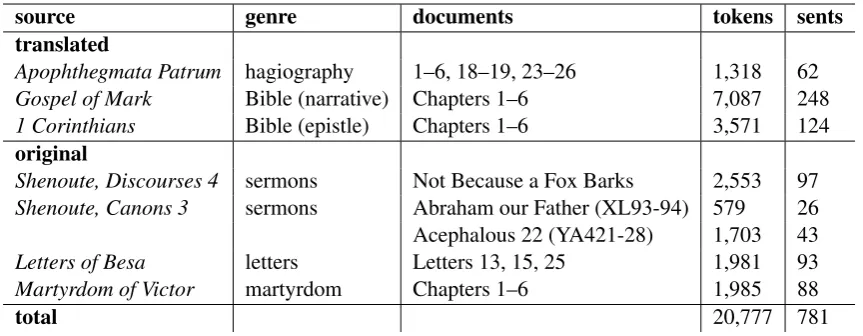
source genre documents tokens sents translated
Apophthegmata Patrum hagiography 1–6, 18–19, 23–26 1,318 62
Gospel of Mark Bible (narrative) Chapters 1–6 7,087 248
1 Corinthians Bible (epistle) Chapters 1–6 3,571 124
original
Shenoute, Discourses 4 sermons Not Because a Fox Barks 2,553 97
Shenoute, Canons 3 sermons Abraham our Father (XL93-94) 579 26
Acephalous 22 (YA421-28) 1,703 43
Letters of Besa letters Letters 13, 15, 25 1,981 93
Martyrdom of Victor martyrdom Chapters 1–6 1,985 88
[image:3.595.84.516.61.229.2]total 20,777 781
Table 1: Texts and genres in UD Coptic.
3 Texts
The selection of texts for the Coptic Treebank was meant to satisfy four criteria:
1. Data should be freely available
2. A range of different genres should be covered
3. Text types should be chosen which are inter-esting to users
4. Data should resemble likely targets for auto-matic parsing using the treebank for training
A dilemma in realizing 3. is that typical UD users interested in computational linguistics, cor-pus linguistics and language typology may have different interests than Coptologists: the former may prefer texts which resemble other treebank texts or are even available in other languages, such as the Bible, while the latter may be most inter-ested in classic Coptic literature by prominent au-thors such as Shenoute of Artipe, archmandrite of the White Monastery in the 3rd–4thcenturies.
To balance these needs, we decided to include both translated Biblical material and original Cop-tic works, with a view to allowing comparisons with other languages for which Bible treebanks are available, as well as studies of untranslated Coptic syntax. Table1 shows the selection of texts cur-rently available in the corpus.
4 Segmentation
While all digital corpora of Coptic referenced in Section2separate bound groups, for treebanking purposes we require a more fine grained tokeniza-tion. The only tokenization for which NLP tools
are available is the one used in the Coptic Scripto-rium project, though automatic segmentation ac-curacy is currently around 94.5% (Feder et al., 2018), meaning that working with data that is al-ready gold-segmented is highly desirable. As a re-sult, the Coptic Treebank inherits some segmenta-tion guidelines, which will be discussed below.2
To represent Coptic segmentation correctly, at least three levels of granularity are required: at the highest level, bound groups, which are spelled to-gether, can be regarded as a purely orthographic device, similar to fused spellings of clitics in En-glish, but much more common. To represent these in the CoNLL-U format, we use multi-tokens and the property SpaceAfter=No on non final tokens, as shown in Table 2 for the two bound groups ‘in|his|deeds of|soul-killing’, which contains the deverbal incorporated noun from(5). This practice corresponds to the same guideline used in Semitic languages, such as Arabic or Hebrew, which use multi-tokens to represent multiword units with a single lexical stress. The second level of granular-ity corresponds to POS-tag bearing units, which correspond to CoNLL-U tokens.
Finally, for units below the POS tag level, such as components of incorporated ‘soul-killing’, we
2
transc=... hn|nef|hb¯eue m|mnt-ref-hetb-psux¯e gloss= ... in|his|deeds of|ness-er-kill-soul ...
12-14 /nnef/bhue
12 /n in ADP PREP 14 case Orig=/np p|SpaceAfter=No 13 nef his DET PPOS ... 14 det SpaceAfter=No
14 /bhue deeds NOUN N 9 obl
15-16 mmntref/etb#uxh
[image:4.595.78.531.93.175.2]15 m of ADP PREP 16 case Orig=p pm|SpaceAfter=No 16 mntref/etb#uxh soul-killing NOUN N 14 nmod Morphs=mnt:ref:/etb:#uxh
Table 2: Segmentation in CoNLL-U format for a sentence fragment. The lemma column has been filled with glosses for convenience, and features in column 6 have been omitted for space.
use the MISC column to reproduce the morpho-logical segmentation of complex items, as shown in the final column in the example, using hyphens as morpheme separators. Although we considered using sub-tokens to represent incorporation, and using thecompound relation, we decided against this in order to maintain parity with CS tokens and segmentation practices, and to match up with the practice in Hebrew and Arabic, which use sub-tokens for constituents of bound groups (and not for smaller units, e.g. portmanteau compounds in both languages3). This also allows us to benefit from existing POS tagging software to feed auto-matic parsing. At the same time, because we have a morphological analysis of complex tokens in the tagged source corpora, we retain this information in the MISC column, and a version of the data in-stantiating the components as tokens could be pro-duced fully automatically if needed. The MISC column is also used to hold an attributeOrigwith original forms of tokens as spelled in the source manuscripts, which often deviate from standard spellings or contain added optional diacritics (the word form column is always normalized). As a result the data can be used to train automatic nor-malization tools.
A further complication arises in the case of fused auxiliaries and pronouns, as in the cases from examples (7) and(8). Here too, a solution splitting the fused form into three tokens would be conceivable, in order to represent the circum-fix auxiliaries. However, CS guidelines do not tokenize such units apart, instead using portman-teau tags such as AOPT PPER (optative auxiliary, fused with personal pronoun), and a lemma join-ing the lemmas of both units via an underscore. A
3e.g. Hebrew
רוזמרramzor’stop-light’ (a portmanteau, lit. ‘light-cue’), which is left unsegmented as a single token. We thank an anonymous reviewer for providing this example.
potential pitfall of splitting these units is that, if we consider a form such ase-f-eto consist of three to-kens, there is a chance that automatic taggers and parsers will tag one of the two ‘e’ vowels correctly as an auxiliary, but not the other, leading to an in-coherent analysis.4 The tokenefe, by contrast, will always receive a single tag, and since the form is unambiguous, it will always be correct. While we would not prioritize ease of tagging over an ad-equate linguistic analysis, we feel that, coupled with the desire to maintain parity with larger cor-pora, Manning’s Law favors this analysis, which is unambiguous, deterministic and easy to convert into a different form if necessary using the native XPOS tags.
We therefore decided to retain CS tokeniza-tion practices with regard to fused forms, both in order to benefit from existing NLP tools and to retain parity with the un-treebanked source cor-pora, which contain a variety of additional non-linguistic annotations. In order to adhere to strict UPOS and UD dependency relations, we have opted to always tag such cases by reference to the argument pronoun, i.e. a form such as ‘efe’ is tagged asPRON and labelednsubj, notAUX/aux. The native CS XPOS tag nevertheless uses the portmanteau notation, and the MISC field includes a segmented form, which can be converted into a subtoken representation if desired.
4
5 POS tags
Coptic Scriptorium offers two tagsets with differ-ent levels of granularity: CS Fine and CS Coarse, distinguishing 44 and 23 tags respectively. Due to the possibility of a number of portmanteau tags in fusional cases, the CS Fine tagset effectively in-cluded 15 additional distinct labels arising from the cross-product of fusable parts-of-speech.
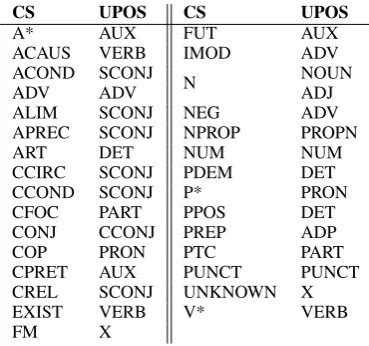
Table3gives the mapping between CS tags and UPOS, but excluding portmanteau tags. In all cases of portmanteau tags, we adopt the strategy outlined in the previous section, of giving con-tent words priority over function words, and more specifically, of preferring arguments over fused auxiliaries.
Coptic auxiliaries fall into two main syntac-tic classes: main clause auxiliaries (e.g. past tense, CS APST) and subordinating auxiliaries (e.g. precursive, APREC, which roughly means ‘after[VERB]ing, ...’. The tag A* in Table3stands for any main clause auxiliary (12 CS Fine tags), while subordinating auxiliary tags are listed sepa-rately, all corresponding toSCONJ in UPOS. The entry P* stands for four pronoun tags mapped to
PRON, and V* stands for all CS verbal tags.
CS UPOS CS UPOS
A* AUX FUT AUX
ACAUS VERB IMOD ADV ACOND SCONJ
N NOUN
ADV ADV ADJ
ALIM SCONJ NEG ADV APREC SCONJ NPROP PROPN
ART DET NUM NUM
CCIRC SCONJ PDEM DET CCOND SCONJ P* PRON CFOC PART PPOS DET CONJ CCONJ PREP ADP COP PRON PTC PART CPRET AUX PUNCT PUNCT CREL SCONJ UNKNOWN X EXIST VERB V* VERB
[image:5.595.88.273.418.591.2]FM X
Table 3: Mapping of CS Fine tags to UPOS.
A point worth noting is that although the CS tags are generally more fine grained than UPOS, no CS tag maps unambiguously to UPOS ADJ. This is because true adjectives are extremely rare in Coptic, limited to about a dozen items, which can appear immediately following a noun they describe. For almost all attributive modification, Coptic uses an ‘of’-PP, i.e. a ‘wise man’ is simply a ‘man of wisdom’. Due to the fact that true ad-jectives are so rare in Coptic (all are archaisms left
over from Late Egyptian), and the fact that some can also be used in the ‘of’ construction as though they were nouns, the CS tagset does not reserve a POS tag for them. However for the handful of items that do occur as adjectival modifiers (post-nominal, not mediated by ‘of’), we use theamod
relation and UPOSADJbased on the relation. Additionally, some CS tags provide morpho-logical information that would otherwise be lost in UPOS, but can be represented in UD features (CoNLL-U column 6), which are outlined in the next section.
6 Morphological features
Morphological features are automatically added to the corpus using DepEdit,5 a freely available Python library for manipulating dependency data in the CoNLL-U format (see Peng and Zeldes 2008). Some of the morphological feature cate-gories are trivial to assign based on word forms, such as gendered and numbered article forms, or pronoun types.
However there are also some features that can be derived from native POS tags, such as mood and polarity: the imperative CS tag VIMP can be used to feed the UD Mood=Impfeature, and some auxiliaries are inherently negative, feeding
thePolarity=Negfeature. For example,
Cop-tic distinguishes some tenses with paired negative and positive auxiliaries (e.g. CS tags APST and
ANEGPST for positive and negative past tense). Some tensed auxiliaries are exclusively negative, such as the perfective negative conjugation (CS
ANY, cf. Loprieno 1995, 221), which roughly translates into a clause modified by ‘not yet’ which has no morphologically positive counterpart. All forms of such auxiliaries are automatically flagged
asPolarity=Negbased on CS tags.
Finally, Coptic possessive determiners indicate gender and number for both the possessor and pos-sessed, as in languages such as French or Ger-man, and therefore we use the ‘layered feature’ facility in the CoNLL-U format, distinguishing
GenderandNumberfromGender[psor]and
Number[psor]for possessor features, as in(9),
which shows a masculine singular noun possessed by an article agreeing with these features, but also marking a third person singular feminine posses-sor.
5https://corpling.uis.georgetown.edu/
(9) pec:hi
pes-¯ei
her-house (house = Masc. Sg.) Gender=Masc|Gender[psor]=Fem|
Number=Sing|Number[psor]=Sing|
Person=3|Poss=Yes|PronType=Prs
‘her house’
7 Dependencies
7.1 Absent relations
UD Coptic uses all UD relations, with the excep-tion of expl andclf, since the language does not have expletive pronouns or classifiers. Among the recommended and frequently used subtypes, we do not use the:passsubtypes (i.e. nsubj:passand
aux:pass) due to the ambiguous nature of Coptic passives. While there is a morphological form, the ‘stative’ (CS tagVSTAT) which can express a stative passive for transitive verbs, as in(10), the same form simply means persisting in a state for intransitive verbs, as in(11).
(10) p:hi
p-¯ei
kht
k¯et
the-house build.VSTAT ‘the house is built’
(11) p:moou
p-moou
/olq
holkj
the-water sweet.VSTAT ‘the water is sweet6’
In both cases, the sense is not actional. For the ac-tional passive more directly translating the English passive, Coptic uses an ambiguous 3rdperson plu-ral, as in (12). When an oblique agent is sup-plied which conflicts in agreement with the non-referential 3rdperson plural, it is possible to dis-tinguish active plural from the passive, as shown in(13).
(12) a:u:/otb:f
a-u-hotb-f
PST-3.PL-kill-3.SG.M
‘they killed him/he was killed’
(13) a:u:/otb:f
a-u-hotb-f
/itn:te:chime
hitn-te-shime
PST-3.PL-kill-3.SG.M by-the-woman
‘he was killed by the woman’ (lit. ‘they killed him by the woman’)
However since cases like (13) are rare, we have
6Many words translated as adjectives in English are verbs
in Coptic: the intransitive infinitivehlokj means ‘become sweet’, and the corresponding stativeholkjmeans ‘be sweet’. Morphologically both are verbal forms in Coptic.
opted not to distinguish passives, annotating 3 person plural verbs uniformly with regular depen-dentnsubjandauxchildren (i.e. active syntax).
7.2 Other problematic constructions
During the annotation process, we encountered several problems and special constructions high-lighting the complications of adapting the UD an-notation scheme to Coptic. One difficulty was handling lacunae in the data: since we wanted to include some major literary texts in their entirety which are only attested in damaged manuscripts, we were not able to select only texts with com-plete sentences, and we also expect parsers trained on our data to be applied to damaged text. In cases where the damaged words can be reconstructed with high confidence (usually meaning that at least their POS tag can be assigned), words are attached as usual. For more incomprehensible or very frag-mentary phrases, especially those tagged as CS
UNKNOWN (UPOS: X), we attach all tokens to the root as dep. For linguistically interpretable scribal errors, by contrast, we use thereparandum
label, using the general UD guidelines for disflu-ency annotation.
As an example of a more linguistic issue with Coptic annotation, we consider the case of appo-sitions that are non-adjacent, as the current UD guidelines define appositional modifiers as “im-mediately following the first noun that serves to define, modify, name, or describe that noun”.7 This definition assumes that appositions are adja-cent, with nothing intervening between two nomi-nals. However, this is problematic for some Coptic constructions where enclitic particles, mostly bor-rowed from Greek such asde‘but, and’, must ap-pear in the second position in the sentence (imme-diately following the first stressed word), breaking up two appositional nominals, as shown in(14).
(14) p:rro
p-rro
de de
dioklhtianoc
Diokl¯etianos
a:f:/rokeue
a-f-hrokeue
the-kingbutDiocletian PST-3SGM-amble
‘but the Emperor Diocletian went about’
Since the very same two nominals would be con-sidered an apposition if the particle did not occur, and since the particle is always a clause-level de-pendent that invariably appears in second position, we decided to analyze this construction asappos.8
7
http://universaldependencies.org/u/ dep/appos.html, accessed 2018-07-10.
sub-Further difficulties in applying UD guidelines to Coptic arise in handling direct objects. Cop-tic exhibits a regular alternation or differential ob-ject marking depending on tense/aspect distinc-tions. In the durative tenses (Layton,2011, 233– 250), including indicative present, future and im-perfect, objects are usually mediated by the prepo-sition n: n- ‘of’ (or before pronouns, taking the formmmo=mmo=), as in(15), whereas in other tenses featuring an auxiliary before the subject, objects are enclitic, appearing directly after the verb without a preposition (this is known as Stern-Jernstedt’s Rule,Jernstedt 1927), as shown earlier in(12).
(15) ce:/wtb
se-h¯otb
mmo:f
mmo=f
3.PL-kill ACC-3.SG.M
‘they are killing him’
The fact that these object positions are semanti-cally identical has led us to analyze both construc-tions asobj. This has the uncomfortable result of the same prepositionn-sometimes acting as an ad-nominal modifier marker (nmod, in a literal ‘of’-PP), and sometimes as an accusative case marker, similarly to the analysis of the differential object marking prepositionetin the UD Hebrew treebank (only used with definite objects). The advantage is that it is easier to use the corpus to extract all object arguments of a certain verb, or to identify all cases of transitive verbs in general. As a crite-rion for objecthood, we use the possibility of the Stern-Jernstedt alternation: this criterion is more easily decidable than other tests which have been advocated, such as passivization (Zeman, 2017), since passives are not always reliably identifiable in Coptic (see above), though if passivizability is taken as a criterion (cf. Przepi´orkowski and Pate-juk 2018) then objects mediated by the preposi-tional case marker are in fact equally passivizable as well.
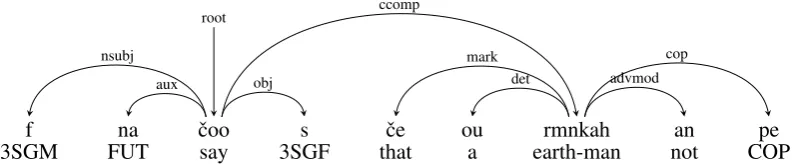
A further complication in Coptic direct objects arises from the fact that object clauses can co-occur with correlate pronouns in the main clause, as shown in Figure 2. In adopting the analysis in the figure we followed the practice found in
type for these cases, e.g. appos:disjoint. While this would certainly be possible, such cases are overall rare, making such a label potentially very sparse. Conversely, it is fairly easy to locate such cases based on the dependency graph if needed, and from a linguistic perspective, there is nothing unusual about such appositions – the unusual construction is more properly the particle invariably appearing in second position.
most UD treebanks, toleratingobjand coreferen-tialccompfor one verb, despite some misgivings.9 Although this analysis conforms to the practice in other treebanks, we are still considering alter-natives, such as marking the pronoun in the matrix clause asexpl, or usingdislocated for the clause. However these solutions also lead to odd splits, whereby a pronoun could be expletive if the object clause was mentioned, but an object if the clause is fully pronominalized (i.e. when only a pronoun is used). Using dislocated is also counter-intuitive, since the clause is not actually out of place: it is in its expected position (not topicalized or unusually postponed). Finally some have proposed mark-ing either the nominal argument or the clause as oblique (Przepi´orkowski and Patejuk, 2018), but this seems odd too, since each construction in iso-lation looks like a core object.
8 Evaluation
In this section we evaluate the application of the UD annotation scheme to Coptic by conducting an inter-annotator agreement experiment using three pairs of annotators. We report label scores (LS) using Cohen’s Kappa and % unlabeled attachment score (UAS) with and without punctuation.
The annotators include two pairs of BA stu-dents with three semesters of Coptic but no experi-ence with corpus annotation or dependencies, and a third pair consisting of one MA student with two semesters of Coptic but substantial experience an-notating English (and some Coptic) dependencies, and one professor proficient in Coptic and depen-dency annotation (these are also the co-authors of the present paper, and will be referred to as the ‘Expert’ group below).10 For the undergraduate students, labeled group A and B, we conducted
9
We take this to be a still open point, which we are looking forward to discussing: The current UD guidelines explicitly rule out multipleobjrelations, but do not specifically refer to obj+ccomp, whichPrzepi´orkowski and Patejuk(2018) take to be equivalent. Other UD literature has been ambivalent about ruling out multipleobjdependents in general (Zeman, 2017, 290). In practice, we have seen UD treebanks in multi-ple languages allowobj+ccomp, such as UD German-GSD, UD English-EWT, the UD French treebanks and others. Ger-man cases in particular seem to mirror the construction above, e.g. Ich findeeswirklich toll, dass es Euch jetztgibt!, lit. “I finditobjreally cool, that youexistccompnow!”.
10
f na ˇcoo s ˇce ou rmnkah an pe
3SGM FUT say 3SGF that a earth-man not COP
root
nsubj
aux obj
mark
det advmod
[image:8.595.101.499.73.157.2]cop
Figure 2: Analysis of a doubled object clause construction:He would say (it) that he is not an earthly man.
annotators tokens UAS (% agreement) LS (kappa)
punctuation no punctuation punctuation no punctuation
Group A: Pre-Adjud. 276 81.1% 79.0% 0.78 0.75
Group A: Post-Adjud. 319 87.7% 86.5% 0.88 0.86
Group B: Pre-Adjud. 287 84.3% 82.9% 0.79 0.76
Group B: Post-Adjud. 297 86.5% 84.6% 0.81 0.79
[image:8.595.93.503.187.286.2]Expert 703 96.0% 95.8% 0.93 0.92
Table 4: Agreement Scores. ‘no punctuation’ denotes scores with punctuation removed from evaluation
two experiments: a pre-adjudication round and a post-adjudication round. In pre-adjudication, an-notators only read the online UD Coptic guide-lines without any prior annotation experience. Af-terwards, student annotators discussed points of disagreement with the professor and adjudicated their sentences, before proceeding to the post-adjudication round, in which we expected annota-tors to fare better. Annotaannota-tors had unlimited time to complete the task and the text in all rounds was a portion ofthe Martyrdom of St. Victor, which was presented together with a standard literary trans-lation. As an annotation interface, we used the Arborator (Gerdes,2013).
Table 4compares the results of the three pairs of annotators. All results are divided into two sec-tions: with and without punctuation.11 Results are further separated into pre-adjudication and post-adjudication for the two undergraduate groups.
As shown, the expert annotator scores and the student annotator scores after post-adjudication exhibit relatively high levels of agreement. Within the label score (LS) category, expert annotators scored k = 0.92 without punctuation and 0.93 with punctuation, both of which can be considered very good agreement. Post-adjudication, group B produced a label score (LS) of 0.81, while group A scored 0.88. Both of these scores can
11Scores that include punctuation are based on punctuation
attachment to the root, but Udapi (Popel et al.,2017) is used to automatically attach punctuation according to UD guide-lines for the final adjudicated gold version.
be interpreted as strong agreement, and notice-ably higher than scores between 0.75–0.79, which were achieved solely by reading the guidelines and without previous annotation experience.
Unlabeled attachment scores (UAS) also shows good results. Expert annotators achieve 95.8% without punctuation and 96.0% with, and the student groups have reasonable post-adjudication agreement scores as high as 86.5% and 87.7%, respectively. We observed notable improvements from pre-adjudication to post-adjudication from the student groups. This shows that annotation ac-curacy on this task can improve after experience and discussing common annotation errors.
The fact that annotators are non-native speakers with limited experience with the language likely affects the inter-annotator agreement results and makes this a challenging task relative to evalua-tions in other languages, such as English. Berzak et al. (2016) report an agreement experiment on English dependencies with a UAS score of 97.16% and an LS score of 96.3%, conducted on section 23 of the Wall Street Journal corpus (Marcus et al., 1993). Although the labeled score is evaluated as % agreement rather than kappa, these results likely outperform our scores. However in a more challenging task of annotating English tweets,Liu et al.(2018) report a UAS score of 88.8% and LS score of 84.3%, showing that quality can vary sub-stantially across text types.12
Bamman et al. (2009) report results from a dependency annotation experiment on Ancient Greek with an attachment score of 87.4% and a label score of 85.3%. While this experiment wasn’t within the UD framework, it offers compa-rable agreement scores with respect to non-native speaker annotation. The scores presented in their study are close to the attachment scores from our undergraduate student annotator pairs, though ad-mittedly Coptic and Greek are typologically very distant. Scores from other African languages are scarce, but Seyoum et al. (2018) report a kappa score of 0.488 for agreement on UD relations for the morphologically rich language Amharic. This score is interpreted as moderate agreement and is substantially lower than our label scores.
We conducted an error analysis to find com-mon areas of disagreement. While some errors can be attributed to simple, non-systematic mis-takes, many high frequency errors are the result of complicated constructions or alternative interpre-tations of the text, which is at times not trivial to translate. The majority of disagreements for the expert annotators pertained to coordination scope (which is often ambiguous in the translation); con-fusion over labeling objects (obj) and obliques (obl), often due to annotating more closely to the source language or the available translation’s in-terpretation; and whether an item has an (obl) re-lation to a verb or an (nmod) relation to its de-pendent noun in constructions that are close to light-verb constructions, but not entirely lexical-ized. Coordination proved challenging for longer ambiguous sentences where, as non-native speak-ers, we relied on our own interpretation of the text for parsing. Confusion over labeling items asobj
andoblcan also be attributed to similar syntactic environments where objects and obliques are both mediated by the prepositionn:n-‘of’.
9 Conclusion
In this paper we presented the Coptic Universal Dependency Treebank, the first treebank in the UD project from the Egyptian phylum of the Afro-Asiatic language family, and the first Coptic tree-bank in general. Our evaluation shows that UD guidelines can be applied to Coptic consistently, with rising accuracy based on annotator experi-ence. We are currently expanding the treebank
tweets, but rather point out the variability in UD agreement scores depending on context.
and aim to reach a size allowing for the training of robust parsers and evaluating parsing results on Coptic in future shared tasks.
The discussion has also shown that there are a number of challenges in adapting the UD scheme for Coptic, some of which are shared with other languages: in particular, we advocate a less strict interpretation of adjacency constraints for the ap-pos relation, which would also be needed for languages such as Classical Greek, and raise is-sues with the consistent encoding of pronomi-nal/clausal double object constructions, as well as differential object marking and the handling of ambiguous passivization. We look forward to dis-cussing these issues with the UD community.
Acknowledgments
This work is funded by the National Endowment for the Humanities (NEH) and the German Re-search Foundation (DFG) (grants HG-229371 and HAA-261271). Special thanks are due to Eliz-abeth Davidson for work on annotating multi-ple documents in the treebank, as well as to Is-rael Avrahamy, Asael Benyami, Yinon Kahan and Oran Szachter for annotating sections of the Mar-tyrdom of Victor. We also thank the anonymous reviewers for helpful comments on previous ver-sions of this paper.
References
Mathew Almond, Joost Hagen, Katrin John, To-nio Sebastian Richter, and Vincent Walter. 2013. Kontaktinduzierter Sprachwandel des ¨ Agyptisch-Koptischen: Lehnwort-Lexikographie im Projekt Database and Dictionary of Greek Loanwords in Coptic (DDGLC). In Perspektiven einer corpus-basierten historischen Linguistik und Philologie, pages 283–315, Berlin. BBAW.
David Bamman, Francesco Mambrini, and Gregory Crane. 2009. An ownership model of annotation: The Ancient Greek dependency treebank. In Pro-ceedings of the Eighth International Workshop on Treebanks and Linguistic Theories (TLT 8), pages 5–15, Groningen.
Heike Behlmer and Frank Feder. 2017. The com-plete digital edition and translation of the Coptic Sahidic Old Testament. A new research project at the G¨ottingen Academy of Sciences and Humani-ties. Early Christianity, 8:97–107.
line T. Schroeder, and Amir Zeldes. 2018. A linked Coptic dictionary online. In Proceedings of LaT-eCH 2018 - The 11th SIGHUM Workshop at COL-ING2018, pages 12–21, Santa Fe, NM.
Kim Gerdes. 2013. Collaborative dependency anno-tation. InProceedings of the Second International Conference on Dependency Linguistics (DepLing 2013), pages 88–97, Prague.
Eitan Grossman. 2014. Transitivity and valency in con-tact: The case of Coptic. In47th Annual Meeting of the Societas Linguistica Europaea, Pozna´n, Poland.
Peter V. Jernstedt. 1927. Das koptische Praesens und die Ankn¨upfungsarten des n¨aheren Objekts. Dok-lady Akademii Nauk SSSR, 1927:69–74.
Bentley Layton. 2011. A Coptic Grammar, third edi-tion, revised and expanded edition. Porta linguarum orientalium 20. Harrassowitz, Wiesbaden.
Yijia Liu, Yi Zhu, Wanxiang Che, Bing Qin, Nathan Schneider, and Noah A. Smith. 2018. Parsing tweets into Universal Dependencies. In Proceedings of NAACL-HLT 2018, pages 965–975.
Antonio Loprieno. 1995.Ancient Egyptian. A Linguis-tic Introduction. Cambridge University Press, Cam-bridge.
Mitchell P. Marcus, Beatrice Santorini, and Mary Ann Marcinkiewicz. 1993. Building a large annotated corpus of English: The Penn Treebank. Special Is-sue on Using Large Corpora, Computational Lin-guistics, 19(2):313–330.
Siyao Peng and Amir Zeldes. 2008. All roads lead to UD: Converting Stanford and Penn parses to En-glish Universal Dependencies with multilayer anno-tations. In Proceedings of the Joint Workshop on Linguistic Annotation, Multiword Expressions and Constructions (LAW-MWE-CxG-2018), pages 167– 177, Santa Fe, NM.
St´ephane Polis and Serge Rosmorduc. 2013. Build-ing a construction-based treebank of Late Egyptian: The syntactic layer in Ramses. In St´ephane Polis & Jean Winand, editor, Texts, Languages & Infor-mation Technology in Egyptology. Selected papers from the meeting of the Computer Working Group of the International Association of Egyptologists, pages 45–59. Presses Universitaires de Li`ege.
Martin Popel, Zdenek Zabokrtsk´y, and Martin Vojtek. 2017. Udapi: Universal API for Universal Depen-dencies. In Universal Dependencies Workshop at NoDaLiDa 2017, pages 96–101.
Adam Przepi´orkowski and Agnieszka Patejuk. 2018. Arguments and adjuncts in Universal Dependencies. InProceedings of COLING2018, pages 3837–3852, Santa Fe, NM.
of the lost corpus. Digital Humanities Quarterly, 10(2).
Binyam Ephrem Seyoum, Yusuke Miyao, and Baye Yi-mam Mekonnen. 2018. Universal Dependencies for Amharic. In Proceedings of LREC 2018, pages 2216–2222, Miyazaki, Japan.
Ariel Shisha-Halevy. 1986. Coptic Grammatical Categories. Structural Studies in the Syntax of Shenoutean Sahidic. Pontificum Institutum Bib-licum, Rome.