Lexicalized Reordering for Left-to-Right Hierarchical Phrase-based
Translation
Maryam Siahbani∗
Department of Computer Information Systems University of the Fraser Valley
Abbotsford BC, Canada
Anoop Sarkar
School of Computing Science Simon Fraser University
Burnaby BC, Canada
Abstract
Phrase-based and hierarchical phrase-based (Hiero) translation models differ radically in the way reordering is modeled. Lexicalized reordering models play an im-portant role in phrase-based MT and such models have been added to CKY-based de-coders for Hiero. Watanabe et al. (2006) propose a promising decoding algorithm for Hiero (LR-Hiero) that visits input spans in arbitrary order and produces the translation in left to right (LR) order which leads to far fewer language model calls and leads to a considerable speedup in de-coding. We introduce a novel shift-reduce algorithm to LR-Hiero to decode with our lexicalized reordering model (LRM) and show that it improves translation quality for Czech-English, Chinese-English and German-English.
1 Introduction
Phrase-based machine translation handles reorder-ing between source and target languages by visit-ing phrases in the source in arbitrary order while generating the target from left to right. A dis-tortion penalty is used to penalize deviation from the monotone translation (no reordering) (Koehn et al., 2003; Och and Ney, 2004). Identical dis-tortion penalties for different types of phrases ig-nore the fact that certain phrases (with certain words) were more likely to reorder than others. State-of-the-art phrase based translation systems address this issue by applying a lexicalized re-ordering model(LRM) (Tillmann, 2004; Koehn et al., 2007; Galley and Manning, 2008; Galley and Manning, 2010) which uses word aligned data to score phrase pair reordering. These models distin-guish three orientations with respect to the previ-ously translated phrase: monotone(M),swap(S), ∗This work was done while the first author was a Ph.D.
student at SFU.
and discontinuous (D), which are primarily de-signed to handle local re-orderings of neighbour-ing phrases.
Hierarchical phrase-based translation (Hiero) (Chiang, 2007) uses hierarchical phrases for trans-lations represented as lexicalized synchronous context-free grammar (SCFG). Non-terminals in the SCFG rules correspond to gaps in phrases which are recursively filled by other rules (phrases). The SCFG rules are extracted from word and phrase alignments of a bitext. Hiero uses CKY-style decoding which parses the source sentence with time complexity O(n3) and syn-chronously generates the target sentence (transla-tion).
Watanabe et al. (2006) proposed a left-to-right (LR) decoding algorithm for Hiero (LR-Hiero) which follows the Earley (Earley, 1970) algorithm to parse the source sentence and synchronously generate the translation in a left-to-right manner. This algorithm is combined with beam search and has time complexity O(n2b) where n is the length of source sentence and b is the size of beam (Huang and Mi, 2010). LR-Hiero con-strains the SCFG rules to be prefix-lexicalized on the target side aka Greibach Normal Form (GNF). Throughout this paper we abuse the no-tation for simplicity and use the term GNF gram-mars for such SCFGs. This leads to a single lan-guage model (LM) history for each hypothesis and speeds up decoding significantly, up to four times faster (Siahbani et al., 2013).
The Hiero translation model handles reorder-ing very differently from a phrase-based model, through weighted translation rules (SCFGs) deter-mined by non-terminal mappings. The ruleX → hneX1pas,do notX1iindicates the translation of the phrase betweenneandpaswill be after the En-glish phrasedo not. However, reordering features can also be added to the Hiero log-linear transla-tion model. Siahbani et al. (2013) introduce a new distortion feature to Hiero and LR-Hiero which
1)X→⟨他 补充 说 , X1/He added that X1⟩
2)X→⟨联合 政府 X1/the coalition government X1⟩
3)X→⟨目前 X1稳定 X2/is now i n stable X1X2⟩
4)X→⟨状况 /condition⟩
5)X→⟨./.⟩
⟨ ,⟦[0,10]⟧,0⟩
⟨ He added that ,⟦[4,10]⟧,4.3⟩
⟨ He added that the coalition government ,⟦[6,10]⟧,7.7⟩
⟨ He added that the coalition government is now i n stable ,⟦[7,8][9,10]⟧,11.2⟩ ⟨ He added that the coalition government is now i n stable condition,⟦[9,10]⟧,13.4⟩ ⟨ He added that the coalition government is now i n stable condition. ,⟦⟧,14.3⟩
rules hypotheses
<s> <s> <s> <s> <s> <s>
[image:2.595.74.292.190.277.2]</s> ⟨ht, hs, hc⟩
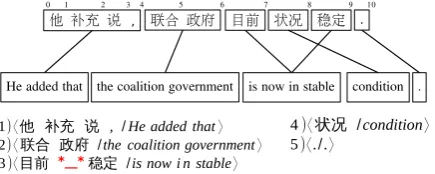
Figure 1: The process of translating a Chinese (Fig. 2) sentence to English using LR-Hiero. Left side shows the rule used in each step of creating the derivation. The hypotheses column shows 3-tuple partial hypotheses: the translation prefix,ht, the ordered list of yet-to-be-covered spans,hs, and costhc.
他 补充 说 , 联合 政府 目前
He added that the coalition government is now in stable condition 状况 稳定
0 1 2 3 4 5 6 7 8 9 10 .
.
1)⟨他 补充 说 , /He added that⟩ 2)⟨联合 政府 /the coalition government⟩ 3)⟨目前 *__*稳定 /is now i n stable⟩
4)⟨状况 /condition⟩ 5)⟨./.⟩
Figure 2: A word-aligned Chinese-English sentence pair on the top (from devset data used in experiments.) The source-target phrase pairs created by removing the non-terminals from the rules used in decoding (Fig. 1) are shown on the bottom.
significantly improves translation quality in LR-Hiero and improves LR-Hiero results to a lesser extent. Nguyen and Vogel (2013) integrate phrase-based distortion and lexicalized reordering features with CKY-based Hiero decoder which significantly im-prove the translation quality. In their approach, each partial hypothesis during decoding is mapped into a sequence of phrase-pairs then the distor-tion and reordering features are computed simi-lar to phrase-based MT. They use a LRM trained for phrase-based MT (Galley and Manning, 2010) which applies some restrictions on the Hiero rules. (Cao et al., 2014; Huck et al., 2013) propose dif-ferent approaches to directly train LRM for Hiero rules. However, these approaches are designed for CKY-decoding and cannot be directly used or adapted for LR-Hiero decoding which uses an Earley-style parsing algorithm. The crucial differ-ence is the nature of bottom-up versus left to right decisions for lexicalized reordering and generat-ing the translation in left-to-right manner. In this paper, we introduce a novel shift-reduce algorithm to learn a lexicalized reordering model (LRM) for LR-Hiero. We show that augmenting LR-Hiero with an LRM improves translation quality for Czech-English, significantly improves results for Chinese-English and German-English, while per-forming three times fewer language model queries on average, compared to CKY-Hiero.
2 Lexicalized Reordering for LR-Hiero
The main idea in phrase-based LRM is to divide possible reorderings into three orientations that can be easily determined during decoding and also from word-aligned sentence pairs (parallel cor-pus). Given a source sentence f, a sequence of target language phrases e = ( ¯e1, . . . ,e¯n) is
gen-erated by the decoder. A phrase alignment a=
(a1, . . . an) defines a source phrase f¯ai for each
target phrasee¯i. For each phrase-pairhf¯ai, eii, the
orientations are described in terms of the previ-ously translated source phrasef¯ai−1:
Monotone(M):f¯aiimmediately followsf¯ai−1. Swap(S):fa¯i−1 immediately followsfa¯i.
Discontinuous(D):f¯aiandf¯ai−1 are not adjacent
in the source sentence.
We only define the left-to-right case here; the right-to-left case (f¯ai+1) is symmetrical. The
prob-ability of an orientation given a phrase pairhf,¯e¯i
can be estimated using relative frequency:
P(o|f,¯ ¯e) = P cnt(o,f,¯e¯)
o0∈{M,S,D}cnt(o0,f,¯e¯) (1)
where, o ∈ {M, S, D} and cnt is computed on word-aligned parallel data (count phrase-pairs and their orientations). Given the sparsity of the ori-entation types, we use smoothing. As the decoder develops a new hypothesis by translating a source phrase,f¯ai, it scores the orientation, oi wrtai−1.
The log probability of the orientation is added as a feature function to the log-linear translation model.
LR-Hiero uses a subset of the Hiero SCFG rules where the target rules are in Greibach Normal Form (GNF):hγ,e β¯ iwhereγ is a string of non-terminal and source words,¯eis a target phrase and
sen-tence,hs and a numeric cost, hc. The initial
hy-pothesis consists of an empty translation (hsi), a span of the whole source sentence and cost 0 (Fig-ure 1). To develop a new hypothesis from a current hypothesis, the LR-Hiero decoder applies a GNF rule to the first untranslated span,hs[0], of old hy-pothesis. The translation prefix of the new hypoth-esis is generated by appending the target side of the applied rule, ¯e, to the translation prefix of the old hypothesis, ht. Corresponding to the applied
rule, the uncovered spans of the old hypothesis are also updated and assigned to the new hypothesis (Figure 1).
Target generation in LR-Hiero is analogous to phrase-based MT. Given an input sentence f, the output translation is a sequence of contiguous target-language phrases e = ( ¯e1, . . . ,e¯n)
incre-mentally concatenated during decoding. We can define a phrase alignmenta = (a1, . . . an)which align each target phrase,ei¯ to a source phrasefai
corresponding to source side of a rule, ri used
at step i. But unlike target, source phrases can be discontiguous. Figure 1 illustrates the process of translating a Chinese-English sentence pair by LR-Hiero. Corresponding to each rule a phrase pair can be created (shown in Figure 2). The final translation is the ordered sequence of target side of these phrase pairs. Although the target genera-tion is similar to phrase-based MT, the LR-Hiero decoder parse the source sentence using the SCFG rules and the order for translating source spans is determined by the grammar. However the LR-Hiero decoder uses an Earley-style parsing algo-rithm and unlike CKY does not utilise translated smaller spans to generate translations for bigger spans bottom-up.
2.1 Training
We computeP(o|f,¯ e¯), which is the probability of an orientation given phrase pair of a rule, r.p =
hf,¯e¯i, on word-aligned data using relative fre-quency. We assume that phrasee¯spans the word ranges . . . t in the target sentence and the phrase
¯
f spans the rangeu . . . vin the source sentence. For a given phrase pairhf,¯ ¯ei, we seto=M if there is a phrase pair,hf¯0,e¯0i, where its target side,
¯
e0, appears just before the target side of the given phrase, ¯e, ors = t0 + 1, and its source side,f¯0, also appears just beforef¯, oru=v0+ 1. Orienta-tion isSif there is a phrase pair,hf¯0,e¯0i, wheree¯0 appears just before¯e, ors=t0+ 1, andf¯0appears just afterf¯, orv=u0−1. Otherwise orientation is
rules ri.f¯ Oi S
1)h0 1 2 3 4X1/
under such circumstanceX1i 2)h5X1/, X1i
3)h6X111/whenX1i 4)h7 8X1/the right of lifeX1i 5)h9 10/was deprivedi
6)h12X1/, X1i
7)h13 14X1/it can onlyX1i 8)h15 16X118/take violenceX1i 9)h17/toi
{−1} {0,1,2,3,4}
{5} {6,11} {7,8} {9,10} {12} {13,14} {15,16,18} {17}
[image:3.595.312.540.63.205.2] [image:3.595.310.526.292.467.2]M M M D M M M M D [(-1)-(-1)] [(-1)-4] [(-1)-5] [(-1)-11] [(-1)-11] [(-1)-11] [(-1)-12] [(-1)-14] [(-1)-18] [(-1)-18]
Figure 3: Computing correct orientation for each rule during decoding in LR-Hiero for the example in Fig. 4. rules: the rules used in the derivation.ri.f¯: the position of rule’s lexical terms in the source sentence;Oi: the identified orientation.S is the recent translated source span (possibly discontinuous). At each stepOiis identified by comparingri.f¯toSin the previous step or last translated source phraseri−1.f¯.
X
X X
X
X
在 这种 情况 下 , 当 生命权被 剥夺 时 , 只 能 采取暴力 的 手段
undersuch circumstance , when the right of life was deprived , it onlycan of violancetake …. ….
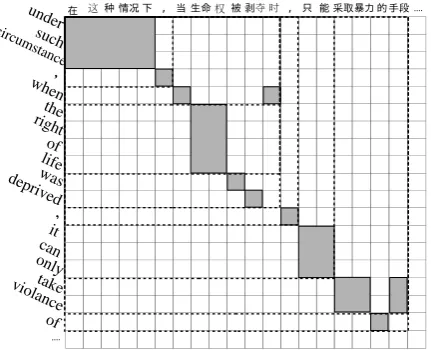
Figure 4: An example showing that the shift-reduce algo-rithm can capture local reorderings like:the right of lifeand was deprived.
D. We consider phrase pairs of any length to com-pute orientation. Note that although phrase pairs extracted from the rules that can be discontinu-ous (on source), just continudiscontinu-ous source phrases in each sentence pair are used to compute orienta-tion (previously translated phrases). Once orien-tation counts for rules (phrase-pairs obtained form rules) are collected from the bitext, the probability modelP(o|f,¯ ¯e)is estimated using recursive MAP smoothing as discussed in (Cherry, 2013).
2.2 Decoding
Phrase-based LRM uses local information to de-termine orientation for a new phrase pair,hfa¯i,ei¯i,
during decoding (Koehn et al., 2007; Tillmann, 2004). For left-to-right order,f¯ai is compared to
the previously translated phrasefa¯i−1. Galley and
reordering model (HRM) which increases the con-sistency of orientation assignments. In HRM, the emphasis on the previously translated phrase is removed and instead a compact representation of the full translation history, as represent by a shift-reduce stack, is used. Once a source span is trans-lated, it is shifted onto the stack; if the two spans on the top are adjacent, then a reduction merges the two. During decoding, orientations are always determined with respect to the top of this stack, rather than the previously translated phrase.
Although we reduce rules to phrase pairs to train the reordering model, LR-Hiero decoder uses SCFG rules for translation and the order of source phrases (spans) are determined by the non-terminals in SCFG rules. Therefore we cannot simply rely on the previously translated phrase to compute the orientation and reorder-ing scores. Since LR-Hiero uses lexicalized glue rules (Watanabe et al., 2006), non-terminals can be matched to very long spans on the source sen-tence. It makes LRM in LR-Hiero comparable to HRM in phrase-based MT. However, we cannot rely on the full translation history like HRM, since translation model is a SCFG grammar encoding reordering information.
We employ a shift-reduce approach to find a compact representation of the recent translated source spans which is also represented by a stack,
S, for each hypothesis. However,S always con-tains just one source span (which might be discon-tiguous), unlike HRM which maintains all previ-ously translated solid spans (In Figure 4, the dotted lines shows the only span in the stack during LR-Hiero decoding). As the decoder applies a rule,ri, the corresponding source phraseri.f¯is compared
respect to the span in S to determine the orien-tation. If they are adjacent or S covers the span
ri.f¯, they are reduced. Otherwise stack is set to
the span of new rule, S = ri.f¯. The orientation
ofri.f¯is computed with respect to S but if they are not adjacent (M or S), we still need to con-sider the possible local reordering with respect to the previous ruleri−1.f¯. In Figure 3, rules #5,#4 are monotone, while both are covered by the cur-rent span in S. Since the stack always contains one span, this algorithm runs inO(1). Therefore, only a limited number of comparisons is used to updateS and compute orientation. Unlike HRM which needs to maintain a sequence of contiguous spans in the stack and runs in linear time.
Figure 3 illustrates the application of shift-reduce approach to compute orientation for initial decoding steps of a Chinese-English sentence pair shown in Figure 4. We show source words in the rules with the corresponding index in the source sentence. Sandri.f¯for the initial hypothesis are set to−1, corresponding to the start of sentence symbol, making it easy to compute the correct ori-entation for spans at the beginning of the input (with index 0).
3 Experiments
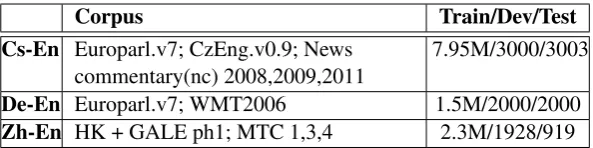
We evaluate lexicalized reordering model for LR-Hiero on three language pairs: German-English (De-En), Czech-English (Cs-En) and Chinese-English (Zh-En). Table 1 shows the corpus statis-tics for all language.
We train a 5-gram LM on the Gigaword corpus using KenLM (Heafield, 2011). The weights in the log-linear model are tuned by minimizing BLEU loss through MERT (Och, 2003) on the dev set for each language pair and then report BLEU scores on the test set. Pop limit for Hiero and LR-Hiero is 500 and beam size for Moses is 1000. Other extraction and decoder settings such as maximum phrase length, etc. are identical across different settings.
We use 3 baselines in our experiments:
• Hiero: we use our in-house implementation of Hiero, Kriya, in Python (Sankaran et al., 2012). Kriya can obtain statistically signif-icantly equal BLEU scores when compared with Moses (Koehn et al., 2007) for sev-eral language pairs (Razmara et al., 2012; Callison-Burch et al., 2012).
• phrase-based: Moses (Koehn et al., 2007) with and without lexicalized reordering fea-tures.
• LR-Hiero: LR-Hiero decoding with cube
pruning and queue diversity of10 (Siahbani and Sarkar, 2014b).
To make the results comparable we use the stan-dard SMT features for log-linear model in transla-tion systems. relative-frequency translatransla-tion proba-bilitiesp(f|e)andp(e|f), lexical translation prob-abilities pl(f|e) and pl(e|f), a language model
Corpus Train/Dev/Test
Cs-En Europarl.v7; CzEng.v0.9; News
commentary(nc) 2008,2009,2011 7.95M/3000/3003
De-En Europarl.v7; WMT2006 1.5M/2000/2000
[image:5.595.151.448.61.135.2]Zh-En HK + GALE ph1; MTC 1,3,4 2.3M/1928/919
Table 1: Corpus statistics in number of sentences. Tuning and test sets for Chinese-English has 4 references.
Model Cs-En De-En Zh-En
Hiero 6279.3 7152.3 6524.7 LR-Hiero + LRM 2015.1 2908.3 2225.7 Table 2: Translation time in terms of average number of LM queries.
Model Cs-En De-En Zh-En
Phrase-based 20.32 24.71 25.68 + LRM 20.74 25.99 26.61 Hiero 20.77 25.72 27.65
LR-Hiero 20.52 24.96 25.73 + NVLRM 20.49 24.98 25.9 + LRM 20.86 25.44 26.57
Table 3: Translation accuracy in terms of BLEU for different baselines and LR-Hiero with lexicalized reordering model. The rows are grouped such that each group use the same model.
by (Siahbani et al., 2013) are added to both Hi-ero and LR-HiHi-ero. The LRM proposed in this pa-per uses a GNF grammar and LR decoding, there-fore we apply it only to LR-Hiero. The GNF rules are obtained from word and phrase aligned bi-text using the rule extraction algorithm proposed by (Siahbani and Sarkar, 2014a).
Table 3 compares the performance of different translation systems in terms of translation quality (BLEU). In all language pairs the proposed lexi-calized reordering model improves the translation quality of LR-Hiero. These observations are com-parable to the effect of LRM in phrase-based trans-lation system. In Cs-En, LRM gets the best results and it significantly improves the the LR-Hiero re-sults for De-En and Zh-En (p-value<0.05, evalu-ated by MultEval (Clark et al., 2011)). To com-pare our approach to Nguyen and Vogel (2013), we adopt their algorithm to LR-Hiero and use the same LRM trained for GNF rules (marked as
NVLRMin Table 3). Unsurprisingly this approach could not improve the translation quality in LR-Hiero. This approach computes the LRM for all candidate translation of each span after
[image:5.595.81.283.262.366.2]obtain-ing the full translations. In bottom-up decoders it helps to prune the hypotheses effectively while in LR-Hiero decoder as we apply a rule before know-ing the translation of smaller spans the computa-tion of LRM will be postponed and gets less effec-tive in decoding.
Table 2 shows the performance in terms of de-coding speed. We use the same wrapper for Hiero and LR-Hiero to query the language model and re-port the average on a sample set of 50 sentences from test sets. We can see LR-Hiero+LRM still works 3 times faster than Hiero in terms of num-ber of LM calls which leads to a faster decoder speed.
4 Conclusion
We have proposed a novel lexicalized reordering model (LRM) for the left-to-right variant of Hi-ero called LR-HiHi-ero distinct from previous LRM models. The previous LRM models proposed for Hiero are just applicable to bottom-up decoders like CKY. We proposed a model for the left-to-right decoding algorithm of LR-Hiero. We showed that our novel shift-reduce algorithm to decode with the lexicalized reordering model significantly improved the translation quality of LR-Hiero on three different language pairs.
Acknowledgments
The authors wish to thank the anonymous viewers for their helpful comments. The re-search was also partially supported by the Nat-ural Sciences and Engineering Research Council of Canada (NSERC RGPIN 262313 and RGPAS 446348) to the second author.
References
Chris Callison-Burch, Philipp Koehn, Christof Monz, Matt Post, Radu Soricut, and Lucia Specia. 2012. Findings of the 2012 workshop on statistical
ma-chine translation. In Proceedings of the Seventh
Hailong Cao, Dongdong Zhang, Mu Li, Ming Zhou, and Tiejun Zhao. 2014. A lexicalized reorder-ing model for hierarchical phrase-based translation. In Proceedings of COLING 2014, the 25th Inter-national Conference on Computational Linguistics: Technical Papers, pages 1144–1153, Dublin, Ire-land, August. Dublin City University and Associa-tion for ComputaAssocia-tional Linguistics.
Colin Cherry. 2013. Improved reordering for
phrase-based translation using sparse features. In
Proceed-ings of the 2013 Conference of the North American Chapter of the Association for Computational Lin-guistics: Human Language Technologies, pages 22– 31, Atlanta, Georgia, June. Association for Compu-tational Linguistics.
David Chiang. 2007. Hierarchical phrase-based
trans-lation. Comput. Linguist., 33(2):201–228, June.
Jonathan H. Clark, Chris Dyer, Alon Lavie, and Noah A. Smith. 2011. Better hypothesis testing for statistical machine translation: Controlling for
op-timizer instability. InProceedings of the 49th
An-nual Meeting of the Association for Computational Linguistics: Human Language Technologies, pages 176–181, Portland, Oregon, USA, June. Association for Computational Linguistics.
Jay Earley. 1970. An efficient context-free parsing
al-gorithm. Commun. ACM, 13(2):94–102, February.
Michel Galley and Christopher D. Manning. 2008. A simple and effective hierarchical phrase
reorder-ing model. In Proceedings of the Conference on
Empirical Methods in Natural Language
Process-ing, EMNLP 2008, pages 848–856, Stroudsburg,
PA, USA. Association for Computational Linguis-tics.
Michel Galley and Christopher D. Manning. 2010. Accurate non-hierarchical phrase-based translation. In Human Language Technologies: The 2010 An-nual Conference of the North American Chapter of the Association for Computational Linguistics, HLT ’10, pages 966–974, Stroudsburg, PA, USA. Associ-ation for ComputAssoci-ational Linguistics.
Kenneth Heafield. 2011. Kenlm: Faster and smaller
language model queries. InProceedings of the Sixth
Workshop on Statistical Machine Translation, WMT ’11, pages 187–197, Stroudsburg, PA, USA. Associ-ation for ComputAssoci-ational Linguistics.
Liang Huang and Haitao Mi. 2010. Efficient incre-mental decoding for tree-to-string translation. In Proceedings of the 2010 Conference on Empirical Methods in Natural Language Processing, EMNLP ’10, pages 273–283, Stroudsburg, PA, USA. Associ-ation for ComputAssoci-ational Linguistics.
Matthias Huck, Joern Wuebker, Felix Rietig, and Her-mann Ney. 2013. A phrase orientation model for
hi-erarchical machine translation. InACL 2013 Eighth
Workshop on Statistical Machine Translation, pages 452–463, Sofia, Bulgaria, August.
Philipp Koehn, Franz Josef Och, and Daniel Marcu.
2003. Statistical phrase-based translation. In
Pro-ceedings of the 2003 Conference of the North Amer-ican Chapter of the Association for Computational Linguistics on Human Language Technology - Vol-ume 1, NAACL ’03, pages 48–54, Stroudsburg, PA, USA. Association for Computational Linguistics.
Philipp Koehn, Hieu Hoang, Alexandra Birch, Chris Callison-Burch, Marcello Federico, Nicola Bertoldi, Brooke Cowan, Wade Shen, Christine Moran, Richard Zens, Chris Dyer, Ondˇrej Bojar, Alexandra Constantin, and Evan Herbst. 2007. Moses: Open source toolkit for statistical machine translation. In Proceedings of the 45th Annual Meeting of the ACL on Interactive Poster and Demonstration Sessions, ACL ’07, pages 177–180, Stroudsburg, PA, USA. Association for Computational Linguistics.
ThuyLinh Nguyen and Stephan Vogel. 2013. Integrat-ing phrase-based reorderIntegrat-ing features into a
chart-based decoder for machine translation. In
Proceed-ings of the 51st Annual Meeting of the Association for Computational Linguistics (Volume 1: Long Pa-pers), pages 1587–1596, Sofia, Bulgaria, August. Association for Computational Linguistics.
Franz Josef Och and Hermann Ney. 2004. The align-ment template approach to statistical machine
trans-lation. Comput. Linguist., 30(4):417–449,
Decem-ber.
Franz Josef Och. 2003. Minimum error rate training in
statistical machine translation. InProceedings of the
41st Annual Meeting on Association for Computa-tional Linguistics - Volume 1, ACL ’03, pages 160– 167, Stroudsburg, PA, USA. Association for Com-putational Linguistics.
Majid Razmara, Baskaran Sankaran, Ann Clifton, and Anoop Sarkar. 2012. Kriya - the sfu system for
translation task at wmt-12. In Proceedings of the
Seventh Workshop on Statistical Machine
Transla-tion, pages 356–361, Montr´eal, Canada, June.
Asso-ciation for Computational Linguistics.
Baskaran Sankaran, Majid Razmara, and Anoop Sarkar. 2012. Kriya - an end-to-end hierarchical
phrase-based MT system. Prague Bull. Math.
Lin-guistics, 97:83–98.
Maryam Siahbani and Anoop Sarkar. 2014a. Ex-pressive hierarchical rule extraction for left-to-right
translation. InProceedings of the Eleventh
Confer-ence of the Association for Machine Translation in the Americas (AMTA), volume 1, pages 1–14.
Maryam Siahbani and Anoop Sarkar. 2014b. Two im-provements to left-to-right decoding for hierarchical
phrase-based machine translation. InProceedings of
Maryam Siahbani, Baskaran Sankaran, and Anoop Sarkar. 2013. Efficient left-to-right hierarchical phrase-based translation with improved reordering. In Proceedings of the 2013 Conference on Em-pirical Methods in Natural Language Processing, pages 1089–1099, Seattle, Washington, USA, Oc-tober. Association for Computational Linguistics. Christoph Tillmann. 2004. A unigram orientation
model for statistical machine translation. In
Pro-ceedings of HLT-NAACL 2004: Short Papers, HLT-NAACL-Short ’04, pages 101–104, Stroudsburg, PA, USA. Association for Computational Linguis-tics.
Taro Watanabe, Hajime Tsukada, and Hideki Isozaki. 2006. Left-to-right target generation for
hierar-chical phrase-based translation. InProceedings of