Recurrent Residual Learning for Sequence Classification
Yiren Wang∗
University of Illinois at Urbana-Champaign [email protected]
Fei Tian Microsoft Research [email protected]
Abstract
In this paper, we explore the possibility of leveraging Residual Networks (ResNet), a powerful structure in constructing extremely deep neural network for image understanding, to improve recurrent neural networks (RNN) for modeling sequential data. We show that for sequence classification tasks, incorporat-ing residual connections into recurrent struc-tures yields similar accuracy to Long Short Term Memory (LSTM) RNN with much fewer model parameters. In addition, we propose two novel models which combine the best of both residual learning and LSTM. Experi-ments show that the new models significantly outperform LSTM.
1 Introduction
Recurrent Neural Networks (RNNs) are powerful tools to model sequential data. Among various RNN models, Long Short Term Memory (LSTM) (Hochreiter and Schmidhuber, 1997) is one of the most effective structures. In LSTM, gating mech-anism is used to control the information flow such that gradient vanishing problem in vanilla RNN is better handled, and long range dependency is bet-ter captured. However, as empirically verified by previous works and our own experiments, to obtain fairly good results, training LSTM RNN needs care-fully designed optimization procedure (Hochreiter et al., 2001; Pascanu et al., 2013; Dai and Le, 2015; Laurent et al., 2015; He et al., 2016; Arjovsky et ∗This work was done when the author was visiting
Mi-crosoft Research Asia.
al., 2015), especially when faced with unfolded very deep architectures for fairly long sequences (Dai and Le, 2015).
From another perspective, for constructing very deep neural networks, recently Residual Networks (ResNet) (He et al., 2015) have shown their ef-fectiveness in quite a few computer vision tasks. By learning a residual mapping between layers with identity skip connections (Jaeger et al., 2007), ResNet ensures a fluent information flow, leading to efficient optimization for very deep structures (e.g., with hundreds of layers). In this paper, we explore the possibilities of leveraging residual learning to improve the performances of recurrent structures, in particular, LSTM RNN, in modeling fairly long se-quences (i.e., whose lengths exceed100). To
sum-marize, our main contributions include:
1. We introduce residual connecting mechanism into the recurrent structure and propose recur-rent residual networks for sequence learning. Our model achieves similar performances to LSTM in text classification tasks, whereas the number of model parameters is greatly reduced.
2. We present in-depth analysis of the strengths and limitations of LSTM and ResNet in respect of sequence learning.
3. Based on such analysis, we further propose two novel models that incorporate the strengths of the mechanisms behind LSTM and ResNet. We demonstrate that our models outperform LSTM in many sequence classification tasks.
2 Background
RNN models sequences by taking sequential input x = {x1,· · · , xT} and generating T step hidden statesh={h1,· · · , hT}. At each time stept, RNN
takes the input vectorxt∈ Rnand the previous hid-den state vectorht−1 ∈ Rmto produce the next
hid-den stateht.
Based on this basic structure, LSTM avoids gradi-ent vanishing in RNN training and thus copes better with long range dependencies, by further augment-ing vanilla RNN with a memory cell vectorct∈ Rm and multiplicative gate units that regulate the infor-mation flow. To be more specific, at each time step t, an LSTM unit takesxt, ct−1, ht−1 as input,
gen-erates the input, output and forget gate signals (de-noted asit,otandftrespectively), and produces the next cell statectand hidden stateht:
˜
ct=tanh(Wc[ht−1, xt] +bc) it=σ(Wi[ht−1, xt] +bi) ft=σ(Wf[ht−1, xt] +bf) ot=σ(Wo[ht−1, xt] +bo) ct=ft⊗Ct−1+it⊗ct˜
ht=ot⊗tanh(ct)
(1)
where⊗refers to element-wise product.σ(x)is the sigmoid functionσ(x) = 1/(1+exp(−x)).Wj(j∈ {i, o, f, c})are LSTM parameters. In the following
part, such functions generatinghtandctare denoted asht, ct=LST M(xt, ht−1, ct−1).
Residual Networks (ResNet) are among the pio-neering works (Szegedy et al., 2015; Srivastava et al., 2015) that utilize extra identity connections to enhance information flow such that very deep neural networks can be effectively optimized. ResNet (He et al., 2015) is composed of several stacked resid-ual units, in which thelth unit takes the following transformation:
hl+1=f(g(hl) +F(hl;Wl)) (2)
wherehl andhl+1 are the input and output for the
lthunit respectively. F is the residual function with weight parametersWl.fis typically the ReLU func-tion (Nair and Hinton, 2010). g is set as identity function, i.e., g(hl) = hl. Such an identity con-nection guarantees the direct propagation of signals
among different layers, thereby avoids gradient van-ishing. The recent paper (Liao and Poggio, 2016) talks about the possibility of using shared weights in ResNet, similar to what RNN does.
3 Recurrent Residual Learning
The basic idea of recurrent residual learning is to force a direct information flow in different time steps of RNNs by identity (skip) connections. In this sec-tion, we introduce how to leverage residual learning to 1) directly construct recurrent neural network in subsection 3.1; 2) improve LSTM in subsection 3.2.
3.1 Recurrent Residual Networks (RRN)
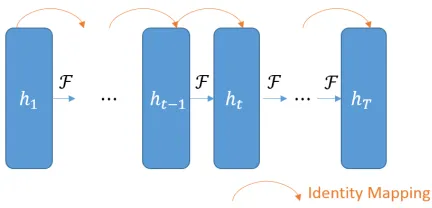
The basic architecture of Recurrent Residual Net-work (RRN for short) is illustrated in Figure 1, in which orange arrows indicate the identity connec-tions from each ht−1 to ht, and blue arrows rep-resent the recurrent transformations taking bothht andxt as input. Similar to equation (2), the recur-rent transformation in RRN takes the following form (denoted asht = RRN(xt, ht−1)in the following
sections):
ht=f(g(ht−1) +F(ht−1, xt;W)), (3)
wheregis still the identity function s.t. g(ht−1) =
ht−1, corresponding to the orange arrows in Figure
1. f is typically set as tanh. For function F with weight parametersW (corresponding to the blue ar-rows in Figure 1), inspired by the observation that higher recurrent depth tends to lead to better perfor-mances (Zhang et al., 2016), we impose K deep transformations inF:
y1t =σ(xtW1+ht−1U1+b1)
y2t =σ(xtW2+y1tU2+b2)
· · ·
yKt =σ(xtWK+ytK−1UK+bK)
F(ht−1, xt) =ytK
(4)
Figure 1:The basic structure of Recurrent Residual Networks.
RRN forces the direct propagation of hidden state signals between every two consecutive time steps with identity connections g. In addition, the mul-tiple non-linear transformations inF guarantees its capability in modelling complicated recurrent rela-tionship. In practice, we found thatK = 2yields fairly good performances, meanwhile leads to half of LSTM parameter size when model dimensions are the same.
3.2 Gated Residual RNN
Identity connections in ResNet are important for propagating the single input image information to higher layers of CNN. However, when it comes to sequence classification, the scenario is quite differ-ent in that there is a new input at every time step. Therefore, a forgetting mechanism to “forget” less critical historical information, as is employed in LSTM (controlled by the forget gate ft), becomes necessary. On the other hand, while LSTM benefits from the flexible gating mechanism, its parametric nature brings optimization difficulties to cope with fairly long sequences, whose long range informa-tion dependencies could be better captured by iden-tity connections.
Inspired by the success of the gating mechanism of LSTM and the residual connecting mechanism with enhanced information flow of ResNet, we fur-ther propose two Gated Residual Recurrent models leveraging the strengths of the two mechanisms.
3.2.1 Model 1: Skip-Connected LSTM (SC-LSTM)
Skip-Connected LSTM (SC-LSTMfor short) in-troduces identity connections into standard LSTM to enhance the information flow. Note that in Figure 1, a straightforward approach is to replaceF with an LSTM unit. However, our preliminary experiments
do not achieve satisfactory results. Our conjecture is that identity connections between consecutive mem-ory cells, which are already sufficient to maintain short-range memory, make the unregulated informa-tion flow overly strong, and thus compromise the merit of gating mechanism.
To reasonably enhance the information flow for LSTM network while keeping the advantage of gat-ing mechanism, startgat-ing from equation (1), we pro-pose to add skip connections between two LSTM hidden states with a wide range of distanceL(e.g., L= 20), such that∀t={1,1 +L,1 + 2L,· · · ,1 +
bT−L−1
L cL}:
ht+L=tanh(ct+L)⊗ot+L+αht (5) Here α is a scalar that can either be fixed as 1
(i.e., identity mapping) or be optimized during train-ing process as a model parameter (i.e., parametric skip connection). We refer to these two variants as
SC-LSTM-I and SC-LSTM-P respectively. Note that in SC-LSTM, the skip connections only exist in time steps1,1 +L,1 + 2L,· · ·,1 +bT−LL−1cL. The basic structure is shown in Figure 2.
Figure 2:The basic structure of Skip-Connected LSTM.
3.2.2 Model 2: Hybrid Residual LSTM (HRL)
Since LSTM generates sequence representations out of flexible gating mechanism, and RRN gener-ates representations with enhanced residual histori-cal information, it is a natural extension to combine the two representations to form a signal that bene-fits from both mechanisms. We denote this model as Hybrid Residual LSTM (HRLfor short).
In HRL, two independent signals, hLST M t gen-erated by LSTM (equation (1)) and hRRNt gener-ated by RRN (equation (3)), are propaggener-ated through LSTM and RRN respectively:
hLST Mt , ct=LST M(xt, hLST Mt−1 , ct−1)
[image:3.612.316.539.387.473.2]The final representation hHRLT is obtained by the mean pooling of the two “sub” hidden states:
hHRLT = 1 2(h
LST M
T +hRRNT ) (7)
hHRLT is then used for higher level tasks such as pre-dicting the sequence label. Acting in this way,hHRL
T contains both thestaticallyforced anddynamically
adjusted historical signals, which are respectively conveyed byhRRN
t andhLST Mt .
4 Experiments
We conduct comprehensive empirical analysis on sequence classification tasks. Listed in the ascend-ing order of average sequence lengths, several public datasets we use include:
1. AG’s news corpus1,a news article corpus with
categorized articles from more than 2,000
news sources. We use the dataset with 4 largest classes constructed in (Zhang et al., 2015).
2. IMDB movie review dataset2, a binary
senti-ment classification dataset consisting of movie review comments with positive/negative senti-ment labels (Maas et al., 2011).
3. 20 Newsgroups (20NG for short), an email collection dataset categorized into 20 news groups. Simiar to (Dai and Le, 2015), we use the post-processed version3, in which
attach-ments, PGP keys and some duplicates are re-moved.
4. Permuted-MNIST(P-MNISTfor short). Fol-lowing (Le et al., 2015; Arjovsky et al., 2015), we shuffle pixels of each MNIST image (Le-Cun et al., 1998) with a fixed random per-mutation, and feed all pixels sequentially into recurrent network to predict the image label. Permuted-MNIST is assumed to be a good testbed for measuring the ability of modeling very long range dependencies (Arjovsky et al., 2015).
1http://www.di.unipi.it/~gulli/AG corpus of news articles.html
2http://ai.stanford.edu/~amaas/data/sentiment/ 3 http://ana.cachopo.org/datasets-for-single-label-text-categorization
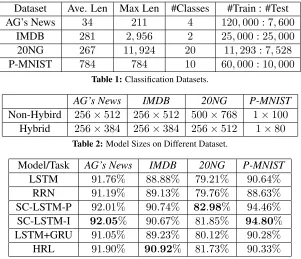
Detailed statistics of each dataset are listed in Table 1. For all the text datasets, we take every word as input and feed word embedding vectors pre-trained by Word2Vec (Mikolov et al., 2013) on Wikipedia into the recurrent neural network. The top most frequent words with 95% total frequency coverage are kept, while others are replaced by the token “UNK”. We use the standard training/test split along with all these datasets and randomly pick15%of training set as dev set, based on which
we perform early stopping and for all models tune hyper-parameters such as dropout ratio (on non-recurrent layers) (Zaremba et al., 2014), gradient clipping value (Pascanu et al., 2013) and the skip connection length L for SC-LSTM (cf. equation (5)). The last hidden states of recurrent networks are put into logistic regression classifiers for label predictions. We use Adadelta (Zeiler, 2012) to perform parameter optimization. All our implementations are based on Theano (Theano De-velopment Team, 2016) and run on one K40 GPU. All the source codes and datasets can be down-loaded at https://publish.illinois. edu/yirenwang/emnlp16source/.
We compare our proposed models mainly with the state-of-art standard LSTM RNN. In addition, to fully demonstrate the effects of residual learning in our HRL model, we employ another hybrid model as baseline, which combines LSTM and GRU (Cho et al., 2014), another state-of-art RNN variant, in a similar way as HRL. We use LSTM+GRUto de-note such a baseline. The model sizes (word embed-ding size × hidden state size) configurations used for each dataset are listed in Table 2. In Table 2, “Non-Hybrid” refers to LSTM, RRN and SC-LSTM models, while “Hybrid” refers to two methods that combines two basic models: HRL and LSTM+GRU. The model sizes of all hybrid models are smaller than the standard LSTM. All models have only one recurrent layer.
4.1 Experimental Results
All the classification accuracy numbers are listed in Table 3. From this table, we have the following ob-servations and analysis:
Dataset Ave. Len Max Len #Classes #Train : #Test AG’s News 34 211 4 120,000 : 7,600
IMDB 281 2,956 2 25,000 : 25,000
20NG 267 11,924 20 11,293 : 7,528
[image:5.612.156.457.56.315.2]P-MNIST 784 784 10 60,000 : 10,000 Table 1:Classification Datasets.
AG’s News IMDB 20NG P-MNIST
Non-Hybird 256×512 256×512 500×768 1×100
Hybrid 256×384 256×384 256×512 1×80 Table 2:Model Sizes on Different Dataset.
Model/Task AG’s News IMDB 20NG P-MNIST
LSTM 91.76% 88.88% 79.21% 90.64%
RRN 91.19% 89.13% 79.76% 88.63%
SC-LSTM-P 92.01% 90.74% 82.98% 94.46%
SC-LSTM-I 92.05% 90.67% 81.85% 94.80%
LSTM+GRU 91.05% 89.23% 80.12% 90.28%
HRL 91.90% 90.92% 81.73% 90.33% Table 3:Classification Results (Test Accuracy).
half of the model parameters, indicating that residual network structure, with connecting mechanism to enhance the information flow, is also an effective approach for sequence learn-ing. However, the fact that it fails to sig-nificantly outperform other models (as it does in image classification) implies that forgetting mechanism is desired in recurrent structures to handle multiple inputs.
2. Skip-Connected LSTM performs much better than standard LSTM. For tasks with shorter se-quences such as AG’s News, the improvement is limited. However, the improvements get more significant with the growth of sequence lengths among different datasets4, and the
per-formance is particularly good in P-MNIST with very long sequences. This reveals the impor-tance of skip connections in carrying on histor-ical information through a long range of time steps, and demonstrates the effectiveness of our approach that adopts the residual connecting mechanism to improve LSTM’s capability of handling long-term dependency. Furthermore, SC-LSTM is robust with different hyperparam-4t-test on SC-LSTM-P and SC-LSTM-I with p value <
0.001.
eter values: we test L = 10,20,50,75 in
P-MNIST and find the performance is not sensi-tive w.r.t. theseLvalues.
3. HRL also outperforms standard LSTM with fewer model parameters5. In comparison, the
hybrid model of LSTM+GRU cannot achieve such accuracy as HRL. As we expected, the ad-ditional long range historical information prop-agated by RRN is proved to be good assistance to standard LSTM.
5 Conclusion
In this paper, we explore the possibility of lever-aging residual network to improve the performance of LSTM RNN. We show that direct adaptation of ResNet performs well in sequence classification. In addition, when combined with the gating mecha-nism in LSTM, residual learning significantly im-prove LSTM’s performance. As to future work, we plan to apply residual learning to other se-quence tasks such as language modeling, and RNN based neural machine translation (Sutskever et al., 2014) (Cho et al., 2014).
References
Martin Arjovsky, Amar Shah, and Yoshua Bengio. 2015. Unitary evolution recurrent neural networks. arXiv preprint arXiv:1511.06464.
Kyunghyun Cho, Bart Van Merri¨enboer, Caglar Gul-cehre, Dzmitry Bahdanau, Fethi Bougares, Holger Schwenk, and Yoshua Bengio. 2014. Learn-ing phrase representations usLearn-ing rnn encoder-decoder for statistical machine translation. arXiv preprint arXiv:1406.1078.
Andrew M Dai and Quoc V Le. 2015. Semi-supervised sequence learning. InAdvances in Neural Information Processing Systems, pages 3061–3069.
Kaiming He, Xiangyu Zhang, Shaoqing Ren, and Jian Sun. 2015. Deep residual learning for image recogni-tion. arXiv preprint arXiv:1512.03385.
Kaiming He, Xiangyu Zhang, Shaoqing Ren, and Jian Sun. 2016. Identity mappings in deep residual net-works. arXiv preprint arXiv:1603.05027.
Sepp Hochreiter and J¨urgen Schmidhuber. 1997. Long short-term memory. Neural computation, 9(8):1735– 1780.
Sepp Hochreiter, Yoshua Bengio, Paolo Frasconi, and Jr-gen Schmidhuber. 2001. Gradient flow in recurrent nets: the difficulty of learning long-term dependen-cies.
Herbert Jaeger, Mantas Lukoˇseviˇcius, Dan Popovici, and Udo Siewert. 2007. Optimization and applications of echo state networks with leaky-integrator neurons. Neural Networks, 20(3):335–352.
C´esar Laurent, Gabriel Pereyra, Phil´emon Brakel, Ying Zhang, and Yoshua Bengio. 2015. Batch nor-malized recurrent neural networks. arXiv preprint arXiv:1510.01378.
Quoc V Le, Navdeep Jaitly, and Geoffrey E Hin-ton. 2015. A simple way to initialize recurrent networks of rectified linear units. arXiv preprint arXiv:1504.00941.
Yann LeCun, L´eon Bottou, Yoshua Bengio, and Patrick Haffner. 1998. Gradient-based learning applied to document recognition. Proceedings of the IEEE, 86(11):2278–2324.
Qianli Liao and Tomaso Poggio. 2016. Bridging the gaps between residual learning, recurrent neural networks and visual cortex.arXiv preprint arXiv:1604.03640. Andrew L. Maas, Raymond E. Daly, Peter T. Pham, Dan
Huang, Andrew Y. Ng, and Christopher Potts. 2011. Learning word vectors for sentiment analysis. In Pro-ceedings of the 49th Annual Meeting of the Associa-tion for ComputaAssocia-tional Linguistics: Human Language Technologies, pages 142–150, Portland, Oregon, USA, June. Association for Computational Linguistics.
Tomas Mikolov, Ilya Sutskever, Kai Chen, Greg S Cor-rado, and Jeff Dean. 2013. Distributed representa-tions of words and phrases and their compositionality. InAdvances in neural information processing systems, pages 3111–3119.
Vinod Nair and Geoffrey E Hinton. 2010. Rectified lin-ear units improve restricted boltzmann machines. In Proceedings of the 27th International Conference on Machine Learning (ICML-10), pages 807–814. Razvan Pascanu, Tomas Mikolov, and Yoshua Bengio.
2013. On the difficulty of training recurrent neural networks. In Proceedings of The 30th International Conference on Machine Learning, pages 1310–1318. Rupesh K Srivastava, Klaus Greff, and J¨urgen
Schmid-huber. 2015. Training very deep networks. In Advances in Neural Information Processing Systems, pages 2368–2376.
Ilya Sutskever, Oriol Vinyals, and Quoc V Le. 2014. Sequence to sequence learning with neural networks. InAdvances in neural information processing systems, pages 3104–3112.
Christian Szegedy, Wei Liu, Yangqing Jia, Pierre Ser-manet, Scott Reed, Dragomir Anguelov, Dumitru Er-han, Vincent Vanhoucke, and Andrew Rabinovich. 2015. Going deeper with convolutions. In Proceed-ings of the IEEE Conference on Computer Vision and Pattern Recognition, pages 1–9.
Theano Development Team. 2016. Theano: A Python framework for fast computation of mathematical ex-pressions. arXiv e-prints, abs/1605.02688, May. Wojciech Zaremba, Ilya Sutskever, and Oriol Vinyals.
2014. Recurrent neural network regularization. arXiv preprint arXiv:1409.2329.
Matthew D Zeiler. 2012. Adadelta: an adaptive learning rate method.arXiv preprint arXiv:1212.5701. Xiang Zhang, Junbo Zhao, and Yann LeCun. 2015.
Character-level convolutional networks for text classi-fication. InAdvances in Neural Information Process-ing Systems, pages 649–657.