Weakly Supervised Tweet Stance Classification by Relational Bootstrapping
Javid Ebrahimi and Dejing Dou and Daniel Lowd
Department of Computer and Information Science, University of Oregon Eugene, Oregon 97403, USA
{javid,dou,lowd}@cs.uoregon.edu
Abstract
Supervised stance classification, in such do-mains as Congressional debates and online forums, has been a topic of interest in the past decade. Approaches have evolved from text classification to structured output predic-tion, including collective classification and se-quence labeling. In this work, we investigate collective classification of stances on Twitter, using hinge-loss Markov random fields (HL-MRFs). Given the graph of all posts, users, and their relationships, we constrain the pre-dicted post labels and latent user labels to cor-respond with the network structure. We focus on a weakly supervised setting, in which only a small set of hashtags or phrases is labeled. Using our relational approach, we are able to go beyond the stance-indicative patterns and harvest more stance-indicative tweets, which can also be used to train any linear text classi-fier when the network structure is not available or is costly.
1 Introduction
Stance classification is the task of determining from text whether the author of the text is in favor of, against, or neutral towards a target of interest. This is an interesting task to study on social networks due to the abundance of personalized and opinion-ated language. Studying stance classification can be beneficial in identifying electoral issues and under-standing how public stance is shaped (Mohammad et al., 2015).
Twitter provides a wealth of information: pub-lic tweets by individuals, their profile information,
whom they follow, and more. Exploiting all these pieces of information, in addition to the text, could help build better NLP systems. Examples of this approach include user preference modeling (Li et al., 2014), stance classification (Rajadesingan and Liu, 2014), and geolocation identification (Jurgens, 2013; Rahimi et al., 2015). For stance classification, knowing the author’s past posting behavior, or her friends’ stances on issues, could improve the stance classifier. These are inherently structured problems, and they demand structured solutions, such as Statis-tical Relational Learning (SRL) (Getoor, 2007). In this paper, we use hinge-loss Markov random fields (HL-MRFs) (Bach et al., 2015), a recent develop-ment in the SRL community.
SemEval 2016 Task 6 organizers (Mohammad et al., 2016) released a dataset with Donald Trump as the target, without stance annotation. The goal of the task was to evaluate stance classification sys-tems, which used minimal labeling on phrases. This scenario is becoming more and more relevant due to the vast amount of data and ever-changing nature of the language on social media. This is critical in ap-plications in which a timely detection is highly de-sired, such as violence detection (Cano Basave et al., 2013) and disaster situations.
Our work is the first to use SRL for stance classi-fication on Twitter. We formulate the weakly super-vised stance classification problem as a bi-type col-lective classification problem: We start from a small set of stance-indicative patterns and label the tweets as positive and negative, accordingly. Then, our re-lational learner uses these noisy-labeled tweets, as well as the network structure, to classify the stance
of other tweets and authors. Our goal will be to constrain pairs of similar tweets, pairs of tweets and their authors, and pairs of neighboring users to have similar labels. We do this through hinge-loss feature functions that encode our background knowledge about the domain: (1) A person is pro/against Trump if she writes a tweet with such stance; (2) Friends in a social network often agree on their stance toward Trump; (3) similar tweets express similar stances.
2 Related Work
Stance classification is related to sentiment classifi-cation with a major difference that the target of inter-est may not be explicitly mentioned in the text and it may not be the target of opinion in the text (Mo-hammad et al., 2016). Previous work has focused on Congressional debates (Thomas et al., 2006; Yesse-nalina et al., 2010), company-internal discussions (Agrawal et al., 2003), and debates in online fo-rums (Anand et al., 2011; Somasundaran and Wiebe, 2010). Stance classification has newly been posed as structured output prediction. For example, cita-tion structure (Burfoot et al., 2011) or rebuttal links (Walker et al., 2012) are used as extra information to model agreements or disagreements in debate posts and to infer their labels. Arguments and counter-arguments occur in sequences; Hasan and Ng (2014) used this observation and posed stance classification in debate forums as a sequence labeling task, and used a global inference method to classify the posts. Sridhar et al. (2015) use HL-MRFs to collec-tively classify stance in online debate forums. We address a weakly supervised problem, which makes our approach different as we do not rely on local text classifiers. Rajadesingan et al. (2014) propose a retweet-based label propagation method which starts from a set of known opinionated users and labels the tweets posted by the people who were in the retweet network.
3 Stance Classification on Twitter 3.1 Markov Random Fields
Markov random fields (MRFs) are widely used in machine learning and statistics. Discriminative Markov random fields such as conditional random fields (Lafferty et al., 2001) are defined by a joint distribution over random variables Y1, ..., Ym
con-ditioned on X1, ..., Xn that is specified by a vec-tor ofdreal-valued potential functionsφl(y, x)for
l= 1, ..., d, and a parameter (weight) vectorθ∈Rd:
P(y|x;θ) = 1
Z(θ, x)exp
hθ, φ(y, x)i
where hθ, φ(y, x)i denotes the dot product of the parameters and the potential functions, andZ(θ, x) is the partition function.
3.2 HL-MRFs for Tweet Stance Classification Finding themaximum a posteriori(MAP) state is a difficult discrete optimization problem and, in gen-eral, is NP-hard. One particular class of MRFs that allows for convex inference is hinge-loss Markov random fields (HL-MRFs) (Bach et al., 2015). In this graphical model, each potential function is a hinge-loss function, and instead of discrete vari-ables, MAP inference is performed over relaxed continuous variables with domain [0,1]n. These hinge-loss functions, multiplied by the correspond-ing model parameters (weights), act as penalizers for soft linear constraints in the graphical model.
Considerti,uj as the random variables denoting the ith tweet and the jth user. The potential function,
φ(ti,uj), relating a user and her tweet is as follows,
max(0, tik−ujk) (1)
where tik andujk denote the respective assertions thattihas labelk, andujhas labelk. The function captures the distance between the label for a user and her tweet. In other words, this function measures the penalty for dissimilar labels for a user and her tweet. For users who are “friends” (i.e., who “follow” each other on Twitter), we add this potential func-tion,
max(0, uik−ujk) (2)
and for the tweet-tweet relations,
sijmax(0, tik−tjk) (3)
Finally, two hard linear constraints are added, to ensure thatti, anduj are each assigned a single bel, or in other words, are fractionally assigned la-bels with weights that sum to one.
X
k
tik = 1, X
k
uik = 1 (4)
Weight learning is performed by an improved struc-tured voted perceptron (Lowd and Domingos, 2007), at every iteration of which we estimate the labels of the users by hard EM. This formulation can work in weakly supervised settings, because the constraints simply dictate similar/neighboring nodes to have similar labels.
In the language of Probabilistic Soft Logic (PSL) (Bach et al., 2015), the constraints can be defined by the following rules:
PSL Rules:
tweet-label(T,L)∧tweet-user(T,U)⇒user-label(U,L) user-label(U1,L)∧friend(U1,U2) ⇒user-label(U2,L) tweet-label(T1,L)∧similar(T1,T2) ⇒tweet-label(T2,L)
PredicateConstraint.Functional , on : user-label PredicateConstraint.Functional , on : tweet-label
Our post-similarity constraint implementation is different from the original PSL implementation due to themultiplicativesimilarity scalar1.
This work is a first step toward relational stance classification on Twitter. Incorporating other re-lational features, such as mention networks and retweet networks can potentially improve our re-sults. Similarly, employing textual entailment tech-niques for tweet similarity will most probably im-prove our results.
4 Experiments and Results 4.1 Data
SemEval-2016 Task 6.b (Mohammad et al., 2016) provided 78,000+ tweets associated with “Donald Trump”. The protocol of the task only allowed min-imal manual labeling, i.e. “tweets or sentences that are manually labeled for stance” were not allowed, but “manually labeling a handful of hashtags” was permitted. Additionally, using Twitter’s API, we collected each user’s follower list and their profile information. This often requires a few queries per 1The original implementation would result in the function, max(0,tik+sij−tjk−1), which is less intuitive than ours.
AlgorithmRelational Bootstrapping
Input:
Unlabeled pairs of tweets and authors (ti,ui). Friendship pairs (ui,uj) between users. Similarity triplets (ti,tj,sij) between tweets.
Stance-indicative regexesR. // Create an initial dataset. Training setX={}.
Harvest positive and negative tweets based onR. Add the harvested tweets toX.
// Augment the dataset by the relational classifier. Learning & inference overP(U,T|X)by our HL-MRF.
Add some classified tweets to training set:X=X+T.
Output: X.
Favor. make( ?)america( ?)great( ?)again, #trumpfor-president, I{’m, am}voting trump, #illegal(.*), patriot, #boycottmacy
Against.racist, bigot, idiot, hair, narcissis(.+)
Table 1:Patterns to collect pro-Trump and anti-Trump tweets.
user. We only considered the tweets which contain no URL, are not retweets, and have at most three hashtags and three mentions.
This task’s goal was to test stance towards the tar-get in 707 tweets. The authors in the test set are not identified, which prevents us from pursuing a fully relational approach. Thus, we adopt a two-phase ap-proach: First, we predict the stance of the training tweets using our HL-MRF. Second, we use the la-beled instances as training for a linear text classifier. This dataset-augmenting procedure is summarized in the AlgorithmRelational Bootstrapping.
4.2 Experimental Setup
We pick the pro-Trump and anti-Trump indicative regular expressions and hashtags, which are shown in Table 1. Tweets that have at least one positive or one negative pattern, and do not have both posi-tive and negaposi-tive patterns, are considered as our ini-tial positive and negative instances. This gives us a dataset with noisy labels; for example, the tweet
“his #MakeAmericaGreatAgain #Tag is a bummer.”
is against Donald Trump, incorrectly labeled favor-able. A quantitative analysis of the impact of noise, and the goodness of initial patterns, can be pursued in the future through a supervised approach.
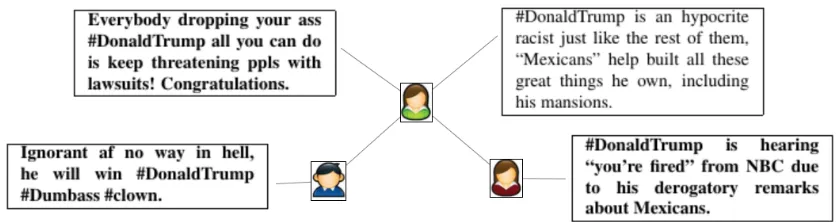
irrele-Figure 1:An example of the output of our relational bootstrapper. A small excerpt of the network, consisting of three users, four tweets and two friendship links. The tweet in regular type face is labeled as anti-Trump in the first phase, because of the word “racist” in the tweet. The other tweets, which are in boldface, are found through SRL harvesting, and are automatically labeled as anti-Trump tweets correctly.
vant to him. This makes it difficult to collect neutral tweets, and we will classify tweets to be in that class based on a heuristic described in the next subsection. Given the limited number of seeds, we need to collect more training instances to build a stance clas-sifier. Because of the original noise in the labels and the imposed fragmentary view of data,self-learning
would perform poorly. Instead, we augment the dataset with tweets that our relational model clas-sifies as positive or negative with a minimum con-fidence (class value 0.52 for pro-Trump and 0.56 for anti-Trump). The hyper-parameters were found through experimenting on a development set, which was the stance-annotated dataset of SemEval Task 6.a. The targets of that dataset include Hillary Clin-ton, Abortion, Climate Change, and Athesim. Since there are more anti-Trump tweets than pro-Trump (Mohammad et al., 2016), for our grid search we prefer a higher confidence threshold for the anti-Trump class, making it harder for the class bias to adversely impact the quality of harvested tweets. We also exclude the tweets that were sent by a user with no friends in the network. An example which show-cases relational harvesting of tweets can be seen in Figure 1, wherein given the evidence, some of which is shown, three new tweets are found.
4.3 Classification
We convert the tweets to lowercase, and we remove stopwords and punctuation marks. For tweet clas-sification, we use a linear-kernel SVM, which has proven to be effective for text classification and ro-bust in high-dimensional spaces. We use the
imple-No. total tweets 21,000
No. initial pro tweets 1,100
No. initial anti tweets 1,490
No. relational-harvested pro tweets 960 No. relational-harvested anti tweets 780 No. edges in tweet similarity network 7,400
[image:4.612.97.516.65.176.2]No. edges in friend network 131,000
Table 2:Statistics of the data
mentation of Pedregosa et al. (2011), and we em-ploy the features below, which are normalized to unit length after conjoinment.
N-grams:tf-idfof binary representation of word n-grams (1–4 gram) and character n-grams (2–6 gram). After normalization, we only pick the top 5% most frequent grams.
Lexicon: Binary indicators of positive-emotion and negative-emotion words in LIWC2007 categories (Tausczik and Pennebaker, 2010).
Sentiment: Sentiment distribution, based on a sen-timent analyzer for tweets, VADER (Hutto and Gilbert, 2014).
[image:4.612.315.540.271.374.2]base-Method Ff avor Fagainst Favg
SVM-ngrams-comb 18.42 38.45 28.43
best-system 57.39 55.17 56.28
SVM-IN 30.43 59.52 44.97
SVM-NB 47.67 57.53 52.60
SVM-RB 52.14 59.26 55.70
[image:5.612.77.300.57.155.2]SVM-RB-N 54.27 60.77 57.52
Table 3:Evaluation on SemEval-2016 Task 6.b.
line is an SVM, trained on another stance classifi-cation dataset (Task 6.a), using a combination of n-gram features (SVM-nn-grams-comb).
SVM-IN is trained on the initial dataset created by linguistic patterns, SVM-RB is trained on the relational-augmented dataset, and SVM-NB is a naive bootstrapping method that simply adds more instances, from the users in the initial dataset, with the same label as their tweets in the initial dataset, and for those who have both positive and negative tweets, does not add more of their tweets.
At test time, we could predict an instance to be of the “neither” class if it contains none of our stance-indicative patterns, nor any of the top 100 word grams that have the highest tf-idf weight in the training set. SVM-RB-N follows this heuris-tic for the “neither” class, while SVM-RB ignores this class altogether.
4.4 Demographics of the Users
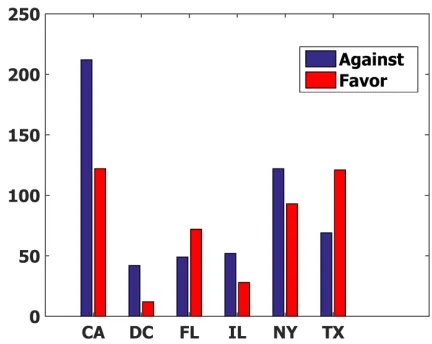
As an application of stance classification, we ana-lyze the demographics of the users based on their profile information. Due to the demographics of Twitter users, one has to be cautious about drawing generalizing conclusions from the analysis of Twit-ter data. We pick a balanced set of 1000 users with the highest degree of membership to any of the two groups. In Figure 2, we plot states represented by at least 50 users in the dataset. We can see that the figure correlates with US presidential electoral poli-tics; supporters of Trump dominate Texas, and they are in the clear minority in California.
5 Conclusions and Future Work
In this paper, we propose a weakly supervised stance classifier that leverages the power of relational learn-ing to incorporate extra features that are generally present on Twitter and other social media, i.e.,
au-Figure 2:Distribution of Twitter users in a number of states.
thorship and friendship information. HL-MRFs en-ables us to use a set of hard and soft linear con-straints to employ both the noisy-labeled instances and background knowledge in the form of soft con-straints for stance classification on Twitter.
While the relational learner tends to smooth out the incorrectly labeled instances, this model still suf-fers from noise in the labels. Labeling features and enforcing model expectation can be used to alleviate the impact of noise; currently, the initial linguistic patterns act as hard constraints for the label of the tweets, which can be relaxed by techniques such as generalized expectation (Druck et al., 2008).
The SemEval dataset has only one target of in-terest, Donald Trump. But the target of the opin-ion in the tweet may not necessarily be him, but re-lated targets, such as Hillary Clinton and Ted Cruz. Thus, automatic detection of targets and inferring the stance towards all of the targets is the next step toward creating a practical weakly-supervised stance classifier.
6 Acknowledgments
[image:5.612.324.540.65.237.2]References
Rakesh Agrawal, Sridhar Rajagopalan, Ramakrishnan Srikant, and Yirong Xu. 2003. Mining newsgroups using networks arising from social behavior. In Pro-ceedings of WWW, pages 529–535.
Pranav Anand, Marilyn Walker, Rob Abbott, Jean E Fox Tree, Robeson Bowmani, and Michael Minor. 2011. Cats rule and dogs drool!: Classifying stance in online debate. InProceedings of the Workshop on Computa-tional Approaches to Subjectivity and Sentiment Anal-ysis, pages 1–9.
Stephen H. Bach, Matthias Broecheler, Bert Huang, and Lise Getoor. 2015. Hinge-loss Markov random fields and probabilistic soft logic. arXiv:1505.04406 [cs.LG].
Clinton Burfoot, Steven Bird, and Timothy Baldwin. 2011. Collective classification of congressional floor-debate transcripts. In Proceedings of ACL, pages 1506–1515.
Amparo Elizabeth Cano Basave, Yulan He, Kang Liu, and Jun Zhao. 2013. A weakly supervised Bayesian model for violence detection in social media. In Pro-ceedings of IJCNLP, pages 109–117.
Gregory Druck, Gideon Mann, and Andrew McCallum. 2008. Learning from labeled features using general-ized expectation criteria. In Proceedings of SIGIR, pages 595–602.
Lise Getoor. 2007. Introduction to statistical relational learning. MIT press.
Kazi Saidul Hasan and Vincent Ng. 2014. Why are you taking this stance? Identifying and classifying reasons in ideological debates. In Proceedings of EMNLP, pages 751–762.
Clayton J Hutto and Eric Gilbert. 2014. Vader: A par-simonious rule-based model for sentiment analysis of social media text. In Proceedings of ICWSM, pages 216–225.
David Jurgens. 2013. That’s what friends are for: Infer-ring location in online social media platforms based on social relationships. InProceedings of ICWSM, pages 273–282.
John Lafferty, Andrew McCallum, and Fernando Pereira. 2001. Conditional random fields: Probabilistic mod-els for segmenting and labeling sequence data. In Pro-ceedings of ICML, pages 282–289.
Jiwei Li, Alan Ritter, and Dan Jurafsky. 2014. Infer-ring user preferences by probabilistic logical reasoning over social networks. arXiv:1411.2679 [cs.SI]. Daniel Lowd and Pedro Domingos. 2007. Efficient
weight learning for Markov logic networks. In Pro-ceedings of PKDD, pages 200–211.
Saif M Mohammad, Xiaodan Zhu, Svetlana Kiritchenko, and Joel Martin. 2015. Sentiment, emotion, purpose,
and style in electoral tweets. Information Processing & Management, 51(4):480–499.
Saif M. Mohammad, Svetlana Kiritchenko, Parinaz Sob-hani, Xiaodan Zhu, and Colin Cherry. 2016. Semeval-2016 task 6: Detecting stance in tweets. In Proceed-ings of SemEval, pages 31–41.
F. Pedregosa, G. Varoquaux, A. Gramfort, V. Michel, B. Thirion, O. Grisel, M. Blondel, P. Prettenhofer, R. Weiss, V. Dubourg, J. Vanderplas, A. Passos, D. Cournapeau, M. Brucher, M. Perrot, and E. Duches-nay. 2011. Scikit-learn: Machine learning in Python. Journal of Machine Learning Research, 12:2825– 2830.
Afshin Rahimi, Trevor Cohn, and Timothy Baldwin. 2015. Twitter user geolocation using a unified text and network prediction model. InProceedings of ACL, pages 630–636.
Ashwin Rajadesingan and Huan Liu. 2014. Identifying users with opposing opinions in Twitter debates. In Proceedings of SBP, pages 153–160.
Swapna Somasundaran and Janyce Wiebe. 2010. Rec-ognizing stances in ideological on-line debates. In Proceedings of the Workshop on Computational Ap-proaches to Analysis and Generation of Emotion in Text, pages 116–124.
Dhanya Sridhar, James Foulds, Bert Huang, Lise Getoor, and Marilyn Walker. 2015. Joint models of disagree-ment and stance in online debate. InProceedings of ACL, pages 116–125.
Yla R Tausczik and James W Pennebaker. 2010. The psychological meaning of words: LIWC and comput-erized text analysis methods. Journal of Language and Social Psychology, 29(1):24–54.
Matt Thomas, Bo Pang, and Lillian Lee. 2006. Get out the vote: Determining support or opposition from con-gressional floor-debate transcripts. InProceedings of EMNLP, pages 327–335.
Marilyn A Walker, Pranav Anand, Robert Abbott, and Ricky Grant. 2012. Stance classification using di-alogic properties of persuasion. In Proceedings of NAACL-HLT, pages 592–596.