AFET: Automatic Fine-Grained Entity Typing by
Hierarchical Partial-Label Embedding
Xiang Ren†∗ Wenqi He†∗ Meng Qu† Lifu Huang] Heng Ji] Jiawei Han†
†University of Illinois at Urbana-Champaign, Urbana, IL, USA
]Computer Science Department, Rensselaer Polytechnic Institute, USA
†{xren7, wenqihe3, mengqu2, hanj}@illinois.edu ]
{huangl7, jih}@rpi.edu
Abstract
Distant supervision has been widely used in current systems of fine-grained entity typ-ing to automatically assign categories (en-tity types) to en(en-tity mentions. However, the types so obtained from knowledge bases are often incorrect for the entity mention’s local context. This paper proposes a novel em-bedding method to separately model “clean” and “noisy” mentions, and incorporates the given type hierarchy to induce loss functions. We formulate a joint optimization problem to learn embeddings for mentions and type-paths, and develop an iterative algorithm to solve the problem. Experiments on three pub-lic datasets demonstrate the effectiveness and robustness of the proposed method, with an average 15% improvement in accuracy over
the next best compared method1.
1 Introduction
Assigning types (e.g., person, organization)
to mentions of entities in context is an important task in natural language processing (NLP). The ex-tracted entity type information can serve as primi-tives for relation extraction (Mintz et al., 2009) and event extraction (Ji and Grishman, 2008), and as-sists a wide range of downstream applications in-cluding knowledge base (KB) completion (Dong et al., 2014), question answering (Lin et al., 2012) and entity recommendation (Yu et al., 2014). While
∗Equal contribution.
1Codes and datasets used in this paper can be
down-loaded athttps://github.com/shanzhenren/AFET.
Mention: “Schwarzenegger”; Context: S3; Candidate Type Set: {person, politician, artist,
actor, author, businessman, althete} ID Sentence S1
S2
S3
...
Governor Arnold Schwarzenegger gi ves a speech at Missi on Serve's serv ice project on Vet erans Day 2010.
The fourth movie in the Predator series entitled 'The Predator' may see the return of action-mov ie star Arnold Schwarzenegger to the franchise.
Schwarzenegger’s first property investment was a block of six units, for which he scraped toget her $US27,000.
...
Entity: Arnold Schwarzenegger
Knowledge Bases
Noisy Training Examples
Candidate Type Set (Sub-tree)
root
product person location organization ...
...
politician artist business man
... ... ...
author actor singer ... Target Type
Hierarchy
Mention: “Arnold Schwarzenegger”; Context: S1; Candidate Type Set: {person, politician, artist,
actor, author, businessman, althete}
...
Mention: “Arnold Schwarzenegger”; Context: S2; Candidate Type Set: {person, politician, artist,
actor, author, businessman, althete}
S1
Distant Supervision
althete
S2
S3
Figure 1: Current systems may detect Arnold
Schwarzeneggerin sentences S1-S3 and assign the same
types to all (listed within braces), when only some types are correct for context (blue labels within braces).
traditional named entity recognition systems (Rati-nov and Roth, 2009; Nadeau and Sekine, 2007) fo-cus on a small set of coarse types (typically fewer than 10), recent studies (Ling and Weld, 2012; Yosef et al., 2012) work on a much larger set of fine-grained types (usually over 100) which form a tree-structured hierarchy (see the blue region of Fig. 1). Fine-grained typing allows one mention to have multiple types, which together constitute a
type-path (not necessarily ending in a leaf node)
in the given type hierarchy, depending on the
lo-cal context(e.g., sentence). Consider the example in
Fig. 1, “Arnold Schwarzenegger” could be labeled as
{person,businessman}in S3 (investment). But
he could also be labeled as{person,politician}
in S1 or {person, artist, actor} in S2. Such
fine-grained type representation provides more in-formative features for other NLP tasks. For
ple, since relation and event extraction pipelines rely on entity recognizer to identify possible arguments in a sentence, fine-grained argument types help dis-tinguish hundreds or thousands of different relations and events (Ling and Weld, 2012).
Traditional named entity recognition systems adopt manually annotated corpora as training data (Nadeau and Sekine, 2007). But the process of manually labeling a training set with large num-bers of fine-grained types is too expensive and error-prone (hard for annotators to distinguish over 100 types consistently). Current fine-grained typing sys-tems annotate training corpora automatically using knowledge bases (i.e., distant supervision) (Ling and Weld, 2012; Ren et al., 2016a). A typical work-flow of distant supervision is as follows (see Fig. 1): (1) identify entity mentions in the documents; (2) link mentions to entities in KB; and (3) assign, to the candidate type set of each mention, all KB types of its KB-linked entity. However, existing distant supervision methods encounter the following limi-tations when doing automatic fine-grained typing.
• Noisy Training Labels. Current practice of
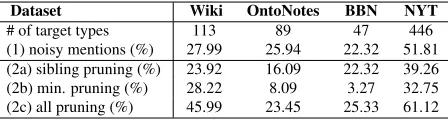
dis-tant supervision may introducelabel noiseto train-ing data since it fails to take a mention’s local con-texts into account when assigning type labels (e.g., see Fig. 1). Many previous studies ignore the la-bel noises which appear in a majority of train-ing mentions (see Table. 1, row (1)), and assume
all types obtained by distant supervision are “cor-rect” (Yogatama et al., 2015; Ling and Weld, 2012). The noisy labels may mislead the trained models and cause negative effect. A few systems try to denoise the training corpora using simple pruning heuristics such as deleting mentions with conflicting types (Gillick et al., 2014). However, such strate-gies significantly reduce the size of training set (Ta-ble 1, rows (2a-c)) and lead to performance degrada-tion (later shown in our experiments). The larger the target type set, the more severe the loss.
• Type Correlation. Most existing methods
(Yo-gatama et al., 2015; Ling and Weld, 2012) treat ev-ery type label in a training mention’s candidate type
set equally and independently when learning the
classifiers but ignore the fact that types in the given hierarchy are semantically correlated (e.g., actor
is more relevant tosingerthan to politician).
As a consequence, the learned classifiers may bias
Dataset Wiki OntoNotes BBN NYT
[image:2.612.316.540.57.118.2]# of target types 113 89 47 446 (1) noisy mentions (%) 27.99 25.94 22.32 51.81 (2a) sibling pruning (%) 23.92 16.09 22.32 39.26 (2b) min. pruning (%) 28.22 8.09 3.27 32.75 (2c) all pruning (%) 45.99 23.45 25.33 61.12
Table 1: A study of label noise. (1): %mentions with
multiplesibling types(e.g.,actor,singer); (2a)-(2c):
%mentions deleted by the three pruning heuristics (2014) (see Sec. 4), for three experiment datasets and New York Times annotation corpus (2014).
toward popular types but perform poorly on infre-quent types since training data on infreinfre-quent types is scarce. Intuitively, one should pose smaller penalty on types which are semantically more relevant to the true types. For example, in Fig. 1 singershould
receive a smaller penalty than politician does,
by knowing that actoris a true type for “Arnold
Schwarzenegger” in S2. This provides classifiers
with additional information to distinguish between two types, especially those infrequent ones.
In this paper, we approach the problem of
auto-matic fine-grained entity typingas follows: (1) Use
pro-posed to model the set of clean mentions to capture type correlation, and a partial-label rank loss is for-mulated to model the “best” candidate type for each noisy mention. Finally, with the learned embeddings (i.e., mapping matrices), one can predict the type-path for each mention in the test set in a top-down manner, using its text features. The major contribu-tions of this paper are as follows:
1. We propose an automatic fine-grained entity typ-ing framework, which reduces label noise in-troduced by distant supervision and incorporates type correlation in a principle way.
2. A novel optimization problem is formulated to jointly embed entity mentions and types to the same space. It models noisy type set with a partial-label rank loss and type correlation with adaptive-margin rank loss.
3. We develop an iterative algorithm for solving the joint optimization problem efficiently.
4. Experiments with three public datasets demon-strate that AFET achieves significant improve-ment over the state of the art.
2 Automatic Fine-Grained Entity Typing Our task is to automatically uncover the type infor-mation for entity mentions (i.e., token spans repre-senting entities) in natural language sentences. The task takes a document collection D (automatically
labeled using a KB Ψin conjunction with a target
type hierarchyY) as input and predicts a type-path
inYfor each mention from the test setDt.
Type Hierarchy and Knowledge Base. Two key
factors in distant supervision are the target type hi-erarchy and the KB. Atype hierarchy, Y, is a tree
where nodes represent types of interests from Ψ.
Previous studies manually create several clean type hierarchies using types from Freebase (Ling and Weld, 2012) or WordNet (Yosef et al., 2012). In this study, we adopt the existing hierarchies constructed using Freebase types2. To obtain types for entities
EΨinΨ, we use the human-curated entity-type facts
in Freebase, denoted asFΨ=(e, y) ⊂ EΨ× Y.
2We use the Freebase dump as of 2015-06-30.
Clean Training Mentions
Noisy Training Mentions
Mention: “S1_Arnold Schwarzenegger”; Context: S1;
Candidate Type Set: {person, politician, artist, actor, author, businessman, althete} Text Features: {HEAD_Arnold, CXT1_B:Governor, CXT1_A:gives,
POS:NN, TKN_arnold, TKN_schwarzenegger, SHAPE_Aa, ...}
Training mentions with extracted features
lc(mi)
Hierarchical Partial-label Embedding
Type Inference
root
product person location organiz ation
...
...
politician artist businessman ... ... ...
author actor singer ...
actor politician
S1_Arnold Schwarzenegger
person
Joint Embedding
Space
CXT1_B: Governor
HEAD_arnold
Mention: “S2_Arnold Schwarzenegger”; Context: S2;
Candidate Type Set: {person, politician, artist, actor, author, businessman, althete} Text Features: {HEAD_Arnold, CXT1_B:star, CXT2_B:action -movie star, CXT3_A:to the franchise, POS:NN, SHAPE_Aa, ...}
...
Mention: “Ted Cruz”; Context: Sn;
Candidate Type Set: {person, politician} Text Features: {HEAD_Ted, CXT1_B:senator, CXT1_B:told,
CXT3_B:campaign of senator, POS:NN, SHAPE_Aa, ...}
CXT1_B:star
artist CXT3_A:play
the role SHAPE:Aa CXT1_A:gives
CXT1_B: Senator
[image:3.612.315.553.57.215.2]Partition training mentions
Figure 2:Framework Overview of AFET.
Automatically Labeled Training Corpora. There
exist publicly available labeled corpora such as Wik-ilinks (Singh et al., 2012) and ClueWeb (Gabrilovich et al., 2013). In these corpora, entity mentions are identified and mapped to KB entities using anchor links. In specific domains (e.g., product reviews) where such public corpora are unavailable, one can utilize distant supervision to automatically label the corpus (Ling and Weld, 2012). Specifically, an en-tity linker will detect mentions mi and map them
to one or more entityei inEΨ. Types of ei in KB
are then associated withmi to form its type set Yi, i.e., Yi = y |(ei, y) ∈ FΨ, y ∈ Y . Formally, a
training corpusDconsists of a set of extractedentity
mentionsM={mi}Ni=1, thecontext(e.g., sentence,
paragraph) of each mention{ci}Ni=1, and the
candi-datetype sets{Yi}Ni=1 for each mention. We
repre-sentDusing a set of triplesD=(mi, ci,Yi) N i=1.
Problem Description. For each test mention, we
aim to predict the correct type-path inY based on
themention’s context. More specifically, the test set
T is defined as a set of mention-context pairs(m, c),
where mentions inT (denoted asMt) are extracted
from their sentences using existing extractors such as named entity recognizer (Finkel et al., 2005). We denote the gold type-path for a test mention m as
Y∗. This work focuses on learning a typing model
from the noisy training corpusD, and estimatingY∗
fromY for each test mentionm (in setMt), based
on mentionm, its contextc, and the learned model.
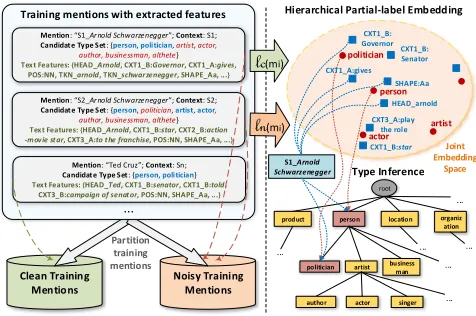
Framework Overview. At a high level, the AFET
infers type-paths for test mentions using the learned embeddings. It consists of the following steps: 1. Extract text features for entity mentions in
train-ing set M and test set Mt using their surface
names as well as the contexts. (Sec. 3.1).
2. Partition training mentions M into a clean set
(denoted asMc) and a noisy set (denoted asMn)
based on their candidate type sets (Sec. 3.2). 3. Perform joint embedding of entity mentions
M and type hierarchy Y into the same
low-dimensional space where, in that space, close ob-jects also share similar types (Secs. 3.3-3.6). 4. For each test mention m, estimate its type-path
Y∗ (on the hierarchy Y) in a top-down manner
using the learned embeddings (Sec. 3.6).
3 The AFET Framework
This section introduces the proposed framework and formulates an optimization problem for learning em-beddings of text features and entity types jointly.
3.1 Text Feature Generation
We start with a representation of entity mentions. To capture the shallow syntax and distributional se-mantics of a mention mi ∈ M, we extract various
features from bothmi itself and its contextci.
Ta-ble 2 lists the set of text features used in this work, which is similar to those used in (Yogatama et al., 2015; Ling and Weld, 2012). We denote the set of
M unique features extracted fromDasF={fj}Mj=1.
3.2 Training Set Partition
A training mentionmi (in setM) is considered as a
“clean” mention if its candidate type set obtained by distant supervision (i.e., Yi) is not ambiguous,i.e.,
candidate types inYi can form asinglepath in tree Y. Otherwise, a mention is considered as “noisy”
mention if its candidate types form multiple type-paths in Y. Following the above hypothesis, we
judge each mention mi (in set M) and place it in
either the “clean” set Mc, or the “noisy” set Mn.
Finally, we haveM=Mc∪ Mn.
3.3 The Joint Mention-Type Model
We propose to learn mappings into low-dimensional vector space, where, both entity mentions and type
...
Example Type-Type Correlation Scores Knowledge Base
(Ben Affleck, act or) (Ben Affleck, director)
(Woody Al len, act or) (Woody Al len, director) (J. K. Rowling, aut hor) (Kobe B ryant, at hlete)
...
Entity-type facts
Ben Affleck
Woody Allen
J. K. Rowling
Kobe Bryant
person director
actor
author
athlete
Corr = (0.6+0.6)/2
=0.6
Corr = (0.25+0.55)/2
=0.4
person
politician artist
actor
businessman author
singer director
athlete
coach
Adaptive Margin
Sn_Ted Cruz
Context in Sn: “The effective
end of Ted Cruz 's presidential campaign came on a call …”
politician athlete
businessman Score
Sn_Ted Cruz Score
ScoreSn_Ted Cruz
Margin = 1 / sim(politician,
athlete) = 3
Margin = 1 / sim(politician,
[image:4.612.317.553.56.179.2]businessman) = 1.5
Figure 3: An illustration of KB-based type correlation
computation, and the proposed adaptive margin.
labels (in the training set) are represented, and in that space,two objects are embedded close to each other
if and only if they share similar types. In doing so,
we later can derive the representation of a test men-tion based on its text features and the learned map-pings. Mapping functions for entity mentions and entity type labels are different as they have differ-ent represdiffer-entations in therawfeature space, but are jointly learned by optimizing a global objective of interests to handle the aforementioned challenges.
Each entity mentionmi ∈ M can be represented
by aM-dimensional feature vectormi∈RM, where
mi,jis the number of occurrences of featurefj(in set F) formi. Each type labelyk ∈ Yis represented by a
K-dimensional binary indicator vectoryk ∈ {0,1}K,
whereyk,k= 1, and0otherwise.
Specifically, we aim to learn a mapping func-tion from the menfunc-tion’s feature space to a low-dimensional vector space,i.e.,ΦM(mi) :RM 7→Rd
and a mapping function from type label space to the same low-dimensional space,i.e., ΦY(yk) : RK 7→ Rd. In this work, we adopt linear maps, as similar to
the mapping functions used in (Weston et al., 2011).
ΦM(mi) =Umi; ΦY(yk) =Vyk, (1)
whereU∈Rd×M andV∈Rd×K are the projection
matrices for mentions and type labels, respectively.
3.4 Modeling Type Correlation
In type hierarchy (tree)Y, types closer to each other
(i.e., shorter path) tend to be more related (e.g., actoris more related toartistthan toperson in the right column of Fig. 2). In KBΨ, types
Feature Description Example
Head Syntactic head token of the mention “HEAD Turing” Token Tokens in the mention “Turing”, “Machine” POS Part-of-Speech tag of tokens in the mention “NN”
Character All character trigrams in the head of the mention “:tu”, “tur”, ..., “ng:” Word Shape Word shape of the tokens in the mention “Aa” for “Turing” Length Number of tokens in the mention “2”
[image:5.612.72.541.54.165.2]Context Unigrams/bigrams before and after the mention “CXT B:Maserati ,”, “CXT A:and the” Brown Cluster Brown cluster ID for the head token (learned usingD) “4 1100”, “8 1101111”, “12 111011111111” Dependency Stanford syntactic dependency (Manning et al., 2014) associatedwith the head token “GOV:nn”, “GOV:turing”
Table 2:Text features used in this paper. “Turing Machine” is used as an example mention from “The band’s former drummer Jerry Fuchs—who
was also a member of Maserati,Turing Machineand The Juan MacLean—died after falling down an elevator shaft.”.
more related todirectorthan toauthorin the left column of Fig. 3). Thus, type correlation be-tweenykandyk0 (denoted aswkk0) can be measured
either using theone over the length of shortest path inY, or using thenormalized number of shared
en-tities in KB, which is defined as follows.
wkk0=Ek∩ Ek0/Ek
+Ek∩ Ek0/Ek0
/2. (2)
Although a shortest path is efficient to compute, its accuracy is limited—It is not always true that a type (e.g., athlete) is more related to its parent type (i.e., person) than to its sibling types (e.g., coach), or that all sibling types are equally re-lated to each other (e.g., actor is more related to director than to author). We later compare these two methods in our experiments.
With the type correlation computed, we propose to apply adaptive penalties on different negative type labels (for a training mention), instead of treat-ing all of the labels equally as in most existing work (Weston et al., 2011). The hypothesis is intu-itive: given the positive type labels for a mention, we force the negative type labels which are related to the positive type labels to receive smaller penalty. For example, in the right column of Fig. 3, negative la-belbusinessmanreceives a smaller penalty (i.e., margin) thanatheledoes, sincebusinessman is more related topolitician.
Hypothesis 1 (Adaptive Margin) For a mention, if
a negative type is correlated to a positive type, the margin between them should be smaller.
We propose an adaptive-margin rank loss to model the set of “clean” mentions (i.e.,Mc), based
on the above hypothesis. The intuition is simple: for each mention, rank all the positive types ahead of negative types, where the ranking score is measured by similarity between mention and type. We denote
Types ranked w.r.t. mi
Partial-Label Rank Loss for Noisy Mentions
Mention: mi = “Sn_Ted Cruz” Context in Sn: “The effective end of Ted Cruz 's
presidential campaign came on a call …”
Mention: mi’ = “S1_Arnold Schwarzenegger” Context in S1: “Governor Arnold Schwarzenegger gives a speech at Mission Serve's service project .…” “Full” Rank Loss for Clean Mentions
Distance between mi and types
Distance between mi and types
Person Politician
Business Artist Athlete
Actor Author Doctor
Score(mi, yk)
0.85 0.77 0.53 0.42 0.40 0.33 0.21 0.05
mi
person Politician Businessman
Athlete
Artist
Actor
mi
person Politician
Businessman Athlete
Artist Actor Location
Athlete
Athlete
Politician Coach Chief Doctor Organization
Location
Politician
Person Business
Artist Athlete
Actor Author Types ranked w.r.t. mi “Best” candidate type
0.88 0.74 0.55 0.41 0.33 0.31 0.25
Positive types
Negative types
Coach
[image:5.612.315.553.213.362.2]Noisy candidate type set
Figure 4:An illustration of the partial-label rank loss.
fk(mi)as the similarity between(mi, yk)and is
de-fined as the inner product ofΦM(mi)andΦY(yk).
`c(mi,Yi,Yi) = X
yk∈Yi
X
yk¯∈Yi
Ljrankyk
f(mi)kΘi,k,¯k;
Θi,k,¯k= max
n
0, γk,¯k−fk(mi) +f¯k(mi) o
;
rankyk
f(mi)= X y¯k∈Yi
1γk,k¯+f¯k(mi)> fk(mi)
.
Here,γk,k¯ is the adaptive margin between positive
typekand negative typek¯, which is defined asγk,¯k=
1 + 1/(wk,¯k+α)with a smooth parameterα.L(x) =
Px
i=11i transforms rank to a weight, which is then
multiplied to the max-margin lossΘi,k,¯kto optimize
precision atx(Weston et al., 2011).
3.5 Modeling Noisy Type Labels
True type labels for noisy entity mentionsMn(i.e.,
candidate types (i.e.,{Yi}as true labels. Instead, we
model the “true” label among the candidate set as
latent value, and try to infer that using text features.
Hypothesis 2 (Partial-Label Loss) For a noisy
mention, the maximum score associated with its candidate types should be greater than the scores associated with any other non-candidate types
We extend the partial-label loss in (Nguyen and Caruana, 2008) (used to learn linear classifiers) to enforce Hypothesis 2, and integrate with the adap-tive margin to define the loss formi(in setMn).
`n(mi,Yi,Yi) = X
¯
k∈Yi
Ljrankyk∗
f(mi)kΩi,¯k;
Ωi,k= maxn0, γk∗,k¯−fk∗(mi) +f¯k(mi) o
;
rankyk∗
f(mi)= X y¯k∈Yi
1γk∗,k¯+f¯k(mi)> fk∗(mi)
where we define . yk∗ = argmaxyk∈Yifk(mi) and
y¯k∗= argmaxyk∈Yifk(mi).
Minimizing `n encourages a large margin
be-tween the maximum scores maxyk∈Yifyk(mi) and
maxy¯
k∈Yifyk(mi). This forces mi to be embed-ded closer to the most “relevant” type in the noisy candidate type set, i.e., y∗ = argmax
yk∈Yifyk(mi), than toany othernon-candidate types (i.e., Hypoth-esis 2). This constrasts sharply with multi-label learning (Yosef et al., 2012), where a large margin is enforced between all candidate types and non-candidate types without considering noisy types.
3.6 Hierarchical Partial-Label Embedding
Our goal is to embed the heterogeneous graphGinto
a d-dimensional vector space, following the three
proposed hypotheses in the section. Intuitively, one
cancollectivelyminimize the objectives of the two
kinds of loss functions`cand`n, across all the
train-ing mentions. To achieve the goal, we formulate a joint optimization problem as follows.
min
U,VO=
X
mi∈Mc
`c(mi,Yi,Yi) + X
mi∈Mn
`n(mi,Yi,Yi).
We use an alternative minimization algorithm based on block-wise coordinate descent (Tseng, 2001) to
jointlyoptimize the objectiveO. One can also apply
stochastic gradient descent to do online update.
Type Inference. With the learned mention
embed-dings {ui}and type embeddings {vk}, we perform
Data sets Wiki OntoNotes BBN
#Types 113 89 47
#Documents 780,549 13,109 2,311
#Sentences 1.51M 143,709 48,899
#Training mentions 2.69M 223,342 109,090
#Ground-truth mentions 563 9,604 121,001
#Features 644,860 215,642 125,637
[image:6.612.315.540.56.136.2]#Edges in graph 87M 5.9M 2.9M
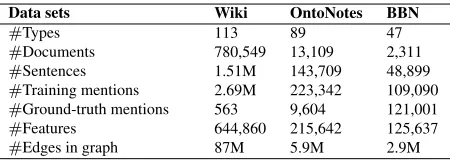
Table 3:Statistics of the datasets.
top-down search in the given type hierarchy Y to
estimate the correct type-path Y∗
i. Starting from the
tree’s root, we recursively find the best type among the children types by measuring the dot product of the corresponding mention and type embeddings,
i.e.,sim(ui,vk). The search process stops when we
reach a leaf type, or the similarity score is below a pre-defined thresholdη >0.
4 Experiments
4.1 Data Preparation
Datasets.Our experiments use three public datasets.
(1)Wiki (Ling and Weld, 2012): consists of 1.5M sentences sampled from Wikipedia articles; (2)
OntoNotes (Weischedel et al., 2011): consists of
13,109 news documents where 77 test documents are manually annotated (Gillick et al., 2014); (3)
BBN(Weischedel and Brunstein, 2005): consists of 2,311 Wall Street Journal articles which are man-ually annotated using 93 types. Statistics of the datasets are shown in Table 3.
Training Data. We followed the process in (Ling
and Weld, 2012) to generate training data for the Wiki dataset. For the BBN and OntoNotes datasets, we used DBpedia Spotlight3 for entity linking. We
discarded types which cannot be mapped to Free-base types in the BBN dataset (47 of 93).
Table 2 lists the set of features used in our experi-ments, which are similar to those used in (Yogatama et al., 2015; Ling and Weld, 2012) except for top-ics and ReVerb patterns. We discarded the features which occur only once in the corpus.
4.2 Evaluation Settings
For the Wiki and OntoNotes datasets, we used the provided test set. Since BBN corpus is fully anno-tated, we followed a 80/20 ratio to partition it into
training/test sets. We report Accuracy (Strict-F1), Micro-averaged F1 (Mi-F1) and Macro-averaged F1 (Ma-F1) scores commonly used in the fine-grained type problem (Ling and Weld, 2012; Yogatama et al., 2015). Since we use the gold mention set for testing, the Accuracy (Acc) we reported is the same as the Strict F1.
Baselines. We compared the proposed method
(AFET) and its variant with state-of-the-art typ-ing methods, embeddtyp-ing methods and partial-label learning methods 4: (1) FIGER (Ling and Weld,
2012); (2) HYENA (Yosef et al., 2012); (3)
FIGER/HYENA-Min (Gillick et al., 2014):
re-moves types appearing only once in the docu-ment; (4) ClusType (Ren et al., 2015): predicts types based on co-occurring relation phrases; (5)
HNM(Dong et al., 2015): proposes a hybrid neu-ral model without hand-crafted features; (6) Deep-Walk (Perozzi et al., 2014): applies Deep Walk to a feature-mention-type graph by treating all nodes as the same type; (7) LINE (Tang et al., 2015b): uses a second-order LINE model on feature-type bi-partite graph; (8) PTE (Tang et al., 2015a): ap-plies the PTE joint training algorithm on feature-mention and type-feature-mention bipartite graphs. (9) WS-ABIE (Yogatama et al., 2015): adopts WARP loss to learn embeddings of features and types; (10) PL-SVM(Nguyen and Caruana, 2008): uses a margin-based loss to handle label noise. (11)CLPL(Cour et al., 2011): uses a linear model to encourage large average scores for candidate types.
We compare AFET and its variant: (1) AFET: complete model with KB-induced type correlation;
(2)AFET-CoH: with hierarchy-induced correlation
(i.e., shortest path distance); (3)AFET-NoCo: with-out type correlation (i.e., all margin are “1”) in the objective O; and (4) AFET-NoPa: without label
partial loss in the objectiveO.
4.3 Performance Comparison and Analyses
Table 4 shows the results of AFET and its variants.
Comparison with the other typing methods.
AFET outperforms both FIGER and HYENA sys-tems, demonstrating the predictive power of the
4We used the published code for FIGER, ClusType, HNM,
LINE, PTE, and DeepWalk, and implemented other baselines which have no public code. Our implementations yield compa-rable performance as those reported in the original papers.
learned embeddings, and the effectiveness of mod-eling type correlation information and noisy candi-date types. We also observe that pruning methods do not always improve the performance, since they ag-gressively filter out rare types in the corpus, which may lead to low Recall. ClusType is not as good as FIGER and HYENA because it is intended for coarse types and only utilizes relation phrases.
Comparison with the other embedding methods.
AFET performs better than all other embedding methods. HNM does not use any linguistic features. None of the other embedding methods consider the label noise issue and treat the candidate type sets as clean. Although AFET adopts the WARP loss in WSABIE, it uses an adaptive margin in the objec-tive to capture the type correlation information.
Comparison with partial-label learning methods.
Compared with PL-SVM and CLPL, AFET obtains superior performance. PL-SVM assumes that only
onecandidate type is correct and does not consider type correlation. CLPL simply averages the model output for all candidate types, and thus may gener-ate results biased to frequent false types. Superior performance of AFET mainly comes from modeling type correlation derived from KB.
Comparison with its variants. AFET always
out-performs its variant on all three datasets. It gains performance from capturing type correlation, as well as handling type noise in the embedding process.
4.4 Case Analyses
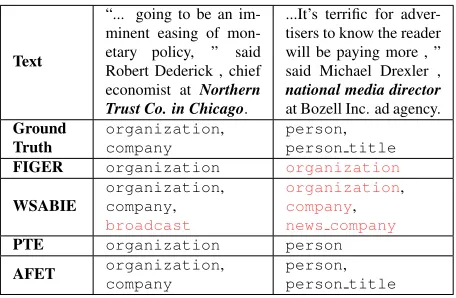
Example output on news articles. Table 5 shows
the types predicted by AFET, FIGER, PTE and WSABIE on two news sentences from OntoNotes dataset: AFET predicts fine-grained types with bet-ter accuracy (e.g., person title) and avoids overly-specific predictions (e.g.,news company). Figure 5 shows the types estimated by AFET, PTE and WSABIE on a training sentence from OntoNotes dataset. We found AFET could discover the best type from noisy candidate types.
... his friend [Travis] would take a psychiatrist on a date to analyze ...
Candidate Types: {organization,
music, person, artist}
WSABIE: {organization}
PTE: {music, person, artist}
AFET: {person}
Figure 5: Example output of AFET and the compared
Typing Wiki OntoNotes BBN
Method Acc Ma-F1 Mi-F1 Acc Ma-F1 Mi-F1 Acc Ma-F1 Mi-F1
CLPL(Cour et al., 2011) 0.162 0.431 0.411 0.201 0.347 0.358 0.438 0.603 0.536
PL-SVM(Nguyen and Caruana, 2008) 0.428 0.613 0.571 0.225 0.455 0.437 0.465 0.648 0.582
FIGER(Ling and Weld, 2012) 0.474 0.692 0.655 0.369 0.578 0.516 0.467 0.672 0.612
FIGER-Min(Gillick et al., 2014) 0.453 0.691 0.631 0.373 0.570 0.509 0.444 0.671 0.613
HYENA(Yosef et al., 2012) 0.288 0.528 0.506 0.249 0.497 0.446 0.523 0.576 0.587
HYENA-Min 0.325 0.566 0.536 0.295 0.523 0.470 0.524 0.582 0.595
ClusType(Ren et al., 2015) 0.274 0.429 0.448 0.305 0.468 0.404 0.441 0.498 0.573
HNM(Dong et al., 2015) 0.237 0.409 0.417 0.122 0.288 0.272 0.551 0.591 0.606
DeepWalk(Perozzi et al., 2014) 0.414 0.563 0.511 0.479 0.669 0.611 0.586 0.638 0.628
LINE(Tang et al., 2015b) 0.181 0.480 0.499 0.436 0.634 0.578 0.576 0.687 0.690
PTE(Tang et al., 2015a) 0.405 0.575 0.526 0.436 0.630 0.572 0.604 0.684 0.695
WSABIE(Yogatama et al., 2015) 0.480 0.679 0.657 0.404 0.580 0.527 0.619 0.670 0.680
AFET-NoCo 0.526 0.693 0.654 0.486 0.652 0.594 0.655 0.711 0.716
AFET-NoPa 0.513 0.675 0.642 0.463 0.637 0.591 0.669 0.715 0.724
AFET-CoH 0.433 0.583 0.551 0.521 0.680 0.609 0.657 0.703 0.712
AFET 0.533 0.693 0.664 0.551 0.711 0.647 0.670 0.727 0.735
Table 4:Study of typing performance on the three datasets.
Text
“... going to be an im-minent easing of mon-etary policy, ” said Robert Dederick , chief economist at Northern Trust Co. in Chicago.
...It’s terrific for adver-tisers to know the reader will be paying more , ” said Michael Drexler ,
national media director
at Bozell Inc. ad agency.
Ground
Truth organizationcompany ,
person,
person title
FIGER organization organization
WSABIE organizationcompany, ,
broadcast
organization,
company,
news company
PTE organization person AFET organizationcompany , personperson title,
Table 5: Example output of AFET and the compared
methods on two news sentences fromOntoNotesdataset.
Testing the effect of training set size and
dimen-sion. Experimenting with the same settings for
model learning, Fig. 6(a) shows the performance trend on the Wiki dataset when varying the sampling ratio (subset of mentions randomly sampled from the training set D). Fig. 6(b) analyzes the
perfor-mance sensitivity of AFET with respect to d—the embedding dimension on the BBN dataset. Accu-racy of AFET improves asdbecomes large but the
gain decreases whendis large enough.
Testing sensitivity of the tuning parameter.
Fig. 7(b) analyzes the sensitivity of AFET with re-spect to α on the BBN dataset. Performance
in-creases as α becomes large. Whenα is large than
0.5, the performance becomes stable.
Testing at different type levels. Fig. 7(a) reports
the Ma-F1 of AFET, FIGER, PTE and WSABIE at different levels of the target type hierarchy (e.g.,
per-0 20 40 60 80 100 Sampling Ratio
0.35 0.40 0.45 0.50 0.55 0.60
Micro-F1
FIGER WSABIE AFET
(a) Varying training set size
0 50 100 150 200 250 300 Embedding Size
0.50 0.55 0.60 0.65 0.70 0.75
Accuracy
PTE WSABIE AFET
[image:8.612.72.300.267.416.2](b) Varyingd
Figure 6: Performance change with respect to (a)
sam-pling ratio of training mentions on the Wiki dataset; and
(b) embedding dimensiondon the BBN dataset.
Level-1 Level-2 Level-3 0.0
0.1 0.2 0.3 0.4 0.5 0.6 0.7 0.8
Accuracy
FIGER WSABIE PTE AFET
(a) Test at different levels
0.0 0.2 0.4 0.6 0.8 1.0 Alpha
0.60 0.65 0.70 0.75 0.80
Accuracy Macro-F1 Micro-F1
(b) Varyingα
Figure 7: Performance change (a) at different levels of
the type hierarchy on the OntoNotes dataset; and (b) with
respect to smooth parameterαon the BBN dataset.
son and location on level-1, politician and artist on level-2, author and actor on level-3). The results show that it is more difficult to distinguish among more fine-grained types. AFET always outperforms the other two method, and achieves a 22.36% im-provement in Ma-F1, compared to FIGER on level-3 types. The gain mainly comes from explicitly mod-eling the noisy candidate types.
Type animal city # of Training Mentions 1882 12421
# of Test Mentions 8 240
WSABIE 0.176 0.546
FIGER 0.167 0.648
PTE 0.222 0.677
AFET 0.400 0.766
Table 6:Example output of AFET and other methods on
frequent/infrequent type fromOntoNotesdataset.
evaluate the performance on frequent and rare types (Table 6). Note that we use a different evaluation metric, which is introduced in (Yosef et al., 2012) to calculate the F1 score for a type. We findAFET
can always perform better than other baselines and it works for both frequent and rare types.
5 Related Work
There has been considerable work on named entity recognition (NER) (Manning et al., 2014), which fo-cuses on three types (e.g., person, location) and cast the problem as multi-class classification fol-lowing the type mutual exclusion assumption (i.e., one type per mention) (Nadeau and Sekine, 2007).
Recent work has focused on a much larger set of fine-grained types (Yosef et al., 2012; Ling and Weld, 2012). As the type mutual exclusion assump-tion no longer holds, they cast the problem as multi-label multi-class (hierarchical) classification prob-lems (Gillick et al., 2014; Yosef et al., 2012; Ling and Weld, 2012). Embedding techniques are also recently applied to jointly learn feature and type rep-resentations (Yogatama et al., 2015; Dong et al., 2015). Del Corroet al. (2015) proposed an unsuper-vised method to generate context-aware candidates types, and subsequently select the most appropriate type. Gillicket al. (2014) discuss the label noise is-sue in fine-grained typing and propose three pruning heuristics. However, these heuristics aggressively delete training examples and may suffer from low recall (see Table. 4).
In the context of distant supervision, label noise issue has been studied for other information extrac-tion tasks such as relaextrac-tion extracextrac-tion (Takamatsu et al., 2012). In relation extraction, label noise is intro-duced by the false positive textual matches of en-tity pairs. In enen-tity typing, however, label noise comes from the assignment of types to entity men-tions without considering their contexts. The forms
of distant supervision are different in these two prob-lems. Recently, (Ren et al., 2016b) has tackled the problem of label noise in fine-grained entity typing, but focused on how to generate a clean training set instead of doing entity typing.
Partial label learning (PLL) (Zhang, 2014; Nguyen and Caruana, 2008; Cour et al., 2011) deals with the problem where each training example is as-sociated with a set of candidate labels, where only
one is correct. Unlike existing PLL methods, our
method considers type hierarchy and correlation.
6 Conclusion and Future Work
In this paper, we study automatic fine-grained
en-tity typing and propose ahierarchical partial-label
embedding method, AFET, that models “clean”
and “noisy” mentions separately and incorporates a given type hierarchy to induce loss functions. AFET builds on a joint optimization framework, learns em-beddings for mentions and type-paths, and itera-tively refines the model. Experiments on three pub-lic datasets show that AFET is effective, robust, and outperforms other comparing methods.
As future work, it would be interesting to study topical features as the context cues of the entity men-tions, to leverage multi-sensing embedding to repre-sent linguistic features with multiple senses, and to exploits other effective modeling methods to inject type hierarchy information. The proposed objective function is general and can be considered to incorpo-rate various language features, to conduct integincorpo-rated modeling of multiple sources, and to be extended to distantly-supervised relation extraction.
7 Acknowledgments
References
Timothee Cour, Ben Sapp, and Ben Taskar. 2011.
Learn-ing from partial labels. JMLR, 12:1501–1536.
Luciano Del Corro, Abdalghani Abujabal, Rainer
Gemulla, and Gerhard Weikum. 2015. Finet:
Context-aware fine-grained named entity typing. In EMNLP.
Xin Luna Dong, Thomas Strohmann, Shaohua Sun, and Wei Zhang. 2014. Knowledge vault: A web-scale
approach to probabilistic knowledge fusion. InKDD.
Li Dong, Furu Wei, Hong Sun, Ming Zhou, and Ke Xu. 2015. A hybrid neural model for type classification of
entity mentions. InIJCAI.
Jesse Dunietz and Dan Gillick. 2014. A new
en-tity salience task with millions of training examples. EACL.
Jenny Rose Finkel, Trond Grenager, and Christopher Manning. 2005. Incorporating non-local information into information extraction systems by gibbs sampling.
InACL.
Evgeniy Gabrilovich, Michael Ringgaard, and Amarnag Subramanya. 2013. Facc1: Freebase annotation of clueweb corpora.
Dan Gillick, Nevena Lazic, Kuzman Ganchev, Jesse
Kirchner, and David Huynh. 2014.
Context-dependent fine-grained entity type tagging. arXiv
preprint arXiv:1412.1820.
Heng Ji and Ralph Grishman. 2008. Refining event
ex-traction through cross-document inference. InACL.
Jyun-Yu Jiang, Chin-Yew Lin, and Pu-Jen Cheng. 2015. Entity-driven type hierarchy construction for freebase.
InWWW.
Thomas Lin, Oren Etzioni, et al. 2012. No noun phrase left behind: detecting and typing unlinkable entities.
InEMNLP.
Xiao Ling and Daniel S Weld. 2012. Fine-grained entity
recognition. InAAAI.
Christopher D Manning, Mihai Surdeanu, John Bauer, Jenny Finkel, Steven J Bethard, and David McClosky. 2014. The stanford corenlp natural language
process-ing toolkit.ACL.
Mike Mintz, Steven Bills, Rion Snow, and Dan Jurafsky. 2009. Distant supervision for relation extraction
with-out labeled data. InACL.
David Nadeau and Satoshi Sekine. 2007. A survey of
named entity recognition and classification.
Lingvisti-cae Investigationes, 30:3–26.
Nam Nguyen and Rich Caruana. 2008. Classification
with partial labels. InKDD.
Bryan Perozzi, Rami Al-Rfou, and Steven Skiena. 2014. Deepwalk: Online learning of social representations.
InKDD.
Lev Ratinov and Dan Roth. 2009. Design challenges and
misconceptions in named entity recognition. InACL.
Xiang Ren, Ahmed El-Kishky, Chi Wang, Fangbo Tao,
Clare R Voss, Heng Ji, and Jiawei Han. 2015.
Clustype: Effective entity recognition and typing by
relation phrase-based clustering. InKDD.
Xiang Ren, Ahmed El-Kishky, Chi Wang, and Jiawei Han. 2016a. Automatic entity recognition and typing
in massive text corpora. InWWW.
Xiang Ren, Wenqi He, Meng Qu, Clare R Voss, Heng Ji, and Jiawei Han. 2016b. Label noise reduction in en-tity typing by heterogeneous partial-label embedding.
InKDD.
Sameer Singh, Amarnag Subramanya, Fernando Pereira, and Andrew McCallum. 2012. Wikilinks: A large-scale cross-document coreference corpus labeled via
links to wikipedia.UM-CS-2012-015.
Shingo Takamatsu, Issei Sato, and Hiroshi Nakagawa. 2012. Reducing wrong labels in distant supervision
for relation extraction. InACL.
Jian Tang, Meng Qu, and Qiaozhu Mei. 2015a. Pte: Pre-dictive text embedding through large-scale
heteroge-neous text networks. InKDD.
Jian Tang, Meng Qu, Mingzhe Wang, Ming Zhang, Jun Yan, and Qiaozhu Mei. 2015b. Line: Large-scale
in-formation network embedding. InWWW.
Paul Tseng. 2001. Convergence of a block coordi-nate descent method for nondifferentiable
minimiza-tion. JOTA, 109(3):475–494.
Ralph Weischedel and Ada Brunstein. 2005. Bbn
pro-noun coreference and entity type corpus. Linguistic
Data Consortium, 112.
Ralph Weischedel, Eduard Hovy, Mitchell Marcus, Martha Palmer, Robert Belvin, Sameer Pradhan,
Lance Ramshaw, and Nianwen Xue. 2011.
Ontonotes: A large training corpus for enhanced pro-cessing.
Jason Weston, Samy Bengio, and Nicolas Usunier. 2011. Wsabie: Scaling up to large vocabulary image
annota-tion. InIJCAI.
Dani Yogatama, Dan Gillick, and Nevena Lazic. 2015. Embedding methods for fine grained entity type
clas-sification. InACL.
Mohamed Amir Yosef, Sandro Bauer, Johannes Hoffart, Marc Spaniol, and Gerhard Weikum. 2012. Hyena: Hierarchical type classification for entity names. In COLING.
Xiao Yu, Xiang Ren, Yizhou Sun, Quanquan Gu, Bradley Sturt, Urvashi Khandelwal, Brandon Norick, and Ji-awei Han. 2014. Personalized entity recommenda-tion: A heterogeneous information network approach.
InWSDM.
Min-Ling Zhang. 2014. Disambiguation-free partial