Using Left-corner Parsing to Encode Universal Structural Constraints
in Grammar Induction
Hiroshi Noji
Graduate School of Information Science Nara Institute of Science and Technology
Yusuke Miyao
National Institute of Informatics
Mark Johnson
Department of Computing Macquarie University
Abstract
Center-embedding is difficult to process and is known as a rare syntactic construction across languages. In this paper we describe a method to incorporate this assumption into the gram-mar induction tasks by restricting the search space of a model to trees with limited center-embedding. The key idea is the tabulation ofleft-cornerparsing, which captures the de-gree of center-embedding of a parse via its stack depth. We apply the technique to learn-ing of famous generative model, the depen-dency model with valence (Klein and Man-ning, 2004). Cross-linguistic experiments on Universal Dependencies show that often our method boosts the performance from the base-line, and competes with the current state-of-the-art model in a number of languages.
1 Introduction
Human languages in the world are divergent, but they also exhibit many striking similarities (Green-berg, 1963; Hawkins, 2014). At the level of syn-tax, one attractive hypothesis for such regularities is that any grammars of languages have evolved un-der the pressures, or biases, to avoid structures that are difficult to process. For example it is known that many languages have a preference for shorter depen-dencies (Gildea and Temperley, 2010; Futrell et al., 2015), which originates from the difficulty in pro-cessing longer dependencies (Gibson, 2000).
Such syntactic regularities can also be useful in applications, in particular in unsupervised (Klein and Manning, 2004; Mareˇcek and ˇZabokrtsk´y,
2012; Bisk and Hockenmaier, 2013) or weakly-supervised (Garrette et al., 2015) grammar induc-tion tasks, where the models try to recover the syn-tactic structure of language without access to the syntactically annotated data, e.g., from raw or part-of-speech tagged text only. In these settings, find-ing better syntactic regularities universal across lan-guages is essential, as they work as a small cue to the correct linguistic structures. A preference ex-ploited in many previous works is favoring shorter dependencies, which has been encoded in various ways, e.g., initialization of EM (Klein and Man-ning, 2004), or model parameters (Smith and Eis-ner, 2006), and this has been the key to success of learning (Gimpel and Smith, 2012).
In this paper, we explore the utility for another universal syntactic bias that has not yet been ex-ploited in grammar induction: a bias against center-embedding. Center-embedding is a syntactic con-struction on which a clause is embedded into another one. An example is “The reporter [who the senator
[who Mary met] attacked] ignored the president.”,
where “who Mary met” is embedded in a larger relative clause. These constructions are known to cause memory overflow (Miller and Chomsky, 1963; Gibson, 2000), and also are rarely observed cross-linguistically (Karlsson, 2007; Noji and Miyao, 2014). Our learning method exploits this universal property of language. Intuitively during learning our models explore the restricted search space, which excludes linguistically implausible trees, i.e., those with deeper levels of center-embedding.
We describe how these constraints can be imposed in EM with the inside-outside algorithm. The central
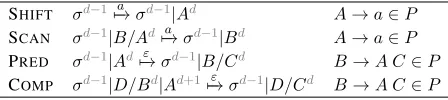
SHIFT σd−17−→a σd−1|Ad A→a∈P SCAN σd−1|B/Ad7−→a σd−1|Bd A→a∈P PRED σd−1|Ad7−→ε σd−1|B/Cd B→A C∈P COMP σd−1|D/Bd|Ad+1 ε
7−
→σd−1|D/Cd B→A C∈P Figure 1: A set of transitions in left-corner parsing. The rules on the right side are the side conditions, in whichP is the set of rules of a given CFG.
idea is to tabulateleft-corner parsing, on which its stack depth captures the degree of center-embedding of a partial parse. Each chart item keeps the cur-rent stack depth and we discard all items where the depth exceeds some threshold. The technique is gen-eral and can be applicable to any model on PCFG; in this paper, specifically, we describe how to ap-ply the idea on the dependency model with valence (DMV) (Klein and Manning, 2004), a famous gen-erative model for dependency grammar induction.
We focus our evaluation on grammar induction from part-of-speech tagged text, comparing the ef-fect of several biases including the one against longer dependencies. Our main empirical finding is that though two biases, avoiding center-embedding and favoring shorter dependencies, are conceptually similar (both favor simpler grammars), often they capture different aspects of syntax, leading to dif-ferent grammars. In particular our bias cooperates well with additional small syntactic cue such as the one that the sentence root tends to be a verb or a noun, with which our models compete with the strong baseline relying on a larger number of hand crafted rules on POS tags (Naseem et al., 2010).
Our contributions are: the idea to utilize left-corner parsing for a tool to constrain the models of syntax (Section 3), the formulation of this idea for DMV (Section 4), and cross-linguistic experiments across 25 languages to evaluate the universality of the proposed approach (Sections 5 and 6).
2 Left-corner parsing
We first describe (arc-eager) left-corner (LC) pars-ing as a push-down automaton (PDA), and then re-formulate it as a grammar transform. In previous work this algorithm has been called right-corner
parsing (e.g., Schuler et al. (2010)); we avoid this term and instead treat it as a variant of LC parsing following more recent studies, e.g., van Schijndel
D
B i j
A
j+ 1 k
COMP
===⇒
D
B i j
C A
[image:2.612.75.299.57.107.2]j+ 1 k
Figure 2: COMP combines two subtrees on the top
of the stack.i, j, kare indices of spans.
and Schuler (2013). The central motivation for this technique is to detect center-embedding in a parse efficiently. We describe this mechanism after pro-viding the algorithm itself. We then give historical notes on LC parsing at the end of this section.
PDA Let us assume a CFG is given, and it is in CNF. We formulate LC parsing as a set of transi-tions between configuratransi-tions, each of which is a pair of the stack and the input position (next input sym-bol). In Figure 1 a transition σ1 7−→a σ2 means that the stack is changed from σ1 to σ2 by reading the next input symbola. We use a vertical bar to
sig-nify the append operation, e.g., σ = σ0|σ1 denotes
σ1is the topmost symbol ofσ. Each stack symbol is either a nonterminal, or a pair of nonterminals, e.g.,
A/B, which represents a subtree rooted atAand is
awaiting symbolB. We also decorate each symbol
with depth; for example,σd−1|Admeans the current
stack depth isd, and the depth of the topmost
sym-bol inσisd−1. The bottom symbol on the stack is
always the empty symbolε0 with depth 0. Parsing
begins withε0. Given the start symbol of CFGS, it
finishes whenS1 is found on the stack.
The key transition here is COMP(Figure 2).1
Ba-sically the algorithm builds a tree by expanding the hypothesis from left to right. In COMP, a subtree
rooted atAis combined with the second top subtree
(D/B) on the stack. This can be done by first pre-dictingthatA’s parent symbol isBand its sibling is C; then it unifies two differentBs to combine them.
PREDis simpler, and it just predicts the parent and
sibling symbols ofA. The input symbols are read
by SHIFT and SCAN: SHIFT addes a new element
on the stack while SCAN fills in the predicted
sib-ling symbol. For an example, Figure 3 shows how
Step Transition Stack Next input symbol
0 ε e
1 SHIFT E1 f
2 PRED D/B1 f
3 SHIFT D/B1F2 g 4 PRED D/B1A/G2 g
5 SCAN D/B1A2 c
6 COMP D/C1 c
7 SCAN D1
Figure 3: Sequence of transitions in LC PDA to parse the tree in Figure 4(a).
D
B
C
c A
G
g F
f E
e
(a)
D1
c D/C1
A2
g A/G2
F2
f D/B1
E1
e
[image:3.612.82.286.54.144.2](b)
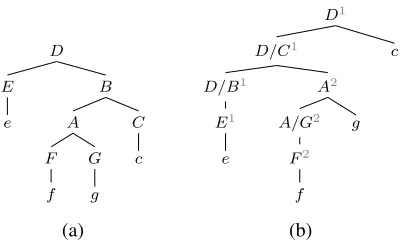
Figure 4: An example of LC transform: (a) the orig-inal parse; and (b) the transformed parse.
this PDA works for parsing a tree in Figure 4(a).
Grammar transform The algorithm above can be
reformulated as a grammar transform, which be-comes the starting point for our application to gram-mar induction. This can be done by extracting the operated top symbols on the stack in each transition:
SHIFT:Ad
→a (A→a∈P); SCAN:Bd
→B/Ada (A
→a∈P); PRED:B/Cd
→Ad (B
→A C∈P);
COMP:D/Cd→D/BdAd+1 (B→A C∈P).
where a rule on the right side is a condition given the set of rulesP in the CFG.
Figure 4 shows an example of this transform. The essential point is that each CFG rule in the trans-formed parse (b) corresponds to a transition in the original algorithm (Figure 1). For example a rule
D/C1 → D/B1 A2 in the parse indicates that the
stack configurationD/B1|A2occurs during parsing
(just corresponding to the step 5 in Figure 3) and COMP is then applied. This can also be seen as an
instantiation of Figure 2.
Stack depth and center-embedding We use the
term center-embedding to distinguish just the tree
structures, i.e., ignoring symbols. That is, the tree
in Figure 4(a) is the minimal, one degree of center-embedded tree, where the constituent rooted at A
is embedded into a larger constituent rooted at D.
Multiple, or degree ≥ 2 of center-embedding
oc-curs if this constituent is also embedded into another larger constituent.
Note that it is only COMP that consumes the top
twosymbols on the stack. This means that a larger stack depth occurs only when COMPis needed.
Fur-thermore, from Figure 2 COMP always induces a
subtree involving new center-embedding, and this is the underlying mechanism that the stack depth of the algorithm captures the degree of center-embedding. One thing to note is that to precisely associate the stack depth and the degree of center-embedding the depth calculation in COMPshould be revised as:
COMP:D/Cd→D/BdAd0 (B →A C ∈P)
d0 =
d (SPANLEN(A) = 1) d+ 1 (otherwise), (1)
where SPANLEN(A) calculates the span length of the constituent rooted atA, which is 2 in Figure 4(b).
This modification is necessary since COMPfor a
sin-gle token occurs for building purely right-branching structures.2 Formally, then, given a tree with
de-greeλof center-embedding the largest stack depth d∗ during parsing this tree is:d∗ =λ+ 1.
Schuler et al. (2010) found that on English tree-banks larger stack depth such as 3 or 4 rarely oc-curs while Noji and Miyao (2014) validated the lan-guage universality of this observation through cross-linguistic experiments. These suggest we may uti-lize LC parsing as a tool for exploiting universal syn-tactic biases as we discuss in Section 3.
Historical notes Rosenkrantz and Lewis (1970) first presented the idea of LC parsing as a gram-mar transform. This is arc-standard, and has no relevance to center-embedding; Resnik (1992) and Johnson (1998) formulated anarc-eagervariant by extending this algorithm. The presented algorithm here is the same as Schuler et al. (2010), and is slightly different from Johnson (1998). The dif-ference is in the start and end conditions: while
[image:3.612.92.295.187.307.2]our parser begins with an empty symbol, Johnson’s parser begins with the predicted start symbol, and finishes with an empty symbol.
3 Learning with structural constraints
Now we discuss how to utilize LC parsing for gram-mar induction in general. An important observation in the above transform is that if we perform chart parsing, e.g., CKY, we can detect center-embedded trees efficiently in a chart. For example, by set-ting a threshold of stack depthδ, we can eliminate
any parses involving center-embedding up to degree
δ−1. Note that in a probabilistic setting, each weight
of a transformed rule comes from the corresponding underlying CFG rule (i.e., the condition).
For learning, our goal is to estimate θ of a
gen-erative model p(z, x|θ) for parse z and its yields (words)x. We take an EM-based simplest approach,
and multiply the original model by a constraint fac-torf(z, x)∈[0,1]to obtain a new model:
p0(z, x|θ)∝p(z, x|θ)f(z, x), (2)
and then optimize θ based on p0(z, x|θ). This is essentially the same approach as Smith and Eisner (2006). As shown in Smith (2006), when training with EM we can increase the likelihood ofp0(z, x|θ)
by just using the expected counts from an E-step on the unnormalized distributionp(z, x|θ)f(z, x).
We investigate the following constraints in our ex-periments:
f(z, x) =
0 (d∗z > δ)
1 (otherwise), (3)
whered∗zis the largest stack depth forzin LC
pars-ing andδis the threshold. This is a hard constraint,
and can easily be achieved by removing all chart items (of LC transformed grammar) on which the depth of the symbol exceedsδ. For example, when δ = 1the model only explores trees without
center-embedding, i.e., right- or left-linear trees.
Length-based constraints Byδ = 2, the model is
allowed to explore trees with one degree of center-embedding. Besides these simple ones, we also in-vestigate relaxingδ = 1that results in an
intermedi-ate betweenδ = 1and2. Specifically, we relax the
depth calculation in COMP(Eq. 1) as follows:
d0 =
d (SPANLEN(A)≤ξ)
d+ 1 (otherwise), (4)
whereξ ≥ 1controls the minimal length of a span
regarded asembedded into another one. For exam-ple, whenξ = 2, the parse in Figure 4(a) isnot
re-garded as center-embedded because the span length of the constituent reduced by COMP(i.e.,A) is 2.
This modification is motivated with our observa-tion that in many cases center-embedded construc-tions arise due to embedding of small chunks, rather than clauses. An example is “... prepared [the cat ’s] dinner”, where “the cat ’s” is center-embedded in our definition. For this sentence, by relaxing the condition with, e.g.,ξ = 3, we can suppress the
in-crease of stack depth. We treatξas a hyperparameter
in our experiments, and in practice, we find that this relaxed constraint leads to higher performance.
4 Dependency grammar induction
In this section we discuss how we can formulate the dependency model with valence (DMV) (Klein and Manning, 2004), a famous generative model
fordependencygrammar induction, on LC parsing.
Though as we will see, applying LC parsing for a de-pendency model is a little involved compared to sim-ple PCFG models, dependency models have been the central for the grammar induction tasks, and we consider it is most appropriate for assessing effec-tiveness of our approach.
DMV is a head-outward generative model of a dependency tree, controlled by two types of multi-nomial distributions. For stop ∈ {STOP,¬STOP}, θS(stop|h,dir,adj)is a Bernoulli random variable to
decide whether or not to attach further dependents indir ∈ {←,→}direction. The adjacencyadj ∈
{TRUE,FALSE} is the key factor to distinguish the
distributions of the first and the other dependents, which is TRUEifh has no dependent yet indir
di-rection. Another type of parameter isθA(a|h,dir), a
probability thath takes aas a dependent indir
di-rection.
X[ran]
X[fast]
fast X[ran]
X[ran]
ran X[dogs]
dogs
(a)
X[ran]1
fast X[ran/fast]1
X[ran]1
ran X[ran/ran]1
X[dogs]1
dogs
(b)
X[ran]
X[ran]
X[fast]
fast X[ran]
ran X[dogs]
dogs
(c)
X[ran]1
fast X[ran/fast]1
X[ran]1
ran X[ran/ran]1
X[dogs]1
dogs
(d)
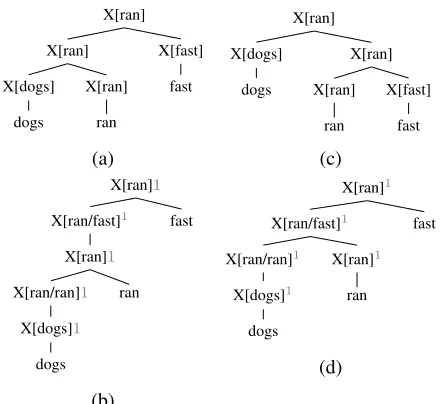
Figure 5: Two CFG parses for “dogs ran fast” and the results of LC transform ((a)→(b); (c)→ (d)).
X[a/b] is an abbreviation for X[a]/X[b].
parameters into each CFG rule of the transformed grammar.3 Below we discuss a problem for (1) and
(2), and then consider parameterization.4
Spurious ambiguity The central issue for apply-ing LC parsapply-ing is thespurious ambiguityin depen-dency grammars. That is, there are more than one (binary) CFG parses corresponding to a given de-pendency tree. This is problematic mainly for two reasons: 1) we cannot specify the degree of center-embedding in a dependency tree uniquely; and 2) this one-to-many mapping prevents the inside-outside algorithm to work correctly (Eisner, 2000).
As a concrete example, Figures 5(a) and 5(c) show two CFG parses corresponding to the depen-dency treedogsxranyfast. We approach this
prob-lem by first providing a grammar transform, which generates all valid LC transformed parses (e.g., Fig-ures 5(b) and 5(d)) and then restricting the grammar
3Another approach might be just applying the technique in Section 3 to some PCFG that encodes DMV, e.g., Headden III et al. (2009). The problem with this approach, in particular with split-head grammars (Johnson, 2007), is that the calculated stack depth no longer reflects the degree of center-embedding in the original parse correctly. As we discuss later, instead, we can speed up inference by applying head-splittingafterobtaining the LC transformed grammar.
4Technical details including the chart algorithm for split-head grammars can be found in the Ph.D. thesis of the first au-thor (Noji, 2016).
X[wh]
i h j
X[wh/wp]
i h j p
X[wp/wp]
i j p Figure 6: The senses of the symbols as a chart item. X[wh/wp]predictsthe next dependent outside of the span while X[wp/wp] predicts the head.
a b c d e ROOT
b
d
d
e d c b
b a
Figure 7: Implicit binarization of the restricted grammar. For each token, if its parent is in the right side (e.g.,b), it attaches all left children first. The
be-havior is opposed when the parent is in its left (e.g.,
d). A dummy root token is placed at the end.
for generating particular parses only.
Naive method Let us begin with the grammar be-low, which suffers from the spurious ambiguity:
SHIFT: X[wh]d→wh
SCAN: X[wh]d→X[wh/wp]dwp
L-PRED: X[wp/wp]d→X[wh]d(wxh wp);
R-PRED: X[wh/wp]d→X[wh]d(wyh wp);
L-COMP: X[wh/wp]d→X[wh/wp]dX[wa]d 0
(wxa wp);
R-COMP: X[wh/wa]d→X[wh/wp]dX[wp]d 0
(wpywa).
Here X[a/b] denotes X[a]/X[b] while wh denotes theh-th word in the sentencew. We can interpret
these rules as the operations on chart items (Figure 6). Note that only PREDand COMP create new
de-pendency arcs and we divide them depending on the direction of the created arcs (L and R).d0 is
calcu-lated by Eq. 4. Note also that for L-COMPand
R-COMPhmight equalp; X[ran/fast]1→X[ran/ran]1
X[ran]2 in Figure 5(d) is such a case for R-COMP.
Removing spurious ambiguity We can show that
by restricting conditions for some rules, the spurious ambiguity can be eliminated (the proof is omitted).
1. Prohibit R-COMPwhenh=p;
2. Assume the span of X[wp]d0 is(i, j)(i ≤p ≤ j). Then allow R-COMPonly wheni=p.
[image:5.612.77.297.56.258.2]example, by the condition 1, this grammar is pro-hibited to generate the parse of Figure 5(d).
Binarization Note that two CFG parses in Fig-ures 5(a) and 5(c) differ in how webinarizea given dependency tree. This observation indicates that our restricted grammarimplicitlybinarizes a depen-dency tree, and the incurred stack depth (or the de-gree of center-embedding) is determined based on the structure of the binarized tree. Specifically, we can show that the presented grammar performs
op-timal binarization; i.e., it minimizes the incurred
stack depth. Figure 7 shows an example, which is not regarded as center-embedded in our procedure. In summary, our method detects center-embedding for a dependency tree, but the degree is determined based on the structure of the binarized CFG parse.
Parameterization We can encode DMV
parame-ters into each rule. A new arc is introduced by one of{L/R}-{PRED/COMP}, and the stop probabilities
can be assigned appropriately in each rule by cal-culating the valence from indices in the rule. For example, after L-PRED,wh does not take any right dependents soθS(stop|wh,→, h=j), wherejis the right span index of X[wh], is multiplied.
Improvement Though we omit the details, we can improve the time complexity of the above grammar fromO(n6) toO(n4)applying the technique
simi-lar to Eisner and Satta (1999) without changing the binarization mechanism mentioned above. We im-plemented this improved grammar.
5 Experimental setup
A sound evaluation metric in grammar induction is known as an open problem (Schwartz et al., 2011; Bisk and Hockenmaier, 2013), which essentially arises from the ambiguity in the notion of head. For example, Universal dependencies (UD) is the recent standard in annotation and prefers content words to be heads, but as shown below this is very different from the conventional style, e.g., the one in CoNLL shared tasks (Johansson and Nugues, 2007):
Ivan is the best dancer
nsbj cop
det amod
sbj nmodnmod
prd
UD
CONLL
The problem is that both trees are correct under some linguistic theories but the standard metric, un-labeled attachment score (UAS), only takes into ac-count the annotation of the current gold data.
Our goal in this experiment is to assess the ef-fect of our structural constraints. To this end, we try to eliminate such arbitrariness in our evaluation as much as possible in the following way:
• We experiment on UD, in which every treebank
follows the consistent UD style annotation.
• We restrict the model to explore only trees that follow the UD style annotation during learn-ing5, by prohibiting every function word6 in a
sentence to have any dependents.
• We calculate UAS in a standard way.
We use UD of version 1.2. Some treebanks are very small, so we select the top 25 largest languages. The input to the model is coarse universal POS tags. Punctuations are stripped off. All models are trained on sentences of length≤15 and tested on≤40.
Initialization Much previous work of dependency grammar induction relies on the technique called harmonic initialization, which also biases the model towards shorter dependencies (Klein and Manning, 2004). Since our focus is to see the effect of struc-tural constraints, we do not try this and initialize models uniformly. However, we add a baseline model with this initialization in our comparison to see the relative strength of our approach.
Models For the baseline, we employ a variant of DMV withfeatures(Berg-Kirkpatrick et al., 2010), which is simple yet known to boost the performance well. The feature templates are almost the same; the only change is that we add backoff features for
STOPprobabilities that ignore both direction and
ad-jacency, which we found slightly improves the per-formance in a preliminary experiment. We set the regularization parameter to 10 though in practice we found the model is less sensitive to this value. We run 100 iterations of EM for each setting. The
dif-5We remove the restriction at test time though we found it does not affect the performance.
6A word with one of the following POS tags: ADP, AUX,
ference of each model is then the type of constraints imposed during the E-step7, or initialization:
• Baseline (FUNC): Function word constraints;
• HARM: FUNCwith harmonic initialization;
• DEP: FUNC+ stack depth constraints (Eq. 3);
• LEN: FUNC + soft dependency length bias,
which we describe below.
For DEP, we useδ= 1.ξto denote the relaxed max-imum depth allowing span length up toξ(Eq. 4).
LEN is the previously explored structural bias
(Smith and Eisner, 2006), which penalizes longer dependencies by modifying each attachment score:
θ0A(a|h,dir) =θA(a|h,dir)·e−γ·(|h−a|−1), (5)
where γ (≥ 0)determines the strength of the bias
and|h−a|is (string) distance betweenhanda.
Note that DEPand LENare closely related;
gen-erally center-embedded constructions are accompa-nied by longer dependencies so LENalso penalizes
center-embedding implicitly. However, the opposite is not true and there exist many constructions with longer dependencies without center-embedding. By comparing these two settings, we discuss the worth of focusing on constraining center-embedding rela-tive to the simpler bias on dependency length.
Finally we also add the system of Naseem et al. (2010) in our comparison. This system encodes many manually crafted rules between POS tags with the posterior regularization technique. For example, the model is encouraged to find NOUN → ADJ
re-lationship. Our systems cannot access to these core grammatical rules so it is our strongest baseline.8 Constraining root word We also see the effects of the constraints when a small amount of grammat-ical rule is provided. In particular, we restrict the candidate root words of the sentence to a noun or a verb; similar rules have been encoded in past work such as Gimpel and Smith (2012) and the CCG in-duction system of Bisk and Hockenmaier (2013).
7We again remove the restrictions at decoding as we ob-served that the effects are very small.
8We encode the customized rules that follow UD scheme. The following 13 rules are used: ROOT →VERB, ROOT → NOUN,VERB→NOUN,VERB→ADV,VERB→VERB,VERB
→AUX,NOUN→ADJ,NOUN→DET,NOUN→NUM,NOUN
→NOUN,NOUN→CONJ,NOUN→ADP,ADJ→ADV.
0
0 0.11 1.20.2 1.30.3 1.40.4 0.52 Parameters (upper=δ; bottom=γ) 20
30 40 50 60
U
AS
(%)
[image:7.612.347.493.66.185.2]Depth boundδ Length biasγ
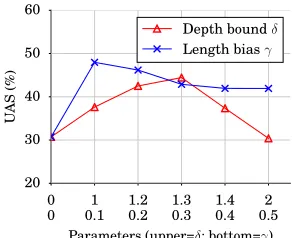
Figure 8: UAS for various settings on (UD) WSJ.
Hyperparameters Selecting hyperparameters in
multilingual grammar induction is difficult; some works tune values for each language based on the development set (Smith and Eisner, 2006; Bisk et al., 2015), but this violates the assumption of unsu-pervised learning. We instead follow many works (Mareˇcek and ˇZabokrtsk´y, 2012; Naseem et al., 2010) and select the values with the English data. For this, we use the WSJ data, which we obtain in UD style from the Stanford CoreNLP (ver. 3.6.0).9
6 Experiments
WSJ Figure 8 shows the result on WSJ. Both DEP
and LEN have one parameter: the maximum depth δ, andγ (Eq. 5), and the figure shows the sensitivity
on them. Note that x-axis = 0 represents FUNC.
For LEN, we can see the optimal parameterγ is
0.1, and degrades the performance when increasing the value; i.e., the small bias is the best. For DEP, we
find the best setting is 1.3, i.e., allowing embedded constituents of length 3 or less (ξ = 3in Eq. 4). We
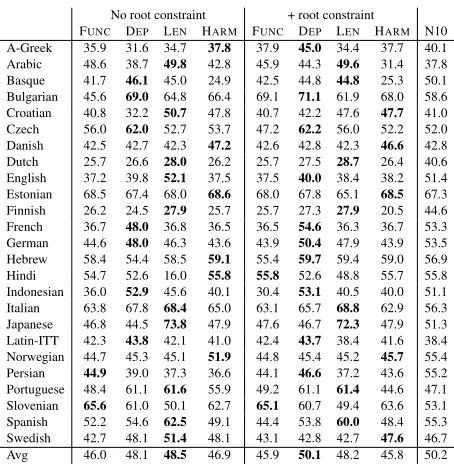
can see that allowing depth 2 degrades the perfor-mance, indicating that depth 2 allows too many trees and does not reduce the search space effectively.10 Multilingual results Table 1 shows the main mul-tilingual results. When we see “No root constraint” block, we notice that our DEP boosts the
perfor-mance in many languages (e.g., Bulgarian, French,
9Note that the English data in UD is Web Treebank (Silveira et al., 2014), not the standard WSJ Penn treebank.
No root constraint + root constraint
[image:8.612.74.301.54.288.2]FUNC DEP LEN HARM FUNC DEP LEN HARM N10 A-Greek 35.9 31.6 34.7 37.8 37.9 45.0 34.4 37.7 40.1 Arabic 48.6 38.7 49.8 42.8 45.9 44.3 49.6 31.4 37.8 Basque 41.7 46.1 45.0 24.9 42.5 44.8 44.8 25.3 50.1 Bulgarian 45.6 69.0 64.8 66.4 69.1 71.1 61.9 68.0 58.6 Croatian 40.8 32.2 50.7 47.8 40.7 42.2 47.6 47.7 41.0 Czech 56.0 62.0 52.7 53.7 47.2 62.2 56.0 52.2 52.0 Danish 42.5 42.7 42.3 47.2 42.6 42.8 42.3 46.6 42.8 Dutch 25.7 26.6 28.0 26.2 25.7 27.5 28.7 26.4 40.6 English 37.2 39.8 52.1 37.5 37.5 40.0 38.4 38.2 51.4 Estonian 68.5 67.4 68.0 68.6 68.0 67.8 65.1 68.5 67.3 Finnish 26.2 24.5 27.9 25.7 25.7 27.3 27.9 20.5 44.6 French 36.7 48.0 36.8 36.5 36.5 54.6 36.3 36.7 53.3 German 44.6 48.0 46.3 43.6 43.9 50.4 47.9 43.9 53.5 Hebrew 58.4 54.4 58.5 59.1 55.4 59.7 59.4 59.0 56.9 Hindi 54.7 52.6 16.0 55.8 55.8 52.6 48.8 55.7 55.8 Indonesian 36.0 52.9 45.6 40.1 30.4 53.1 40.5 40.0 51.1 Italian 63.8 67.8 68.4 65.0 63.1 65.7 68.8 62.9 56.3 Japanese 46.8 44.5 73.8 47.9 47.6 46.7 72.3 47.9 51.3 Latin-ITT 42.3 43.8 42.1 41.0 42.4 43.7 38.4 41.6 38.4 Norwegian 44.7 45.3 45.1 51.9 44.8 45.4 45.2 45.7 55.4 Persian 44.9 39.0 37.3 36.6 44.1 46.6 37.2 43.6 55.2 Portuguese 48.4 61.1 61.6 55.9 49.2 61.1 61.4 44.6 47.1 Slovenian 65.6 61.0 50.1 62.7 65.1 60.7 49.4 63.6 53.1 Spanish 52.2 54.6 62.5 49.1 44.4 53.8 60.0 48.4 55.3 Swedish 42.7 48.1 51.4 48.1 43.1 42.8 42.7 47.6 46.7 Avg 46.0 48.1 48.5 46.9 45.9 50.1 48.2 45.8 50.2
Table 1: Attachment scores on UD with or without root POS constraints. A-Greek = Ancient Greek. N10 = Naseem et al. (2010) with modified rules.
Indonesian, and Portuguese), though LENperforms
equally well and in average, LEN performs slightly
better. Harmonic initialization does not work well. We then move on to the settings with the con-straint on root tags. Interestingly, in these settings DEP performs the best. The model competes with
Naseem et al.’s system in average, and outperforms it in many languages, e.g., Bulgarian, Czech, etc. LEN, on the other hand, decreases the average score.
Analysis Why does DEPperform well in
particu-lar with the restriction on root candidates? To shed light on this, we inspected the output parses of En-glish with no root constraints, and found that the types of errors are very different across constraints.
Figure 9 shows a typical example of the differ-ence. One difference between trees is in the con-structions of phrase “On ... pictures”. LEN
pre-dicts that “On the next two” comprises a constituent, which modifies “pictures” while DEP predicts that
“the ... pictures” comprises a constituent, which is correct, although the head of the determiner is in-correctly predicted. On the other hand, LENworks
well to find more primitive dependency arcs between POS tags, such as arcs from verbs to nouns, which are often incorrectly recognized by DEP.
These observations may partially answer the
On the next two pictures he took ... ADP DET ADJ NUM NOUN PRON VERB ... DEP
[image:8.612.311.543.68.141.2]LEN
Figure 9: A comparison of output parses by DEP
and LEN(with no root constraints). Dashed arcs are
misclassified ones.
Prec. Recall F1 FUNC(English) 11.6 18.4 14.1
DEP(English) 22.4 37.1 27.9 LEN(English) 21.6 31.0 25.5 FUNC(Avg.) 22.5 30.0 25.6 DEP(Avg.) 27.8 34.5 30.5 LEN(Avg.) 24.0 33.7 27.9
FUNC+ROOT(Avg.) 22.0 29.4 25.0 DEP+ROOT(Avg.) 28.1 35.2 31.0
[image:8.612.343.513.216.324.2]LEN+ROOT(Avg.) 21.8 31.2 25.6
Table 2: Unlabeled bracket scores in various set-tings. Avg. is the average score across languages.
question above. The main source of improvements by DEP is detections of constituents, but this
con-straint itself does not help to resolve some core dependency relationships, e.g., arcs from verbs to nouns. The constraint on root POS tags is thus or-thogonal to this approach, and it may help to find such core dependencies. On the other hand, the de-pendency length bias is the most effective to find basic dependency relationships between POS tags while the resulting tree may involve implausible constituents. Thus the effect of the length bias seems somewhat overlapped with the root POS constraints, which may be the reason why they do not well col-laborate with each other.
Bracket scores We verify the above intuition
quantitatively. To this end, we convert both the pre-dicted and gold dependency trees into the unlabeled bracket structures, and then compare them on the standard PARSEVAL metrics. This bracket tree is not binarized; for example, we extract (X a b (X c d)) from the tree axbycyd. Table 2 shows the results, and we can see that DEP always performs
the best, showing that DEPleads to the models that
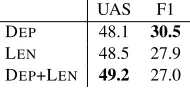
UAS F1 DEP 48.1 30.5 LEN 48.5 27.9 DEP+LEN 49.2 27.0
Table 3: Average scores of DEP, LEN, and the
com-bination.
is in Enlgish the bracket and dependency scores are only loosely correlated. In Table 1, UASs for FUNC,
DEP, and LENare 37.2, 39.8, and 52.1, respectively,
though F1 of DEPis substantially higher. This
sug-gests that DEPoften finds more linguistically
plausi-ble structures even when the improvement in UAS is modest. We conjecture that this performance change between constraints essentially arise due to the na-ture of DEP, which eliminates center-embedding,
i.e., implausible constituent structures, rather than dependency arcs.
Combining DEP and LEN These results suggest DEPand LENcapture different aspects of syntax. To
furuther understand this difference, we now evaluate the models withbothconstraints. Table 3 shows the average scores across languages (without root con-straints). Interestingly, the combination (DEP+LEN)
performs the best in UAS while the worst in bracket F1. This indicates the ability of DEP to find good
constituent boundaries is diminished by combining LEN. We feel the results are expected observing that
center-embedded constructions are a special case of longer dependency constructions. In other words, LEN is a stronger constraint than DEP in that the
structures penalized by DEP are only a subset of
structures penalized by LEN. Thus when LEN and
DEP are combined LEN overwhelms, and the
ad-vantage of DEPis weakened. This also suggests not
penalizing all longer dependencies is important for learning accurate grammars. The improvement of UAS suggests there are also collaborative effects in some aspect.
7 Conclusion
We have shown that a syntactic constraint that elim-inates center-embedding is helpful in dependency grammar induction. In particular, we found that our method facilitates to find linguistically correct constituent structures, and given an additional cue on dependency, the models compete with the
sys-tem relying on a significant amount of prior lin-guistic knowledge. Future work includes applying our DEP constraint into other PCFG-based
gram-mar induction tasks beyond dependency gramgram-mars. In particular, it would be fruitful to apply our idea into constituent structure induction for which, to our knowledge, there has been no successful PCFG-based learning algorithm. As discussed in de Mar-cken (1999) one reason for the failures of previous work is the lack of necessary syntactic biases, and our approach could be useful to alleviate this issue. Finally, though we have focused on unsupervised learning for simplicity, we believe our syntactic bias also leads to better learning in more practical scenar-ios, e.g., weakly supervised learning (Garrette et al., 2015).
Acknowledgements
We would like to thank John Pate for the help in preliminary work, as well as Taylor Berg-Kirkpatric for sharing his code. We are also grateful to Edson Miyamoto and Makoto Kanazawa for the valuable feedbacks. The first author was supported by JSPS KAKENHI Gran-in-Aid for JSPS Fellows (Grant Numbers 15J07986), and MOU Grant in National Institute of Informatics.
References
Taylor Berg-Kirkpatrick, Alexandre Bouchard-Cˆot´e, John DeNero, and Dan Klein. 2010. Painless unsu-pervised learning with features. InHuman Language Technologies: The 2010 Annual Conference of the North American Chapter of the Association for Com-putational Linguistics, pages 582–590, Los Angeles, California, June. Association for Computational Lin-guistics.
Yonatan Bisk and Julia Hockenmaier. 2013. An hdp model for inducing combinatory categorial grammars. Transactions of the Association for Computational Linguistics, 1:75–88.
Yonatan Bisk, Christos Christodoulopoulos, and Julia Hockenmaier. 2015. Labeled grammar induction with minimal supervision. InProceedings of the 53rd An-nual Meeting of the Association for Computational Linguistics and the 7th International Joint Conference on Natural Language Processing (Volume 2: Short Pa-pers), pages 870–876, Beijing,China, July.
Kenneth Church, Pierre Isabelle, Sandra Manzi, Eve-lyne Tzoukermann, and David Yarowsky, editors, Nat-ural Language Processing Using Very Large Corpora, volume 11 ofText, Speech and Language Technology, pages 191–208. Springer Netherlands.
Jason Eisner and Giorgio Satta. 1999. Efficient pars-ing for bilexical context-free grammars and head au-tomaton grammars. In Proceedings of the 37th An-nual Meeting of the Association for Computational Linguistics on Computational Linguistics, ACL ’99, pages 457–464, Stroudsburg, PA, USA. Association for Computational Linguistics.
Jason Eisner. 2000. Bilexical Grammars and Their Cubic-Time Parsing Algorithms. In Harry Bunt and Anton Nijholt, editors,Advances in Probabilistic and Other Parsing Technologies, pages 29–62. Kluwer Academic Publishers, October.
Richard Futrell, Kyle Mahowald, and Edward Gibson. 2015. Large-scale evidence of dependency length minimization in 37 languages. Proceedings of the Na-tional Academy of Sciences, 112(33):10336–10341. Dan Garrette, Chris Dyer, Jason Baldridge, and Noah
Smith. 2015. Weakly-supervised grammar-informed bayesian ccg parser learning.
E. Gibson. 2000. The dependency locality theory: A distance-based theory of linguistic complexity. In Im-age, languIm-age, brain: Papers from the first mind artic-ulation project symposium, pages 95–126.
Daniel Gildea and David Temperley. 2010. Do gram-mars minimize dependency length? Cognitive Sci-ence, 34(2):286–310.
Kevin Gimpel and Noah A. Smith. 2012. Concavity and initialization for unsupervised dependency pars-ing. In Proceedings of the 2012 Conference of the North American Chapter of the Association for Com-putational Linguistics: Human Language Technolo-gies, pages 577–581, Montr´eal, Canada, June. Asso-ciation for Computational Linguistics.
Joseph H. Greenberg. 1963. Some universals of gram-mar with particular reference to the order of meaning-ful elements. In Joseph H. Greenberg, editor, Univer-sals of Human Language, pages 73–113. MIT Press, Cambridge, Mass.
John A Hawkins. 2014. Cross-linguistic variatoin and efficiency. Oxford University Press, jan.
William P. Headden III, Mark Johnson, and David Mc-Closky. 2009. Improving unsupervised dependency parsing with richer contexts and smoothing. In Pro-ceedings of Human Language Technologies: The 2009 Annual Conference of the North American Chapter of the Association for Computational Linguistics, pages 101–109, Boulder, Colorado, June. Association for Computational Linguistics.
Richard Johansson and Pierre Nugues. 2007. Extended constituent-to-dependency conversion for English. In Proceedings of NODALIDA 2007, Tartu, Estonia, May. Mark Johnson. 1998. Finite-state approximation of constraint-based grammars using left-corner grammar transforms. In Christian Boitet and Pete Whitelock, editors,COLING-ACL, pages 619–623. Morgan Kauf-mann Publishers / ACL.
Mark Johnson. 2007. Transforming projective bilexical dependency grammars into efficiently-parsable cfgs with unfold-fold. InProceedings of the 45th Annual Meeting of the Association of Computational Linguis-tics, pages 168–175, Prague, Czech Republic, June. Association for Computational Linguistics.
Fred Karlsson. 2007. Constraints on multiple center-embedding of clauses. Journal of Linguistics, 43(2):365–392.
Dan Klein and Christopher Manning. 2004. Corpus-based induction of syntactic structure: Models of de-pendency and constituency. In Proceedings of the 42nd Meeting of the Association for Computational Linguistics (ACL’04), Main Volume, pages 478–485, Barcelona, Spain, July.
David Mareˇcek and Zdenˇek ˇZabokrtsk´y. 2012. Ex-ploiting reducibility in unsupervised dependency pars-ing. In Proceedings of the 2012 Joint Conference on Empirical Methods in Natural Language Process-ing and Computational Natural Language LearnProcess-ing, pages 297–307, Jeju Island, Korea, July. Association for Computational Linguistics.
George A. Miller and Noam Chomsky. 1963. Finitary models of language users. In D. Luce, editor, Hand-book of Mathematical Psychology, pages 2–419. John Wiley & Sons.
Tahira Naseem, Harr Chen, Regina Barzilay, and Mark Johnson. 2010. Using universal linguistic knowl-edge to guide grammar induction. InProceedings of the 2010 Conference on Empirical Methods in Natural Language Processing, pages 1234–1244, Cambridge, MA, October. Association for Computational Linguis-tics.
Hiroshi Noji and Yusuke Miyao. 2014. Left-corner transitions on dependency parsing. InProceedings of COLING 2014, the 25th International Conference on Computational Linguistics: Technical Papers, pages 2140–2150, Dublin, Ireland, August. Dublin City Uni-versity and Association for Computational Linguistics. Hiroshi Noji. 2016. Left-corner Methods for Syntac-tic Modeling with Universal Structural Constraints. Ph.D. thesis, Graduate University for Advanced Stud-ies, Tokyo, Japan, March.
D.J. Rosenkrantz and P.M. Lewis. 1970. Deterministic left corner parsing. InSwitching and Automata The-ory, 1970., IEEE Conference Record of 11th Annual Symposium on, pages 139–152, Oct.
William Schuler, Samir AbdelRahman, Tim Miller, and Lane Schwartz. 2010. Broad-coverage parsing using human-like memory constraints. Computational Lin-guistics, 36(1):1–30.
Roy Schwartz, Omri Abend, Roi Reichart, and Ari Rap-poport. 2011. Neutralizing linguistically problem-atic annotations in unsupervised dependency parsing evaluation. In Proceedings of the 49th Annual Meet-ing of the Association for Computational LMeet-inguistics: Human Language Technologies, pages 663–672, Port-land, Oregon, USA, June. Association for Computa-tional Linguistics.
Natalia Silveira, Timothy Dozat, Marie-Catherine de Marneffe, Samuel Bowman, Miriam Connor, John Bauer, and Christopher D. Manning. 2014. A gold standard dependency corpus for English. In Proceed-ings of the Ninth International Conference on Lan-guage Resources and Evaluation (LREC-2014). Noah A. Smith and Jason Eisner. 2006. Annealing
structural bias in multilingual weighted grammar in-duction. In Proceedings of the International Confer-ence on Computational Linguistics and the Associ-ation for ComputAssoci-ational Linguistics (COLING-ACL), pages 569–576, Sydney, July.
Noah A. Smith. 2006. Novel Estimation Methods for Unsupervised Discovery of Latent Structure in Natu-ral Language Text. Ph.D. thesis, Johns Hopkins Uni-versity, Baltimore, MD, October.