Proceedings of NAACL-HLT 2019, pages 96–108 96
Massively Multilingual Adversarial Speech Recognition
Oliver Adams, Matthew Wiesner, Shinji Watanabe, and David Yarowsky Department of Computer Science
Johns Hopkins University, Baltimore MD, USA
{oadams1,wiesner,shinjiw,yarowsky}@jhu.edu
Abstract
We report on adaptation of multilingual end-to-end speech recognition models trained on as many as 100 languages. Our findings shed light on the relative importance of similarity between the target and pretraining languages along the dimensions of phonetics, phonol-ogy, language family, geographical location, and orthography. In this context, experi-ments demonstrate the effectiveness of two additional pretraining objectives in encourag-ing language-independent encoder representa-tions: a context-independent phoneme objec-tive paired with a language-adversarial classi-fication objective.
1 Introduction
The main difficulty in creating automatic speech recognition (ASR) systems for a large number of the world’s 7,000 languages is a lack of training data. Such data comes in the form of speech paired with transcriptions, a pronunciation lexicon, and text for language model training. A common technique in data-constrained settings is to learn language-independent representations of speech via multilingual training. Popular approaches in-clude the use of multilingual bottleneck features (Vesely et al.,2012) as well as multilingual model training before fine-tuning to a target language (Scanzio et al.,2008;Vu et al.,2012).
Prior work in multilingual and cross-lingual speech recognition has been restricted to a small handful of the world’s most-spoken languages, relying on multilingual corpora such as Global-Phone (Schultz, 2002), the IARPA Babel cor-pora (Gales et al., 2014), or the VoxForge1 cor-pora. Most work typically only reports on models trained on a subset of these languages.
In this paper we explore pretraining multilin-gual ASR models using speech from as many as
1voxforge.org
100 languages from the CMU Wilderness Mul-tilingual Speech Dataset (Black, 2019).2 To the best of our knowledge, this is the greatest num-ber of languages that has been used in multilingual ASR model training to date. We perform experi-ments to guide the choice of languages used when pretraining the model and assess the relative im-portance of similarity between the pretraining lan-guages and target language in terms of geographic location, phonology, phonetic inventory, language family and orthography.
We examine these variables in the context of two experimental setups: one where models are adapted to target language and target speakers, and one where models are adapted to target lan-guage but non-target speakers. The first task is relevant to language documentation contexts, which often involves transcribing speech of spe-cific speakers for which there already exists some transcribed speech as training data (Michaud et al., 2018). The second case is relevant to incident re-sponse as modelled by LORELEI (Strassel and Tracey, 2016), where there may only be a sin-gle target-language consultant available for which transcribed speech can be elicited, but the goal is to have an ASR model that generalizes to multiple speakers.
Multilingual ASR training on such a scale presents challenges because of this language diversity. In order to guide the model to learn language-independent representations that are more amenable to adaptation, we experiment with two auxiliary training tasks. The first is context-independent phoneme sequence predic-tion to help bridge orthographic inconsistencies between languages. The second is a domain-adversarial classification objective (Ganin et al., 2016) over languages to encourage invariance
of the model with respect to language-specific phenomena. The hierarchical combination of grapheme and phoneme objectives has only been used in monolingual end-to-end frameworks ( Kr-ishna et al.,2018;Rao and Sak,2017). Language-adversarial training in ASR (Yi et al., 2018) has not been done at this scale before, nor in an end-to-end framework.
Our experiments are designed to answer the fol-lowing questions:
1. Is there benefit in scaling multilingual model training to a large number of languages?
2. In what circumstances, if any, does the addition of a phoneme and/or language-adversarial objective improve multilingual models?
3. How should we choose languages with which to pretrain a multilingual model?
4. Do the answers to the above questions change when adapting to target versus non-target speakers in the target language?
We find that using the auxiliary objectives in pretraining facilitates model transfer to unseen languages, especially when the pretraining lan-guages are very dissimilar (Section 6). When the target speakers are seen in adaptation (Section 7), similarity of the pretraining languages and the target language is more important than quantity of pretraining languages. Choosing as pretrain-ing languages geographically proximal languages tends to help more than phonetically and phono-logically similar but otherwise distant languages. However, when adapting to a handful of non-target speakers of the target language (Section8), the do-main mismatch caused by the unseen speaker, lan-guage, or recording environment degrades perfor-mance. Exposing the model to as many pretraining languages as possible becomes vital to minimize this mismatch. Results on this task demonstrate that a massively multilingual seed model substan-tially outperforms other seed models trained on languages similar to the target. We have provided an ESPnet recipe to train and test our models.3
2 Related Work
This paper builds on work on multilingual ASR, end-to-end ASR, and adversarial learning.
3https://github.com/espnet/espnet/
tree/master/egs/cmu_wilderness/asr1
Multilingual transfer in ASR often relies on using bottle-neck features (Vesely et al.,2012;Vu et al., 2012; Karafi´at et al., 2018) and adapting an acoustic model trained on one language to ef-fectively recognize the sounds of other languages (Schultz and Waibel,2001;Le and Besacier,2005; Stolcke et al.,2006;T´oth et al.,2008;Plahl et al., 2011; Thomas et al., 2012; Imseng et al., 2014; Do et al.,2014;Heigold et al.,2013;Scharenborg et al.,2017). However, while most work uses less than 10 languages for model training, we include up to 100 languages in training.
End-to-end ASR has recently become popular, with approaches such as attention-based encoder-decoder models (Chorowski et al., 2015; Chan et al., 2015), the connectionist temporal classi-fication (CTC) objective of Graves et al. (2006, 2013), or a combination of both (Kim et al.,2016; Hori et al., 2017). These approaches have also been deployed in multilingual settings ( Toshni-wal et al.,2017; Chiu et al.,2018;M¨uller et al., 2017;Dalmia et al.,2018;Watanabe et al.,2017a). Our baseline approach to multilingual knowledge transfer is most similar toInaguma et al. (2018), and involves training a hybrid CTC-attention seed model.
Hierarchical and multi-task approaches in-cluding combining grapheme and phoneme pre-diction in monolingual contexts (Rao and Sak, 2017;Krishna et al., 2018) at different levels of the network, or using sub-word units of varying granularity (Sanabria and Metze,2018), have been shown to improve ASR performance. In this pa-per we extend the approach of hierarchical place-ment of additional objectives in order to enforce language independent, transferable models.
primary task of speech recognition.
Domain-adversarial training has been used in speech recognition to learn features invariant to noise conditions (Shinohara,2016), accents (Sun, 2018), and sex (Tripathi et al.,2018). Most closely related to our work is that ofYi et al.(2018), who use a language-adversarial objective when prepar-ing multilprepar-ingual bottleneck features from four lan-guages for a hidden Markov model (HMM) ASR pipeline. In contrast, our work uses an adversarial objective across many languages, pairing it with a context-independent phoneme objective in an end-to-end framework.
3 Data
We scraped the data that forms the CMU Wilder-ness dataset, using a freely available script.4 This dataset consists of dramatized readings of the Bible in hundreds of languages. Each reading is ascribed a rating based on alignment quality which fits into one of these classes:very good,good,
okay, andnot okay.
The script used to preprocess the data uses a universal pronunciation module in Festival ( Tay-lor et al., 1998)5 to produce pronunciation lexi-cons using an approach based on that of UniTran (Yoon et al.,2007), which we use to create phone-mic transcriptions.
3.1 Characteristics of the Speech
The dataset consists of readings of the Bible, with readings typically of just a few speakers, mostly male. These are often dramatized, with sound effects and background music. For many pur-poses this could be considered a limitation of the data. Although the characteristics of the speech are unique, it allows us to investigate multilin-gual models over many languages without the con-founds of an overly noisy environment. It is not unreasonable to expect our findings to generalize to other speech recognition domains.
3.2 Evaluation Languages
While the dataset includes only a single reading of the Bible for most languages, there are a num-ber with two or more. We evaluate on languages for which we can find two or more readings. This is so that we can compare adaptation to a target
4
https://github.com/festvox/ datasets-CMU_Wilderness
5http://www.cstr.ed.ac.uk/projects/
festival/
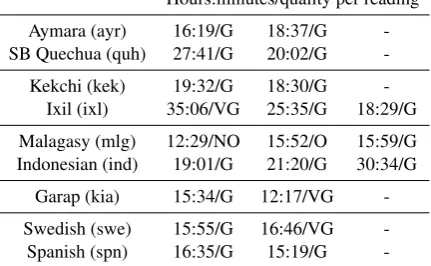
Hours:minutes/quality per reading Aymara (ayr) 16:19/G 18:37/G -SB Quechua (quh) 27:41/G 20:02/G -Kekchi (kek) 19:32/G 18:30/G
-Ixil (ixl) 35:06/VG 25:35/G 18:29/G Malagasy (mlg) 12:29/NO 15:52/O 15:59/G Indonesian (ind) 19:01/G 21:20/G 30:34/G
Garap (kia) 15:34/G 12:17/VG -Swedish (swe) 15:55/G 16:46/VG -Spanish (spn) 16:35/G 15:19/G
-Table 1: The duration of each reading in the evalua-tion languages (ISO 639-3 language codes in parenthe-ses), before our preprocessing. Alignment quality cat-egories arevery good(VG),good(G),okay(O),
not okay(NO).SB Quechuadenotes South Bolivian Quechua.
language but not the speakers of the target reading (we refer to this task aslanguage adaptation, as explored in Section 8) with adaptation to the tar-get language as well as the tartar-get reading (we refer to this task asreading adaptation). We addition-ally restricted the evaluation languages to those that have at least onegoodorvery good read-ing in terms of alignment quality. Table1presents the evaluation languages and readings grouped by family or geographic location, along with their du-rations.
4 Auxiliary Training Objectives
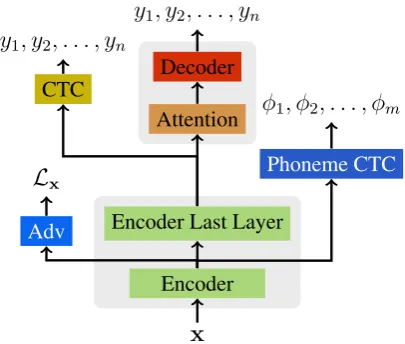
In addition to scaling ASR training to 100 lan-guages, a key contribution of our work is the use of a context-independent phoneme objective paired with a language-adversarial classification objec-tive in a end-to-end grapheme-based neural net-work, as illustrated in Figure1.
4.1 Baseline Model
[image:3.595.308.524.72.205.2]probabilities over graphemes to encourage mono-tonicity in decoding.
4.2 Phoneme Objective
The end-to-end neural model performs direct grapheme prediction without recourse to a pronun-ciation lexicon as traditional hybrid HMM-DNN models do. Since different orthographies may be mutually disjoint or only weakly related to the phonetic content of the input speech, we use a context-independent phoneme CTC objective to encourage learning of representations independent of such orthographic idiosyncrasies.
We performed limited preliminary experiments to determine how best to use the phoneme objec-tive, which corroborated recent work in hierarchi-cal training objectives that supports inserting the phoneme objective in the layers below the final layer (Krishna et al.,2018). We also found that us-ing the phoneme objective durus-ing adaptation was harmful and therefore in all reported experiments we use it only during multilingual pretraining.
4.3 Language-Adversarial Pretraining
For language-adversarial training we used a log-linear classifier over all languages seen in pretrain-ing. An utterance-level mean of the penultimate encoder layer states is fed into the classifier. For each batch in training we update the network us-ing the interpolated grapheme and phoneme objec-tives before a separate update step using the adver-sarial objective.
We follow the learning rate scheduling ofGanin et al.(2016), where the weight of the adversarial objective relative to the speech recognition tasks followsλ(p) = 1+exp(2−10p)−1over the course of training, wherep ∈[0,1]is a measure of training progress. We drop the adversarial objective during target language adaptation.
5 Experimental Setup
5.1 Language Versus Reading Adaptation
We chose as target adaptation languages those lan-guages for which we have multiple readings of the Bible. This allows us to assess adaptation of the pretrained multilingual model in two scenarios:
language adaptation andreading adaptation. In
reading adaptation, it is adapted to data from each reading of the target language, including the read-ing from which we select held-out evaluation ut-terances. Inlanguage adaptationit is adapted only
x
Encoder Encoder Last Layer
Attention Decoder
y1, y2, . . . , yn
y1, y2, . . . , yn
CTC
Phoneme CTC φ1, φ2, . . . , φm
Adv
[image:4.595.316.519.63.235.2]Lx
Figure 1: The end-to-end architecture used during pre-training. xis the input speech features,y1, y2, . . . , yn is a character sequence the model is trained to output (eg. “knife”). φ1, φ2, . . . , φmis a phoneme sequence the model is trained to output (eg. /naIf/), andLxis the
language identity of the input speechx.
to readings that are not represented in the evalu-ation set. This last case, of adapting to just one or several speakers of a new language (in order to ultimately have a system that generalizes beyond those speakers in the language) is not common in speech recognition experimentation. Results and findings for language adaptation will be presented in Section8.
5.2 Training Settings
We established training, validation and test sets for each reading using a random 80/10/10 split. When pretraining or adapting the multilingual systems, we used the combined training sets of the con-stituent readings.
We used 80-dimensional log Mel filterbank fea-tures with 3-dimensional pitch feafea-tures. We tuned hyperparameters for these models using one Ay-mara reading.6 We found that a 4 layer encoder, 1 layer decoder with 768 for the encoder hidden size and projections, decoder hidden size, and attention hidden size yielded equal-best results with deeper models. These settings were then used for training the models used in our experiments.
For the training objective, we linearly interpo-lated the the attentional decoder cross-entropy loss with the grapheme CTC and phoneme CTC objec-tives. Equal weight was given to all three since we found that to be effective in preliminary exper-iments. Note however, that the effective weight of
Target MONO QUE CYR QUE+CYR
- +phn+adv - +phn+adv - +phn +adv +phn+adv
[image:5.595.72.525.63.150.2]Aymara 40.6 34.3 34.5 (+0.6%) 37.9 35.9 (-5.3%) 34.6 34.2 34.8 34.2(-1.2%) SB Quechua 14.8 13.8 14.0 (+1.4%) 16.3 17.0 (+4.3%) 14.9 14.2 14.0 13.9 (-6.7%) Indonesian 14.9 15.1 15.3 (+1.3%) 16.1 17.9 (+11.2%) 15.8 15.6 15.5 14.7(-7.0%) Avg. rel.∆: (+1.1%) Avg. rel.∆: (+3.4%) Avg. rel.∆: (-4.9%)
Table 2: Word error rate (%) comparison of multilingual models adapted to target languages, with and without auxiliary training objectives (relative change in parentheses). Additionally including Cyrillic-script languages in pretraining (CYR) doesn’t consistently improve over a model pretrained on Quechuan languages (QUE) unless additional phoneme and language-adversarial objectives (+phnand+adv) are used in combination (+phn+adv). The auxiliary objectives help when pretraining languages are varied, but hinder when they are very similar. The final four columns suggest that the objectives are complementary. Average relative word error rate change for each pretraining set when adding in the auxiliary objectives (versus no aditional objectives) is indicated byAvg. rel.∆.
the adversarial objective effectively changes over the course of training because of the learning rate scheduling mentioned in §4.3. We trained for 15 epochs in all cases except where otherwise noted.
Note that during adaptation we initialize the model using both the multilingual encoder and de-coder. We found this to work best in preliminary experimentation on a Spanish reading.
6 Preliminary Investigation of the Auxiliary Objectives
In this section we evaluate the use of the auxiliary phoneme and language-adversarial objectives de-scribed in Section 4 on two divergent groups of languages that are distinct along a number of di-mensions, including orthography, language fam-ily and phonology, in order to assess the auxiliary objectives’ capacity to bridge the divide between these languages during pretraining. This serves as an initial exploration before further experiments in Section7and Section8, where we choose from a broader set of pretraining languages.
Pretraining languages We pretrained models on two groups of languages separately and to-gether. The first consists of six languages from the Quechuan language family, including sub-varieties of Quechua I and II (qub, quf, qvs, qvw, qwh and qvh). We henceforth refer to this group as QUE. The second consists of six languages that use the Cyrillic script and we refer to this group as CYR. These languages include Nogai (nog), Bashkir (bak), Gagauz (gag), Khakas (kjh), Crimean Tatar (crh), and Russian (rus). With the exception of Russian, these languages are all Tur-kic. The character sets do not overlap between QUEand CYRand this was a deliberate choice in
this preliminary experiment to maximize the dif-ferences between the two groups.
Evaluation languages To test the pretrained models in varied contexts, we evaluate our models on three languages: Central Aymara (ayr), South Bolivian Quechua (SB Quechua; quh), and In-donesian (ind). These languages vary in a num-ber of dimensions: SB Quechua is very closely related to QUE, while Indonesian is distant;
Ay-mara is phonologically very similar to Quechuan languages, but is considered to be from a different family; Aymara had a high monolingual baseline error rate, while the others are lower; and Indone-sian has three readings while the others have two. However, all evaluation languages use the Latin script. Note that in this section we assess perfor-mance in the reading adaptation case, while Sec-tion8presents results on the held-out reading case.
Experiments Table2compares the performance of monolingual target-language models to mod-els adapted to the target language after being pretrained on QUE, CYR and their combination, QUE+CYR. CYRpretraining underperforms pre-training with QUE for all evaluation languages
likely due to the orthographic mismatch with all of the evaluation languages. The model pre-trained on QUE+CYR also underperforms QUE.
Introducing the auxiliary phoneme and language-adversarial objectives helps to overcome this per-formance loss, making the QUE+CYR-pretrained
qvh / /
qvh /i/
rus / /
rus /i/
nog / /
nog /i/
qvh / /
qvh /i/
rus / /
rus /i/
nog / /
[image:6.595.79.523.64.236.2]nog /i/
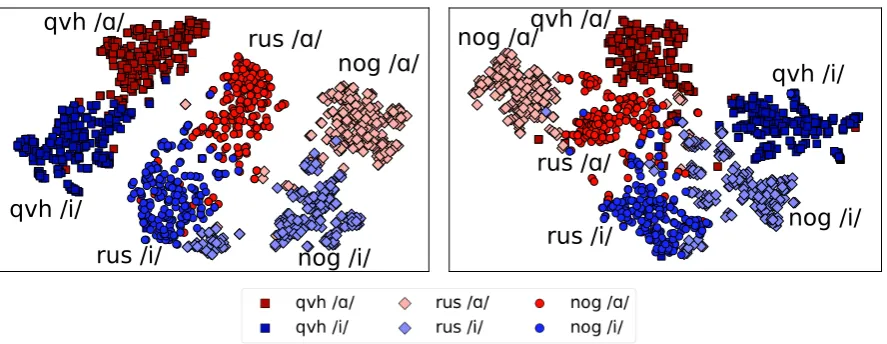
Figure 2: t-SNE representation of encoder states corresponding to /A/ and /i/ across Quechua (Huamalies Dos de Mayo; qvh), Russian (rus), and Nogai (nog). Left: the model without the phoneme and adversarial objective.
Right: the phoneme and language-adversarial objectives are added in, causing phoneme clusters between languages to gather closer together, and language to become less relevant in cluster placement.
amount of data in very closely related languages is available (in this case, close to 100 hours of QUE
data), then there is little to be gained from highly unrelated languages.
When pretraining on QUE and CYRseparately, the auxiliary objectives underperformed baseline multilingual pretraining on average. The varia-tion in languages within these groups is far less than the variation between groups. Given that the phoneme and adversarial objectives are intended to overcome variation between pretraining lan-guages, this result indicates that there must be a sufficient level of diversity in the pretraining lan-guages before the auxiliary objectives are of ben-efit when adapting to certain target languages.
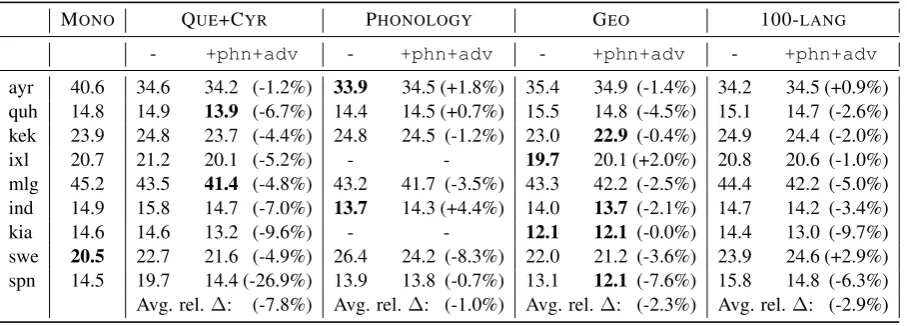
Results from pretraining on QUE+CYRshowed either objective to help on average, and that the effects are complementary. Because of this, we opted to include them together in subsequent ex-perimentation. We evaluated this best perform-ing model on the larger set of other evaluation languages. Results in Table 3 show that in all cases multilingual pretraining of QUE+CYRwith the auxiliary objectives outperformed its counter-part without the objectives (which frequently un-deperformed the monolingual model), and in all but one case this led to an improvement over the monolingual baseline.7
To gain insight into how the auxiliary objectives change the representation of speech learnt by the
7However, this doesn’t hold in the
language adaptation
scenario, where the auxiliary objectives help QUE+CYRonly slightly; see Section8.
models, we applied 2D t-SNE dimensionality re-duction (Van Der Maaten and Hinton,2008). Fig-ure 2 plots the representations of two phonemes in three languages learnt by the encoder8 in the case without and with the auxiliary objectives. In the multilingual pretraining baseline, six clus-ters are represented for each language–phoneme combination. These appear stratified by language, with different phoneme clusters within languages close to one another. With the auxiliary objectives, phoneme clusters between languages move closer to one another, while language identity becomes less relevant in determining which phoneme clus-ters neighbour one another. In the latter plot, the Nogai phonemes become separated by a Russian /A/. This is particularly salient since the Nogai speaker was female, while the Russian speaker had a deep male voice.
7 Reading Adaptation
In the previous section we explored the use of two dissimilar groups of languages in a multilingual setup. Multilingual pretraining of languages from a different language family and script benefitted from an explicit phoneme objective and adversar-ial objective when there was sufficient diversity in the pretraining languages. However, a change in orthography was conflated with a change in language family, geographic location, and
phono-8We established the correspondence between encoder
MONO QUE+CYR PHONOLOGY GEO 100-LANG
- +phn+adv - +phn+adv - +phn+adv - +phn+adv
[image:7.595.73.527.62.225.2]ayr 40.6 34.6 34.2 (-1.2%) 33.9 34.5 (+1.8%) 35.4 34.9 (-1.4%) 34.2 34.5 (+0.9%) quh 14.8 14.9 13.9 (-6.7%) 14.4 14.5 (+0.7%) 15.5 14.8 (-4.5%) 15.1 14.7 (-2.6%) kek 23.9 24.8 23.7 (-4.4%) 24.8 24.5 (-1.2%) 23.0 22.9 (-0.4%) 24.9 24.4 (-2.0%) ixl 20.7 21.2 20.1 (-5.2%) - - 19.7 20.1 (+2.0%) 20.8 20.6 (-1.0%) mlg 45.2 43.5 41.4 (-4.8%) 43.2 41.7 (-3.5%) 43.3 42.2 (-2.5%) 44.4 42.2 (-5.0%) ind 14.9 15.8 14.7 (-7.0%) 13.7 14.3 (+4.4%) 14.0 13.7 (-2.1%) 14.7 14.2 (-3.4%) kia 14.6 14.6 13.2 (-9.6%) - - 12.1 12.1 (-0.0%) 14.4 13.0 (-9.7%) swe 20.5 22.7 21.6 (-4.9%) 26.4 24.2 (-8.3%) 22.0 21.2 (-3.6%) 23.9 24.6 (+2.9%) spn 14.5 19.7 14.4 (-26.9%) 13.9 13.8 (-0.7%) 13.1 12.1 (-7.6%) 15.8 14.8 (-6.3%) Avg. rel.∆: (-7.8%) Avg. rel.∆: (-1.0%) Avg. rel.∆: (-2.3%) Avg. rel.∆: (-2.9%)
Table 3: Word error rate (%) comparison of adaptation of models pretrained on: Quechuan and Cyrillic-script languages (QUE+CYR), languages phonologically and phonetically similar to the target (PHON/INV), geograph-ically proximate languages (GEO), and a massively multilingual set of languages (100-LANG). In each case we compared the average relative WER change when adding auxiliary phoneme and language-adversarial objectives (+phn+adv). Dashed entries had phonology and phonetic inventories that weren’t well attested in URIEL, so were not assessed.
logical/phonetic characteristics. In this section, we investigate which factors are most important in choosing languages for multilingual pretraining and how useful it is to scale up model pretraining to many languages. This exploration is conducted in the reading adaptation scenario; language adap-tation with unseen target speakers is addressed in Section8. Beyond answering these questions, this investigation reveals more information about the utility of the proposed auxiliary objectives in dif-ferent scenarios.
Phonology & Geography We test across a num-ber of evaluation languages (c.f. Table 1) by de-termining, for each evaluation language, groups of pretraining languages that are similar to the evaluation languages in different ways. In or-der to determine language similarity in a prin-cipled way we used URIEL and lang2vec ( Lit-tell et al., 2017) to produce feature vectors for each language based on information from sev-eral linguistic resources before calculating their cosine similarity. For each language we used two feature vectors. The first is a concate-nation of the lang2vec phonology average
andinventory averagevectors, characteriz-ing phonological properties and phonetic inven-tory. The second represents geographic loca-tion. We denote these two groups PHON/INVand
GEO respectively.9 Geographic proximity may
9We didn’t create P
HON/INVsets for Ixil and Garap be-cause their phonological features and phonetic inventories were not well attested, and we didn’t use the lang2vec
lan-serve as a proxy for other similarities not captured in PHON/INV, including language family, ortho-graphic similarity, and the likelihood of exchanged loan words.
We filtered for languages in the dataset with
good or very good alignments before rank-ing them by cosine similarity with the evaluation languages in terms of phonological and phonetic similarity as well as geographical proximity. To create each of the pretraining sets, we took be-tween 7 and 14 of the top languages, matching approximately the total duration of the phoneti-cally/phonologically similar groups with the ge-ographically proximate language groups.10 For most languages, there is no overlap between the GEOand PHON/INVsets.
Massively multilingual model As a further point of comparison, we pretrain a model on around 100 languages (denoted 100-LANG), for approximately 1650 training hours in total.11
7.1 Auxiliary Objectives Findings
The results in Table 3 extend on our findings in Section 6, continuing to support the benefit of the use of the auxiliary objectives while shedding more light on the type of language variability the objectives help to overcome. GEOand 100-LANG
guage family vectors since most of the Quechuan languages were not captured as being highly similar to SB Quechua.
10
An exhaustive list of the CMU Wilderness language codes for each pretraining group can be found in Appendix
A, along with durations of each pretraining set.
benefitted comparably from the objectives on av-erage, while PHON/INV did less so. QUE+CYR
benefitted the most. This suggests that the objec-tives may help more when pretraining languages are orthographically, phonetically and phonologi-cally diverse.
Unlike the other languages, the Swedish PHON/INVvectors were not well attested. As a re-sult the Swedish PHON/INVgroup has languages with a similar phonetic inventory that were also unattested phonologically. This model underper-formed the monolingual model by a large margin, suggesting that similarity of phonetic inventory alone may not be so useful alone without similar-ity of phonological features. Models pretrained on this set also benefitted the most from the auxiliary objectives. It may be the case that the auxiliary objectives push together representations of allo-phones within languages, and pronunciation vari-ations of the same phonemes between languages. When Swedish is discounted, the average relative improvement when adding auxiliary objectives for PHON/INVbecomes negligable.
The PHON/INV configurations are hurt by the auxiliary objectives for SB Quechua and Aymara and Indonesian. The PHON/INV sets for the
first two of these languages emphasized Quechuan languages, and this corroborates the indication in Section 6 that the auxiliary objectives may not help so much when pretraining languages are similar. On the other hand, the Indone-sian PHON/INVincluded Afro-Asiatic and
Niger-Congo languages, as well an Indo-European lan-guage and Huave, a lanlan-guage isolate from Mexico, yet it was not improved by auxiliary objectives.
7.2 Choice of Pretraining Languages
The average relative word error rate (WER) change for GEO against PHON/INV was -2.2%
without auxiliary objectives, and -4.4% with them,12 suggesting that features correlated with geography are useful for guiding pretraining lan-guage selection. Counter-examples were Aymara, SB Quechua and Malagasy, which performed worse when pretrained on GEO. In the case of SB
Quechua, only one Quechuan language was repre-sented in GEO(Inga), while PHON/INVhad three (qub, qvh, quf). Madagascar is far removed from where most Austronesian languages are spoken, so Malagasy’s GEOset were almost all Niger-Congo
12Discounting Swedish, this becomes +0.2% and -3.1%.
1 10
20.0 40.0 60.0 80.0
Hours of training/adaptation data
W
ord
error
rate
(%)
MONO
100-LANG
[image:8.595.310.525.62.221.2]100-LANG+phn+adv
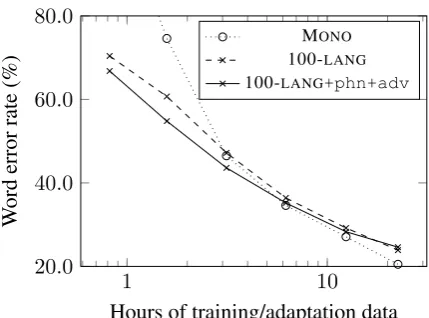
Figure 3: Scaling training/adaptation data for Swedish. Adapting to the full dataset, the auxiliary objectives un-derperformed both the monolingual and baselines, but yields an advantage when the model is adapted to less target language data.
languages, while the PHON/INVhad a diverse ar-ray of Austronesian, Indo European, Afro-Asiatic, Sino-Tibetan and Mayan languages. However, on average, these results suggest that geographical proximity is a decent guide to pretraining language selection. Another advantage is that it requires no explicit phonological features, making it applica-ble to a much larger number of languages.
The average relative WER change of
100-LANG against MONO was +1.3%, indicating that
massively multilingual pretraining by itself not useful if the target speakers are seen in train-ing. Using the auxiliary objectives overcame the difference, resulting in a -1.6% average rel-ative WER change. However, pretraining with GEO+phn+advyielded an average relative delta of -7.4% over the monolingual model. Though more languages help, they are not necessarily bet-ter than geographically proximal languages (how-ever, results are very different when not adapting to target speakers: see Section8).
In two cases pretraining with 100-LANG was hindered by the auxiliary objective. In one of these cases, Swedish, both 100-LANG variations
are seen.
8 Language Adaptation
Previous sections have addressed the reading adaptation scenario, where the ASR model is adapted to speech from the target reading (ie. where target speakers have been heard in adapta-tion). In this section we evaluate in a language adaptation scenario, adapting to readings in the target language, but not the target reading. The question of how well a multilingual model can be adapted to a language on the basis of recordings from a small number of target-language speakers is relevant to incident response situations such as those modelled by LORELEI (Strassel and Tracey, 2016), where a single language consultant is avail-able for which recorded speech can be made. We performed experiments analogous to those of the previous sections where the evaluation reading was not seen in training or adaptation. This is a challenging task as the model must generalize to multiple speakers of a language on the basis of seeing only several in training. Most of the find-ings corroborate what was found in the previous sections. Here we highlight differences.
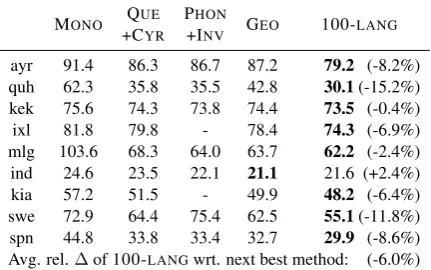
Massively multilingual pretraining led to sub-stantially better performance than other methods, unlike in the reading adaptation task. For each evaluation language, the 100-LANGmodel outper-formed the next best method, with one exception: Indonesian. In that case GEO set performed the
best, as the languages were not only geograph-ically proximate, but also consisted entirely of other Austronesian languages. The takeaway (c.f. Table4) is that you should always use more pre-training languages unless you know your target speakers, as in the reading adaptation scenario.
Auxiliary objectives remained useful on the whole. However, while the difference in WER achieved when adding the auxiliary objectives was similar to those reported in Section 7 for PHON/INVand 100-LANG, GEO and QUE+CYR
no longer achieved improvements. QUE+CYR
notably only achieved a -0.2% average relative WER change when adding the auxiliary objec-tives, while achieving -7.8% in the reading adapta-tion case. While the auxiliary objectives remained useful on the whole, their effect was dwarfed by the value of adding more languages.
MONO QUE
+CYR
PHON
+INV GEO 100-LANG
[image:9.595.308.524.64.199.2]ayr 91.4 86.3 86.7 87.2 79.2 (-8.2%) quh 62.3 35.8 35.5 42.8 30.1(-15.2%) kek 75.6 74.3 73.8 74.4 73.5 (-0.4%) ixl 81.8 79.8 - 78.4 74.3 (-6.9%) mlg 103.6 68.3 64.0 63.7 62.2 (-2.4%) ind 24.6 23.5 22.1 21.1 21.6 (+2.4%) kia 57.2 51.5 - 49.9 48.2 (-6.4%) swe 72.9 64.4 75.4 62.5 55.1(-11.8%) spn 44.8 33.8 33.4 32.7 29.9 (-8.6%) Avg. rel.∆of 100-LANGwrt. next best method: (-6.0%)
Table 4: Adaptation to the non-target reading in the target language. All language sets use the auxiliary training objectives, which again exhibited an relative gain over the corresponding model without. The rel-ative deltas of 100-LANGare with respect to the next closest model on a language-by-language basis.
Phonology versus Geography GEOsets with or without auxiliary objectives lost their edge over PHON/INV, with high variance in scores. The
amount of training data becomes the dominating variable affecting WER.
9 Conclusions
We have explored the utility of pretraining multi-lingual models on a variety of language sets, scal-ing to as as many as 100 languages. Our exper-iments have demonstrated the value of auxiliary phoneme and language-adversarial pretraining ob-jectives in a multilingual end-to-end ASR frame-work, particularly when the pretraining languages are diverse. Our results suggest how to pick pre-training languages when target speakers are seen in the adaptation data: find geographically prox-imal languages. When adapting to just several non-target speakers, exposure to more speech in pretraining is the most important thing for model generality, even if from a wide range of dissimilar languages.
Acknowledgments
References
Alan W Black. 2019. CMU Wilderness Multilingual Speech Dataset. InICASSP.
William Chan, Navdeep Jaitly, Quoc V. Le, and Oriol Vinyals. 2015. Listen, attend and spell. InICASSP.
Chung-Cheng Chiu, Tara N Sainath, Yonghui Wu, Ro-hit Prabhavalkar, Patrick Nguyen, Zhifeng Chen, Anjuli Kannan, Ron J Weiss, Kanishka Rao, Katya Gonina, et al. 2018. State-of-the-art speech recogni-tion with sequence-to-sequence models. InICASSP.
Jan K Chorowski, Dzmitry Bahdanau, Dmitriy Serdyuk, Kyunghyun Cho, and Yoshua Bengio. 2015. Attention-based models for speech recogni-tion. Advances in Neural Information Processing Systems 28, pages 577–585.
Siddharth Dalmia, Ramon Sanabria, Florian Metze, and Alan W Black. 2018. Sequence-based multi-lingual low resource speech recognition. InICASSP.
Van Hai Do, Xiong Xiao, Eng Siong Chng, and Haizhou Li. 2014. Cross-lingual phone mapping for large vocabulary speech recognition of under-resourced languages. IEICE Transactions on Infor-mation and Systems, E97-D(2).
Mark J F Gales, Kate M Knill, Anton Ragni, and Shakti P Rath. 2014. Speech recognition and key-word spotting for low-resource languages: BABEL project research at CUED. In Spoken Language Technologies for Under-Resourced Languages.
Yaroslav Ganin, Evgeniya Ustinova, Hana Ajakan, Pascal Germain, Hugo Larochelle, Franc¸ois Lavi-olette, Mario Marchand, and Victor Lempitsky. 2016. Domain-adversarial training of neural net-works. Journal of Machine Learning Research, 17(1).
A Graves, A.-R. Mohamed, and G Hinton. 2013. Speech recognition with deep recurrent neural net-works.ICASSP.
Alex Graves, Santiago Fernandez, Faustino Gomez, and Jurgen Schmidhuber. 2006. Connectionist temporal classification: labelling unsegmented se-quence data with recurrent neural networks.ICML.
Georg Heigold, Vincent Vanhoucke, Alan Senior, Patrick Nguyen, Marc’Aurelio Ranzato, Matthieu Devin, and Jeffrey Dean. 2013. Multilingual acous-tic models using distributed deep neural networks. InICASSP.
Sepp Hochreiter and J¨urgen Schmidhuber. 1997. Long short-term memory.Neural computation, 9(8).
Takaaki Hori, Shinji Watanabe, Yu Zhang, and William Chan. 2017.Advances in joint CTC-attention based end-to-end speech recognition with a deep CNN en-coder and RNN-LM. InINTERSPEECH.
David Imseng, Petr Motlicek, Herv´e Bourlard, and Philip N Garner. 2014. Using out-of-language data to improve an under-resourced speech recognizer.
Speech Communication, 56.
Hirofumi Inaguma, Jaejin Cho, Murali Karthick Baskar, Tatsuya Kawahara, and Shinji Watanabe. 2018. Transfer learning of language-independent end-to-end ASR with language model fusion.
arXiv:1811.02134.
Martin Karafi´at, Murali Karthick Baskar, Shinji Watanabe, Takaaki Hori, Matthew Wiesner, and Jan “Honza” ˇCernock´y. 2018. Analysis of multilin-gual sequence-to-sequence speech recognition sys-tems.arXiv:1811.03451.
Suyoun Kim, Takaaki Hori, and Shinji Watanabe. 2016. Joint CTC-attention based end-to-end speech recognition using multi-task learning. InICASSP.
Kalpesh Krishna, Shubham Toshniwal, and Karen Livescu. 2018. Hierarchical multitask learning for CTC-based speech recognition.arXiv:1807.06234.
Viet Bac Le and Laurent Besacier. 2005. First steps in fast acoustic modeling for a new target language: application to Vietnamese. InICASSP.
Patrick Littell, David Mortensen, Ke Lin, Kather-ine Kairis, Carlisle Turner, and Lori Levin. 2017. URIEL and lang2vec: Representing languages as ty-pological, geographical, and phylogenetic vectors. InEACL.
Alexis Michaud, Oliver Adams, Trevor Anthony Cohn, Graham Neubig, and S´everine Guillaume. 2018. In-tegrating automatic transcription into the language documentation workflow: Experiments with Na data and the Persephone toolkit. Language Documenta-tion & ConservaDocumenta-tion, 12.
Markus M¨uller, Sebastian St¨uker, and Alex Waibel. 2017. Phonemic and Graphemic Multilingual CTC Based Speech Recognition. arXiv:1711.04564.
Adam Paszke, Sam Gross, Soumith Chintala, Gre-gory Chanan, Edward Yang, Zachary DeVito, Zem-ing Lin, Alban Desmaison, Luca Antiga, and Adam Lerer. 2017. Automatic differentiation in pytorch.
NeurIPS.
Christian Plahl, Ralf Schl¨uter, and Hermann Ney. 2011. Cross-lingual portability of Chinese and English neural network features for French and German LVCSR. InAutomatic Speech Recognition and Un-derstanding (ASRU), IEEE Workshop on.
Kanishka Rao and Haim Sak. 2017. Multi-accent speech recognition with hierarchical grapheme based models.ICASSP.
Ramon Sanabria and Florian Metze. 2018. Hierarchi-cal multi task learning with CTC. InIEEE Spoken Language Technology Workshop (SLT).
Stefano Scanzio, Pietro Laface, Luciano Fissore, Roberto Gemello, and Franco Mana. 2008. On the use of a multilingual neural network front-end. In
INTERSPEECH.
Odette Scharenborg, Francesco Ciannella, Shruti Palaskar, Alan Black, Florian Metze, Lucas Ondel, and Mark Hasegawa-Johnson. 2017. Building an ASR system for a low-research language through the adaptation of a high-resource language ASR system: preliminary results. InInternational Conference on Natural Language, Signal and Speech Processing (ICNLSSP).
Tanja Schultz. 2002. GlobalPhone: a multilingual speech and text database developed at Karlsruhe University. InSeventh International Conference on Spoken Language Processing.
Tanja Schultz and Alex Waibel. 2001. Experi-ments on cross-language acoustic Modeling. EU-ROSPEECH’01.
Mike Schuster and Kuldip K Paliwal. 1997. Bidirec-tional recurrent neural networks. IEEE Transactions on Signal Processing, 45(11).
Tom Sercu, Christian Puhrsch, Brian Kingsbury, and Yorktown Heights. 2016. Very deep multilingual convolutional neural networks for LVCSR. In
ICASSP.
Yusuke Shinohara. 2016. Adversarial multi-task learn-ing of deep neural networks for robust speech recog-nition. InINTERSPEECH.
Karen Simonyan and Andrew Zisserman. 2014. Very deep convolutional networks for large-scale image recognition. arXiv:1409.1556.
A. Stolcke, F. Grezl, Mei-Yuh Hwang, Xin Lei, N. Morgan, and D. Vergyri. 2006. Cross-domain and cross-language portability of acoustic features estimated by multilayer perceptrons. InICASSP.
Stephanie Strassel and Jennifer Tracey. 2016. LORELEI language packs: data, tools, and re-sources for technology development in low resource languages. LREC.
Sining Sun. 2018. Domain adversarial training for ac-cented speech recognition. InICASSP.
Paul Taylor, Alan W Black, and Richard Caley. 1998. The architecture of the Festival speech synthesis sys-tem. In ESCA/COCOSDA Workshop (ETRW) on Speech Synthesis.
Samuel Thomas, Sriram Ganapathy, Hynek Herman-sky, and Speech Processing. 2012. Multilingual MLP features for low-resource LVCSR systems. In
ICASSP.
Shubham Toshniwal, Tara N. Sainath, Ron J. Weiss, Bo Li, Pedro Moreno, Eugene Weinstein, and Kan-ishka Rao. 2017. Multilingual speech recognition with a single end-to-end model. InICASSP.
L´aszl´o T´oth, Joe Frankel, G´abor Gosztolya, and Simon King. 2008. Cross-lingual portability of MLP-based tandem features - a case study for English and Hun-garian. INTERSPEECH.
Aditay Tripathi, Aanchan Mohan, Saket Anand, and Maneesh Singh. 2018. Adversarial learning of raw speech features for domain invariant speech recog-nition. InICASSP.
Laurens Van Der Maaten and Geoffrey Hinton. 2008. Visualizing data using t-SNE. Technical report.
Karel Vesely, Martin Karafi´at, Frantisek Grezl, Marcel Janda, and Ekaterina Egorova. 2012. The language-independent bottleneck features. In Spoken Lan-guage Technology Workshop (SLT), 2012 IEEE.
Ngoc Thang Vu, Florian Metze, and Tanja Schultz. 2012. Multilingual bottle-neck features and its ap-plication for under-resourced languages. In The third International Workshop on Spoken Language Technologies for Under-resourced languages.
Shinji Watanabe, Takaaki Hori, and John R Hershey. 2017a. Language independent end-to-end archi-tecture for joint language identification and speech recognition. InAutomatic Speech Recognition and Understanding Workshop (ASRU), IEEE Workshop on.
Shinji Watanabe, Takaaki Hori, Suyoun Kim, John R. Hershey, and Tomoki Hayashi. 2017b. Hybrid CTC/attention architecture for end-to-end speech recognition. IEEE Journal on Selected Topics in Signal Processing.
Jiangyan Yi, Jianhua Tao, Zhengqi Wen, and Ye Bai. 2018. Adversarial multilingual training for low-resource speech recognition.ICASSP.
Su-Youn Yoon, Kyoung-Young Kim, and Richard Sproat. 2007. Multilingual transliteration using fea-ture based phonetic method. InACL.
A List of readings in each language set
Target language readings MLGEIV, ML-GRCV, MLGRPV, IX1WBT, IXIWBT, IXL-WBT, INZNTV, INZSHL, INZTSI, QUHRBV, QUHSBB, QEJLLB, QUBPBS, QUFLLB, QVSTBL, QVWTBL, QWHLLB, SPNBDA, SPNWTC, KIABSC, KIAWBT, KEKIBS, KEKSBG, SWESFB, SWESFV, AYMSBU, AYMBSB.
Evaluation readings AYMSBU, MLGRPV, IXIWBT, INZSHL, QUHRBV, SPNBDA, KIAWBT, KEKIBS, SWESFV.
QUE (97.6 training hours) QEJLLB, QUBPBS, QUFLLB, QVSTBL, QVWTBL, QWHLLB.
CYR(59.6 training hours) NOGIBT, BAKIBT, GAGIB1, KJHIBT, RUSS76, CRHIBT.
AYR-PHON/INV (145.3 training hours) QUBPBS, TOBBSA, QUFLLB, QVSTBL, INBWBT, QEJLLB, JICWBT, QU1LSM, QUTIBS.
AYR-GEO (146.2 training hours) IGNSBB, TNATBL, GNWNTM, ESENTM, MCBTBL, GYRSBB, CBSBSP
QUH-PHON/INV (177.9 training hours) TO-BBSA, DUGBTL, QUBPBS, TZHSBM, HUS-LLB, NYFBTL, NCUWBT, QEJHUS-LLB, QUFHUS-LLB, HAGGIL, NZIBSG, MNBTBL.
QUH-GEO(178.5 training hours) GNWNTM, IGNSBB, TOBBSA, ENXBSP, GYRSBB, CAXSBB, CEGNTP, TNATBL, ESENTM, TERTBL.
KEK-PHON+INV (142.1 training hours) QU1LSM, QUTIBS, TZTWBT, TUFWYI, QWHLLB, PAGPBS, UDUSIM, YUASBM.
KEK-GEO (137.0 training hours) MOPWBT, POHBSG, CA1WBT, CKIWBT, TZTWBT, QU1LSM, QUTIBS, BZJBSW.
MLG-PHON/INV (198.2 training hours) RONBSR, TGLPBS, KVNWBT, HUVTBL, KBRSIM, TPMWBT, BTXLAI, KACUBS, WMWWYI, IGNSBB, HAEBSE, IBATIV, HILHPV, TZBSBM.
MLG-GEO (205.38 training hours) WMWWYI, VMWBSM, MFEBSM, SEHBSM, TOHSBM, CCESBM, KDCPBT, CWEPBT,
KKIBST, NYYBST, KSBBST, KDNBSZ, DUGBTL, GOGBST.
IND-PHON/INV (193.1 training hours) IBA-TIV, TGLPBS, HAEBSE, KERABT, KACUBS, NYFBTL, RONBSR, CWTATB, HUVTBL, BTXLAI, IGNSBB, JAVNRF, DUGBTL, MNKBSG.
IND-GEO(191.5 training hours) SUNIBS, NI-JLAI, JAVNRF, PSELAI, IBATIV, PTULAI, MV-PLAI, PPKLAI, BEMV-PLAI, NPYLAI, LEWLAI, MWVLAI.
SWE-PHON/INV (122.4 training hours) KDJBSU, NZIBSG, ANVWBT, DGABSG, SHKBSS, SLDTBL, KUSTBL, MUYWBT, NCUWBT, LIABSL, CKOGIL.
SWE-GEO(122.4 training hours) RMCWFW, EN1NIV, RMORAM, RONBSR, GAGIB1, GAG-IBT, CRHGAG-IBT, KPVGAG-IBT, LTNNVV, ALSBSA, UDMIBT, XALIBT, BAKIBT.
SPN-PHON/INV (123.7 training hours) KVN-WBT, HAEBSE, HUVTBL, GUGRPV, HUSLLB, GUMTBL, NYFBTL, KWIWBT.
SPN-GEO (129.5 training hours) PORARA, LTNNVV, EN1NIV, RMORAM, ALSBSA, RM-CWFW, RONBSR, GAGIB1, GAGIBT, CRHIBT, TAQWBT, FUQWBT, MYKWBT.