A u t o m a t i n g Feature Set Selection for Case-Based Learning of
Linguistic Knowledge
Claire Cardie
Department of Computer Science
Cornell University
Ithaca, NY 14853-7501
E-mail: [email protected]
Abstract
This paper addresses the issue of "algorithm vs. representation" for case-based learning of lin- guistic knowledge. We first present empirical evidence that the success of case-based learning methods for natural language processing tasks de- pends to a large degree on the feature set used to describe the training instances. Next, we present a technique for automating feature set selection for case-based learning of linguistic knowledge. Given as input a baseline case representation, the method modifies the representation in response to a number of predefined linguistic biases by adding, deleting, and weighting features appro- priately. We apply the linguistic bias approach to feature set selection to the problem of relative pronoun disambiguation and show that the case- based learning algorithm improves as relevant bi- asses are incorporated into the underlying instance representation. Finally, we argue that the linguis- tic bias approach to feature set selection offers new possibilities for case-based learning of natural lan- guage: it simplifies the process of instance repre- sentation design and, in theory, obviates the need for separate instance representations for each lin- guistic knowledge acquisition task. More impor- tantly, the approach offers a mechanism for explic- itly combining the frequency information available from corpus-based techniques with linguistic bias information employed in traditional linguistic and knowledge-based approaches to natural language processing.
Introduction
Standard symbolic machine learning techniques have been successfully applied to a number of tasks in natural language processing (NLP). Ex- amples include the use of decision trees for syntac- tic analysis (Magerman, 1995), coreference (Aone and Bennett, 1995; McCarthy and Lehnert, 1995), and cue phrase identification (Litman, 1994); the use of inductive logic programming for learning semantic grammars and building prolog parsers
113
(Zelle and Mooney, 1994; Zelle and Mooney, 1993); the use of conceptual clustering algorithms for rel- ative pronoun resolution (Cardie, 1992a; Cardie 1992b), and the use of case-based learning tech- niques for lexical tagging tasks (Cardie, 1993a; Daelemans et al., submitted). In theory, both sta- tistical and machine learning techniques can sig- nificantly reduce the knowledge-engineering effort for building large-scale NLP systems: they offer an automatic means for acquiring robust heuris- tics for a host of lexical and structural disam- biguation tasks. It is well-known in the machine learning community, however, that the success of a learning algorithm depends critically on the representation used to describe the training and test instances (Almuallim and Dietterich, 1991, Langley and Sage, in press). Unfortunately, the task of designing an appropriate instance represen- tation - - also known as f e a t u r e set s e l e c t i o n - - can be extraordinarily difficult, time-consuming, and knowledge-intensive (Quinlan, 1983). This poses a problem for current statistical and machine learn- ing approaches to natural language understanding where a new instance representation is typically required for each linguistic task tackled.
tion (Riloffand Lehnert, 1994); for lexical tag- ging tasks like part-of-speech tagging and seman- tic feature tagging (Daelemans et al., submitted, Cardie, 1994, Cardie, 1993a); for semantic inter- pretation (e.g., concept extraction (Cardie, 1994, Cardie, 1993a)); and for a number of low-level language acquisition tasks, including stress ac- quisition (Daelemans et al., 1994) and grapheme- to-phoneme conversion (Bosch and Daelemans, 1993). In the sections below, we first present empirical evidence t h a t the success of case-based learning methods for natural language processing tasks depends to a large degree on the feature set used to describe the training instances. Next, we present a technique for automating feature set se- lection for case-based learning of linguistic knowl- edge. Given as input a baseline instance represen- tation comprised of both relevant and irrelevant attributes, the method modifies the representa- tion in response to any of a number of predefined linguistic biases. More specifically, the technique uses linguistic biases to discard irrelevant features from the representation, to add new features to the representation, and to weight features appro- priately. We then apply the linguistic bias ap- proach to feature set selection in one natural lan- guage learning task - - the relative pronoun (RP) disambiguation task from Cardie (1992a, 1992b) . Experiments indicate that the case-based learning algorithm improves on the relative pronoun task as relevant biases are incorporated into the under- lying instance representation. Furthermore, us- ing the modified instance representation, the case- based learning algorithm is able to outperform a set of hand-coded heuristics designed for the same task.
Finally, we argue t h a t the linguistic bias ap- proach to feature set selection offers new possibil- ities for case-based learning of natural language:
• It provides a natural mechanism for combin- ing the frequency information available from corpus-based NLP techniques with linguistic bias information employed in traditional linguis- tic and knowledge-based approaches to language processing. The development of computational models of language processing that combine fre- quencies and linguistic biases has been noted by Pereira (Pereira, 1994) as an important area of research in corpus-based NLP.
• The linguistic bias approach to feature set selec- tion simplifies and shortens the process of de- signing an appropriate instance representation for individual natural language learning tasks. System developers can safely include features for all available knowledge sources in the base- line instance representation - - the irrelevant ones will be discarded automatically.
* By adopting the automated approach to fea- ture set selection for CBL of linguistic knowl- edge, the same underlying instance representa- tion can, in theory, be used across many linguis- tic knowledge acquisition tasks. A separate in- stance representation need not be designed each time we want to apply the learning algorithm to a new problem in natural language understand- ing.
The remainder of the paper is organized as follows. The section below describes the basic case-based learning algorithm used throughout the paper. The following section determines the role of the underlying instance representation in case- based learning of natural language by comparing the accuracy of the CBL algorithm on a number of natural language learning tasks using different instance representations. Next, we present the lin- guistic bias approach to feature set selection and applies the technique to the relative pronoun dis- ambiguation task. We conclude with a discussion of the general implications of the linguistic bias approach to feature set selection for case-based learning of natural language.
T h e B a s i c C a s e - B a s e d L e a r n i n g A l g o r i t h m
Throughout the paper, we employ a simple k- nearest neighbor case-based learning algorithm. In addition, we assume t h a t the learning algorithm is embedded in a parser or larger NLP system and, hence, has access to all knowledge sources t h a t are available to the NLP system.
In case-based approaches to natural language understanding, the goal of the training phase is to collect a set of cases t h a t describe ambiguity res- olution episodes for a particular problem in text analysis. To do this, a small set of sentences is first selected randomly from an annotated train- ing corpus. Next, the sentence analyzer processes the training sentences and creates a training case every time an instance of the ambiguity occurs. To learn heuristics for prepositional phrase at- tachment, for example, the parser would create a case whenever it recognizes a prepositional phrase. Each case is a set of features, or attribute-value pairs, that encode the context in which the ambi- guity was encountered. In general, the context fea- tures represent the state of the parser at the point of the ambiguity. In addition, each case is anno- tated with one or more pieces of "class" informa- tion that describe how the ambiguity was resolved in the current example. We will refer to these as
formation indicates the position of the preferred attachment point. As cases are created, they are stored in a case base.
After training, the system can use the case base to resolve ambiguities in novel sentences. Whenever the sentence analyzer encounters an ambiguity, it creates a problem case, automati- cally filling in its context portion based on the state of the natural language system at the point of the ambiguity. The structure of a problem case is identical to that of a training case except that the solution part of the case is missing. Next, the case retrieval algorithm compares the problem case to those stored in the case base, finds the most similar training case, and then uses the class information to resolve the current ambiguity.
T h e experiments described below employ the following case retrieval algorithm:
1. Compare the problem case, X, to each case, Y, in the case base and calculate for each pair:
Igl
Z match(XN,, Ylv,)
i = 1
where N is the set of features used to describe all instances, Ni is the ith feature in the ordered set,
XN~
is the value of Ni in the problem case,YN~
is the value of Ni in the training case, andmatch(a, b)
is a function that returns 1 if a andb are equal and 0 otherwise.
2. Return the k highest-scoring cases plus any ties. 3. Let the retrieved cases vote on the predicted class (solution) value and use that value to re- solve the ambiguity for X. We use a simple majority vote and break ties randomly.
The case retrieval algorithm is essentially a simple k-nearest neighbors algorithm, with minor modi- fications to handle symbolic features.
T h e R o l e o f R e p r e s e n t a t i o n i n C a s e - B a s e d L e a r n i n g o f L i n g u i s t i c
K n o w l e d g e
This section explores the role of the instance rep- resentation in case-based learning of natural lan- guage. In particular, it should be clear that the basic case-based learning Mgorithm will perform poorly when cases contain many irrelevant at- tributes (Aha et al., 1991, Aha, 1989). Unfortu- nately, deciding which features are important for a particular learning task is difficult, especially when interactions among potentially relevant fea- tures are unpredictable.
In previous work (Cardie, 1994), for example, we applied the above case-based learning algo- r i t h m to a number of problems in sentence analysis
both with and without mechanisms for feature set selection. Table 1 summarizes our results for si- multaneous part-of-speech and semantic class (i.e., word sense) tagging. 1 Details regarding the exper- iments are included as part of Table 1. It shows that tagging accuracy increases significantly when access to the available feature set is appropriately limited. More specifically, each tagging decision is initially described in the case representation in terms of 33 features: 22 local context features en- code syntactic and semantic information for the words within a five-word window centered on the current word; 11 global context features encode information for any major syntactic constituents that have been recognized (e.g., semantic class and concept activation information for the subject, di- rect object, verb). The general idea behind the representation of context is to include any infor- mation available to the parser that might be useful for inferring the part of speech and semantic fea- tures of the current word. Results for the CBL al- gorithm using all 33 features are shown in the col- umn labeled "w/o feature selection." Intuitively, however, it seems that very different subsets of the feature set may be useful for part-of-speech prediction and semantic class prediction. Not sur- prisingly, the accuracy of the CBL algorithm in- creases when task-specific subsets of the original feature set are used instead of all of the available features (see the last column of Table 1).
The task-specific subsets for the lexical tag- ging experiments of Table 1 were obtained auto- matically using the C4.5 decision tree algorithm (Quinlan, 1992) as described in Cardie(1993b). Very briefly, in addition to storing training cases in the case base, we use them to train a decision tree for each of the selected lexical tasks. Features that appear in the pruned decision tree are assumed to be relevant to the task; features that are missing from the tree are assumed to be unnecessary for the task. The feature sets proposed by C4.5 reduce the number of attributes used in the case retrieval algorithm from 33 to an average of 14, 11, and 15 features for part-of-speech, general semantic class, and specific semantic class tagging, respectively. 2 In addition, this automated approach to feature selection outperforms feature sets chosen by hand (Cardie, 1993b): the automated approach locates features that human experts consider mildly rel- evant to the task at best, but that, in practice, provide statistically reliable cues for the prediction
1 Word senses were represented in terms of a two- level domain-specific semantic feature hierarchy.
Table 1: R e s u l t s for Lexical Tagging Using C a s e - B a s e d L e a r n i n g W i t h a n d W i t h o u t F e a t u r e Set Selection. (All experiments draw training and test cases from a base set of 120 sentences from the MUC/TIPSTER Joint Ventures corpus (MUC-5, 1994). A relatively small corpus was used because the domain-specific semantic class tags and the tags for another lexical tagging task (not described here) were not available as part of any existing annotated corpus and had to be provided manually. The results presented are 10-fold cross validation averages using the same breakdown of training/test set cases for each experiment. The parser used to generate training and test cases was the CIRCUS system (Cardie and Lehnert, 1991; Lehnert, 1990). The case retrieval algorithm was modified slightly to prefer cases among the top k = 10 cases that match the current word. A more detailed description of the experiments and an analysis of the results can be found in Cardie(1993a, 1994).)
Lexical Tagging
Task part-of-speech
general semantic class
specific semantic class
Number Examples of Class
of Information w/o feature selection
Classes (% correct)
18 noun, gerund, noun modifier, adverb 14
42 company name, government, factory
CBL Algorithm
91.1
w/feature selection (% correct)
95.0
joint venture entity, 67.1 80.6 human, facility
73.7 85.5
local global
! II I
I p r e c e d i n g II f o l l o w i n g I 1 0
i il. i
tNINttkA
~ w ~ ' ~ ' , , ~ . , , , , , ~ , , > .z ~ d z ~ o z z ~ o z ~ o ~ o ~ ~o
I
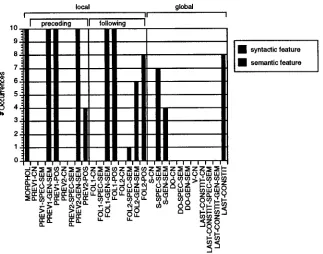
1 1 syntactic feature semantic feature [image:4.612.155.478.352.606.2]task. Among the features deemed most important for part-of-speech tagging, for example, included the general semantic class of the two preceding words, the general semantic class of the following word, and the semantic class of the subject of the current clause. This is in addition to more ob- viously relevant features: e.g., the morphology of the current wordi the part of speech of the pre- ceding and following words. A histogram of the relevant features for part-of-speech tagging across the 10 folds of the cross-validation experiments are shown in Figure 1.
Based on the experiments described in this section, we can conclude that the overall accuracy of case-based learning of linguistic knowledge de- pends to a large degree on the feature set used in the case representation. Moreover, automatic ap- proaches to feature set selection can outperform feature sets chosen manually by taking advantage of statistical relationships in the data that are dif- ficult for humans to predict and that may be id- iosyncrasies of the task and data set at hand.
U s i n g L i n g u i s t i c a n d C o g n i t i v e B i a s e s f o r F e a t u r e S e t S e l e c t i o n
We saw in the last section that the performance case-based learning algorithms degrades when fea- tures irrelevant to the learning task are included in the underlying instance representation. As a re- sult, the basic CBL algorithm for lexical tagging tasks was augmented with a decision tree algo- rithm whose job it was to discard irrelevant fea- tures from the case representation. This section presents a new technique for feature set selection for case-based learning of natural language. The new approach is potentially more powerful than the decision tree m e t h o d in that it can improve a baseline case representation in three ways rather than one:
1. It discards irrelevant features from the represen- tation.
2. It determines the relative importance of relevant features.
3. It has a limited capability for adding new fea- tures when the existing ones are inadequate for the learning task.
Furthermore, the algorithm relies on an inductive bias that m a y be more appropriate to problems in natural language understanding than the infor- mation gain metric used in the C4.5 decision tree system: our linguistic bias approach to feature set selection automatically and explicitly encodes any of a predefined set of linguistic biases and cogni- tive processing limitations into a baseline instance representation.
Thus far, we have incorporated three such bi- ases into the feature set selection algorithm: (1) a recency bias, (2) a restricted m e m o r y bias, and (3) a subject accessibility bias. Modifications to the instance representation in response to these biases either
directly
orindirectly
change the feature set used to describe all instances. Direct changes to the representation are made by adding or deleting features; indirect changes modify a weight associ- ated with each feature.In the paragraphs below, we describe these bi- ases and show how they can be used to modify the case representation for the task of relative pro- noun (RP) disambiguation. The goal of the learn- ing algorithm for relative pronoun disambiguation is: (1) to determine whether the wh-word is be- ing used as a relative pronoun, and, if it is, (2) to determine which constituents comprise the an- tecedent. In the sentence,
I saw the boy
who
won the contest.for example, the CBL system must decide that "who" is a relative pronoun that refers to "the boy."
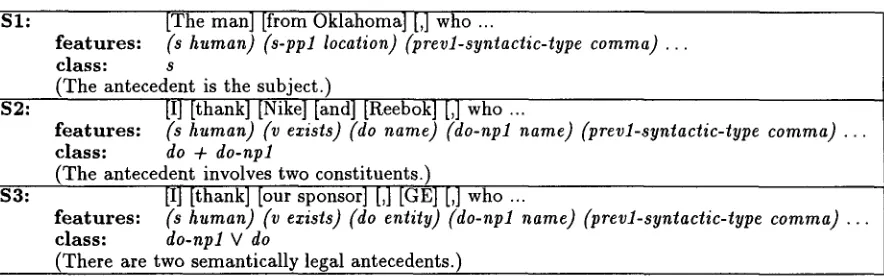
The baseline instance representation for the relative pronoun task is similar to the one used for the lexical tagging tasks. T h e main difference is that additional global context features are in- cluded in the case representation - - namely, the parser includes one attribute-value pair for every constituent in the clause that precedes the relative pronoun. Figure 2 shows a portion of three relative pronoun disambiguation cases using the baseline case representation. Each constituent is described in terms of its syntactic class and its position in the sentence as it was encountered by the CIR- CUS parser. The value for each feature provides the phrase's semantic class. The class information assigned to each case describes the location of the correct antecedent. Note that no attachment de- cisions have been made by the parser; these will be made by learning algorithm as needed. In our current implementation, the learning algorithm, rather than the parser, is also responsible for in- terpreting any conjunctions and appositives that are part of the antecedent as shown in sentences $2 and $3 of Figure 2.
SI: [The man] [from Oklahoma] [,] who ...
features:
(s human) (s-ppl location) (pvevl-syntactic-type comma) ...
class: s(The antecedent is the subject.)
S2:
[I] [thank] [Nike] [andl [Reebok] [,] who ...
features:
(s human) (v exists) (do name) (do-up1 name) (prevl-syntactic-type comma)...
class:do -t- do-up1
(The antecedent involves two constituents.)
83: [I] [thank] [our sponsor] [,] [GE] [,] who ...
features:
(s human) (v exists) (do entity) (do-up1 name) (prevl-syntactic-type comma)...
class:do-up1 V do
(There are two semantically legal antecedents.)
Figure 2: B a s e l i n e I n s t a n c e Representation.
training and test instances to include every fea- ture of the normalized feature set, filling in a
nil
value if the feature does not apply for the particu- lar instance. Unfortunately, this means that most of the features in a normalized case will be one of these "missing features." To ensure that the case retrieval algorithm focuses on features that are present rather than missing from the problem case, we also modify the original case retrieval al- gorithm to award full credit for matches on fea- tures present in the problem case and to allow par- tial credit for matches on missing features. This is accomplished by associating with each feature a weight that indicates the importance of the fea- ture in determining case similarity and by using aweighted
nearest-neighbor case retrieval algorithm:1. Set the weight,
wl,
associated with each feature, f , in the normalized feature set3:w I
= 0.2 if ff is missing from the (unnormalized) problem case,w/
= 1 otherwise.2. Compare the problem case, P , to each training case, T, in the case base and calculate, for each pair:
Igl
WN, * match(PN,,
TNi)i=1
where N is the normalized feature set, Ni is the ith feature in
N, PN~
is the value of Ni in the problem case,TN~
is the value ofNi
in the training case, andmatch(a, b)
is a function that returns 1 if a and b are equal and 0 otherwise. 3. Return the case with the highest score as wellas all ties.
4. Let the retrieved cases vote on the value of the antecedent. Again, we use a simple majority vote and break ties randomly.
3A number of other values for the missing features weight were tested as well.
[image:6.612.93.535.83.223.2]Results using this 1-nearest neighbor CBL al- gorithm for relative pronoun disambiguation us- ing the baseline case representation are shown in Table 2. For these experiments, we drew train- ing and test cases (241 instances) from MUC-3 texts that describe Latin American terrorist events (Chinchor et al., 1993). As above, all results are 10-fold cross validation averages and the parser used to generate training and test cases was the CIRCUS system. T h e performance of the CBL al- gorithm is compared to that of: (1) a default rule that always chooses the most recent phrase as the antecedent, and (2) a set of hand-coded heuristics developed for the same task specifically for use in the terrorism domain. Chi-square significance tests indicate: (1) that the hand-coded heuristics perform better (at the 95% level) than the default rule and (2) that the CBL system is not signifi- cantly different from either the default rule or the hand-coded heuristics.
Table 2: Relative P r o n o u n Disambiguation Using C B L Without Feature Set Selection.
% correct)
CBL Default i ~
-Algorithm Strategy Heuristics
w / o feature set selection
76.2 74.3 80.5
[image:6.612.334.540.535.598.2]rithm from 69.2% correct to 84.2%. In all ex- periments below, the same ten training and test set combinations as in the baseline experiments of Table 2 will be used. This procedure ensures that differences in performance are not attributable to the random partitions chosen for the test set.
I n c o r p o r a t i n g t h e R e c e n c y B i a s
In processing language, people consistently show a bias towards the use of the most recent infor- mation (e.g., Ffazier and Fodor (1978), Gibson (1990), Kimball: (1973), Nicol (1988)). In par- ticular, Cuetos and Mitchell (1988), Frazier and Fodor (1978), and others have investigated the im- portance of recency in finding the antecedents of relative pronouns. They found that there is a pref- erence for choosing the most recent noun phrase in sentences of the form NP V NP OF-PP, with ambiguous relative pronoun antecedents, e.g.:
The journalist interviewed the daughter of the colonel who had had the accident.
In addition, Gibson et al. (1993) looked at phrases of the form: NP1 P R E P NP2 OF NP3 RELATIVE-CLAUSE,. E.g.,
...the lamps near the paintings of the house that was damaged in the flood.
...the lamps near the painting of the houses that was damaged in the flood.
...the lamp near the paintings of the houses that was damaged in the flood.
He found that the most recent noun phrase (NP3) was initially preferred as the antecedent and that recognizing antecedents in the NP2 and NP1 po- sitions were significantly harder than recognizing the most recent noun phrase as the antecedent.
We translate this recency bias into representa- tional changes for the training and problem cases in two ways. The first is a direct modification to the attributes that comprise the case representa- tion, and the second modifies the weights to in- dicate a constituent's distance from the relative pronoun.
In the first approach, we label the each con- stituent feature by its position relative to the rel- ative pronoun. This establishes a right-to-left la- beling of constituents rather than the left-to-right labeling that the baseline representation incorpo- rates. In Figure 3, for example, "in Congress" re- ceives the attribute ppl in the right-to-left labeling because it is a prepositional phrase one position to the left of "who." Similarly, "the hardliners" receives the attribute np2 because it is a noun phrase two positions to the left of "who." The right-to-left ordering yields a different feature set and, hence, a different case representation. For ex-
119
ample, the right-to-left labeling assigns the same antecedent value (i.e., ppP) to both of the following sentences:
• "it was a message from the hardliners in Congress, who..."
• "it was from the hardliners in Congress, who..."
The baseline (left-to-right) representation, on the other hand, labels the antecedents with distinct attributes - - do-ppl and v-ppl, respectively.
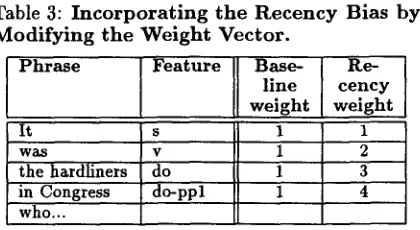
In the second approach to incorporating the recency bias, we increment the weight associated with each constituent as a function of its proximity to the relative pronoun (see Table 3). The feature associated with the constituent farthest from the relative pronoun receives a weight of one, and the weights are increased by one for each subsequent constituent. All features added to the case as a result of feature normalization (not shown in Ta- ble 3) receive a weight of one.
Table 3: I n c o r p o r a t i n g t h e R e c e n c y B i a s b y M o d i f y i n g t h e W e i g h t V e c t o r .
It
w a s
the hardliners in Congress
who...
F e a t u r e B a s e -
l i n e
weight
s 1
v 1
do 1
do-ppl 1
R e - c e n c y
weight
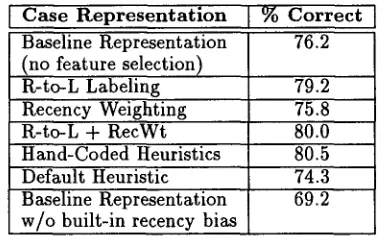
The results of experiments that use each of the recency representations separately and in a com- bined form are shown in Table 4. To combine the two implementations of the recency bias, we first relabel the attributes of a case using the right-to- left labeling and then initialize the weight vector using the recency weighting procedure described above. The table shows that the recency weighting representation alone tends to degrade prediction of relative pronoun antecedents as compared to the baseline CBL system. Both the right-to-left label- ing and combined representations improve perfor- mance - - they perform significantly better than the default heuristic, but do not yet exceed the level of the hand-coded heuristics. T h e final row of results will be described below.
[image:7.612.322.532.330.445.2]Sentence:
b a s e l i n e
representation:
[image:8.612.219.413.189.307.2]r i g h t - t o - l e f t l a b e l i n g :
[It[ [was] [the hardliners] [in Congress] [,] who ...
(s entity) (v exists) (do human) (do-ppl entity) (prevl-syntactic-type
prep.phrase) ...
(class do)(s entity) (v exists) (np2 human) (ppl entity) (prevl-syntactic-type
prep-phrase) ...
(class np2)Figure 3: I n c o r p o r a t i n g
the Recency
B i a s U s i n g a R i g h t - t o - L e f t L a b e l i n g .Table 4: R e s u l t s f o r t h e R e c e n c y B i a s
Representations.
[ Case Representation
[ % C o r r e c t [Baseline Representation 76.2 (no feature selection)
R-to-L Labeling 79.2 Recency Weighting 75.8 R-to-L + RecWt 80.0 Hand-Coded Heuristics 80.5 Default Heuristic 74.3 Baseline Representation 69.2 w / o built-in recency bias
mance of the recency weighting representation, on the other hand, m a y be caused by (1) its lack of such a representation of local context, and (2) its bias against antecedents t h a t are distant from the relative pronoun (e.g., "...to help especially
those
people
living in the Patagonia region of Argentina, who are being treated inhumanely..."). Nineteen of the 241 cases have antecedents that include the often distant subject of the preceding clause.Furthermore, the recency bias performs well in spite of the fact that the baseline represen- tation already provides a built-in recency bias. The baseline represents the constituent that pre- cedes the relative pronoun up to three times in the baseline representation - - as a constituent fea- ture (e.g., "direct object") and via the "last con- stituent" global context features. 4 The last row in Table 4 shows the performance of the baseline representation when this built-in bias is removed by discarding the
last-constituent
features.Incorporating the
R e s t r i c t e d M e m o r yBias
Psychological studies have determined that peo- ple can remember at most seven plus or minus two items at any one time (Miller, 1956). More re- cently, D a n e m a n and Carpenter (1983, 1980) show that working m e m o r y capacity affects a subject's ability to find the referents of pronouns over vary-
4This means that when the constituent immedi- ately preceding "who" in the problem case and a train- ing case match, that constituent accounts for a greater percentage of the similarity score than does any other constituent.
ing distances. King and Just (1991) show that differences in working m e m o r y capacity can cause differences in the reading time and comprehension of certain classes of relative clauses. Moreover, it has been hypothesized that language learning in humans is successful precisely because limits on information processing capacities allow chil- dren to ignore much of the linguistic d a t a they re- ceive (Newport, 1990). Some computational lan- guage learning systems (e.g., E l m a n (1990)) actu- ally build a short term m e m o r y directly into the architecture of the system.
Our baseline case representation does not nec- essarily make use of this
restricted memory bias,
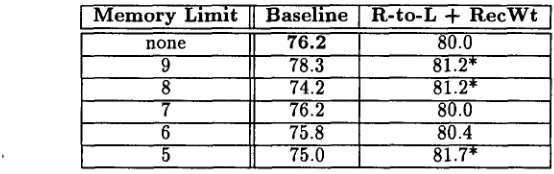
however. Each case is described in terms of the normalized feature set, which contains an aver- age of 38.8 features. Unfortunately, incorporat- ing the restricted m e m o r y limitations into the case representation is problematic. Previous restricted memory studies (e.g., short term m e m o r y stud- ies) do not state explicitly what the m e m o r y limit should be - - it varies from five to nine depending on the cognitive task and depending on the size and type of the "chunks" that have to be remem- bered. In addition, the restricted m e m o r y bias alone does not state which chunks, or features, to keep and which to discard.Table 5: R e s u l t s f o r t h e R e s t r i c t e d M e m o r y Bias R e p r e s e n t a t i o n . (% correct, *'s indicate significance with respect to the original baseline result shown in boldface, * ~ p = 0.05)
M e m o r y Limit
none
Baseline 776.2
78.3 74.2 76.2 75.8 75.0
R-to-L + RecWt
80.0 81.2" 81.2" 80.0 80.4 81.7*
cards all but the n selected features from the case representation. Results for the restricted mem- ory bias representation are shown in Table 5. The first column of results shows the effect of mem- ory limitations on the baseline representation. In general, the restricted memory bias with random feature selection degrades the ability of the sys- tem to predict relative pronoun antecedents al- though none of the changes is statistically signifi- cant. This is not surprising given that the current implementation of the bias is likely to discard rel- evant features as well as irrelevant features. We expect that this bias will have a positive impact on performance only when it is combined with lin- guistic biases that provide feature relevancy infor- mation. This is, in fact, the case: the final column in Table 5 shows the effect of restricted memory limitations on the combined recency representa- tion. To incorporate the restricted memory bias and the combined recency bias into the baseline case representation, we (1) apply the right-to-left labeling, (2) rank the features of the case accord- ing to the recency weighting, and (3) keep the n features with the highest weights (where n is the memory limit). Ties are broken randomly.
We expected: the merged representation to perform rather well because the combined recency bias representation worked well on its own and be- cause the restricted memory (RM) bias essentially discards features that are distant from the relative pronoun and rarely included in the antecedent. As shown in the last column of Table 5, four out of five RM/recency variations posted higher ac- curacies than the combined recency representa- tion. In fact, three of the RM/recency represen- tations now outperform the original baseline rep- resentation (shown in boldface) at the 95% sig- nificance level. (Until this point, the best rep- resentation had been the combined recency rep- resentation, which significantly outperformed the default heuristic, but not the baseline case repre- sentation.)
I n c o r p o r a t i n g t h e S u b j e c t A c c e s s i b i l i t y
Bias
A number of studies in psycholinguistics have noted the special importance of the first item men- tioned in a sentence. In particular, it has been shown that the accessibility of the first discourse object, which very often corresponds to the sub- ject of the sentence, remains high even at the end of a sentence (Gernsbacher et al., 1989). This sub- ject accessibility bias is an example of a more gen- eral focus of attention bias. In vision learning problems, for example, the brightest object in view may be a highly accessible object for the learning agent; in aural tasks, very loud or high-pitched sounds may be highly accessible. We incorpo- rate the subject accessibility bias into the baseline representation by increasing the weight associated with the constituent attribute that represents the subject of the clause preceding the relative pro- noun whenever that feature is part of the normal- ized feature set.
Table 6: R e s u l t s for t h e S u b j e c t Accessibility
Bias Representation. (% correct)
Baseline 76.2
Baseline, SubjWt=2 75.0 Baseline, SubjWt=5 74.2 Baseline, SubjWt=7 73.7 Baseline, SubjWt=10 73.3
[image:9.612.139.416.116.203.2]subject as a major constituent of the sentence (i.e., "s") rather than by labeling it merely as a low-level noun phrase (i.e., "np"). It may be that this built- in encoding of the bias is adequate or that, like the restricted memory bias, additional modifications to the baseline representation are required before the subject accessibility bias can have a positive effect on the learning algorithm's ability to find relative pronoun antecedents.
Table 7 shows the effects of merging the sub- ject accessibility bias with both recency biases and the restricted memory bias (RM). The results in the first column (Baseline) are just the results from Table 6 - - they indicate the performance of the baseline case representation with various levels of the subject accessibility bias. The second col- umn shows the effect of incorporating the subject accessibility bias into the combined recency bias representation. To create this merged represen- tation, we first establish the right-to-left labeling of features and then add together the weight vec- tors recommended by the recency weighting and subject accessibility biases. As was the case with the baseline representation, incorporation of the subject accessibility bias steadily decreases perfor- mance of the learning algorithm as the weight on the subject constituent is increased. None of the changes is statistically significant.
The remaining five columns of Table 7 show the effects of incorporating all three linguistic bi- ases into the baseline case representation. To create this representation, we (1) relabel the at- tributes using the right-to-left labeling, (2) incor- porate the subject and recency weighting repre- sentations by adding the weight vectors proposed by each bias, (3) apply the restricted memory bias by keeping only the n features with the highest weights (where n is the memory limit) and choos- ing randomly in case of ties. Results for these ex- periments indicate that some combinations of the linguistic bias parameters work very well together and others do not. In general, associating a weight of two with the subject constituent improves the accuracy of the learning algorithm as compared to the corresponding representation that omits the subject accessibility bias. (Compare the first and second rows of results). In particular, three repre- sentations (shown in italics) now outperform the best previous representation (which had the r-to- 1 labeling, recency weighting, memory limit = 5 and achieved 81.7% correct). In addition, the best-performing representation now outperforms the hand-coded relative pronoun disambiguation rules (84.2% vs. 80.5%) at the 90% significance level.
In summary, this section presented a linguistic bias approach to feature set selection and applied it to the problem of finding the antecedent of the
relative pronoun "who." Our experiments showed that performance of the case-based learning algo- rithm steadily improved as each of the available linguistic biases was used to modify the baseline case representation. Although one would not ex- pect monotonic improvement to continue forever, it is clear that explicit incorporation of linguis- tic biases into the case representation can improve the learning algorithm performance for the relative pronoun disambiguation task. Table 8 summarizes these results. When all three biases are included in the case representation, the learning algorithm performs significantly better than the hand-coded rules (84.2% correct vs. 80.5% correct) at the 90% confidence level.
D i s c u s s i o n a n d C o n c l u s i o n s
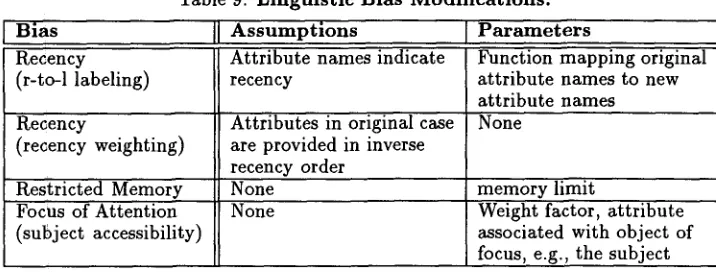
It should be emphasized that modifications to the baseline case representation in response to each of the individual linguistic biases are performed a u t o m a t i c a l l y by the CBL system, subject to the constraints provided in Table 9. Upon invocation of the CBL algorithm, the user need only specify (1) the names of the biases to incorporate into the case representation, and (2) any parameters required for those biases (e.g., the memory limit for the restricted memory bias).
In addition, the linguistic bias approach to feature set selection relies on the following gen- eral procedure when incorporating more than one linguistic bias into the baseline representation:
1. First, incorporate any bias that relabels at- tributes (e.g., r-to-1 labeling).
2. Then, incorporate biases that modify feature weights by adding the weight vectors proposed by each bias (e.g., recency weighting, subject accessibility bias).
3. Finally, incorporate biases that discard features (e.g., restricted memory bias), but give pref- erence to those features assigned the highest weights in Step 2.
Thus far, we have implemented just three lin- guistic biases, all of which represent broadly ap- plicable cognitive processing limitations. We ex- pect that additional biases will be needed to han- dle new natural language learning tasks, but that, in general, a relatively small set of linguistic biases should be adequate for handling large number of problems in natural language learning. Examples of other useful linguistic biases to make available include: minimal attachment, right association, lexical preference biases, and a syntactic structure identity bias.
Table 7: A d d i t i o n a l R e s u l t s f o r t h e S u b j e c t A c c e s s i b i l i t y B i a s R e p r e s e n t a t i o n . (% correct, *'s indicate significance with respect to the original baseline result shown in b o l d f a c e , • ~ p = 0.05, ** --, p = 0.01; RM refers to the memory limit).
S u b j e c t W e i g h t
none
2
S u b j A c c R - t o - L R e c W t
R M = 5 Baseline SubjAcc
R-to-L R e c W t
76.2 80.0 75.0 79.6 74.2 78.3 73.7 77.5 73.3 76.7
81.7"
8 4 . 2 * *
79.6 79.6
SubjAcc
R - t o - L R e c W t
R M = 6
80.4
8 2 . 5 *
S u b j A c c S u b j A c c R - t o - L R - t o - L R e c W t R e c W t R M = 7 R M = 8
80.0
82.1 *
78.3 77.9
81.2" 81.2" 80.4 76.7
S u b j A c c R - t o - L R e c W t
R M = 9
81.2" 80.8 79.6 77.9
10 79.6 79.2 78.3 80.4 79.6
Table 8: S u m m a r y o f L i n g u i s t i c B i a s R e s u l t s .
C a s e R e p r e s e n t a t i o n % C o r r e c t Baseline w / o Built-in Recency Bias 69.2 Default Heuristic: Choose Most Recent Phrase 74.3
Baseline 76.2
Baseline
+ Recency Bias 80.0
Hand-Coded Heuristics 80.5
Baseline
+ Recency Bias
+ Restricted Memory Bias (limit=5) 81.7 Baseline
+ Recency Bias
+ Restricted Memory Bias (limit=5)
+ Subject Accessibility Bias (subj wt=2) 84.2
Table
Bias A s s u m p t i o n s
Recency (r-to-1 labeling)
Recency
(recency weighting)
Attribute names indicate recency
Attributes in original case are provided in inverse recency order
9: L i n g u i s t i c Bias M o d i f i c a t i o n s .
P a r a m e t e r s
Function mapping original attribute names to new attribute names None
Restricted Memory None Focus of Attention None (subject accessibility)
m e m o r y limit
Weight factor, attribute associated with object of focus, e.g., the subject
[image:11.612.94.509.154.250.2] [image:11.612.164.442.323.487.2] [image:11.612.122.480.561.698.2]best performance for a particular natural language learning task. Our current approach assumes that the expert knowledge of computational linguists is easier to apply at the level of linguistic bias se- lection than at the feature set selection level - - so at the very least, this expert knowledge can be used to seed the bias selection algorithm. For the relative pronoun task, for example, we assumed that all three linguistic biases were relevant and then exhaustively enumerated all combinations of the biases, choosing the combination that per- formed best in cross-validation testing. Because this method will get quickly out of hand as ad- ditional biases are included or parameters tested, future work should investigate less costly alterna- tives to linguistic bias selection.
In addition, we have tested the linguistic bias approach to feature selection on just one natural language learning task. We believe, however, that it offers a generM approach for case-based learning of natural language. In theory, it allows system de- velopers to use the same underlying case represen- tation for a variety of problems in NLP rather than developing a new representation as each new task is tackled. The underlying case representation only has to change when new knowledge sources become available to the NLP system in which the CBL system is embedded. Hence, the baseline case representation is parser-dependent (i.e., NLP system-dependent) rather than task-dependent.
In particular, we are currently applying the linguistic bias CBL approach to the problem of general pronoun resolution. While it appears that our existing linguistic bias set will be of use, we be- lieve that the CBL system will benefit from addi- tional linguistic biases. Centering constraints (see Brennan et al., 1987), for example, can be encoded as linguistic biases and applied to the pronoun res- olution task to increase system performance.
Furthermore, we have focused on applying the linguistic bias approach to feature set selection for case-based learning algorithms only. In future work, we plan to investigate the use of the ap- proach for feature selection in conjunction with other standard machine learning algorithms. Here we expect that very different manipulations of the baseline case representation will be needed to im- plement the linguistic biases presented in this pa- per.
Finally, the viability of both the linguistic bias approach to feature set selection and the gen- eral CBL approach to natural language learning must be tested using much larger corpora. Exper- iments on case-based part-of-speech tagging by re- searchers at Tilburg University (Daelemans et al., submitted), however, indicate that the CBL ap- proach to natural language learning will scale to
much larger data sets.
In summary, this paper begins to address the issue of "algorithm vs. representation" for case- based learning of linguistic knowledge. We have shown empirically that the feature set used to de- scribe training and test instances plays an impor- tant role for a number of tasks in natural lan- guage understanding. In addition, we have pre- sented an automated approach to feature set se- lection for case-based learning of linguistic knowl- edge. The approach takes a baseline case represen- tation and modifies it in response to one of three linguistic biases by adding, deleting, and weight- ing features appropriately. We applied the tech- nique to the task of relative pronoun disambigua- tion and found that the case-based learning al- gorithm improves as relevant biases are used to modify the underlying case representation. Fi- nally, we have argued that the linguistic bias ap- proach to feature set selection offers new possibil- ities for case-based learning of natural language. It simplifies the process of designing an appro- priate instance representation for individual natu- ral language learning tasks because system devel- opers can safely include in the baseline instance representation features for all available knowledge sources. In the long run, it may obviate the need for separate instance representations for each lin- guistic knowledge acquisition task. More impor- tantly, the linguistic bias CBL approach to natural language learning offers a mechanism for explic- itly combining the frequency information available from corpus-based techniques with linguistic bias information employed in traditional linguistic and knowledge-based approaches to natural language processing.
R e f e r e n c e s
(Aha et al., 1991) D. Aha, D. Kibler, and M. Al- bert. 1991. Instance-Based Learning Algo- rithms. Machine Learning, 6(1):37-66.
(Aha, 1989) D. Aha. 1989. Instance-Based Learn- ing Algorithms. In Proceedings of the Sixth In- ternational Conference on Machine Learning,
pages 387-391, Cornell University, Ithaca, NY. Morgan Kaufmann.
(Almuallim and Dietterich, 1991) H. Almual- lim and T. G. Dietterich. 1991. Learning With Many Irrelevant Features. In Proceedings of the Ninth National Conference on Artificial Intel- ligence, pages 547-552, Anaheim, CA. AAAI Press / MIT Press.
Annual Meeting of the A CL, pages 122-129. As- sociation for Computational Linguistics. (Bosch and Daelemans, 1993) A. van den Bosch
and W. Daelemans. 1993. Data-oriented meth- ods for grapheme-to-phoneme conversion. In
Proceedings of European Chapter of ACL, pages 45-53, Utrecht. Also available as ITK Research Report 42.
(Brennan et al., 1987) Susan E. Brennan, Mari- lyn Walker Friedman, and Carl J. Pollard. 1987. A Centering Approach to Pronouns. In Proceed- ings of the 25th Annual Meeting of the ACL.
Association for Computational Linguistics. (Cardie and Lehnert, 1991) C. Cardie and
W. Lehnert. 1991. A Cognitively Plausible Ap- proach to Understanding Complicated Syntax. In Proceedings of the Ninth National Conference on Artificial Intelligence, pages 117-124, Ana- heim, CA. AAAI Press / MIT Press.
(Cardie, 1992a) C. Cardie. 1992a. Corpus-Based Acquisition of Relative Pronoun Disambigua- tion Heuristics. In Proceedings of the 30th An- nual Meeting of the ACL, pages 216-223, Uni- versity of Delaware, Newark, DE. Association for Computational Linguistics.
(Cardie, 1992b) C. Cardie. 1992b. Learning to Disambiguate Relative Pronouns. In Proceed- ings of the Tenth National Conference on Arti- ficial Intelligence, pages 38-43, San Jose, CA. AAAI Press / MIT Press.
(Cardie, 1993a)C. Cardie. 1993a. A Case- Based Approach to Knowledge Acquisition for Domain-Specific Sentence Analysis. In Proceed- ings of the Eleventh National Conference on Ar- tificial Intelligence, pages 798-803, Washington, DC. AAAI Press / MIT Press.
(Cardie, 1993b) C. Cardie. 1993b. Using De- cision Trees to Improve Case-Based Learning. In P. Utgoff, editor, Proceedings of the Tenth International Conference on Machine Learn- ing, pages 25-32, University of Massachusetts, Amherst, MA. Morgan Kaufmann.
(Cardie, 1994) C. Cardie. 1994. Domain-Specific Knowledge Acquisition for Conceptual Sentence Analysis. Ph.D. thesis, University of Mas- sachusetts, Amherst, MA. Available as Univer- sity of Massachusetts, CMPSCI Technical Re- port 94-74.
(Chinchor et al., 1993) N. Chinchor, L. Hirschman, and D. Lewis. 1993. Evaluat- ing Message Understanding Systems: An Anal- ysis of the Third Message Undestanding Con- ference (MUC-3). Computational Linguistics,
19(3):409-449.
(Cuetos and Mitchell, 1988) F. Cuetos and D. C. Mitchell. 1988. Cross-Linguistic Differences
125
in Parsing: Restrictions on the Use of the Late Closure Strategy in Spanish. Cognition,
30(1):73-105.
(Daelemans et al., 1994) W. Daelemans, G. Durieux, and S. Gillis. 1994. The Acquisition of Stress: A Data-Oriented Approach. Compu- tational Linguistics, 20(3):421-451.
(Daelemans et al., submitted)
W. Daelemans, J. Zavrel, Berck P., and Gillis S. submitted. Memory-Based Part of Speech Tagging. Tilburg University.
(Daneman and Carpenter, 1980) M. Dane- man and P. A. Carpenter. 1980. Individual Differences in Working Memory and Reading.
Journal of Verbal Learning and Verbal Behav- ior, 19:450-466.
(Daneman and Carpenter, 1983)
M. Daneman and P. A. Carpenter. 1983. In- dividual Differences in Integrating Information Between and Within Sentences. Journal of Ex- perimental Psychology: Learning, Memory, and Cognition, 9:561-584.
(Elman, 1990) J. Elman. 1990. Finding Structure in Time. Cognitive Science, 14:179-211.
(Frazier and Fodor, 1978)L. Frazier and J. D. Fodor. 1978. The Sausage Machine: A New Two-Stage Parsing Model. Cognition, 6:291- 325.
(Gernsbacher et al., 1989) M. A. Gernsbacher, D. J. Hargreaves, and M. Beeman. 1989. Build- ing and Accessing Clausal Representations: The Advantage of First Mention Versus the Advan- tage of Clause Recency. Journal of Memory and Language, 28:735-755.
(Gibson et al., 1993) E. Gibson, N. Pearlmutter, E. Canseco-Gonzalez, and G. Hickok. 1993. Cross-linguistic Attachment Preferences: Evi- dence from English and Spanish. In Sixth An- nual CUNY Sentence Processing Conference,
University of Massachusetts, Amherst, MA. Only abstract in the Sentence Processing Con- ference proceedings. Full manuscript to appear in journal.
(Gibson, 1990) E. Gibson. 1990. Recency Prefer- ences and Garden-Path Effects. In Proceedings of the Twelfth Annual Conference of the Cog- nitive Science Society, Massachusetts Institute of Technology, Cambridge, MA. Lawrence Erl- baum Associates.
(Kimball, 1973) J. Kimball. 1973. Seven Prin- ciples of Surface Structure Parsing in Natural Language. Cognition, 2:15-47.
(Kolodner, 1993) J. Kolodner. 1993. Case-Based Reasoning. Morgan Kaufmann, San Mateo, CA. (Langley and Sage, in press)
P. Langley and S. Sage. in press. Scaling to domains with irrelevant features. In R. Greiner, editor, Computational learning theory and natu- ral learning systems, volume 4. The MIT Press, Cambridge, MA.
(Lehnert, 1990) W. Lehnert. 1990. Sym- bolic/Subsymbolic Sentence Analysis: Exploit- ing the Best of Two Worlds. In J. Barnden and J. Pollack, editors, Advances in Connec- tionist and Neural Computation Theory, pages 135-164. Ablex Publishers, Norwood, NJ. (Litman, 1994) Diane J. Litman. 1994. Classify-
ing Cue Phrases in Text and Speech Using Ma- chine Learning. In Proceedings of the Twelfth National Conference on Artificial Intelligence,
pages 806-813. AAAI Press / MIT Press. (Magerman, 1995) David M. Magerman. 1995.
Statistical Decision-Tree Models for Parsing. In
Proceedings of the 33rd Annual Meeting of the ACL, pages 276-283. Association for Computa- tional Linguistics.
(McCarthy and Lehnert, 1995)
Joseph F. McCarthy and Wendy G. Lehnert. 1995. Using Decision Trees for Coreference Res- olution. In C. Mellish, editor, Proceedings of the Fourteenth International Conference on Artifi- cial Intelligence, pages 1050-1055.
(Miller, 1956) G. A. Miller. 1956. The Magical Number Seven, Plus or Minus Two: Some Lim- its on our Capacity for Processing Information.
Psychological Review, 63(1):81-97.
(MUC, 1994) 1994. Proceedings of the Fifth Mes- sage Understanding Conference (MUC-5}. Mor- gan Kaufmann, San Marco, CA.
(Newport, 1990) E. Newport. 1990. Maturational Constraints on Language Learning. Cognitive Science, 14:11-28.
(Nicol, 1988) J. Nicol. 1988. Coreference Pro- cessing During Sentence Comprehension. Ph.D. thesis, Massachusetts Institute of Technology, Cambridge, MA.
(Pereira, 1994) F. Pereira. 1994. Frequencies vs Biases: Machine learning problems in natu- ral language processing. In Proceedings of the Eleventh International Conference on Machine Learning, page 380, Rutgers University, New Brunswick, NJ. Morgan Kaufmann.
(Quinlan, 1983) J. R. Quinlan. 1983. Learning Ef- ficient Classification Procedures and Their Ap- plication to Chess End Games. In R. S. Michal- ski, J. G. Carbonell, and T. M. Mitchell, ed- itors, Machine Learning: An Artificial lntelli-
gence Approach. Morgan Kaufmann, San Ma- teo, CA.
(Quinlan, 1992) J. R. Quinlan. 1992. C4.5: Pro- grams for Machine Learning. Morgan Kauf- mann, San Mateo, CA.
(Riesbeck and Schank, 1989) C. Riesbeck and R. Schank. 1989. Inside Case-Based Reason- ing. Erlbaum, Northvale, NJ.
(Riloff and Lehnert, 1994) E. Riloff and W. Lehn- ert. 1994. Information extraction as a basis for high-precision text classification. A C M Trans- actions on Information Systems, 12(3):296-333. (Simmons and Yu, 1992) Robert F. Simmons and
Yeong-Ho Yu. 1992. The Acquisition and Use of Context-Dependent Grammars for English.
Computational Linguistics, 18(4):391-418. (Stanfill and Waltz, 1986) C. Stanfill and
D. Waltz. 1986. Toward Memory-based Rea- soning. Communications of the ACM, 29:1213- 1228.
(Zelle and Mooney, 1993) J. Zelle and R. Mooney. 1993. Learning Semantic Grammars with Con- structive Inductive Logic Programming. In Pro- ceedings of the Eleventh National Conference on Artificial Intelligence, pages 817-822, Washing- ton, DC. AAAI Press / MIT Press.