Proceedings of NAACL-HLT 2019, pages 1702–1723
1702
What makes a good conversation?
How controllable attributes affect human judgments
Abigail See∗
Stanford University
Stephen Roller Facebook AI Research
Douwe Kiela Facebook AI Research
Jason Weston Facebook AI Research
Abstract
A good conversation requires balance – be-tween simplicity and detail; staying on topic and changing it; asking questions and an-swering them. Although dialogue agents are commonly evaluated via human judgments of overall quality, the relationship between quality and these individual factors is less well-studied. In this work, we examine two controllable neural text generation methods, conditional training and weighted decoding, in order to control four important attributes for chitchat dialogue: repetition, specificity, response-relatedness and question-asking. We conduct a large-scale human evaluation to measure the effect of these control parame-ters on multi-turn interactive conversations on the PersonaChat task. We provide a detailed analysis of their relationship to high-level as-pects of conversation, and show that by con-trolling combinations of these variables our models obtain clear improvements in human quality judgments.
1 Introduction
Neural generation models for dialogue, despite their ubiquity in current research, are still poorly understood. Well known problems, such as the genericness and repetitiveness of responses (
Ser-ban et al.,2016a), remain without a de facto
solu-tion. Strikingly, the factors that determine human judgments of overall conversation quality are al-most entirely unexplored. Most works have been limited to the next utterance prediction problem, whereas a multi-turn evaluation is necessary to evaluate the quality of a full conversation.
In this work we both (i) conduct a large-scale study to identify the fine-grained factors governing human judgments of full conversations, and (ii) develop models that apply our findings in practice,
∗
[image:1.595.310.523.217.345.2]A.S. completed most of this work at Facebook (FAIR).
Figure 1: We manipulate four low-level attributes and measure their effect on human judgments of individual conversational aspects, as well as overall quality.
leading to state-of-the-art performance. Specifi-cally, we identify and study eight aspects of con-versation that can be measured by human judg-ments, while varying four types of low-level at-tributes that can be algorithmically controlled in neural models; see Figure1. To control the low-level model attributes, we consider two simple but general algorithms: conditional training, in which the neural model is conditioned on additional con-trol features, and weighted decoding, in which control features are added to the decoding scoring function at test time only.
One major result of our findings is that existing work has ignored the importance of conversational flow, as standard models (i) repeat or contradict previous statements, (ii) fail to balance specificity with genericness, and (iii) fail to balance asking questions with other dialogue acts. Conducting experiments on the PersonaChat task (Zhang et al.,
2018b), we obtain significantly higher
engaging-ness scores than the baseline by optimizing con-trol of repetition, specificity and question-asking over multiple turns. Using these findings, our best model matches the performance of the winning en-try in the recent NeurIPS ConvAI2 competition
more data but had no control (see Section 8.1). Our code, pretrained models, and full chatlogs, are
available at https://parl.ai/projects/
controllable_dialogue.
2 Related Work
Dialogue Dialogue evaluation is relatively well
understood in goal-oriented tasks, where auto-mated approaches can be coded by measuring task completion (Bordes et al., 2017; El Asri et al.,
2017;Hastie, 2012;Henderson et al.,2014;Wen
et al., 2017). Task success combined with
dia-logue cost can be linked to human judgments like user satisfaction via the PARADISE framework
(Walker et al.,1997).
However in chitchat tasks, which we study in this work, automatic metrics and their relation to human ratings are less well-understood. While word-overlap metrics are effective for question-answering and machine translation, for dialogue they have little to no correlation with human judg-ments (Liu et al., 2016;Novikova et al., 2017) – this is due to the open-ended nature of dialogue. There are more recent attempts to find better auto-matic approaches, such as adversarial evaluation
(Li et al., 2017b) and learning a scoring model
(Lowe et al.,2017), but their value is still unclear.
Nevertheless, a number of studies only use au-tomatic metrics, with no human study at all (Lowe
et al.,2015;Parthasarathi and Pineau,2018;
Ser-ban et al., 2016b). Other works do use human
evaluations (Dinan et al.,2018;Li et al.,2016a,b;
Venkatesh et al., 2017; Vinyals and Le, 2015;
Zhang et al.,2018b), typically reporting just one
type of judgment (either quality or appropriate-ness) via a Likert scale or pairwise comparison. Most of those works only consider single turn evaluations, often with a shortened dialogue his-tory, rather than full multi-turn dialogue.
A more comprehensive evaluation strategy has been studied within the scope of the Alexa prize
(Venkatesh et al.,2017;Guo et al.,2018) by
com-bining multiple automatic metrics designed to cap-ture various conversational aspects (engagement, coherence, domain coverage, conversational depth and topical diversity). Though these aspects have some similarity to the aspects studied here, we also focus on lower-level aspects (e.g. avoiding repeti-tion, fluency), to understand how they correspond to both our controllable attributes, and to overall quality judgments.
Controllable neural text generation
Re-searchers have proposed several approaches to control aspects of RNN-based natural language generation such as sentiment, length, speaker style and tense (Fan et al., 2018; Ficler and
Goldberg, 2017; Ghazvininejad et al., 2017; Hu
et al., 2017; Kikuchi et al., 2016; Peng et al.,
2018; Wang et al., 2017). In particular, several
works use control to tackle the same common sequence-to-sequence problems we address here (particularly genericness and unrelated output), in the context of single-turn response generation
(Baheti et al.,2018;Li et al.,2016a,2017a;Shen
et al.,2017;Xing et al.,2017;Zhang et al.,2018a;
Zhou et al., 2017). By contrast, we focus on
developing controls for, and human evaluation of, multi-turn interactive dialogue – this includes a new method (described in Section 5) to control attributes at the dialogue level rather than the utterance level.
In this work, we require a control method that is both general-purpose (one technique to simul-taneously control many attributes) and easily tun-able (the control setting is adjusttun-able after train-ing). Given these constraints, we study two control methods: conditional training (variants of which have been described byFan et al.(2018);Kikuchi
et al.(2016);Peng et al.(2018)) and weighted
de-coding (described byGhazvininejad et al.(2017) as a general technique, and byBaheti et al.(2018) to control response-relatedness). To our knowl-edge, this work is the first to systematically com-pare the effectiveness of two general-purpose con-trol methods across several attributes.
3 The PersonaChat dataset
met-rics (perplexity, hits@1 and F1 score), and then with respect to human judgment via the question “How much did you enjoy talking to this user?” on a scale of 1–4.
4 Baseline model
Our baseline model is a 2-layer LSTM sequence-to-sequence model with attention. On any dia-logue turn, the inputxto the encoder is the entire dialogue history (separated using unique speaker-identifying tokens), with the model’s own persona prepended. Conditioned on this input sequence
x, the decoder generates a response y. Except when stated otherwise, all our models decode us-ing beam search with beam size 20.
We initialized the word embedding matrix with 300-dimensional GloVe embeddings (Pennington
et al.,2014). Using the ParlAI framework (Miller
et al.,2017), we pretrained the model on a dataset
of 2.5 million Twitter message-response pairs,1 then fine-tuned it on PersonaChat. On the Per-sonaChat validation set, the baseline model has a perplexity of 26.83 and F1 of 17.02, which would have placed us 4th out of 26 models in the Con-vAI2 competition (Dinan et al.,2019). We attempt to improve over this baseline using control.
5 Controllable text generation methods
Suppose we have a sequence-to-sequence model which gives P(y|x) = ΠtP(yt|x, y1, . . . , yt−1),
the conditional probability of a response y (the model’s next utterance) given inputx(the context, which in our case includes the model’s own per-sona and the dialogue history).
Contrary to most previous work, which con-trolsat the sentence level, we wish to control at-tributes of the output y at the dialogue level – meaning that a single control setting is used for a whole dialogue. For example, to control question-asking, we provide a control setting at the begin-ning of each dialogue (e.g.20% questionsor70% questions) rather than providing a control setting for each utterance (e.g. is a question or isn’t a question). With this approach, the sequence-to-sequence model is able to choose what value the controlled attribute should take for any particular utterance, but we are able to choose the overall dis-tribution. We find that this approach works well – for example, the sequence-to-sequence model is
1The Twitter dataset is provided in ParlAI; details can be
found here:https://parl.ai/docs/tasks.html
generally good at detecting when to ask a ques-tion. In particular, this is easier than the alterna-tive: developing a separate process to decide, for each utterance, whether to ask a question.
In this section, we describe the two methods – which we call Conditional Training (CT) and Weighted Decoding (WD) – that we use to control attributes of the outputyat the dialogue level.
5.1 Conditional Training (CT)
Conditional Training (Fan et al., 2018; Kikuchi
et al., 2016; Peng et al., 2018) is a method to
learn a sequence-to-sequence model P(y|x, z), where z is a discrete control variable. If the control attribute is naturally continuous (for ex-ample in our work, repetitiveness, specificity and response-relatedness), we usezto represent buck-eted ranges. For a binary attribute like question-asking,zrepresents an overall probability (as ex-plained in Section5).
To train a CT model, we first automatically an-notate every(x, y)pair in the training set with the attribute we wish to control (for example, whether
y contains a question mark). During training, for each example we determine the correspond-ing z value (for continuous attributes, this sim-ply means sorting into the correct bucket; for question-asking, see Section6.4). Next, the con-trol variable z is represented via an embedding (each of the possible values ofz has its own em-bedding). For all our experiments, the embedding is of length 10; this was determined via hyperpa-rameter tuning. There are several possible ways to condition the sequence-to-sequence model onz
– for example, append z to the end of the input sequence, or usez as the START symbol for the decoder. We find it most effective to concatenate
zto the decoder’s input on every step.2Lastly, the CT model learns to produce y = y1, . . . , yT by
optimizing the cross-entropy loss:
lossCT=−
1 T
T
X
t=1
logP(yt|x, z, y1, . . . , yt−1)
Our CT models are initialized with the parameters from the baseline sequence-to-sequence model
P(y|x) (the new decoder parameters are
initial-ized with small random values), then fine-tuned to optimize lossCT on the PersonaChat training set,
until convergence of lossCTon the validation set.
2To build a CT modelP(y|x, z
1, . . . , zn)conditioned on
multiplecontrols{z1, . . . , zn}, we can simply concatenate
5.2 Weighted Decoding (WD)
Weighted Decoding (Ghazvininejad et al., 2017) is a decoding method that increases or decreases the probability of words with certain features. The technique is applied only at test time, requiring no change to the training method. A limitation of WD is that the controllable attribute must be defined at the word-level; any desired utterance-level at-tribute must be redefined via word-level features.
In weighted decoding, on thetthstep of decod-ing, a partial hypothesisy<t =y1, . . . , yt−1 is
ex-panded by computing the score for each possible next wordwin the vocabulary:
score(w, y<t;x) =score(y<t;x)
+ logPRNN(w|y<t, x) +
X
i
wi∗fi(w;y<t, x).
Here,logPRNN(w|y<t, x)is the log-probability of
the wordwcalculated by the RNN, score(y<t;x)
is the accumulated score of the already-generated words in the hypothesis y<t, and fi(w;y<t, x)
aredecoding featureswith associated weightswi.
There can be multiple featuresfi (to control
mul-tiple attributes), and the weights wi are
hyperpa-rameters to be chosen.
A decoding featurefi(w;y<t, x)assigns a real
value to the wordw, in the context of the text gen-erated so far y<t and the contextx. The feature
can be continuous (e.g. the unigram probability of
w), discrete (e.g. the length of w in characters), or binary (e.g. whether w starts with the same letter as the last word iny<t). A positive weight
wiincreases the probability of wordswthat score
highly with respect to fi; a negative weight
de-creases their probability.
Note that weighted decoding and conditional training can be applied simultaneously (i.e. train a CT model then apply WD at test time) – a strat-egy we use in our experiments.
6 Controlling conversational attributes
In this section, we describe how we use condi-tional training and weighted decoding to control four attributes: repetition, specificity, response-relatedness and question-asking. We evaluate the effectiveness of both control methods via auto-matic metrics (i.e., measuring how well the at-tribute was controlled), and use our findings to se-lect control methods and control settings to be ex-plored further via human evaluation (Section8).
6.1 Repetition
Our baseline model exhibits three types of rep-etition, which we call external repetition (self-repetition across utterances), internal repetition (self-repetition within utterances), and partner repetition(repeating the conversational partner).
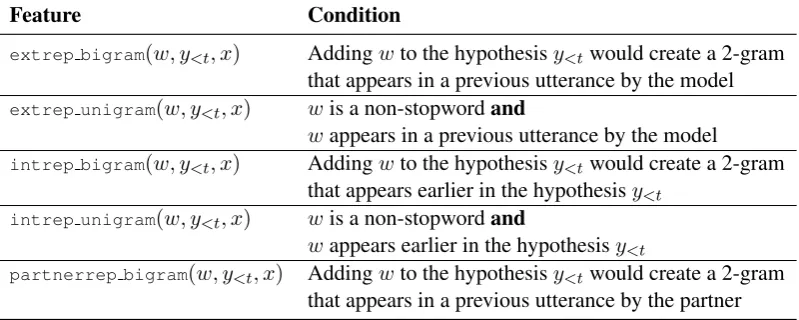
To control repetition with weighted decod-ing,3 we define five n-gram based decoding features (see Appendix D). Three of these features (extrep bigram, intrep bigram and partnerrep bigram) identify repeating bigrams
for the three repetition types. The other two features (extrep unigram and intrep unigram) identify repeating content words. By applying a negative weight to these features, we can reduce repetition. In particular, if the weight is−∞, our method is equivalent to n-gram blocking as de-scribed byKulikov et al.(2018). We observe that repetition control is very important, thus all further control experiments include repetition control.
6.2 Specificity
Like many sequence-to-sequence models using beam search decoding, our baseline frequently asks generic questions such asWhat music do you like?and gives dull, unspecific responses, such as I like all kinds of music.
We control specificity using Normalized Inverse Document Frequency (NIDF) as a measure of word rareness.4The Inverse Document Frequency of a word w is IDF(w) = log(R/cw) where R
is the number of responses in the dataset, andcw
is the number of those responses that contain w. Normalized IDF (which ranges from 0 to 1) is
NIDF(w) = IDF(w)−min idf
max idf−min idf (1)
wheremin idfandmax idfare the minimum and maximum IDFs, taken over all words in the vo-cabulary. To control specificity with weighted de-coding, we use NIDF as a decoding feature. As shown in Table 1, this method produces reason-able outputs when the feature weight is within a certain range, but at the extremes the outputs are
3We also tried controlling repetition with conditional
training, definingz as the (bucketed) maximum ROUGE-L precision between the responseyand the bot’s previous ut-terances. However, this method was unsuccessful because there are not enough repetitive examples in the training data for the model to learn the control. Experimenting with data augmentation to solve this problem is an area for future work.
4Note that our NIDF specificity features are similar to the
Input:Yes, I’m studying law at the moment
Baseline Response:That sounds like a lot of fun!
Wt NIDF Weighted Decoding Response
-5.0 0.6% Oh...
0.0 17.1% That sounds like a lot of fun!
3.0 18.3% That sounds like a lot of fun. How long have you been studying?
7.0 38.5% I majored in practising my spiritual full time philosophy test
10.0 71.9% Oh wow! Merna jean isa paino yi
hao hui bu acara sya gila[. . . ]
z NIDF Conditional Training Response
0 16.8% Sounds like you are a great person!
2 18.3% So you are a law student?
4 18.4% That sounds like a lot of fun
6 22.8% That sounds like a rewarding job!
8 24.4% That sounds like a rewarding career!
Table 1: Middle: Example of controlling specificity (NIDF) via weighted decoding. At the extremes, the model produces only the most rare or the most com-mon tokens. Bottom: Example of controlling speci-ficity via conditional training. This gives a narrower NIDF range, but all the responses are appropriate.
nonsensical. The boundary for nonsensical output differs from example to example.
To control specificity with conditional training, we define the specificity of an utterance y to be the mean NIDF of the words iny. Thus our con-trol variablez is mean NIDF (discretized into 10 equal-sized buckets). As shown in Table 1, this method gives outputs with a narrower NIDF range, but overall produces less nonsensical outputs.
6.3 Response-relatedness
In conversation, it’s generally desirable to produce a response that is related to the partner’s last utter-ance; for example if the partner saysMy grandfa-ther died last month, it is appropriate to sayI’m so sorry. Were you close to your grandfather? How-ever, our baseline model frequently responds with unrelated utterances likeDo you have any pets?
To control response-relatedness with weighted decoding, we use the decoding featureresp rel:
resp rel(w;y<t, x) =
cos sim(word emb(w),sent emb(`))
where word emb(w) is the GloVe embedding for the word w, sent emb(`) is the sentence embed-ding for the partner’s last utterance`(note`is part of the contextx), andcos sim is the cosine simi-larity between the two. In particular, the sentence embedding sent emb(s) for an utterance s is a
Input:Do you go get coffee often
Baseline Response:I do, when I am not playing the piano.
Wt Sim Weighted Decoding Response
-10.0 -0.05 I am a musician.
0.0 -0.02 I do, when I am not playing the piano.
5.0 0.40 I do, usually at starbucks.
8.0 0.59 Not usually, especially when you drink latte.
11.0 0.72 Not often, usually with drinks,
espresso, latte, tea, etc.
Table 2: Example of controlling response-relatedness (cosine similarity to input) via weighted decoding. Pos-itive weights (e.g. 5.0) can yield more on-topic re-sponses, but higher weights (e.g. 11.0) can result in nonsensical lists of topically related words.
weighted average of the GloVe embeddings of the words ins, with the first principal component pro-jected out; for full details, seeArora et al.(2017). This method of controlling response-relatedness is similar to that described in (Baheti et al., 2018). We find that weighted decoding is effective to con-trol the semantic relatedness of the model’s re-sponse to the partner’s last utterance (see Table2). As before, we find that extreme weights lead to nonsensical output.
To control response-relatedness with condi-tional training, we try defining the control vari-able z to becos sim(sent emb(y),sent emb(`)), the overall cosine similarity between the partner’s last utterance`and the model’s responsey(again, we discretizez). However, we find this method in-effective – the CT model learns only a very weak connection between z and the semantic related-ness of the output (see Section7for more details).
6.4 Question-asking
Considerate chitchat requires a reciprocal asking and answering of questions – asking too few or too many can appear self-centered or nosy. We control question-asking in order to study these trade-offs. To control question-asking with weighted de-coding, we use the binary decoding feature is qn word(w), which is equal to 1 if and only
0 1 2 3 4 5 6 7 8 9 10 10 (boost)
Question-Asking Control Level (CT)
0% 20% 40% 60% 80% 100%
% Utterances containing '?'
[image:6.595.75.287.66.201.2]Question-controlled CT Question-controlled CT w/ rep ctrl Target for question-controlled CT Beam search baseline Repetition-controlled baseline Gold data
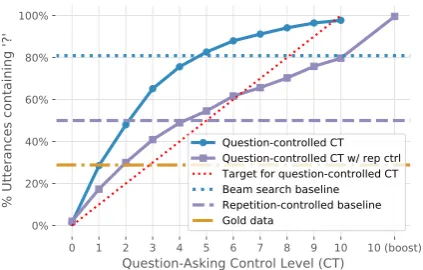
Figure 2: Controlling question-asking via conditional training. Exact numbers can be found in AppendixF.
What???????orWho? When? How?).
For conditional training, we regard an utterance
y as containing a question if and only if y con-tains a question mark. We train our CT model on a control variable z with 11 possible values:
{0, . . . ,10}. As discussed in Section5, we wish
to control question-asking at the distributional, di-alogue level, rather than at the binary, utterance level. Thus the settingz=imeans that the model should produce, on average, utterances contain-ing ‘?’ with probability i/10. During training we randomly assign examples to buckets such that each bucketiis trained on examples with the cor-rect proportion of questions (i/10), and all buckets have the same amount of training examples.
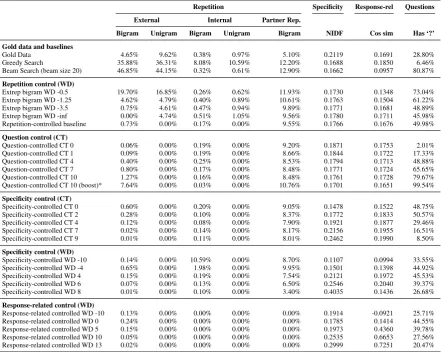
We find that conditional training is effective to control question-asking – as shown in Figure 2, by increasing z from 0 to 10, we obtain a range of question-asking rates from 1.40% to 97.72%. However, when we introduce repetition control, question-asking is reduced – in particular, thez= 10setting (which should produce 100% questions) now only produces 79.67% questions. The pri-mary problem is the weighted decoding feature extrep bigram, which discourages bigrams that
have appeared in previous utterances – this pre-vents the model from producing bigrams that com-monly occur in many questions, such as do you and what is. To fix this, we introduce an extra setting z = 10 (boost), in which we do not use the featureextrep bigramfor weighted decoding during beam search, but we do use it to rerank the candidates after beam search. This setting, which allows the model to produce necessary question-asking bigrams, yields a 99.54% question-question-asking rate, at the cost of slightly increased external bi-gram repetition (see AppendixF).
For controlling question-asking, conditional training is preferable to weighted decoding for two reasons. Firstly, it allows us to achieve (close to) 0% questions, 100% questions, or anything in be-tween, without introducing the risk of degenerate output. Secondly, presence-of-a-question-mark captures the true attribute of interest (question-asking) more exactly and directly than presence of interrogative words. For these reasons, only the CT method is considered in the human evaluation.
7 Comparison of control methods
The previous section shows that conditional train-ing and weighted decodtrain-ing are both useful tech-niques, with different strengths and weaknesses.
The primary disadvantage of conditional train-ing is that it sometimes fails to learn the connec-tion between the control variablez and the target outputy. In practice, we find the model can learn simple attributes of the output (such as the pres-ence of ‘?’, and overall genericness), but not re-lationships between the input and output (such as semantic relatedness). By contrast, weighted de-coding can force the desired feature to appear in the output by raising the weight arbitrarily high (though this may have unintended side-effects).
The primary disadvantage of weighted decod-ing is that it risks godecod-ing off-distribution when the weight is too strong. By contrast, condi-tional training produces mostly well-formed, in-distribution outputs. This highlights the impor-tance of learned control – it is safer to learn to produce output that both satisfies the control vari-able and is appropriate, than to alter the decoding process to satisfy the control variable, potentially trading off appropriateness in the process.
Other considerations include: (1) Convenience: conditional training requires retraining; weighted decoding doesn’t, but is slower at test time. (2) Data availability: conditional training requires training examples of the controllable attribute, whereas weighted decoding can control any com-putable feature without requiring examples. (3) Attribute definition: conditional training can con-trol sentence-level attributes, but they must be dis-crete. By contrast, weighted decoding requires word-level features, but they can be continuous.
8 Human evaluation results
evalua-tion of 28 model configuraevalua-tions (see AppendixE), plus human-human conversations for comparison.
Approach In our evaluation, a crowdworker
chats with a model (or in the human-human case, another crowdworker) for six conversational turns, then answers eight multiple-choice ques-tions which each capture different aspects of con-versational quality: avoiding repetition, interest-ingness, making sense, fluency, listening, inquisi-tiveness, humanness and engagingness. The eight questions are Likert questions on a 1-4 scale, where higher is better.5 To match the ConvAI2 Challenge, we also add a persona retrieval ques-tion, in which the crowdworker is asked to select which of two possible personas was the model’s persona. For full details of the evaluation design, see AppendixB.
Our evaluation is the same as the ConvAI2 Challenge evaluation, but more detailed – Con-vAI2 includes only engagingness and persona re-trieval.6 As in the ConvAI2 challenge, each of our 28 model configurations was evaluated by over 100 crowdworkers, and the results were adjusted for annotator variance via a Bayesian calibration
(Kulikov et al.,2018).
In designing our evaluation, we aimed to cap-ture the four aspects we expected to directly im-prove via control (avoiding repetition, interesting-ness, listening, inquisitiveness), two important er-ror classes we thought would be affected by our controls (fluency, making sense), and two overall quality measures (engagingness, humanness).
8.1 Main findings
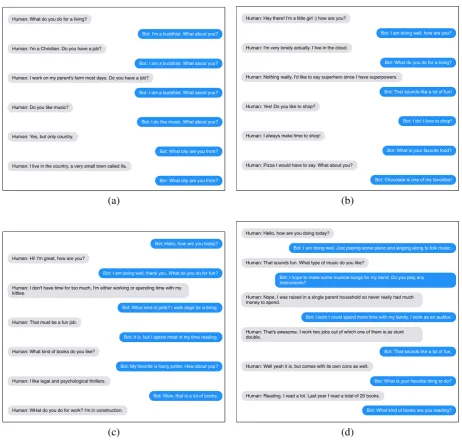
In this section we summarize the main findings of our human evaluation – whose full results can be found in AppendicesG andH, with sample con-versations in AppendixC.
As Figure 3 shows, controlling for repetition, specificity and question-asking all lead to large
5
Exceptions: Avoiding repetition is a 1-3 scale, as we found this gave clearer instructions. Inquisitiveness has an optimal score of 3; 1 and 2 represent too little question-asking, and 4 represents too much.
6
There are three other minor differences between our evaluation and ConvAI2’s: (1) We fix capitalization and spac-ing before showspac-ing the chatbot’s utterances to crowdwork-ers, while ConvAI2 show the raw lowercase tokenized form. We found the latter interferes with fluency evaluation. (2) We conduct 6 dialogue turns, while ConvAI2 conducts 4-6. This was necessary to evaluate repetitiveness. (3) We use (publicly-available) validation set personas, while ConvAI2 uses (hidden) test set personas. This enables us to release our evaluation chatlogs.
engagingness improvements over the greedy and beam-search baseline models. In particular, we find that controlling for multi-turn (self) repetition is important and should be incorporated alongside other attribute control methods. We found no im-provement by controlling response-relatedness.
To better understand these overall engagingness improvements, we consider the full set of human judgments, shown in Figure 4. We find that re-ducing repetition leads to improvements across all our aspects of conversational quality. Increasing specificity shows improvements in interestingness and listening ability over the repetition-controlled baseline, while increasing question-asking shows improvements in inquisitiveness and interesting-ness over the repetition-controlled baseline.
Our most engaging model, which controls both repetition and question-asking – marked ‘Ques-tion (CT)’ in Figure 3 (left) – matches the en-gagingness of the winning entry in the ConvAI2 competition, as both models achieve a raw score7
of 3.1 (Dinan et al., 2019). However, the
Con-vAI2 winner, Lost in Conversation, was trained on approximately 12×as much data as our model. Lost in Conversation is based on the OpenAI GPT Language Model (Radford et al., 2018), which is pretrained on the BookCorpus (Zhu et al.,2015), which contains approximately 985 million words, whereas our model is pretrained on the Twitter dataset (approximately 79 million words).
Altogether, our evaluation clearly shows that controlling low-level attributes over multiple turns leads to improved overall quality.
8.2 Effect of controlled attributes
Repetition (WD) We observe that
self-repetition across utterances (external self-repetition) is by far the most severe form of repetition in our beam search baseline model. We evaluate several settings of the extrep bigram weighted decoding feature, and find that an aggressive repetition-reduction setting (reducing bigram repetition rate to below gold data levels) is rated best. We also find that blocking repeated content words improves the avoiding repetition score. See AppendicesE,FandGfor full details.
As shown in Figure 3 (left) and Figure 4, our repetition-controlled model improves hugely
7Although the same Bayesian calibration method was
Greedy
Beam searchRepetition (WD)Specificity (WD)Question (CT) Human 2.2
2.4 2.6 2.8 3.0
3.2 Engagingness
-10 More Generic
-8 -6 -4 -2 0
No control2 4 6 8 More10 Specific Specificity Control Level (WD) 2.2
2.4 2.6 2.8 3.0 3.2
Engagingness Specificity-controlled WDBeam search baseline Human
Repetition-controlled baseline
0 Fewer Questions
1 2 3 4 5 6 7 8 9 10 10 (boost) More Questions Question-Asking Control Level (CT) 2.2
2.4 2.6 2.8 3.0 3.2
Engagingness Question-controlled CTBeam search baseline Human
[image:8.595.75.521.70.157.2]Repetition-controlled baseline
Figure 3: Calibrated human judgments of engagingness for the baselines and best controlled models (left); for different specificity control settings (middle); and for different question-asking control settings (right).
2.00 2.25 2.50 2.75
3.00Avoiding Repetition
2.25 2.50 2.75 3.00
Interestingness
3.2 3.4 3.6 3.8
Making Sense
3.0 3.2 3.4 3.6
Fluency
2.50 2.75 3.00 3.25
3.50 Listening
1.75 2.00 2.25 2.50
2.75 Inquisitiveness
2.0 2.5 3.0
3.5 Humanness
[image:8.595.69.524.202.286.2]Greedy search Beam search Repetition-controlled (WD) Specificity-controlled (WD) Question-controlled (CT) Human
Figure 4: Calibrated human judgments of conversational aspects for the baselines and best controlled models. Note: In Figure3and here, the Specificity and Question controlled models both include Repetition control, but Question control doesn’t include Specificity control, or vice versa.
over the beam search baseline in all metrics, and achieves close-to-human scores on all metrics ex-cept humanness. This striking result demonstrates that repetition is by far the biggest limiting qual-ity factor for naive sequence-to-sequence dialogue agents. The result also emphasizes the importance of multi-turn dialogue evaluation to detect the problem. We refer to this model as the repetition-controlled baseline, and use it as a basis for all re-maining experiments (i.e., we control specificity, response-relatedness and question-asking on top of these repetition-control settings).
Specificity (WD, CT) For our weighted
decod-ing models, the extreme settdecod-ings (very generic and very specific) score poorly in engagingness due to the frequent presence of degenerate output – see Figure3 (middle). We find that the weight = 4
setting (which is more specific than the repetition-controlled baseline and about as specific as the gold data) maximizes engagingness. As shown in Figure3(left) and Figure4, this more-specific model is rated more interesting, engaging, and a better listener than the repetition-controlled base-line, but at the cost of reduced fluency and making sense. Our CT model with z = 7 (which has a similar NIDF level as WD with weight= 4) shows similar results, but the improvements are smaller. For further discussion on the interestingness of our specificity models, see Section8.3.
Response-relatedness (WD) We evaluated
sev-eral control settings (weight=−10,5,10,13) and found that none scored better than weight = 0
(no response-relatedness control); see Appendix
H. This is surprising – prior to running the human evaluation, we annotated 100 examples ourselves to determine the best control settings. While we identified a more responsive setting (weight = 5) as less likely than the uncontrolled model to ig-nore the user, crowdworkers rated it as a slightly worselistener than the uncontrolled model. One explanation for this discrepancy is that the more responsive model takes more risks, using more rare words (0.197 NIDF, up from 0.178), and thus receives a lower makes-sense score (3.41, down from 3.70). We hypothesize that, compared to us, the crowdworkers are less tolerant of slightly non-sensical output, and more tolerant of generic unre-lated utterances.
Question-asking (CT) As shown in Figure 3
Model Win% Top 3 reasons for preferring model
Specificity WD (weight= 6) 84.1% More information; Better flow; More descriptive
Specificity WD (weight= 4) 75.5% More information; They describe their life in more detail; Funny
Specificity CT (z= 7) 56.2% More information; Better flow; Seems more interested
Table 3: A/B tests comparing various specificity-controlled models to the repetition-controlled baseline on inter-estingness. We find all comparisons are significant (p < .05; binomial test).
that although asking too many questions is less en-gaging, most crowdworkers will not directly criti-cize a chatbot that asks questions on every turn – only 11.9% of crowdworkers judged the z = 10
(boost) setting, which asks 99.5% questions, as asking too many questions.8 For full details of these scores, see AppendixFandH.
For time and budget reasons, we did not eval-uate any models controlling both question-asking and specificity. However, we expect it is possible to obtain further improvements by doing so.
8.3 A/B tests for interestingness
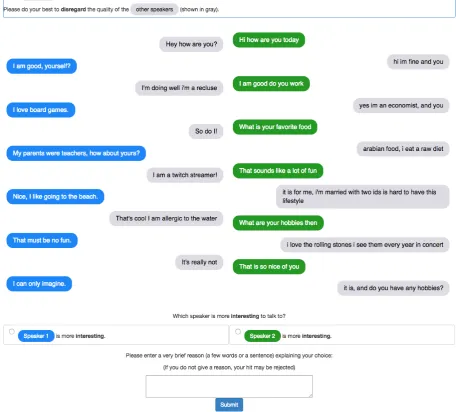
Though our more-specific models yielded signifi-cant improvements in engagingness, we were sur-prised that they did not yield clearer improve-ments in interestingness. To investigate further, we conducted an A/B interestingness evaluation of three specificity-controlled models, compared to the repetition-controlled baseline. Crowdworkers were shown two conversations (from the main hu-man evaluation) and asked to choose which model was more interesting (see Figure7for details). We collected 500 samples per comparison, plus 200 additional human vs repetition-controlled baseline samples, which were used to filter for quality con-trol. After discarding low-quality crowdworkers, we have roughly 300 evaluations per comparison, with an average Cohen’sκ= 0.6.
As shown in Table3, all three models were rated significantly more interesting than the repetition-controlled baseline. This convincingly shows that producing utterances with more rare words is a valid strategy to improve interestingness. We have two explanations for why these interestingness dif-ferences did not materialize in our main evalua-tion. Firstly, interestingness is a particularly sub-jective metric (unlike more tangible metrics such as avoiding repetition and making sense) – this makes it hard to calibrate across crowdworkers.
8Though this conclusion may hold true for the
Per-sonaChat task – a synthetic chatting task that instructs par-ticipants to get to know each other – in real-life social con-versations, incessant question-asking may be less tolerated.
Secondly, we suspect that in our original evalu-ation, the crowdworkers may have evaluated the interestingness of the task rather than the chat-bot. This could account for why subtle increases in conversational ability did not result in higher in-terestingness ratings – the PersonaChat task itself has a natural interestingness limit.
9 Conclusion
What makes a good conversation? Through
our evaluation, we showed that a good conversa-tion is about balance – controlling for the right level of repetition, specificity and question-asking is important for overall quality. We also found that conversational aspects such as interestingness, listening, and inquisitiveness are all important – though optimizing these can introduce a trade-off against certain types of errors (such as repetitive, disfluent, or nonsensical output). Secondly, multi-turn evaluation is essential to study what makes a good conversation – multiple turns are required to reveal issues such as repetition, consistency, and question-asking frequency. Lastly, what do we mean by ‘good’? Although humanness and engag-ingness are both commonly used as overall qual-ity metrics, the two are very different. While our models achieved close-to-human scores on engag-ingness, they failed to get close on humanness – showing that a chatbot need not be human-like to be enjoyable. This striking result also demon-strates the importance of measuring more than one quality metric when evaluating dialogue agents.
Outlook Our work shows that neural generative
References
Sanjeev Arora, Yingyu Liang, and Tengyu Ma. 2017. A simple but tough-to-beat baseline for
sentence embeddings. InProceedings of the
In-ternational Conference on Learning Represen-tations (ICLR).
Ashutosh Baheti, Alan Ritter, Jiwei Li, and Bill Dolan. 2018. Generating more interesting re-sponses in neural conversation models with
dis-tributional constraints. In Proceedings of the
2018 Conference on Empirical Methods in Nat-ural Language Processing, pages 3970–3980. Association for Computational Linguistics.
Antoine Bordes, Y-Lan Boureau, and Jason We-ston. 2017. Learning end-to-end goal-oriented
dialog. InProceedings of the International
Con-ference on Learning Representations (ICLR).
Emily Dinan, Varvara Logacheva, Valentin Ma-lykh, Alexander Miller, Kurt Shuster, Jack Ur-banek, Douwe Kiela, Arthur Szlam, Iulian Ser-ban, Ryan Lowe, et al. 2019. The second
conversational intelligence challenge (convai2).
arXiv preprint arXiv:1902.00098.
Emily Dinan, Stephen Roller, Kurt Shuster, An-gela Fan, Michael Auli, and Jason Weston.
2018. Wizard of Wikipedia:
Knowledge-powered conversational agents. arXiv preprint
arXiv:1811.01241.
Layla El Asri, Hannes Schulz, Shikhar Sharma, Jeremie Zumer, Justin Harris, Emery Fine, Rahul Mehrotra, and Kaheer Suleman. 2017.
Frames: a corpus for adding memory to
goal-oriented dialogue systems. In
Proceed-ings of the 18th Annual SIGDIAL Meeting on Discourse and Dialogue, pages 207–219, Saarbr¨ucken, Germany. Association for Com-putational Linguistics.
Angela Fan, David Grangier, and Michael Auli. 2018. Controllable abstractive summarization. In Proceedings of the 2nd Workshop on Neu-ral Machine Translation and Generation, pages 45–54. Association for Computational Linguis-tics.
Jessica Ficler and Yoav Goldberg. 2017. Control-ling Control-linguistic style aspects in neural language
generation. InProceedings of the Workshop on
Stylistic Variation, pages 94–104. Association for Computational Linguistics.
Marjan Ghazvininejad, Xing Shi, Jay Priyadarshi, and Kevin Knight. 2017. Hafez: an interactive
poetry generation system. In Proceedings of
ACL 2017, System Demonstrations, pages 43– 48. Association for Computational Linguistics.
Fenfei Guo, Angeliki Metallinou, Chandra Kha-tri, Anirudh Raju, Anu Venkatesh, and Ashwin Ram. 2018. Topic-based evaluation for
conver-sational bots. Advances in Neural Information
Processing Systems, Conversational AI Work-shop.
Helen Hastie. 2012. Metrics and evaluation
of spoken dialogue systems, pages 131–150.
Springer.
Matthew Henderson, Blaise Thomson, and Ja-son D Williams. 2014. The second dialog state
tracking challenge. InProceedings of the 15th
Annual Meeting of the Special Interest Group on Discourse and Dialogue (SIGDIAL), pages 263–272.
Zhiting Hu, Zichao Yang, Xiaodan Liang, Ruslan Salakhutdinov, and Eric P Xing. 2017. Toward
controlled generation of text. In Thirty-fourth
International Conference on Machine Learn-ing.
Yuta Kikuchi, Graham Neubig, Ryohei Sasano, Hiroya Takamura, and Manabu Okumura. 2016.
Controlling output length in neural
encoder-decoders. In Proceedings of the 2016
Con-ference on Empirical Methods in Natural Lan-guage Processing, pages 1328–1338. Associa-tion for ComputaAssocia-tional Linguistics.
Ilya Kulikov, Alexander H Miller, Kyunghyun Cho, and Jason Weston. 2018. Importance of
a search strategy in neural dialogue modelling.
arXiv preprint arXiv:1811.00907.
Jiwei Li, Michel Galley, Chris Brockett, Jian-feng Gao, and Bill Dolan. 2016a. A diversity-promoting objective function for neural
conver-sation models. InProceedings of the 2016
Con-ference of the North American Chapter of the Association for Computational Linguistics: Hu-man Language Technologies, pages 110–119. Association for Computational Linguistics.
Jiwei Li, Will Monroe, and Dan Jurafsky. 2017a.
Learning to decode for future success. arXiv
preprint arXiv:1701.06549.
reinforcement learning for dialogue generation. InProceedings of the 2016 Conference on Em-pirical Methods in Natural Language Process-ing, pages 1192–1202, Austin, Texas. Associa-tion for ComputaAssocia-tional Linguistics.
Jiwei Li, Will Monroe, Tianlin Shi, S´ebastien Jean, Alan Ritter, and Dan Jurafsky. 2017b. Ad-versarial learning for neural dialogue genera-tion. arXiv preprint arXiv:1701.06547.
Chia-Wei Liu, Ryan Lowe, Iulian Serban,
Mike Noseworthy, Laurent Charlin, and Joelle Pineau. 2016. How not to evaluate your dia-logue system: An empirical study of unsuper-vised evaluation metrics for dialogue response
generation. pages 2122–2132.
Ryan Lowe, Michael Noseworthy, Iulian Vlad Serban, Nicolas Angelard-Gontier, Yoshua Bengio, and Joelle Pineau. 2017. Towards an automatic turing test: Learning to evaluate
di-alogue responses. In Proceedings of the 55th
Annual Meeting of the Association for Compu-tational Linguistics (Volume 1: Long Papers), pages 1116–1126. Association for Computa-tional Linguistics.
Ryan Lowe, Nissan Pow, Iulian Serban, and Joelle Pineau. 2015. The Ubuntu dialogue corpus: A large dataset for research in unstructured
multi-turn dialogue systems. In Proceedings of the
16th Annual Meeting of the Special Interest Group on Discourse and Dialogue, pages 285– 294, Prague, Czech Republic. Association for Computational Linguistics.
Alexander Miller, Will Feng, Dhruv Batra, An-toine Bordes, Adam Fisch, Jiasen Lu, Devi Parikh, and Jason Weston. 2017. ParlAI: A
dialog research software platform. In
Pro-ceedings of the 2017 Conference on Empiri-cal Methods in Natural Language Processing: System Demonstrations, pages 79–84, Copen-hagen, Denmark. Association for Computa-tional Linguistics.
Jekaterina Novikova, Ondˇrej Duˇsek, Amanda Cer-cas Curry, and Verena Rieser. 2017. Why we
need new evaluation metrics for nlg. In
Pro-ceedings of the 2017 Conference on Empiri-cal Methods in Natural Language Processing, pages 2241–2252.
Prasanna Parthasarathi and Joelle Pineau. 2018.
Extending neural generative conversational
model using external knowledge sources. In
Proceedings of the 2018 Conference on Empir-ical Methods in Natural Language Processing, pages 690–695, Brussels, Belgium. Association for Computational Linguistics.
Nanyun Peng, Marjan Ghazvininejad, Jonathan May, and Kevin Knight. 2018. Towards
con-trollable story generation. In Proceedings of
the First Workshop on Storytelling, pages 43– 49. Association for Computational Linguistics.
Jeffrey Pennington, Richard Socher, and Christo-pher Manning. 2014.GloVe: Global vectors for
word representation. InProceedings of the 2014
Conference on Empirical Methods in Natural Language Processing (EMNLP), pages 1532– 1543, Doha, Qatar. Association for Computa-tional Linguistics.
Alec Radford, Karthik Narasimhan, Tim Sali-mans, and Ilya Sutskever. 2018. Improving
lan-guage understanding by generative pre-training.
Iulian Vlad Serban, Ryan Lowe, Laurent Charlin, and Joelle Pineau. 2016a. Generative deep
neu-ral networks for dialogue: A short review.
Ad-vances in Neural Information Processing Sys-tems workshop on Learning Methods for Dia-logue.
Iulian Vlad Serban, Alessandro Sordoni, Yoshua Bengio, Aaron C Courville, and Joelle Pineau. 2016b. Building end-to-end dialogue systems using generative hierarchical neural network
models. InAAAI, volume 16, pages 3776–3784.
Xiaoyu Shen, Hui Su, Yanran Li, Wenjie Li, Shuzi Niu, Yang Zhao, Akiko Aizawa, and Guoping Long. 2017. A conditional variational
frame-work for dialog generation. In Proceedings
of the 55th Annual Meeting of the Association for Computational Linguistics (Volume 2: Short Papers), pages 504–509. Association for Com-putational Linguistics.
Anu Venkatesh, Chandra Khatri, Ashwin Ram, Fenfei Guo, Raefer Gabriel, Ashish Nagar, Ro-hit Prasad, Ming Cheng, Behnam Hedayatnia, Angeliki Metallinou, et al. 2017. On
evaluat-ing and comparevaluat-ing conversational agents.
Ad-vances in Neural Information Processing Sys-tems, Conversational AI Workshop.
Oriol Vinyals and Quoc Le. 2015. A neural
con-versational model. In Proceedings of the 31st
Marilyn A. Walker, Diane J. Litman, Candace A. Kamm, and Alicia Abella. 1997. PARADISE: A framework for evaluating spoken dialogue
agents. InProceedings of the 35th Annual
Meet-ing of the Association for Computational Lin-guistics, pages 271–280, Madrid, Spain. Asso-ciation for Computational Linguistics.
Di Wang, Nebojsa Jojic, Chris Brockett, and Eric Nyberg. 2017. Steering output style and topic
in neural response generation. InProceedings
of the 2017 Conference on Empirical Methods in Natural Language Processing, pages 2140– 2150. Association for Computational Linguis-tics.
Tsung-Hsien Wen, David Vandyke, Nikola
Mrkˇsi´c, Milica Gasic, Lina M. Rojas Barahona, Pei-Hao Su, Stefan Ultes, and Steve Young. 2017. A network-based end-to-end trainable
task-oriented dialogue system. InProceedings
of the 15th Conference of the European Chapter of the Association for Computational Linguis-tics: Volume 1, Long Papers, pages 438–449. Association for Computational Linguistics.
Chen Xing, Wei Wu, Yu Wu, Jie Liu, Yalou Huang, Ming Zhou, and Wei-Ying Ma. 2017.
Topic aware neural response generation. In
AAAI, volume 17, pages 3351–3357.
Ruqing Zhang, Jiafeng Guo, Yixing Fan, Yanyan Lan, Jun Xu, and Xueqi Cheng. 2018a. Learn-ing to control the specificity in neural response
generation. InProceedings of the 56th Annual
Meeting of the Association for Computational Linguistics (Volume 1: Long Papers), pages 1108–1117, Melbourne, Australia. Association for Computational Linguistics.
Saizheng Zhang, Emily Dinan, Jack Urbanek, Arthur Szlam, Douwe Kiela, and Jason Weston. 2018b. Personalizing dialogue agents: I have a
dog, do you have pets too? InProceedings of
the 56th Annual Meeting of the Association for Computational Linguistics (Volume 1: Long Pa-pers), pages 2204–2213, Melbourne, Australia. Association for Computational Linguistics.
Ganbin Zhou, Ping Luo, Rongyu Cao, Fen Lin, Bo Chen, and Qing He. 2017. Mechanism-aware neural machine for dialogue response
generation. InAAAI, pages 3400–3407.
Yukun Zhu, Ryan Kiros, Rich Zemel, Ruslan Salakhutdinov, Raquel Urtasun, Antonio Tor-ralba, and Sanja Fidler. 2015. Aligning books
and movies: Towards story-like visual
explana-tions by watching movies and reading books. In
Supplementary Material
[image:13.595.75.524.49.643.2]A Screenshots of human evaluation interface
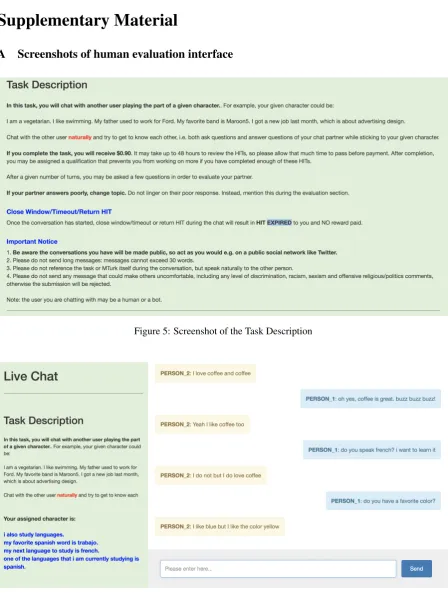
Figure 5: Screenshot of the Task Description
[image:13.595.73.519.367.636.2]B Human evaluation questionnaire design
Here are the questions and multiple-choice options used in the human evaluation, in the order presented:
[Engagingness] How much did you enjoy talking to this user? •Not at all•A little•Somewhat•A lot
[Interestingness] How interesting or boring did you find this conversation? •Very boring•A little boring•A little interesting•Very interesting
[Inquisitiveness] How much did the user try to get to know you? •Didn’t ask about me at all•Asked about me some
•Asked about me a good amount•Asked about me too much
[Listening] How much did the user seem to pay attention to what you said? •Always ignored what I said•Mostly ignored what I said
•Mostly paid attention to what I said•Always paid attention to what I said
[Avoiding Repetition] How repetitive was this user?
•Repeated themselves over and over•Sometimes said the same thing twice
•Always said something new
[Fluency] How naturally did this user speak English?
•Very unnatural•Mostly unnatural•Mostly natural•Very natural
[Making sense] How often did this user say something which did NOT make sense? •Never made any sense•Most responses didn’t make sense
•Some responses didn’t make sense•Everything made perfect sense
[Humanness] Do you think this user is a bot or a human?
•Definitely a bot•Probably a bot•Probably a human•Definitely a human
[Persona retrieval] Which prompt (character) do you think the other user was given for this conversation?
C Example conversations from human evaluation
Human: What do you do for a living?
Bot: I'm a buddhist. What about you?
Human: I'm a Christian. Do you have a job?
Bot: I am a buddhist. What about you?
Human: I work on my parent's farm most days. Do you have a job?
Bot: I am a buddhist. What about you?
Human: Do you like music?
Bot: I do like music. What about you?
Human: Yes, but only country.
Bot: What city are you from?
Human: I live in the country, a very small town called Ila.
Bot: What city are you from?
Human: Hey there! I'm a little girl :) how are you?
Bot: I am doing well, how are you?
Human: I'm very lonely actually. I live in the cloud.
Bot: What do you do for a living?
Human: Nothing really, I'd like to say superhero since I have superpowers.
Bot: That sounds like a lot of fun!
Human: Yes! Do you like to shop?
Bot: I do! I love to shop!
Human: I always make time to shop!
Bot: What is your favorite food?
Human: Pizza I would have to say. What about you?
Bot: Chocolate is one of my favorites!
(a) (b)
Bot: Hello, how are you today?
Human: Hi! I'm great, how are you?
Bot: I am doing well, thank you. What do you do for fun?
Human: I don't have time for too much, I'm either working or spending time with my kitties.
Bot: What kind of pets? I walk dogs for a living.
Human: That must be a fun job.
Bot: It is, but I spend most of my time reading.
Human: What kind of books do you like?
Bot: My favorite is harry potter. How about you?
Human: I like legal and psychological thrillers.
Bot: Wow, that is a lot of books.
Human: WHat do you do for work? I'm in construction.
Human: Hello, how are you doing today?
Bot: I am doing well. Just playing some piano and singing along to folk music.
Human: That sounds fun. What type of music do you like?
Bot: I hope to make some musical songs for my band. Do you play any instruments?
Human: Nope, I was raised in a single parent household so never really had much money to spend.
Bot: I wish I could spend more time with my family. I work as an auditor.
Human: That's awesome. I work two jobs out of which one of them is as stunt double.
Bot: That sounds like a lot of fun.
Human: Well yeah it is, but comes with its own cons as well.
Bot: What is your favorite thing to do?
Human: Reading. I read a lot. Last year I read a total of 20 books.
Bot: What kind of books are you reading?
[image:16.595.75.538.89.529.2](c) (d)
D Repetition-control decoding features
Feature Condition
extrep bigram(w, y<t, x) Addingwto the hypothesisy<t would create a 2-gram that appears in a previous utterance by the model extrep unigram(w, y<t, x) wis a non-stopwordand
wappears in a previous utterance by the model
intrep bigram(w, y<t, x) Addingwto the hypothesisy<t would create a 2-gram that appears earlier in the hypothesisy<t
intrep unigram(w, y<t, x) wis a non-stopwordand
wappears earlier in the hypothesisy<t
[image:17.595.100.500.98.258.2]partnerrep bigram(w, y<t, x) Addingwto the hypothesisy<t would create a 2-gram that appears in a previous utterance by the partner
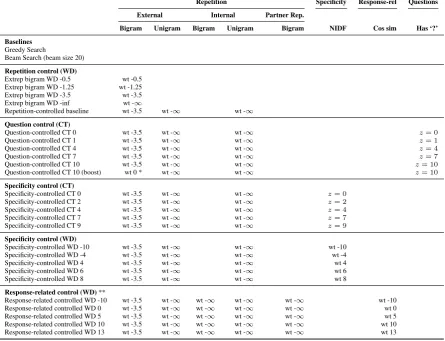
E Control settings for all configurations
Repetition Specificity Response-rel Questions
External Internal Partner Rep.
Bigram Unigram Bigram Unigram Bigram NIDF Cos sim Has ‘?’
Baselines
Greedy Search
Beam Search (beam size 20)
Repetition control (WD)
Extrep bigram WD -0.5 wt -0.5
Extrep bigram WD -1.25 wt -1.25
Extrep bigram WD -3.5 wt -3.5
Extrep bigram WD -inf wt -∞
Repetition-controlled baseline wt -3.5 wt -∞ wt -∞
Question control (CT)
Question-controlled CT 0 wt -3.5 wt -∞ wt -∞ z= 0
Question-controlled CT 1 wt -3.5 wt -∞ wt -∞ z= 1
Question-controlled CT 4 wt -3.5 wt -∞ wt -∞ z= 4
Question-controlled CT 7 wt -3.5 wt -∞ wt -∞ z= 7
Question-controlled CT 10 wt -3.5 wt -∞ wt -∞ z= 10
Question-controlled CT 10 (boost) wt 0 * wt -∞ wt -∞ z= 10
Specificity control (CT)
Specificity-controlled CT 0 wt -3.5 wt -∞ wt -∞ z= 0
Specificity-controlled CT 2 wt -3.5 wt -∞ wt -∞ z= 2
Specificity-controlled CT 4 wt -3.5 wt -∞ wt -∞ z= 4
Specificity-controlled CT 7 wt -3.5 wt -∞ wt -∞ z= 7
Specificity-controlled CT 9 wt -3.5 wt -∞ wt -∞ z= 9
Specificity control (WD)
Specificity-controlled WD -10 wt -3.5 wt -∞ wt -∞ wt -10
Specificity-controlled WD -4 wt -3.5 wt -∞ wt -∞ wt -4
Specificity-controlled WD 4 wt -3.5 wt -∞ wt -∞ wt 4
Specificity-controlled WD 6 wt -3.5 wt -∞ wt -∞ wt 6
Specificity-controlled WD 8 wt -3.5 wt -∞ wt -∞ wt 8
Response-related control (WD)**
Response-related controlled WD -10 wt -3.5 wt -∞ wt -∞ wt -∞ wt -∞ wt -10
Response-related controlled WD 0 wt -3.5 wt -∞ wt -∞ wt -∞ wt -∞ wt 0
Response-related controlled WD 5 wt -3.5 wt -∞ wt -∞ wt -∞ wt -∞ wt 5
Response-related controlled WD 10 wt -3.5 wt -∞ wt -∞ wt -∞ wt -∞ wt 10
[image:18.595.77.523.101.442.2]Response-related controlled WD 13 wt -3.5 wt -∞ wt -∞ wt -∞ wt -∞ wt 13
Table 5: Control settings for all configurations that were human-evaluated. ‘wt’ means the weight used for a weighted decoding feature and ‘z=’ means the setting (i.e. bucket) for the control variable in conditional training.
* In the setting Question-controlled CT 10 (boost), the feature extrep bigram is not used for weighted decoding during beam search, but itisused to rerank the candidates after beam search. See Section6.4for details.
F Automatic metrics for all configurations
Repetition Specificity Response-rel Questions
External Internal Partner Rep.
Bigram Unigram Bigram Unigram Bigram NIDF Cos sim Has ‘?’
Gold data and baselines
Gold Data 4.65% 9.62% 0.38% 0.97% 5.10% 0.2119 0.1691 28.80%
Greedy Search 35.88% 36.31% 8.08% 10.59% 12.20% 0.1688 0.1850 6.46%
Beam Search (beam size 20) 46.85% 44.15% 0.32% 0.61% 12.90% 0.1662 0.0957 80.87%
Repetition control (WD)
Extrep bigram WD -0.5 19.70% 16.85% 0.26% 0.62% 11.93% 0.1730 0.1348 73.04%
Extrep bigram WD -1.25 4.62% 4.79% 0.40% 0.89% 10.61% 0.1763 0.1504 61.22%
Extrep bigram WD -3.5 0.75% 4.61% 0.47% 0.94% 9.89% 0.1771 0.1681 48.89%
Extrep bigram WD -inf 0.00% 4.74% 0.51% 1.05% 9.56% 0.1780 0.1711 45.98%
Repetition-controlled baseline 0.73% 0.00% 0.17% 0.00% 9.55% 0.1766 0.1676 49.98%
Question control (CT)
Question-controlled CT 0 0.06% 0.00% 0.19% 0.00% 9.20% 0.1871 0.1753 2.01%
Question-controlled CT 1 0.09% 0.00% 0.19% 0.00% 8.66% 0.1844 0.1722 17.33%
Question-controlled CT 4 0.40% 0.00% 0.25% 0.00% 8.53% 0.1794 0.1713 48.88%
Question-controlled CT 7 0.80% 0.00% 0.17% 0.00% 8.48% 0.1771 0.1724 65.65%
Question-controlled CT 10 1.27% 0.00% 0.16% 0.00% 8.48% 0.1761 0.1728 79.67%
Question-controlled CT 10 (boost)* 7.64% 0.00% 0.03% 0.00% 10.76% 0.1701 0.1651 99.54%
Specificity control (CT)
Specificity-controlled CT 0 0.60% 0.00% 0.20% 0.00% 9.05% 0.1478 0.1522 48.75%
Specificity-controlled CT 2 0.28% 0.00% 0.10% 0.00% 8.37% 0.1772 0.1833 50.57%
Specificity-controlled CT 4 0.12% 0.00% 0.08% 0.00% 7.90% 0.1921 0.1877 29.46%
Specificity-controlled CT 7 0.02% 0.00% 0.14% 0.00% 8.17% 0.2156 0.1955 16.51%
Specificity-controlled CT 9 0.01% 0.00% 0.11% 0.00% 8.01% 0.2462 0.1990 8.50%
Specificity control (WD)
Specificity-controlled WD -10 0.14% 0.00% 10.59% 0.00% 8.70% 0.1107 0.0994 33.55%
Specificity-controlled WD -4 0.65% 0.00% 1.98% 0.00% 9.95% 0.1501 0.1398 44.92%
Specificity-controlled WD 4 0.15% 0.00% 0.19% 0.00% 7.54% 0.2121 0.1972 45.53%
Specificity-controlled WD 6 0.07% 0.00% 0.13% 0.00% 6.50% 0.2546 0.2040 39.37%
Specificity-controlled WD 8 0.01% 0.00% 0.10% 0.00% 3.40% 0.4035 0.1436 26.68%
Response-related control (WD)
Response-related controlled WD -10 0.13% 0.00% 0.00% 0.00% 0.00% 0.1914 -0.0921 25.71%
Response-related controlled WD 0 0.24% 0.00% 0.00% 0.00% 0.00% 0.1785 0.1414 44.55%
Response-related controlled WD 5 0.15% 0.00% 0.00% 0.00% 0.00% 0.1973 0.4360 39.78%
Response-related controlled WD 10 0.05% 0.00% 0.00% 0.00% 0.00% 0.2535 0.6653 27.56%
[image:19.595.80.522.96.448.2]Response-related controlled WD 13 0.02% 0.00% 0.00% 0.00% 0.00% 0.2999 0.7251 20.47%
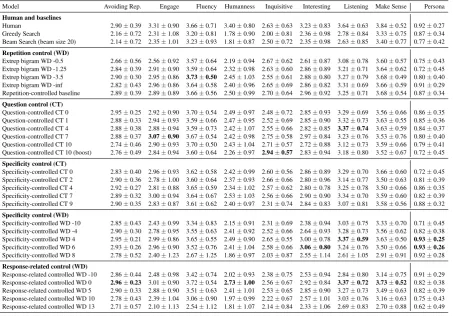
G Human evaluation results for all configurations
Model Avoiding Rep. Engage Fluency Humanness Inquisitive Interesting Listening Make Sense Persona
Human and baselines
Human 2.90±0.39 3.31±0.90 3.66±0.71 3.40±0.80 2.63±0.63 3.23±0.83 3.64±0.63 3.84±0.52 0.92±0.27 Greedy Search 2.16±0.72 2.31±1.08 3.20±0.81 1.78±0.90 2.00±0.81 2.36±0.98 2.78±0.84 3.33±0.75 0.87±0.34 Beam Search (beam size 20) 2.14±0.72 2.35±1.01 3.23±0.93 1.81±0.87 2.50±0.72 2.35±0.98 2.63±0.85 3.40±0.77 0.77±0.42
Repetition control (WD)
Extrep bigram WD -0.5 2.66±0.56 2.56±0.92 3.57±0.64 2.19±0.94 2.67±0.62 2.61±0.87 3.08±0.78 3.60±0.57 0.75±0.43 Extrep bigram WD -1.25 2.84±0.39 2.91±0.90 3.59±0.64 2.32±0.98 2.63±0.60 2.86±0.89 3.21±0.71 3.64±0.62 0.72±0.45 Extrep bigram WD -3.5 2.90±0.30 2.95±0.86 3.73±0.50 2.45±1.03 2.55±0.61 2.88±0.80 3.27±0.79 3.68±0.49 0.80±0.40 Extrep bigram WD -inf 2.82±0.43 2.96±0.86 3.64±0.58 2.40±0.96 2.65±0.69 2.86±0.82 3.31±0.69 3.66±0.59 0.91±0.29 Repetition-controlled baseline 2.89±0.39 2.89±0.89 3.66±0.56 2.50±0.99 2.70±0.64 2.96±0.92 3.25±0.71 3.68±0.54 0.87±0.34
Question control (CT)
Question-controlled CT 0 2.95±0.25 2.92±0.90 3.70±0.54 2.49±0.97 2.48±0.72 2.85±0.93 3.29±0.69 3.56±0.66 0.86±0.35 Question-controlled CT 1 2.88±0.33 2.94±0.93 3.59±0.66 2.47±0.95 2.52±0.69 2.85±0.90 3.32±0.73 3.63±0.55 0.85±0.36 Question-controlled CT 4 2.88±0.38 2.88±0.94 3.59±0.73 2.42±1.07 2.55±0.66 2.82±0.85 3.37±0.74 3.63±0.59 0.84±0.37 Question-controlled CT 7 2.88±0.37 3.07±0.90 3.67±0.54 2.42±0.98 2.75±0.58 2.97±0.84 3.23±0.76 3.53±0.76 0.80±0.40 Question-controlled CT 10 2.74±0.46 2.90±0.93 3.70±0.50 2.43±1.04 2.71±0.57 2.72±0.88 3.12±0.73 3.59±0.66 0.79±0.41 Question-controlled CT 10 (boost) 2.76±0.49 2.84±0.94 3.60±0.64 2.26±0.97 2.94±0.57 2.83±0.94 3.18±0.80 3.52±0.67 0.72±0.45
Specificity control (CT)
Specificity-controlled CT 0 2.83±0.40 2.96±0.93 3.62±0.58 2.42±0.99 2.60±0.56 2.86±0.89 3.29±0.70 3.66±0.60 0.72±0.45 Specificity-controlled CT 2 2.90±0.36 2.78±1.00 3.60±0.64 2.37±0.93 2.66±0.66 2.80±0.96 3.14±0.77 3.50±0.63 0.81±0.39 Specificity-controlled CT 4 2.92±0.27 2.81±0.88 3.65±0.59 2.34±1.02 2.57±0.62 2.80±0.78 3.25±0.78 3.50±0.66 0.86±0.35 Specificity-controlled CT 7 2.89±0.32 3.00±0.94 3.64±0.67 2.53±1.03 2.56±0.66 2.90±0.90 3.34±0.70 3.59±0.60 0.82±0.39 Specificity-controlled CT 9 2.90±0.35 2.83±0.87 3.61±0.62 2.40±0.97 2.31±0.74 2.84±0.83 3.07±0.81 3.58±0.56 0.88±0.32
Specificity control (WD)
Specificity-controlled WD -10 2.85±0.43 2.43±0.99 3.34±0.83 2.15±0.91 2.31±0.69 2.38±0.94 3.03±0.75 3.33±0.70 0.71±0.45 Specificity-controlled WD -4 2.90±0.30 2.78±0.95 3.55±0.63 2.41±0.92 2.52±0.66 2.64±0.93 3.28±0.73 3.56±0.62 0.82±0.38 Specificity-controlled WD 4 2.95±0.21 2.99±0.86 3.65±0.55 2.49±0.90 2.65±0.55 3.00±0.78 3.37±0.59 3.63±0.50 0.93±0.25
Specificity-controlled WD 6 2.93±0.26 2.96±0.90 3.52±0.76 2.41±1.04 2.58±0.66 3.06±0.80 3.24±0.76 3.50±0.66 0.93±0.26
Specificity-controlled WD 8 2.78±0.52 2.40±1.23 2.67±1.25 1.86±0.97 2.03±0.87 2.55±1.14 2.61±1.05 2.91±0.91 0.92±0.28
Response-related control (WD)
[image:20.595.75.529.95.411.2]Response-related controlled WD -10 2.86±0.44 2.48±0.98 3.42±0.74 2.02±0.93 2.38±0.75 2.53±0.94 2.84±0.80 3.14±0.75 0.91±0.29 Response-related controlled WD 0 2.96±0.23 3.01±0.90 3.72±0.54 2.73±1.00 2.56±0.67 2.92±0.84 3.37±0.72 3.73±0.52 0.82±0.38 Response-related controlled WD 5 2.90±0.33 2.88±0.90 3.51±0.63 2.41±1.01 2.53±0.65 2.85±0.90 3.27±0.73 3.49±0.63 0.82±0.39 Response-related controlled WD 10 2.78±0.43 2.39±1.04 3.06±0.90 1.97±0.99 2.22±0.67 2.57±1.01 3.03±0.76 3.16±0.63 0.75±0.43 Response-related controlled WD 13 2.71±0.57 2.10±1.13 2.54±1.12 1.81±1.07 2.14±0.84 2.33±1.06 2.69±0.83 2.70±0.88 0.62±0.49
Table 7: Raw scores (mean±std.) for all models and human evaluation metrics.
The first eight columns are Likert metrics on a 1-4 scale (except Avoiding Repetition, which is a 1-3 scale), where higher is better (except Inquisitiveness, which has an optimal score of 3). The last column, Persona Retrieval, is on a scale from 0 to 1 where higher is better.
Model Avoiding Rep. Engage Fluency Humanness Inquisitive Interesting Listening Make Sense
Human and baselines
* Human 2.79±0.12 3.04±0.11 3.36±0.12 3.35±0.11 2.44±0.12 2.92±0.11 3.32±0.13 3.68±0.11
* Greedy Search 2.08±0.10 2.24±0.11 3.03±0.10 1.75±0.12 1.95±0.10 2.29±0.13 2.62±0.10 3.23±0.10 * Beam Search (beam size 20) 2.08±0.11 2.29±0.11 3.09±0.13 1.71±0.13 2.42±0.11 2.29±0.14 2.47±0.12 3.35±0.13
Repetition control (WD)
Extrep bigram WD -0.5 2.62±0.10 2.54±0.12 3.35±0.12 2.13±0.11 2.63±0.11 2.56±0.11 2.93±0.11 3.48±0.11 Extrep bigram WD -1.25 2.78±0.09 2.82±0.13 3.40±0.12 2.27±0.12 2.54±0.09 2.76±0.10 3.05±0.11 3.53±0.14 Extrep bigram WD -3.5 2.83±0.11 2.93±0.10 3.56±0.10 2.43±0.11 2.47±0.11 2.83±0.10 3.14±0.10 3.62±0.12 Extrep bigram WD -inf 2.74±0.11 2.87±0.14 3.49±0.12 2.32±0.13 2.56±0.11 2.75±0.12 3.13±0.12 3.59±0.12 * Repetition-controlled baseline 2.86±0.12 2.82±0.12 3.53±0.10 2.40±0.11 2.62±0.13 2.84±0.12 3.10±0.11 3.58±0.14
Question control (CT)
Question-controlled CT 0 2.87±0.12 2.84±0.13 3.51±0.10 2.46±0.11 2.36±0.09 2.76±0.09 3.10±0.10 3.49±0.12 Question-controlled CT 1 2.82±0.11 2.88±0.11 3.42±0.10 2.46±0.12 2.47±0.11 2.79±0.13 3.14±0.11 3.55±0.10 Question-controlled CT 4 2.78±0.12 2.88±0.10 3.47±0.11 2.40±0.09 2.53±0.13 2.83±0.13 3.24±0.11 3.59±0.10 * Question-controlled CT 7 2.81±0.10 2.99±0.11 3.54±0.09 2.35±0.11 2.66±0.12 2.92±0.12 3.11±0.10 3.47±0.10 Question-controlled CT 10 2.67±0.13 2.87±0.11 3.52±0.12 2.35±0.12 2.63±0.12 2.66±0.10 2.94±0.11 3.53±0.12 Question-controlled CT 10 (boost) 2.68±0.12 2.74±0.09 3.42±0.12 2.19±0.13 2.79±0.11 2.74±0.11 3.00±0.12 3.45±0.13
Specificity control (CT)
Specificity-controlled CT 0 2.79±0.10 2.93±0.09 3.44±0.12 2.38±0.11 2.56±0.12 2.84±0.12 3.12±0.13 3.61±0.11 Specificity-controlled CT 2 2.78±0.12 2.74±0.11 3.39±0.13 2.31±0.13 2.56±0.13 2.74±0.12 2.99±0.11 3.47±0.10 Specificity-controlled CT 4 2.82±0.10 2.80±0.13 3.44±0.14 2.32±0.13 2.51±0.12 2.78±0.15 3.09±0.13 3.46±0.13 Specificity-controlled CT 7 2.81±0.12 2.91±0.13 3.43±0.11 2.45±0.10 2.49±0.11 2.81±0.12 3.15±0.12 3.55±0.11 Specificity-controlled CT 9 2.80±0.13 2.78±0.10 3.41±0.12 2.35±0.13 2.28±0.11 2.79±0.11 2.91±0.11 3.51±0.12
Specificity control (WD)
Specificity-controlled WD -10 2.76±0.11 2.41±0.12 3.19±0.12 2.15±0.11 2.28±0.13 2.35±0.12 2.89±0.11 3.28±0.12 Specificity-controlled WD -4 2.83±0.10 2.76±0.12 3.37±0.10 2.36±0.11 2.46±0.11 2.62±0.12 3.14±0.09 3.52±0.11 * Specificity-controlled WD 4 2.84±0.10 2.96±0.12 3.45±0.13 2.44±0.12 2.56±0.09 2.94±0.11 3.20±0.10 3.54±0.11 Specificity-controlled WD 6 2.81±0.09 2.91±0.10 3.34±0.09 2.31±0.11 2.53±0.12 2.93±0.12 3.09±0.10 3.41±0.12 Specificity-controlled WD 8 2.70±0.11 2.39±0.12 2.54±0.12 1.80±0.13 2.00±0.10 2.49±0.12 2.47±0.10 2.87±0.11
Response-related control (WD)
Response-related controlled WD -10 2.77±0.12 2.45±0.12 3.26±0.11 1.96±0.10 2.31±0.12 2.47±0.12 2.73±0.11 3.12±0.12 Response-related controlled WD 0 2.87±0.12 2.97±0.11 3.55±0.09 2.62±0.11 2.48±0.10 2.88±0.12 3.21±0.09 3.70±0.10
[image:21.595.78.524.183.526.2]Response-related controlled WD 5 2.79±0.10 2.83±0.09 3.35±0.12 2.40±0.12 2.51±0.13 2.80±0.13 3.13±0.12 3.41±0.12 Response-related controlled WD 10 2.74±0.11 2.42±0.12 2.93±0.11 1.95±0.12 2.20±0.12 2.56±0.12 2.90±0.12 3.12±0.10 Response-related controlled WD 13 2.63±0.12 2.06±0.11 2.40±0.09 1.74±0.11 2.07±0.11 2.25±0.12 2.49±0.14 2.63±0.10
Table 8: Calibrated scores (mean±std.) for all models and human evaluation metrics.
The first eight columns are Likert metrics on a 1-4 scale (except Avoiding Repetition, which is a 1-3 scale), where higher is better (except Inquisitiveness, which has an optimal score of 3). The last column, Persona Retrieval, is on a scale from 0 to 1 where higher is better.
The maximum of each column (excluding Human row) is in bold.