735
Event Detection without Triggers
Shulin Liu, Yang Li, Xinpeng Zhou, Tao Yang, Feng Zhang Tencent AI Lab
{forestliu, youngyli, xinpengzhou}@tencent.com
{rigorosyang, jayzhang}@tencent.com
Abstract
The goal of event detection (ED) is to detect the occurrences of events and categorize them. Previous work solved this task by recogniz-ing and classifyrecogniz-ing event triggers, which is de-fined as the word or phrase thatmost clear-lyexpresses an event occurrence. As a con-sequence, existing approaches required both annotated triggers and event types in train-ing data. However, triggers are nonessential to event detection, and it is time-consuming for annotators to pick out the “most clear-ly” word from a given sentence, especially from a long sentence. The expensive anno-tation of training corpus limits the applica-tion of existing approaches. To reduce man-ual effort, we explore detecting events with-out triggers. In this work, we propose a novel framework dubbed asType-awareBiasNeural Network with AttentionMechanisms (TBN-NAM), which encodes the representation of a sentence based on target event types. Ex-perimental results demonstrate the effective-ness. Remarkably, the proposed approach even achieves competitive performances com-pared with state-of-the-arts that used annotat-ed triggers.
1 Introduction
This work tackles the task of event detection (ED), whose goal is to detect the occurrences of prede-fined events and categorize them. For example, consider the following sentence “In Baghdad, a cameraman died when an American tank fired on the Palestine Hotel.”, an ideal event detection sys-tem should recognize two events, Death and At-tack(suppose that bothDeathandAttackare in the predefined event set) .
Previous work typically solved this task by rec-ognizing and classifying event triggers. Accord-ing to ACE (Automatic Context Extraction) even-t evaluaeven-tion program, eveneven-t even-trigger is defined as
the word or phrase thatmost clearlyexpresses an event occurrence. Take the following sentence as an example:
S:In Baghdad, a cameramandiedwhen an American tankfiredon the Palestine Hotel.
“died” is the trigger word of Death event, and “fired” is the trigger word of Attack event. The majority of existing approaches modeled this task as word classification (Ji and Grishman, 2008;
Liao and Grishman, 2010;Hong et al., 2011; Li et al., 2013; Nguyen and Grishman, 2015; Liu et al.,2016b,a;Chen et al.,2017), which predicted whether each word in a given sentence is an event trigger and what type of event it triggered. As a consequence, these approaches required both an-notated triggers and event types for training.
However, event triggers are nonessential to this task. Remind that the goal of event detection is to recognize and categorize events, thus trigger-s could be viewed atrigger-s intermediate retrigger-sulttrigger-s of thitrigger-s task. Furthermore, it is time-consuming for anno-tators to pick out the “most clearly” word from a given sentence, especially from a long sentence, which limits the application of existing ED ap-proaches. To reduce manual effort, we explore detecting events without triggers. In this study, the only annotated information of each sentence is the types of events occurred in it. Consider the aforementioned exampleSagain, its annotation is {Death, Attack}. On the contrast, previous work also required an annotated trigger for each even-t, which means the annotated information ofSis {Death:died,Attack:fired}in previous work.
labels. In machine learning, this problem is called multi-label problem. (2)Trigger absence prob-lem: previous work illustrated that trigger words play important roles in event detection(Chen et al.,
2015;Liu et al.,2016a). It is challenging to model this information without annotated triggers.
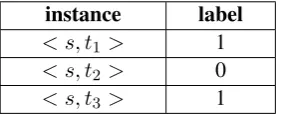
To solve the first challenge, we transform multi-label classification to multiple binary classification problems. Specifically, a given sentencesattached each pre-defined event type t forms an instance, which is expected to be labeled with 0 or 1 ac-cording to whetherscontains an event of typet. For example, suppose there totally are 3 prede-fined types of events(denoted byt1, t2andt3), and
sentence scontains two events of typet1 andt3,
then it could be transformed to the following three instances:
instance label < s, t1 > 1
< s, t2 > 0
[image:2.595.112.253.318.375.2]< s, t3 > 1
Table 1: Example of instances in binary classifications for sentences, which contains events of typet1andt3.
In this paradigm, sentences that convey multiple events will yield multiple positive pairs, thus the multi-label problem could be well solved.
Furthermore, each type of events are usually triggered by a set of specific words, which are called event trigger words. For example, Death events are usually triggered by “die”, “passed away”, ”gone”, etc. Therefore, event trigger word-s are important clueword-s to thiword-s taword-sk. Since exiword-sting work explicitly exploited annotated trigger words in their approaches, they can directly model this observation. However, in our case, annotated trig-gers are unavailable. To model this information, we propose a simple but effective model, called Type-awareBias Neural Network with Attention Mechanisms (TBNNAM).
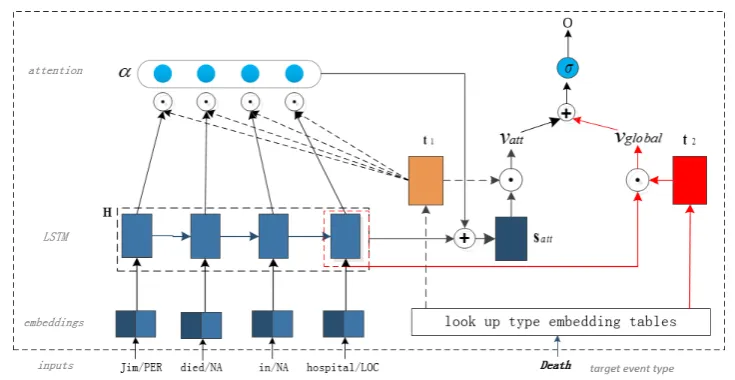
Figure1illustrates the framework ofTBNNAM. The input is consisted of two parts: a tokenized sentence with NER tags and a target event type. The outputois expected to be 1 if the given sen-tence conveys an event of the target type, other-wise 0 (the output should be 1 for the example given in Figure1). Specifically, given a sentence, the proposed model first transforms the input to-kens into embeddings, and applies an LSTM layer
to calculate a context-dependent representation for each token. Then it computes an attention vector, α, based on the target event type, where the trig-ger word is expected to obtain higher score. Fi-nally, the sentence representationsattis calculated based onα. Here,sattis expected to focus on lo-cal information (trigger word). To capture global information, the final output, o, is also connected to the last LSTM units, which encodes the glob-al information of the input sentence. Furthermore, to reinforce the influence of positive samples, we devise a bias objective function in our model . We call our model “type-aware” because the represen-tation of a sentence,satt, is calculated based on the target event type.
We have conducted experimental comparisons on a widely used benchmark dataset ACE20051. The results illustrate that our approach outper-forms all the compared baselines, and even achieves competitive performances compared with exiting approaches that used annotated triggers. We publish our code for further study by the NLP community.2
In summary, the main contributions of this work are: (1) To the best of our knowledge, this is the first work that focuses on detecting events with-out triggers. Compared with existing approaches, the proposed method requires less manual anno-tations. (2) Without triggers, this task encounters two challenges: multi-label problem and trigger absence problem. We propose a simple but effec-tive model, which even achieves competieffec-tive re-sults compared with approaches that using anno-tated triggers. (3) Since this is the first work on detecting events without triggers, we implement a series of baseline models for this task, and system-atically evaluate and analyze them.
2 Background
2.1 Task Definition
Event detection task requires that certain speci-fied types of events, which are mentioned in the annotated data, to be detected. The most com-mon used benchmark dataset in previous work is ACE 2005 corpus. This corpus includes 8 type-s of eventtype-s, with 33 type-subtypetype-s. Following previ-ous work(Ahn,2006;Ji and Grishman,2008;Liao and Grishman,2010;Hong et al.,2011;Li et al.,
1
https://catalog.ldc.upenn.edu/LDC2006T06
2https://github.com/liushulinle/event detection without
Figure 1: The framework of type-aware bias neural network with attention mechanisms. The input is consisted of two parts: a tokenized sentence with NER tags and a target event type. t1andt2are two different embedding
vectors of the target event type. The outputo is expected to be 1 if the given sentence conveys an event of the target type, otherwise 0 (the output should be 1 for the case in this figure). We call it “type-aware” because the representation of sentence,satt, is calculated based on the target event type.
2013;Chen et al., 2015;Nguyen and Grishman,
2016), we treat them simply as 33 separate event types and ignore the hierarchical structure among them. Consider the following sentence “In Bagh-dad, a cameraman died when an American tank fired on the Palestine Hotel”, an ideal event detec-tor should detect two events from this sentence: a Dieevent and anAttackevent.
2.2 Related Work
Event detection is one of important topics in NLP. Many approaches have been proposed for this task. Nearly all the existing methods on ACE event task follow supervised paradigm. We fur-ther divide them into feature-based methods and representation-based methods.
In feature-based methods, a diverse set of s-trategies has been exploited to convert classifica-tion clues into feature vectors. Ahn (2006) us-es the lexical featurus-es(e.g., full word), syntactic features (e.g., dependency features) and external-knowledge features(WordNet (Miller, 1998)) to extract the event. Inspired by the hypothesis of One Sense Per Discourse (Yarowsky, 1995), Ji and Grishman (2008) combined global evidence from related documents with local decisions for the event extraction. To capture more clues from the texts,Gupta and Ji(2009),Liao and Grishman
(2010) andHong et al.(2011) proposed the cross-event and cross-entity inference for the ACE cross-event task. Li et al.(2013) proposed a joint model to
capture the combinational features of triggers and arguments.Liu et al.(2016b) proposed a global in-ference approach to employ both latent local and global information for event detection.
In recent years, representation-based methods have dominated the research. In this paradigm, candidate event mentions are represented by em-beddings, which typically are fed into neural net-works. Chen et al. (2015) and Nguyen and Gr-ishman (2015) are the first work in this paradig-m. Their models are based on CNNs (Convolu-tional Neural Networks). To model the dependen-cy of triggers and arguments,Nguyen and Grish-man(2016) proposed a joint event extraction ap-proach based RNNs(Recurrent Neural Networks).
Liu et al.(2017) proposed to encode argument in-formation in event detection via supervised atten-tion mechanisms. Recently, Nguyen and Grish-man(2018) andSha et al.(2018) proposed to ex-ploit syntactic information for event detection.
All the existing approaches required annotated triggers. The expensive annotation of training da-ta limits the application of these approaches. To reduce manual effort, we perform this task with-out event triggers.
3 Methodology
sentences that do not contain any events. To cap-ture the hidden trigger information, we propose a simple but effective model, called Type-aware BiasNeuralNetwork withAttentionMechanisms (TBNNAM). Our model is “type-aware” because it calculates the representation of a sentence based on the target event type. Figure 1 illustrates the framework ofTBNNAM. The input is consisted of two parts: a tokenized sentence with NER tags and a target event type. The outputois expected to be 1 if the given sentence conveys an event of the tar-get type, otherwise 0. Next, we describe the struc-ture of this model in bottom-up order.
3.1 Input Tokens
Given a sentence, we use Stanford CoreNLP tool-s3(Manning et al., 2014) to convert texts into to-kens. The ACE 2005 corpus annotated not only events but also entities for each given sentence. Following previous work, we exploit the annotat-ed entity tags in our model(Li et al.,2013;Chen et al., 2015;Nguyen and Grishman, 2015, 2016;
Liu et al.,2016b).
3.2 Word/Entity Embeddings
Word embeddings learned from a large amount of unlabeled data have been shown to be able to cap-ture the meaningful semantic regularities of word-s(Bengio et al.,2003;Erhan et al., 2010). Much work(Socher et al., 2012; Zeng et al., 2014) has shown its power in many NLP tasks.
In this work, we use the Skip-gram mod-el(Mikolov et al.,2013) to learn word embeddings on the NYT corpus4. Furthermore, we random-ly initialized an embedding table for each entity tags. All the input word tokens and entity tags will be transformed into low-dimensional vectors by looking up these embedding tables. In this work, we denote the dimension of word embeddings by dw, and that of entity embeddings byde.
3.3 Event Type Embeddings
As illustrated in Figure 1, an event type is trans-formed into two embedding vectors: t1 and t2.
The first one (colored with brown) is designed to capture local information (hidden trigger word), and the latter one (colored with red) is designed to capture global information. Both of them are randomly initialized. The dimension of event type embeddings is denoted bydevt.
3
http://stanfordnlp.github.io/CoreNLP
4https://catalog.ldc.upenn.edu/LDC2008T19
3.4 LSTM Layer
As shown in Figure1, the LSTM layer is run over the sequence of concatenation of word and entity embeddings. LSTM has three gates(input i, for-getf and output o), and a cell memory vector c. The input gate can determine how incoming vec-torsx(t)alter the state of the memory cell. The output gate can allow the memory cell to have an effect on the outputs. Finally, the forget gate al-lows the cell to remember or forget its previous state.
3.5 Attention Layer
Each type of events are usually triggered by a set of specific words, which are called event trigger words. For example, Death events are usually triggered by “die”, “passed away”, ”gone”, etc. Therefore, event trigger words are important clues to this task. However, this information is hidden in our task, because annotated triggers are unavail-able. To model the hidden triggers, we introduce attention mechanisms in our approach.
As illustrated in Figure1, the attention vectorα is calculated based on the target event type embed-dingt1and the hidden stateshyielded by LSTM.
Specifically, the attention score for thek-th token in a given sentence is calculated by the following equation:
αk= exp(hk·t
T 1)
P
iexp(hi·tT1)
(1)
In this model, trigger words of the target even-t even-type are expeceven-ted even-to obeven-tain higher scores even-than other words. Finally, the representation of the sen-tence,satt, is computed by the following equation:
satt=αTH (2)
where α = [α1, ..., αn] is the attention vector,
H= [h1,h2, ...,hn]is a matrix,hkis the LSTM’s output for thek-th token, andsattis the represen-tation of the given sentence.
3.6 Output Layer
As illustrated in Figure1, the final outputois con-nected to two components: vatt and vglobal. On one hand, vatt is calculated by the dot produc-t ofsattandt1, which is designed to capture local
to capture global features of a sentence. Finally,o is defined as the weighted sum ofvattandvglobal:
o=σ(λ·vatt+ (1−λ)·vglobal) (3)
where σ is the Sigmoid function, λ ∈ [0,1] is a hyper-parameter for trade-off between vatt and vglobal.
3.7 Bias Loss Function
We devise a bias loss function to reinforce the in-fluence of positive samples because of the follow-ing reasons. 1)positive samples are much less than negative samples. In our approach, each training sample is a<sentence,event type> pair, whose label is 1 or 0 according to whether the giv-en sgiv-entgiv-ence conveys an evgiv-ent of type t. For ex-ample, we totally have 33 target event types, if a sentence only contains one event, then it will be transformed into 32 negative pairs and 1 positive pair. The majority of sentences convey at most t-wo events, thus negative samples are much more than positive samples. 2) positive samples are more informative than negatives.A positive pair < s, t > means thatsconveys an event of type t, whereas negative pair meanssdoes not convey any event of typet. Apparently, the former is more informative.
Given all of the (suppose T) training instances (x(i), y(i)), the loss function is defined as follows:
J(θ) = 1 T
T
X
i=1
(o(xi)−y(i))2(1 +y(i)·β) +δ||θ||2
(4) where x is a pair consisted of a sentence and a target event type, y ∈ {0,1}, θ is the parameter of our model and δ > 0is the weight of L2 nor-malization term. (1 +y(i) ·β) is the bias term. Specifically, the value of this term is 1 for negative samples (y(i)is 0) and 1 +β for positive samples (y(i)is 1), whereβ ≥0.
3.8 Training
We train the model by using a simple optimization technique called stochastic gradient descent (S-GD) over shuffled mini-batches with the Adadelta rule (Zeiler,2012). Regularization is implemented by a dropout and L2 norm.
Given a instancex, the model assign it a labeley according to the following equation:
e
y=
0 o(x)<0.5
[image:5.595.315.520.60.202.2]1 otherwise (5)
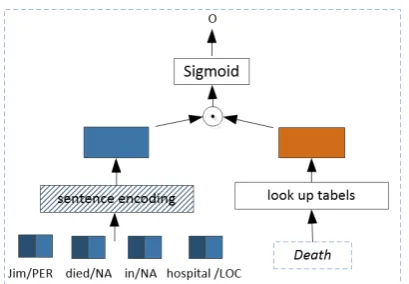
Figure 2: The framework of binary classification based approaches. The outputois expected to be 1 if the giv-en sgiv-entgiv-ence conveys an evgiv-ent of the target type, other-wise 0.
wherex is a pair< s,t >,o(x)is the output of the model forx, andyeis the final predicted result.
4 Baseline Systems
Since this is the first work to perform event de-tection without triggers, we implement a series of baseline systems for comparisons, which could be divided into two categories: binary classification based methods and multi-class classification based methods.
4.1 Binary Classification
Similar with the proposed approach, baseline sys-tems in this group solved this task via binary clas-sification. Figure 2 illustrates the framework of these methods. These models take a sentence and a target event type as input. Then all the inputs are transformed into embeddings by looking up em-bedding tables. These models have the same loss function as the proposed approach (see Equation
4). The key component of these models is sen-tence encoder. According to the strategy of encod-ing sentence, we implement three models for com-parison:BC-CNN, BC-LSTMlast,BC-LSTMavg.
• BC-CNN employs a CNN model to encode sentence.
• BC-LSTMlastemploys LSTM model, and use the hidden state of the last token as the repre-sentation of a given sentence.
Figure 3: The framework of multi-class classification based approaches.
4.2 Multi-class Classification
All existing approaches model the task of even-t deeven-teceven-tion (wieven-th even-triggers) via muleven-ti-class classi-fication5. Given a sentence, these methods pre-dict whether each token is an event trigger and what type of event it triggered. We also imple-ment several multi-class classification based sys-tems for comparison. Since annotated triggers are unavailable in our task, the sentence is the input of our model. Figure3 illustrates the framework of these models. Following existing work(Chen et al.,2015;Liu et al.,2017), we employ a negative log-likelihood loss function in the soft-max classi-fier: J(θ) = −1
T
PT
i=1log(p(y(i)|x(i), θ)), where
(x(i), y(i)) is a training sample,y(i)is a label from the valid label set (all the predefined event type-s plutype-s aNA for none event), T is the total num-ber of training instances, θ is the parameters of the model. According to the strategy of encoding sentence, we implement three models: MC-CNN, MC-LSTMlastandMC-LSTMavg.
• MC-CNN employs a CNN model to encode sentence.
• MC-LSTMlast employs LSTM model, and use the hidden state of the last token as the representation of a given sentence.
• MC-LSTMavg also employs LSTM model, but use the average of all hidden states as the representation of a given sentence.
5Multi-class classification means a classification task with
more than two classes, but each sample belongs to only one class. “multi-class” is different from “multi-label”.
5 Experimental Results
5.1 Experimental Setup
In this section, we introduce the dataset, evalua-tion metrics and the settings of hyper parameters.
5.1.1 Dataset
Our experiments are conducted on ACE 2005 dataset. Following the evaluation of previous work(Li et al., 2013; Chen et al., 2015; Nguyen and Grishman, 2016; Liu et al., 2017), we ran-domly selected 30 articles from different genres as the development set, and subsequently conduct-ed a blind test on a separate set of 40 ACE 2005 newswire documents. We used the remaining 529 articles as our training set.
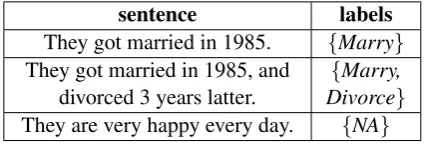
This work focuses on detecting events without triggers. Therefore, we remove trigger annotations from the corpus. Specifically, we employ Stanford CoreNLP Toolkit to split each document into sen-tences, and assign each sentence with a set of la-bels according to the original annotations in ACE 2005 corpus. If a sentence does not contain any event, we assign it with a special label, NA. If a sentence contains multiple events of the same type (less than 3% in ACE corpus), we only keep one label for each type. Table2shows several samples of the our corpus.
sentence labels
They got married in 1985. {Marry} They got married in 1985, and
divorced 3 years latter.
{Marry, Divorce} They are very happy every day. {NA}
Table 2: Examples of instances in our corpus (without event trigger annotations).
5.1.2 Evaluation Metrics
Following previous work (Liao and Grishman,
2010;Li et al.,2013;Chen et al.,2015;Liu et al.,
2017), we use precision (P), recall (R) and F1
-measure (F1) to evaluate the results.
Precision:the proportion of correctly predicted events in total predicted events.
Recall: the proportion of correctly predicted events in total gold events of the dataset.
F1-measure: 2×PP+×RR
5.1.3 Hyper Parameters
[image:6.595.310.523.450.522.2]Figure 4: Experimental results on development dataset with different setting ofλ.
methods P(%) R(%) F1(%)
MC-CNN 73.3 46.3 56.8 BC-CNN 76.6 52.9 62.6
MC-LSTMlast 57.9 42.3 48.9
BC-LSTMlast 69.8 52.2 59.7
MC-LSTMavg 60.3 42.7 50.0
BC-LSTMavg 68.1 49.2 57.1
Table 3: Experimental results on ACE 2005 corpus. Methods with name MC-* are based on multi-class classification, and methods with nameBC-*are based on binary classification.
set the dimension of word embeddings as 200, the dimension of entity type embeddings as 50, batch size as 100, the hyper parameter for theL2 norm
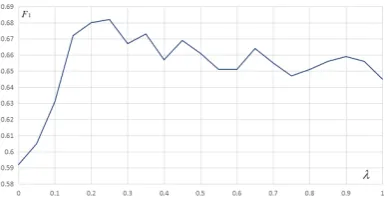
as10−5, β in the bias term as 1.0. Furthermore, we also tuneλin Equation3on the development dataset. Figure 4 illustrates experimental result-s with different result-settingresult-s of λ, finally we set λas 0.25. And in all the CNN-based baseline systems, the sizes of filter windows are set to 1, 2, 3 with 100 feature maps each.
5.2 Multi-class Classification vs. Binary Classification
Table3illustrates the experimental results, where methods with nameMC-*are based on multi-class classification, and methods with name BC-* are based on binary classification. According to the strategy to encode a sentence, methods in Table3
are grouped into three parts. From the table, we make the following observations:
• In each group, binary classification based ap-proach significantly outperforms multi-class classification based approach. The reason is thatBC-*can solve the multi-label problem, butMC-* can not. Moreover,MC-*achieve much lower recall than BC-*, because they predict at most one event for each sentence.
methods P(%) R(%) F1(%)
BC-CNN 76.6 52.9 62.6 BC-LSTMlast 69.8 52.2 59.7
BC-LSTMavg 68.1 49.2 57.1
BC-LSTMatt 68.3 64.5 66.3
our TBNNAM 76.2 64.5 69.9
Nguyen’s CNN† 71.8 66.4 69.0 Chen’s DMCNN† 75.6 63.6 69.1 Liu’s PSL† 75.3 64.4 69.4 DS-DMCNN‡† 75.7 66.0 70.5
Table 4: Experimental results on ACE 2005 corpus. Methods in the first group are baseline systems. Meth-ods in the second group are the proposed approaches. Methods in the last group are state-of-the-art ED sys-tems. †requiring annotated triggers, ‡using external data
• Methods with CNN as sentence encoder achieve better performance than that with L-STM. The reason is that trigger words are im-portant clues to event detection, and CNN is good at extracting such local features.
5.3 Overall Performances
In this section, we illustrates the results of the proposed approach (see Table 4). The results of baseline systems are listed in the first group. Methods in the second group are the proposed approaches. They have the same model structure as Figure1. InBC-LSTMatt,λ(see Equation3) is set as 1.0, which is designed to show the effects of the proposed attention strategy. In TBNNAM, λ is set as 0.25, which is designed to employ both local information (captured by the attention mechanism) and global information (captured by the last output of LSTM). Methods in the last group are state-of-the-art ED systems on ACE 2005 dataset. We give a brief introduction of them as follows:
1). Nguyen’s CNN: the CNN model proposed by
Nguyen and Grishman(2015)
2). Chen’s DMCNN: the dynamic multi-pooling CNN model proposed byChen et al.(2015) 3). Liu’s PSL: the soft probabilistic soft logic model proposed byLiu et al.(2016b)
4). DS-DMCNN: the DMCNN model augmented with automatic labeled data, proposed by Chen et al.(2017)
[image:7.595.85.280.62.162.2] [image:7.595.81.282.208.314.2]Figure 5: Visualization of attention weight vectorαof sample instances learned by our model.
• BC-LSTMatt outperforms all the baseline systems with remarkable gains, which demonstrates the effectiveness of the pro-posed attention mechanism.
• TBNNAM achieves better performance than BC-LSTMatt (69.9% vs. 66.3%), which means that global information captured by the last state of LSTM is also important to this task. Such global information and local information captured by the attention mecha-nisms are complementary to each other.
• All state-of-the-art ED systems require an-notated triggers. Without trigger annotation-s, our approach achieves competitive resultannotation-s, even outperforms some of them.
5.4 Analysis of Weightα
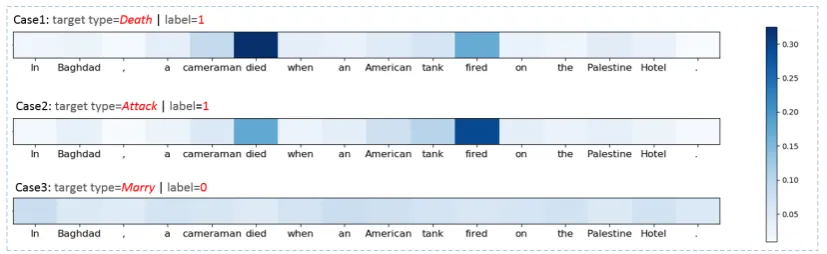
Figure5 shows several examples of the attention vectorα learned by our model. In the first case, “died” is the most significant keyword for the Deathevent, and our model succeeded to capture this feature by assigning it with a large attention s-core. Similarly, in the second case, “fired” is a key clue of Attack event, and our model also learned it and assigned it with a large attention score. Ac-tually, “died” and “fired” are the trigger words of DeathandAttack events, respectively. Therefore, we argue that, although annotated triggers are u-navailable, our model still can exploit trigger in-formation for this task. Moreover, our approach also could model the dependencies among differ-ent evdiffer-ents, which has been demonstrated useful for this task(Liao and Grishman,2010;Liu et al.,
2016b). For example,Attackevents often co-occur withDeathevents. In Case1 and Case2 (Figure5), our approach models such information by paying attention on both words “died” and “fired”. Fur-thermore, the 3-rd case is a negative sample, thus
methods P(%) R(%) F1(%)
BC-LSTMatt\Bias 74.5 57.2 64.7
BC-LSTMatt 68.3 64.5 66.3
[image:8.595.309.525.224.299.2]TBNNAM\Bias 76.6 59.8 67.2 TBNNAM 76.2 64.5 69.9
Table 5: Results of systems without/with bias term in loss function, where*\Biasdo not use bias term.
there is no key clues. Our model assigned each token with nearly equivalent attention score.
5.5 Effects of Bias Term in Loss Function
In this section, we illustrates the effectiveness of the bias term in Equation 4. Table5 shows ex-perimental results. Methods named with “*\Bias” do not use bias term. From the table, we ob-serve that systems with bias term in loss function significantly outperform those without bias term, which demonstrates the correctness of our analy-sis in Section3.7 that positive samples should be reinforced during training.
6 Conclusions
References
David Ahn. 2006. The stages of event extraction. In
Proceedings of the Workshop on Annotating and Reasoning about Time and Events, pages 1–8. As-sociation for Computational Linguistics.
Yoshua Bengio, R´ejean Ducharme, Pascal Vincent, and Christian Janvin. 2003. A neural probabilistic lan-guage model. The Journal of Machine Learning Re-search, 3:1137–1155.
Yubo Chen, Shulin Liu, Xiang Zhang, Kang Liu, and Jun Zhao. 2017. Automatically labeled data genera-tion for large scale event extracgenera-tion. InProceedings of the 55th Annual Meeting of the Association for Computational Linguistics (Volume 1: Long Paper-s), pages 409–419, Vancouver, Canada.
Yubo Chen, Liheng Xu, Kang Liu, Daojian Zeng, and Jun Zhao. 2015. Event extraction via dynam-ic multi-pooling convolutional neural networks. In
Proceedings of the 53rd Annual Meeting of the As-sociation for Computational Linguistics, pages 167– 176. Association for Computational Linguistics.
Dumitru Erhan, Yoshua Bengio, Aaron Courville, Pierre-Antoine Manzagol, Pascal Vincent, and Samy Bengio. 2010. Why does unsupervised pre-training help deep learning? The Journal of Machine Learn-ing Research, 11:625–660.
Prashant Gupta and Heng Ji. 2009. Predicting un-known time arguments based on cross-event prop-agation. In Proceedings of the ACL-IJCNLP 2009 Conference Short Papers, pages 369–372. Associa-tion for ComputaAssocia-tional Linguistics.
Yu Hong, Jianfeng Zhang, Bin Ma, Jianmin Yao, Guodong Zhou, and Qiaoming Zhu. 2011. Using cross-entity inference to improve event extraction. In Proceedings of the 49th Annual Meeting of the Association for Computational Linguistics: Human Language Technologies, pages 1127–1136. Associ-ation for ComputAssoci-ational Linguistics.
Heng Ji and Ralph Grishman. 2008. Refining even-t exeven-traceven-tion even-through cross-documeneven-t inference. In
Proceedings of ACL-08: HLT, pages 254–262. As-sociation for Computational Linguistics.
Qi Li, Heng Ji, and Liang Huang. 2013. Joint event extraction via structured prediction with global fea-tures. InProceedings of the 51st Annual Meeting of the Association for Computational Linguistics (Vol-ume 1: Long Papers), pages 73–82.
Shasha Liao and Ralph Grishman. 2010. Using doc-ument level cross-event inference to improve event extraction. InProceedings of the 48th Annual Meet-ing of the Association for Computational LMeet-inguistic- Linguistic-s, pages 789–797.
Shulin Liu, Yubo Chen, Shizhu He, Kang Liu, and Jun Zhao. 2016a. Leveraging framenet to improve au-tomatic event detection. InProceedings of the 54th
Annual Meeting of the Association for Computation-al Linguistics, volume 1, pages 2134–2143. Associ-ation for ComputAssoci-ational Linguistics.
Shulin Liu, Yubo Chen, Kang Liu, and Jun Zhao. 2017. Exploiting argument information to improve even-t deeven-teceven-tion via supervised aeven-teven-teneven-tion mechanisms. In
Proceedings of the 55th Annual Meeting of the Asso-ciation for Computational Linguistics, pages 1789– 1798, Vancouver, Canada. Association for Compu-tational Linguistics.
Shulin Liu, Kang Liu, Shizhu He, and Jun Zhao. 2016b. A probabilistic soft logic based approach to exploit-ing latent and global information in event classifi-cation. InProceedings of the thirtieth AAAI Con-ference on Artificail Intelligence, pages 2993–2999. Association for Computational Linguistics.
Christopher D. Manning, Mihai Surdeanu, John Bauer, Jenny Finkel, Steven J. Bethard, and David Mc-Closky. 2014. The Stanford CoreNLP natural lan-guage processing toolkit. InAssociation for Compu-tational Linguistics (ACL) System Demonstrations, pages 55–60.
Tomas Mikolov, Kai Chen, Greg Corrado, and Jef-frey Dean. 2013. Efficient estimation of word rep-resentations in vector space. arXiv preprint arX-iv:1301.3781.
George Miller. 1998. WordNet: An electronic lexical database. MIT press.
Huu Thien Nguyen and Ralph Grishman. 2015. Event detection and domain adaptation with convolutional neural networks. InProceedings of the 53rd Annual Meeting of the Association for Computational Lin-guistics, pages 365–371. Association for Computa-tional Linguistics.
Huu Thien Nguyen and Ralph Grishman. 2016. Mod-eling skip-grams for event detection with convolu-tional neural networks. InProceedings of the 2016 Conference on Empirical Methods in Natural Lan-guage Processing, pages 886–891. Association for Computational Linguistics.
Thien Huu Nguyen and Ralph Grishman. 2018. Graph convolutional networks with argument-aware pool-ing for event detection.
Lei Sha, Feng Qian, Baobao Chang, and Zhifang Sui. 2018. Jointly extracting event triggers and argu-ments by dependency-bridge rnn and tensor-based argument interaction.InAAAI.
David Yarowsky. 1995. Unsupervised word sense dis-ambiguation rivaling supervised methods. In33rd Annual Meeting of the Association for Computation-al Linguistics. Association for Computational Lin-guistics.
Matthew D Zeiler. 2012. Adadelta: An adaptive learn-ing rate method.arXiv preprint arXiv:1212.5701.