Original Article
Long no-coding RNAs and mRNAs
expression profile in human colorectal
cancer:
analysis based on the B7-H4 regulation
Yunfu Shi1, Wenjuan Yang1, Yiming Qi1, Lu Li3, Jianing Liu3, Xiufang Hong2
1Department of Oncology, Tongde Hospital of Zhejiang Province, Hangzhou 310012, Zhejiang, People’s
Repub-lic of China; 2Department of Geriatrics, Zhejiang Hospital, No 12, Lingyin Road, Hangzhou 310013, Zhejiang,
People’s Republic of China; 3Queen Mary Department of Medical College of Nanchang University, 1299 Xuefu
Road, Nanchang 330000, Jiangxi, People’s Republic of China
Received April 21, 2018; Accepted October 30, 2018; Epub December 15, 2018; Published December 30, 2018
Abstract: B7-H4 is now recognized as a kind of co-stimulatory proteins that can interact with the ligands, and it has been extensively proven to have the ability in not only inhibiting T cell proliferation but also inducing cell cycle arrest and at the same time decreasing the secretion of cytokines, exhibiting an independent prognostic indicator for various cancers. However, studies concerning how to regulate long non-coding RNAs (lncRNAs) and mRNAs in the human colon cancer by the B7-H4 are still seldom noticed by previous works. Here, we report on using the RNA-sequencing (RNA-seq) and bioinformatic analysis to profile differential expression genes in SW1116 with or without over-expressed B7-H4. A total of 167 differential genes, including 39 lncRNAs and 128 mRNAs, are identified. Our findings in RNA-seq are validated randomly using qRT-PCR, and results reveal that GO and KEGG analyses play the role in predicting the possible roles of B7-H4 in colon cancer cells, namely, B7-H4 contributes to regulate the protein processing and mRNA surveillance related pathways.
Keywords: B7-H4 expression, colorectal cancer, long non-coding RNAs, RNA-seq
Introduction
V-set domain-containing T-cell activation inhibi-tor 1 (VTCN1), which is also known as B7-H4, belongs to the B7 superfamily. The family mem-bers are co-stimulatory proteins to interact with the ligands like CD28 on T lymphocytes [1]. Up until now, it has been found that B7-H4 can suppress T cell proliferation, resulting in induc-ing cell cycle arrest and decreasinduc-ing the secre-tion of cytokines, such as IL-2, IL-4, IL-10, and IFN-γ [2]. As a result, B7-H4 has acted as a dis -tinct member of B7-family, and it has been extensively suggested for expressing the lung, colon, kidney, skeletal muscle, pancreas, and pancreas [3, 4]. However, the existence of B7-H4 protein in normal cell is very limited [3]. Despite the tightly expressed protein in normal cells, various cancer tissues over xpress B7-H4 protein, and the expression level is found to be related to tumor size, TNM stage, and survival period [5, 6]. One meta-analysis, enrolled 3771 patients with different kinds of cancers,
dem-onstrates B7-H4 is an independent predictive symbol of cancer patients [7].
Over the past decades, the improvement of RNA microarrays and high-throughput sequenc-ing have shown the wide expression of long non-coding RNAs (lncRNAs) in human cells and their crucial roles in various diseases, including cancers [8]. LncRNAs are described as a group of RNAs with more than 200 nucleotides in length, which are not predicted to encode pro-teins. They have been proven to not only regu-late transcription in cis or trans and proteins or RNA molecules but also affect other RNAs pro-cessing and organize nuclear domains [9]. However, some transcripts, annotated as puta-tive lncRNAs, are actually translated into pro-teins [10, 11].
in which we has proved the expression level of B7-H4 in colon cancer tissues can be appar-ently elevated as compared to the adjacent normal ones and B7-H4 siRNA that can prohibit efficiently proliferation, invasion, and migration of colon cancer cells [12], here we carry out this study to investigate differentially expressed lncRNAs and mRNAs in human colon adenocar-cinoma cell SW1116 with or without over-expression of B7-H4, aiming to dig out a deeper mechanisms of B7-H4 regulation in colon cancer.
Materials, analysis methods and experimental detail
Plasmids, cell culture, transfection and lentivi-rus infection
The plasmid of pLX304-VTCN1 was obtained from Shanghai Jiaotong University School of Medicine, Shanghai, China, and so was the mock-vehicle for negative control. The human embryonic kidney cell HEK-293T and human colon adenocarcinoma cell SW1116 was pur -chased from American Type Cell Culture (ATCC). All cells were cultured according to culture methods offered by ATCC (www.atcc.org). The transfection was performed by using Lipo- fectamine 3000 (Invitrigen, CA, USA), when cells grew to 60-80% confluence. Supernatant containing lentivirus was packed in HEK-293T
and purification (Epicentre Ribo-Zero Gold Kit, Illumina, San Diego, USA), were broken into small pieces and reverse-transcribed to build the cDNA library as recommended protocol (Illumina, San Diego, USA). The sequencing was then performed on Illumina X10 (LC-Bio Tech, Hangzhou, China).
Transcripts assembly
Adapter contaminations were abandoned thr- ough Cutadapt and quality of sequence was certified by FastQC [13]. Clean reads were then mapped to the reference genome built with Topaht2 and Bowtie2.
LncRNA identification
Transcripts that overlapped with known mRNAs nad transcripts (shorter than 200 bp) were abandoned. Coding Non-Coding Index (CNCI), Coding Potential Calculator (CPC) were utilized to predict transcripts for coding capability. All transcripts with CNCI score < 0 and CPC score < -1 were discarded. The remaining transcripts were treated as lncRNAs.
Different expression analysis of lncRNAs and mRNAs
String Tie was used to perform expression level for mRNAs and lncRNAs by calculating FPKM [14]. Differential expression of lncRNAs and
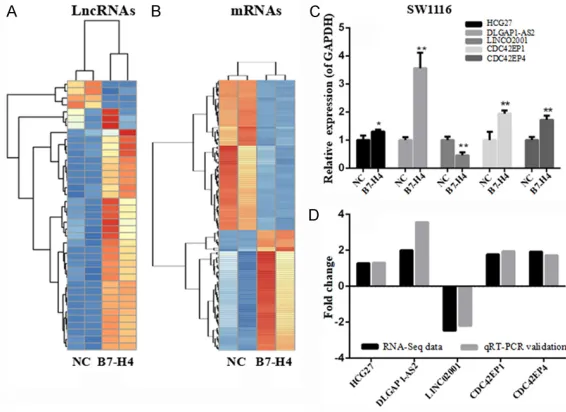
Figure 1. Differential expression of lncRNAs (A) and mRNAs (B) with and without B7-H4; Validation of RNA-seq data by qRT-PCR results for 3 lncRNAs and 2 mRNAs, (C) and (D) are qRT-PCR results and the comparison between qRT-PCR result and RNA-seq data, respectively.
cells. Viral supernatant was added into 60-70% conflu -ence cells for infection. After 48 h, cells were incubated with 5 μg/ml blasticidin (Ther-mo Fisher Scientific, MA, USA) for selection over 1 week.
RNA library construction and sequencing
[image:2.612.89.372.72.278.2]Quantitative real time-polymerase chain reaction (qRT-PCR)
RNA extraction was carried out as we described above. Reverse transcription was performed by TUREscript 1st Stand cDNA SYNTHESIS Kit (Aidlab, Beijing, China). The quantification and analysis of target mRNAs and lncRNAs were performed using SYBR Green qPCR (ABI, Foster City, CA, USA) with specific primers, while GAPDH as the internal control. The procedure was listed in our study before [17]. Experimental results
Differentially expressed lncRNAs and mRNAs in SW1116 with over-expression of B7-H4
A genome-wide sequencing was performed to identify atypical expression of lncRNAs and mRNAs from duplicated samples of SW1116 with and without over-expression of B7-H4. A total of 39 lncRNAs and 128 mRNAs were chos- en to differentially express. Of these, 35 lncRNAs and 71 mRNAs were up-regulated mRNAs was chosen with absolute value of log2
(fold change, FC) > 1 and with statistical signifi -cance (p value < 0.05) by R package [15].
Target gene forecast and functional analysis for lncRNAs
To seek the function of lncRNAs, the cis-target and trans-target genes of lncRNAs were pre-dicted to investigate probable functions by BLAST2GO [16]. The trans-target genes of lncRNAs were predicted through free energy between RNA secondary structures. The mRNAs 100 kb up- and downstream of lncRNAs, on the other way, were presumed to be cis -tar-get genes. Significance was expressed as a p
value < 0.05.
ones in the group over-expressed B7-H4 as compared to negative control (NC) group. In the meanwhile, 4 lncRNAs and 57 mRNAs were down-regulated ones. The differently expressed lncRNAs (A) and mRNAs (B) were shown in Figure 1.
Validation of transcription levels of lncRNAs and mRNAs
To verify the RNA-seq data, the expression of lncRNAs and mRNAs in the third pair of cells with and without over-expressed B7-H4 was detected by qRT-PCR. A total of 3 lncRNAs (HCG27, DLGAP1-AS2 and LINCO2001) and 2 mRNAs (CDC42EP1 and CDC42EP4) were ran-domly selected (see Figure 1C). The
[image:3.612.91.376.70.466.2]son between qRT-PCR and RNA-seq data
[image:4.612.96.523.85.198.2]showed similar trends (see Figure 1D). The con- activity. In this study, 8 KEGG pathways were enriched based on a cutoff criteria of P < 0.05
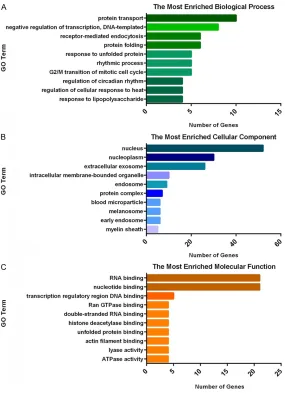
[image:4.612.89.376.186.653.2]Figure 3. Functional analysis for differentially expressed lncRNAs and mRNAs (top 10), (A) is the most enriched biological process, (B) is the most enriched Cellular Component and (C) is the most enriched molecular function.
Table 1. Enriched KEGG pathways (mRNAs)
Pathway ID Pathway Name Genes p value
ko03320 PPAR signaling pathway ANGPTL4; LPL; PCK2; UBC 0.00 ko04141 Protein processing in endoplasmic reticulum DNAJA1; HSP90AA1; HSPA8; HSPH1; LMAN1; YOD1 0.00 ko04920 Adipocytokine signaling pathway ADIPOR2; PCK2; SLC2A1 0.01 ko04144 Endocytosis ARF6; CHMP1B; HSPA8; PIP5KL1; TFRC 0.02
ko00350 Tyrosine metabolism FAHD1; MAOB 0.03
ko03015 mRNA surveillance pathway NXT1; PNN; WDR82 0.03
ko04915 Estrogen signaling pathway HBEGF; HSP90AA1; HSPA8 0.04
ko03022 Basal transcription factors TAF5; TAF9 0.04
sistency proved the accuracy and reliability of RNA-seq data.
Functional analysis for differ-entially expressed mRNAs
(Table 1). These results indicate us that B7-H4 has been involved in the pathways associated with endocrine system (ko03320, ko04920, ko04915), cellular processes (ko04144), genetic information processing (ko04141, ko03015, ko03022) and metabolism (ko00- 350).
LncRNA cis- or trans-target prediction
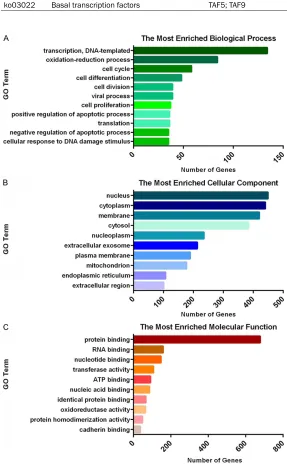
According to previous results [9], lncRNA regu-lating gene expression can be broadly classi-fied into the act in cis (i.e., affecting the expres-sion of nearby genes) and trans (i.e., influencing the gene expression or chromatin states in region distant from the transcription site). In this work, the trans-target genes of lncRNAs were predicted through free energy between RNA secondary structures. On the other way, mRNAs 100 kb up- and downstream of lncRNAs were considered as the cis-target genes. The di- fferential lncRNAs were annotated by analyzing the functions of these target mRNAs, and the results have been shown in Figure 3. In the fig
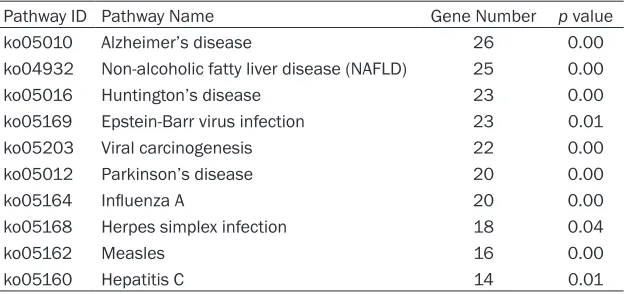
-genetic information processing (ko04141, ko- 03015, ko03013, ko03010) and signal trans-duction (ko04066). Furthermore, the top 10 diseases enriched by differentially expressed genes are associated with not only cancers (ko05203), but also endocrine and metabolic disease (ko04932), neurodegenerative diseas-es (ko05010, ko05012, ko05016) and infec -tious diseases (ko05162, ko05164, ko05160, ko05168, ko05169).
Survival analysis for lncRNAs
In order to verify whether the differential lncRNAs influence colon cancer patients’ sur -vival, we used GEPIA18 (Gene Expression Profiling Interactive Analysis, http://gepia.can -cer-pku.cn/), a web tool which is based on TCGA and GTEx data to analyze. Of 39 lncRNAs, DNAJC9-AS1, HCG27 and RP11-339B21.13 are showed to be independently factors to pre-dict patients’ overall survival (OS) by using quartile cutoff for high or low expression divi-sion (p < 0.05). These 3 lncRNAs were up-regu-Table 2. Enriched KEGG pathways (lncRNAs and mRNAs)
Pathway ID Pathway Name Gene Number p value
ko04141 Protein processing in endoplasmic reticulum 24 0.00
ko03013 RNA transport 23 0.00
ko00190 Oxidative phosphorylation 22 0.00
ko04110 Cell cycle 22 0.00
ko03010 Ribosome 17 0.00
ko04066 HIF-1 signaling pathway 16 0.00
ko03015 mRNA surveillance pathway 16 0.00
ko04922 Glucagon signaling pathway 16 0.00
ko00240 Pyrimidine metabolism 15 0.00
[image:5.612.92.406.84.231.2]ko04360 Axon guidance 13 0.03
Table 3. Enriched KEGG pathways referred to diseases (lncRNAs and mRNAs)
Pathway ID Pathway Name Gene Number p value
ko05010 Alzheimer’s disease 26 0.00
ko04932 Non-alcoholic fatty liver disease (NAFLD) 25 0.00
ko05016 Huntington’s disease 23 0.00
ko05169 Epstein-Barr virus infection 23 0.01
ko05203 Viral carcinogenesis 22 0.00
ko05012 Parkinson’s disease 20 0.00
ko05164 Influenza A 20 0.00
ko05168 Herpes simplex infection 18 0.04
ko05162 Measles 16 0.00
ko05160 Hepatitis C 14 0.01
ure, the enriched GO terms were shown to be a bit different from the result of solo mRNAs analysis. The most enri- ched BPs includes tran-scription, oxidation-re- duction process, cell cycle and so on. The most enriched CCs are combined with nucleus, cytoplasm, membrane and cytosol. It is obvi-ous that the genes referred to RNA binding and nucleotide binding are more than other MFs.
[image:5.612.91.407.276.423.2]lated markedly by over-expressed B7-H4, and furthermore, patients in the 3 high-expression groups had dramatically shorter mean OS than those in the low-expression ones (see Figure 4). Further research on the correlation between B7-H4 and the 3 lncRNAs in colon cancer will be valuable.
Discussion
The incidence and mortality rate of colon can-cer has kept growing in the past few years. The latest five-year survival rate of colon cancer patients in China has been up to 57.6% [19]. In recent years, the immunotherapeutic approach-es, such as cytotoxic T-lymphocyte-associated protein 4 (anti-CTLA-4), and programmed dea- th-ligand 1 (anti-PD-1), have been considered as an efficient effect for cancer treatment, but have only served for a subgroup of patients [1, 20]. The expression of B7-H4 is increased noticeably in various cancers, making it being a promising alternative target for cancer re- search. To our best knowledge, the present study is the first one to report differential expression of lncRNAs and mRNAs in colon cancer cells with or without over-expressed B7-H4.167 differential genes, including 39
can be used to regulate the autophagic turn-over of plastid constituents in plants [23, 24]. Except for the only one over-expressed CHMP1B in esophageal squamous cell carcinoma tis-sues [25], there is still no previous works con-cerning CHMP1B and cancers. The lncRNAs (e.g., DLGAP1-AS2 and LINC02001) which can be regulated largely by B7-H4 have been vali-dated by some novel lncRNAs that can get only gene IDs. The functions of these lncRNAs, how-ever, still remain unclear, but we could predict their possible roles via the target mRNAs. Obviously, the result of functional analysis for differential mRNAs alone is quite different from the one for mRNAs combined with lncRNAs. As the former one is analyzed at gene level by the differential mRNAs only, the latter one is ana-lyzed by the target mRNAs interacting with dif-ferential lncRNAs in transcriptional level. Protein processing in endoplasmic reticulum (ER) is one of the most enriched KEGG path -ways for both mRNA solo analysis and lncRNAs combining with mRNA analysis. It implies that B7-H4 may unsettle ER protein folding capacity and led to so-called “ER stress”, which is uncov-ered to impede the protection of anti-cancer immunity yet again [26].
Figure 4. Survival analysis for 3 lncRNAs in colon cancer, (A) UCG27, (B) DNAJC9-AS1 and (C) RP11-339B21.13.
lncRNAs and 128 mRNAs, have been chosen between 2 over-expressed B7-H4 sam-ples and 2 negative control ones. The results for qRT-PCR in another pair of cell samples validated the findings in RNA-seq.
[image:6.612.91.373.71.356.2]The mRNA surveillance pathway which is used to ensure quality and fidelity of messenger RNAs (mRNAs) is another one enriched in both analyses. The surveillance is achieved by mark-ing abnormal mRNAs for endogenous nucleas-es dnucleas-estruction. Neverthelnucleas-ess, cancers are dis-covered to exploit this process to degrade some key tumor-suppressor genes such as p53 [27].
As B7-H4 is a negative factor in T lymphocytes response, the differential genes is associated with infectious diseases such as measles, Epstein-Barr virus, herpes simplex infection, influenza A and hepatitis C as expected. Interestingly, we also get a fair number of neu-rodegenerative diseases in the enriched KEGG pathway list. These diseases including Al- zheimer’s disease, Parkinson’s disease and Huntington’s disease have similar amyloid ori -gins caused by accumulation of misfolded pro-teins [28]. According to the most recently-reported work [29], depletion of Foxp3+
regulatory T cells (i.e., Tregs) can help to miti-gate Alzheimer’s disease pathology, the pres -ence of which is correlated positively with B7-H4 expression. Tregs also play an important role in regulating inflammatory processes in liver disease [30]. It gives the explanation for why there are so many differential genes involved in non-alcoholic fatty liver disease (NAFLD).
Additionally, here we also explore the prognos-tic value of differential lncRNAs based on TCGA and GTEx data in colon cancer. Only 3 lncRNAs (DNAJC9-AS1, HCG27 and RP11-339B21.13) are showed to be independently prognostic indicators, while others are excluded because they had not been validated yet.
Conclusion
In this work, we comprehensively analyzed lncRNAs and mRNAs regulated by B7-H4 for the first time, in which the RNA-sequencing (RNA-seq) and bioinformatic analysis was used to profile differential expression genes in SW1116 with or without over-expressed B7-H4. Our find -ings showed that B7-H4 contributes to regulate the protein processing and mRNA surveillance related pathways. This work we exhibited here enables us to understand better not only the role of B7-H4 in colon cancer in immune aspect, but also the protein processing and, in the
meanwhile, the mRNA surveillance related aspect.
Acknowledgements
We acknowledge the work of Dr. Yunfu Shi, Wenjuan Yang, Yiming Qi and Xiufang Hong to revise this paper.
Disclosure of conflict of interest
This study was supported by funds from Zhejiang Province Association of Traditional Chinese Medicine (2018ZA005) as well as Science and Technology Department of Zhejiang Province (2018KY198) to Xiufang Hong and from Zhejiang Province Association of Traditional Chinese Medicine (2017ZB013) to Yunfu Shi.
Address correspondence to: Xiufang Hong, De- partment of Oncology, Tongde Hospital of Zhejiang Province, Hangzhou 310012, Zhejiang, People’s Republic of China. Tel: +86 0571 8159 5201; E-mail:
[email protected]; [email protected]
References
[1] Podojil JR, Miller SD. Potential targeting of B7-H4 for the treatment of cancer. Immunol Rev 2017; 276: 40-51.
[2] Chen L. Co-inhibitory molecules of the B7-CD28 family in the control of T-cell immunity. Nat Rev Immunol 2004; 4: 336-347.
[3] Sica GL, Choi IH, Zhu G, Tamada K, Wang SD, Tamura H. B7-H4, a molecule of the B7 family, negatively regulates T cell immunity. Immunity 2003; 18: 849-861.
[4] Prasad DV, Richards S, Mai XM, Dong C. B7S1, a novel B7 family member that negatively regu-lates T cell activation. Immunity 2003; 18: 863-873.
[5] Jeon YK, Park SG, Choi IW, Lee SW, Lee SM, Choi I. Cancer cell-associated cytoplasmic B7-H4 is induced by hypoxia through hypoxia-in-ducible factor-1alpha and promotes cancer cell proliferation. Biochem Biophys Res Com-mun 2015; 459: 277-283.
[6] Chen Y, Sun J, Zhao H, Zhu D, Zhi Q, Song, S. The coexpression and clinical significance of costimulatory molecules B7-H1, B7-H3, and B7-H4 in human pancreatic cancer. Onco Tar-gets Ther 2014; 7: 1465-1472.
[8] Zhang J, Zhu Y, Wang R. Long noncoding RNAs in respiratory diseases. Histol Histopathol 2018; 33: 747-756.
[9] Kopp F, Mendell JT. Functional classification and experimental dissection of long noncoding rnas. Cell 2018; 172: 393-407.
[10] Matsumoto A, Pasut A, Matsumoto M, Ya-mashita R, Fung J, Monteleone E. mTORC1 and muscle regeneration are regulated by the LINC00961-encoded SPAR polypeptide. Na -ture 2017; 541: 228-232.
[11] Anderson DM, Anderson KM, Chang CL, Mak -arewich CA, Nelson BR, McAnally JR. A micro-peptide encoded by a putative long noncoding RNA regulates muscle performance. Cell 2015; 160: 595-606.
[12] Peng HX, Wu WQ, Yang DM, Jing R, Li J, Zhou FL. Role of B7-H4 siRNA in proliferation, migra-tion, and invasion of LOVO colorectal carcino-ma cell line. Biomed Res Int 2015; 2015: 326981.
[13] Lei D, Lv L, Yang L, Wu W, Liu Y, Tu Y. Genome-wide analysis of mRNA and long noncoding rna profiles in chronic actinic dermatitis. Biomed Res Int 2017; 2017: 7479523.
[14] Pertea M, Pertea GM, Antonescu CM, Chang TC, Mendell JT, Salzberg SL. StringTie enables improved reconstruction of a transcriptome from RNA-seq reads. Nat Biotechnol 2015; 33: 290-295.
[15] Frazee AC, Pertea G, Jaffe AE, Langmead B, Salzberg SL, Leek JT. Ballgown bridges the gap between transcriptome assembly and expres-sion analysis. Nat Biotechnol 2015; 33: 243-246.
[16] Conesa A, Götz S, García-Gómez JM, Terol J, Talón M, Robles M. Blast2GO: a universal tool for annotation, visualization and analysis in functional genomics research. Bioinformatics 2005; 21: 3674-3676.
[17] Chu YM, Peng HX, Xu Y, Yang DM, Zhou FL, Li J, Kuai R, Lin Y. MicroRNA-1254 inhibits the mi -gration of colon adenocarcinoma cells by tar-geting PSMD10. J Dig Dis 2017; 18: 169-178. [18] Tang Z, Li C, Kang B, Gao G, Li C, Zhang Z. GE
-PIA: a web server for cancer and normal gene expression profiling and interactive analyses. Nucleic Acids Res 2017; 45: W98-W102. [19] Allemani C, Matsuda T, Di Carlo V, Harewood R,
Matz M, Nikšić M, Bonaventure A, Valkov M, Johnson CJ, Estève J, Ogunbiyi OJ, Azevedo E Silva G, Chen WQ, Eser S, Engholm G, Stiller CA, Monnereau A, Woods RR, Visser O, Lim GH, Aitken J, Weir HK, Coleman MP; CONCORD Working Group. Global surveillance of trends in cancer survival 2000-14 (CONCORD-3): analysis of individual records for 37 513 025 patients diagnosed with one of 18 cancers from 322 population-based registries in 71 countries. Lancet 2018; 391: 1023-1075.
[20] Matson V, Fessler J, Bao R, Chongsuwat T, Zha Y, Alegre ML, Luke JJ, Gajewski TF. The com -mensal microbiome is associated with anti-PD-1 efficacy in metastatic melanoma pa -tients. Science 2018; 359: 104-108.
[21] Burdelski C, Jakani-Karimi N, Jacobsen F, Möller-Koop C, Minner S, Simon R, Sauter G, Steurer S, Clauditz TS, Wilczak W. IMP3 overex-pression occurs in various important cancer types and is linked to aggressive tumor fea-tures: a tissue microarray study on 8,877 hu-man cancers and normal tissues. Oncol Rep 2018; 39: 3-12.
[22] Ohashi R, Sangen M, Namimatsu S, Takei H, Naito Z. IMP3 contributes to poor prognosis of patients with metaplastic breast carcinoma: a clinicopathological study. Ann Diagn Pathol 2017; 31: 30-35.
[23] Spitzer C, Li F, Buono R, Roschzttardtz H, Chung T, Zhang M, Osteryoung KW, Vierstra RD, Otegui MS. The endosomal protein charged multivesicular body protein1 regulates the au-tophagic turnover of plastids in arabidopsis. Plant cell 2015; 27: 391-402.
[24] Row PE, Liu H, Hayes S, Welchman R, Charala-bous P, Hofmann K, Clague MJ, Sanderson CM, Urbé S. The MIT domain of UBPY consti-tutes a CHMP binding and endosomal localiza-tion signal required for efficient epidermal growth factor receptor degradation. J Biol Chem 2007; 282: 30929-30937.
[25] Wang M, An S, Wang D, Ji H, Geng M, Guo X, Wang Z. Quantitative proteomics identify the possible tumor suppressive role of protease-activated receptor-4 in esophageal squamous cell carcinoma cells. Pathol Oncol Res 2018. [26] Cubillos-Ruiz JR, Bettigole SE, Glimcher LH. Tu
-morigenic and immunosuppressive effects of endoplasmic reticulum stress in cancer. Cell 2017; 168: 692-706.
[27] Popp MW, Maquat LE. Nonsense-mediated mRNA decay and cancer. Curr Opin Genet Dev 2018; 48: 44-50.
[28] Han J, Kaufman RJ. Physiological/pathological ramifications of transcription factors in the un -folded protein response. Genes Dev 2017; 31: 1417-1438.
[29] Baruch K, Rosenzweig N, Kertser A, Deczkows -ka A, Sharif AM, Spinrad A. Breaking immune tolerance by targeting Foxp3(+) regulatory T cells mitigates alzheimer’s disease pathology. Nat Commun 2015; 6: 7967.