3906
Context-Aware Cross-Lingual Mapping
Hanan Aldarmaki1 and Mona Diab1,2
1The George Washington University
2AWS, Amazon AI
[email protected],[email protected]
Abstract
Cross-lingual word vectors are typically ob-tained by fitting an orthogonal matrix that maps the entries of a bilingual dictionary from a source to a target vector space. Word vectors, however, are most commonly used for sen-tence or document-level representations that are calculated as the weighted average of word embeddings. In this paper, we propose an alternative to word-level mapping that bet-ter reflects sentence-level cross-lingual simi-larity. We incorporate context in the transfor-mation matrix by directly mapping the aver-aged embeddings of aligned sentences in a par-allel corpus. We also implement cross-lingual mapping of deep contextualized word embed-dings using parallel sentences with word align-ments. In our experiments, both approaches resulted in cross-lingual sentence embeddings that outperformed context-independent word mapping in sentence translation retrieval. Fur-thermore, the sentence-level transformation could be used for word-level mapping without loss in word translation quality.
1 Introduction
Cross-lingual word vector models aim to embed words from multiple languages into a shared vec-tor space to enable cross-lingual transfer and dic-tionary expansion (Upadhyay et al., 2016). One of the most common and effective approaches for obtaining bilingual word embeddings is by fitting a linear transformation matrix on the entries of a bilingual seed dictionary (Mikolov et al., 2013). This approach is versatile and scalable: multilin-gual embeddings can be obtained by mapping the vector spaces of multiple languages into a shared target language, typically English. In addition, imposing an orthogonality constraint on the map-ping ensures that the original pair-wise distances are preserved after the transformation and results
in better word translation retrieval (Artetxe et al., 2016;Smith et al.,2017).
While word vector spaces tend to be globally consistent across language variations (Aldarmaki et al., 2018), individual words like homographs with unrelated senses (e.g. ‘bank’, ‘coast’) and phrasal verbs (‘stand up’, ‘stand out’) are likely to behave less consistently in multilingual vector spaces due to their different usage distributions. Consequently, using such words in the alignment dictionary may result in suboptimal overall map-ping. We propose two approaches to counteract this effect by incorporating sentential context in the mapping process without explicit word sense disambiguation or additional linguistic resources. The first approach is based on the recently pro-posed contextualized embeddings from language models, ELMo (Peters et al., 2018). Using a parallel corpus with word-alignments, we extract contextualized embeddings to construct a context-aware dictionary for mapping. The second ap-proach is to learn a transformation between sen-tence embeddings rather than individual word em-beddings. Since these embeddings include context that spans full sentences, we surmise that a map-ping learned at this level would be more robust to individual word misalignments.
2 Related Work
For cross-lingual alignment, we follow the popu-lar approach of fitting a linear transformation ma-trix between word vector spaces that are indepen-dently trained for each language. Aligning mono-lingual word vector spaces using a seed dictio-nary was originally proposed in Mikolov et al. (2013). In Artetxe et al. (2016) andSmith et al. (2017), it was shown that imposing an orthogonal-ity constraint on the transformation leads to bet-ter word translation quality. Recently, contextu-alized word embeddings were proposed, where a sequential neural network is trained as a language model and then used to extract context-sensitive word representations from the hidden states ( Pe-ters et al., 2018). We use parallel text in order to align independently-trained contextualized em-beddings across languages. Schuster et al.(2019) independently proposed a cross-lingual alignment approach for contextualized embeddings without the use of parallel text.
3 Approach
3.1 Orthogonal Bilingual Mapping
Given a dictionary of source to target pairs
hx, yiand matrix representationsXandY whose columns are vector representations of the corre-sponding dictionary items, we seek to find an or-thogonal transformation matrixR that minimizes the distances between the transformed vectors in
RXandY. Formally,
R= arg min
ˆ R
kRXˆ −Yk s. t. RˆTRˆ =I (1)
where k.k denotes the Frobenius norm. The or-thogonality constraint ensures that pair-wise dis-tances in the original source vector space are pre-served after the transformation. As shown in (Sch¨onemann,1966), the solution can be found by singular value decomposition ofY XT
Y XT =UΣVT
Then,
R =U VT (2)
The resultant transformation, R, can then be used to transform additional vectors in the source vector space. The quality of the transformation depends on the size and accuracy of the initial
dictionary, and it is typically evaluated on word translation precision using nearest neighbor search (Smith et al.,2017).
3.2 Mapping of Contextualized Embeddings
Word embeddings in a given language tend to have similar structures as their translations in a tar-get language (Aldarmaki et al.,2018), which en-ables orthogonal mappings of word vector spaces to generalize well across various languages. How-ever, items in bilingual dictionaries typically re-fer to specific word senses. In a given dictio-nary pair, the source word may have multiple senses that are not consistent with its aligned tar-get translation (and vise versa), which could re-sult in suboptimal global mappings. Intuitively, better mappings could be obtained using sense-disambiguated word embeddings, which could be approximated from context. ELMo (Embeddings from Language Models) is a recently-proposed deep model for obtaining contextualized word em-beddings, which are calculated as the hidden states of a bi-LSTM network trained as a language model (Peters et al.,2018). The network can be used in lieu of static word embeddings within other mod-els, which yields better performance in a range of tasks, including word sense disambiguation. Sen-tence embeddings can be obtained from ELMo by averaging the contextualized word embeddings (Perone et al.,2018).
Since ELMo generates dynamic, context-dependent vectors, we cannot use a simple word-level dictionary to map the model across lan-guages. Instead, we use a parallel corpus with word alignments, i.e using an IBM Model (Brown et al., 1993), to extract a dynamic dictionary of aligned contextualized word embeddings. De-pending on the size of the parallel corpus, a large dictionary can be extracted to learn an orthogonal mapping as described in Section3.1, which is then applied post-hoc on newly generated contextual-ized embeddings.
3.3 Sentence-Level Mapping
Section3.1using a dictionary of aligned sentence embeddings. Over a large parallel corpus, the ag-gregate mapping can yield a more optimal global solution compared to word-level mapping. This approach can be applied using any model capable of generating monolingual sentence embeddings. In this work, we use the average of word vectors in each sentence, where the word vectors are either static or contextualized. For inference, monolin-gual sentence embeddings are generated first, then mapped to the target space using the sentence-level transformation matrix.1
4 Experiments
We used skip-gram with subword information, i.e FastText (Bojanowski et al., 2017), for the static word embeddings, and ELMo for contextualized word embeddings. Sentence embeddings were calculated from ELMo as the arithmetic average of the contextualized embeddings2. For FastText, we applied weighted averaging using smooth inverse frequency (Arora et al.,2017), which works better for sentence similarity compared to other averag-ing schemes (Aldarmaki and Diab,2018).
4.1 Data and Processing
We trained and aligned all models using the same monolingual and parallel datasets. For mono-lingual training, we used the 1 Billion Word benchmark (Chelba et al.,2014) for English, and equivalent subsets of ∼400 million tokens from WMT’13 (Bojar et al.,2013) news crawl data. We trained monolingual ELMo and FastText with de-fault parameters. We used the WMT’13 common-crawl data for cross-lingual mapping, and the WMT’13 test sets for evaluating sentence trans-lation retrieval. For all datasets, the only prepro-cessing we performed was tokenization.
4.2 Evaluation Framework
We evaluated the cross-lingual mapping ap-proaches on sentence translation retrieval, where we calculate the accuracy of retrieving the correct translation from the target side of a test parallel corpus using nearest neighbor search with cosine similarity. To assess the minimum bilingual data
1Since we use vector averaging, it doesn’t matter whether we apply the learned transformation to the word embeddings before averaging, or to the sentence embeddings after aver-aging.
2We found that using the arithmetic average for ELMo yields better results than weighted averaging.
requirements of each approach and measure how the various models respond to additional data, we split the training parallel corpus into smaller sub-sets of increasing sizes, starting from 100 to a mil-lion sentences (we double the size at each step). Data splits and evaluation scripts are available at https://github.com/h-aldarmaki/ sent_translation_retrieval.
4.3 Alignment Schemes
For ELMo, word embeddings need to be calcu-lated from context, so we extracted a dictionary of contextualized words from the parallel cor-pora by first applying word-level alignments us-ing Fast Align (Dyer et al., 2013). We then cal-culated the contextualized embeddings for source and target sentences, and extracted a dictionary from the aligned words that have a one-to-one alignment (i.e. we excluded phrasal alignments). Since this can result in a very large dictionary, we capped the number of dictionary words at 1M for efficiency. For a fair comparison with Fast-Text word-level mapping, we extracted a dictio-nary from word alignment probabilities using the same parallel sets. For each word in the source language, we extracted its translation as the word with the maximum alignment probability if the maximum was unique3. As a baseline, we used static dictionaries from (Conneau et al., 2017) to obtain word-level mappings (dict). All align-ments were performed from the source languages to English.
4.3.1 Results
Sentence translation retrieval results in all lan-guage directions are shown in Figure1 (note the x-axis denotes the size of the alignment corpus in log scale). The arrows indicate the translation di-rection from source to target, withenfor English,
esfor Spanish, anddefor German. For clarity, the legend shows the average accuracies in the final step (1M).
Overall, ELMo word alignment resulted in the highest sentence translation retrieval accuracies, even with small amounts of training data; it ex-ceeded the static dictionary baseline at around 2K parallel sentences. Sentence-level mapping outperformed word-level mapping only when ad-ditional parallel data were used (over 50K sen-tences).
1K 10K 100K 1M .2
.5 .8 1
NN
accur
acy
es→en
1K 10K 100K 1M .2
.5 .8 1
de→en
1K 10K 100K 1M .2
.5 .8 1
NN
accur
acy
en→es
1K 10K 100K 1M .2
.5 .8
1 en→de
1K 10K 100K 1M .2
.5 .8 1
# parallel sentences
NN
accur
acy
es→de
1K 10K 100K 1M .2
.5 .8 1
# parallel sentences de→es
1K 10K 100K 1M .2
.5 .8 1
# parallel sentences Average
[image:4.595.333.497.59.279.2]ELMo (word)82.23% ELMo (sent)84.03% FastText(word)74.00% FastText(sent)76.92% FastText(dict)69.04%
Figure 1: Nearest neighbor sentence translation ac-curacy as a function of (log) parallel corpus size. (word) refers to word-level mapping, (sent) to sentence-level mapping, and (dict) refers to the baseline (using a static dictionary for mapping). The legend shows the average accuracies of each model us-ing 1M parallel sentences.
With 1M sentences, sentence-level mapping of FastText yielded an increase of∼3% in all direc-tions. Sentence-level ELMo underperformed in the→endirections until we used 100K sentences, where we observed a sharp increase in accuracy compared to the previous step of 50K sentences. For ELMo, we note particular improvements in zero-shot translation retrieval between the source languages:esandde, where ELMo-based models performed much higher than FastText. The oppo-site is true for the → en directions, although the difference is not as notable. This is an interesting
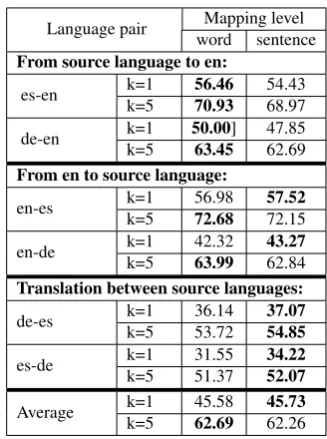
Language pair Mapping level word sentence From source language to en:
es-en k=1 56.46 54.43 k=5 70.93 68.97
de-en k=1 50.00] 47.85 k=5 63.45 62.69 From en to source language:
en-es k=1 56.98 57.52 k=5 72.68 72.15
en-de k=1 42.32 43.27 k=5 63.99 62.84 Translation between source languages:
de-es k=1 36.14 37.07 k=5 53.72 54.85
es-de k=1 31.55 34.22 k=5 51.37 52.07
Average k=1 45.58 45.73 k=5 62.69 62.26
Table 1: Word translation precision atk (%) usingk
nearest neighbor search, withk∈ {1,5}.
[image:4.595.69.292.64.470.2]Language pair Mapping level word sentence en-es 0.6280 0.6362 en-de 0.6480 0.6476 es-de 0.6349 0.6383 Average 0.6370 0.6407
Table 2: The harmonic mean of Pearson and Spearman correlations with human judgment on the SemEval’17 cross-lingual word similarity task.
observation and may indicate that contextualized dictionaries result in a more balanced mapping, while context-independent embeddings overfit the mapping to the specific direction used for align-ment.
4.3.2 Word-level Evaluation
Cross-lingual word embeddings are typically eval-uated in word-translation retrieval: the precision of correctly retrieving a translation from the vo-cabulary of another language. Since this is a context-free task, we evaluated the performance of static word embeddings, FastText, using word vs. sentence mapping (with 1M parallel sentences). The transformation matrix learned at the sentence level is used to transform the word embeddings.
[image:4.595.346.488.322.392.2]the sentence-level yields equivalent performance to word-level mapping. While word-level map-ping was slightly better in translating from source languages (German and Spanish) to English, the sentence-level mapping was better when trans-lating between the source languages. In the word similarity task, sentence-level mappings per-formed slightly better in two out of the three cases. Overall, the performance of both models are com-parable, which indicates that a single transforma-tion matrix learned at the sentence-level can be used for both word and sentence-level tasks.
5 Discussion and Conclusions
We introduced alternatives to the popular word mapping approach that incorporate context in the mapping process. Given parallel corpora, context-aware mappings were learned by mapping aligned contextualized word embeddings or directly map-ping the parallel sentence embeddings. Exper-imental results showed significant gains in sen-tence translation retrieval using contextualized mappings compared to context-independent word mapping. While word-level mappings worked bet-ter with smaller parallel corpora, the performance of sentence-level mapping continued to increase with additional data until it outperformed word-level mapping. In future work, we will explore the viability of the sentence mapping approach on other sentence embedding models.
References
Hanan Aldarmaki and Mona Diab. 2018. Evaluation of unsupervised compositional representations. Pro-ceedings of the 27th International Conference on Computational Linguistics.
Hanan Aldarmaki, Mahesh Mohan, and Mona Diab. 2018. Unsupervised word mapping using structural similarities in monolingual embeddings. Transac-tions of the Association of Computational Linguis-tics, 6.
Sanjeev Arora, Yingyu Liang, and Tengyu Ma. 2017. A simple but tough-to-beat baseline for sentence em-beddings.
Mikel Artetxe, Gorka Labaka, and Eneko Agirre. 2016. Learning principled bilingual mappings of word em-beddings while preserving monolingual invariance. In Proceedings of the 2016 Conference on Empiri-cal Methods in Natural Language Processing.
Piotr Bojanowski, Edouard Grave, Armand Joulin, and Tomas Mikolov. 2017. Enriching word vectors with
subword information. Transactions of the Associa-tion for ComputaAssocia-tional Linguistics, 5:135–146.
Ondrej Bojar, Christian Buck, Chris Callison-Burch, Christian Federmann, Barry Haddow, Philipp Koehn, Christof Monz, Matt Post, Radu Soricut, and Lucia Specia. 2013. Findings of the 2013 workshop on statistical machine translation. InProceedings of the eighth workshop on statistical machine transla-tion, pages 1–44.
Peter F Brown, Vincent J Della Pietra, Stephen A Della Pietra, and Robert L Mercer. 1993. The mathemat-ics of statistical machine translation: Parameter esti-mation. Computational linguistics, 19(2):263–311.
Jose Camacho-Collados, Mohammad Taher Pilehvar, Nigel Collier, and Roberto Navigli. 2017. Semeval-2017 task 2: Multilingual and cross-lingual semantic word similarity. InProceedings of the 11th Interna-tional Workshop on Semantic Evaluation (SemEval-2017), pages 15–26.
Ciprian Chelba, Tomas Mikolov, Mike Schuster, Qi Ge, Thorsten Brants, Phillipp Koehn, and Tony Robin-son. 2014. One billion word benchmark for mea-suring progress in statistical language modeling. In
Fifteenth Annual Conference of the International Speech Communication Association.
Alexis Conneau, Guillaume Lample, Marc’Aurelio Ranzato, Ludovic Denoyer, and Herv´e J´egou. 2017. Word translation without parallel data. arXiv preprint arXiv:1710.04087.
Chris Dyer, Victor Chahuneau, and Noah A Smith. 2013. A simple, fast, and effective reparameteriza-tion of ibm model 2. In Proceedings of the 2013 Conference of the North American Chapter of the Association for Computational Linguistics: Human Language Technologies, pages 644–648.
Tomas Mikolov, Quoc V Le, and Ilya Sutskever. 2013. Exploiting similarities among languages for ma-chine translation. arXiv preprint arXiv:1309.4168.
Christian S Perone, Roberto Silveira, and Thomas S Paula. 2018. Evaluation of sentence embeddings in downstream and linguistic probing tasks. arXiv preprint arXiv:1806.06259.
Matthew Peters, Mark Neumann, Mohit Iyyer, Matt Gardner, Christopher Clark, Kenton Lee, and Luke Zettlemoyer. 2018. Deep contextualized word repre-sentations. InProceedings of the 2018 Conference of the North American Chapter of the Association for Computational Linguistics: Human Language Technologies, Volume 1 (Long Papers).
Peter H Sch¨onemann. 1966. A generalized solution of the orthogonal procrustes problem. Psychometrika, 31(1):1–10.
zero-shot dependency parsing. arXiv preprint arXiv:1902.09492.
Samuel L Smith, David HP Turban, Steven Hamblin, and Nils Y Hammerla. 2017. Offline bilingual word vectors, orthogonal transformations and the inverted softmax. arXiv preprint arXiv:1702.03859.