3355
Transferable Neural Projection Representations
Chinnadhurai Sankar Mila, Universit´e de Montr´eal∗
Montreal, QC, Canada [email protected]
Sujith Ravi Google Research Mountain View, CA, USA
Zornitsa Kozareva Google
Mountain View, CA, USA [email protected]
Abstract
Neural word representations are at the core of many state-of-the-art natural language process-ing models. A widely used approach is to pre-train, store and look up word or character em-bedding matrices. While useful, such represen-tations occupy huge memory making it hard to deploy on-device and often do not generalize to unknown words due to vocabulary pruning.
In this paper, we propose a skip-gram based architecture coupled with Locality-Sensitive Hashing (LSH) projections to learn efficient dynamically computable representations. Our model does not need to store lookup tables as representations are computed on-the-fly and require low memory footprint. The representa-tions can be trained in an unsupervised fash-ion and can be easily transferred to other NLP tasks. For qualitative evaluation, we analyze the nearest neighbors of the word representa-tions and discover semantically similar words even with misspellings. For quantitative evalu-ation, we plug our transferable projections into a simple LSTM and run it on multiple NLP tasks and show how our transferable projec-tions achieve better performance compared to prior work.
1 Introduction
Pre-trained word representations are at the core of many neural language understanding models. Among the most popular and widely used word embeddings are word2vec (Mikolov et al.,2013), GloVe (Pennington et al.,2014) and ELMO (Peters et al., 2018). The biggest challenge with word embedding is that they require lookup and a large memory footprint, as we have to store one entry (d-dim vector) per word and it blows up.
In parallel, the tremendous success of deep learn-ing models and the explosion of mobile, IoT
de-∗
Work done during internship at Google.
vices coupled together with the growing user pri-vacy concerns have led to the need for deploying deep learning models on-device for inference. This has led to new research in compressing large and complex deep learning models for low power on-device deployment. Recently, (Ravi and Kozareva,
2018) developed an on-device neural text classifi-cation model. They proposed to reduce the mem-ory footprint of large neural networks by replacing the input word embeddings with projection based representations. (Ravi and Kozareva,2018) used n-gram features to generate binary LSH (Charikar,
2002) randomized projections on the fly surpassing the need to store word emebdding tables and reduc-ing the memory size. The projection models reduce the memory occupied by the model fromO(|V|)
toO(nP), where|V|refers to the vocabulary size andnP refers to number of projection operations (Ravi,2017). Two key advantages of the projection based representations over word embeddings are: (1) they are fixed and have low memory size; (2) they can handle out of vocabulary words. However, the projections in (Ravi and Kozareva,2018) are static and currently do not leverage pre-training on large unsupervised corpora, which is an important property to make the projections transferable to new tasks.
In this paper, we propose to combine the best of both worlds by learning transferable neural jection representations over randomized LSH pro-jections. We do this by introducing new neural architecture inspired by the skip gram model of (Mikolov et al.,2013) and combined with a deep MLP plugged on top of LSH projections. In order to make this model train better, we introduce new regularizing loss function, which minimizes the co-sine similarities of the words within a mini-batch. The loss function is critical for generalization.
vo-cabulary words and misspellings, (3) captures se-mantic and syntactic properties of words; (4) can be easily plugged to other NLP models and (5) can support training with data augmentation by perturb-ing characters of input words. To validate the per-formance of our approach, we conduct a qualitative analysis of the nearest neighbours in the learned representation spaces and a quantitative evaluation via similarity, language modeling and NLP tasks.
2 Neural Projection Model
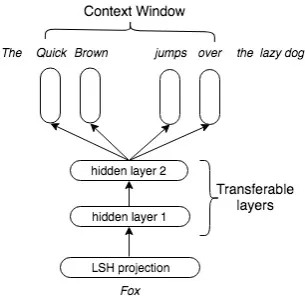
We propose a novel model (NP-SG) to learn com-pact neural representations that combines the bene-fit of representation learning approaches like skip-gram model with efficient LSH projections that can be computed on-the-fly.
2.1 Vanilla Skip-Gram Model
In the skip-gram model (Mikolov et al., 2013), we learn continuous distributed representations for words in a large fixed vocabulary,Vto predict the context words surrounding them in documents. We maintain an embedding look up table,v(w)∈Rd
for every word,w∈V.
For each word, wt in the training
cor-pus of size T, the set of context words Ct = {wt−Wt, . . . , wt−1, wt+1, . . . , wt+Wt}
in-cludes Wt words to the left and right of wt
re-spectively. Wtis the window size randomly
sam-pled from the set{1,2, . . . , N}, whereN is the maximum window size. Given a pair of words,
{wc, wt}, the probability ofwc being within the
context window ofwtis given by equation1.
P(wc|wt) =σ(v0(wc)|v(wt))
= 1
1 + exp(−v0(w
c)|v(wt))
(1)
wherev, v0 are input and context embedding look up tables.
2.2 Neural Projection Skip-Gram (NP-SG)
In the neural projection approach, we replace the input embedding look up table,v(w)in equation1
with a deepn-layer MLP over the binary projection, P(w)as shown equation2.
vP(w) =N(fn(P(w))) (2)
wherevP(w)∈Rd,fnis an-layer deep neural
[image:2.595.341.494.63.211.2]net-work encoder with ReLU non-linear activations after each layer except for the last layer as shown
Figure 1: Neural Projection Skip-gram (NP-SG) model
in Figure1.Nrefers to a normalization applied to the final layer offn. We experimented with
Batch-normalization, L2-normalization and layer normal-ization; batch-normalization works the best.
The binary projection P(w) is computed us-ing locality-sensitive projection operations (Ravi,
2017) which can be performed on-the-fly (i.e., with-out any embedding look up) to yield a fixed, low-memory footprint binary vector. Unlike (Ravi and Kozareva,2018) which usesstaticprojections to encode the entire input text and learn a classifier, NP-SG creates atrainabledeep projection repre-sentation for words using LSH projections over character-level features combined with contextual information learned via the skip-gram architecture.
2.3 Training NP-SG Model
We follow a similar approach as Mikolov et al.
(2013) and others for training our neural projection skip-gram model (NP-SG). We define the training objective to maximize the probability of predicting the context words given the current word. Formally, the model tries to learn the word embeddings by maximizing the objective,J(θ)known as negative sampling (NEG), given by equation3.
J(θ) =
T
X
t=1 X
wc∈Ct
Jwt,wc(θ) (3)
Jwt,wc(θ) = log(P(wc|wt))
+
k
X
i=1,wi∼Pn(w)
log(1−P(wi|wt))
(4)
wherekis the number of randomly sampled words from the training corpus according to the noise distribution, Pn(w) ∝ U(w)3/4, where U(w) is
Model improvements: Training an NP-SG model as is, though efficient, may not lead to highly dis-criminative representations. During training, we noticed that the word representations,vP(w)were getting projected in a narrow sub-space where the cosine similarities of all the words in the dataset were too close to1.0. This made the convergence slower and led to poor generalization.
2.4 Discriminative NP-SG Models
To encourage the word representations to be more spaced out in terms of the cosine similarities, we introduce an additional explicit regularizing L2-loss function. With the assumption that the words in each mini-batch are randomly sampled, we add a L2-loss over the cosine similarities between all the words within a mini-batch, as shown in equation6.
Loss=J(θ) + Lcs2 (wmb) (5)
Lcs2 (wmb) =λ · k {CS(wi, wj)|i, j∈[0, mb)} k22 (6)
where CS(wi, wj) refers to the cosine similarity
betweenwi and wj, mb refers to the mini-batch
size andwmbrefers to the words in the mini-batch.
We enforce this using a simple outerproduct trick. We extract the cosine-similarities between all the words within a mini-batch in a single shot by com-puting the outer-product of theL2row normalized
word representations corresponding to each mini-batchˆvP(wmb), as shown in equation7.
Lcs2 (wmb) = λ
2 · kFlatten(ˆvP(wmb) ·ˆvP(wmb) |
)k22 (7)
2.5 Improved NP-SG Training
Since the NP-SG model does not have a fixed vo-cabulary size, we can be flexible and leverage a lot more information during training compared to stan-dard skip-gram models which require vocabulary pruning for feasibility.
To improve training for NP-SG model, we aug-ment the dataset with inputs words after applying character level perturbations to them. The pertur-bations are such a way that they are commonly occurring misspellings in documents. We mainly experiment with three types of pertub operation APIs (Gao et al.,2018).
• insert(word, n): We randomly choosenchars from the character vocabulary and insert them
randomly into the inputword. We ignore the locations of first and last character in the word for theinsertoperation. Example transforma-tion:sample→samnple.
• swap(word, n): We randomly swap the lo-cation of two characters in the wordntimes. As with theinsert operation, we ignore the first and last character in the word for the swap operation. Example transformation: sample→sapmle.
• duplicate(word, n): We randomly duplicate a character in the word byntimes. Example transformation:sample→saample.
We would like to note that the perturbation oper-ations listed above are not exhaustive and we plan to experiment with more operations in the future.
3 Training Setup
3.1 Dataset
We train our skipgram models on the wikipedia data XML dump, enwik91. We extract the
nor-malized English text from the XML dump using the Matt Mahoneys pre-processing perl script2. We fix the vocabulary to the top100kfrequently occurring words. We sub-sample words in the training corpus, dropping them with probability,
P(w) = 1−p
t/f req(w), wheref req(w)is the frequency of occurrence ofwin the corpus and we set the threshold,tto10−5. We perturb the input words with a probability of0.4using a randomly chosen perturbation described in Section2.5.
3.2 Implementation Details
We fix the number of random projections to 80
and the projection dimension to14. We use a 2-layer MLP (sizes: [2048,100]) regularized with dropout (with probability of0.65) and weight decay (regularization parameter of0.0005) to transform the binary random projections to continuous word representation. For the vanilla skipgram model, we fix the embedding size to100. For both models, we use25negative samples for the NEG loss. We learn the parameters using the Adam optimizer (Kingma and Ba,2014) with a default learning rate of0.001, clipping the gradients which have a norm larger than 5.0. We initialize the weights of the MLP using Xavier initialization, and output embeddings
1
http://mattmahoney.net/dc/enwik9.zip
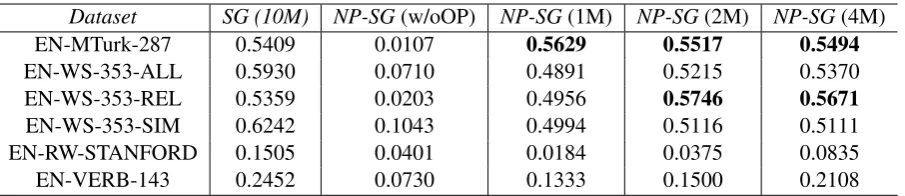
Dataset SG (10M) NP-SG(w/oOP) NP-SG(1M) NP-SG(2M) NP-SG(4M)
EN-MTurk-287 0.5409 0.0107 0.5629 0.5517 0.5494
EN-WS-353-ALL 0.5930 0.0710 0.4891 0.5215 0.5370
EN-WS-353-REL 0.5359 0.0203 0.4956 0.5746 0.5671
EN-WS-353-SIM 0.6242 0.1043 0.4994 0.5116 0.5111
EN-RW-STANFORD 0.1505 0.0401 0.0184 0.0375 0.0835
[image:4.595.75.528.61.159.2]EN-VERB-143 0.2452 0.0730 0.1333 0.1500 0.2108
Table 1: Similarity Tasks: # of params,100kvocabulary size for skipgram baseline,100embedding size.
uniformly random in the range[−1.0,1.0]. We use a batch size of1024in all our experiments. We found thatλ = 0.01for the outerproduct loss to be working better after experimenting with other values. Training time for our model was around
0.85times that of the skipgram model. Both the models were trained for10epochs.
4 Experiments
We show both qualitative and quantitative evalua-tion on multiple tasks for the NP-SG model.
4.1 Qualitative Evaluation and Results
Table2shows the nearest neighbors produced by NP-SG for select words. Independent of whether it is an original or misspelled word, our NP-SG model accurately retrieves relevant and semanti-cally similar words.
Word Nearest neighbours
king reign, throne, kings, knights, vii, regent kingg vii, younger, peerage, iv, tiberius, frederick woman man, young, girl, child, girls, women wwoamn man, herself, men, couple, herself, alive city town, village, borough, township, county ciity town, village, borough, county, unorganized time few, times, once, entire, prominence, since tinme times, once, takes, taken, another, only zero two, three, seven, one, eight, four zzero two, three, five, six, seven, four
Table 2: Sampled nearest neighbors for NP-SG.
4.2 Quantitative Evaluation and Results
We evaluate our NP-SG model on similarity, lan-guage modeling and text classification tasks. Simi-larity tests the ability to capture words, while lan-guage modeling and classification warrant the abil-ity to transfer the neural projections.
4.2.1 Similarity Task
We evaluate our NP-SG word representations on 4 different widely used benchmark datasets for mea-suring similarities.
Dataset: MTurk-287 (Radinsky et al.,2011) has 287 pairs of words and was constructed by crowd-sourcing the human similarity ratings using Ama-zon Mechanical Turk. WS353(Finkelstein et al.,
2001) has 353 pairs of similar English words rated by humans and is further split intoWS353-SIM. WS353-REL(Agirre et al.,2009) captures differ-ent types of similarities and relatedness. RW-STANFORD(Luong et al., 2013) has 2034 rare word pairs sampled from different frequency bins. Evaluation:For all the datasets, we compute the Spearmans rank correlation coefficient between the rankings computed by skip-gram models (baseline SG and NP-SG) and the human rankings. We use cosine similarity metric to measure word similarity. Results: Table1shows that NP-SG, with signifi-cantly smaller number of parameters comes close to the skip-gram model (SG) and even outperforms it with 2.5x-10x compression. NP-SG gets bet-ter representations even with misspellings which cannot be handled by vanilla SG.
It is interesting to note that the vanilla skip-gram model does well onWS353-SIM compared toWS353-REL. This behavior is reversed in our NP-SG model, which indicates that it captures meronym-holonym relationships better than the vanilla skip-gram model. Although NP-SG handles out of vocabulary words in the form of misspellings, it needs further improvement for rare word similar-ity task. We plan to improve it by including context word n-gram features in the LSH projection func-tion, allowing NP-SG to also leverage information from the context words in the case of rare words and provide word sense disambiguation.
4.2.2 Language Modeling
for5epochs. We replace the input embeddings in the LSTM with transferable encoder layer of the NP-SG model. We train the LSTMs with and with-out pretrained initializations. Since we observed convergence issues with the single layer NP-SG representation, we considered 2-layer MLP with layer sizes (1024, 256) for the NP-SG represen-tations. We found that while the model without pretrained NP-SG layer got stuck at a perplexity of around300, the pretrained version converged to a perplexity of140, comparable to the embedding based network. We leave the analysis of the impact of the deeper NP-SG layers to the future work.
4.2.3 Text Classification
For the text classification evaluations, we used two different tasks and datasets. For the dialog act clas-sification task, we used the MRDA dataset from the ICSI Meeting Recorder Dialog Act Corpus (Adam et al., 2003). MRDA is a multiparty dialog an-notated with 5 dialog act tags. For the question classification task, we used the TREC dataset (Lin and Katz,2006). The task is given a question to predict the most relevant category.
We trained a single layer LSTM (hidden size:
256) with and without the pretrained NP-SG layers. Overall, we observed accuracy improvements of
+5.7%and+3.75%compared to baseline models without pretrained NP-SG initializations on TREC and MRDA respectively.
5 Conclusion
In this paper, we introduced a new neural archi-tecture (NP-SG), which learns transferable word representations that can be efficiently and dynami-cally computed on device without any embedding look up. We proposed an unsupervised method to train the new architecture and learn more discrimi-native word representations. We compared the new model with a skip-gram approach and showed qual-itative and quantqual-itative comparisons on multiple language tasks. The evaluations show that our NP-SG model learns better representations even with misspellings and reaches competitive results with skip-gram on similarity tasks, even outperforming with 2.5x-10x fewer parameters.
Acknowledgments
The authors would like to thank the Google Ex-pander team for many helpful discussions.
References
Janin Adam, Don Baron, Jane Edwards, Dan Ellis, David Gelbart, Nelson Morgan, Barbara Peskin, Thilo Pfau, Elizabeth Shriberg, Andreas Stolcke, and Chuck Wooters. 2003. The icsi meeting corpus. InProceedings of the 5TH SIGdial Workshop on Dis-course and Dialogue, pages 364–367.
Eneko Agirre, Enrique Alfonseca, Keith B. Hall, Jana Kravalova, Marius Pasca, and Aitor Soroa. 2009. A study on similarity and relatedness using distribu-tional and wordnet-based approaches. In Human Language Technologies: Conference of the North American Chapter of the Association of Computa-tional Linguistics, Proceedings, May 31 - June 5, 2009, Boulder, Colorado, USA, pages 19–27.
Moses S. Charikar. 2002. Similarity estimation tech-niques from rounding algorithms. In Proceedings of the Thiry-fourth Annual ACM Symposium on The-ory of Computing, STOC ’02, pages 380–388, New York, NY, USA. ACM.
Lev Finkelstein, Evgeniy Gabrilovich, Yossi Matias, Ehud Rivlin, Zach Solan, Gadi Wolfman, and Eytan Ruppin. 2001. Placing search in context: the con-cept revisited. InProceedings of the Tenth Interna-tional World Wide Web Conference, WWW 10, Hong Kong, China, May 1-5, 2001, pages 406–414.
Ji Gao, Jack Lanchantin, Mary Lou Soffa, and Yan-jun Qi. 2018. Black-box generation of adversar-ial text sequences to evade deep learning classifiers. In2018 IEEE Security and Privacy Workshops, SP Workshops 2018, San Francisco, CA, USA, May 24, 2018, pages 50–56.
Diederik Kingma and Jimmy Ba. 2014. Adam: A method for stochastic optimization. arXiv preprint arXiv:1412.6980.
Jimmy J. Lin and Boris Katz. 2006. Building a reusable test collection for question answering. JA-SIST, 57(7):851–861.
Thang Luong, Richard Socher, and Christopher D. Manning. 2013. Better word representations with recursive neural networks for morphology. In Pro-ceedings of the Seventeenth Conference on Compu-tational Natural Language Learning, CoNLL 2013, Sofia, Bulgaria, August 8-9, 2013, pages 104–113.
Tomas Mikolov, Ilya Sutskever, Kai Chen, Gregory S. Corrado, and Jeffrey Dean. 2013. Distributed rep-resentations of words and phrases and their com-positionality. In Advances in Neural Information Processing Systems 26: 27th Annual Conference on Neural Information Processing Systems 2013. Pro-ceedings of a meeting held December 5-8, 2013, Lake Tahoe, Nevada, United States., pages 3111– 3119.
on Empirical Methods in Natural Language Process-ing (EMNLP), pages 1532–1543. Association for Computational Linguistics.
Matthew Peters, Mark Neumann, Mohit Iyyer, Matt Gardner, Christopher Clark, Kenton Lee, and Luke Zettlemoyer. 2018. Deep contextualized word repre-sentations. InProceedings of the 2018 Conference of the North American Chapter of the Association for Computational Linguistics: Human Language Technologies, Volume 1 (Long Papers), pages 2227– 2237. Association for Computational Linguistics.
Kira Radinsky, Eugene Agichtein, Evgeniy Gabrilovich, and Shaul Markovitch. 2011. A word at a time: computing word relatedness using temporal semantic analysis. In Proceedings of the 20th International Conference on World Wide Web, WWW 2011, Hyderabad, India, March 28 - April 1, 2011, pages 337–346.
Sujith Ravi. 2017. Projectionnet: Learning efficient on-device deep networks using neural projections.
CoRR, abs/1708.00630.
Sujith Ravi and Zornitsa Kozareva. 2018. Self-governing neural networks for on-device short text classification. In Proceedings of the 2018 Confer-ence on Empirical Methods in Natural Language Processing, Brussels, Belgium, October 31 - Novem-ber 4, 2018, pages 804–810.