Proceedings of the 2019 Conference on Empirical Methods in Natural Language Processing 5499
Emotion Detection with Neural Personal Discrimination
Xiabing Zhou1, Zhongqing Wang1∗, Shoushan Li1, Guodong Zhou1, Min Zhang1
1School of Computer Scienceand Technology, Soochow University, China
{zhouxiabing, lishoushan, gdzhou, minzhang}@suda.edu.cn
Abstract
There have been a recent line of works to auto-matically predict the emotions of posts in so-cial media. Existing approaches consider the posts individually and predict their emotion-s independently. Different from previouemotion-s re-searches, we explore the dependence among relevant posts via the authors’ backgrounds, since the authors with similar backgrounds, e.g.,gender,location, tend to express similar emotions. However, such personal attributes are not easy to obtain in most social media websites, and it is hard to capture attributes-aware words to connect similar people. Ac-cordingly, we propose a Neural Personal Dis-crimination (NPD) approach to address above challenges by determining personal attributes from posts, and connecting relevant posts with similar attributes to jointly learn their emo-tions. In particular, we employ adversarial discriminators to determine the personal at-tributes, with attention mechanisms to aggre-gate attributes-aware words. In this way, social correlationship among different posts can be better addressed. Experimental results show the usefulness of personal attributes, and the effectiveness of our proposed NPD approach in capturing such personal attributes with sig-nificant gains over the state-of-the-art models.
1 Introduction
The advent of social media and its prosperity en-able the creation of massive online user-generated content including opinions and product reviews. Analyzing such user-generated contents allows to detect the users’ emotional states, which are useful for various downstream applications.
In the literature, there are a large number of works on emotion detection (Roberts et al.,2012;
Abdul-Mageed and Ungar, 2017; Gupta et al.,
2017), both discrete and neural models have been
∗
corresponding auther
used to predict the emotions of posts in social me-dia. For example, Roberts et al. (2012) used a series of binary SVM classifiers to detect the e-motion of a post, whileGupta et al. (2017) used sentiment based semantic embedding and a LST-M model to learn the representation of a post for emotion detection.
Different from previous researches, which con-sider each post individually, we think that post-s in post-social media are much correlated by the au-thors’ backgrounds. Motivated by the principle of homophily (Lazarsfeld et al., 1954), the idea that similarity and connection tend to co-occur, or “birds of a feather flock together”, suggests that users, connected by mutual personal backgrounds, may hold similar opinions toward a post ( Thelwal-l, 2010). In the literature, the personal attributes, such as gender, location, age, have been proved useful in personal background construction (Li et al.,2016): people with different attributes tend to express their emotions through different ways. For example, the happiness emotion in [E1] is expressed through some femininity sense word-s, such as “little brother”, “handsome”, while the
happiness emotion in [E2] is expressed using a dialectal word “bashi(comfortable)”, which con-tains strong characteristic of the Sichuan dialect1. Therefore, it is necessary to jointly detect the emo-tion of posts with the personal attributes.
[E1]]:-ý7î: °† å
å /
(Congratulations to Chinese basketball team on becoming the champion, the little brother of Xinjiang is really hand-some.)
[E2]ÙÍ) Ù* /ô
(It is just bashi to eat this in such weather!)
However, the personal attributes are not easy to obtain in most social media websites. On one hand, most websites may not contain useful per-sonal information. On the other hand, people are normally not willing to attach their person-al information in sociperson-al media. Besides, inte-grating personal attributes into emotion detec-tion is challenging, since it is hard to capture attributes-aware words, such as “little brother” and “bashi”(comfortable), to connect the posts with similar backgrounds. Although there are some related works on either personal attribute extrac-tion (Wang et al.,2014) or emotion detection with personal attributes (Li et al.,2016), none of them address both challenges at the same time.
In this paper, we propose a Neural Personal Dis-crimination (NPD) model with both adversarial discriminators and attention mechanisms to tack-le above chaltack-lenges. Here, the Adversarial dis-criminators(Goodfellow et al.,2014) are used to determine the personal attributes, e.g., gender or location, of a post, providing the inherent corre-lationship between emotions and personal back-grounds, while the Attention mechanisms (Wang et al., 2016) are utilized to aggregate the repre-sentation of informative attributes-aware words to a vector for emotion prediction, providing in-sights into which words contribute to a personal background. Experimental results show the use-fulness of personal attributes in emotion detection, and the effectiveness of our proposed NPD model with both adversarial discriminators and attention mechanisms over the state-of-the-art discrete and neural models.
2 Related Work
Earlier works on emotion detection are based on discrete models. For example,Yang et al.(2007) built a support vector machine (SVM) model and a conditional random field (CRF) model for the e-motion detection. Bhowmick et al. (2009) used a multi-label kNN model to classify a new sen-tence into multiple emotion categories.Quan et al.
(2015) proposed a logistic regression model for social emotion detection. Recently, with the devel-opment of artificial intelligence, neural network models have been successfully applied to vari-ous NLP tasks (Collobert et al., 2011;Goldberg,
2016). However, few works use neural network models for emotion detection.Abdul-Mageed and Ungar (2017) used a gated recurrent neural net-work model for emotion detection with a large-scale dataset.Zhang et al.(2018) used an auxiliary and attention based LSTM to detect emotion on a cross-lingual dataset.
Lexicon and social information are very impor-tant for emotion detection, and there are many researches focus on this topic. For example, S-trapparava and Mihalcea (2008) used WordNet-Affect to compute the sentimental score of a post. More recently, In addition,Hovy(2015) used both the age and gender information of the authors to improve the performance of sentiment analysis.
Vosoughi et al.(2016) explored the relationship a-mong locations, date time, authors and sentiments. Different from previous works which consid-er each post individually, we think that the post-s in post-social media can be connected through the authors’ backgrounds and should be better ad-dressed. On the basis, we propose a neural al discrimination model to determine the person-al background attributes from each post through adversarial discriminators, and aggregate the rep-resentation of informative attributes-aware words through attention mechanisms.
3 Vanilla Model for Emotion Detection
In this section, we propose a vanilla model. In the next section, we show how to utilize the neu-ral personal discrimination model to improve the vanilla model by capturing personal attributes.
3.1 Document Representation
In general, we denote a post as a documentdwith
n words {w1, w2, ..., wn}. Given the post, we use a standard Long Short-Term Memory (LST-M) model to learn the shared document represen-tation. Specially, we transform each tokenwiinto a real-valued vectorxi using the word embedding vector ofwi, obtained by looking up a pre-trained
word embedding tableDvia the skip-gram algo-rithm to train embeddings (Mikolov et al.,2013). We then employ the LSTM model overdto gen-erate a hidden vector sequence {h1, h2, ..., hn}.
tuned during training.
3.2 Multi-label Emotion Detection
Emotion detection aims to predict the emotion la-bels of posts. We follow (Wang et al.,2016) which adopts five kinds of emotions2 in the study. S-ince there may be more than one emotion in a post, emotion detection can be considered as a multi-label classification task: we useK emotion-specific binary perceptions (K = 5) to predict if the post has the corresponding emotion or not. The advantage of multi-label classification is that it learns and predicts all the emotion labels jointly. Formally, giving an input vector H, a hidden layer is first used to induce a set of high-level fea-tures for each emotionj:
˜
Hj =σ(WjH+bj), (1)
and then,Hj is used as inputs to a softmax output layer:
ˆ
yj = softmax( ˜WjH˜j+ ˜bj) (2)
Here,Wj,bj,W˜j, and˜bj are model parameters.
3.3 Training
Given the word sequence in a post, our training ob-jective is to minimize the cross-entropy loss over a set of training examples(xi, yi)|N
i=1, with a `2 -regularization term,
Jy(θy) =− N X
i=1 K X
j=1
yijlog ˆyji +λ 2||θy||
2 (3)
whereyij represents the label of the j-th emotion forxi, θy is the set of model parameters andλis
the parameter for`2regularization.
In this paper, the model parameters are opti-mized by AdaGrad (Duchi et al.,2011), and Skip-gram algorithm (Mikolov et al.,2013) is used for word embedding.
4 Neural Personal Discrimination Model
The drawback of above vanilla model is that it does not consider the deep personal correlation-ship among different posts.
2The five emotions include happiness, sadness, anger, fear, andsurprise, please refer to “Experiments Section” of the paper for more details.
In this study, we think that the posts in social media can be connected through the authors’ back-grounds. Therefore, we propose a Neural Person-al Discrimination (NPD) model to connect peo-ple and learn their emotions collectively. We use
adversarial discriminators to determine the per-sonal attributes to construct the perper-sonal profiles, and employ attention mechanisms to aggregate attributes-aware words. In this way, the social cor-relationship between different posts can be well addressed.
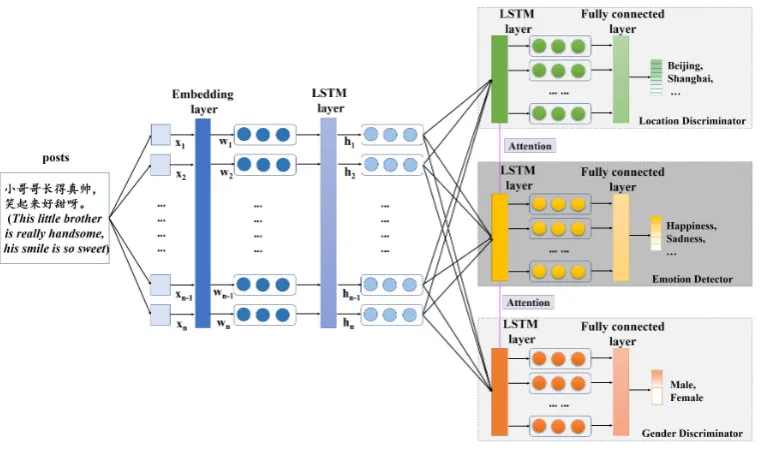
Figure1illustrates our proposed neural person-al discrimination model for emotion detection. In particular, we first learn the representation of each post using a LSTM model, same as the vanilla joint model. Then, we use adversarial discrimi-nators to determine the personal attributes of each post. Finally, we employ attention mechanism-s to aggregate the repremechanism-sentation of informative attributes-aware words into a vector for the emo-tion predicemo-tion. In the following of this secemo-tion, we illustrate the details of the infrastructure one by one.
4.1 Personal Adversarial Discriminators
A straightforward way to jointly detect personal attributes and the emotion of a post is to treat emo-tion detecemo-tion as a multi-label classificaemo-tion. How-ever, such model may not be able to separate the posts from different attributes directly, and thus fail to learn the correlationship between the emo-tion of a post and the personal backgrounds of the authors. To address this issue, we utilize adver-sarial discriminators to determine the personal at-tributes of the authors, and to learn the emotion and the attributes of the authors collectively. Ad-versarial networks have achieved much success in various studies, especially in image and text gen-eration (Goodfellow et al.,2014;Wang and Wan,
2018; Fedus et al., 2018). In this part, we pro-pose two adversarial discriminators, i.e, a gender discriminator and a location discriminator, to de-termine the personal attributes of each post.
Gender Discriminator. The gender discrimi-nator is employed to determine the author’s gender of each post. Letgi ∈ [0,1]represents the
proba-bility of the gender label (female or male) for the gender discriminator, andf is the function param-eterized byθfwhich maps an embedding vector to
param-Figure 1: Overview of the neural personal discrimination model.
eterized by θg maps a hidden representation
vec-torhgi to a predicted gender label ˆgi with the loss function is:
Jgend= N X
i=1
{gilog ˆgi+(1−gi) log(1−gi)ˆ }, (4)
wheregiˆ =G(f(xi)).
In this study, the gender discriminator is trained towards a saddle point of the loss function through maximizing the loss overθgwhile minimizing the loss overθf (Ganin et al.,2017).
Location Discriminator.The location discrim-inator is employed to determine the authors’ loca-tion of a post3. Let`ji ∈[0,1]represents probabil-ity of thej-th location information of thei-th post andj∈ {1,2, . . . , m}, where,mis the number of provinces. The loss function is:
Jloc= N X
i=1 m X
j=1
`jilog ˆ`ji, (5)
where, `ˆji = L(f(xi)) and L(h`i;θ`) are the
pa-rameters of the location discriminator,h`i =f(xi)
is the hidden represent from the postxi
From the optimization of both discriminators, we can find that both hg andh` represent the la-tent feature representation of posts, which inte-grate the discrimination of various personal infor-mation. With the goal atG(θg)andL(θ`)try best
3In this study, location discriminator is used to detect the author’s province of a post.
to determine the gender and location of the au-thors. The adversarial network makes use of min-max optimization.
4.2 Personal Attention Mechanisms
In emotion detection, not all words contribute e-qually to the representation of emotions and per-sonal attributes. Hence, we employ attention mechanisms to extract the words that are impor-tant to the personal backgrounds of posts, and to aggregate the representations of those informative attributes-aware words. With regard to the two adversarial discriminators, we propose attention mechanisms to build two representation (vg and
v`) from the gender and location discriminators respectively, and then concatenate them togeth-er to construct the ovtogeth-erall ptogeth-ersonal representation through the informative attributes-aware words .
Gender Attention. We use an attention func-tion to aggregate the gender-aware representafunc-tion of the salient words to formulate the gender atten-tion vector vg. Here, the gender attention mod-el outputs a continuous vectorvg ∈ Rd×1 recur-rently by feeding the hidden representation vec-tors{hg1, hg2,· · ·, hgnt}as inputs. Specifically, vg
is computed as a weighted sum ofhgi (0≤i≤nt), namely
vg = nt X
i
αihgi (6)
where nt is the hidden variable size, αi ∈ [0,1]
is the weight of hgi, and P
[image:4.595.111.494.62.287.2]piece of hidden state hgi, the scoring function is calculated as follows:
vig = tanh(Wghgi +bg) (7)
αi= exp(v g)
P jexp(v
g j)
(8)
Location Attention. Similar with the gender attention mechanism, the location attention mod-el outputs a continuous vector v` ∈ Rd×1 recur-rently by feeding the hidden representation vec-tors{h`1, h`2,· · ·, h`nk} as inputs. Specifically,v`
is computed as a weighted sum ofh`i (0≤i≤nt), namely
v` = nk X
i
βih`i (9)
v`i = tanh(W`h`i +b`) (10)
βi= exp(v `)
P
jexp(vj`)
(11)
where,nkis the location hidden variable size, and βiis the same setting asαi.
Finally, we concatenatevgandv`to capture the overall personal representation through all the per-sonal attributes discriminators.
V =vg⊕v` (12)
4.3 Adversarial Training with Neural Personal Discrimination
The proposed NPD model can be trained in a end-to-end manner once we obtain the loss function of the emotion detector and the attribute discrimina-tors. Our ultimate training goal is to minimize the loss function with parametersθ={θf, θy, θg, θ`}
as follow:
J(θ) =λ1Jy+λ2Jgend+λ3Jloc (13)
Whereλ1,λ2andλ3 are the weight parameters to balance the importance of losses between the emo-tion detecemo-tion and the two personal attribute dis-criminators.
Specifically, Eq.13is defined by finding a sad-dle pointθy,ˆ θfˆ ,θg,ˆ θ`ˆ such that
(ˆθf,θˆy) = arg min θf,θy
J(θf, θy,θˆg,θˆ`) (14)
ˆ
θg = arg max θg J(ˆθf,
ˆ
θy, θg,θˆ`) (15)
ˆ
θ`= arg max θ` J(ˆθf,
ˆ
θy,θg, θ`)ˆ (16)
As suggested previously, a saddle point is de-fined by Eq.14−Eq.16, and can be achieved as a stationary point the gradient updates:
θf ←θf −µ(λ1 ∂Jyi ∂θf −λ2
∂Jgendi
∂θf −λ3 ∂Jloci
∂θf )
(17)
θy ←θy−µλ1 ∂Jyi ∂θy
(18)
θg←θg−µλ2 ∂Jgendi
∂θg (19)
θ` ←θ`−µλ3 ∂Jloci
∂θ`
(20)
whereµis the learning rate.
5 Experimentation
5.1 Experimental Settings
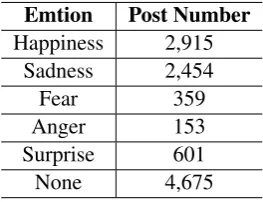
We collect the data from Weibo.com, one of the most popular SNS websites in China. We crawl all the posts and corresponding personal profiles from the website. The dataset contains 11,157 mi-croblog posts from 839 users. We employed six graduated students to annotate the corpus with a well-defined annotation guideline. Every two an-notators annotate a same part of corpus, if they have disagreement on some posts, we ask anoth-er annotator to vote with them. The annotation guideline is based onLee et al.(2013). Five basic emotions are annotated, namely happiness, sad-ness, fear, anger and surprise (Lee et al., 2013;
Wang et al.,2017). Table 1illustrates the statis-tics of each emotion. From the table, we find that the frequency ofhappinessandsadnessare simi-lar. Moreover, the frequency offear andangeris much less than other three emotions.
We randomly select 70% posts as the training data, and remaining 30% posts as the test data. For evaluation, F1-measure is used to evaluate the performance of proposed model in each emotion. Average F1-measure is used to evaluate the overall performance of all emotions.
Table 2: Experimental results of different models.
Method F1.
Happiness Sadness Anger Surprise Fear Average
SVM 0.628 0.462 0.390 0.117 0.091 0.338
Abdul17 0.656 0.492 0.429 0.103 0.111 0.358
Vaswani17 0.644 0.494 0.392 0.113 0.121 0.353
[image:6.595.115.247.214.315.2]NPD 0.657 0.510 0.459 0.135 0.127 0.378
Table 1: The statistics of emotion distribution in the dataset
Emtion Post Number
Happiness 2,915
Sadness 2,454
Fear 359
Anger 153
Surprise 601
None 4,675
5.2 Experimental Results
We compare the proposed Neural Personal Dis-crimination (NPD) model with several represen-tative baselines models in Table2, where,1)SVM
is a widely used baseline to predict the emotion of a post in social media (Yang et al., 2007).2) Ab-dul17is a standard LSTM model which consist of a LSTM layer and a fully connected layer, and it is modified from the model inAbdul-Mageed and Ungar(2017). The LSTM model yields the state-of-the-art performance on emotion detection in re-cent researches.3)Vaswani17is an improved LST-M model with a self-attention mechanism. The self-attention mechanism is used to capture the structural information and has been successful-ly applied in various natural language processing tasks recently (Cheng et al.,2016;Vaswani et al.,
2017)
From Table2, we find that all of the neural mod-els outperform SVM significantly. This indicates that neural models are much more effective than discrete models in emotion detection. In addition, our proposed NPD model outperforms both the s-tandard LSTM model (Abdul17) and the improved LSTM model with self-attention (Vaswani17) sig-nificantly. This shows the effectiveness of our pro-posed NPD model with both adversarial discrimi-nators and attention mechanisms. This also shows the usefulness of personal attributes for emotion detection. Moreover, we find that the performance of Vaswani17 is even lower than the standard
L-STM model. This shows that simply integrating a self-attention mechanism may not be able to well capture informative words for emotion detection in social media.
5.3 Analysis and Discussion
In this subsection, we analyze the influence of d-ifferent factors in the proposed NPD model, and give some statistics and examples to illustrate the effectiveness of the proposed NPD model with d-ifferent personal attributes.
5.3.1 Influence of Personal Attributes
We illustrate the influence of personal attributes in the proposed NPD model in Table 3, where, 1)LSTM-attributesis a LSTM based multi-label classification model, which predicts both the e-motion and the attribute labels of each post col-lectively.2)NPD-gender ablates the location at-tribute, i.e., only considering the gender attributes in the NPD model.3) NPD-location ablates the gender attribute, i.e., only considering the location attributes in the NPD model.
Table 3: Comparison of various models with different personal attributes.
Method Average F1.
LSTM 0.358
LSTM-attributes 0.341
NPD-gender 0.360
NPD-location 0.363
NPD 0.378
Table 4: Influence of network structures.
Method Average F1.
LSTM 0.358
LSTM-attention 0.363
LSTM-adversarial 0.375
NPD 0.378
5.3.2 Influence of Network Structures
After analyzing the influence of different at-tributes, we analyze the influence of network structures in Table4, whereLSTM-attention ab-lates the adversarial discriminators, and only uti-lizes attention mechanisms with a multi-label clas-sification setting, andLSTM-adversarialablates the attention mechanisms and only utilizes adver-sarial discriminators for emotion detection.
From Table4, we can see that both the attention mechanisms (LSTM-attention) and the adversar-ial discriminators (LSTM-adversaradversar-ial) are effec-tive in emotion detection. Moreover, the adver-sarial discriminators are much more effective than the attention mechanisms. This shows that the personal attribute discriminator is more important than learning informative attributes-aware words. Moreover, the NPD model obtains the best results by integrating both adversarial discriminators and attention mechanisms.
5.3.3 Statistics
We give the statistics of gender and location to explore the correlationship between emotion and personal attributes.
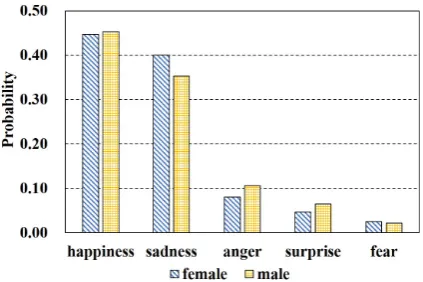
[image:7.595.104.258.92.187.2]Distribution of Gender.Figure2illustrates the distribution of emotions between genders. Here, the Y-axis is conditional probability of each emo-tion given gender. From the figure, we can find that women tend to express the sadness emotion, while men tend to express anger emotion. This may be due to the fact that the different person-ality has different emotion expressions, i.e., senti-mentality of the female and the impulsion of the
Figure 2: Distribution of gender.
Figure 3: Distribution of location.
male.
Distribution of Location. Figure 3 is an ex-ample of the distribution of emotions between lo-cations. As discussed in the above section, we use the province of authors as location attributes. Here, the Y-axis represents the conditional prob-ability of each emotion given location. From the figure, we can find that the authors’ location can may influence their emotions in many aspects. For example, people tend to express the positive (i.e., happiness) emotion than the negative emotion in Jiangsu. One of the most comfortable and devel-oped regions in China. Due to air pollution and populations, people tend to express the negative e-motion than the positive ee-motion in Beijing. In addition, people in Hong Kong always feel crowd-ing and tend to express the sadness emotion. Fi-nally, people always feel happy and comfortable in Sichuan, well known as “country of paradise” in China.
[image:7.595.311.525.251.393.2]experimen-Table 5: Examples predicted labels of LSTM and NPD
Post LSTM NPD
[E3]@$$Ê,Þ]ý‹ ý Z,ô è†,°°ÉQ94œ Á.
(@Momo Jun, this guy can even make Taro Balls from Jiufen of Taiwan. It is so bash. This ice fruit dessert is so soft and chewy.)
Sadness Happiness
[E4] ‚î, ¹ Ç, „7^ú:.
(Next tv show is not to be missed, because my Mr. Mcdreamy will be coming.)
None Happiness
[E5] Ù«S bmôJ, †} „°,ÓœÛφ',v' •
¹¢ÖÜ6.
(I can t compliment my body. Eating too much ice leads to my dysmenorrhea. I must to drink more brown sugar ginger tea)
None Sadness
tal results of personal attribute influence shows the same conclusion.
5.3.4 Case Study
We select three examples from the test set to eval-uate the effectiveness of the proposed NPD mod-el for better comparison with the LSTM modmod-el in Table 5. In [E3], through “bashi(conformable)” is a strong cue word of the happiness emotion, it is treated as a general word without indicating any location information from the LSTM mod-el. At the same time, the location information (Sichuan Province) determined by the location discriminator and the attention mechanism makes “bashi(conformable)” critical in the NPD model, and these enable the NPD model determines the correcthappinessemotion. In [E4] and [E5], both posts contain implicit gender information. For ex-ample, “Mr. Mcdreamy” implies the female’s af-fection for the handsome male, and “dysmenor-rhea” is a female physiological disease. Without the background of such gender information, it is impossible to infer any potential emotional infor-mation from these two words. This explains why the LSTM model fails to detect any emotion from the examples (Noneof emotion). However, our N-PD model successfully determines the gender of these two posts by the gender discriminator, and improves the weight of these two words for emo-tion detecemo-tion by the attenemo-tion mechanisms. In this way, the emotions of the three examples are cor-rectly detected through the proposed NPD model.
6 Conclusion
Most of previous studies consider each post in-dividually in emotion detection, one of the most important tasks in sentiment analysis. However, since the posts in social media are generated by
users, it is natural that these posts can be con-nected through authors’ personal background at-tributes. In this paper, we propose a neural person-al discrimination model with both adversariperson-al dis-criminators and attention mechanisms to connect posts with similar personal attributes. Here, the adversarial discriminators are used to determine the personal attributes, and the attention mecha-nisms are employed to aggregate attributes-aware words. In this way the social correlations be-tween different posts can be captured. The exper-imental results show the usefulness of the person-al attributes and the effectiveness of our proposed neural personal discrimination model in modeling such personal attributes with significant perfor-mance improvement over the state-of-the-art base-lines.
Acknowledgment
This work was support by National Natural Sci-ence Foundation of China (No. 61702518, No.61806137, No.61525205) and a project fund-ed by the Priority Academic Program Develop-ment of Jiangsu Higher Education Institutions.. This work was also supported by the joint research project of Alibaba and Soochow University. Final-ly, we would like to thank the anonymous review-ers for their insightful comments and suggestions.
References
Muhammad Abdul-Mageed and Lyle H. Ungar. 2017. Emonet: Fine-grained emotion detection with gated recurrent neural networks. InACL, pages 718–728.
Jianpeng Cheng, Li Dong, and Mirella Lapata. 2016. Long short-term memory-networks for machine reading. pages 551–561.
Ronan Collobert, Jason Weston, L´eon Bottou, Michael Karlen, Koray Kavukcuoglu, and Pavel P. Kuksa. 2011. Natural language processing (almost) from scratch. Journal of Machine Learning Research, 12:2493–2537.
Niko Colneriˆc and Janez Demsar. 2018. Emotion recognition on twitter: Comparative study and train-ing a unison model. IEEE Transactions on Affective Computing, PP(99):1–14.
John C. Duchi, Elad Hazan, and Yoram Singer. 2011. Adaptive subgradient methods for online learning and stochastic optimization. Journal of Machine Learning Research, 12:2121–2159.
William Fedus, Ian J. Goodfellow, and Andrew M. Dai. 2018. Maskgan: Better text generation via filling in the . InICLR, pages 1–16.
Yaroslav Ganin, Evgeniya Ustinova, Hana Ajakan, Pascal Germain, Hugo Larochelle, Franc¸ois Lavi-olette, Mario Marchand, and Victor S. Lempitsky. 2017. Domain-adversarial training of neural net-works. pages 189–209.
Yoav Goldberg. 2016. A primer on neural network models for natural language processing.J. Artif. In-tell. Res., 57:345–420.
Ian J. Goodfellow, Jean Pouget-Abadie, Mehdi Mirza, Bing Xu, David Warde-Farley, Sherjil Ozair, Aaron C. Courville, and Yoshua Bengio. 2014. Gen-erative adversarial nets. InNIPS, pages 2672–2680.
Umang Gupta, Ankush Chatterjee, Radhakrishnan S-rikanth, and Puneet Agrawal. 2017. A sentiment-and-semantics-based approach for emotion de-tection in textual conversations. CoRR, ab-s/1707.06996. Version 4.
Dirk Hovy. 2015. Demographic factors improve clas-sification performance. InACL, pages 752–762.
Paul F Lazarsfeld, Robert K Merton, et al. 1954. Friendship as a social process: A substantive and methodological analysis. Freedom and control in modern society, 18(1):18–66.
Sophia Yat Mei Lee, Ying Chen, Chu-Ren Huang, and Shoushan Li. 2013. Detecting emotion causes with a linguistic rule-based approach.Computational In-telligence, 29(3):390–416.
Junjie Li, Haitong Yang, and Chengqing Zong. 2016. Sentiment classification of social media text con-sidering user attributes. InNLPCC/ICCPOL, pages 583–594.
Tomas Mikolov, Ilya Sutskever, Kai Chen, Gregory S. Corrado, and Jeffrey Dean. 2013. Distributed repre-sentations of words and phrases and their composi-tionality. InNIPS, pages 3111–3119.
Xiaojun Quan, Qifan Wang, Ying Zhang, Luo Si, and Wenyin Liu. 2015. Latent discriminative models for social emotion detection with emotional dependen-cy.ACM Trans. Inf. Syst., 34(1):2:1–2:19.
Kirk Roberts, Michael A. Roach, Joseph Johnson, Josh Guthrie, and Sanda M. Harabagiu. 2012. Em-patweet: Annotating and detecting emotions on twit-ter. InLREC, pages 3806–3813.
Carlo Strapparava and Rada Mihalcea. 2008.Learning to identify emotions in text. In SAC, pages 1556– 1560.
Mike Thelwall. 2010. Emotion homophily in social network site messages.First Monday, 15(4):1–8.
Ashish Vaswani, Noam Shazeer, Niki Parmar, Jakob Uszkoreit, Llion Jones, Aidan N. Gomez, Lukasz Kaiser, and Illia Polosukhin. 2017. Attention is all you need. InNIPS, pages 6000–6010.
Soroush Vosoughi, Helen Zhou, and Deb Roy. 2016. Enhanced twitter sentiment classification using con-textual information. CoRR, abs/1605.05195. Ver-sion 1.
Ke Wang and Xiaojun Wan. 2018. Sentigan: Gener-ating sentimental texts via mixture adversarial net-works. InIJCAI, pages 4446–4452.
Xuren Wang and Qiuhui Zheng. 2013. Text emotion classification research based on improved latent se-mantic analysis algorithm. InICCSEE, pages 210– 213.
Zhongqing Wang, Sophia Yat Mei Lee, Shoushan Li, and Guodong Zhou. 2017. Emotion analysis in code-switching text with joint factor graph model.
IEEE/ACM Trans. Audio, Speech & Language Pro-cessing, 25(3):469–480.
Zhongqing Wang, Shoushan Li, Hanxiao Shi, and Guodong Zhou. 2014. Skill inference with personal and skill connections. InCOLING, pages 520–529.
Zhongqing Wang, Yue Zhang, Sophia Yat Mei Lee, Shoushan Li, and Guodong Zhou. 2016. A bilingual attention network for code-switched emotion predic-tion. InCOLING, pages 1624–1634.
Changhua Yang, Kevin Hsin-Yih Lin, and Hsin-Hsi Chen. 2007. Emotion classification using web blog corpora. InWI-IAT, pages 275–278.