Proceedings of the 2019 EMNLP and the 9th IJCNLP (System Demonstrations), pages 259–264 259
What’s Wrong with Hebrew NLP?
And How to Make it Right
Reut Tsarfaty Amit Seker Shoval Sadde Stav Klein Open University of Israel, University Road 1, Ra’anana, Israel {reutts,shovalsa,amitse,stavkl}@openu.ac.il
Abstract
For languages with simple morphology, such as English, automatic annotation pipelines such as spaCy or Stanford’s CoreNLP success-fully serve AI/DS projects in academia and the industry. For many morphologically-rich lan-guages (MRLs), similar pipelines show sub-optimal performance that limits their applica-bility for text analysis in research and com-merical use. The suboptimal performance is mainly due to errors in early morphological disambiguation decisions, which cannot be re-covered later in the pipeline, yielding incoher-ent annotations on the whole. In this paper we describe the design and use of the ONLP
suite, a joint morpho-syntactic parsing frame-work for processing Modern Hebrew texts. The joint inference over morphology and syn-tax substantially limits error propagation, and leads to high accuracy. ONLP provides rich and expressive output which already serves di-verse academic and commercial needs. Its ac-companying demo further serves educational activities, introducing Hebrew NLP intricacies to researchers and non-researchers alike.
1 Introduction
NLP pipelines for the automatic annotation of un-structured texts are at the core of language tech-nology applications for Data Science, Text Ana-lytics and Artificial Intelligence. For English, an-notation pipelines such as spaCy (Honnibal and Montani,2017) or Stanford’s CoreNLP (Manning et al.,2014) successfully deliver the ability to au-tomatically annotate unstructured texts with their underlying linguistic structures, including: Part-of-Speech (POS) Tags, Morphological Features, Dependency Relations, Named Entities, and so on. These annotations serve research labs, non-profit organizations and commercial endeavors in their quest tomake senseof the vast amount of unstruc-tured data available to them.
Universal processing pipelines such as UDPipe (Straka et al.,2016) aim to serve a range of other languages, but unfortunately, their performance on many morphologically rich languages (MRLs) (Tsarfaty et al., 2010), and in particular Semitic languages, is not on a par with their performance on English. This, in turn, greatly limits their appli-cability for further research and commercial use. The main reason for this sub-optimal performance on Semitic languages is that the pipeline design inherent in these frameworks is inappropriate for languages that exhibit extreme morphological am-biguity in their input stream. This is because errors made in morphological segmentation and disam-biguation early on, jeopardize the system accuracy down the pipeline. For Hebrew, this performance gap has long been a show-stopper for advancing Language Technology and Artificial Intelligence for the Hebrew-speaking community. With this contribution, we aim to remedy this situation.
In this paper we describe the design and use of the ONLPsystem, ajointmorphological-syntactic parsing framework for processing the Semitic language Modren Hebrew (Henceforth, Hebrew). The system is accurate, efficient, and provides rich and expressive output including: Segmentation, POS tags, Lemmas, Features and Labeled Depen-dencies. Thejointtraining and inference over the different layers substantially limits error propaga-tion, and leads in turn to speed and high accuracy. Among the technical advantages of the ONLPsuite
2 The Linguistic Challenge
In morphologically-rich languages (MRLs), each input token may consist of multiple lexical and functional units (henceforth,morphemes), each of which serves a particular role in the overall syn-tactic or semantic representation. In Hebrew, for example, the token‘!הדבעמהמשכו‘ corresponds to five word tokens in English, each of which car-rying its distinct role: ‘!ו‘ (and, CC), ‘!שכ‘(when, REL),‘!ְמ‘(from, IN),‘!ה‘(the, DT),‘!הדבעמ‘(lab, NN).1This means that in order to process Hebrew texts, one first needs to segment the Hebrew to-kens into their constituting morphemes. At the same time, Hebrew raw tokens are highly ambigu-ous. A token such as: ‘!הפקה‘ may be interpreted as ‘!הפקה‘ (orbit, NN), ‘!ה‘ + ‘!הפק‘ (the+coffee, DT+NN), or ‘!Pקה’+ ‘!לש’ + ‘!איה‘ (perimeter of her, NN+POSS+PRP), etc. This is further com-plicated by the lack of diacritics in standardized texts, meaning that most vowels are not present, and thus out of context no reading is a-priory more likely than the others. Onlyin contextthe correct interpretation and segmentation become apparent. These facts create an apparent loop in the de-sign of NLP pipelines for Hebrew:syntactic pars-ing requires morphological disambiguation – but morphological disambiguation requires syntactic context. This apparent loop has called for the de-velopment of joint systems rather than pipelines, for Semitic languages processing (Tsarfaty,2006;
Green and Manning,2010). This joint hypothesis has proven useful for Hebrew and Arabic phrase-structure parsing (Goldberg and Tsarfaty, 2008;
Green and Manning,2010;Goldberg and Elhadad,
2011). The ONLP suite is a dependency-based
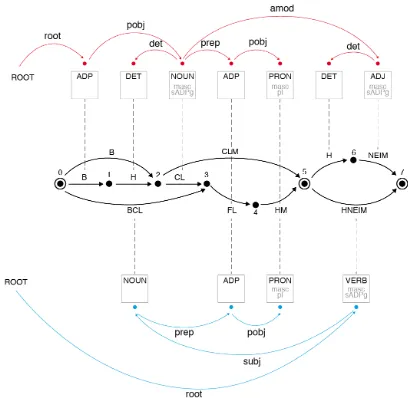
parsing framework implementing this joint hy-pothesis, over the entire morpho-syntactic search-space, as depicted in Figure1(More et al.,2019).
3 The Architectural Design
The core of ONLP is YAP (Yet Another Parser), a morpho-syntactic parser for morphological and syntactic analysis of Hebrew Texts. YAP re-implements and extends the structure-prediction framework of Zhang and Clark (2011). We de-scribeYAP in detail inMore and Tsarfaty(2016) andMore et al. (2019). Here we only provide a bird’s eye view of the architecture.
[image:2.595.322.526.77.276.2]1We use the annotation conventions of Sima’an et al. (2001) that underlie the Hebrew SPMRL schemehttp:// www.spmrl.org/spmrl2013-sharedtask.html.
Figure 1: The Joint Morpho-Syntactic Search-Space. Lattice paths vary in length. Each lattice path can be assigned an exponential number of dependency trees.
In YAP we embrace the extreme morpholog-ical ambiguity in Hebrew. That is, we do not
aim to resolve morphological ambiguity via pre-processing. The input to YAP is the complete Mor-phological Analysis (MA)of an input sentencex, termed here MA(x). MA(x)is alatticestructure, consisting of all possible morphological analysis possibilities of the input sentence, as seen in the middle of Figure 1. Each lattice arc is a tuple specifying thestart-index, end-index, theformof the segment, its part-of-speech, lemma, features, and theindexof the raw token the arc
originated from. Anarcin the lattice can serve as a node in a syntactic dependency tree. Each contiguous path in the lattice presents one valid morphological segmentation of the sentence, for which a dependency tree can be assigned, as in Figure1. For each path in the lattice, there is an exponential number of dependency trees that are potentially applicable.
We refer to the task of selecting the most likely lattice-path asMorphological Disambigua-tion (MD), and to the task of selecting the most likely dependency tree for a given path as Depen-dency Parsing(DEP). For an input sentencex, our goal is to jointly predict a single pair of MD(x)
and DEP(x) that are consistent with one another, and form the most-likely analysis of the sentence.
The MD component is the transition-based
(2016), which is formally based on the structure-prediction framework ofZhang and Clark(2011). MD accepts a sentence lattice MA(x) as input and delivers a selected sequence of arcs (mor-phemes) MD(x) as output. The transition-based system for MD selects arcs for MD one at a time. It decodes the lattice using beam-search, and keeps the K-best paths at each step, scored accord-ing to morpheme-level and token-level features, weighted via structured-perceptron learning.
The DEP component is a re-implementation of theZhang and Nivre(2011) dependency parser for English, adapted for Hebrew. We assume an Arc-Eager transition system and beam-search decod-ing. Feature weights are learned via the structured perceptron. We employ a carefully-designed fea-ture set that reflects linguistic properties of He-brew such as its rich morphological paradigms, flexible word-order, agreement, etc. This provides SOTA results on Hebrew dependency parsing, al-beit in Oracle (i.e., gold morphology) scenario.
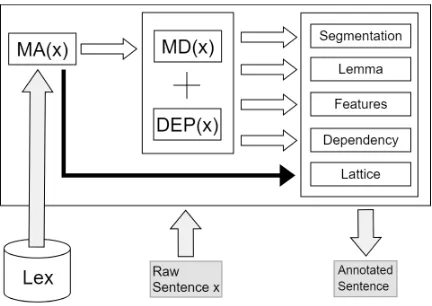
Seen that both the MD and DEP realize the same formal framework and computational ma-chinery, we can easily unify them and treat the morpho-synactic task as a single objective. The transition systems are combined and the beam-search decoder interleaves morphological and syn-tactic decisions. Now morphological decisions may be affected by syntactic content, and vice versa. The architecture is depicted in Figure 2. In More et al. (2019) we compared the perfor-mance of our joint system to our own pipeline, and to other parsing systems available for Hebrew. Our empirical results inMore and Tsarfaty(2016);
More et al.(2019) show significant improvements of YAP’s joint model for both the morphological and syntactic tasks, over all standalone morpho-logical or syntactic parsers available for Hebrew.
4 The Annotation Scheme
We deliver automatic morpho-syntactic annota-tion of Hebrew texts based on the scheme of the SPMRL Hebrew dependency treebank. The SPMRL Hebrew scheme employs the labels of
Sima’an et al. (2001) for morphology and POS tags, and the Unified-SD scheme of Tsarfaty
(2013) for the labeled dependencies.2Specifically, we deliver the following annotation layers:
[image:3.595.308.524.61.214.2]2With an eye for future comparability, we further devel-oped a conversion algorithm to convert the dependency tree from Unified-SD to Universal Dependencies (UD).https: //universaldependencies.org/
Figure 2: A bird’s eye view of the Architecture
Morphological Segmentation The most basic form of analysis of Hebrew texts is the segmenta-tion of raw tokens into multiple meaning-bearing units that we call morphemes.3 Due to ortho-graphic and phonological processes, some mor-phemes do not appear explicitly in the surface form. Our segmentation recovers all morphemes, both overt and covert. For example, the token
‘!תיבב’ (in the house) is segmented as‘!ב’ + ‘!ה’ + ‘!תיב’.
Part-of-Speech (POS) Tags Each morphologi-cal segment is assigned a single Part-of-Speech tag category that indicates its syntactic role. The set of tags used by the system is based on the SPMRL scheme which in turn adopts the POS labels from
Sima’an et al.(2001) (detailed in our appendix).
Morphological Features Along with the POS category, we specify for each segment the prop-erties that are signalled by inflectional morphol-ogy. The scheme encodes the following prop-erties: Number [S (Singular) / P (Plural) / D (Dual)], Gender [F (Female) / M (Male) / F,M (both)], Person[1 / 2 / 3 / A (All)],4 andTense
[Past, Present, Future, Imperative, Infinitive].5
Lemmas Each segment is also assigned a lemma, i.e., the cannonical representation of its core (uninflected) meaning.6 For Hebrew nouns
and adjectives, the lemma is chosen to be the Masculine-Singular form. For verbs, the lemma is in the Masculine-Singular-3per form in Past tense.
3
In UD they are calledwords. In Hebrew NLP they are calledsegments. We usemorphemesorsegmentsherein.
4
Ais used in cases where all analyses are valid, such as in Beinoni form - ‘!תלכוא’ (I/you/she eat.singular.feminine)
5
Dependency Tree The dependency tree is de-fined over all morphological segments and an ar-tificial root node. It consists of a set of labeled binary relations that indicate the bi-lexical depen-dencies between segments. Note that the SPMRL dependency scheme, as opposed to UD, always se-lects functional heads, rather than lexical heads. The dependency labeling is based on the scheme fromTsarfaty(2013), repeated in the appendix.
Lattices As explained in section3above, a word can be segmented into morphemes in multiple ways, which are constrained by a broad-coverage lexicon. In addition to the parsed output, we make available for each input sentence its sentence lat-tice, i.e. the set of all possible segmentations for a given sentence, along with all possible mor-phosyntactic analyses for each arc.
5 Technical Details and Forms of Use
YAP is implemented in the Go language.7 It re-quires 6GB of RAM to run, and employs a sim-ple 3-step installation, given in the supsim-plementray material. The input to the system is a tokenized sentence, with tokens appearing one per line, and a line break after every sentence.8 The output is a dependency tree (where each node in the tree is a lattice arc) provided in the CoNLL-X format (Buchholz and Marsi, 2006). YAP is trained on the Hebrew section of the SPMRL shared task. It also makes use of the broad-coverage lexicon of
Itai and Wintner (2008) for finding all potential lattice paths. In case of out-of-vocabulary (OOV) items, we employ a simple heuristic where we sug-gest the 10 most-likely analyses of rare tokens ob-served during training.
Simple Use | Command line From the com-mand line, one can process one input file at a time, with a single sentence or more. The input file must be formatted with a single token per line, and an empty line denoting the end of every sentence.
Processing a file is done in 2 steps: First, run Morphological Analysis using./yap hebmato generate a sentence lattice containing all possible morphological breakdowns of each token. YAP will save the lattice to the file specified via the
-outflag.
7
https://golang.org/
8We assume the tokenization convention of MILA (Itai
and Wintner,2008).
Now you can run joint Morphological Disam-biguation and Dependency Parsing using./yap jointto jointly predict the best lattice path and corresponding dependency tree. The input to this command is the output file generated in the pre-vious step, and there are 3 output files: one con-taining word segments, one concon-taining the disam-biguated lattice path, and one containing the com-plete dependency tree in CoNLL-X format.
Advanced Use|RESTful API YAP can run as a RESTful server that accepts parse requests. To do this simply start the server, listening on localhost port 8000. Now you can call the joint endpoint with a json object containing the list of tokens to process in the HTTP data payload. The response is a json object containing the three output levels (MA, MD and Dep). You can use jq and sed (or any other json and line processing tools) to format the (tab separated value) responses and reassemble the output. Check our appendix for an illustration.
Educational Use| The Online Demo In 2018 we decided to create an online demo of the system, for educational purposes: (i) To expose NLP/AI researchers to NLP capabilities available for He-brew. (ii) To educate non-CS scientists and engi-neers who work with Hebrew data (e.g., digital hu-manities) on text annotations that can potentially be useful for their applications. (iii) To launch out-reach activities where we teachwhat is NLPto the local community (e.g., school kids).9
To use the demo, simply go toonlp.openu. ac.iland type a Hebrew sentence in the textbox. The demo is built with Django and Bootstrap web frameworks. It sends the user’s Hebrew text input to the ONLPserver, which returns a CoNLL-X for-matted parse along with the complete sentence lat-tice. Pre-processing includes pre-morphological tokenization of the input, where punctuation is be-ing separated from the tokens. Double quotation marks are being separated from the word unless they appear before the last character of the word, to avoid over-segmentation of acronyms.10 The tokenized sequence is then passed to the ONLP
server. The CoNLL-X output is then processed into the following layers: the FORM column is concatenated and presented as ”Segmented Text”, and the POS, LEMMA, FEATS and DEPS are
pre-9
E.g., https://www.youtube.com/watch?v= TFwQeoKpznA&feature=youtu.be
Tok MA MD POS Lem Feats Deps Joint
Tasks
MILA X X NITE X X X Hebrew-NLP X
Adler X X X
Goldberg X
Pipelines
UDPipe X X X X X X X CoreNLP X X X X X X X
[image:5.595.76.289.62.166.2]ONLP X X X X X X X X
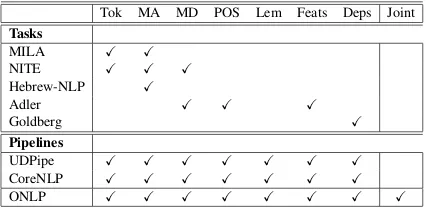
Table 1: Existing Coverage for Hebrew NLP Tasks
sented in separate accordion tabs. Furthermore, the demo presents the sentence lattice which is the input to the joint parser. This is useful for debug-ging, and for analyzing lexical-coverage in out-of-domain scenarios.
Expert Use|Out of Domain Scenarios A bot-tleneck for the system in out-of-domain parsing scenarios is the coverage of the lexicon. We rely on a general-purpose lexicon containing over 500K entries. OOV words are treated via heuris-tics we designed, which are suitable for the gen-eral case only. However, identifying vocabulary items accurately may be critical when applying the parser to new domains with domain-specific infor-mation (medical, financial, political, etc.). Fortu-nately, we can extend the system with a domain-specific lexicon, thus extending the MA coverage. Due to joint inference, the availability of a bet-ter suited lexical analysis triggers better lexico-syntacticdecisions on the whole.11
6 Related and Future Work
Hebrew NLP in general and Hebrew parsing in particular are known to be challenging, due to in-teresting linguistic properties, the scarcity of an-notated data, and the small research community around. So, Hebrew has been seriously under-studied in NLP. During the early 2000s, the MILA knowledge center was established, where the two of the main Hebrew resources for NLP were devel-oped: the Hebrew treebank (Sima’an et al.,2001) and the Hebrew Lexicon (Itai and Wintner,2008). Morphological Taggers for Hebrew using local linear-context have been trained on these data and were made available for free use (Adler and El-hadad, 2006; Bar-haim et al., 2008). However, their performance was not on a par with parallel tools for English and thus insufficient for commer-cial use. Hebrew dependency parsing was initially
11We discuss how exactly this is executed in the appendix.
provided by Goldberg and Elhadad (2009), but the parser providedunlabeleddependency, and the pipeline relied on Adler’s morphological tagger. This left the predicted dependency trees inaccurate and unsatisfying. Joint morpho-syntactic models for constituency-based parsing based onTsarfaty
(2010) showed good performance on benchmark data, but was never released for open use.
With the development of the UD treebanks collection, general frameworks such as UDPipe (Straka et al.,2016) and CoreNLP (Manning et al.,
2014) have been trained on the Hebrew UD tree-bank, and made the model available. However, these models provide performance that is still far from satisfactory. As we also demonstrate in our screen-cast,12 these systems make critical mis-takes, even with the simplest sentences. We con-jecture that this is due to their inherent pipeline assumption: initial layers of processing present many mistakes. due to the extreme morphological ambiguity, and later layers cannot recover.13 No-tably, neural-network models utilizing word em-beddings, (e.g., UDPipe) also lag behind.
Table 1 shows the task-coverage of existing tools and toolkits for NLP in Hebrew, academic as well as private initiatives (NITE,Hebrew-NLP). The task-coverage of the ONLP suite we present is on a par with international standards (UD-Pipe, CoreNLP), and its level of performance was shown to exceed all existing models (More et al.,
2019). We are currently working towards Named-Entity Recognition as well as Open Information Extraction, to be added to ONLPin the near future.
7 Conclusion
This paper presents ONLP, a complete language-processing framework for automatic annotation of Modern Hebrew Texts. The framework covers morphological segmentation, POS tags, lemmas and features, and dependency parsing, predicted jointly. The system is easy to install and to use, and we support multiple forms of usage fitting user-personas with different needs. We hope the availability of an open-source, accurate, and easy-to-use system for NLP in Hebrew will benefit the local NLP open-source community and greatly ad-vance Hebrew language technology research and development, in academia and in the industry.
12
https://www.youtube.com/watch?v= H6pvh1x20FQ
Acknowledgements
We thank the NLPH community, in particular Shay Palachi, Amit Shkolnick and Yuval Fein-stein, for discussion and insightful comments. We further thank Avi Bivas (Israel Innovation Author-ity) and Milo Avisar for promoting NLP initia-tives in Israel. This research is supported by an ISF grant (1739/26) and an ERC Starting grant (677352), for which we are grateful.
References
Meni Adler and Michael Elhadad. 2006. An unsuper-vised morpheme-based hmm for Hebrew morpho-logical disambiguation. InACL. The Association for Computer Linguistics.
Roy Bar-haim, Khalil Sima’an, and Yoad Winter. 2008. Part-of-speech tagging of Modern Hebrew text. Nat-ural Language Engineering, 14(2):223–251.
Sabine Buchholz and Erwin Marsi. 2006. Conll-x shared task on multilingual dependency parsing. In
Proceedings of CoNLL, pages 149–164.
Yoav Goldberg and Michael Elhadad. 2009. Hebrew dependency parsing: Initial results. In Proceed-ings of the 11th International Conference on Parsing Technologies, IWPT ’09, pages 129–133.
Yoav Goldberg and Michael Elhadad. 2011. Joint He-brew segmentation and parsing using a PCFGLA lat-tice parser. InProceedings of ACL.
Yoav Goldberg and Reut Tsarfaty. 2008. A sin-gle framework for joint morphological segmentation and syntactic parsing. InProceedings of ACL.
Spence Green and Christopher D. Manning. 2010. Bet-ter Arabic parsing: Baselines, evaluations, and anal-ysis. InProceedings of COLING.
Matthew Honnibal and Ines Montani. 2017. spaCy 2: Natural language understanding with Bloom embed-dings, convolutional neural networks and incremen-tal parsing. To appear.
Alon Itai and Shuly Wintner. 2008. Language re-sources for Hebrew. Language Resources and Eval-uation, 42(1):75–98.
Christopher Manning, Mihai Surdeanu, John Bauer, Jenny Finkel, Steven Bethard, and David McClosky. 2014. The stanford corenlp natural language pro-cessing toolkit. InProceedings ACL: system demon-strations, pages 55–60.
Amir More, Amit Seker, Victoria Basmova, and Reut Tsarfaty. 2019. Joint transition-based models for morpho-syntactic parsing: Parsing strategies for MRLs and a case study from modern Hebrew.
Transactions of the Association for Computational Linguistics, 7:33–48.
Amir More and Reut Tsarfaty. 2016. Data-driven mor-phological analysis and disambiguation for morpho-logically rich languages and universal dependencies. In Proceedings of COLING, pages 337–348. The COLING 2016 Organizing Committee.
Khalil Sima’an, Alon Itai, Yoad Winter, Alon Altman, and N. Nativ. 2001. Building a tree-bank of Modern Hebrew text. Traitment Automatique des Langues, 42(2).
Milan Straka, Jan Hajic, and Jana Strakov´a. 2016. Ud-pipe: Trainable pipeline for processing conll-u files performing tokenization, morphological analysis, pos tagging and parsing. InProceedings of the Tenth International Conference on Language Resources and Evaluation (LREC 2016), Paris, France. Euro-pean Language Resources Association (ELRA).
Reut Tsarfaty. 2006. Integrated morphological and syntactic disambiguation for modern Hebrew. In
Proceedings ACL-CoLing Student Research Work-shop, pages 49–54, Stroudsburg, PA, USA. ACL.
Reut Tsarfaty. 2010. Relational-realizational parsing. Ph.D. thesis.
Reut Tsarfaty. 2013. A unified morphosyntactic scheme for stanford dependencies. InProceedings of ACL.
Reut Tsarfaty, Djam´e Seddah, Yoav Goldberg, San-dra K¨ubler, Marie Candito, Jennifer Foster, Yannick Versley, Ines Rehbein, and Lamia Tounsi. 2010. Sta-tistical parsing of morphologically rich languages (spmrl): What, how and whither. InProceedings of the NAACL HLT 2010 First Workshop on Statis-tical Parsing of Morphologically-Rich Languages, SPMRL ’10, pages 1–12, Stroudsburg, PA, USA. Association for Computational Linguistics.
Yue Zhang and Stephen Clark. 2011. Syntactic pro-cessing using the generalized perceptron and beam search. Computational Linguistics, 37(1):105–151.
Yue Zhang and Joakim Nivre. 2011. Transition-based dependency parsing with rich non-local features. In
Proceedings of the ACL, HLT ’11, pages 188–193, Stroudsburg, PA, USA. ACL.
A Resources
1. Paper Appendix and Supplementary Materials:
https://arxiv.org/abs/1908.05453
2. Github:
https://github.com/OnlpLab/yap
3. Demo - Website:
http://onlp.openu.org.il
4. Demo - Screencast:
https://www.youtube.com/watch?v= H6pvh1x20FQ
5. API Docker Image:
https://hub.docker.com/r/onlplab/ yap-api
6. SPMRL-to-UD Conversion:
https://github.com/OnlpLab/Hebrew_UD
7. ONLP Lab Website: