Proceedings of the 2019 EMNLP and the 9th IJCNLP (System Demonstrations), pages 115–120 115
Journalist-in-the-Loop: Continuous Learning as a Service for Rumour
Analysis
Twin Karmakharm Nikolaos Aletras
Department of Computer Science University of Sheffield, UK
[t.karmakharm, n.aletras, k.bontcheva]@sheffield.ac.uk Kalina Bontcheva
Abstract
Automatically identifying rumours in social media and assessing their veracity is an im-portant task with downstream applications in journalism. A significant challenge is how to keep rumour analysis tools up-to-date as new information becomes available for particular rumours that spread in a social network. This paper presents a novel open-source web-based rumour analysis tool that can continuous learn from journalists. The system features a rumour annotation service that allows journal-ists to easily provide feedback for a given so-cial media post through a web-based interface. The feedback allows the system to improve an underlying state-of-the-art neural network-based rumour classification model. The sys-tem can be easily integrated as a service into existing tools and platforms used by journal-ists using a REST API.
1 Introduction
Identifying rumours and assessing their veracity in social media is an important task with downstream applications in journalism (Zubiaga et al.,2018a). Such tools can be used to make journalists more productive and also have the potential to be valu-able tools in informing the public about the ve-racity of rumours especially during political crises and pre-electoral periods (Tsakalidis et al.,2018). Individual and collaborative manual approaches to rumour analysis do not scale due to the large volume and velocity of user generated content (Konstantinovskiy et al.,2018). On the other hand, automatic machine learning-based approaches are often falling short on accuracy, when presented with previously unseen rumours (Zubiaga et al.,
2018a).
Current rumour analysis practices also tend to entail journalists making decisions using a dis-parate set of tools, such as Google reverse
im-age search, Tweetdeck, or more experimental ma-chine learning-based rumour or video analysis al-gorithms. Even the latest research projects in these areas, e.g. PHEME (Derczynski and Bontcheva,
2014), InVID (Teyssou et al.,2017), Hoaxy (Shao et al., 2016), envisage the computer algorithms as intelligence augmentation tools for the journal-ists, used to scale up their abilities to deal with a large volume, velocity, and variety of social con-tent with uncertain veracity.
Even though large amounts of new human in-sights and evidence accumulate over time, journal-ists cannot use this to improve their tools since the machine learning models behind them are not up-datable. This is a major limitation on the practical usefulness of these tools, since our latest research (Lukasik et al.,2015) on rumour stance and verac-ity classification, for example, demonstrated that giving the machine learning models as few as just ten human-labelled examples from a newly emerg-ing rumour can improve the algorithm accuracy by at least 10%.
Therefore, not only journalists can benefit from using machine intelligence to improve their pro-ductivity, but also the underlying algorithms can get smarter, if only journalists could feed back the new evidence in a way that enables the tools to learn from such new data.
This paper presents a new open source web ser-vice for rumour analysis1 that can improve over time by using feedback from journalists. The main user requirement is for journalists to invest mini-mal time and effort providing the additional man-ual feedback which in turn will yield productiv-ity gains from the more accurate machine learn-ing models. From a technological perspective, the assumption being tested is that continuous learn-ing and human which computation techniques can
be used to underpin an easy to use misinformation analysis interface for journalists. Due to this being a prototype project, we focus initially on rumour analysis and only on Twitter.
To test this hypothesis, we have built a pro-totype web service that brings together state-of-the-art machine learning-based algorithms for ru-mour detection (Aker et al.,2019). Journalists are able to access the service via a web-based applica-tion interface from their desktop or mobile devices and monitor and verify emerging rumours in so-cial media. The web application uses the machine learning algorithms, in order to quickly gather and present journalists with evidence around the narra-tives being monitored, e.g. how fast is the rumour spreading and which are the users who are most af-fected; who are the key proponents; is the rumour attracting polarised opinions and discussions; how likely is the rumour to be true. Our main aim is to support much more complex types of analysis, than just focusing on the veracity of an individual piece of information, e.g. has an image or a video been tampered with.
2 Related Work
In 2016 alone, the Duke Reporters Lab reported a 50% increase in global fact-checking by me-dia and independent fact-checking organisations.2 Journalists and news editors currently use largely manual processes for analysis, investigation, and verification of social media and other online con-tent. A limited number of production quality tools are currently available to support them in the indi-vidual steps of this process, with much of the tech-nology still in research and experimental phases.
In more detail, existing projects and tools are mostly focused on images/video forensics and ver-ification (e.g. InVID (Teyssou et al., 2017), RE-VEAL3), crowdsourced verification (e.g. Check-Desk4, Veri.ly5), fact-checking claims made by politicians (e.g. Politifact6, FactCheck.org7, Full-Fact8), citizen journalism (e.g. Citizen Desk), repositories of checked facts/rumours/websites (e.g. Emergent (Ferreira and Vlachos, 2016),
2https://reporterslab.org/
global-fact-checking-up-50-percent 3
https://revealproject.eu/ 4https://meedan.com/en/check/ 5https://veri.ly
6
https://www.politifact.com/ 7
https://www.factcheck.org/ 8https://fullfact.org/
FactCheck7 , Decodex9), or pre-trained machine learning models and tools, which however can-not be adapted by the journalists to new data (e.g. PHEME (Derczynski and Bontcheva,2014), REVEAL3).
There are also existing tools for visualising and analysing online rumours which are related to the user interface of our system:
• RumorLens (Resnick et al., 2014) is a pro-totype aimed at citizens and journalists, to help detect rumours early, then classify posts as spreading or correcting the given rumour, and also visualising its spread. A human-in-the-loop learning showed good results on the tweet retrieval task. This motivated us to pro-pose extending this approach to other rumour and misinformation analysis tasks.
• TwitterTrails (Metaxas et al.,2015) is an in-teractive, web-based tool that visualises the origin and propagation characteristics of a ru-mour and its refutation, on Twitter. Another visualisation-based framework for studying rumour propagation is RumourFlow (Dang et al.,2016).
• Hoaxy (Shao et al., 2016) is a recent open-source tool focused on visualising and searching over claims and fact checks. Such sophisticated visualisations are out of scope of our system, but relevant open-source vi-sualisation tools, e.g. from Hoaxy, could be integrated in the future.
• CrossCheck10 was a collaborative rumour checking project led by First Draft and Google News Lab, during the French elec-tions. Its output was a useful dataset of false or unverified rumours.
• Meedan’s Check4 is an open-source break-ing news verification platform, which how-ever does not support continuously updated machine learning methods.
• ClaimBuster (Hassan et al., 2017) is a tool which gathered volunteer and expert-based claim annotations to train machine learning methods for claim classification (factual vs
9
non-factual). In contrast, we propose a ser-vice where rumour annotation is carried out as a side effect of the journalist workflow, as well as having a wider range of machine learning methods, for different rumour anal-ysis tasks.
However, to the best of our knowledge, the above tools do not consider using feedback pro-vided by journalists to continuously update their underlying rumour classification models.
3 Journalist-in-the-Loop System Overview
The system is an integration of state-of-the-art ma-chine learning algorithms for detecting emerging rumours; analysing the online narratives around them for stance and temporal evolution; and au-tomatic veracity classification. The starting point are our open source algorithms from the PHEME project (Derczynski and Bontcheva,2014) adapted to fit the learning paradigm, so the models evolve as more journalist-labelled data comes in.
The core of the rumour analysis service consists of three main parts: (1) a rumour classification system; (2) a rumour annotation service; and (3) a database which stores the training data required by the classification system and allows the system to be updated continuously using the newly anno-tated rumours. The diagram in Fig. 1provides an overview of the system.
4 Rumour Classification System
The rumour classification system contains and manages the model that is used for classifying new unseen rumours. The system is built on top of the PyTorch11 deep learning framework and consists
of three components.
First, the data processing component is used to transform text into a representation suitable for the Rumour Classification Model where its in-puts and outin-puts are described in Section4.1. If there are many annotations provided by the user for the same piece of rumour, the system chooses the most frequent one. The processed text is then transformed into a set of matrices that can be di-rectly used in the model training process.
Second, the model training component trains and validates the model using the available anno-tated rumours dataset prepared by the data
pro-11https://pytorch.org
cessing component. The dataset is randomised and split in to training (80%) and testing (20%) sets. In this case, there is no validation dataset as there is currently no further tuning of hyperparam-eters, hence more data is dedicated for training the model instead. Once the training is complete, the model’s parameters are then saved to be used in the next stage.
Finally, the prediction component offers an in-terface for making predictions on new unseen ru-mours which is used directly by the Rumour An-notation Service as described in Section 5. The component uses the stored model’s parameters from the last stage.
4.1 Rumour Classification Model
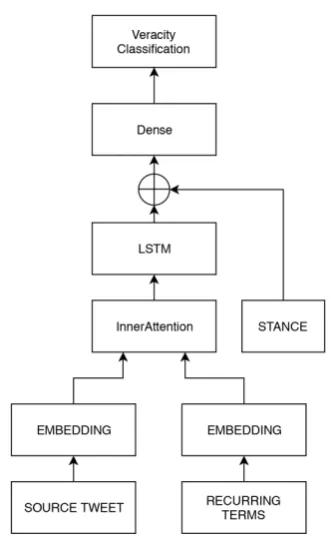
The model used in the Rumour Classification Sys-tem is based on the state-of-the-art rumour verac-ity classification algorithm ofAker et al. (2019). It is a recurrent network which classifiers Twitter rumours into three categories, true, false or unver-ified. A diagram of the model can be seen in Fig.
2.
The model takes three inputs. First input is the source tweets, the text is cleaned and tokenized before being fed into the network. The second in-put are the recurring terms that occur frequently and which are associated to each veracity cate-gory (e.g. the word ‘live’ has strong association with true rumours). In this case, only the recur-ring terms that are associated with false rumours are used as they are shown to give the best result. The third input is the stance related to the tweet obtained from the comments associated with the tweet. The stance are proportions of associated tweets which either support the original tweet, de-nies it or are neutral (e.g. further questions or sim-ply making comments without supporting or deny-ing).
The tokenized source tweets and recurring terms are embedded using the pre-trained Google news word2vec model (Mikolov et al.,2013). The embedded source tweets and recurring terms are then fed into an attention layer that uses the re-curring terms to weight the importance of the source tweet words. The output of the atten-tion layer is fed into a Long-Short Term Mem-ory (LSTM) layer (Hochreiter and Schmidhuber,
Figure 1: Data flow diagram of the rumour classification service.
Figure 2: Network diagram of the rumour veracity model.
for a three-category classification output.
4.2 Data and Initial Results
The initial data source used for seeding the ru-mour veracity classification model is the Ru-mourEval2017 dataset (Derczynski et al., 2017) which is derived from the PHEME dataset ( Zubi-aga et al., 2018b). The RumourEval2017 dataset contains 325 Twitter conversation threads dis-cussing rumours with respect to eight different man-made events like Germanwings Air Crash, Charlie Hebdo, Ottowa Shootings, etc. Each thread in the dataset is annotated as true, false or unverified. Also each reply to a source tweet is annotated with one of the labels: supporting,
denying, questioning and commenting. It is split into training, development and test set as in the RumourEval2017 challenge with 272, 25 and 28 rumours respectively. The dataset has a majority class baseline of 0.429.
Evaluation is performed by comparing against several state-of-the-art approaches – NileTMRG (Enayet and El-Beltagy, 2017), Branch LSTM (Zubiaga et al., 2018b), Multi-task Learning (Kochkina et al., 2018), vanilla LSTM (without inner-attention), LSTM with soft attention ( Bah-danau et al., 2014) and our Inner-Attention al-gorithm. The algorithms achieved F-1 scores of 0.539, 0.558, 0.491, 0.528, 0.496, 0.616 and accu-racy of 0.571, 0.571, 0.5, 0.537, 0.5, and 0.607 re-spectively. We expect the results should improve as more data is added to the training set through the Rumour Annotation Service. Further analysis and discussion of the algorithm and its evaluation can be found inAker et al.(2019).
5 Rumour Annotation Service
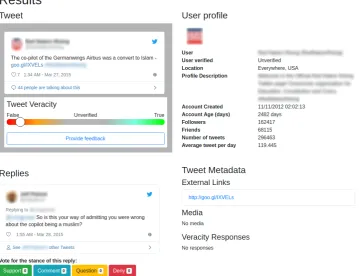
[image:4.595.97.263.237.508.2]Figure 3: A screenshot of the web-based interface. The source tweet is shown on the top left. The veracity classification is displayed below the tweet on a single axis scale that ranges between False (red), Unverified (grey) and True (green). Metadata about the tweet is shown on the right. Replies to the tweet are shown on the bottom left where journalists can annotate the stance of each reply.
a journalist chooses to annotate a rumour, it will be instantly stored into the database, allowing the classification system to get updated regularly by leveraging the newly annotated rumours.
The journalist can currently make two types of annotations. Firstly, annotations on the veracity of the rumour itself. Whether it is true, false, or un-verified, and are encouraged to provide evidence for making this claim. Secondly, they can anno-tate on the stance of the responses to the rumour. The stance of the response can either be to sup-port the claim, deny the claim, or to offer further questions or comments, which we currently regard as neutral stance. When creating a dataset for re-training with user-provided annotations, each tweet, for both rumour veracity and stance classifi-cation, uses the class with the majority vote. Each tweet must also have 50% or more votes in the ma-jority category to be used.
6 Conclusion and Future Work
This paper presented an open source web service for analysis of rumours on social media. The sys-tem uses a state-of-the-art deep neural network
model (Aker et al., 2019) to classify Twitter ru-mours and allows journalists to provide annotated feedback to the system allowing the predictions to be improved as it is used.
In the future, we intend to also integrate a ru-mour stance classifier. User credibility will be taken into account to affect the influence of their annotations by analysing the accuracy and quality of provided evidence. In this demo, we focused only on the Twitter platform but we plan to offer support for other social media platforms, such as Reddit and 4chan. Finally, as new rumour classifi-cation models are developed, they could easily be integrated into the system to provide an ensemble of predictions.
Acknowledgements
References
Ahmet Aker, Alfred Sliwa, Fahim Dalvi, and Kalina Bontcheva. 2019. Rumour verification through re-curring information and an inner-attention mech-anism. Online Social Networks and Media, 13:100045.
Dzmitry Bahdanau, Kyunghyun Cho, and Yoshua Ben-gio. 2014. Neural machine translation by jointly learning to align and translate. arXiv preprint arXiv:1409.0473.
Anh Dang, Abidalrahman Moh’d, Evangelos Milios, and Rosane Minghim. 2016. What is in a ru-mour: Combined visual analysis of rumour flow and user activity. InProceedings of the 33rd Computer Graphics International, CGI ’16, pages 17–20, New York, NY, USA. ACM.
L Derczynski and Kalina Bontcheva. 2014. Pheme: Veracity in digital social networks. CEUR Workshop Proceedings, 1181:19–22.
Leon Derczynski, Kalina Bontcheva, Maria Liakata, Rob Procter, Geraldine Wong Sak Hoi, and Arkaitz Zubiaga. 2017. Semeval-2017 task 8: Rumoureval: Determining rumour veracity and support for ru-mours.Proceedings of the 11th International Work-shop on Semantic Evaluation (SemEval-2017).
Omar Enayet and Samhaa R El-Beltagy. 2017. Niletmrg at semeval-2017 task 8: Determining ru-mour and veracity support for ruru-mours on twitter. In
Proceedings of the 11th International Workshop on Semantic Evaluation (SemEval-2017), pages 470– 474.
William Ferreira and Andreas Vlachos. 2016. Emer-gent: a novel data-set for stance classification. In
Proceedings of the 2016 conference of the North American chapter of the association for computa-tional linguistics: Human language technologies, pages 1163–1168.
Naeemul Hassan, Anil Nayak, Vikas Sable, Chengkai Li, Mark Tremayne, Gensheng Zhang, Fatma Ar-slan, Josue Caraballo, Damian Jimenez, Siddhant Gawsane, Shohedul Hasan, Minumol Joseph, and Aaditya Kulkarni. 2017. Claimbuster: the first-ever end-to-end fact-checking system. Proceedings of the VLDB Endowment, 10:1945–1948.
Sepp Hochreiter and J¨urgen Schmidhuber. 1997. Long short-term memory. Neural computation, 9(8):1735–1780.
Elena Kochkina, Maria Liakata, and Arkaitz Zubiaga. 2018. All-in-one: Multi-task learning for rumour verification.arXiv preprint arXiv:1806.03713.
Lev Konstantinovskiy, Oliver Price, Mevan Babakar, and Arkaitz Zubiaga. 2018. Towards automated factchecking: Developing an annotation schema and benchmark for consistent automated claim detec-tion.
Michal Lukasik, Trevor Cohn, and Kalina Bontcheva. 2015. Estimating collective judgement of rumours in social media. ArXiv, abs/1506.00468.
Panagiotis Takas Metaxas, Samantha Finn, and Eni Mustafaraj. 2015. Using twittertrails.com to in-vestigate rumor propagation. In Proceedings of the 18th ACM Conference Companion on Computer Supported Cooperative Work & Social Computing, CSCW’15 Companion, pages 69–72, New York, NY, USA. ACM.
Tomas Mikolov, Ilya Sutskever, Kai Chen, Greg S Cor-rado, and Jeff Dean. 2013. Distributed representa-tions of words and phrases and their compositional-ity. InAdvances in neural information processing systems, pages 3111–3119.
Paul Resnick, Samuel Carton, Souneil Park, Yuncheng Shen, and Nicole Zeffer. 2014. Rumorlens: A sys-tem for analyzing the impact of rumors and correc-tions in social media. InProc. Computational Jour-nalism Conference, pages 10121–0701.
Chengcheng Shao, Giovanni Luca Ciampaglia, Alessandro Flammini, and Filippo Menczer. 2016.
Hoaxy: A platform for tracking online misinfor-mation. In Proceedings of the 25th International Conference Companion on World Wide Web, WWW ’16 Companion, pages 745–750, Republic and Canton of Geneva, Switzerland. International World Wide Web Conferences Steering Committee.
Denis Teyssou, Jean-Michel Leung, Evlampios Apostolidis, Konstantinos Apostolidis, Symeon Papadopoulos, Markos Zampoglou, Olga Pa-padopoulou, and Vasileios Mezaris. 2017. The invid plug-in: Web video verification on the browser. In
Proceedings of the First International Workshop on Multimedia Verification, MuVer ’17, pages 23–30, New York, NY, USA. ACM.
Adam Tsakalidis, Nikolaos Aletras, Alexandra I Cristea, and Maria Liakata. 2018. Nowcasting the stance of social media users in a sudden vote: The case of the Greek Referendum. InProceedings of the 27th ACM International Conference on Infor-mation and Knowledge Management, CIKM, pages 367–376.
Arkaitz Zubiaga, Ahmet Aker, Kalina Bontcheva, Maria Liakata, and Rob Procter. 2018a. Detection and resolution of rumours in social media: A survey.
ACM Computing Surveys (CSUR), 51(2):32.