72
DX-HITSZ at BioNLP-OST 2019: Trigger Word Detection and Thematic
Role Identification via BERT and Multitask Learning
Dongfang Li1, Ying Xiong1, Baotian Hu1, Hanyang Du1 Buzhou Tang1,2, Qingcai Chen1,2
1Harbin Institute of Technology (Shenzhen), Shenzhen, China
2Peng Cheng Laboratory, Shenzhen, China
{crazyofapple, xiongying0929, dhy1996525}@gmail.com {hubaotian, tangbuzhou, qingcai.chen}@hit.edu.cn
Abstract
The prediction of the relationship between the disease with genes and its mutations is a very important knowledge extraction task that can potentially help drug discovery. In this paper, we present our approaches for trig-ger word detection (task 1) and the identifi-cation of its thematic role (task 2) in AGAC track of BioNLP Open Shared Task 2019. Task 1 can be regarded as the traditional name entity recognition (NER), which culti-vates molecular phenomena related to gene mutation. Task 2 can be regarded as rela-tion extracrela-tion which captures the thematic roles between entities. For two tasks, we ex-ploit the pre-trained biomedical language rep-resentation model (i.e., BERT) in the pipe of information extraction for the collection of mutation-disease knowledge from PubMed. And also, we design a fine-tuning technique and extra features by using multi-task learn-ing. The experiment results show that our pro-posed approaches achieve 0.60 (ranks 1) and 0.25 (ranks 2) on task 1 and task 2 respectively in terms ofF1metric.
1 Introduction
Using the natural language processing methods to discover and mine drug-related knowledge from text has been a hot topic in recent years. For the goal of drug repurposing, an active gene annotation corpus (AGAC) was developed as a benchmark dataset (Wang et al., 2018b). The AGAC track is part of the BioNLP Open Shared Task 2019, aims to gather text mining approaches among the BioNLP community to propel drug-oriented knowledge discovery. It consists of three tasks for the extraction of mutation-disease knowl-edge from PubMed abstracts: trigger words NER, thematic roles identification, and mutation-disease knowledge discovery. We participated in the trig-ger words NER and thematic roles identification tasks.
Recently, pre-trained models have been the dominant paradigm in natural language process-ing. They achieved remarkable state-of-the-art performance across a wide range of related tasks, such as textual entailment, natural language infer-ence, question answering, etc. BERT, proposed by Devlin et al. (2019), has achieved a better-marked result in GLUE leaderboard with a deep transformer architecture (Wang et al., 2018a). BERT first trains a language model on an un-supervised large-scale corpus, and then the pre-trained model is fine-tuned to adapt to downstream tasks. This fine-tuning process can be seen as a form of transfer learning, where BERT learns knowledge from the large-scale corpus and trans-fer it to downstream tasks. While BERT was built for general-purpose language understanding, there are also some pre-trained models follow-ing BERT architecture that effectively leverage domain-specific knowledge from a large set of unannotated biomedical texts (e.g. PubMed ab-stracts, clinical notes), such as SciBERT ( Belt-agy et al., 2019), BioBERT (Lee et al., 2019), NCBI BERT (Peng et al.,2019), etc. These mod-els can effectively transfer knowledge from a large amount of unlabeled texts to biomedical text min-ing models with minimal task-specific architecture modifications.
sentence
segmentation Pre-trained Models + Masking CRF
Ma
in
tas
k
O
ther
D
at
as
et
s …
tokenization
data processing
Trigger words NER
Main task loss
Auxiliary task loss
Auxiliary task loss
Auxiliary task loss
…
Combinations
recognized entity
Thematic roles identification +
+
+
+
Relation Extraction
[image:2.595.119.479.62.223.2]word features
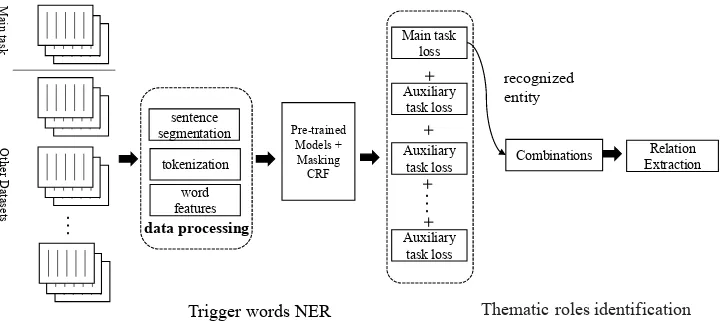
Figure 1: The pipeline of our approach. We first split PubMed abstracts into sentences, tokenize them into words and extract some features like POS tags, then a BERT-based method for NER offset and entity recognition, and finally predict relations for each potential entity pair.
2 Background
The model architecture of BERT (Devlin et al., 2019) is a multi-layer bidirectional Transformer encoder based on the original Transformer model (Vaswani et al., 2017). The input rep-resentation is a concatenation of WordPiece em-beddings (Wu et al., 2016), positional embed-dings, and the segment embedding. A special classification embedding ([CLS]) is inserted as the first token and a special token ([SEP]) is added as the final token. It is firstly pre-trained with two strategies on large-scale unlabeled text, i.e., masked language model and next sentence pre-diction. The pre-trained BERT model provides a powerful context-dependent sentence represen-tation and can be used for various target tasks, i.e., text classification and machine comprehen-sion, through the fine-tuning procedure.
Hence, the BERT model can be easily ex-tended to the medical domain information extrac-tion pipeline, first extracting the trigger words and then determining the relationship between them, as illustrated in Figure1.
3 Our Approach
3.1 Task 1: Trigger Words NER
Task 1 aims to identify trigger words in the PubMed digest and annotating them as correct trigger markers or entities (Var, MPA, Interaction, Pathway, CPA, Reg, PosReg, NegReg, Disease, Gene, Protein, Enzyme). It can be seen as an NER task involving the identification of many domain-specific proper nouns in the biomedical corpus.
We first split each PubMed abstracts into sen-tences using ’\n’ or ’.’, and convert each sen-tence into words by NLTK1 tokenizer. After that, words are further tokenized into its word pieces x = (x1, . . . , xT). Then we use a represen-tation based on the BERT from the last layer
H = (h1, . . . ,hT). In order to make better use of the word-level information, POS tagging labels and word shape embedding representation (Liu et al., 2015) of each word 2 are also concate-nated into the output of BERT, passing through a single projection layer, followed by a conditional random fields (CRF) layer with a masking con-straint3to calculate the token-level label probabil-ityp= (p1, . . . , pT). When fine-tuning the BERT, we found that the performance of the model per-formed better in the case of BIO for the selec-tion of the tagging schemes compared to BIOES. We further extend our model to multi-task learn-ing joint trained by sharlearn-ing the architecture and parameters. Although the differences in differ-ent datasets, multi-task means joint learning with other biomedical corpora. The assumption is to make more efficient use of the data and to encour-age the models to learn more generalized represen-tations. More specially, the same token-level in-formation and BERT encoder are shared and each data set has a specific output layer, e.g., CRF layer. Our final loss function is obtained as follows:
−XλcilogP(yci|xci) +λrkWk2 (1)
1https://www.nltk.org/ 2
If a word is tokenized into several tokens, each token will be given the same tagging labels.
where yci denote true tag sequence and xci
de-note the input tokens for corpora ci, λci and λr
are weighted parameters.
3.2 Task 2: Thematic Roles Identification
Task 2 is to identify the thematic roles (ThemeOf, CauseOf) between trigger words.
We treat it as a multi-label classification prob-lem by introducing ”no relation (NA)” label. When constructing the training data of task 2, we use the relationship of two entities with a distance of no more than one sentence. For NA label, ran-dom sampling is performed. In the testing process, relation label will be assigned to the corresponding thematic role when its probability is maximum and larger than the threshold. Otherwise, it will be pre-dicted as no relation. We also anonymously use a predefined tag (such as%Disease) to represent a target named entity. And we additionally append two concrete predicted entity words separated by the [SEP] tag after each sentence. Following Shi and Lin(2019), we also add the token-level rela-tive distance to the subject entity information for each token, i.e. 0 for the position tbetween two entities, t− s for tokens before first entity and t− e for tokens after second entity, where s, e are the starting and ending positions of first and second entity after tokenization, respectively. The relation logits of two entities are performed using a single output layer from the BERT, as
y= softmax(Whcls+b) (2)
wherehclsdenotes the hidden state of the first spe-cial token ([CLS]).
4 Experiments
In this section, we provide the leaderboard per-formance and conduct an analysis of the effect of models from different settings.
4.1 Experimental Setup
The AGAC track organizers develop an active gene annotation corpus (AGAC) (Wang et al., 2018b; Gachloo et al., 2019), for the sake of knowledge discovery in drug repurposing. The track corpus consists of 1250 PubMed abstracts: 250 for public, 1000 for final evaluation. We ran-domly split the public texts into train and develop-ment data sets with the radio of 8:2. The training set is used to learn model parameters, the develop-ment set to select optimal hyper-parameters. For
Dataset #Train #Dev #Test
BC5CDR 4,559 4,580 4,796 NCBI disease 5,423 922 939
[image:3.595.319.514.62.132.2]BC2GM 12,573 2,518 5,037 2010 i2b2/VA 16,315 - 27,626
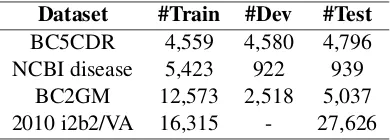
Table 1: Datasets for joint learning in recognizing the trigger words.
evaluation results, we measure the trigger words recognition and thematic roles extraction perfor-mance with F1 score. Table 1 shows the
exter-nal data sets used under the joint learning method. The BIO form of these data sets is different from that of task 1, hence we use different projection and CRF layers. But not the more data sets, the better. We found that the NCBI disease (Do˘gan et al.,2014) and BC5CDR (Li et al.,2016) datasets are helpful for the final results, and the perfor-mance is reduced when using BC2GM (Smith et al., 2008) and 2010 i2b2VA dataset (Uzuner et al.,2011).
4.2 Implementation and Hyperparameters
We tried the original BERT4, BioBERT5 and NCBI BERT6 pre-trained models. Each training example is pruned to at most 384 and 512 tokens for named entity recognition (NER) and relation extraction (RE). We use a batch size of 5 for NER, and 32 for RE. We also use the hierarchical learn-ing rate in the trainlearn-ing process so that the pre-trained parameters and the newly added parame-ters converge at different optimization processes. For fine-tuning, we train the models for 20 epochs using a learning rate of 2×10⁻⁵ for pre-trained weights and 3×10⁻⁵ for others. The learning parameters were selected based on the best per-formance on the dev set. For NER, we ensemble 5 models from 5-fold cross-validation and 2 mod-els using the normal training-validation approach. For RE, we ensemble 3 models that used all the construction data in training.
4.3 Main Results
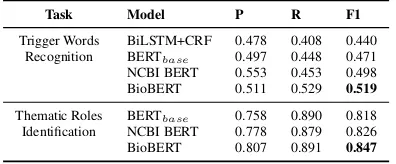
Table 2 compares the results of the two tasks of the pre-trained model in trigger words NER and thematic roles identification. We report the im-pact of using different pre-training models on the
4https://github.com/google-research/ bert
5
Task Model P R F1
Trigger Words BiLSTM+CRF 0.478 0.408 0.440 Recognition BERTbase 0.497 0.448 0.471
NCBI BERT 0.553 0.453 0.498 BioBERT 0.511 0.529 0.519
Thematic Roles BERTbase 0.758 0.890 0.818
[image:4.595.83.281.63.145.2]Identification NCBI BERT 0.778 0.879 0.826 BioBERT 0.807 0.891 0.847
Table 2: Model comparision in development set with different pre-trained models
development set results. We found that even pre-trained models in the general field are superior to the classic BiLSTM+CRF tagging method ( Lam-ple et al.,2016). From the last three lines of each task, we can see that different pre-trained models have different results under the same experimental settings. It proves the effectiveness of pre-training tasks in specific domain. During the fine-tuning process of task 1, we found that the joint extrac-tion of entities with other datasets improved our final results.
Label P R F1
[image:4.595.344.488.99.158.2]CPA 0.39 0.27 0.32 Disease 0.57 0.57 0.57 Enzyme 0.75 0.16 0.26 Gene 0.71 0.64 0.68 Interaction 0.50 0.29 0.36 MPA 0.46 0.47 0.47 NegReg 0.71 0.62 0.66 Pathway 0.83 0.36 0.50 PosReg 0.64 0.61 0.63 Protein 0.32 0.17 0.22 Reg 0.75 0.50 0.60 Var 0.64 0.63 0.64 ALL 0.63 0.56 0.60
Table 3: Precision (P), Recall (R) and F1 scores in test set of Task 1.
The results for task 1 is summarized in Table3. The difference in the performance in the different labels is partly sourced by the imbalance distribu-tion of trigger labels in the corpus. Our method ends up first place on the leaderboard and sub-stantially improving upon previous state-of-the-art methods. The results for task 2 is summarized in Table4. Our method ends up second place on the leaderboard. Our method has a large discrepancy between the development set performance and test set performance. It may be the test set is quite different from our constructed data set. This is
also related to how we use recognized entities, sentence- or document-level combinations.
Label P R F1
CauseOf 0.60 0.26 0.36 ThemeOf 0.63 0.11 0.19 ALL 0.61 0.16 0.25
Table 4: Precision (P), Recall (R) and F1 scores in test set of Task 2.
4.4 Ablation Study
As shown in Table5, we found that adding a layer of BiLSTM behind the BERT encoder did not im-prove the performance of the model, resulting in a 0.04 loss ofF1. For NER tasks, external features
are effective for the model’s performance. So we verified the efficacy of word shape and POS tags on task 1, and we found that adding this informa-tion can increase the F1 value of our model by
more than 0.01.
Model P R F1
[image:4.595.106.261.358.554.2]BioBERT 0.511 0.529 0.519 + BiLSTM 0.502 0.448 0.473 - Word shape 0.539 0.453 0.492 - POS tags 0.518 0.482 0.499
Table 5: Ablation study of Task 1 in development set.
5 Conclusion
[image:4.595.324.509.367.437.2]Acknowledgment: This work was supported by Natural Science Foundation of China (Grant No.61872113), and the joint project with Baidu Inc.
References
Iz Beltagy, Arman Cohan, and Kyle Lo. 2019.Scibert: Pretrained contextualized embeddings for scientific text.CoRR, abs/1903.10676.
Jacob Devlin, Ming-Wei Chang, Kenton Lee, and Kristina Toutanova. 2019. BERT: pre-training of deep bidirectional transformers for language under-standing. In Proceedings of the 2019 Conference of the North American Chapter of the Association for Computational Linguistics: Human Language Technologies, NAACL-HLT 2019, Minneapolis, MN, USA, June 2-7, 2019, Volume 1 (Long and Short Pa-pers), pages 4171–4186.
Rezarta Islamaj Do˘gan, Robert Leaman, and Zhiyong Lu. 2014. Ncbi disease corpus: a resource for dis-ease name recognition and concept normalization.
Journal of biomedical informatics, 47:1–10.
Mina Gachloo, Yuxing Wang, and Jingbo Xia. 2019. A review of drug knowledge discovery using bionlp and tensor or matrix decomposition. Genomics & Informatics, 17(2).
Guillaume Lample, Miguel Ballesteros, Sandeep Sub-ramanian, Kazuya Kawakami, and Chris Dyer. 2016. Neural architectures for named entity recognition.
arXiv preprint arXiv:1603.01360.
Jinhyuk Lee, Wonjin Yoon, Sungdong Kim, Donghyeon Kim, Sunkyu Kim, Chan Ho So, and Jaewoo Kang. 2019. Biobert: a pre-trained biomedical language representation model for biomedical text mining.CoRR, abs/1901.08746.
Jiao Li, Yueping Sun, Robin J Johnson, Daniela Sci-aky, Chih-Hsuan Wei, Robert Leaman, Allan Peter Davis, Carolyn J Mattingly, Thomas C Wiegers, and Zhiyong Lu. 2016. Biocreative v cdr task corpus: a resource for chemical disease relation extraction.
Database, 2016.
Xiaodong Liu, Pengcheng He, Weizhu Chen, and Jian-feng Gao. 2019. Multi-task deep neural networks for natural language understanding. arXiv preprint arXiv:1901.11504.
Zengjian Liu, Yangxin Chen, Buzhou Tang, Xiaolong Wang, Qingcai Chen, Haodi Li, Jingfeng Wang, Qiwen Deng, and Suisong Zhu. 2015. Automatic de-identification of electronic medical records using token-level and character-level conditional random fields. Journal of biomedical informatics, 58:S47– S52.
Yifan Peng, Shankai Yan, and Zhiyong Lu. 2019.
Transfer learning in biomedical natural language processing: An evaluation of BERT and elmo on ten benchmarking datasets. InProceedings of the 18th BioNLP Workshop and Shared Task, BioNLP@ACL 2019, Florence, Italy, August 1, 2019., pages 58–65.
Peng Shi and Jimmy Lin. 2019. Simple bert models for relation extraction and semantic role labeling. arXiv preprint arXiv:1904.05255.
Larry Smith, Lorraine K Tanabe, Rie Johnson nee Ando, Cheng-Ju Kuo, I-Fang Chung, Chun-Nan Hsu, Yu-Shi Lin, Roman Klinger, Christoph M Friedrich, Kuzman Ganchev, et al. 2008. Overview of biocreative ii gene mention recognition. Genome biology, 9(2):S2.
¨
Ozlem Uzuner, Brett R South, Shuying Shen, and Scott L DuVall. 2011. 2010 i2b2/va challenge on concepts, assertions, and relations in clinical text.
Journal of the American Medical Informatics Asso-ciation, 18(5):552–556.
Ashish Vaswani, Noam Shazeer, Niki Parmar, Jakob Uszkoreit, Llion Jones, Aidan N. Gomez, Lukasz Kaiser, and Illia Polosukhin. 2017. Attention is all you need. InAdvances in Neural Information Pro-cessing Systems 30: Annual Conference on Neural Information Processing Systems 2017, 4-9 Decem-ber 2017, Long Beach, CA, USA, pages 5998–6008.
Alex Wang, Amanpreet Singh, Julian Michael, Felix Hill, Omer Levy, and Samuel R Bowman. 2018a. Glue: A multi-task benchmark and analysis platform for natural language understanding. arXiv preprint arXiv:1804.07461.
Yuxing Wang, Xinzhi Yao, Kaiyin Zhou, Xuan Qin, Jin-Dong Kim, Kevin Bretonnel Cohen, and Jingbo Xia. 2018b. Guideline design of an active gene an-notation corpus for the purpose of drug repurposing. In2018 11th International Congress on Image and Signal Processing, BioMedical Engineering and In-formatics (CISP-BMEI), pages 1–5. IEEE.