Document-Level Multi-Aspect Sentiment Classification as
Machine Comprehension
Yichun Yin1, Yangqiu Song2, Ming Zhang1
1School of Electronics Engineering and Computer Science, Peking University, Beijing, China 2Department of Computer Science and Engineering, HKUST, Hong Kong
{yichunyin, mzhang cs}@pku.edu.cn,[email protected]
Abstract
Document-level multi-aspect sentiment classification is an important task for cus-tomer relation management. In this paper, we model the task as a machine compre-hension problem where pseudo question-answer pairs are constructed by a small number of aspect-related keywords and as-pect ratings. A hierarchical iterative atten-tion model is introduced to build aspect-specific representations by frequent and repeated interactions between documents and aspect questions. We adopt a hi-erarchical architecture to represent both word level and sentence level informa-tion, and use the attention operations for aspect questions and documents alterna-tively with the multiple hop mechanism. Experimental results on the TripAdvisor and BeerAdvocate datasets show that our model outperforms classical baselines.
1 Introduction
Document-level sentiment classification is one of the pragmatical sentiment analysis tasks (Pang and Lee,2007;Liu,2010). There are many Web sites having platforms for users to input reviews over products or services, such as TripAdvisor, Yelp, Amazon, etc. Most of reviews are very compre-hensive and thus long documents. Analyzing these documents to predict ratings of products or ser-vices is an important complementary way for bet-ter customer relationship management. Recently, neural network based approaches have been de-veloped and become state-of-the-arts for long-document sentiment classification (Tang et al.,
2015a,b; Yang et al., 2016). However, predict-ing an overall score for each long document is not enough, because the document can mention
dif-“The situation is good, it's very clean, but there is nothing special. Breakfast at downstairs is directly from grocery store. Water pressure is good! A decent choice for sleeping. New York is expensive place!”
Cleanliness:5 Room:: 4 Value:: 2
Review
Rating
Figure 1: Example: hotel review with aspects.
ferent aspects of the corresponding product or ser-vice. For example, in Figure1, there could be dif-ferent aspects for a review of hotel. These aspects help customer service better understand what are the major pros and cons of the product or ser-vice. Compared to the overall rating, users are less motivated to give aspect ratings. Therefore, it is more practically useful to perform document-level multi-aspect sentiment classification task, predict-ing different ratpredict-ings for each aspect rather than an overall rating.
One straightforward approach for document-level multi-aspect sentiment classification is multi-task learning (Caruana, 1997). For neural networks, we can simply treat each aspect (e.g., rating from one to five) as a classification task, and let different tasks use softmax classifier to extract task-specific representations at the top layer while share the input and hidden layers to mutually en-hance the prediction results (Collobert et al.,2011;
Luong et al.,2016). However, such approach ig-nores the fact that the aspects themselves have semantic meanings. For example, as human be-ings, if we were asked to evaluate the aspect rat-ing of a document, we simply read the review, and find aspect-related keywords, and see around com-ments. Then, we aggregate all the related snippets to make a decision.
In this paper, we propose a novel approach to treat document-level multi-aspect sentiment
Hierarchical Attention Module
Hierarchical Attention Module
Hierarchical Attention Module ……
d, q1 d, q2 d, qK
𝒅𝟏 𝒅𝟐 …… 𝒅𝑲
……
Classifier Classifier Classifier
Iterative Attention Module
Input Encoder
𝒅𝒌
qk
Input Encoder
Input Encoder
Input Encoder ……
…… Iterative Attention Module Iterative
Attention Module Iterative
Attention Module
s1, qk s2, qk sT, qk
[image:2.595.75.526.62.223.2]Hierarchical Attention Module
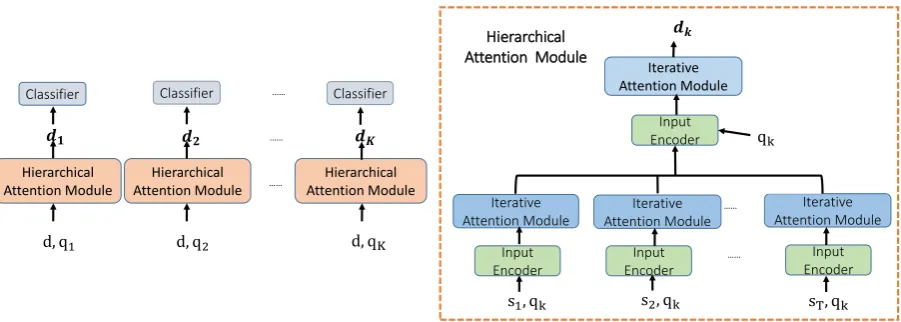
Figure 2: The architecture of our model. Left: multi-task learning. Right: hierarchical attention module which includes input encoders and iterative attention modules.
sification as a machine comprehension (Kumar
et al., 2016; Sordoni et al., 2016) problem. To mimic human’s evaluation of aspect classification, we create a list of keywords for each aspect. For
example, when we work on theRoomaspect, we
generate some keywords such as “room,” “bed,” “view,” etc. Then we can ask pseudo questions: “How is the room?” “How is the bed?” “How is the view?” and provide an answer “Rating 5.” In this case, we can train a machine comprehen-sion model to automatically attend corresponding text snippets in the review document to predict the aspect rating. Specifically, we introduce a hier-archical and iterative attention model to construct aspect-specific representations. We use a hierar-chical architecture to build up different representa-tions at both word and sentence levels interacting with aspect questions. At each level, the model consists of input encoders and iterative attention
modules. The input encoder learns memories1
of documents and questions with Bi-directional LSTM (Bi-LSTM) model and non-linear mapping respectively. The iterative attention module takes into memories as input and attends them sequen-tially with a multiple hop mechanism, performing effective interactions between documents and as-pect questions.
To evaluate the effectiveness of the proposed model, we conduct extensive experiments on the TripAdvisor and BeerAdvocate datasets and the results show that our model outperforms typical baselines. We also analyze the effects of
num-1Following the work (Weston et al., 2015; Sukhbaatar et al.,2015), we refer the memory to a set vectors which are stacked together and could be attended.
bers of the hop and aspect words on performances. Moreover, a case study for attention results is per-formed at both word and sentence levels.
The contributions of this paper are two-fold. First, we study the document-level multi-aspect sentiment classification as a machine comprehen-sion problem and introduce a hierarchical itera-tive attention model for it. Second, we demon-strate the effectiveness of proposed model on two datasets, showing that our model outperforms classical baselines. The code and data for this
paper are available athttps://github.com/
HKUST-KnowComp/DMSCMC.
2 Method
In this section, we introduce our proposed method.
2.1 Problem Definition and Hierarchical Framework
We first briefly introduce the problem we work on. Given a piece of review, our task is to predict the ratings of different aspects. For example, in Fig-ure1, we predict the ratings ofCleanliness,Room, andValue. To achieve this, we assume that there are existing reviews with aspect ratings for ma-chines to learn. Formally, we denote the review document as d containing a set of Td sentences
{s1, s2, . . . sTd}. For thet-th sentencest, we use a set of wordsw1, w2, . . . w|st| to represent it, and usewi,wwi andwpi as the one-hot encoding, word
embedding, and phrase embedding forwi
respec-tively. The phrase embedding encodes the seman-tics of phrases where the current word wi is the
{q1, q2, . . . , qK}, we use Nk aspect-related
key-words, nqk1, qk2. . . qkNk o
, to represent it. Simi-larly, we useqki,qw
ki as the one-hot encoding and word embedding forqki respectively.
There are several sophisticated methods for choosing aspect keywords (e.g., topic model). Here, we consider a simple way where five seeds were first manually selected for each aspect and then more words were obtained based on their co-sine similarities with seeds2
As shown in Figure2(left), our framework fol-lows the idea of multi-task learning, which learns different aspects simultaneously. In this case, all these tasks share the representations of words and architecture of semantic model for the final clas-sifiers. Different from straightforward neural net-work based multi-task learning (Collobert et al.,
2011), for each documentdand an aspectqk, our
model uses both the content ofdand all the related keywordsnqk1, qk2. . . qkNk
o
as input. Since the keywords can cover most of the semantic mean-ings of the aspect, and we do not know which document mentions which semantic meaning, we build an attention model to automatically decide it (introduced in Section2.3). Assuming that the keywords have been decided, we use a hierarchi-cal attention model to select useful information from the review documents. As shown in Figure2
(right), the hierarchical attention of keywords is applied to both sentence level (to select meaning-ful words) and document level (to select mean-ingful sentence). Thus, our model builds aspect-specific representations in a bottom-up manner.
Specifically, we obtain sentence representa-tionssk
1,sk2, . . .skT using the input encoder
(Sec-tion 2.2) and iterative attention module (Sec-tion 2.3) at the word level. Then we take sen-tence representations andk-th aspect as input and apply the sentence-level input encoder and atten-tion model to generate the document representa-tion dk for final classification. As shown in
Fig-ure2(right), the attention model is applied twice at different levels of the representation.
2.2 Input Encoder
The input module builds memory vectors for the iterative attention module and is performed both at word and sentence levels. For a document, it con-2For example, the words “value,” “price,” “worth,” “cost,” and “$” are selected as seeds for aspectPrice. The informa-tion for seeds can be found in our released resource.
verts word sequence into word level memoryMd w
and sentence sequence into sentence level mem-oryMd
s respectively. For an aspect questionqk, it
takes a set of aspect-specific words{qki}1≤i≤Nk as input and derives word level memoryMq
w and
sentence level memoryMq s.
To construct Md
w, we obtain word embeddings
n ww
1,ww2, . . .ww|st| o
from an embedding matrix
EA applied to all words shown in the corpus.
Then, LSTM (Hochreiter and Schmidhuber,1997) model is used as the encoder to produce hidden vectors of words based on the word embeddings. At each step, LSTM takes input ww
t and derives
a new hidden vector byht = LSTM(wwt,ht−1).
To preserve the subsequent context information for words, another LSTM is ran over word se-quence in a reverse order simultaneously. Then the forward hidden vector −→ht and backward hidden
vector←−htare concatenated as phrase embedding
wpt. We stack these phrase embeddings together
as word level memory Md
w. Similarly, we feed
sentence representations into another Bi-LSTM to derive the sentence level memoryMd
s. Note that,
the sentence representations are obtained using the iterative attention module which is described as Eq. (5) in Section2.3.
Since we have question keywords as input, to allow the interactions between questions and doc-uments, we also build question memory in follow-ing way. We obtainQk = qwki 1≤i≤Nk by look-ing up an embeddlook-ing matrix 3 EB applied to all
question keywords. Then a non-linear mapping is applied to obtain the question memory at word level:
Mqk
w = tanh(QkWqw), (1)
whereWq
w is the parameter matrix to adaptqk at
word level. Similarly, we use another mapping to obtain the sentence level memory:
Mqk
s = tanh(QkWqs), (2)
whereWq
s is the parameter matrix to adapt qk at
sentence level.
2.3 Iterative Attention Module
The iterative attention module (IAM) attends and reads memories of questions and documents al-ternatively with a multi-hop mechanism, deriving 3EA andEB are initialized by the same pre-trained
𝐌𝐰/𝐬𝐪
𝒑𝟏
𝒑𝟐
...
...
...
𝒑𝟐𝒎−𝟏
𝒑𝟐𝒎−𝟐
𝐌𝐰/𝐬𝐪 𝐌𝐰/𝐬𝐪
𝐌𝐰/𝐬𝐝 𝐌𝐰/𝐬𝐝 𝐌𝐰/𝐬𝐝
𝒑𝟐𝒎
[image:4.595.94.274.76.258.2]𝒑𝟎
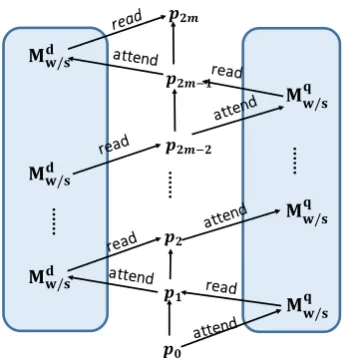
Figure 3: The iterative attention module.
aspect-specific sentence and document represen-tations. As we discussed in the introduction, the set of selected question keywords may not best characterize the aspect for different documents. Thus, the IAM module introduces a backward at-tention to use document information (word or sen-tence) to select useful keywords of each aspect as the document-specific question to build attention model.
The illustration of IAM is shown in Figure3. To obtain sentence representations, it takesMd
w and
Mq
was the input and performsmiterations (hops).
For each iteration, IAM conducts four operations: (1) attends the question memory by the selective
vector p and summarizes question memory
vec-tors into a single vectorq; (2) updates the selec-ˆ
tive vector by the previous one andq; (3) attendsˆ
document (content) memory based on the updated selective vector and summarizes memory vectors in to a single vectorˆc; (4) updates the selective vector by the previous one andˆc.
We unify operations (1) and (3) by an attention function ˆx = A(p,M), where M could be Md
w
orMq
w which corresponds ˆx = ˆc orˆx = ˆq. The
attention functionAis decomposed as:
H= tanh(MWa(1p))
a=softmax(HvT a) ˆ
x=XaiMi,
(3)
where1is a vector with all elements are 1, which copies the selective vector to meet the dimension requirement. The Wa and va are parameters, a
is attention weights for memory vectors, and Mi
meansi-th row inM.
Operations (2) and (4) are formulated as an up-date functionp2i−{l} = U(ˆx,p2i−{l}−1), where i is the hop index,lcan be 0 or 1 which corresponds toˆx = ˆc orˆx = ˆqrespectively. We initializep0 by a zero vector. The update functionU can be a recurrent neural network (Xiong et al.,2017) or other heuristic weighting functions. In this paper, we introduce a simple strategy:
p2i−{l}= ˆx, (4) which ignores the previous selective vector but succeeds to obtain comparable results with other more complicated function in the initial experi-ments.
Multi-hop mechanism attends different mem-ory locations in different hops (Sukhbaatar et al.,
2015), capturing different interactions between documents and questions. In order to preserve the information of various kinds of interactions, we concatenate allˆc’s in each hop as the final repre-sentations of sentences:
s= [ˆc1; ˆc2;· · ·ˆcm]. (5)
After obtaining sentence representations, we feed them into the sentence-level input encoder,
deriving the memories Md
s and Mqs. Then, the
aspect-specific document representationdk is
ob-tained by the sentence-level IAM in a similar way. 2.4 Objective Function
For each aspect, we obtain aspect-specific docu-ment representations{dk}1≤k≤K. All these
repre-sentations are fed into classifiers, each of which in-cludes a softmax layer. The softmax layer outputs the probability distribution over|Y|categories for the distributed representation, which is defined as:
p0(d, k) =softmax(Wclassk dk), (6) whereWclass
k is the parameter matrix.
We define the cross-entropy objective function between gold sentiment distribution p(d, k) and predicted sentiment distribution p0(d, k) as the
classification loss function:
−X
d∈D
K
X
k=1
|Y|
X
i=1
p(d, k)log(p0(d, k)), (7)
Dataset #docs #words/doc #words/sent
TripAdvisor 29,391 251.7 18.0
[image:5.595.75.293.62.102.2]BeerAdvocate 51,020 144.5 12.1
Table 1: Statistics of the datasets. The rating scale of TripAdvisor dataset is 1-5. The rating scale of BeerAdvocate dataset is 1-10.
3 Experiment
In this section, we show experimental results to demonstrate our proposed algorithm.
3.1 Datasets
We conduct our experiments on
TripAdvi-sor (Wang et al., 2010) and BeerAdvocate
(McAuley et al.,2012;Lei et al., 2016) datasets, which contain seven aspects (value, room, lo-cation, cleanliness, check in/front desk, service, andbusiness service) and four aspects (feel,look,
smell, andtaste) respectively. We follow the pro-cessing step (Lei et al.,2016) by choosing the re-views with different aspect ratings and the new datasets are described in Table1. We tokenize the datasets by Stanford corenlp4 and randomly split them into training, development, and testing sets with 80/10/10%.
3.2 Baseline Methods
To demonstrate the effectiveness of the proposed method, we compare our model with following baselines:
Majority uses the majority sentiment label in development sets as the predicted label.
SVM uses unigram and bigram as text features and uses Liblinear (Fan et al.,2008) for learning.
SLDArefers to supervised latent Dirichlet allo-cation (Blei and Mcauliffe,2010) which is a sta-tistical model of labeled documents.
NBoW is a neural bag-of-words model
averag-ing embeddaverag-ings of all words in a document and feeds the resulted embeddings into SVM classifier.
DAN is a deep averaging network model which
consists of several fully connected layers with av-eraged word embeddings as input. One novel word dropout strategy is employed to boost model performances (Iyyer et al.,2015).
CNN continuously performs a convolution
op-eration over a sentence to extract words neighbor-ing features, then gets a fixed-sized representation by a pooling layer (Kim,2014).
4http://nlp.stanford.edu/software/corenlp.shtml
LSTM is one variant of recurrent neural net-work and has been proved to be one of state-of-the-art models for document-level sentiment clas-sification (Tang et al., 2015a). We use LSTM to refer Bi-LSTM which captures both forward and backward semantic information.
HAN means the hierarchical attention network which is proposed in (Yang et al., 2016) for doc-ument classification. Note that, the originalHAN
depends GRU as the encoder. In our experiments, LSTM-based HAN obtains slightly better results. Thus, we report the results of HAN with LSTM as the encoder.
We extend DAN, CNN, LSTM with the
hierar-chical architecture and multi-task framework, the
corresponding models areMHDAN,MHCNN and
MHLSTM respectively. Besides, MHAN is also evaluated as one baseline, which isHAN with the multi-task learning.
3.3 Implementation Details
We implement all neural models using
Theano (Theano Development Team, 2016).
The model parameters are tuned based on the de-velopment sets. We learn 200-dimensional word
embeddings with Skip-gram model (Mikolov
et al., 2013) on in-domain corpus, which fol-lows (Tang et al., 2015a). The pre-trained word embeddings are used to initialize the embedding
matrices EA and EB. The dimensions of all
hidden vectors are set to 200. For TripAdvisor dataset, the hop numbers of word-level and sentence-level iterative attention modules are set to 4 and 2 respectively. For BeerAdvocate dataset, the hop numbers are set to 6 and 2.
The number of selected keywords Nk = N is
set to 20. To avoid model over-fitting, we use dropout and regularization as follows: (1) the regularization parameter is set to 1e-5; (2) the dropout rate is set to 0.3, which is applied to both sentence and document vectors. All parameters are trained by ADADELTA (Zeiler,2012) without needing to set the initial learning rate. To ensure fair comparisons, we make baselines have same settings as the proposed model, such as word embeddings, dimensions of hidden vectors and optimization details and so on.
3.4 Results and Analyses
Model Dev TripAdvisor Test Dev BeerAdvocate Test
Accuracy MSE Accuracy MSE Accuracy MSE Accuracy MSE
Majority 24.47 2.533 23.89 2.549 24.48 4.706 24.41 4.545
SVM 34.30 1.982 35.26 1.963 25.70 3.286 25.79 3.270
SLDA 31.58 2.131 32.81 2.110 25.39 3.372 25.73 3.391
NBoW 38.43 1.866 39.09 1.808 28.99 2.883 28.85 2.919
DAN 40.30 1.569 40.93 1.531 31.25 2.569 32.44 2.279
CNN 43.25 1.474 43.35 1.456 34.17 2.173 33.37 2.217
LSTM 43.85 1.525 44.02 1.470 35.23 2.112 34.78 2.097
HAN 44.47 1.312 44.68 1.301 36.57 1.903 36.03 1.920
MHDAN 42.22 1.554 42.47 1.549 32.76 2.358 32.54 2.376
MHCNN 44.19 1.329 43.79 1.398 36.10 1.966 35.33 1.976
MHLSTM 44.53 1.308 44.72 1.272 38.14 1.785 37.04 1.809
MHAN 44.72 1.294 44.94 1.210 37.98 1.783 36.82 1.813
[image:6.595.73.523.59.262.2]Our 46.21 1.091 46.56 1.083 39.43 1.696 38.06 1.755
Table 2: Comparison of our model and other baseline methods.
Model AccuracyTripAdvisorMSE AccuracyBeerAdvocateMSE MHLSTM 44.75 (0.24) 1.256 (0.05) 37.28 (0.43) 1.802 (0.17)
MHAN 45.02 (0.33) 1.221 (0.12) 37.02 (0.22) 1.810 (0.15)
Our 46.65†(0.29) 1.084∗(0.06) 38.25†(0.35) 1.749∗(0.18)
Table 3: The results of average accuracy/MSE and standard deviation of models on test sets. We choose
MHAN andMHLSTM as comparison baselines for TripAdvisor and BeerAdvocate respectively. In t-tests, the marker∗refers to p-value<0.05 and the marker†refers to p-value<0.01.
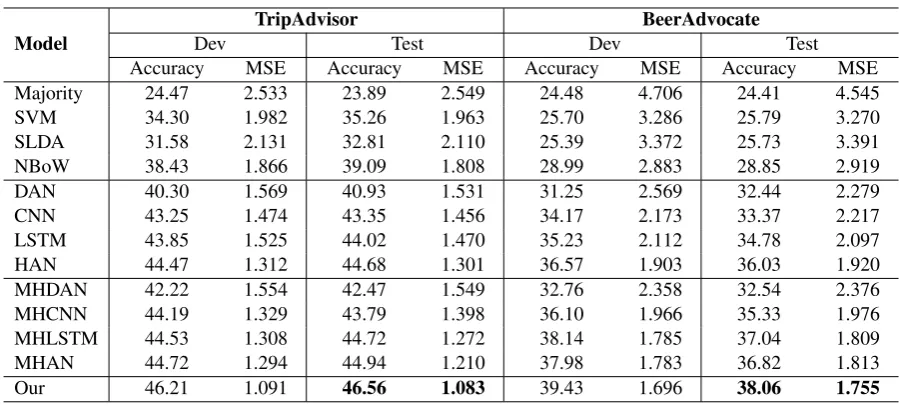
Compared to SVM and SLDA, NBoW achieves higher accuracy by 3% in both datasets, which shows that embedding features are more effec-tive than traditional ngram features on these two datasets. All neural network models outperform NBoW. It shows the advantages of neural net-works in the document sentiment classification.
From the results of neural networks, we can observe that DAN performs worse than LSTM and CNN, and LSTM achieves slightly higher re-sults than CNN. It can be explained that the sim-ple composition method averaging embeddings of words in a document but ignoring word order, may not be as effective as other flexible compo-sition models, such as LSTM and CNN, on as-pect classification. Additionally, we observe that the multi-task learning and hierarchical architec-ture are beneficial for neural networks. Among all baselines, MHAN and MHLSTM achieve compa-rable results and outperform others.
Compared with MHAN and MHLSTM, our method achieves improvements of 1.5% (3% rel-ative improvement) and 1.0% (2.5% relrel-ative im-provement) on TripAdvisor and BeerAdvocate
re-spectively, which shows that the incorporation of iterative attention mechanism helps the deep neu-ral network based model build up more discrim-inative aspect-aware representation. Note that BeerAdvocate is relatively more difficult since the predicted ratings are from 1 to 10 while TripAd-visor is 1 to 5. Moreover, t-test is conducted by randomly splitting datasets into train/dev/test sets and random initialization. The results on test sets are described in Table3which show performance of our model is stable.
3.5 Case Study for Attention Results
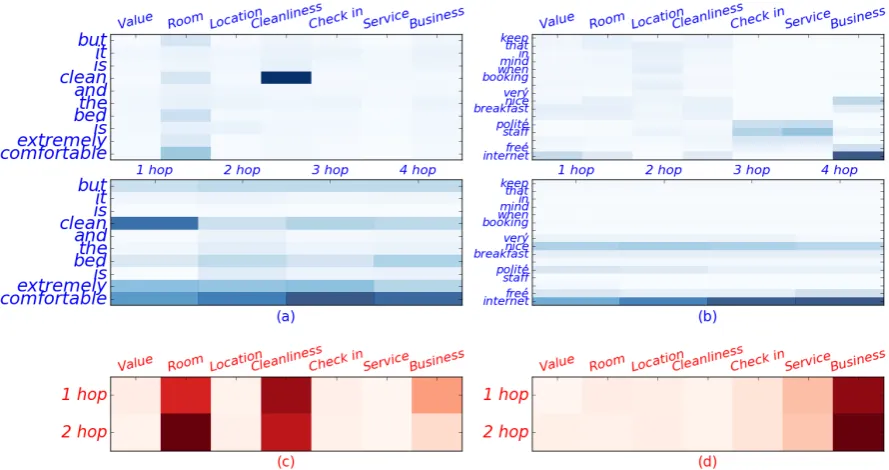
In this section, we sample two sentences from TripAdvisor to show the visualization of atten-tion results for case study. Both word-level and sentence-level attention visualizations are shown in Figure4. We normalize the word weight by the sentence weight to make sure that only important words in a document are highlighted.
Figure 4: The attention visualization of words and sentences. Darker color means higher weight. (a) and (b) are the visualization of word weights; (c) and (d) are the visualization of sentence weights. The top figures in (a) and (b) show the word weights of fourth hop for each aspect. The bottom figures in (a) and (b) visualize the word weights of different hops for the aspectsRoomandBusinessrespectively.
weights in the aspect Room, and the wordclean
are highlighted by the aspect Cleaniness. In the second sentence, the word internet is assigned a high attention value for Business. Moreover, the bottom figures in (a) and (b) show that (1) word weights of different hops are various; (2) attention values in higher hop are more reasonable. Specif-ically, in the first sentence, the weight of word
cleanis higher than the wordcomfortablein first hop, while comfortablesurpassesclean in higher hops. In the second sentence, we observe that the value of wordinternetincreases with the number of hop. Thus, we can see that the more sensible weights are obtained for words through the pro-posed iterative attention mechanism. Similarly, the figures (c) and (d) show that the conclusion from words is also suitable for sentences. For the first sentence, the sentence weight regarding the aspectRoomis lower thanCleanlinessin the first hop, but surpassesCleanlinessin the second hop. For the second sentence, the weight forBusiness
becomes higher in the second hop.
3.6 Effects of Hop and Aspect Keywords In this experiment, we investigate the effects of
hop numbermand size of aspect keywordsN on
performances. All the experiments are conducted
on the development set. Due to lack of space, we only present the results of TripAdvisor and the re-sults of BeerAdvocate have a similar behavior as TripAdvisor.
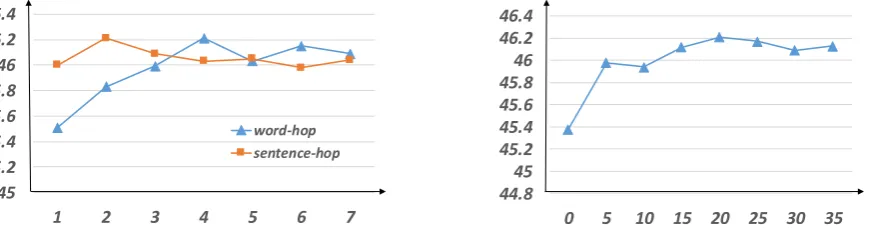
For the hop number, we varymfrom 1 to 7 and the results are shown in Figure 5 (left). We can see that: (1) at the word level, the performance
in-creases whenm ≤4, but shows no improvement
afterm > 4; (2) at the sentence level, model
per-forms best when m = 2. Moreover, we can see
that the hop number of word level leads to larger variation than the hop number of sentence level.
For the size of aspect keywords, we vary N
from 0 to 35, incremented by 5. Note that, we set a learnable vector to represent question mem-ory whenN = 0. The results are shown in Fig-ure5(right). We observe that the performance
in-creases when N ≤ 20, and has no improvement
afterN > 20. This indicates that a small number of keywords can help the proposed model achieve competitive results.
4 Related Work
hand-44.8 45 45.2 45.4 45.6 45.8 46 46.2 46.4
0 5 10 15 20 25 30 35 45
45.2 45.4 45.6 45.8 46 46.2 46.4
1 2 3 4 5 6 7
[image:8.595.89.524.64.186.2]word-hop sentence-hop
Figure 5: Results of different hops and different sizes of question keywords. Left: different the hop numbers; Right: different sizes of keywords.
crafted features to predict aspect ratings. To
han-dle the correlation between aspects, McAuley
et al. (2012) added a dependency term in final multi-class SVM objective. There were also some heuristic based methods and sophisticated topic models where multi-aspect sentiment classifica-tion is solved as a subproblem (Titov and Mc-Donald, 2008; Wang et al., 2010; Diao et al.,
2014; Pappas and Popescu-Belis, 2014). How-ever, these approaches often rely on strict assump-tions about words and sentences, for example, us-ing the word syntax to determine if a word is an aspect or a sentiment word, or relating a sen-tence with an specific aspect. Another related problem is called aspect-based sentiment classi-fication (Pontiki et al., 2014, 2016; Poria et al.,
2016), which first extracts aspect expressions from sentences (Poria et al., 2014; Balahur and Mon-toyo, 2008; Chen et al., 2014, 2013), and then determines their sentiments. With the develop-ments of neural networks and word embeddings in NLP, neural network based models have shown the state-of-the-art results with less feature engi-neering work.Tang et al.(2016) employed a deep memory network for aspect-based sentiment clas-sification given the aspect location andLakkaraju et al.(2014) employed recurrent neural networks and its variants for the task of extraction of aspect-sentiment pair. However, these tasks are sentence-level. Another related research field is document-level sentiment classification because we can treat single aspect sentiment classification as an indi-vidual document classification task. This line of research includes (Tang et al.,2015b;Chen et al.,
2016;Tang et al.,2016;Yang et al.,2016) which are based on neural networks in a hierarchical structure. However, they did not work on multi-ple aspects.
Machine Comprehension. Recently, neural network based machine comprehension (or read-ing) has been studied extensively in NLP, with the releases of large-scale evaluation datasets ( Her-mann et al., 2015; Hill et al., 2016; Rajpurkar et al., 2016). Most of the related studies focus on attention mechanism (Bahdanau et al., 2014) which is firstly proposed in machine translating and aims to solve the long-distance dependency between words. Hermann et al. (2015) used Bi-LSTM to encode document and query, and pro-posed Attentive Reader and Impatient Reader. The first one attends document based on the query rep-resentation, and the second one attends document by the representation of each token in query with
an incremental manner. Memory Networks (
We-ston et al., 2015;Sukhbaatar et al., 2015) attend and reason document representation in a multi-hop fashion, enriching interactions between doc-uments and questions. Dynamic Memory Net-work (Kumar et al., 2016) updates memories of documents by re-running GRU models based on derived attention weights. Meanwhile, the query representation is refined by another GRU model. Gated-Attention Reader (Dhingra et al., 2016) proposes a novel attention mechanism, which is based on multiplicative interactions between the query embeddings and the intermediate states of a recurrent neural network document reader. Bi-Directional Attention Model (Xiong et al., 2017;
in a hierarchical architecture and has different pro-cedures in the iterative attention module. Another related research problem is visual question an-swering which uses an image as question context rather than a set of keywords as question. Neu-ral network based visual question answering (Lu et al., 2016;Xiong et al., 2016) is similar as the proposed models in text comprehension.
5 Conclusion
In this paper, we model the document-level multi-aspect sentiment classification as a text compre-hension problem and propose a novel hierarchical iterative attention model in which documents and pseudo aspect-questions are interleaved at both word and sentence-level to learn aspect-aware document representation in a unified model. Ex-tensive experiments show that our model outper-forms the other neural models with multi-task framework and hierarchical architecture.
6 Acknowledgments
This paper is partially supported by the National Natural Science Foundation of China (NSFC Grant Nos. 61472006 and 91646202) as well as the National Basic Research Program (973 Pro-gram No. 2014CB340405). This work was also supported by NVIDIA Corporation with the do-nation of the Titan X GPU, Hong Kong CERG Project 26206717, China 973 Fundamental R&D Program (No.2014CB340304), and the LORELEI Contract HR0011-15-2-0025 with DARPA. The views expressed are those of the authors and do not reflect the official policy or position of the De-partment of Defense or the U.S. Government. We also thank the anonymous reviewers for their valu-able comments and suggestions that help improve the quality of this manuscript.
References
Dzmitry Bahdanau, Kyunghyun Cho, and Yoshua Ben-gio. 2014. Neural machine translation by jointly learning to align and translate. In Proceedings of ICLR.
Alexandra Balahur and Andres Montoyo. 2008. A feature dependent method for opinion mining and classification. InNatural Language Processing and Knowledge Engineering. pages 1–7.
David M. Blei and Jon D. Mcauliffe. 2010. Supervised topic models. Advances in Neural Information Pro-cessing Systems3:327–332.
Rich Caruana. 1997. Multitask learning. Machine Learning28(1):41–75.
Huimin Chen, Maosong Sun, Cunchao Tu, Yankai Lin, and Zhiyuan Liu. 2016. Neural sentiment classifica-tion with user and product attenclassifica-tion. InProceedings of EMNLP. pages 1650–1659.
Zhiyuan Chen, Arjun Mukherjee, and Bing Liu. 2014. Aspect extraction with automated prior knowledge learning. InACL. pages 347–358.
Zhiyuan Chen, Arjun Mukherjee, Bing Liu, Meichun Hsu, Malu Castellanos, and Riddhiman Ghosh. 2013. Exploiting domain knowledge in aspect ex-traction. InEMNLP. pages 1655–1667.
Ronan Collobert, Jason Weston, L´eon Bottou, Michael Karlen, Koray Kavukcuoglu, and Pavel Kuksa. 2011. Natural language processing (almost) from scratch. Journal of Machine Learning Research
12(Aug):2493–2537.
Bhuwan Dhingra, Hanxiao Liu, William W Cohen, and Ruslan Salakhutdinov. 2016. Gated-attention readers for text comprehension. arXiv preprint arXiv:1606.01549.
Qiming Diao, Minghui Qiu, Chao-Yuan Wu, Alexan-der J Smola, Jing Jiang, and Chong Wang. 2014. Jointly modeling aspects, ratings and sentiments for movie recommendation (jmars). InProceedings of KDD. ACM, pages 193–202.
Rong-En Fan, Kai-Wei Chang, Cho-Jui Hsieh, Xiang-Rui Wang, and Chih-Jen Lin. 2008. Liblinear: A library for large linear classification. Journal of ma-chine learning research9(Aug):1871–1874. Karl Moritz Hermann, Tomas Kocisky, Edward
Grefenstette, Lasse Espeholt, Will Kay, Mustafa Su-leyman, and Phil Blunsom. 2015. Teaching ma-chines to read and comprehend. InProceedings of NIPS. pages 1693–1701.
Felix Hill, Antoine Bordes, Sumit Chopra, and Jason Weston. 2016. The goldilocks principle: Reading children’s books with explicit memory representa-tions. InProceedings of ICLR.
Sepp Hochreiter and J¨urgen Schmidhuber. 1997. Long short-term memory. Neural computation
9(8):1735–1780.
Mohit Iyyer, Varun Manjunatha, Jordan L Boyd-Graber, and Hal Daum´e III. 2015. Deep unordered composition rivals syntactic methods for text classi-fication. InProceedings of ACL. pages 1681–1691. Yoon Kim. 2014. Convolutional neural networks for
sentence classification. InProceedings of EMNLP. pages 1746–1751.
Himabindu Lakkaraju, Richard Socher, and Chris Man-ning. 2014. Aspect specific sentiment analysis using hierarchical deep learning. In NIPS Workshop on Deep Learning and Representation Learning. Tao Lei, Regina Barzilay, and Tommi Jaakkola. 2016.
Rationalizing neural predictions. InProceedings of EMNLP. Austin, Texas, pages 107–117.
Bing Liu. 2010. Sentiment analysis and subjectivity. In
Handbook of Natural Language Processing, Second Edition., pages 627–666.
Bin Lu, Myle Ott, Claire Cardie, and Benjamin K Tsou. 2011. Multi-aspect sentiment analysis with topic models. InICDM Workshops. IEEE, pages 81–88. Jiasen Lu, Jianwei Yang, Dhruv Batra, and Devi
Parikh. 2016. Hierarchical question-image co-attention for visual question answering. In Proceed-ings of NIPS. pages 289–297.
Minh-Thang Luong, Quoc V Le, Ilya Sutskever, Oriol Vinyals, and Lukasz Kaiser. 2016. Multi-task se-quence to sese-quence learning. In Proceedings of ICLR.
Julian McAuley, Jure Leskovec, and Dan Jurafsky. 2012. Learning attitudes and attributes from multi-aspect reviews. In Proceedings of ICDM. IEEE, pages 1020–1025.
Tomas Mikolov, Ilya Sutskever, Kai Chen, Greg S Cor-rado, and Jeff Dean. 2013. Distributed representa-tions of words and phrases and their compositional-ity. InProceedings of NIPS. pages 3111–3119. Bo Pang and Lillian Lee. 2007. Opinion mining and
sentiment analysis. Foundations and Trends in In-formation Retrieval2(1-2):1–135.
Nikolaos Pappas and Andrei Popescu-Belis. 2014. Ex-plaining the stars: Weighted multiple-instance learn-ing for aspect-based sentiment analysis. In Proceed-ings of EMNLP. pages 455–466.
Maria Pontiki, Dimitris Galanis, Haris Papageorgiou, Ion Androutsopoulos, Suresh Manandhar, Moham-mad AL-SMoham-madi, Mahmoud Al-Ayyoub, Yanyan Zhao, Bing Qin, Orphee De Clercq, Veronique Hoste, Marianna Apidianaki, Xavier Tannier, Na-talia Loukachevitch, Evgeniy Kotelnikov, N´uria Bel, Salud Mar´ıa Jim´enez-Zafra, and G¨uls¸en Eryi˘git. 2016. Semeval-2016 task 5: Aspect based sentiment analysis. InProceedings of SemEval. pages 19–30. Maria Pontiki, Dimitris Galanis, John Pavlopoulos,
Harris Papageorgiou, Ion Androutsopoulos, and Suresh Manandhar. 2014. Semeval-2014 task 4: As-pect based sentiment analysis. InProceedings of Se-mEval. pages 27–35.
Soujanya Poria, Erik Cambria, Lun-Wei Ku, Chen Gui, and Alexander Gelbukh. 2014. A rule-based ap-proach to aspect extraction from product reviews. In Proceedings of the second workshop on natural
language processing for social media (SocialNLP). pages 28–37.
Soujanya Poria, Iti Chaturvedi, Erik Cambria, and Fed-erica Bisio. 2016. Sentic lda: Improving on lda with semantic similarity for aspect-based sentiment anal-ysis. InInternational Joint Conference on Neural Networks. pages 4465–4473.
Pranav Rajpurkar, Jian Zhang, Konstantin Lopyrev, and Percy Liang. 2016. Squad: 100,000+ questions for machine comprehension of text. InProceedings of EMNLP. pages 2383–2392.
Minjoon Seo, Aniruddha Kembhavi, Ali Farhadi, and Hannaneh Hajishirzi. 2017. Bidirectional attention flow for machine comprehension. Proceedings of ICLR.
Alessandro Sordoni, Philip Bachman, Adam Trischler, and Yoshua Bengio. 2016. Iterative alternating neu-ral attention for machine reading. arXiv preprint arXiv:1606.02245.
Sainbayar Sukhbaatar, Jason Weston, Rob Fergus, et al. 2015. End-to-end memory networks. In Proceed-ings of NIPS. pages 2440–2448.
Duyu Tang, Bing Qin, and Ting Liu. 2015a. Document modeling with gated recurrent neural network for sentiment classification. In EMNLP. pages 1422– 1432.
Duyu Tang, Bing Qin, and Ting Liu. 2015b. Learn-ing semantic representations of users and products for document level sentiment classification. InACL. pages 1014–1023.
Duyu Tang, Bing Qin, and Ting Liu. 2016. Aspect level sentiment classification with deep memory net-work. InProceedings of EMNLP. pages 214–224.
Theano Development Team. 2016. Theano: A Python framework for fast computation of mathe-matical expressions.arXiv e-printsabs/1605.02688. http://arxiv.org/abs/1605.02688.
Ivan Titov and Ryan T McDonald. 2008. A joint model of text and aspect ratings for sentiment summariza-tion. In Proceedings of ACL. Citeseer, volume 8, pages 308–316.
Hongning Wang, Yue Lu, and Chengxiang Zhai. 2010. Latent aspect rating analysis on review text data: a rating regression approach. InProceedings of KDD. ACM, pages 783–792.
Jason Weston, Sumit Chopra, and Antoine Bordes. 2015. Memory networks. InProceedings of ICLR.
Caiming Xiong, Victor Zhong, and Richard Socher. 2017. Dynamic coattention networks for question answering. Proceedings of ICLR.
Zichao Yang, Diyi Yang, Chris Dyer, Xiaodong He, Alex Smola, and Eduard Hovy. 2016. Hierarchical attention networks for document classification. In
Proceedings of NAACL-HLT. pages 1480–1489. Matthew D Zeiler. 2012. Adadelta: an adaptive