Deep Neural Solver for Math Word Problems
Yan Wang Xiaojiang Liu Shuming Shi Tencent AI Lab
{brandenwang, kieranliu, shumingshi}@tencent.com
Abstract
This paper presents a deep neural solver to automatically solve math word prob-lems. In contrast to previous statistical learning approaches, we directly translate math word problems to equation templates using a recurrent neural network (RNN) model, without sophisticated feature engi-neering. We further design a hybrid mod-el that combines the RNN modmod-el and a similarity-based retrieval model to achieve additional performance improvement. Ex-periments conducted on a large dataset show that the RNN model and the hy-brid model significantly outperform state-of-the-art statistical learning methods for math word problem solving.
1 Introduction
Developing computer models to automatically solve math word problems has been an interest of NLP researchers since 1963Feigenbaum et al.
(1963);Bobrow(1964);Briars and Larkin(1984);
Fletcher(1985). Recently, machine learning tech-niquesKushman et al.(2014);Amnueypornsakul and Bhat (2014); Zhou et al. (2015); Mitra and Baral (2016) and semantic parsing methods Shi et al.(2015); Koncel-Kedziorski et al.(2015) are proposed to tackle this problem and promising re-sults are reported on some datasets. Although progress has been made in this task, performance of state-of-the-art techniques is still quite low on large datasets having diverse problem typesHuang et al.(2016).
A typical math word problems are shown in Ta-ble1. The reader is asked to infer how many pens Dan and Jessica have, based on constraints pro-vided. Given the success of deep neural network-s (DNN) on many NLP tanetwork-sknetwork-s (like POS tagging,
Problem: Dan have 2 pens, Jessica have 4 pens. How many pens do they have in total ?
Equation: x = 4+2
Solution: 6
Table 1: A math word problem
syntactic parsing, and machine translation), it may be interesting to study whether DNN could also help math word problem solving. In this paper, we propose a recurrent neural network (RNN) model for automatic math word problem solving. It is a sequence to sequence (seq2seq) model that trans-forms natural language sentences in math word problems to mathematical equations. Experiments conducted on a large dataset show that the RNN model significantly outperforms state-of-the-art s-tatistical learning approaches.
Since it has been demonstrated Huang et al.
(2016) that a simple similarity based method per-forms as well as more sophisticated statistical learning approaches on large datasets, we imple-ment a similarity-based retrieval model and com-pare with our seq2seq model. We observe that al-though seq2seq performs better on average, the re-trieval model is able to correctly solve many prob-lems for which RNN generates wrong results. We also find that the accuracy of the retrieval model positively correlate with the maximal similarity s-core between the target problem and the problems in training data: the larger the similarity score, the higher the average accuracy is.
Inspired by these observations, we design a hy-brid model which combines the seq2seq model and the retrieval model. In the hybrid model, the retrieval model is chosen if the maximal similar-ity score returned by the retrieval model is larger than a threshold, otherwise the seq2seq model is selected to solve the problem. Experiments on our
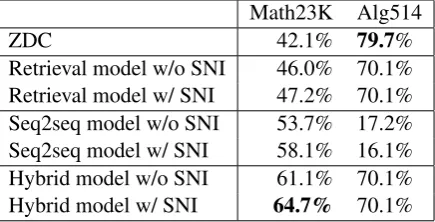
dataset show that, by introducing the hybrid mod-el, the accuracy increases from 58.1% to 64.7%.
Our contributions are as follows:
1) To the best of our knowledge, this is the first work of using DNN technology for automatic math word problem solving.
2) We propose a hybrid model where a se-q2seq model and a similarity-based retrieval mod-el are combined to achieve further performance improvement.
3) A large dataset is constructed for facilitating the study of automatic math problem solving.1
The remaining part of this paper is organized as follows: After analyzing related work in Sec-tion 2, we formalize the problem and introduce our dataset in Section 3. We present our RNN-based seq2seq model in Section 4, and the hybrid model in Section 5. Then experimental results are shown and analyzed in Section 6. Finally we conclude the paper in Section 7.
2 Related work
2.1 Math Word Problems Solving
Previous work on automatic math word problem solving falls into two categories: symbolic ap-proaches and statistical learning apap-proaches.
In 1964, STUDENTBobrow(1964) handles al-gebraic problems by two steps: first, they trans-form natural language sentences into kernel sen-tences using a small set of transformation pat-terns. Then the kernel sentences are transformed to mathematical expressions by pattern match-ing. A similar approach is also used to solve En-glish rate problemsCharniak(1968,1969). Ligu-da and Pfeiffer Liguda and Pfeiffer (2012) pro-pose modeling math word problems with aug-mented semantic networks. In addition, Addi-tion/subtraction problems are studied most Bri-ars and Larkin(1984);Dellarosa(1986);Bakman
(2007);Yuhui et al.(2010);Roy et al.(2015). In 2015, Shi et.al Shi et al. (2015) propose a system SigmaDolphin which automatically solves math word problems by semantic parsing and rea-soning. In the same year, Koncel et.al Koncel-Kedziorski et al.(2015) also formalizes the prob-lem of solving multi-sentence algebraic word problems as that of generating and scoring equa-tion trees.
1We plan to make the dataset publicly available when the
paper is published
Since 2014, statistical learning based approach-es are proposed to solve the math word problems. Hosseini et al.Hosseini et al.(2014) deal with the open-domain aspect of algebraic word problems by learning verb categorization from training data. Kushman et al. Kushman et al. (2014) proposed a equation template system to solve a wide range of algebra word problems. Zhou et al. Zhou et al.
(2015) further extends this method by adopting the max-margin objective, which results in higher ac-curacy and lower time cost. In addition, Roy and RothRoy et al.(2015);Roy and Roth(2016) tries to handle arithmetic problems with multiple step-s and operationstep-s without depending on additional annotations or predefined templates. Mitra et al.
Mitra and Baral (2016) presents a novel method to learn to use formulas to solve simple addition-subtraction arithmetic problems.
As reported in 2016 Huang et al.(2016), state-of-the-art approaches have extremely low per-formance on a big and highly diverse data set (18,000+ problems). In contrast to these ap-proaches, we study the feasibility of applying deep learning to the task of math word problem solving.
2.2 Sequence to Sequence (seq2seq) Learning
With the framework of seq2seq learning Sutskev-er et al. (2014); Wiseman and Rush (2016), re-cent advances in neural machine translation (N-MT)Bahdanau et al.(2014);Cho et al.(2014) and neural responding machine (NRM) Shang et al.
(2015) have demonstrated the power of recurren-t neural nerecurren-tworks (RNNs) arecurren-t caprecurren-turing and recurren- trans-lating natural language semantics. The NMT and NRM models are purely data-driven and directly learn to converse from end-to-end conversational corpora.
Recently, the task of translating natural lan-guage queries into regular expressions is explored by using a seq2seq modelLocascio et al. (2016), which achieves a performance gain of 19.6% over previous state-of-the-art models. To our knowl-edge, we are the first to apply seq2seq model to the task of math word problem solving.
3 Problem Formulation and Dataset 3.1 Problem Formulation
A math word problem P is a word sequence Wp and contains a set of variables Vp =
{v1, . . . , vm, x1, . . . , xk} where v1, . . . , vm are
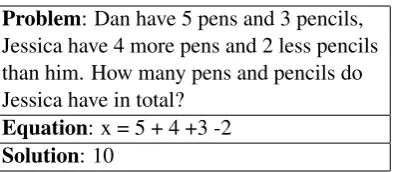
Problem: Dan have 5 pens and 3 pencils, Jessica have 4 more pens and 2 less pencils than him. How many pens and pencils do Jessica have in total?
Equation: x = 5 + 4 +3 -2
[image:3.595.77.274.60.146.2]Solution: 10
Table 2: A math word problem
whose values are unknown. A problemP can be solved by a mathematical equationEp formed by
Vpand mathematical operators.
In math word problems, different equations may belong to a same equation template. For exam-ple, equation x = (9 ∗ 3) + 7 and equation x= (4∗5) + 2share the same equation template x = (n1∗n2) +n3. To decrease the diversity of equations, we map each equation to an equation templateTp through a number mappingMp. The
number mapping process can be defined as:
Definition 1 Number mapping: For a problem
P withmknown numbers, a number mappingMp
maps the numbers in problemPto a list of number tokens{n1, . . . , nm}by their order in the problem
text.
Definition 2 Equation template: A general for-m of equations. For a problefor-mP with equationEp
and number mappingMp, its equation template is
obtained by mapping numbers in Ep to a list of
number tokens{n1, . . . , nm}according toMp.
Take the problem in Table 2 as an example, first we can obtain a number mapping from the prob-lem:
M :{n1 = 5; n2= 3; n3 = 4; n4 = 2;} and then the given equation can be expressed as an equation template:
x=n1+n3+n2−n4
After number mapping, the problem in Table 2 can be mapped to:
“Dan haven1pens andn2pencils, Jessica have n3 more pens andn4 less pencils than him. How
many pens and pencils do Jessica have in total?”
We solve math word problems by generating e-quation templates through a seq2seq model. The input of the seq2seq model is the sequenceWP
af-ter number mapping, and the output is an equation templateTP. The equationEP can be obtained by
applying the corresponding number mappingMP
toTP.
3.2 Constructing a Large Dataset
Most public datasets for automatic math word problem solving are quite small and contains lim-ited types of problems. The most frequently used Alg514 (Kushman et al., 2014) dataset contains only 514 linear algebra problems with 28 equa-tion templates. There are 1,000 problems in the newly constructed DRAW-1K (Shyam and Ming-Wei,2017) dataset. Dophin1878 (Shi et al.,2015) includes 1,878 number word problems. An ex-ception is the Dolphin18K dataset (Huang et al.,
2016) which contains 18,000+ problems. Howev-er, this dataset has not been made publicly avail-able so far.
Since DNN-based approaches typically need large training data, we have to build a large dataset of labeled math word problems. We crawl over 60,000 Chinese math word problems from a cou-ple of online education web sites. All of them are real math word problems for elementary school s-tudents. We focus on one-unknown-variable lin-ear math word problems in this paper. For oth-er problem types, we would like to leave as fu-ture work. Please pay attention that the solutions to the problems are in natural language, and we have to extract equation systems and structured answers from the solution text. We implemen-t a rule-based eximplemen-tracimplemen-tion meimplemen-thod for implemen-this purpose, which achieves very high precision and medium recall. That is, most equations and structured an-swers extracted by our method are correct, and many problems are dropped from the dataset. As a result, we get dataset Math23k which contains 23,161 problems labeled with structured equation-s and anequation-swerequation-s. Pleaequation-se refer to Table 3 for equation-some equation- s-tatistics of the dataset and a comparison with other public datasets.
4 Deep Neural Solver
In this section, we propose aRNN-based seq2seq modelto translate problem text to math equations. Since not all numbers in problem text may be use-ful for solving the problem, we propose, in Section 4.2, a significant number identification model to distinguish whether a number in a problem should appear in the corresponding equations.
4.1 RNN based Seq2seq Model
in-dataset #problems #templates #sentences #words problem types
Alg514 514 28 1.62k 19.3k algebra, linear
Dolphin1878 1,878 1,183 3.30k 41.4k number word problems
DRAW-1K 1,000 Unknown 6.23k 81.5k algebra, linear, one-VAR
[image:4.595.80.518.62.132.2]Math23K 23,161 2,187 70.1k 822k algebra, linear, one-VAR Table 3: Statistics of our dataset and several publicly available datasets
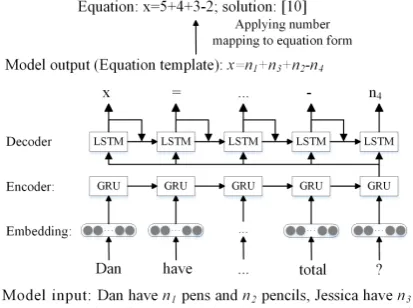
Figure 1: The seq2seq model
put sequenceW is the problem after number map-ping:
“Dan haven1pens andn2pencils, Jessica have n3 more pens andn4 less pencils than him. How
many pens and pencils do Jessica have in total?”
The output sequence R = {r1, . . . , rs} is the
equation template:
x=n1+n3+n2−n4
The gated recurrent units (GRU) (Chung et al.,
2014) and long short-memory (LSTM) ( Hochreit-er and SchmidhubHochreit-er,1997) cells are used for en-coding and deen-coding, respectively. The reason why we use GRU as the encoder instead of LSTM is that the GRU has less parameters and less likely to be overfitted on small dataset. Four
fundamen-tal operational stages of GRU are as follows:
zt=σ(W(z)xt+Uzht−1) (Update gate) rt=σ(W(r)xt+Urht−1) (Reset gate)
ˆ
ht=tanh(rtUht−1+W xt) (New memory)
ht=(1−zt)hˆt+ztht−1 (Hidden state) (1)
whereσ represents the sigmoid function andis an element-wise multiplication. The inputxtis a
wordwtalong with previously generated character
rt−1. The variablesU andW are weight matrices for each gate.
The fundamental operational stages of LSTM are as follows:
it=σ(W(i)xt+Uiht−1) (Input gate) ft=σ(W(f)xt+Ufht−1) (Forget gate) ot=σ(W(o)xt+Uoht−1) (Output gate)
˜
ct=tanh(W(c)xt+U(c)ht−1) (New memory) ct=ftc˜t−1+itc˜t (Final memory)
ht=ottanh(ct) (Hidden state)
(2) where the inputxtis a wordwtalong with
previ-ously generated characterrt−1.
Then, we redesigned the activation function of the seq2seq model, which is different from vanil-la seq2seq models. If we directly generate equa-tion templates by a softmax funcequa-tion, some incor-rect equations may be generated, such as: “x =
n1 + +∗ n2” and “x = (n1 ∗n2”. To ensure that the output equations are mathematically cor-rect, we need to find out which characters are ille-gal according to previously generated characters. This is done by five predefined rules like:
• Rule 1: If rt−1 in {+,−,∗, /}, then rt will
not in{+,−,∗, /,),=};
• Rule 2: Ifrt−1 is a number, thenrtwill not
[image:4.595.76.283.175.329.2]• Rule 3: If rt−1 is “=”, then rt will not in
{+,−,∗, /,=,)};
• Rule 4: If rt−1 is “(”, then rt will not in
{(,),+,−,∗, /,=};
• Rule 5: Ifrt−1 is “)”, then rt will not be a
number and not in{(,)};
A binary vectorρtcan be generated depends on
rt−1 and these rules. Each position inρtis
corre-sponding to a character in the output vocabulary, where “1” represents that the character is mathe-matically correct, and “0” indicates mathematical-ly incorrect. Thus, the output probability distribu-tion at each time-steptcan be calculated as:
P( ˆrt|ht) = ρte hT
tWs
P
ρtehTtWs (3)
wherehtis the output of LSTM decoder, andWs
is the weight matrix. The probability of mathemat-ically incorrect characters will be 0.
Our model is five layers deep, with a word em-bedding layer, a two-layer GRU as encoder and a two-layer LSTM as decoder. Both the encoder and decoder contain 512 nodes. We perform standard dropout during training (Srivastava et al.,2014) af-ter GRU and LSTM layer with dropout probability equal to 0.5. We train for 80 epochs, utilizing a mini-batch size of 256 and a learning-rate of 0.01.
4.2 Significant Number Identification (SNI)
In a math word problem, not all numbers appear in the equation for solving the problem. An ex-ample is shown in Table 4, where the number“1”
in“1 day, 1 girl”and number“2” in“She has 2 types of”should not be used in equation construc-tion. We say a number issignificantif the number should be included in the equation to the problem; otherwise it isinsignificant. For the problem in Ta-ble 4, significant numbers are9,3, and5, while1
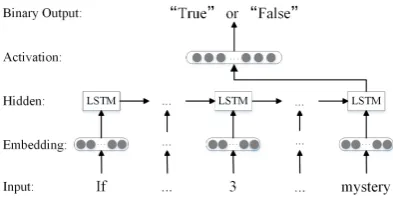
and2 are insignificant numbers. Identifying sig-nificant and insigsig-nificant numbers are important for constructing correct equations. For this pur-pose, we build a LSTM-based binary classification model to determine whether a number in a piece of problem text is significant.
The training data for SNI model are extract-ed from the math word problems. Each number and its context in problems is a training instance of SNI. An instance will be labelled“True” if the number issignificant, otherwise it will be labelled
“False”. The structure of SNI model is shown in Figure2. By using single layer LSTMs with 128 nodes and a symmetric window of length 3, our model achieves 99.1% accuracy. Table 4 is an ex-ample of number mapping with and without SNI.
Problem: 1 day, 1 girl was organizing her book case making sure each of the shelves had exactly 9 books on it. She has 2 types of books - mystery books and picture books. If she had 3 shelves of mystery books and 5 shelves of picture books, how many books did she have in total?
Number mapping:n1 = 1;n2= 1;n3 = 9; n4 = 2;n5 = 3;n6 = 5
Equation template:x=n5∗n3+n6∗n3
Number mapping with SNI:
n1 = 9;n2 = 3;n3 = 5
Equation template with SNI: x=n2∗n1+n3∗n1
[image:5.595.309.526.139.430.2]Problem after number mapping and SNI: 1 day, 1 girl was organizing her book case making sure each of the shelves had exactlyn1 books on it. She has 2 types of books -mystery books and picture books. If she hadn2shelves of mystery books andn3shelves of picture books, how many books did she have in total?
Table 4: Significant number identification (SNI) example
Figure 2: The significant number identification model
5 Hybrid Model
To compare the performance of our deep neural solver and traditional statistical learning methods, we implement a similarity-based retrieval model (refer to Section 5.1 for more details).
[image:5.595.316.513.490.591.2]re-Figure 3: Green area: problems correctly solved by the retrieval model;Blue area: problems cor-rectly solved by the seq2seq model; Overlapped area: problems correctly solved by both model-s;White area: problems that both models fail to solve
trieval model and those solved by the seq2seq model. We can see that although seq2seq perform-s better on average, the retrieval model iperform-s able to correctly solve many problems that seq2seq can-not solve. If we can combine the two models prop-erly to build a hybrid model, more problems may get solved.
In this section, we first give some details about the retrieval model in Section 5.1, then the hybrid model is introduced in Section 5.2.
5.1 Retrieval Model
The retrieval model solves problems by calculat-ing the lexical similarity between the testcalculat-ing prob-lem and each probprob-lem in the training data, and then the equation template of the most similar problem is applied to the testing problem. Each problem is modeled as a vector of word TF-IDF scoresW = [w1,d, w2,d, . . . , wN,d]T, where
wt,d=tft,d∗|d∈D|D|t|∈d| (4)
andtft,dis the word frequency of wordtin
prob-lem d; |D| is the total number of problems in dataset;|d∈D|t∈d|is the number of documents containing the word t.
The similarity between the testing problemPT
and another problem Qcan be calculated by the Jaccard similarity between their corresponding vectors:
J(PT, Q) = ||PPT ∩Q| T ∪Q| =
|PT ∩Q|
|PT|+|Q| − |PT ∩Q|
(5)
The retrieval model will choose training prob-lemQ1 that have the maximal similarity withPT
and use the equation templateT ofQ1as the tem-plate of problemPT.
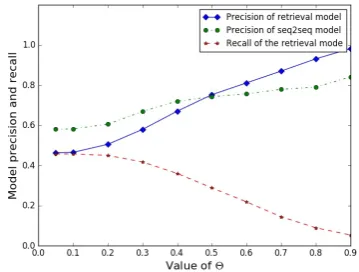
An important and interesting observation about the retrieval model is the relation between the maximal similarity and solution accuracy. Figure
[image:6.595.89.269.60.169.2]4shows the results of only considering the prob-lems for those the maximal similarity returned by retrieval model is above a threshold θ (in oth-er words, we skip a problem if its corresponding maximal similarity is below the threshold). It is clear that the larger the similarity score, the higher the average accuracy is. In our hybrid model, we make use of this property to combine the seq2seq model and the retrieval model.
Figure 4: Precision and recall of the retrieval mod-el, and the precision of the seq2seq model w.r.t. different similarity threshold (θ) values
5.2 Hybrid Model
Our hybrid model combines the retrieval mod-el and the seq2seq modmod-el by setting a hyper-parameterθas the threshold of similarity. In algo-rithm 1, if the Jaccard similarity between testing problemPT and the retrieved problemQ1is high-er thanθ, the model will choose the equation tem-plateTofQ1as the equation template of problem PT. Otherwise an equation template will be
gen-erated by a seq2seq model. As shown in Figure4, the retrieval model has a higher precision than the seq2seq model when we set a high threshold.
6 Experiments
[image:6.595.320.500.301.437.2]Algorithm 1Hybrid model
Input: Q: problems in training data; PT: testing problem;
θ: pre-defined threshold of similarity
Output: Problem solution
1: Get equation templates and number mappings for training problems Qand testing problem PT.
2: Number identification: identify significan-t numbers
3: Retrieval:
choose problemQ1 fromQthat has the max-imal Jaccard similarity withPT
4: ifJ(PT, Q1)> θthen
5: Apply the retrieval model: select equation templateT ofQ1
6: else
7: Apply the seq2seq model: T =
seq2seq(PT) 8: end if
9: Applying number mappings of PT to T and
calculating final solution
method on the proposed Math23K dataset. We fur-ther show that the baseline method cannot solve problems with new equation templates. In con-trast, the proposed seq2seq model is quite robust on problems with new equation templates (refer to Table 7).
6.1 Experimental Setup
Datasets: As introduced in Section 3.2, we col-lected a dataset called Math23K which contain-s 23161 math word problemcontain-s labeled with equa-tion templates and answers. All these problems are linear algebra questions with only one variable. There are 2187 equation templates in the dataset. In addition, we also evaluate our method on a pub-lic dataset Alg514 (Kushman et al.,2014).
Baseline: We compare our proposed methods with two baselines. The first baseline is the re-trieval model introduced in Section 5.1. The sec-ond one is ZDC (Zhou et al., 2015), which is an improved version of KAZB (Kushman et al.,
2014). It maps a problem to one equation template defined in the training set by reasoning across problem sentences. It reports an accuracy of 79.7% on the Alg514 dataset. The Stanford parser is adopted in ZDC to parse all math word problems
Math23K Alg514
ZDC 42.1% 79.7%
Retrieval model w/o SNI 46.0% 70.1% Retrieval model w/ SNI 47.2% 70.1%
Seq2seq model w/o SNI 53.7% 17.2%
Seq2seq model w/ SNI 58.1% 16.1%
Hybrid model w/o SNI 61.1% 70.1%
[image:7.595.309.527.63.174.2]Hybrid model w/ SNI 64.7% 70.1%
Table 5: Model comparison (average accuracy of 5-fold cross validation)
ZDC R R(S) Seq Seq(S) H
R(S) >
Seq
Seq(S)
H
[image:7.595.312.520.225.289.2]H(S)
Table 6: Result of significance test. The meaning of abbreviations in this table is as follows: R: re-trieval model w/o SNI; R(S): rere-trieval model w/ S-NI; Seq: seq2seq model w/o SS-NI; Seq(S): seq2seq model w/ SNI; H: hybrid model w/o SNI; H(S): hybrid model w/ SNI
to Stanford coreNLP output formats.2
6.2 Experimental Results
Each approach is evaluated on each dataset via 5-fold cross-validation: In each run, 4 5-folds are used for training and 1 fold is used for testing. Evalu-ation results are summarized in Table5. First, to test the effectiveness ofsignificant number identi-fication(SNI), model performance before and af-ter the application of SNI are compared. Then, the performance of the hybrid model, seq2seq model, and retrieval model are examined on two datasets respectively.
To check whether the performance improve-ments are significant enough, we conduct statisti-cal significance study upon pairs of methods. Ta-ble 6 shows the results of sign test, where the symbol > indicates that the method in the row significantly (with p value< 0.05) improves the performance of the method in the column, and the symbolindicates that the performance im-provement is extremely significant (with p value <0.01).
Several observations can be made from the re-2We also try to run KAZB on our dataset, but fail on our
sults. First, the seq2seq model significantly out-performs state-of-the-art statistical learning meth-ods (ZDC and the retrieval model). Second, by combining the retrieval model and the seq2seq model using a simple mechanism, our hybrid mod-el achieves significant performance gain with re-spect to the seq2seq model. Third, the SNI mod-ule can effectively improve model accuracy. The accuracy of the hybrid model and seq2seq mod-el gains approximatmod-ely 4% increase after number identification. Please pay attention that on the s-mall dataset of Alg514, the seq2seq model be-haves much worse than others. This is not surpris-ing, because deep neural networks typically need large training data.
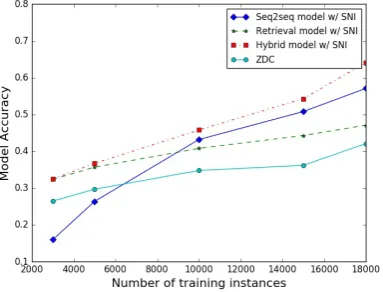
Figure 5 shows the performance of differen-t models on various scales of differen-training dadifferen-ta. As expected, the seq2seq model performs very well on big datasets, but poorly on small datasets.
Figure 5: Performance of different models versus the size of training set
Ability to Generate New Equation Templates:
please note that many problems in Math23K can be solved using the same equation template. For example, a problem which corresponds to the e-quationx = (9∗3) + 7 and a different problem that maps tox= (4∗5) + 2share the same equa-tion template.
One nice property of the seq2seq model is its a-bility of generating new equation templates. Most previous statistical learning methods (with a few exceptions) for math word problem solving are on-ly able to select an equation template from those in the training data. In other words, they cannot generate new templates. To test the performance of the seq2seq model in generating new templates,
Math23K
ZDC 15.1%
Retrieval model w/o SNI 26.1% Retrieval model w/ NI 29.2% Seq2seq model w/o SNI 40.3% Seq2seq model w/ SNI 47.5%
[image:8.595.327.503.60.174.2]Hybrid model w/o SNI 40.3% Hybrid model w/ SNI 47.7%
Table 7: Experimental results of non-overlapping templates between training data and test data
we make a new split of our dataset between train-ing data and test data, to ensure that the traintrain-ing data and the test data do not share overlapped tem-plates. As a result, we get a training set with 19, 024 problems and 1, 802 equation templates, and a testing set with 4, 137 problems and 315 equation templates.
Experimental results on the new training set and test set are shown is shown in Table7. By com-paring Table 5 and Table 7, it is clear that the gap between the seq2seq model and the baselines be-comes larger in the new settings. It is because the seq2seq model can effectively generate new equa-tion templates for new problems, instead of select-ing equation templates from the trainselect-ing set.
Although ZDC and the retrieval model cannot generate new templates, their accuracy is not zero in the new settings. That is because one problem can be solved by multiple equation templates: Al-though one problem is labeled with templateT1in the test set, it may also be solved by another tem-plateT2 in the training set.
6.3 Discussion
Compare to most previous statistical learning methods for math problem solving, our proposed seq2seq model and hybrid model have the follow-ing advantages: 1) They have higher accuracy on large training data. On the Math23K dataset, the hybrid model achieves at least 22% higher accura-cy than the baselines. 2) They have the ability of generating new templates (i.e., templates that are not in the training data. 3) They do not rely on sophisticated feature engineering.
7 Conclusion
[image:8.595.84.276.348.494.2]equation template. This is the first work of ap-plying deep learning technologies to math word problem solving. In addition, we have designed a hybrid model which combines the seq2seq mod-el and a retrieval modmod-el to further improve perfor-mance. A large dataset has been constructed for model training and empirical evaluation. Exper-imental results show that both the seq2seq mod-el and the hybrid modmod-el significantly outperfor-m state-of-the-art statistical learning outperfor-methods in math word problem solving.
The output of our seq2seq model is a single e-quation containing one unknown variable. There-fore our approach is only applicable to the prob-lems whose solution involves one linear equation of one unknown variable. As future work, we plan to extend our model to be able to generate equation systems and nonlinear equations.
References
Bussaba Amnueypornsakul and Suma Bhat. 2014. Machine-guided solution to mathematical word problems. InPACLIC. pages 111–119.
Dzmitry Bahdanau, Kyunghyun Cho, and Yoshua Ben-gio. 2014. Neural machine translation by jointly learning to align and translate. arXiv preprint arX-iv:1409.0473.
Yefim Bakman. 2007. Robust understanding of word problems with extraneous information. arX-iv preprint math/0701393.
Daniel G Bobrow. 1964. Natural language input for a computer problem solving system .
Diane J Briars and Jill H Larkin. 1984. An integrated model of skill in solving elementary word problems.
Cognition and instruction1(3):245–296.
Eugene Charniak. 1968. CALCULUS WORD PROB-LEMS. Ph.D. thesis, Massachusetts Institute of Technology.
Eugene Charniak. 1969. Computer solution of calcu-lus word problems. InProceedings of the 1st inter-national joint conference on Artificial intelligence. Morgan Kaufmann Publishers Inc., pages 303–316.
Kyunghyun Cho, Bart Van Merri¨enboer, Dzmitry Bah-danau, and Yoshua Bengio. 2014. On the properties of neural machine translation: Encoder-decoder ap-proaches. arXiv preprint arXiv:1409.1259.
Junyoung Chung, Caglar Gulcehre, KyungHyun Cho, and Yoshua Bengio. 2014. Empirical evaluation of gated recurrent neural networks on sequence model-ing. arXiv preprint arXiv:1412.3555.
Denise Dellarosa. 1986. A computer simulation of childrens arithmetic word-problem solving. Behav-ior Research Methods, Instruments, & Computers
18(2):147–154.
Edward A Feigenbaum, Julian Feldman, et al. 1963.
Computers and thought. New York.
Charles R Fletcher. 1985. Understanding and solving arithmetic word problems: A computer simulation.
Behavior Research Methods, Instruments, & Com-puters17(5):565–571.
Sepp Hochreiter and J¨urgen Schmidhuber. 1997. Long short-term memory. Neural computation
9(8):1735–1780.
Mohammad Javad Hosseini, Hannaneh Hajishirzi, Oren Etzioni, and Nate Kushman. 2014. Learning to solve arithmetic word problems with verb catego-rization. InEMNLP. pages 523–533.
Danqing Huang, Shuming Shi, Chin-Yew Lin, Jian Yin, and Wei-Ying Ma. 2016. How well do computers solve math word probl ems? large-scale dataset con-struction and evaluation. Proceedings of the 2016 North American Chapter of the ACL (NAACL HLT)
.
Rik Koncel-Kedziorski, Hannaneh Hajishirzi, Ashish Sabharwal, Oren Etzioni, and Siena Dumas Ang. 2015. Parsing algebraic word problems into equa-tions.TACL3:585–597.
Nate Kushman, Yoav Artzi, Luke Zettlemoyer, and Regina Barzilay. 2014. Learning to automatically solve algebra word problems. Association for Com-putational Linguistics.
Christian Liguda and Thies Pfeiffer. 2012. Model-ing math word problems with augmented semantic networks. InInternational Conference on Applica-tion of Natural Language to InformaApplica-tion Systems. Springer, pages 247–252.
Nicholas Locascio, Karthik Narasimhan, Eduardo DeLeon, Nate Kushman, and Regina Barzilay. 2016. Neural generation of regular expressions from natu-ral language with minimal domain knowledge. arX-iv preprint arXarX-iv:1608.03000.
Arindam Mitra and Chitta Baral. 2016. Learning to use formulas to solve simple arithmetic problems. ACL. Subhro Roy and Dan Roth. 2016. Solving gener-al arithmetic word problems. arXiv preprint arX-iv:1608.01413.
Subhro Roy, Tim Vieira, and Dan Roth. 2015. Reason-ing about quantities in natural language. Transac-tions of the Association for Computational Linguis-tics3:1–13.
Shuming Shi, Yuehui Wang, Chin-Yew Lin, Xiaojiang Liu, and Yong Rui. 2015. Automatically solving number word problems by semantic parsing and rea-soning. InEMNLP. pages 1132–1142.
Upadhyay Shyam and Chang Ming-Wei. 2017. An-notating derivations: A new evaluation strategy and dataset for algebra word problems. InEACL. pages 494–504.
Nitish Srivastava, Geoffrey E Hinton, Alex Krizhevsky, Ilya Sutskever, and Ruslan Salakhutdinov. 2014. Dropout: a simple way to prevent neural networks from overfitting. Journal of Machine Learning Re-search15(1):1929–1958.
Ilya Sutskever, Oriol Vinyals, and Quoc V Le. 2014. Sequence to sequence learning with neural network-s. InAdvances in neural information processing sys-tems. pages 3104–3112.
Sam Wiseman and Alexander M Rush. 2016. Sequence-to-sequence learning as beam-search op-timization. arXiv preprint arXiv:1606.02960. Ma Yuhui, Zhou Ying, Cui Guangzuo, Ren Yun, and
Huang Ronghuai. 2010. Frame-based calculus of solving arithmetic multi-step addition and subtrac-tion word problems. InEducation Technology and Computer Science (ETCS), 2010 Second Interna-tional Workshop on. IEEE, volume 2, pages 476– 479.