A Simple Regularization-based
Algorithm for Learning Cross-Domain Word Embeddings
Wei Yang
University of Waterloo [email protected]
Wei Lu
Singapore University of Technology and Design
Vincent W. Zheng
Advanced Digital Sciences Center vincent.zheng
@adsc.com.sg
Abstract
Learning word embeddings has received a significant amount of attention recently. Often, word embeddings are learned in an unsupervised manner from a large collec-tion of text. The genre of the text typi-cally plays an important role in the effec-tiveness of the resulting embeddings. How to effectively train word embedding mod-els using data from different domains re-mains a problem that is underexplored. In this paper, we present a simple yet effec-tive method for learning word embeddings based on text from different domains. We demonstrate the effectiveness of our ap-proach through extensive experiments on various down-stream NLP tasks.
1 Introduction
Recently, the learning of distributed representa-tions for natural language words (or word embed-dings) has received a significant amount of atten-tion (Mnih and Hinton,2007;Turian et al.,2010; Mikolov et al.,2013a,b,c;Pennington et al.,2014). Such representations were shown to be able to cap-ture syntactic and semantic level information asso-ciated with words (Mikolov et al.,2013a). Word embeddings were shown effective in tasks such as named entity recognition (Sienˇcnik, 2015), sen-timent analysis (Li and Lu, 2017) and syntactic parsing (Durrett and Klein,2015). One common assumption made by most of the embedding meth-ods is that, the text corpus is from one single do-main; e.g., articles from bioinformatics. How-ever, in practice, there are often text corpora from multiple domains; e.g., we may have text collec-tions from broadcast news or Web blogs, whose words are not necessarily limited to bioinformat-ics. Can these corpora from different domains help
learn better word embeddings, so as to improve the downstream NLP applications in a target domain like bioinformatics? Our answer is yes, because despite the domain differences, these additional domains do introduce more text data converying useful information (i.e., more words, more word co-occurrences), which can be helpful for consoli-dating the word embeddings in the target bioinfor-matics domain.
In this paper, we propose a simple and easy-to-implement approach for learning cross-domain word embeddings. Our model can be seen as a regularized skip-gram model (Mikolov et al., 2013a,b), where the source domain information is selectively incorporated for learning the target do-main word embeddings in a principled manner.
2 Related Work
Learning a continuous representation for words has been studied for quite a while (Hinton et al., 1986). Many earlier word embedding meth-ods employed the computationally expensive neu-ral network architectures (Collobert and Weston, 2008; Mikolov et al., 2013c). Recently, an ef-ficient method for learning word representations, namely the skip-gram model (Mikolov et al., 2013a,b) was proposed and implemented in the widely used word2vec toolkit. It tries to use the current word to predict the surrounding context words, where the prediction is defined over the embeddings of these words. As a result, it learns the word embeddings by maximizing the likeli-hood of predictions.
Domain adaptation is an important research topic (Pan et al., 2013), and it has been consid-ered in many NLP tasks. For example, domain adaptation is studied for sentiment classification (Glorot et al.,2011) and parsing (McClosky et al., 2010), just to name a few. However, there is very
little work on domain adaptation for word embed-ding learning. One major reason preventing peo-ple from using text corpora from different domains for word embedding learning is the lack of guid-ance on which kind of information is worth learn-ing from the source domain(s) for the target do-main. In order to address this problem, some pi-oneering work has looked into this problem. For example,Bollegala et al.(2015) considered those frequent words in the source domain and the target domain as the “pivots”. Then it tried to use the piv-ots to predict the surrounding “non-pivpiv-ots”, mean-while ensuring the pivots to have the same em-bedding across two domains. Emem-beddings learned from such an approach were shown to be able to improve the performance on a cross-domain sen-timent classification task. However, this model fails to learn embeddings for many words which are neither pivots nor non-pivots, which could be crucial for some downstream tasks such as named entity recognition.
3 Our Approach
Let us first state the objective of the skip-gram model (Mikolov et al.,2013a) as follows:
LD =
X
(w,c)∈D
#(w, c)logσ(w·c)
+ Xk
i=1 Ec0
i∼P(w)[logσ(−w·c
0
i)]
(1)
where Drefers to the complete text corpus from which we learn the word embeddings. The word
wis the current word, cis the context word, and #(w, c) is the number of times they co-occur in D. We usewandcto denote the vector represen-tations forwandc, respectively. The functionσ(·) is the sigmoid function. The wordc0
i is a
“nega-tive sample” sampled from the distributionP(w)– typically chosen as the unigram distributionU(w) raised to the3/4rd power (Mikolov et al.,2013b). In our approach, we first learn for each word
wan embeddingwsfrom the source domainDs.
Next we learn the target domain embeddings as follows:
L0Dt =LDt+
X
w∈Dt∩Ds
αw· ||wt−ws||2 (2)
whereDtrefers to the target domain, andwtis the
target domain representation forw. Such an
regu-larized objective can still be optimized using stan-dard stochastic gradient descent. Note that in the above formula, the regularization term only con-siders words that appear in both source and target domain, ignoring words that only appear in either the source or the target domain only.
Our approach is inspired by the recent regularization-based domain adaptation frame-work (Lu et al., 2016). Here, αw measures the
amount of transfer across the two domains when learning the representation for word w. If it is large, it means we require the embeddings of word
win the two domains to be similar. We defineαw
as follows:
αw=σ(λ·φ(w)) (3)
whereλis a hyper-parameter to decide the scaling factor of the significance functionφ(·), which al-lows the user to control the degree of “knowledge transfer” from source domain to target domain.
How do we define the significance function
φ(w) that controls the amount of transfer for the wordw? We first define the frequency of the word
win the datasetDasfD(w), the number of times
the word w appears in the domain D. Based on this we can define the normalized frequency for the wordwas follows:
FD(w) = max fD(w)
w0∈DkfD(w0) (4) whereDk⊂ Dconsists of all except for the topk
most frequent words fromD1.
We define the function φ(·) based on the fol-lowing metric that is motivated by the well-known Sørensen-Dice coefficient (Sørensen,1948;Dice, 1945) commonly used for measuring similarities:
φ(w) = 2· FDs(w)· FDt(w)
FDs(w) +FDt(w)
(5)
Why does such a definition make sense? We note that the value of φ(w) would be high only if both both FDs(w) and FDt(w) are high – in
this case the wordwis a frequent word across dif-ferent domains. Intuitively, these are likely those words whose semantics do not change across the two domains, and we should be confident about making their embeddings similar in the two do-mains. On the other hand, domain-specific words
Enwik9 PubMed Gigaword (EN) Yelp IMDB Tweets (EN) Tweets (ES) Eswiki
# tokens 124.3M 124.9M 135.6M 38.9M 29.0M 162.8M 69.4M 102.8M
[image:3.595.309.526.127.215.2]# sents – 5,000,000 5,400,000 2,376,079 1,230,465 16,185,356 6,785,697 3,684,670
Table 1: Statistics for datasets used for embedding learning in all experiments.
tend to be more frequent in one domain than the other. In this case, the resulting φ(w) will also have a lower score, indicating a smaller amount of transfer across the two domains. While other user-defined significance functions are also possible, in this work we simply adopt such a function based on the above simple observations. We will vali-date our assumptions with experiments in the next section.
4 Experiments
We present extensive evaluations to assess the ef-fectiveness of our approach. Following recent ad-vice by Nayak et al. (2016) and Faruqui et al. (2016), to assess the quality of the learned word embeddings, we considered employing the learned word embeddings as continuous features in several down-stream NLP tasks, including entity recogni-tion, sentiment classificarecogni-tion, and targeted senti-ment analysis.
We have used various datasets from different domains for learning cross-domain word embed-dings under different tasks. We list the data statis-tics in Table1.
4.1 Baseline Methods
We consider the following baseline methods when assessing the effectiveness of our approach.
• DISCRETE: only discrete features (such as
bag of words, POS tags, word n-grams and POS tag n-grams, depending on the actual down-stream task) were considered. All fol-lowing systems include both these base fea-tures and the respective additional feafea-tures. • SOURCE: we train word embeddings from
the source domain as additional features. • TARGET: we train word embeddings from
the target domain as additional features. • ALL: we combined the data from two
do-mains to form a single dataset for learning word embeddings as additional features. • CONCAT: we simply concatenate the learned
embeddings from both source and target do-mains as additional features.
Method P GENIAR F ACE
1 P R F1
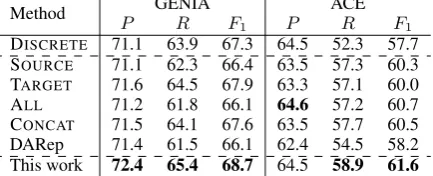
DISCRETE 71.1 63.9 67.3 64.5 52.3 57.7 SOURCE 71.1 62.3 66.4 63.5 57.3 60.3 TARGET 71.6 64.5 67.9 63.3 57.1 60.0 ALL 71.2 61.8 66.1 64.6 57.2 60.7 CONCAT 71.5 64.1 67.6 63.5 57.7 60.5 DARep 71.4 61.5 66.1 62.4 54.5 58.2 This work 72.4 65.4 68.7 64.5 58.9 61.6
Table 2: Results on entity recognition. • DARep: we use the previous approach of
Bollegala et al. (2015) for learning cross-lingual word representations as additional features.
4.2 Entity Recognition
Our first experiment was conducted on entity recognition (Tjong Kim Sang and De Meulder, 2003;Florian et al.,2004), where the task is to ex-tract semantically meaning entities and their men-tions from the text.
For this task, we built a standard entity recogni-tion model using condirecogni-tional random fields ( Laf-ferty et al., 2001). We used the standard fea-tures which are commonly used for different meth-ods, including word unigrams and bigrams, bag-of-words features, POS tag window features, POS tag unigrams and bigram features. We conducted two sets of experiments on two different datasets. The first dataset is the GENIA dataset (Ohta et al., 2002), a popular dataset used in bioinformatics, and the second is the ACE-2005 dataset (Walker et al.,2006), which is a standard dataset used for various information extraction tasks.
For the GENIA dataset which consists of 10,946 sentences, we used Enwik9 as the source domain and PubMed as the target domain for learning word embeddings. We set the dimension of word representations as 50.
For the experiments on ACE, we selected the BN subset of ACE2005, which consists of 4,460 CNN headline news and share a similar domain with Gigaword. We used Enwik9 as the source domain and Gigaword as the target domain. We followed a procedure similar to GENIA for exper-iments.
0.2 0.4 0.6 0.8 1 0.86
0.88 0.9 0.92
Percentage of training set
F1
score
DISCRETE SOURCE
TARGET ALL
CONCAT DARep Lu et al. This work
0.2 0.4 0.6 0.8 1
0.8 0.85
Percentage of training set
F1
score
DISCRETE SOURCE
TARGET ALL
[image:4.595.92.508.64.179.2]CONCAT DARep Lu et al. This work
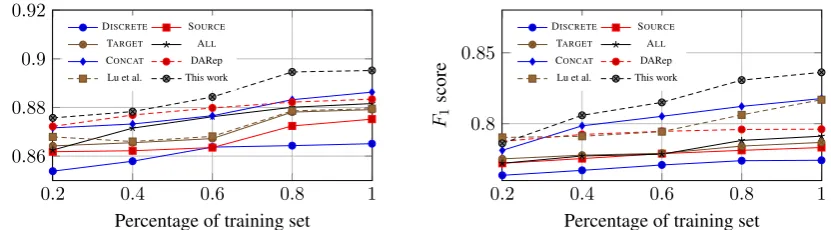
Figure 1: Results on sentiment classification. Left: Yelp (source) to IMDB (target). Right: IMDB (source) to Yelp (target).
portion. We then trained a model using the re-maining 90% as the training portion and used the development portion for development of the hy-perparameterλ. After development, we re-trained the models using the original training set2.
We report the results in Table 2. From the re-sults we can observe that the embeddings learned using our algorithm can lead to improved perfor-mance when used in this particular down-stream NLP task. We note that in such a task, many en-tities consist of domain-specific terms, therefore learning good representations for such words can be crucial. As we have discussed earlier, our reg-ularization method enables our model to differen-tiate domain-specific words from words which are more general in the learning process. We believe this mechanism can lead to improved learning of representations for both types of words.
4.3 Sentiment Classification
The second task we consider is sentiment classi-fication, which is essentially a text classification task, where the goal is to assign each text docu-ment a class label indicating its sentidocu-ment polarity (Pang et al.,2002;Liu,2012).
This is also the only task presented in the pre-vious DARep work byBollegala et al.(2015). As such, we largely followed Bollegala et al.(2015) for experiments. Instead of using the dataset they used which only consists of 2,000 reviews, we considered two much larger datasets – IMDB and Yelp 2014 – for such a task, which was previously used in a sentiment classification task (Tang et al., 2015). IMDB dataset (Diao et al.,2014) is crawled from the movie review site IMDB3 which
con-sists of 84,919 reviews. Yelp 2014 dataset concon-sists
2We selected the optimal value for the hyper-parameter
λfrom the setλ ∈ {0.1,1,5,10,20,30,50}for all experi-ments in this paper.
3http://www.imdb.com
of 231,163 online reviews provided by the Yelp Dataset Challenge4.
FollowingBollegala et al.(2015), for this task we simply learned the word embeddings from the training portion of the review datasets themselves only. No external data was used for learning word embeddings. AsBollegala et al.(2015) only eval-uated on a small dataset in their paper for such a task, to understand the effect of varying the amount of training data, we also tried to train our model on datasets with different sizes. We con-ducted two sets of experiments: we first used the Yelp dataset as the source domain and IMDB as the target domain, and then we switched these two datasets in our second set of experiments. Fig-ure 1 shows the F1 measures for different word
embeddings when different amounts of training data were used. We also compared with the pre-vious approach for domain adaptation (Lu et al., 2016) which only employs discrete features. We can observe that when the dataset becomes large, our learned word embeddings are shown to be more effective than all other approaches. When the complete training set is used, our model sig-nificantly outperforms DARep (p <0.05for both directions with bootstrap resampling test (Koehn, 2004)). DARep appears to be effective when the training dataset is small. However, as the train-ing set size increases, there is no significant im-provement for such an approach. As we can also observe from the figure, our approach consistently gives better results than baseline approaches (ex-cept for the second experiment when 20% of the data was used). Furthermore, when the amount of training data increases, the differences between our approach and other approaches generally be-come larger.
Such experiments show that our model works
Model P. EnglishR. F Spanish
1 P. R. F1
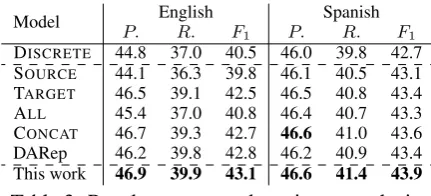
[image:5.595.72.288.61.159.2]DISCRETE 44.8 37.0 40.5 46.0 39.8 42.7 SOURCE 44.1 36.3 39.8 46.1 40.5 43.1 TARGET 46.5 39.1 42.5 46.5 40.8 43.4 ALL 45.4 37.0 40.8 46.4 40.7 43.3 CONCAT 46.7 39.3 42.7 46.6 41.0 43.6 DARep 46.2 39.8 42.8 46.2 40.9 43.4 This work 46.9 39.9 43.1 46.6 41.4 43.9 Table 3: Results on targeted sentiment analysis.
well when different amounts of data are available, and our approach appears to be more competitive when a large amount of data is available.
4.4 Targeted Sentiment Analysis
We also conducted experiments on targeted senti-ment analysis (Mitchell et al.,2013) – the task of jointly recognizing entities and their sentiment in-formation. We used the state-of-the-art system for targeted sentiment analysis by Li and Lu (2017) whose code is publicly available 5, and used the
data from (Mitchell et al., 2013) which consists of 7,105 Spanish tweets and 2,350 English tweets, with named entities and their sentiment informa-tion annotated. Note that the model of Li and Lu (2017) is a structured prediction model that involves latent variables. The experiments here therefore allow us to assess the effectiveness of our approach on such a setup involving latent vari-ables. We follow Li and Lu (2017) and report precision (P.), recall (R.) and F1-measure (F1)
for such a targeted sentiment analysis task, where the prediction is regarded as correct if and only if both the entity’s boundary and its sentiment infor-mation are correct. Also, unlike previous experi-ments, which are conducted on English only, these experiments additionally allow us to assess our ap-proach’s effectiveness when a different language other than English is considered.
For the English task, we used Enwik9 as the source domain for learning word embeddings, and our crawled English tweets as the target domain. For the Spanish task, we used Eswiki as the source domain, and we also crawled Spanish tweets as the target domain. See Table1for the statistics. Sim-ilar to the experiments conducted for entity recog-nition, we split the first 80% of the data for train-ing, the next 10% for development and the last 10% for evaluation. We tuned the hyper-parameter
λusing the development set and re-trained the em-beddings on the dataset combining the training and
5Available at http://statnlp.org/research/st/.
the development set, which are then used in fi-nal evaluations. Results are reported in Table 3, which show our approach is able to achieve the best results across two datasets in such a task, and outperforms DARep (p < 0.05). Interestingly, the concatenation approach appears to be competi-tive in this task, especially for the Spanish dataset, which appears to be better than the DARep ap-proach. However, we note such an approach does not capture any information transfer across differ-ent domains in the learning process. In contrast, our approach learns embeddings for the target do-main by capturing useful cross-dodo-main informa-tion and therefore can lead to improved modeling of embeddings that are shown more helpful for this specific down-stream task.
5 Conclusion and Future Work
In this paper, we presented a simple yet effec-tive algorithm for learning cross-domain word em-beddings. Motivated by the recent regularization-based domain adaptation framework (Lu et al., 2016), the algorithm performs learning by aug-menting the skip-gram objective with a simple reg-ularization term. Our work can be easily extended to multi-domain scenarios. The method is also flexible, allowing different user-defined metrics to be incorporated for defining the function control-ling the amount of domain transfer.
Future work includes performing further in-vestigations to better understand and to visual-ize what types of information has been trans-ferred across domains and how such informa-tion influence different types of down-stream NLP tasks. It is also important to under-stand how such an approach will work on other types of models such as neural networks based NLP models. Our code is available at
http://statnlp.org/research/lr/.
Acknowledgments
References
Danushka Bollegala, Takanori Maehara, and Ken ichi Kawarabayashi. 2015. Unsupervised cross-domain word representation learning. In Proc. of ACL-IJCNLP, pages 730–740.
Ronan Collobert and Jason Weston. 2008. A unified architecture for natural language processing: Deep neural networks with multitask learning. InProc. of ICML, pages 160–167. ACM.
Qiming Diao, Minghui Qiu, Chao-Yuan Wu, Alexan-der J Smola, Jing Jiang, and Chong Wang. 2014. Jointly modeling aspects, ratings and sentiments for movie recommendation (jmars). InProc. of KDD, pages 193–202.
Lee R Dice. 1945. Measures of the amount of ecologic association between species. Ecology, 26(3):297– 302.
Greg Durrett and Dan Klein. 2015. Neural crf parsing.
arXiv preprint arXiv:1507.03641.
Manaal Faruqui, Yulia Tsvetkov, Pushpendre Rastogi, and Chris Dyer. 2016. Problems with evaluation of word embeddings using word similarity tasks. arXiv preprint arXiv:1605.02276.
R. Florian, H. Hassan, A. Ittycheriah, H. Jing, N. Kambhatla, X. Luo, N. Nicolov, and S. Roukos. 2004. A statistical model for multilingual entity de-tection and tracking. InProc. of NAACL/HLT, pages 1–8.
Xavier Glorot, Antoine Bordes, and Yoshua Bengio. 2011. Domain adaptation for large-scale sentiment classification: A deep learning approach. InProc. of ICML, pages 513–520.
G. E. Hinton, J. L. McClelland, and D. E. Rumelhart. 1986. Parallel distributed processing: Explorations in the microstructure of cognition, vol. 1. chap-ter Distributed Representations, pages 77–109. MIT Press, Cambridge, MA, USA.
Philipp Koehn. 2004. Statistical significance tests for machine translation evaluation. InProc. of EMNLP, pages 388–395.
John Lafferty, Andrew McCallum, Fernando Pereira, et al. 2001. Conditional random fields: Probabilistic models for segmenting and labeling sequence data. InProc. of ICML, pages 282–289.
Hao Li and Wei Lu. 2017. Learning latent sentiment scopes for entity-level sentiment analysis. InProc. of AAAI, pages 3482–3489.
Bing Liu. 2012. Sentiment analysis and opinion min-ing. Synthesis lectures on human language tech-nologies, 5(1).
Wei Lu, Hai Leong Chieu, and Jonathan L¨ofgren. 2016. A general regularization framework for do-main adaptation. In Proc. of EMNLP, pages 950– 954.
David McClosky, Eugene Charniak, and Mark John-son. 2010. Automatic domain adaptation for pars-ing. InProc. of NAACL-HLT, pages 28–36.
Tomas Mikolov, Kai Chen, Greg Corrado, and Jef-frey Dean. 2013a. Efficient estimation of word representations in vector space. arXiv preprint arXiv:1301.3781.
Tomas Mikolov, Ilya Sutskever, Kai Chen, Greg S Cor-rado, and Jeff Dean. 2013b. Distributed representa-tions of words and phrases and their compositional-ity. InProc. of NIPS, pages 3111–3119.
Tomas Mikolov, Wen-tau Yih, and Geoffrey Zweig. 2013c. Linguistic regularities in continuous space word representations. In Proc. of NAACL-HLT, pages 746–751.
Margaret Mitchell, Jacqueline Aguilar, Theresa Wil-son, and Benjamin Van Durme. 2013. Open do-main targeted sentiment. InProc. of EMNLP, pages 1643–1654.
Andriy Mnih and Geoffrey Hinton. 2007. Three new graphical models for statistical language modelling. InProc. of ICML, pages 641–648.
Neha Nayak, Gabor Angeli, and Christopher D Man-ning. 2016. Evaluating word embeddings using a representative suite of practical tasks. ACL 2016, page 19.
Tomoko Ohta, Yuka Tateisi, and Jin-Dong Kim. 2002. The genia corpus: An annotated research abstract corpus in molecular biology domain. In Proc. of the second international conference on Human Lan-guage Technology Research, pages 82–86.
Sinno Jialin Pan, Zhiqiang Toh, and Jian Su. 2013. Transfer joint embedding for cross-domain named entity recognition. ACM Transactions on Informa-tion Systems (TOIS), 31(2):7.
Bo Pang, Lillian Lee, and Shivakumar Vaithyanathan. 2002. Thumbs up?: sentiment classification using machine learning techniques. In Proc. of EMNLP, pages 79–86.
Jeffrey Pennington, Richard Socher, and Christopher D Manning. 2014. Glove: Global vectors for word representation. In Proc. of EMNLP, volume 14, pages 1532–1543.
Scharolta Katharina Sienˇcnik. 2015. Adapting word2vec to named entity recognition. In Proc. of NODALIDA, 109, pages 239–243. Link¨oping Uni-versity Electronic Press.
Duyu Tang, Bing Qin, and Ting Liu. 2015. Learning semantic representations of users and products for document level sentiment classification. InProc. of ACL-IJCNLP, pages 1014–1023.
Erik F Tjong Kim Sang and Fien De Meulder. 2003. Introduction to the conll-2003 shared task: Language-independent named entity recognition. In
Proc. of HLT-NAACL, pages 142–147.
Joseph Turian, Lev Ratinov, and Yoshua Bengio. 2010.
Word representations: a simple and general method for semi-supervised learning. InProceedings of the 48th annual meeting of the association for compu-tational linguistics, pages 384–394. Association for Computational Linguistics.