Improved Statistical Machine Translation
Using Monolingually-Derived Paraphrases
Yuval Marton,∗ Chris Callison-Burch,† and Philip Resnik∗∗Department of Linguistics and the CLIP Lab at the Institute for Advanced Computer Studies (UMIACS) University of Maryland College Park, MD 20742-7505, USA
{ymarton,resnik}@umiacs.umd.edu †Computer Science Department, Johns Hopkins University 3400 N. Charles Street (CSEB 226-B) Baltimore, MD 21218
Abstract
Untranslated words still constitute a ma-jor problem for Statistical Machine Trans-lation (SMT), and current SMT systems are limited by the quantity of parallel training texts. Augmenting the training data with paraphrases generated by pivot-ing through other languages alleviates this problem, especially for the so-called “low density” languages. But pivoting requires additional parallel texts. We address this problem by deriving paraphrases monolin-gually, using distributional semantic simi-larity measures, thus providing access to larger training resources, such as compa-rable and unrelated monolingual corpora. We present what is to our knowledge the first successful integration of a colloca-tional approach to untranslated words with an end-to-end, state of the art SMT sys-tem demonstrating significant translation improvements in a low-resource setting. 1 Introduction
Phrase-based systems, flat and hierarchical alike (Koehn et al., 2003; Koehn, 2004b; Koehn et al., 2007; Chiang, 2005; Chiang, 2007), have achieved a much better translation coverage than word-based ones (Brown et al., 1993), but untranslated words remain a major problem in SMT. For ex-ample, according to Callison-Burch et al.(2006), a SMT system with a training corpus of 10,000 words learned only 10% of the vocabulary; the same system learned about 30% with a training corpus of 100,000 words; and even with a large training corpus of nearly 10,000,000 words it only reached about 90% coverage of the source vocab-ulary. Coverage of higher order n-gram levels is
even harder. This problem plays a major part in re-ducing machine translation quality, as reflected by both automatic measures such as BLEU(Papineni
et al., 2002) and human judgment tests. Improving translation coverage accurately is therefore impor-tant for SMT systems.
The first solution that might come to mind is to use larger parallel training corpora. However, current state-of-the-art SMT systems cannot learn from non-aligned corpora, while sentence-aligned parallel corpora (bitexts) are a limited resource (See Section 2 for discussion of automatically-compiled bitexts). Another direction might be to make use of non-parallel corpora for training. However, this requires developing techniques to extract alignments or translations from them, and in a sufficiently fast, memory-efficient, and scal-able manner. One approach that can, in princi-ple, better exploit both alignments from bitexts and make use of non-parallel corpora is the dis-tributional collocational approach, e.g., as used by Fung and Yee (1998) and Rapp (1999). However, the systems described there are not easily scalable, and require pre-computation of a very large col-location counts matrix. Related attempts propose generating bitexts from comparable and “quasi-comparable” bilingual texts by iteratively boot-strapping documents, sentences, and words (Fung and Cheung, 2004), or by using a maximum entropy classifier (Munteanu and Marcu, 2005). Alignment accuracy remains a challenge for them. Recent work has proposed augmenting the training data with paraphrases generated by pivot-ing through other languages (Callison-Burch et al., 2006; Madnani et al., 2007). This indeed allevi-ates the vocabulary coverage problem, especially for the so-called “low density” languages. How-ever, these approaches still require bitexts where
one side contains the original source language. The paradigm described in this paper involves constructing monolingual distributional profiles (DPs; a.k.a. word association profiles, or co-occurrence vectors) of out-of-vocabulary words and phrases in the source language; then, gener-ating paraphrase candidates from phrases that co-occur in similar contexts, and assigning them sim-ilarity scores. The highest ranking paraphrases are used to augment the translation phrase table. The table augmentation idea is similar to Callison-Burch et al.’s (Callison-Burch et al., 2006), but our proposed paradigm does not require using a limited resource such as parallel texts in order to generate paraphrases. Moreover, our proposed paradigm can, in principle, achieve large-scale ac-quisition of paraphrases with high semantic simi-larity. However, using parallel training texts in pivoting techniques offers the potential advantage of implicit translational knowledge, in the form of sentence alignments, while our approach is un-guided in this respect. Therefore, we conducted experiments to find out how these relative advan-tages play out. We present here, to our knowledge for the first time, positive results of integrating dis-tributional monolingually-derived paraphrases in an end-to-end state-of-the-art SMT system.
In the rest of this paper we discuss related work in Section 2, describe the distributional hypothesis and distributional profiles in Section 3, and present the monolingually-derived paraphrase generation system in Section 4. We report our experiments and results in Section 5, and conclude by dis-cussing the implications and future research direc-tions in Section 6.
2 Related Work
This is not the first to attempt to ameliorate the out-of-vocabulary (OOV) words problem in sta-tistical machine translation, and other natural lan-guage processing tasks. This work is most closely related to that of Callison-Burch et al. (2006), who also translate source-side paraphrases of the OOV phrases. There, paraphrases are generated from bitexts of various language pairs, by “pivot-ing”: translating the OOV phrases to an additional language (or languages) and back to the source language. The quality of these paraphrases is es-timated by marginalizing translation probabilities to and from the additional language side(s) e, as follows: p(f2|f1) = Pep(e|f1)p(f2|e). A
ma-jor disadvantage of their approach is that it relies on the availability of parallel corpora in other lan-guages. While this works for English and many European languages, it is far less likely to help when translating from other source languages, for which bitexts are scarce or non-existent. Also, the pivoting approach is inherently noisy (in both the paraphrase candidates’ correct sense, and their translational likelihood), and it is likely to fare poorly with out-of-domain translation. One ad-vantage of the bitext-dependent pivoting approach is the use of the additional human knowledge that is encapsulated in the parallel sentence alignment. However, we argue that the ability to use much larger resources for paraphrasing should trump the human knowledge advantage.
More recently, Callison-Burch (2008) has im-proved performance of this pivoting technique by imposing syntactic constraints on the paraphrases. The limitation of such an approach is the reliance on a good parser (in addition to reliance on bi-texts), but a good parser is not available in all languages, especially not in resource-poor lan-guages. Another approach using a pivoting tech-nique augments the human reference translation with paraphrases, creating additional translation “references” (Madnani et al., 2007). Both ap-proaches have shown gains in BLEUscore.
Barzilay and McKeown (2001) extract para-phrases from a monolingual parallel corpus, con-taining multiple translations of the same source. In addition to the parallel corpus usage limitations described above, this technique is further limited by the small size of such materials, which are even scarcer than the resources in the pivoting case.
Dolan et al. (2004) explore generating para-phrases by edit-distance and headlines of time-and topic-clustered news articles; they do not ad-dress the OOV problem directly, as their focus is sentence-level paraphrases; although they use a standard SMT measure, alignment error rate (AER), they only report results of the alignment quality, and not of an end-to-end SMT system. Much of the previous research largely focused on morphological analysis in order to reduce type sparseness; Callison-Burchet al.(2006) list some of the influential work in that direction.
with their target languages paraphrases (Fung and Yee, 1998; Rapp, 1999; Diab and Finch, 2000). This approach is sometimes viewed as, or com-bined with, an information retrieval (IR) approach, and normalizes strength-of-association measures (see Section 3) with IR-related measures such as TF/IDF (Fung and Yee, 1998). To date, reported implementations suffer from scalability issues, as they pre-compute and hold in memory a huge col-location matrix; we know of no report of using this approach in an end-to-end SMT system.
Another approach aiming to reduce OOV rate concentrates on increasing parallel training set size without using more dedicated human transla-tion (Resnik and Smith, 2003; Oard et al., 2003).
3 Collocational Profiles
The distributional hypothesis and distribu-tional profiles. Natural language processing (NLP) applications that assume the distributional hypothesis (Harris, 1940; Firth, 1957) typically keep track of word co-occurrences in distribu-tional profiles(a.k.a. collocation vectors, or con-text vectors). Each distributional profile DPu (for some wordu) keeps counts of co-occurrence of u with all words within a usually fixed dis-tance from each of its occurrences (asliding win-dow) in some training corpus. More advanced pro-files keep “strength of association” (SoA) infor-mation between u and each of the co-occurring words, which is calculated from the counts of u, the counts of the other word, their co-occurrence count, and the count of all words in the corpus (corpus size). The information on the other words with respect touis typically kept in a vector whose dimensions correspond to all words in the training corpus. This is described in Equation (1), where
V is the training corpus vocabulary:
DPu ={< wi, SoA(u, wi)>|u, wi∈V} for allis.t.1≤i≤ |V| (1)
Semantic similarity between wordsuandvcan be estimated by calculating the similarity (vector distance) between their profiles. Slightly more for-mally, the distributional hypothesis assumes that if we had access to the hypothetical true (psycho-linguistic) semantic similarity function over word pairs,semsim(u, v), then
∀u, v, w∈V,
[semsim(u, v)> semsim(u, w)] =⇒
[psim(DPu, DPv)> psim(DPu, DPw)], (2) where V is the language vocabulary, DPword is the distributional profile of word, andpsim() is a 2-place vector similarity function (all further described below). Paraphrasing and other NLP applications that are based on the distributional hypothesis assume entailment in the reverse di-rection: the right-hand-side of Formula (2) (pro-file/vector similarity) entails the left-hand-side (semantic similarity).
The sliding window and word association (SoA) measures. Some researchers count positional
collocations in a sliding window, i.e., the co-counts and SoA measures are calculated per rel-ative position (e.g., for some word/token u, po-sition 1 is the token immediately after u; posi-tion -2 is the token preceding the token that pre-cedesu) (Rapp, 1999); other researchers use non-positional (which we dub here flat) collocations, meaning, they count all token occurrences within the sliding window, regardless of their positions in it relative to u (McDonald, 2000; Mohammad and Hirst, 2006). We use here flat collocations in a 6-token sliding window. Beside simple co-occurrence counts within sliding windows, other SoA measures include functions based on TF/IDF (Fung and Yee, 1998), mutual information (PMI) (Lin, 1998), conditional probabilities (Schuetze and Pedersen, 1997), chi-square test, and the log-likelihood ratio (Dunning, 1993).
psim(DPu, DPv) =cos(DPu, DPv)
=
P
wi∈V SoA(u, wi)SoA(v, wi)
r P
wi∈V SoA(u, wi)
2r P
wi∈V SoA(v, wi)
2
(3) In principle, any SoA can be used with any profile similarity measure. However, in practice, only some SoA/similarity measure combinations do well, and finding the best combination is still more art than science. Some successful combina-tions are cosCP (Schuetze and Pedersen, 1997),
LinP MI (Lin, 1998),CityLL (Rapp, 1999), and Jensen–Shannon divergence of conditional prob-abilities (JSDCP). We use here cosine of log-likelihood vectors (McDonald, 2000).
Phrasal distributional profiles. Word DPs can be generalized to phrasal DPs, simply by count-ing words that co-occur within a slidcount-ing window around the target phrase’s occurrences (i.e., count-ing occurrences of words up to 6 words before or after the target phrase). For example, when building a DP for the target phrasecounting words
in the previous sentence, then simply is in rela-tive position -2, and sliding is in relative posi-tion 5. Searching for similar phrasal DPs poses an additional challenge over the word DP case (see Section 4), but there is no additional diffi-culty in building the phrasal profile itself as de-scribed above. In preliminary experiments we found no gain in using phrasal collocates (i.e., count how many times aphraseof more than one word co-occurs in a sliding window around the tar-get word/phrase).
4 Searching and Scoring Phrasal Paraphrases
The system design is as follows: upon receiv-ing OOV phrase phr, build distributional profile
DPphr. Next, gather contexts: for each occur-rence of phr, keep surrounding (left and right) contextL__R. For each such context, gather para-phrase candidatesX which occur betweenLand
R in other locations in the training corpus, i.e., all X such that LXR occur in the corpus. Fi-nally, rank all candidatesX, by building distribu-tional profileDPX and measuring profile similar-ity betweenDPX andDPphr, for eachX. Output
k-best candidates above a certain similarity score threshold. The rest of this section describes this system in more detail.
Build phrasal profileDPphr. Build a profile of all word collocates, as described in Section 3. Use sliding window of size MaxP os = 6. If phr
is very frequent (above some threshold of t oc-currences), uniformly sample onlytoccurrences, multiplying the gathered co-counts by factor of
count(phr)/t. We sett= 10000.
Gather context. The challenge in choosing the relevant context is this: if it is very short and/or very frequent (e.g., “the __ is”), then it might not be very informative, in the sense that many words can appear in that context (in this example, practi-cally any noun); however, if it is too long (too spe-cific), then it might not occur enough times else-where (or not at all) in the training corpus. There-fore, to balance between these two extremes, we use the following heuristics. Start small: Start with setting the left part of the context Lto be a single word/token to the left of phrase phr. If it is stoplisted, append the next word to the left (now having a bigram left context instead of a unigram), and repeat until the left context is not in the sto-plist. Repeat similarly for R, the context to the right of phr. Add the resultingL__R context to a context list. We stoplist “promiscuous” words, i.e., those that have more thanStoplistT hreshold
collocates in the training corpus, using the above
MaxP os parameter value. We also stoplist bi-grams which occur more than t times and com-prise solely from stoplisted unigrams.
Gather candidates. For each gathered context in the context list, gather all paraphrase candidate phrases X that connect left hand side context L
with right hand side context R, i.e., gather all X
such that the sequenceLXRoccurs in the corpus. In practice, to keep search complexity low, limit
X to be up to lengthMaxP hraseLen. Also, to further speed up runtime, we uniformly sample the context occurrences.
Rank candidates. For each candidate X, build distributional profile DPX, and evaluate
psim(DPphr, DPX).
5 Experiment
We examined the application of the system’s para-phrases to handling unknown para-phrases when trans-lating from English into Chinese (E2C) and from Spanish into English (S2E). For all baselines we used the phrase-based statistical machine transla-tion system Moses (Koehn et al., 2007), with the default model features, weighted in a log-linear framework (Och and Ney, 2002). Feature weights were set with minimum error rate training (Och, 2003) on a development set using BLEU(Papineni
et al., 2002) as the objective function. Test re-sults were evaluated using BLEUand TER (Snover
et al., 2005). The phrase translation probabili-ties were determined using maximum likelihood estimation over phrases induced from word-level alignments produced by performing Giza++ train-ing (Och and Ney, 2000) on both source and tar-get sides of the parallel training sets. When the baseline system encountered unknown words in the test set, its behavior was simply to reproduce the foreign word in the translated output.
The paraphrase-augmented systems were iden-tical to the corresponding baseline system, with the exception of additional (paraphrase-based) translation rules, and additional feature(s). Simi-larly to Callison-Burchet al.(2006), we added the following feature:
h(e, f) = 8 > > > > > < > > > > > :
psim(DPf0, DPf) If phrase table entry(e, f) is generated from(e, f0)
using monolingually-derived paraphrases.
1 Otherwise,
(4)
Note that it is possible to construct a new trans-lation rule from f toevia more than one pair of source-side phrase and its paraphrase; e.g., if f1
is a paraphrase off, and so isf2, and bothf1, f2
translate to the samee, then both lead to the con-struction of the new rule translating f to e, but with potentially different feature scores.
In order to eliminate this duplicity and lever-age over these alternate paths which can be used to increase our confidence level in the new rule, we did the following: For each paraphrase f
of some source-side phrases fi, with respec-tive similarity scores sim(fi, f), we calculated an aggregate score asim with a “quasi-online-updating” method as follows: asimi = (1 −
asimi−1)sim(fi, f), whereasim0 = 0. The
ag-gregate scoreasimis updated in an “online”
fash-ion with each pairfi, f as they are processed, but only the finalasimkscore is used, after allkpairs have been processed. Simple arithmetics can show that this method is insensitive to the order in which the paraphrases are processed. We only augment the phrase table with a single rule from f to e, and in it are the feature values of the phrasefifor which the scoresim(fi, f)was the highest.
5.1 English-to-Chinese Translation
For the English-Chinese (E2C) baseline system, we trained on the LCD Sinorama and FBIS tests (LCD2005T10 and LCD2003E14), and seg-mented the Chinese side with the Stanford Seg-menter (Tseng et al., 2005). After tokenization and filtering, this bitext contained 231,586 lines (6.4M + 5.1M tokens). We trained a trigram lan-guage model on the Chinese side. We then split the bitext to 32 even slices, and constructed a reduced set of about 29,000 lines (sentences) by using only every eighth slice. The purpose of creating this subset model was to simulate a resource-poor lan-guage. See Table 1.
Set # Tokens Source+Target
E2C 29K 0.8 + 0.6 E2C Full 6.4 + 5.1
bnc+apw 187
S2E 10K 0.3 + 0.3 S2E 20K 0.6 + 0.6 S2E 80K 2.3 + 2.3
wmt09 84
wmt09+acquis 139 wmt09+acquis+afp 402
Table 1: Training set sizes (million tokens).
For development, we used the Chinese-English NIST MT 2005 evaluation set, taking one of the English references as source, and the Chinese source as a single reference translation. We tested the system using the English-Chinese NIST MT evaluation 2008 test set with its four reference translations.
ar-bitrary similarity threshold of minScore = 0.3. We experimented with three variants: adding a single additional feature for all paraphrases ( 1-6grams); using only paraphrases of unigrams (1grams); and adding two features, one only sen-sitive to unigrams, and the other only to the rest (1 + 2-6grams). All features had the same de-sign as described in Section 5, each had an asso-ciated weight (as all other features), and all fea-ture weights in each system, including the base-line, were tuned using a separate minimum error rate training for each system.
Results are shown in Table 2. For the E2C sys-tems, for which we had four reference translations for the test set, we used shortest reference length, and used the NIST-provided script to split the out-put words to Chinese characters before evaluation. Statistical significance for the BLEU results were
calculated using Koehn’s (Koehn, 2004) pair-wise bootstrapping test with 95% confidence interval.
On the E2C 29,000-line subset, the augmented system had a significant 1.7 BLEUpoints gain over
its baseline. On the full size model, results were negative. Note that our E2C full size baseline is reasonably strong: Its character-based BLEU
score is slightly higher than the JHU-UMD sys-tem that participated in the NIST 2008 MT evalua-tion (constrained training track), although we used a subset of that system’s training materials, and a smaller language model. Results there ranged from 15.69 to 30.38 BLEU (ignoring a seeming
outlier of 3.93).
5.2 Spanish-to-English Translation
In order to to permit a more direct comparison with the pivoting technique, we also experimented with Spanish to English (S2E) translation, fol-lowing Callison-Burch et al. (2006). For base-line we used the Spanish and English sides of the Europarl multilingual parallel corpus (Koehn, 2005), with the standard training, development, and test sets. We created training subset models of 10,000, 20,000, and 80,000 aligned sentences, as described in Callison-Burchet al.(2006). For better comparison with their pivoting system, we used the same 5-gram language model, develop-ment and test sets: For developdevelop-ment, we used the Europarl dev2006 Spanish and English sides, and for testing we used the Europarl 2006 test set.
We trained the Spanish paraphrase generation system on the Spanish corpora available from
dataset E2C model BLEU TER
29k baseline 15.21 90.354 29k 1grams 16.87*** 90.370 29k 1-6grams 16.54*** 90.376 29k 1 + 2-6grams 16.88*** 90.349
Full baseline 22.17 90.398
[image:6.595.308.520.70.198.2]Full 1grams 21.64*** 90.459 Full 1-6grams 21.75 90.421 Full 1 + 2-6grams 21.39*** 90.433
Table 2: E2C Results: character-based BLEUand
TER scores. All models have one additional fea-ture over baseline, except for the "1 + 2-6" mod-els that have one feature for unigrams and an-other feature for bigrams to 6-grams. Paraphrases with score < .3 were filtered out. *** = sig-nificance test over baseline with p < 0.0001, using Koehn’s (2004) pair-wise bootstrap resam-pling test for BLEUwith 95% confidence interval.
Paraphrase Score
Source:deal
agreement 0.56
accord 0.53
talks 0.45
contract 0.42
peace deal 0.33
merger 0.32
agreement is 0.30
Source:fall
rise 0.87
slip 0.82
tumbled today 0.68
fell today 0.67
tumble 0.65
fall tokyo ap stock prices fell 0.56
are mixed 0.54
Source:to provide any other
to give any 0.74
to give further 0.70
to provide any 0.68
to give any other 0.62
to provide further 0.61
to provide other 0.53
to reveal any 0.52
to provide any further 0.48
to disclose any 0.47
to publicly discuss the 0.43
Source:we have a situation that
uncontroversial question about our 0.66 obviously with the developments this morning 0.65 community staffing of community centres 0.64 perhaps we are getting rather impatient 0.63
er around the inner edge 0.60
interested in going to the topics 0.60
and that is the day that 0.60
as a as a final point 0.59
left which it may still have 0.56
[image:6.595.308.520.348.728.2]the EACL 2009 Fourth Workshop on Statistical Machine Translation:1 the Spanish side of the
Europarl-v4, news training 2008, and news com-mentary 2009. We also re-trained adding the JRC-Acquis-v3 corpus2 to the paraphrase training set,
and then adding also the LDC Spanish Gigaword (LDC2006T12) and truncating the resulting cor-pus after the first 150M lines. We lowercased these training sets, tokenized and removed punc-tuation marks and numbers, and this resulted in training set sizes as detailed in Table 1. We gen-erated paraphrases for phrases up to four tokens in length, and used two arbitrary similarity thresh-olds ofminScore = 0.3 (as in the E2C experi-ments), and 0.6, for enforcing only higher preci-sion paraphrasing.
We experimented with these variants: a single feature for all paraphrase (1-4grams); using only paraphrases of unigrams (1grams); and using two features: one only sensitive to unigrams and bi-grams, and the other to the rest (1-2 + 3-4grams).
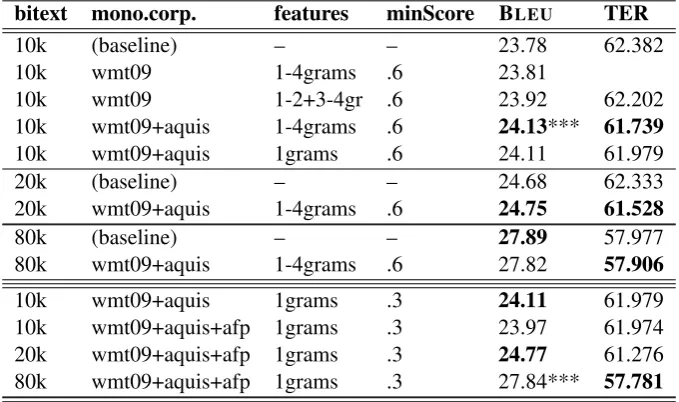
Results are shown in Table 4. We used BLEU
over lowercased outputs to evaluate all S2E sys-tems, and Koehn’s significance test as above.
On the S2E 10,000-line subset, both the1grams
and1-4gramsmodels achieved significant gains of .4 BLEUpoints over the baseline. We concluded
from a manual evaluation of the 10,000-line mod-els that the two major weaknesses of the baseline system were (not surprisingly) number of untrans-lated (OOV) words / phrases, followed by number of superfluous words / phrases.
On the larger subset models, no system sig-nificantly outperformed the baseline. Note that our S2E baselines’ scores are higher than those of Callison-Burchet al.(2006), since we evaluate lowercased outputs, instead of recased ones.
6 Discussion and Future Work
We have shown that monolingually-derived para-phrases, based on distributional semantic similar-ity measures over a source-language corpus, can improve the performance of statistical machine translation (SMT) systems. Our proposed method has the advantage of not relying on bitexts in order to generate the paraphrases, and therefore gives access to large amounts of monolingual training data, for which creating bitexts of equivalent size is generally unfeasible. We haven’t trained our
1http://www.statmt.org/wmt09 2http://wt.jrc.it/lt/Acquis
system on nearly as large a corpus as it can han-dle, and indeed we see this as a natural next step.
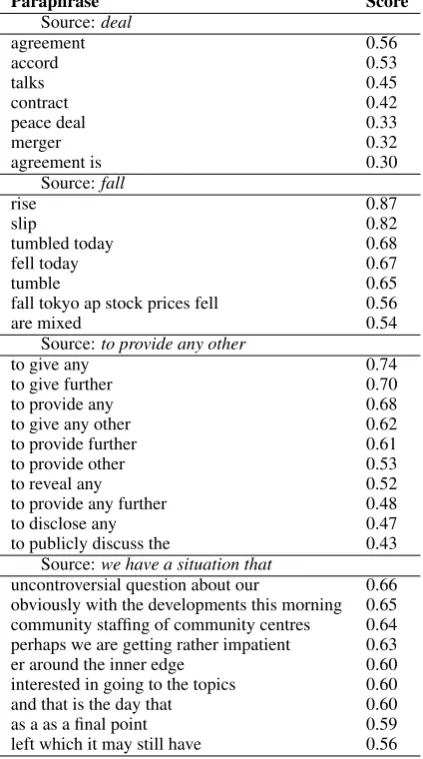
Results support the assumption that a larger monolingual paraphrase training set yields bet-ter paraphrases: our S2E 1-4grams model per-formed significantly better than baseline when us-ingwmt09+aquisfor paraphrasing, but when only using wmt09, the model had a smaller advantage that did not reach significance. However, for the S2E1gramsmodel, there was a slight decrease in performance when switching paraphrasing corpus fromwmt09+aquistowmt09+aquis+afp. This ef-fect might be due to the genre or unbalanced con-tent of the additional corpus, or perhaps it is the case that in this corpus size, paraphrases of higher-level ngrams benefitted from the additional text much more than paraphrases of unigrams did. The two rightmost columns in Table 5 show that al-though Spanish monolingual paraphrases for the unigrambaileimprove when using the larger cor-pus, (e.g.,danzaandun baliebecome the third and fourth top candidates, pushing much worse candi-dates far down the list), the two top paraphrase candidates remained unchanged. However, for the 4gram a favor del informe, antonymous can-didates, which are bad and misleading for trans-lation, are pushed down from the top first and third spots by synonymous, better candidates. Ta-ble 3 contains additional examples of good and bad top paraphrase candidates, also in English. Paraphrases of phrases seem to be of lower qual-ity than those of unigrams, as can be seen at the bottom of the table.
These results also show that our method is es-pecially useful in settings involving low-density languages or special domains: The smaller sub-set models, emulating a resource-poor language situation, show higher gains than larger models (which are supersets of the smaller subset models), when augmented with paraphrases derived from the same paraphrase training set. This was vali-dated in two very different language pairs: English to Chinese, and Spanish to English. We believe that larger monolingual training sets for paraphras-ing can help languages with richer resources, and we intend to explore this too.
Although the gains in the Spanish-English sub-sets are somewhat smaller than the pivoting tech-nique reported in Callison-Burch et al. (2006), e.g., .7 BLEU for the 10k subset, we take these
bitext mono.corp. features minScore BLEU TER
10k (baseline) – – 23.78 62.382
10k wmt09 1-4grams .6 23.81
10k wmt09 1-2+3-4gr .6 23.92 62.202
10k wmt09+aquis 1-4grams .6 24.13*** 61.739
10k wmt09+aquis 1grams .6 24.11 61.979
20k (baseline) – – 24.68 62.333
20k wmt09+aquis 1-4grams .6 24.75 61.528
80k (baseline) – – 27.89 57.977
80k wmt09+aquis 1-4grams .6 27.82 57.906
10k wmt09+aquis 1grams .3 24.11 61.979 10k wmt09+aquis+afp 1grams .3 23.97 61.974 20k wmt09+aquis+afp 1grams .3 24.77 61.276 80k wmt09+aquis+afp 1grams .3 27.84*** 57.781
Table 4: S2E Results: Lowercase BLEU and TER. Paraphrases with score <minScorewere filtered out.
*** = significance test over baseline withp <0.0001, using Koehn’s (2004) pair-wise bootstrap test for BLEUwith 95% confidence interval.
pivot wmt09+acquis wmt09+acquis+afp
Source:baile
danza el baile el baile
bailar baile y baile y
a de david palomar y la danza
dans viejo como quien se acomoda una un baile empresa por julián estrada el tercero de teatro
coro al baile a la baloncesto el cine
Source:a favor del informe
a favor de este informe en contra del informe favor del informe favor del informe a favor de este informe en contra del informe el informe en contra de este informe a favor de este informe a favor a favor de la resolución en contra de este informe por el informe a favor de esta resolución en contra de la resolución al informe a favor del informe del señor a favor del informe del sr. su a favor del informe del sr. en contra del informe del sr. del informe en contra de la propuesta a favor del excelente informe de este informe contra el informe a favor del informe deprez
Table 5: Comparison of Spanish paraphrases: by pivoting, and by two monolingual corpora. Ordered from best to worst score.
system example
source cuando escucho las distintas intervenciones , creo que quienes afirman que deberíamos analizar nuestras prioridades y limitar el número de objetivos que queremos conseguir , están en lo cierto . reference when i listen to the various comments made , i find myself agreeing with those who recommend
that we take a look at our priorities and then limit the number of aims we want to achieve baseline escuchowhen the various speeches, i believe that those whoafirmanthat we should our
environmentallimitarpriorities and the number of objectives we want to achieve, are in this way. pivoting (MW) when i canhearthe various speeches , i believe that those people that we should look at our
priorities and tolimitthe number of objectives we want to achieve , are in fact .
wmt09+acquis escuchowhen the various speeches, i believe that those whoclaimingthat we should environmental .1-4grams limitarour priorities and the number of objectives we want to achieve, are on the way.
[image:8.595.71.411.72.273.2]wmt09+acquis escuchowhen the various speeches, i believe that those whoconsideredthat we should our .1grams environmental priorities andreducingthe number of objectives we want to achieve, are on the way. wmt09+acquis+afp escuchowhen the various speeches, i believe that those whosaythat we should our environmental .1grams priorities andreducethe number of objectives we want to achieve, are on the way.
gains with larger monolingual training sets. Pivot-ing techniques (translatPivot-ing back and forth) rely on limited resources (bitexts), and are subject to shifts in meaning due to their inherent double transla-tion step. In contrast, large monolingual resources are relatively easy to collect, and our system in-volves only a single translation/paraphrasing step per target phrase. Table 5 also shows an exemplar comparison with the pivoting paraphrases used in Callison-Burch et al.(2006). It seems that the piv-oting paraphrases might suffer more from having frequent function words as top candidates, which might be a by-product of their alignment “promis-cuity”. However, the top antonymous candidate problem seems to mainly plague the monolin-gual distributional paraphrases (but improves with larger corpora). See also Table 6.
The paraphrase quality remains an issue with this method (as with all other paraphrasing meth-ods). Some possible ways of improving it, be-sides using larger corpora, are: using syntactic in-formation (Callison-Burch, 2008), using semantic knowledge such as thesaurus or WordNet to per-form word sense disambiguation (WSD) (Resnik, 1999; Mohammad and Hirst, 2006), improving the similarity measure, and refining the similarity threshold. We would like to explore ways of incor-porating syntactic knowledge that do not sacrifice coverage as much as in Callison-Burch (2008); in-corporating semantic knowledge to disambiguate phrasal senses; using context to help sense disam-biguation (Erk and Padó, 2008); and optimizing the similarity threshold for use in SMT, for exam-ple on a held-out dataset: too high a threshold re-duces coverage, while too low a threshold results in bad paraphrases and translation.
The method presented here is quite general, and therefore different similarity measures, including other corpus-based ones, can be plugged in to gen-erate paraphrases. We are looking into using DPs with word-sense disambiguation: Since it has been shown that similarity is often judged by the se-mantic distance of the closest senses of the two target words (Mohammad and Hirst, 2006), and that paraphrases generated this way are likely to be of higher quality (Marton et al., 2009), hence it is also likely that the overall performance of an SMT system using them will also improve further. One potential advantage of using bitexts for paraphrase generation is the usage of implicit hu-man knowledge, i.e., sentence alignments. The
concern that not using this knowledge would turn out detrimental to the performance of SMT sys-tems augmented by paraphrases as described here was largely put to rest, as our method improved the tested subset SMT systems’ quality.
Acknowledgments
Many thanks to Chris Dyer for his help with the E2C set, and to Adam Lopez for his imple-mentation of pattern matching with Suffix Ar-ray. This research was partially supported by the GALE program of the Defense Advanced Re-search Projects Agency, Contract No. HR0011-06-2-001 and NSF award 0838801, by the Euro-MatrixPlus project funded by the European Com-mission, and by the US National Science Foun-dation under grant IIS-0713448. The views and findings are the authors’ alone.
References
Regina Barzilay and Kathleen McKeown. 2001.
Ex-tracting paraphrases from a parallel corpus. In
Pro-ceedings of ACL-2001.
P.F. Brown, S.A.D. Pietra, V.J.D. Pietra, and R.L. Mer-cer. 1993. The mathematics of statistical machine
translation. Computational Linguistics, 19(2):263–
313.
Lou Burnard. 2000. Reference Guide for the British
National Corpus. Oxford University Computing Services, Oxford, England, world edition edition. Chris Callison-Burch, Philipp Koehn, and Miles
Os-borne. 2006. Improved statistical machine
trans-lation using paraphrases. In Proceedings
NAACL-2006.
Chris Callison-Burch. 2008. Syntactic constraints on
paraphrases extracted from parallel corpora. In
Pro-ceedings of EMNLP 2008, Waikiki, Hawai’i. David Chiang. 2005. A hierarchical phrase-based
model for statistical machine translation. In
Pro-ceedings of ACL-05, pages 263–270.
David Chiang. 2007. Hierarchical phrase-based
trans-lation. Computational Linguistics, 33(2):201–228.
Mona Diab and Steve Finch. 2000. A statistical word-level translation model for comparable corpora. In
Proceedings of the Conference on Content-Based Multimedia Information Access (RIAO).
B. Dolan, C. Quirk, and C. Brockett. 2004. Unsu-pervised construction of large paraphrase corpora:
exploiting massively parallel news sources. In
Pro-ceedings of the 20th International Conference on Computational Linguistics of the Association for Computational Linguistics, Geneva, Switzerland. T. Dunning. 1993. Accurate methods for the statistics
of surprise and coincidence. Computational
Katrin Erk and Sebastian Padó. 2008. A struc-tured vector space model for word meaning in
con-text. InProceedings of the Conference on Empirical
Methods in Natural Language Processing (EMNLP-2086), pages 897–906, Honolulu, HI.
John R. Firth. 1957. A synopsis of linguistic theory
1930 ˝U55. Studies in Linguistic Analysis, (special
volume of the Philological Society):1–32. Distribu-tional Hypothesis.
Pascale Fung and Percy Cheung. 2004.
Multi-level bootstrapping for extracting parallel sentences
from a quasi-comparable corpus. InProceedings of
the 20th international conference on Computational Linguistics, page 1051, Geneva, Switzerland. Asso-ciation for Computational Linguistics.
Pascale Fung and Lo Yuen Yee. 1998. An ir approach for translating new words from nonparallel,
com-parable texts. InProceedings of COLING-ACL98,
pages 414–420, Montreal, Canada.
Zellig S. Harris. 1940. Review of louis h. gray, foun-dations of language (new york: Macmillan, 1939).
Language, 16(3):216 ˝U231.
Philipp Koehn, Franz Josef Och, and Daniel Marcu.
2003. Statistical phrase-based translation. In
Pro-ceedings of HLT-NAACL, pages 127–133.
Philipp Koehn, Hieu Hoang, Alexandra Birch, Chris Callison-Burch, Marcello Federico, Nicola Bertoldi, Brooke Cowan, Wade Shen, Christine Moran Richard Zens, Chris Dyer, Ondrej Bojar, Alexandra Constantin, and Evan Herbst. 2007. Moses: Open source toolkit for statistical machine
translation. InAnnual Meeting of the Association
for Computational Linguistics (ACL), demonstration session, Prague, Czech Republic.
Philipp Koehn. 2004. Statistical significance tests for
machine translation evaluation. InProc. EMNLP.
Philipp Koehn. 2004b. Pharaoh: A beam search de-coder for phrase-based statistical machine
transla-tion models. InProceedings of AMTA.
Philipp Koehn. 2005. A parallel corpus for statistical
machine translation. InProceedings of MT-Summit.
Dekang Lin. 1998. An information-theoretic
defini-tion of similarity. In Proceedings of the 15th
In-ternational Conference on Machine Learning, pages 296–304, San Francisco, CA.
Nitin Madnani, Necip Fazil Ayan, Philip Resnik, and Bonnie Dorr. 2007. Using paraphrases for
parame-ter tuning in statistical machine translation. In
Pro-ceedings of the ACL Workshop on Statistical Ma-chine Translation.
Yuval Marton, Saif Mohammad, and Philip Resnik. 2009. Estimating semantic distance using soft se-mantic constraints in knowledge-source / corpus
hy-brid models. InProcedings of EMNLP, Singapore.
S. McDonald. 2000. Environmental determinants of
lexical processing effort. Ph.D. thesis, University of Edinburgh.
Saif Mohammad and Graeme Hirst. 2006. Distribu-tional measures of concept-distance: A task-oriented
evaluation. In Proceedings of the Conference on
Empirical Methods in Natural Language Processing (EMNLP-2006), Sydney, Australia.
Dragos Stefan Munteanu and Daniel Marcu. 2005. Im-proving machine translation performance by
exploit-ing non-parallel corpora. Computational
Linguis-tics, 31(4):477–504.
Doug Oard, David Doermann, Bonnie Dorr, Daqing He, Phillip Resnik, William Byrne, Sanjeeve Khu-danpur, David Yarowsky, Anton Leuski, Philipp Koehn, and Kevin Knight. 2003. Desperately
seek-ing cebuano. InProceedings of HLT-NAACL.
Franz Josef Och and Hermann Ney. 2000. Improved
statistical alignment models. InProceedings of the
38th Annual Meeting of the ACL, pages 440–447. Franz Josef Och and Hermann Ney. 2002.
Discrimina-tive training and maximum entropy models for
sta-tistical machine translation. InProceedings of ACL.
Franz Josef Och. 2003. Minimum error rate training
in statistical machine translation. InProceedings of
the 41st Annual Meeting of the ACL, pages 160–167. Kishore Papineni, Salim Roukos, Todd Ward, John Henderson, and Florence Reeder. 2002. Corpus-based comprehensive and diagnostic MT evaluation: Initial Arabic, Chinese, French, and Spanish results. InProceedings of the ACL Human Language Tech-nology Conference, pages 124–127, San Diego, CA. Reinhard Rapp. 1999. Automatic identification of word translations from unrelated english and german
corpora. InProceedings of the 37th Annual
Confer-ence of the Association for Computational Linguis-tics., pages 519–525.
Philip Resnik and Noah Smith. 2003. The web
as a parallel corpus. Computational Linguistics,
29(3):349–380.
Philip Resnik. 1999. Semantic similarity in a taxon-omy: An information-based measure and its appli-cation to problems of ambiguity in natural language.
Journal of Artificial Intelligence Research (JAIR), 11:95–130.
Hinrich Schuetze and Jan O. Pedersen. 1997. A cooccurrence-based thesaurus and two applications
to information retreival. Information Processing
and Management, 33(3):307 ˝U318.
Matthew Snover, Bonnie J. Dorr, Richard Schwartz, John Makhoul, Linnea Micciulla, and Ralph Weischedel. 2005. A study of translation error rate with targeted human annotation. Technical Report LAMP-TR-126, CS-TR-4755, UMIACS-TR-2005-58, University of Maryland, July, 2005.
Huihsin Tseng, Pichuan Chang, Galen Andrew, Daniel Jurafsky, and Christopher Manning. 2005. A
con-ditional random field word segmenter. In Fourth