What’s with the Attitude? Identifying Sentences with Attitude in Online
Discussions
Ahmed Hassan Vahed Qazvinian
University of Michigan Ann Arbor Ann Arbor, Michigan, USA
hassanam,vahed,[email protected]
Dragomir Radev
Abstract
Mining sentiment from user generated content is a very important task in Natural Language Processing. An example of such content is threaded discussions which act as a very im-portant tool for communication and collabo-ration in the Web. Threaded discussions in-clude e-mails, e-mail lists, bulletin boards, newsgroups, and Internet forums. Most of the work on sentiment analysis has been centered around finding the sentiment toward products or topics. In this work, we present a method to identify the attitude of participants in an online discussion toward one another. This would enable us to build a signed network representation of participant interaction where every edge has a sign that indicates whether the interaction is positive or negative. This is different from most of the research on so-cial networks that has focused almost exclu-sively on positive links. The method is exper-imentally tested using a manually labeled set of discussion posts. The results show that the proposed method is capable of identifying at-titudinal sentences, and their signs, with high accuracy and that it outperforms several other baselines.
1 Introduction
Mining sentiment from text has a wide range of applications from mining product reviews on the Web (Morinaga et al., 2002; Turney and Littman, 2003) to analyzing political speeches (Thomas et al., 2006). Automatic methods for sentiment mining are very important because manual extraction of them is very costly, and inefficient. A new application of sentiment mining is to automatically identify atti-tudes between participants in an online discussion. An automatic tool to identify attitudes will enable
us to build a signed network representation of par-ticipant interaction in which the interaction between two participants is represented using a positive or a negative edge. Even though using signed edges in social network studies is clearly important, most of the social networks research has focused only on positive links between entities. Some work has re-cently investigated signed networks (Leskovec et al., 2010; Kunegis et al., 2009), however this work was limited to a few number of datasets in which users were allowed to explicitly add negative, as well as positive, relations. This work will pave the way for research efforts to examine signed social networks in more detail. It will also allow us to study the re-lation between explicit rere-lations and the text under-lying those relation.
Although similar, identifying sentences that dis-play an attitude in discussions is different from iden-tifying opinionated sentences. A sentence in a dis-cussion may bear opinions about a definite target (e.g., price of a camera) and yet have no attitude to-ward the other participants in the discussion. For in-stance, in the following discussion Alice’s sentence has her opinion against something, yet no attitude toward the recipient of the sentence, Bob.
Alice: “You know what, he turned out to be a great disappointment”
Bob: “You are completely unqualified to judge this great person”
However, Bob shows strong attitude toward Alice. In this work, we look at ways to predict whether a sentence displays an attitude toward the text recip-ient. An attitude is the mental position of one par-ticipant with regard to another parpar-ticipant. it could be either positive or negative. We consider features which takes into account the entire structure of sen-tences at different levels or generalization. Those
features include lexical items, part-of-speech tags, and dependency relations. We use all those patterns to build several pairs of models that represent sen-tences with and without attitude.
The rest of the paper is organized as follows. In Section 2 we review some of the related prior work on identifying polarized words and subjectivity anal-ysis. We explain the problem definition and discuss our approach in Sections 3 & 4. Finally, in Sec-tions 5 & 6 we introduce our dataset and discuss the experimental setup. Finally, we conclude in Section 7.
2 Related Work
Identifying the polarity of individual words is a well studied problem. In previous work, Hatzivassiloglou and McKeown (1997) propose a method to iden-tify the polarity of adjectives. They use a manu-ally labeled corpus to classify each conjunction of an adjective as “the same orientation” as the adjec-tive or “different orientation”. Their method can label simple in “simple and well-received” as the same orientation and simplistic in “simplistic but received” as the opposite orientation of well-received. Although the results look promising, the method would only be applicable to adjectives since noun conjunctions may collocate regardless of their semantic orientations (e.g., “rise and fall”).
In other work, Turney and Littman (2003) use sta-tistical measures to find the association between a given word and a set of positive/negative seed words. In order to get word co-occurrence statistics they use the “near” operator from a commercial search en-gine on a given word and a seed word.
In more recent work, Takamura et al. (2005) used the spin model to extract word semantic orientation. First, they construct a network of words using def-initions, thesaurus, and co-occurrence statistics. In this network, each word is regarded as an electron, which has a spin and each spin has a direction tak-ing one of two values: up or down. Then, they use the energy point of view to propose that neighboring electrons tend to have the same spin direction, and therefore neighboring words tend to have the same polarity orientations. Finally, they use the mean field method to find the optimal solution for electron spin directions.
Previous work has also used WordNet, a lexi-cal database of English, to identify word polarity. Specifically, Hu and Liu (2004) use WordNet syn-onyms and antsyn-onyms to predict the polarity of any given word with unknown polarity. They label each word with the polarity of its synonyms and the op-posite polarity of its antonyms. They continue in a bootstrapping manner to label all unlabeled in-stances. This work is very similar to (Kamps et al., 2004) in which a network of WordNet synonyms is used to find the shortest path between any given word, and the words “good” and “bad”. Kim and Hovy (Kim and Hovy, 2004) used WordNet syn-onyms and antsyn-onyms to expand two lists of positive and negative seed words. Similarly, Andreevskaia and Bergler (2006) used WordNet to expand seed lists with fuzzy sentiment categories, in which words could be more central to one category than the other. Finally, Kanayama and Nasukawa (2006) used syn-tactic features and context coherency, defined as the tendency for same polarities to appear successively, to acquire polar atoms.
opinion about some topic yet no attitude. The lan-guage constituents considered in opinion detection may be different from those used to detect attitude. Moreover, extracting attitudes from online discus-sions is different from targeting subjective expres-sions (Josef Ruppenhofer and Wiebe, 2008; Kim and Hovy, 2004). The later usually has a limited set of targets that compete for the subjective expres-sions (for example in movie review, targets could be: director, actors, plot, and so forth). We cannot use similar methods because we are working on an open domain where anything could be a target. A very de-tailed survey that covers techniques and approaches in sentiment analysis and opinion mining could be found in (Pang and Lee, 2008).
There is also some related work on mining on-line discussions. Lin et al (2009) proposes a sparse coding-based model simultaneously model seman-tics and structure of threaded discussions. Shen et al (2006) proposes three clustering methods for exploiting the temporal information in the streams, as well as an algorithm based on linguistic fea-tures to analyze the discourse structure information. Huang et al (2007) used an SVM classifier to extract (thread-title, reply) pairs as chat knowledge from on-line discussion forums to support the construction of a chatbot for a certain domain. Other work has focused on the structure of questions and question-answer pairs in online forums and discussions (Ding et al., 2008; Cong et al., 2008).
3 Problem Definition
Assume we have a set of sentences exchanged be-tween participants in an online discussion. Our ob-jective is to identify sentences that display an atti-tude from the text writer to the text recepient from those that do not. An attitude is the mental posi-tion of one particpant with regard to another partic-ipant. An attitude may not be directly observable, but rather inferred from what particpants say to one another. The attitude could be either positive or neg-ative. Strategies for showing a positive attitude may include agreement, and praise, while strategies for showing a negative attitude may include disagree-ment, insults, and negative slang. After identifying sentences that display an attitude, we also predict the sign (positive or negative) of that attitude.
4 Approach
In this section, we describe a model which, given a sentence, predicts whether it carries an attitude from the text writer toward the text recipient or not. Any given piece of text exchanged between two partici-pants in a discussion could carry an attitude toward the text recipient, an attitude towards the topic, or no attitude at all. As we are only interested in at-titudes between participants, we limit our study to sentences that use second person pronouns. Second person pronouns are usually used in conversational genre to indicate that the text writer is addressing the text recipient. After identifying those sentences, we do some pre-processing to extract the most relevant fragments. We examine these fragments to to iden-tify the polarity of every word in the sentence. Every word could be assigned a semantic orientation. The semantic orientation could be either positive, nega-tive, or neutral. The existence of polarized words in any sentence is an important indicator of whether it carries an attitude or not.
The next step is to extract several patterns at different levels of generalization representing any given sentence. We use those patterns to build two Markov models for every kind of patterns. The first model characterizes the relation between different tokens for all patterns that correspond to sentences that have an attitude. The second model is similar to the first one, but it uses all patterns that correspond to sentences that do not have an attitude. Given a new sentence, we extract the corresponding patterns and estimate the likelihood of every pattern being generated from the two corresponding models. We then compare the likelihood of the sentence under the two models and use this as a feature to predict the existence of an attitude. A pair of models will be built for every kind of patterns. If we haven dif-ferent patterns, we will havendifferent likelihood ratios that come fromnpairs of models.
4.1 Word Polarity Identification
re-lated words based on synonyms, hypernyms, and similar to relations. For words that do not appear in Wordnet, we used Wiktionary, a collaboratively constructed dictionary. We also add some links based on co-occurrence statistics between words as from a large corpus. The resulting graph is a graph
G(W, E)where W is a set of word/part-of-speech pairs, andE is the set of edges connecting related words.
We define a random walk model on the graph, where the set of nodes correspond to the state space of the random walk. Transition probabilities are cal-culated by normalizing the weights of the edges out of every node. LetS+andS−be two sets of ver-tices representing seed words that are already la-beled as either positive or negative respectively. We used the list of labeled seeds from (Hatzivassiloglou and McKeown, 1997) and (Stone et al., 1966). For any given word w, we calculate the mean hitting time betweenw, and the two seed setsh(w|S+), and
h(w|S−). The mean hitting timeh(i|k)is defined as the average number of steps a random walker, start-ing in statei 6= k, will take to enter statekfor the first time (Norris, 1997). Ifh(w|S+)is greater than
h(w|S−), the word is classified as negative, oth-erwise it is classified as positive. We also use the method described in (Wilson et al., 2005) to deter-mine the contextual polarity of the identified words. The set of features used to predict contextual polar-ity include word, sentence, polarpolar-ity, structure, and other features.
4.2 Identifying Relevant Parts of Sentences
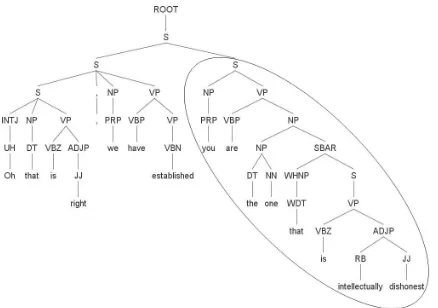
The writing style in online discussion forums is very informal. Some of the sentence are very long, and punctuation marks are not always properly used. To solve this problem, we decided to use the grammat-ical structure of sentences to identify the most rele-vant part of sentences that would be the subject of further analysis. Figure 1 shows a parse tree repre-senting the grammatical structure of a particular sen-tence. If we closely examine the sentence, we will notice that we are only interested in a part of the sentence that includes the second person pronoun ”you“. We extract this part, by starting at the word of interest , in this case ”you“, and go up in the hi-erarchy till we hit the first sentence clause. Once, we reach a sentence clause, we extract the
[image:4.612.315.534.121.275.2]corre-sponding text if it is grammatical, otherwise we go up one more level to the closest sentence clause. We used the Stanford parser to generate the grammatical structure of sentences (Klein and Manning, 2003).
Figure 1: An example showing how to identify the rele-vant part of a sentence.
4.3 Sentences as Patterns
The fragments we extracted earlier are more rele-vant to our task and are more suitable for further analysis. However, these fragments are completely lexicalized and consequently the performance of any analysis based on them will be limited by data spar-sity. We can alleviate this by using more general representations of words. Those general representa-tions can be used a long with words to generate a set of patterns that represent each fragment. Each pat-tern consists of a sequence of tokens. Examples of such patterns could use lexical items, part-of-speech (POS) tags, word polarity tags, and dependency re-lations.
We use three different patterns to represent each fragments:
• Lexical patterns: All polarized words are re-places with the corresponding polarity tag, and all other words are left as is.
• Part-of-speech patterns: All words are replaced with their POS tags. Second person pronouns are left as is. Polarized words are replaced with their polarity tags and their POS tags.
to the closed polarized word is extracted. The second person pronoun, the polarized word tag, and the types of the dependency relations along the path connecting them are used as a pat-tern. It has been shown in previous work on relation extraction that the shortest path be-tween any two entities captures the the in-formation required to assert a relationship be-tween them (Bunescu and Mooney, 2005). Ev-ery polarized word is assigned to the closest second person pronoun in the dependency tree. This is only useful for sentences that have po-larized words.
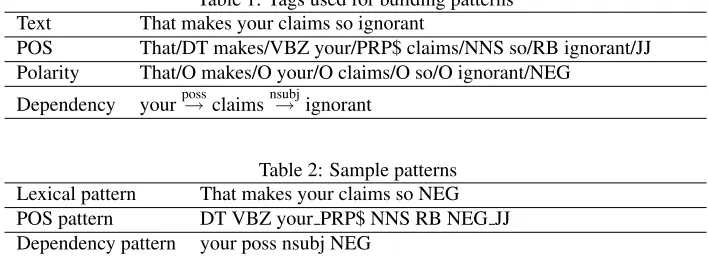
Table 1 shows the different kinds of representa-tions for a particular sentence. We use text, part-of-speech tags, polarity tags, and dependency rela-tions. The corresponding patterns for this sentence are shown in Table 2.
4.4 Building the Models
Given a set of patterns representing a set of sen-tences, we can build a graph G = V, E, w where
V is the set of all possible token that may appear in the patterns. E = V ×V is the set of possible transitions between any two tokens. w:E → [0..1] is a weighting function that assigns to every pair of states(i, j)a weightw(i, j)representing the proba-bility that we have a transition from stateito state
j.
This graph corresponds to a Markovian model. The set of states are the vocabulary, and the the tran-sition probabilities between states are estimated us-ing Maximum Likelihood estimation as follows:
Pij = Nij
Ni
whereNij is the number of times we saw a transition
fromito statej, andNiis the total number of times
we saw stateiin the training data. This is similar to building a language model over the language of the patterns.
We build two such models for every kind of pat-terns. The first model is built using all sentences that appeared in the training dataset and was labeled as having an attitude, and the second model is built us-ing all sentences in the trainus-ing dataset that do not have an attitude. If we havenkinds of patterns, we
will build one such pair for every kind of patterns. Hence, we will end up with2nmodels.
4.5 Identifying Sentences with Attitude
We split our training data into two splits; the first containing all sentences that have an attitude and the second containing all sentences that do not have an attitude. Given the methodology described in the previous section, we buildnpairs of Markov mod-els. Given any sentence, we extract the correspond-ing patterns and estimate the log likelihood that this sequence of tokens was generated from every model. Given a model M, and sequence of tokens T = (T1, T2, . . . T Sn), the probability of this token
se-quence being generated fromM is:
PM(T) = n
Y
i=2
P(Ti|T1, . . . , Ti−1) =
n
Y
i=2
W(Ti−1, Ti)
wherenis the number of tokens in the pattern, and
W is the probability transition function. The log likelihood is then defined as:
LLM(T) = n
X
i=2
logW(Ti−1, Ti)
For every pair of models, we may use the ratio be-tween the two likelihoods as a feature:
f = LLMatt(T)
LLMnoatt(T)
whereTis the token sequence,LLMatt(T)is the log
likelihood of the sequence given the attitude model, andLLMnoatt(T)is the log likelihood of the pattern
given the no-attitude model.
Given the n kinds of patterns, we can calculate three different features. A standard machine learn-ing classifier is then trained uslearn-ing those features to predict whether a given sentence has an attitude or not.
4.6 Identifying the Sign of an Attitude
Table 1: Tags used for building patterns Text That makes your claims so ignorant
POS That/DT makes/VBZ your/PRP$ claims/NNS so/RB ignorant/JJ Polarity That/O makes/O your/O claims/O so/O ignorant/NEG
Dependency yourposs→ claimsnsubj→ ignorant
Table 2: Sample patterns Lexical pattern That makes your claims so NEG POS pattern DT VBZ your PRP$ NNS RB NEG JJ Dependency pattern your poss nsubj NEG
words, it is classified as positive. If the sentence has only negative and neutral words, it is classified as negative. If the sentence has both positive and negative words, we calculate the summation of the polarity scores of all positive words and that of all negative words. The polarity score of a word is an indicator of how strong of a polarized word it is. If the former is greater, we classify the sentence as pos-itive,otherwise we classify the sentence as negative. The problem with this method is that it assumes that all polarized words in a sentence with an atti-tude target the text recipient. Unfortunately, that is not always correct. For example, the sentence ”You are completely unqualified to judge this great per-son” has a positive word ”great” and a negative word ”unqualified”. The first method will not be able to predict whether the sentence is positive or negative. To solve this problem, we use another method that is based on the paths that connect polarized words to second person pronouns in a dependency parse tree. For every positive wordw, we identify the shortest path connecting it to every second person pronoun in the sentence then we compute the average length of the shortest path connecting every positive word to the closest second person pronoun. We repeat for negative words and compare the two values. The sentence is classified as positive if the average length of the shortest path connecting positive words to the closest second person pronoun is smaller than the corresponding value for negative words. Otherwise, we classify the sentence as negative.
5 Data
Our data was randomly collected from a set of dis-cussion groups. We collected a large number of
threads from the first quarter of 2009 from a set of Usenet discussion groups. All threads were in En-glish, and had 5 posts or more. We parsed the down-loaded threads to identify the posts and senders. We kept posts that have quoted text and discarded all other posts. The reason behind that is that partici-pants usually quote other participartici-pants text when they reply to them. This restriction allows us to iden-tify the target of every post, and raises the proba-bility that the post will display an attitude from its writer to its target. We plan to use more sophsticated methods for reconstructing the reply structure like the one in (Lin et al., 2009). From those posts, we randomly selected approximately 10,000 sentences that use second person pronouns. We explained ear-lier how second person pronouns are used in discus-sions genres to indicate the writer is targeting the text recipient. Given a random sentence selected from some random discussion thread, the probabil-ity that the sentence does not have an attitude is sig-nificantly larger than the probability that it will have an attitude. Hence, restricting our dataset to posts with quoted text and sentences with second person pronouns is very important to make sure that we will have a considerable amount of attitudinal sen-tences. The data was tokenized, sentence-split, part-of-speech tagged with the OpenNLP toolkit. It was parsed with the Stanford dependency parser (Klein and Manning, 2003).
5.1 Annotation Scheme
A B C D
A - 82.7 80.6 82.1
B 81.0 - 81.9 82.9
C 77.8 78.2 - 83.8
D 78.3 77.7 78.6
-Table 3: Inter-annotator agreement
Agreement, and praise are indicators of positive at-titude. Our annotators were instructed to read every sentence and assign two labels to it. The first speci-fies whether the sentence displays an attitude or not. The existence of an attitude was judged on a three point scale: attitude, unsure, and no-attitude. The second is the sign of the attitude. If an attitude ex-ists, annotators were asked to specify whether the attitude is positive or negative. To evaluate inter-annotator agreement, we use theagr operator pre-sented in (Wiebe et al., 2005). This metric measures the precision and recall of one annotator using the annotations of another annotator as a gold standard. The process is repeated for all pairs of annotators, and then the harmonic mean of all values is reported. Formally:
agr(A|B) = |A∩B|
|A| (1)
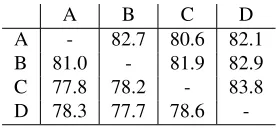
whereA, andBare the annotation sets produced by the two reviewers. Table 3 shows the value of the
agr operator for all pairs of annotators. The har-monic mean of the agr operator is 80%. The agr
operator was used over the Kappa Statistic because the distribution of the data was fairly skewed.
6 Experiments
6.1 Experimental Setup
We performed experiments on the data described in the previous section. The number of sentences with an attitude was around 20% of the entire dataset. The class imbalance caused by the small number of attitude sentences may hurt the performance of the learning algorithm (Provost, 2000). A common way of addressing this problem is to artificially rebal-ance the training data. To do this we down-sample the majority class by randomly selecting, without replacement, a number of sentences without an at-titude that equals the number of sentences with an
attitude. That resulted in a balanced subset, approx-imately4000sentences, that we used in our experi-ments.
We used Support Vector Machines (SVM) as a classifier. We optimized SVM separately for every experiment. We used 10-fold cross validation for all tests. We evaluate our results in terms of precision, recall, accuracy, and F1. Statistical significance was tested using a 2-tailed paired t-test. All reported re-sults are statistically significant at the 0.05 level. We compare the proposed method to several other base-lines that will be described in the next subsection. We also perform experiments to measure the perfor-mance if we mix features from the baselines and the proposed method.
6.2 Baselines
The first baseline is based on the hypothesis that the existence of polarized words is a strong indicator that the sentence has an attitude. As a result, we use the number of polarized word in the sentence, the percentage of polarized words to all other words, and whether the sentences has polarized words with mixed or same sign as features to train an SVM clas-sifier to detect attitude.
The second baseline is based on the proximity be-tween the polarized words and the second person pronouns. We assume that every polarized word is associated with the closest second person pronoun. Letw be a polarized word and p(w) be the closes second person pronoun, andsurf dist(w, p(w))be the surface distance betweenwandp(w). This base-line uses the minimum, maximum, and average of
surf dist(w, p(w))for all polarized words as fea-tures to train an SVM classifier to identify sentences with attitude.
[image:7.612.116.254.53.117.2]Figure 2: Accuracy, Precision, and Recall for the Pro-posed Approach and the Baselines.
0 10 20 30 40 50 60 70 80 90 100 0
10 20 30 40 50 60 70 80 90 100
Recall
Precision
[image:8.612.82.292.63.185.2]MM SurfDist DepDist Pol
Figure 3: Precision Recall Graph.
6.3 Results and Discussion
Figure 2 compares the accuracy, precision, and re-call of the proposed method (ML), the polarity based classifier (POL), the surface distance based classi-fier (Surf Dist), and the dependency distance based classifier (Dep Dist). The values are selected to opti-mize F1. The figure shows that the surface distance based classifier behaves poorly with low accuracy, precision, and recall. The two other baselines be-have poorly as well in terms of precision and accu-racy, but they do very well in terms of recall. We looked at some of the examples to understand why those two baselines achieve very high recall. It turns out that they tend to predict most sentences that have polarized words as sentences with attitude. This re-sults in many false positives and low true negative rate. Achieving high recall at the expense of losing precision is trivial. On the other hand, we notice that
0 10 20 30 40 50 60 70 80 90 100 75
76 77 78 79 80 81 82
Training Set Size (%)
Accuracy
Figure 4: Accuracy Learning Curve for the Proposed Method.
the proposed method results in very close values of precision and recall at the optimum F1 point.
To better compare the performance of the pro-posed method and the baseline, we study the the precision-recall curves for all methods in Figure 3. We notice that the proposed method outperforms all baselines at all operating points. We also notice that the proposed method provides a nice trade-off be-tween precision and recall. This allows us some flex-ibility in choosing the operating point. For example, in some applications we might be interested in very high precision even if we lose recall, while in other applications we might sacrifice precision in order to get high recall. On the other hand, we notice that the baselines always have low precision regardless of recall.
Table 4 shows the accuracy, precision, recall, and F1 for the proposed method and all baselines. It also shows the performance when we add features from the baselines to the proposed method, or merge some of the baselines. We see that we did not get any im-provement when we added the baseline features to the proposed method. We believe that the proposed method captures all the information captured by the baselines and more.
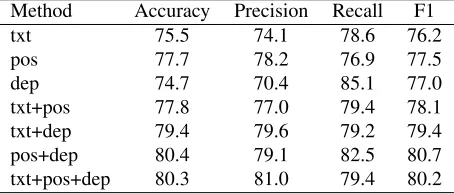
[image:8.612.77.278.245.411.2]to the performance we get when using all features in Table 5. We see that the part-of-speech patterns per-forms better than the text patterns. This makes sense because the former suffers from data sparsity. De-pendency patterns performs best in terms of recall, while part-of-speech patterns outperform all others in terms of precision, and accuracy. All pairs of features outperform any single feature that belong to the corresponding pair in terms of F1. We also notice that using the three features results in better performance when compared to all other combina-tions. This shows that every kind of pattern captures slightly different information when compared to the others. It also shows that merging the three features improves performance.
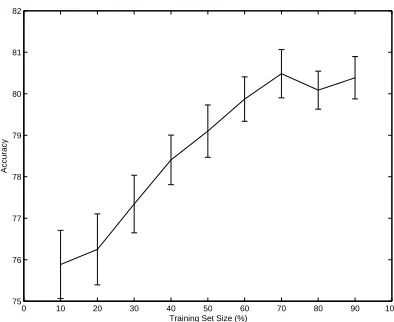
One important question is how much data is re-quired to the proposed model. We constructed a learning curve, shown in Figure 4, by fixing the test set size at one tenth of the data, and varying the training set size. We carried out ten-fold cross validation as with our previous experiments. We see that adding more data continues to increase the accu-racy, and that accuracy is quite sensitive to the train-ing data. This suggests that addtrain-ing more data to this model could lead to even better results.
We also measured the accuracy of the two meth-ods we proposed for predicting the sign of attitudes. The accuracy of the first model that only uses the count and scores of polarized words was95%. The accuracy of the second method that used depen-dency distance was97%.
6.4 Error Analysis
We had a closer look at the results to find out what are the reasons behind incorrect predictions. We found two main reasons. First, errors in predicting word polarity usually propagates and results in er-rors in attitude prediction. The reasons behind incor-rect word polarity predictions is ambiguity in word senses and infrequent words that have very few con-nection in thesaurus. A possible solution to this type of errors is to improve the word polarity identifica-tion module by including word sense disambigua-tion and adding more links to the words graph using glosses or co-occurrence statistics. The second rea-son is that some sentences are sarcastic in nature. It is so difficult to identify such sentences. Identify-ing sarcasm should be addressed as a separate
prob-Method Accuracy Precision Recall F1
ML 80.3 81.0 79.4 80.2
POL 73.1 66.4 93.9 77.7
ML+POL 79.9 77.9 83.4 80.5
SurfDist 70.2 67.1 79.2 72.7
DepDist 73.1 66.4 93.8 77.8
SurfDist+ 73.1 66.4 93.8 77.7
DepDist
ML+SurfDist 73.9 67.2 93.6 78.2
ML+DepDist 72.8 66.1 93.8 77.6
ML+SurfDist+ 74.0 67.2 93.4 78.2
DepDist
SurfDist+ 73.1 66.3 93.8 77.7
DepDist+POL
ML+SurfDist+ 73.0 66.2 93.8 77.6
DepDist+POL
Table 4: Precision, Recall, F1, and Accuracy for the pro-posed method, the baselines, and different combinations of proposed method and the baselines features
Method Accuracy Precision Recall F1
txt 75.5 74.1 78.6 76.2
pos 77.7 78.2 76.9 77.5
dep 74.7 70.4 85.1 77.0
txt+pos 77.8 77.0 79.4 78.1
txt+dep 79.4 79.6 79.2 79.4
pos+dep 80.4 79.1 82.5 80.7
txt+pos+dep 80.3 81.0 79.4 80.2
Table 5: Precision, Recall, F1, and Accuracy for different combinations of the proposed method’s features.
lem. A method that utilizes holistic approaches that takes context and previous interactions between dis-cussion participants into consideration could be used to address it.
7 Conclusions
only. It also allows us to study dynamics behind in-teractions in online discussions, the relation between text and social interactions, and how groups form and break in online discussions.
Acknowledgments
This research was funded by the Office of the Di-rector of National Intelligence (ODNI), Intelligence Advanced Research Projects Activity (IARPA), through the U.S. Army Research Lab. All state-ments of fact, opinion or conclusions contained herein are those of the authors and should not be construed as representing the official views or poli-cies of IARPA, the ODNI or the U.S. Government.
References
Alina Andreevskaia and Sabine Bergler. 2006. Mining wordnet for fuzzy sentiment: Sentiment tag extraction from wordnet glosses. InEACL’06.
Carmen Banea, Rada Mihalcea, and Janyce Wiebe. 2008. A bootstrapping method for building subjec-tivity lexicons for languages with scarce resources. In LREC’08.
Razvan C. Bunescu and Raymond J. Mooney. 2005. A shortest path dependency kernel for relation extrac-tion. In HLT ’05, pages 724–731, Morristown, NJ, USA. Association for Computational Linguistics. Gao Cong, Long Wang, Chin-Yew Lin, Young-In Song,
and Yueheng Sun. 2008. Finding question-answer pairs from online forums. InSIGIR ’08, pages 467– 474.
Shilin Ding, Gao Cong, Chin-Yew Lin, and Xiaoyan Zhu. 2008. Using conditional random fields to extract con-texts and answers of questions from online forums. In ACL’08, pages 710–718.
Vasileios Hatzivassiloglou and Kathleen R. McKeown. 1997. Predicting the semantic orientation of adjec-tives. InEACL’97, pages 174–181.
Vasileios Hatzivassiloglou and Janyce Wiebe. 2000. Ef-fects of adjective orientation and gradability on sen-tence subjectivity. InCOLING, pages 299–305. Minqing Hu and Bing Liu. 2004. Mining and
summariz-ing customer reviews. InKDD’04, pages 168–177. Jizhou Huang, Ming Zhou, and Dan Yang. 2007.
Ex-tracting chatbot knowledge from online discussion fo-rums. InIJCAI’07, pages 423–428.
Swapna Somasundaran Josef Ruppenhofer and Janyce Wiebe. 2008. Finding the sources and targets of subjective expressions. In Proceedings of the Sixth International Language Resources and Evalua-tion (LREC’08).
Jaap Kamps, Maarten Marx, Robert J. Mokken, and Maarten De Rijke. 2004. Using wordnet to measure semantic orientations of adjectives. InNational Insti-tute for, pages 1115–1118.
Hiroshi Kanayama and Tetsuya Nasukawa. 2006. Fully automatic lexicon expansion for domain-oriented sen-timent analysis. InEMNLP’06, pages 355–363. Soo-Min Kim and Eduard Hovy. 2004. Determining the
sentiment of opinions. InCOLING, pages 1367–1373. Dan Klein and Christopher D. Manning. 2003. Accurate
unlexicalized parsing. InACL’03, pages 423–430. J´erˆome Kunegis, Andreas Lommatzsch, and Christian
Bauckhage. 2009. The slashdot zoo: mining a so-cial network with negative edges. InWWW’09, pages 741–750, New York, NY, USA.
Jure Leskovec, Daniel Huttenlocher, and Jon Kleinberg. 2010. Predicting positive and negative links in online social networks. InWWW ’10, pages 641–650, New York, NY, USA. ACM.
Chen Lin, Jiang-Ming Yang, Rui Cai, Xin-Jing Wang, and Wei Wang. 2009. Simultaneously modeling se-mantics and structure of threaded discussions: a sparse coding approach and its applications. In SIGIR ’09, pages 131–138.
George A. Miller. 1995. Wordnet: a lexical database for english.Commun. ACM, 38(11):39–41.
Satoshi Morinaga, Kenji Yamanishi, Kenji Tateishi, and Toshikazu Fukushima. 2002. Mining product reputa-tions on the web. InKDD’02, pages 341–349. Tetsuya Nasukawa and Jeonghee Yi. 2003. Sentiment
analysis: capturing favorability using natural language processing. In K-CAP ’03: Proceedings of the 2nd international conference on Knowledge capture, pages 70–77.
J. Norris. 1997. Markov chains. Cambridge University Press.
Bo Pang and Lillian Lee. 2008. Opinion mining and sentiment analysis. Foundations and Trends in Infor-mation Retrieval, 2(1-2):1–135.
Ana-Maria Popescu and Oren Etzioni. Extracting prod-uct features and opinions from reviews. In HLT-EMNLP’05.
Foster Provost. 2000. Machine learning from imbal-anced data sets 101. InProceedings of the AAAI Work-shop on Imbalanced Data Sets.
Ellen Riloff and Janyce Wiebe. 2003. Learning extraction patterns for subjective expressions. In EMNLP’03, pages 105–112.
Dou Shen, Qiang Yang, Jian-Tao Sun, and Zheng Chen. 2006. Thread detection in dynamic text message streams. InSIGIR ’06, pages 35–42.
meetings. InProceedings of the SIGdial Workshop on Discourse and Dialogue.
Philip Stone, Dexter Dunphy, Marchall Smith, and Daniel Ogilvie. 1966. The general inquirer: A computer ap-proach to content analysis. The MIT Press.
Hiroya Takamura, Takashi Inui, and Manabu Okumura. 2005. Extracting semantic orientations of words using spin model. InACL’05, pages 133–140.
Matt Thomas, Bo Pang, and Lillian Lee. 2006. Get out the vote: Determining support or opposition from Congressional floor-debate transcripts. In EMNLP 2006, pages 327–335.
Peter Turney and Michael Littman. 2003. Measuring praise and criticism: Inference of semantic orientation from association. ACM Transactions on Information Systems, 21:315–346.
Janyce Wiebe, Theresa Wilson, and Claire Cardie. 2005. Annotating expressions of opinions and emotions in language. Language Resources and Evaluation, 1(2):0.
Janyce Wiebe. 2000. Learning subjective adjectives from corpora. In Proceedings of the Seventeenth National Conference on Artificial Intelligence and Twelfth Conference on Innovative Applications of Ar-tificial Intelligence, pages 735–740.
Theresa Wilson, Janyce Wiebe, and Paul Hoffmann. 2005. Recognizing contextual polarity in phrase-level sentiment analysis. In HLT/EMNLP’05, Vancouver, Canada.