Children's Communities programme evaluation 2018 report
BATTY, Elaine <http://orcid.org/0000-0001-7524-3515>, HARRIS, Catherine,
LEATHER, David, PEARSON, Sarah <http://orcid.org/0000-0001-5049-5396>,
WILSON, Ian <http://orcid.org/0000-0001-8813-3382>, COLDWELL, Michael
<http://orcid.org/0000-0002-7385-3077>, CARTER, Caron
<http://orcid.org/0000-0002-9280-6241>, STIELL, Bernadette
<http://orcid.org/0000-0001-8784-6989> and WILLIS, Benjamin
<http://orcid.org/0000-0002-4346-0459>
Available from Sheffield Hallam University Research Archive (SHURA) at:
http://shura.shu.ac.uk/24554/
This document is the author deposited version. You are advised to consult the
publisher's version if you wish to cite from it.
Published version
BATTY, Elaine, HARRIS, Catherine, LEATHER, David, PEARSON, Sarah, WILSON,
Ian, COLDWELL, Michael, CARTER, Caron, STIELL, Bernadette and WILLIS,
Benjamin (2018). Children's Communities programme evaluation 2018 report.
Project Report. Save the Children UK.
Copyright and re-use policy
See
http://shura.shu.ac.uk/information.html
Children's Communities Programme
Evaluation
2018 report
Elaine Batty, Cathy Harris, Dave Leather, Sarah Pearson, Ian Wilson
Centre for Regional Economic and Social Research (CRESR)
Mike Coldwell, Caron Carter, Bernadette Stiell, Ben Willis
Centre for Development and Research in Education (CDARE)
Sheffield Hallam University
Acknowledgements
This is the second annual report of the Children's Communities programme evaluation. The evaluation is being undertaken between 2016 and 2019 by the Centre for Regional Economic and Social Research (CRESR), and the Centre for Development and Research in Education (CDaRE), both at Sheffield Hallam University.
The authors would like to thank the three Children's Community partnerships for participating in fieldwork, providing access to evidence, data and documentation and facilitating the attendance of evaluation team members at meetings and events.
Contents
Summary ... i
1. Introduction ... 1
2. Findings ... 11
3. Discussion ... 26
4. Conclusions and Recommendations ... 30
Appendix 1: Evaluation Design ... 34
Appendix 2: Evaluation activities and data collection ... 52
Appendix 3: Process evaluation reports for each Children's Community ... 56
Summary
Introduction
A Children's Community brings together local stakeholders (which include commissioners, funders, service providers and local residents) in an area to work together to bring about changes in local systems to improve outcomes for children and young people. It has a number of features including a long term focus on a specific neighbourhood; a shared vision and Theory of Change based on in-depth understanding of community assets and needs; and all relevant partners working together to ensure co-ordinated interventions from ‘cradle to career’ and across children’s school, home and community lives. Save the Children UK is working with three Children's Communities: Pembury in the London Borough of Hackney, Wallsend in North Tyneside, and Smallshaw-Hurst in Tameside.
The Children's Communities Evaluation
The evaluation of the Children's Communities programme is concerned with both process: how and why change in local systems and services is happening in the Children's Communities; and impact: what difference does this change make to outcomes for children and young people, at both individual and area levels? The evaluation methodology has two components:
• A Children's Communities Analytical Framework is being used to the chart progress of the Communities at three system levels: strategic direction; operational management; and services and programmes. This framework allows judgements to be made in relation to whether the Children's Community in question is at the initial building stage; at the intermediate developing stage or at the more developed sustaining stage. Data for this framework is gathered through interviews with representatives of Children's Community governance groups (including local resident representatives), partner organisations and core teams, and through observations and documentary analysis. • The impact and outcomes framework identifies both long term (area level) and
progression (individual level) indicators, which are populated respectively with publicly available secondary and administrative data, and data collected through surveys and interviews with service users in each area.
Further details and linked documents can be found on the Save the Children website here.
Children’s Communities Findings
important to ensure that the learning that is emerging is used to inform change across the local system. Although there is a high level of commitment to the Children's Community amongst local leaders, and a widespread recognition of the Community as a positive driver of change, there is not as yet a consistent recognition of accountability for shared outcomes across all service areas.
The work of the Pembury Children's Community has included a focus on early years, and this is likely to have contributed to Pembury early years development outcomes being strong relative to both the borough and national benchmarks. Children's outcomes at Key Stage Two are improving, although they are still behind those for Hackney and England. Key Stage Four outcomes are consistently strong, and above those for the borough and England. Levels of childhood obesity have fallen overall in Pembury, although they remain high at both Reception and Year Six and significantly higher than averages for Hackney and England. This is not an area of focus for the Children's Community at present, but the data suggest that this should be an issue for future consideration.
For Pembury Children's Community, we would anticipate that the implementation of a new three year plan will provide an opportunity to firmly consolidate the progress of the Children's Community thus far, and for the majority of the features of a sustaining Community to be present.
A significant amount of work has gone into getting the Smallshaw-Hurst Children's Community to its current stage, highlighting the time and resources needed to start up a Children's Community in an area that does not have a history of collaborative working. A strategic partnership is emerging, and developing a shared commitment to achieving change through collaborative action. A consensus on the core aims, and the work needed to translate these aims into actions is building amongst local stakeholders and we anticipate that more concrete plans and actions will be evident in the next evaluation period.
Early years outcomes in Smallshaw-Hurst in 2017 were significantly lower than for Tameside and England, indicating that a focus here is appropriate. Levels of childhood obesity at Reception are above the national average but levels of obesity at Year Six have fallen substantially and in 2016/17 were below the national average. Outcomes at Key Stages Two and Four vary across local schools but are improving overall.
Smallshaw-Hurst Children’s Community has made good progress against the Children's Communities Analytical Framework, and overall has been assessed as being in a building
stage in relation to strategic direction, operational management and services and programmes.
In the Wallsend Children's Community, a new core team has provided a more focussed approach to collaboration, built around an agreed three year plan developed in tandem with a refreshed governance structure. The work of the core team facing out into services and organisations to explain the Children's Community, and to build engagement and understanding of how this can improve outcomes through partnership working, is beginning to show benefits. The governance group is more purposeful, and the core team is focussed on delivering and monitoring the new plan and its components.
In the Wallsend Children's Community, children's outcomes at Key Stage Two vary according to which school they attend, but outcomes in many local schools are above those for North Tyneside and England and improving over time. Outcomes at Key Stage Four are declining, and in 2017/18 were below North Tyneside and England averages. Obesity levels for children in Wallsend are slightly higher than those in England at Reception (although falling over time) and higher than those for England (and increasing) at Year Six.
clearer intermediate goals to provide a stronger strategic focus for governance. Overall, we judge the community to be at the intermediate developing stage.
Overall programme findings
1. The evidence collected in Year Two of the evaluation confirms that all three areas are embodying the principles of the Children's Community model. All are focussed on a geographical area, with a long term vision for change and working across multiple aspects of children's lives.
2. There are different opportunities (and limitations) associated with the different sizes of the Children's Communities and there may be trade-offs to be made between the size of a Children's Community and breadth of focus looking across multiple aspects of children's lives.
3. Communities are at different stages in the development of collective system leadership, although all have made efforts over the past twelve months to develop or refine governance arrangements to help embed a sense of shared accountability amongst local stakeholders.
4. There are ongoing questions across all three Children's Communities around representation and how the voice of local communities is heard and responded to in the context of local systems change.
5. The Theory of Change documents developed by the Communities in the early stages of the programme are being used now as a reminder of the broad direction each Community is taking and their long term objectives. In the two established Children's Communities, more specific three year plans have been developed. These are acting to fill the gap by focussing on shorter term action requirements, and have re-energised stakeholders and given a renewed sense of purpose. In Wallsend, there is a recognised need for a bridge between the two: a set of clearer intermediate Children's Community goals or staging points. Identifying a set of such outcomes for the Children's Community over and above the outcomes for any specific project associated with it is a necessary next step.
6. There is evidence that the work of the core teams has been instrumental in facilitating improved co-operation and collaboration between services. In the more developed Communities the projects funded by seed corn grants (from Save the Children UK) are positively received by beneficiaries and are providing exemplars of models of improved service delivery.
7. Overall, in all three areas, it is not yet possible to demonstrate robust evidence of impacts on children, young people and families. Whilst the underlying model is evidence-based its implementation varies, and difficulties in collecting and sharing impact data have hampered further evidence-informed decision-making.
Conclusions and recommendations
Drawing on the above, a set of recommendations can be made, for the Children's Communities, Save the Children UK and others. Key conclusions and recommendations are as follows:
1. Delivering change in large geographical areas across multiple aspects of children's lives may require a greater level of resource than is currently available to the Children's Communities.
2. Developing a model for local systems change is useful in understanding the development of the Children's Communities but change is a long-term and complex process which is subject to multiple factors which may help or hinder and so bridging short-term and long-term goals is important.
Recommendation: Children's Communities should develop clear sets of intermediate goals.
Recommendation: The Analytical Framework should continue to be used to monitor Children's Communities’ progress and could be adapted for other similar initiatives.
3. 'Test and learn' approaches to new models of service delivery are an effective tool for demonstrating and achieving change. The seed corn funded projects have acted as a focus for stakeholder engagement and allowed Children's Communities to build credibility and trust with local partners.
Recommendation: Save the Children UK should continue to provide access to seed corn funding.
4. Children's Communities need consistent individual-level data.
Recommendation: Communities need to work to put in place a robust data infrastructure to provide consistent individual-level data for evaluation and decision-making purposes.
5. Children's Communities need to ensure that the voices of local children, young people and families are informing their work.
1
1.
Introduction
1.1.
Children's Communities
A Children's Community brings together local stakeholders (including commissioners, funders, service providers and local residents) in an area to work together to bring about changes in local systems to improve outcomes for children and young people. It has a number of features:
• A long term focus on a specific neighbourhood
• A shared vision and Theory of Change (ToC), based on in-depth understanding of community assets and needs
• All relevant partners work together to ensure a co-ordinated approach from ‘cradle to career’, working across children’s school, home and community lives.
Save the Children UK is working with three Children's Communities: Pembury in the London Borough of Hackney, Wallsend in North Tyneside, and Smallshaw-Hurst in Greater Manchester.
The Pembury Children's Community is focussed on the Pembury estate which houses approximately 4,000 residents. The Children's Community is led and staffed by Peabody Housing Association and Hackney Council. Other partners include early years providers, schools, health services and the voluntary sector. Between 2016 and 2019 the Children's Community has focused on three priority areas: enabling Pembury children to be more ready for school; enabling young people to achieve their ambitions; routes out of poverty for Pembury families.
The Wallsend Children's Community is the NE28 postcode area which includes almost 45,000 residents. A core team is employed by Save the Children UK. The Children's Community is built on a history of collaboration between schools in the area. Other partners include the local authority, health and early years providers. The Children's Community is focussing on three strands of activity: early intervention (getting things right early), health (fit for life) and children's futures (realising aspirations).
More information about the Children's Communities can be found here: http://www.childrenscommunitynetwork.org.uk/
The Children's Communities Year One evaluation report can be read here: https://www4.shu.ac.uk/research/cresr/sites/shu.ac.uk/files/childrens-community-eval-2017-report.pdf
1.2.
Children's Communities Evaluation
The Children's Communities evaluation is concerned with the process of developing Children’s Communities and their impact on children’s and young people’s outcomes, as well as a capacity building stream which is supporting the Children's Communities in their own local evaluation activities (not reported on here).
Figure 1.1: Children's Communities Evaluation Evaluation strand Process evaluation: documenting and analysing the
implementation of the initiative
Impact evaluation: assessing the impact of the initiative for
beneficiaries
Support for Children's Communities to develop systems for research, monitoring, evaluation activities, and using learning from the evidence generated Aims The aim of the process
evaluation is to have a clear understanding of the set-up and ongoing development of
Children’s Communities, identifying what has worked well, and what has not, on the basis of learning and progress to date.
The aim of the impact evaluation is to test the hypothesis that ‘a better system leads to better outcomes for children’, by identifying any early impacts on children’s outcomes and the relationship between the process of developing Children’s Communities and these impacts.
The aim of the capacity-building strand is to have put in place systems and structures to collect data for the Children’s Communities for long-term monitoring and measurement, and to have supported additional local activity in relation to evaluating specific Children's Community interventions. How is this being achieved?
Use of the Children’s Communities Analytical Framework which brings together a Children’s Communities
development model and a Local Systems Change framework (developed by Save the Children UK) to provide a basis for analysis of the progress of Children’s
Communities. The framework enables the identification of progress to date, what is working well, what is not and what is unknown, through a set of research topics and questions, measures and indicators.
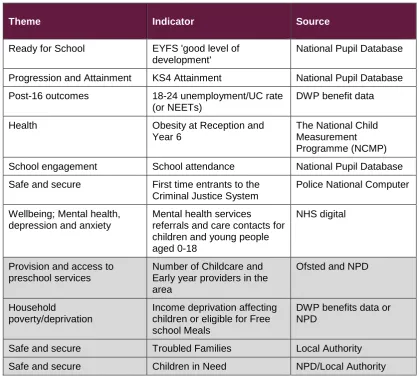
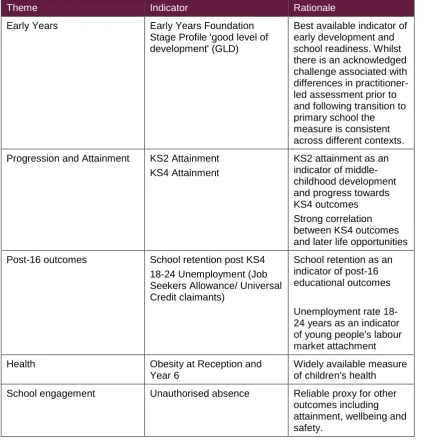
Identification of a set of core indicators which speak to Children’s Communities’ theory of change priorities, which can be populated through available reliable
datasets.
Development of a set of progress measures which are indicative of progress towards core indicators. These will be populated through a range of data-gathering activities: a template Children’s Community survey will be used across
Communities; evaluations of seed corn and similar activities carried out by the Children's
Communities, and interviews with children, young people and parents.
Development of capacity-building ‘systems’ to support the programme evaluation and local data and evaluation activities in line with each
Children's Community's local data & evaluation strategy. This includes development of data dashboards, evaluation protocols, templates for project and evaluation design and information-sharing.
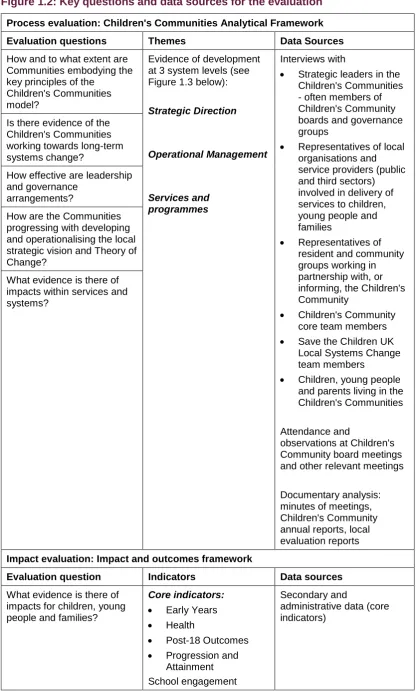
Figure 1.2: Key questions and data sources for the evaluation
Process evaluation: Children's Communities Analytical Framework Evaluation questions Themes Data Sources
How and to what extent are Communities embodying the key principles of the
Children's Communities model?
Evidence of development at 3 system levels (see Figure 1.3 below):
Strategic Direction
Operational Management
Services and programmes
Interviews with
• Strategic leaders in the Children's Communities - often members of Children's Community boards and governance groups
• Representatives of local organisations and service providers (public and third sectors) involved in delivery of services to children, young people and families
• Representatives of resident and community groups working in partnership with, or informing, the Children's Community
• Children's Community core team members
• Save the Children UK Local Systems Change team members
• Children, young people and parents living in the Children's Communities
Attendance and
observations at Children's Community board meetings and other relevant meetings
Documentary analysis: minutes of meetings, Children's Community annual reports, local evaluation reports Is there evidence of the
Children's Communities working towards long-term systems change?
How effective are leadership and governance
arrangements?
How are the Communities progressing with developing and operationalising the local strategic vision and Theory of Change?
What evidence is there of impacts within services and systems?
Impact evaluation: Impact and outcomes framework
Evaluation question Indicators Data sources
What evidence is there of impacts for children, young people and families?
Core indicators:
• Early Years
• Health
• Post-18 Outcomes
• Progression and Attainment School engagement
Secondary and
Progress Indicators:
• being ready for school
• doing well at school
• general health
• having the skills and competencies to be ready for work
• overall wellbeing/life satisfaction
• provision of support for schooling, education and employment that is available
• relationships with family and friends
• satisfaction with school/education establishments
• satisfaction with the neighbourhood
the provision of leisure and social activities that are available.
Interviews with children, young people and parents Surveys of service users
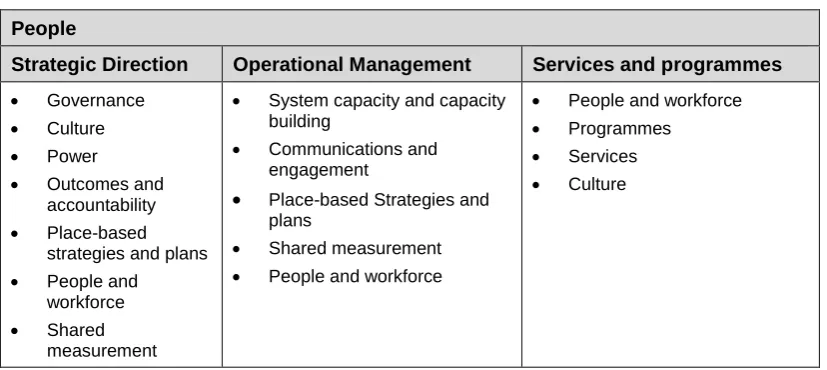
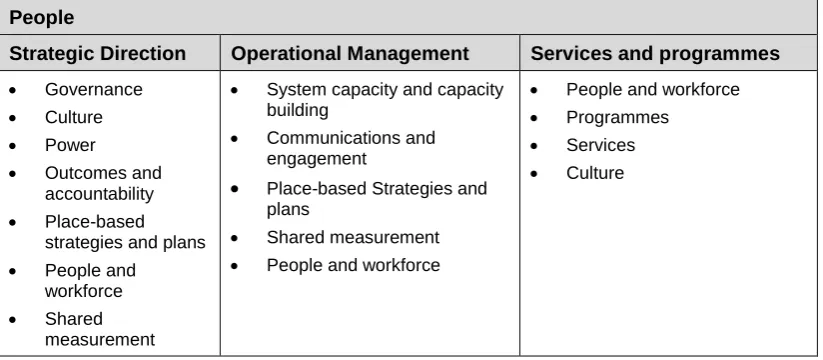
The themes in the Children’s Communities Analytical Framework are broken down further into sub-themes as indicated in Figure 1.3 below.
Figure 1.3: Children's Communities Analytical framework: system level categories
People
Strategic Direction Operational Management Services and programmes • Governance
• Culture
• Power
• Outcomes and accountability
• Place-based strategies and plans
• People and workforce
• Shared measurement
• System capacity and capacity building
• Communications and engagement
• Place-based Strategies and plans
• Shared measurement
• People and workforce
• People and workforce
• Programmes
• Services
• Culture
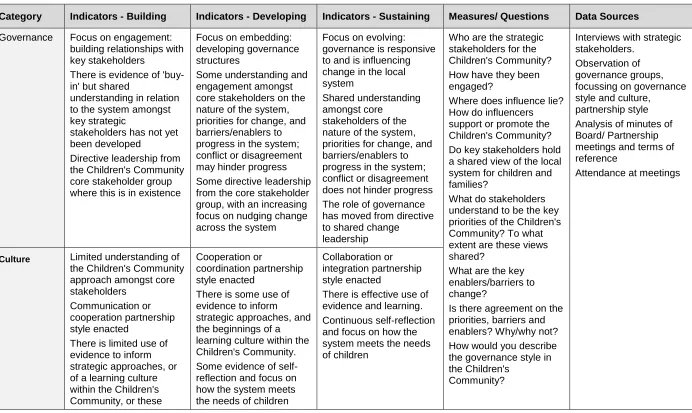
Under each heading we utilise a three-stage categorisation of maturity ('building', 'developing', 'sustaining') to capture the processes through which a newly formed Children's Community becomes an established agent of local change. The associated assumption is that moving through the maturity phases, from building to sustaining will have positive longer term outcomes for families, children and young people in the area.
[image:14.595.108.528.53.373.2] [image:14.595.113.527.470.655.2]level for each top level heading, and a set of associated questions which informed data gathering activities.
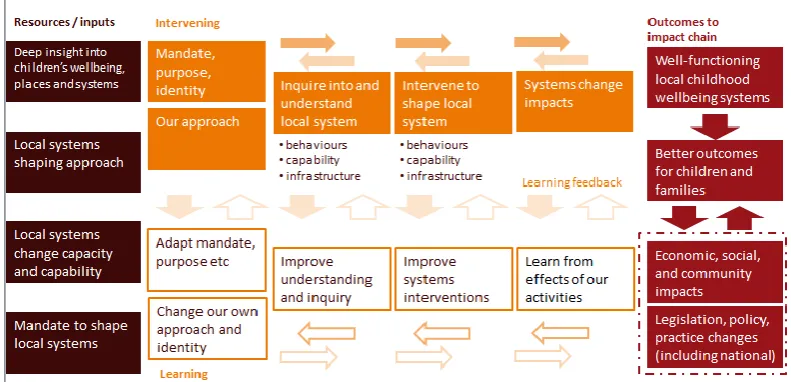
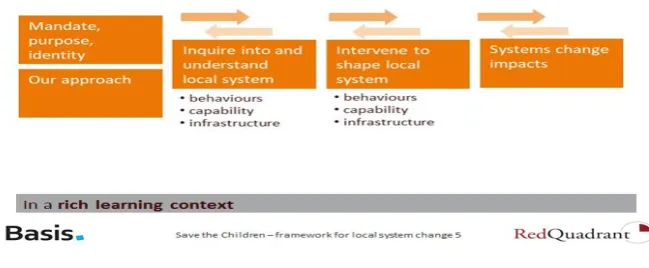
The Analytical Framework is based on assumptions around the causal process underlying the programme. Figure 1.4 below shows the Children's Community as an agent of change in a local system with an associated set of structures, processes and functions, and the relationships between the Children's Communities and the wider systems within which they are working. The figure also hypothesises the relationship between Children's Communities and outcomes for both local systems and children and young people.
Figure 1.4: How the work of the Children's Communities is hypothesised to influence long-term outcomes for children and young people
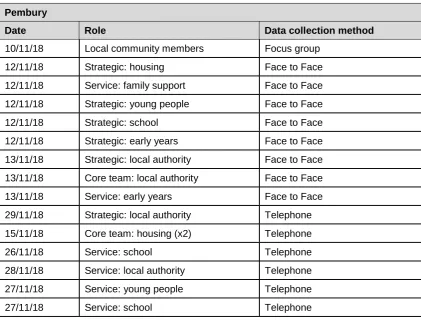
A full explanation of the evaluation frameworks, and the data gathering activities informing this report is contained at Appendix 1.
1.3.
The report
The remainder of this report is structured as follows:
• Chapter Two summarises the findings of the process and impact evaluations in each of the Children's Communities in the twelve months to December 2018
• Chapter Three discusses the evaluation findings and draws out learning for the Children's Community Programme
• Chapter Four presents conclusions and recommendations.
• Appendix 1 contains a full description of the approach that is being taken to evaluating the Children's Communities
• Appendix 2 summarises the data gathering activities informing this report • Appendix 3 contains a detailed report for each Children's Community • Appendix 4 contains outcomes data for each Children's Community.
Services and programmes
Operational management of
Children's Community Strategic leadership
of Children's Community
longer term outcomes
for place
longer term outcomes for families, children and
young people
[image:15.595.111.558.235.471.2]2
2.
Findings
This chapter presents our findings from the second year of the Children's Community evaluation. The analysis draws on all data sources and is presented in three sections, each of which focuses on one of the current Children's Communities. Each subsection contains three elements:
• Process evaluation - drawing on qualitative data to assess the progress of each Children's Community against the Children’s Communities Analytical Framework • Impact evaluation - initial beneficiary data and evidence from interviews with service users to assess progression outcomes, including their experiences of living in Children's Community areas; core indicator trend data
• Overall assessment - a short summary drawing together process and impact evaluation data for each community.
The fuller, more detailed analysis of progress for each Children's Community, and data for the core indicators is provided at Appendices 3 and 4.
2.1.
Pembury
Process evaluation
Strategic Direction
• There has been further review and consolidation of governance structures with a view to a more focussed and purposeful approach at the thematic level in the current evaluation period. This is providing a good platform for shared learning, leading to the implementation of new approaches across the local system. • There is widespread recognition of the Children's Community as a driver of
change and a high level of 'buy-in' from key local agencies. The coming 12 months provide opportunities to engage partners working in outcome areas not previously addressed, including children's health. Not all strategic partners are able to identify how shared accountability might be achieved.
• There is a clear focus on evidence and data driven approaches, although the sharing of data has been slow, partly due to technical and data governance challenges, but also because there has not been a dedicated data, evaluation and impact role in the core team.
• The three year plan has provided a strong focus on action for the Children's Community, and there are clear links to the Community's Theory of Change. It will be important that the new three year plan (from March 2019) sets out clear delivery milestones and targets which link to the achievement of longer term goals. • Overall, in relation to the strategic direction of the Children's Community we
assess the Pembury Children's Community to be at the developing stage and moving towards sustaining.
Operational Management
• The core team is widely seen to have been very effective at facilitating coalition and partnership building and engaging with the local community. Recent changes to the composition of the team provide opportunities to review community engagement.
• A multi-layered approach to communications makes good use of strong community links and benefits from the location of the Children's Community in a widely recognised and accessible location on the estate. The visibility of the Children's Community is considerably enhanced by its presence in the Pembury Community Centre.
• At the time of writing, a new three year plan (from March 2019) is to be developed on the basis of a review of progress against the first three year plan and in the context of the overall Theory of Change.
• There is some progress on data sharing, albeit slow. As the data dashboard is populated with more data it will be used by the Children's Community to inform new work and in due course to assess progress in improving outcomes. • Overall, in relation to the operational management of the Children's Community
Services and programmes
• There is widespread recognition of the Children's Community amongst local services and agencies, which is facilitated by the neighbourhood focus of the Community and visible local presence. Awareness is evident amongst organisations and services not actively engaged.
• The Community is building examples of collaborative working in key areas: early years and pre-school; supporting young people; supporting families. Evaluation and learning from these initiatives is informing development of new approaches within the Children's Community and more widely across the borough.
• Overall, in relation to services and programmes, we assess the Pembury Children's Community to be at the developing stage.
Impact evaluation
Progression outcomes
In Pembury, data was gathered via a pilot beneficiary survey, qualitative research with children and families and evaluation of a seed corn funded intervention. There were small numbers of survey responses (n=57); the key finding was that positive outcomes were reported from participants in the three local services (youth club, fashion project and the 16+ social group), especially in relation to the development of skills (fashion project) and confidence and knowledge (16+ social group).
Qualitative research carried out with children, young people and parents indicated in summary that:
• Interviewees experienced Pembury as a positive place to live with a strong sense of community. Although these interviewees had not been spoken to before, they expressed the view that the area is improving as a place to live
• The Pembury Community centre, Pembury Pathways and the Pembury youth club were experienced positively, and the Ready for School seed corn project suggested positive outcomes for young children.
Seed corn projects
Pembury Ready for School
The Pembury Ready for School project is supported by seed corn funding from Save the Children UK, supplemented with funding from the academy involved. It supports children living on the estate to make a successful transition to school and throughout their first year at primary school. The project works with Mossbourne Parkside Academy, and supported a first cohort of children in 2017-18. A second cohort of Pembury children at the Academy is receiving support in the 2018-19 academic year.
term, and families with children with the highest levels of need also receive home learning sessions.
The first cohort of Pembury children were behind their peers at baseline assessment on entry into Reception. Analysis of progress for these children suggests that the Ready for School cohort made more progress on average than their peers, and that within the project, those receiving targeted support made the most progress. At the end of their Reception year, outcomes for the Ready for School children were comparable with those of their peers.
Core Indicators
In Early Years, in Pembury1, 73% of children achieved a good level of development (GLD) in the Early Years Foundation Stage Profile, compared with 71% in both Hackney and England. The figure for Pembury has increased over the past three years, broadly in line with local and national improvements.
Looking at Progress and attainment, at Key Stage Two (KS2), 59% of pupils achieved the 'expected standard', compared with 71% in Hackney. Attainment at KS2 in Pembury has improved by an increase of 26 percentage points in the last three years, compared with seven points in Hackney and 11 points in England, thus outperforming both local and national benchmarks. At Key Stage Four (KS4), 86% of pupils at Mossbourne Community Academy (the local secondary school) achieved five or more GCSEs (A* to C/9-4) or equivalent in 2017/18, a figure that has been fairly stable over the past five years. This is well above the national average (currently 60%).
Turning to Post-16 outcomes, in Pembury, 97% of pupils Mossbourne Community Academy stay on for at least two terms after KS4 (a figure that increased by one percentage point over the past three years). This is above the averages for Hackney and England. Turning to unemployment, in Pembury, around 4% of the young people aged 18-24 are unemployed2, compared with 3% in Hackney. In both Pembury and Hackney there has been a fall of four percentage points in youth unemployment in the period since February 2018.
In relation to Health, in Pembury, 14% of Reception age children are obese, compared with 12% in Hackney. This has been a decrease of three percentage points in Pembury since the 2008/09-10/11 period, compared with a two percentage point fall in Hackney, although the number remains high compared to the 9% of obese children in that age group in England. Thirty per cent of Year Six children are obese, compared with 27% in Hackney and 20% in England. Obesity levels amongst Year Six children have increased by four percentage points since the 2008/09-10/11, compared with a two percentage point increase in Hackney and one point in England.
School engagement as measured by overall absence rates indicates lower rates of both absence and persistent absence in the two local schools compared with Hackney and England. There is little change over time, indicating school absence is not a significant issue in local schools.
1 Data for outcomes at EYFS, KS2 and KS4 is based on local schools, not specifically children living in the
Children's Community. Note that school-based outcome measures at EYFS and KS2 in Pembury are for a single school, the Mossbourne Parkside Academy, as this is the primary school accepting the largest number of children living on the Pembury estate. Other local schools contain very small numbers of pupils.
2 Unemployment in this instance is calculated using the number of Job Seekers Allowance and Universal Credit
Overall
In Pembury there has been ongoing delivery of interventions which are building collaboration and demonstrating new ways of working. An important next step for the Children's Community is to roll-out learning from these initiatives both across partners in Pembury and more widely in Hackney. The governance structure continues to develop and the shift to a more focussed and action-oriented approach through theme groups is providing a framework for a targeted and data-driven approach to address local needs. There is an ongoing emphasis on community engagement, in both local activities and in informing the work of the Community, and considerable effort and resource is directed toward this. Whilst it is clear that the priorities of Pembury residents are influencing the work of the Community, there may be an opportunity to improve feedback mechanisms (particularly to the residents group) both to influence the Children's Community operations and management, and to help the residents group understand how it has influenced change.
Factors that have contributed to sustained progress in this Children's Community include continuity in staffing; senior level support and significant resources from the two lead organisations; a small area focus which facilitates close collaboration and joint working; a community presence and a hub for community engagement; and a supportive local political and policy context.
At the time of writing, a small amount of beneficiary data has been collected through a pilot survey in the Pembury Children's Community. Although the sample size means that caution is needed in drawing any conclusions from the data it does indicate that participants identify benefits associated with initiatives supported by the Children's Community, which aligns with the positive developments identified above. Qualitative data provides evidence on people's experiences of living in Children's Communities and participating in activities and services. The data from interviews, with children, young people and parents in Pembury is generally positive, with a strong sense of a vibrant and engaged community, an improving area and parents feeling that local service providers are responsive to their needs.
The work of the Community has focussed on early years, and this focus is likely to have contributed to Pembury early years development outcomes being strong relative to both the borough and national benchmarks. Children's outcomes at Key Stage Two are behind those for Hackney and England, although they have improved in the three years 2015/16 to 2017/18 which indicates that the focus on school transition is appropriate. Levels of childhood obesity in Pembury are the highest in all of the Children's Communities at both Reception and Year Six and significantly higher than averages for Hackney and England. Furthermore, although levels of obesity amongst Reception age children in Pembury have fallen between 2008/9 and 2016/17 they have increased for Year Six children in the same period. This is not an area of focus for the Children's Community at present, but the data trends suggest that this should be an issue for future consideration.
For Pembury, we would anticipate that the implementation of a new three year plan will provide an opportunity to firmly consolidate the progress of the Children's Community thus far, and for the majority of the features of a 'sustaining' Community to be present. In particular the following would be expected to be seen over the next six to twelve months (drawing on the Children's Communities Analytical framework categories, see Table 1.3, above):
Governance:
• A greater level of shared accountability amongst a wider range of strategic stakeholders.
• Consultation with the residents' steering group to review their understanding of the remit and purpose of the group.
Outcomes and accountability, place-based strategies and plans:
• Development of a new three year plan, based on robust evaluation of progress against the first three year plan, and clear identification of success measures for the next three years.
Shared measurement:
• Finalise a systematic approach to capturing data and reporting to the governance group.
• Continue to build impact data to measure impact, including in the dashboard.
Communications and engagement:
• Ongoing community engagement with a focus on children and young people.
2.2.
Smallshaw-Hurst
Consideration of the process and impact evaluation findings for the Smallshaw-Hurst Children’s Community needs to take into account the stage of development of the Community relative to Pembury and Wallsend. The Children’s Community staff team was only established in early June 2017, which can be taken as the inception of the Children's Community. Another consideration is that the Children’s Community did not emerge out of an existing partnership rooted in the area. As a result, most of the core team’s first 18 months of operation has been spent establishing relationships and gaining knowledge about the area, including its assets and strengths and the challenges to address. The Children’s Community is now in the process of establishing its governance structure and focussing its attentions to bring about systems change to improve outcomes for children, young people and families.
Process evaluation
Strategic Direction
• Bringing stakeholders together to break down barriers to collaborative working has been a key success for the Smallshaw-Hurst Children's Community in this period. Evaluation interviews undertaken in Year One of the evaluation identified that the area does not have a strong tradition of collaboration across different services and therefore the building of relationships and coalitions across the local system has been an important early focus.
• A governance structure is being established, comprising managers and leaders in local organisations and service areas. The building of relationships with those at the service manager/leader level has been a deliberate strategy of the Children's Community, viewed by the core team as an appropriate approach while they build momentum and implement early activity. The next stage will be to engage system leaders: for instance senior directors in key local organisations who oversee broad portfolios.
• There is a broad agreement for an ambition to develop mutual responsibility for outcomes. Data gathered through observation at meetings of the emergent governance groups identified a high degree of commitment to a shared accountability approach. An important next step for this Community is to identify how this can be achieved, taking into account the need for shared measurement. • The Children's Community themes (parents, early years and learning; aspirations, education and employability; and being healthy, safe and supported) align with those identified in relevant Neighbourhood Plans and organisational targets. The next stage of development is to integrate, and align the Children's Community into local place-based strategies adopted by partner organisations including housing providers and the local authority.
• The core team has established a detailed understanding of the area, built on extensive data analysis and early consultation with the local community which we reported on in the Year One evaluation report. The next steps identified by the core team are to work with partners to develop a vision for the area, be strategic in making the case for the Children's Community approach to other agencies which are not yet engaged and to identify how they can add capacity to support local systems change to improve outcomes for children, young people and families.
• Overall, the strategic direction of the Smallshaw-Hurst Children's Community was assessed to be at the building stage, but with some elements of developing also in evidence.
Operational Management
• To date, the agenda (in terms of the pace and focus for change, and in relation to specific meeting agendas) has mainly been set by the Children's Community core team. However, theme working groups have been set up and a governance structure is forming which is beginning to see some of the momentum for the Children's Community pass to wider stakeholders.
• There is a developing recognition amongst local stakeholders of the Children's Community and what it aims to achieve. Engagement is strong in most key service areas. There is no formal communication strategy in place currently; this will be developed once the governance structure is in place.
set up to develop these and lead on implementation. The (systems change related) activity in the Children's Community has brought people together, broken down barriers and facilitated the identification of shared priorities.
• The team have developed links with data controllers as part of data and asset mapping. Analysis of local data has identified issues within the area and informed possible responses. The next stage is to finalise local indicators of change (additional to the core indicators set out in this report) and develop local evaluation strategies.
• There has been some turnover in the core staff team. Continuity of the lead has been important to maintain stakeholder relationships and local knowledge. The core operational team anticipates that it will act as a bridge between the community and leaders of services and organisations; a .key aspect of this role is to bring evidence, make recommendations and influence the actions and activities of services and programmes.
• Overall, the operational management of the Smallshaw-Hurst Children's Community was assessed to be at the building stage, but with some elements of
developing also in evidence. Services and programmes
• Due to the early development stage of the Smallshaw-Hurst Children's Community, the fieldwork did not include interviews focussing on service delivery. This is because, although there is a growing recognition of the Children's Community amongst local stakeholders, at this stage there has been very limited action which can be identified as leading to change in local services and programmes.
• The following key points emerged from the interviews with strategic stakeholders and the core team and contribute to an understanding of the baseline situation against which any future change in services and programmes can be assessed:
- Smallshaw-Hurst is a community where residents have limited or poor access to many universal services for example primary care, dentists and early years provision. Challenges to service access which the Children's Community aims to address include the time, resources and (lack of) confidence that service users associate with the need to travel to access services outside of the area.
- In terms of the organisations and services operating in the Smallshaw-Hurst area the view was expressed by interviewees that 'the skills are all there' but there is a need to ‘join the dots up’ so that they are maximised. The co-ordinated and collaborative approach emphasised through the Children's Community is seen to offer an opportunity to maximise the impact of local services.
- Leadership and power were viewed as being strong within organisations operating across the wider local authority area. A key challenge in Smallshaw-Hurst is to harness, and maximise, strong local leadership to the benefit of the Community.
Impact evaluation
Progression outcomes
• The Children's Community has undertaken early mapping work to identify community needs but is yet to implement any data gathering through local surveys (or equivalent) to assess progress towards progression outcomes. This will be a priority for the Smallshaw-Hurst Children's Community in the coming year. • There has also been concern that the Community's developing approach to
community engagement should not be affected by extensive external evaluation work with local children, young people and parents. As such, the evaluation has gathered only very limited early data in this period through two interviews with parents living in Smallshaw-Hurst. Headline findings were that they felt positive and safe in their communities; but they felt the need to travel to access a range services. This is consistent with the views of strategic stakeholders and the Children's Community core staff team. Further interviews with local residents will be carried out in the next evaluation period.
• At this stage there has not been any delivery of seed corn projects in Smallshaw-Hurst.
Core indicators
Regarding Early Years, 63% of children in schools in Smallshaw-Hurst attained a good level of development (GLD) in the Early Years Foundation Stage Profile in 2017, compared with 66% in Tameside and 71% in England as a whole.
In relation to Progression and attainment, KS2 data for the primary schools in Smallshaw-Hurst varied, with all schools above the 2017 national average of 64% but most just below the Tameside average of 70%, with general upward trends (see Appendix 4 for more detail). The two secondary schools located in Smallshaw-Hurst had very different KS4 profiles, with above Tameside and England averages in St Damien's RC College and below average for Great Academy Ashton, although with broadly similar trend data.
Turning to Post-16 outcomes, 90% of pupils at Great Academy Ashton stay on for two terms past KS4, compared with 92% at St Damian's RC Science College and Tameside as a whole, below the 94% average for England. St Damian's RC Science College experienced an increase of three percentage points during the period in question, whilst Tameside saw the figure fall by four percentage points and Great Academy Ashton by three percentage points. The England average stayed steady during this period. Eight per cent of 18-24 year olds in Smallshaw-Hurst are unemployed3, in comparison with Tameside, where the figure is 6%. Smallshaw-Hurst has seen a considerable decline in youth unemployment, from as high as 18% in February 2013, to the current figure, representing a fall of 10 percentage points. The figure in Tameside, by comparison, fell by six percentage points during the same period.
In relation to Health in Smallshaw-Hurst, obesity in Reception age children is 12% compared with 10% in Tameside and 9% in England. Obesity amongst Reception aged children has increased by two percentage points in Smallshaw-Hurst from 2008/9-10/11 to 2014/15-16/17 compared with no change in Tameside and England. In Year Six children, obesity is 19% compared with 20% in Tameside and England. Obesity rates at Year Six have fallen by five percentage points in Smallshaw-Hurst
3 Unemployment in this instance is calculated using the number of Job Seekers Allowance and Universal Credit
during the period in question, but increased by one percentage point in Tameside and in England.
School engagement, measured by overall and persistent absence, was mixed in Smallshaw-Hurst, with no clear patterns. Primary schools were distributed both above and below the Tameside and England averages. Great Ashton secondary had poorer absence rates than the Tameside average, whereas St Damien's RC Science College had lower levels of absence. Persistent absence worsened in almost all Smallshaw-Hurst schools between 2015 and 2017.
Overall
A significant amount of work has gone into getting the Smallshaw-Hurst Children's Community to its current stage. This highlights the time and resources that are needed to start up a Children's Community, especially in the absence of a previous longstanding partnership(s). In this and previous phases of evaluation the core staff team have talked about the importance of a year zero where the focus is to: map the area in terms of data, strengths, barriers and provision of assets and services, establishing and building relationships.
A strategic partnership is emerging in Smallshaw-Hurst, developing a shared commitment to achieving change for young people and children in the area through collaborative action. A consensus on the core aims and work needed to translate these into actions in the next period are building amongst local stakeholders and we anticipate that more concrete plans and actions to start to put these plans into action will be evident in the next evaluation period.
In relation to impact evaluation, at this point data should be seen as baselines to build on. Early years outcomes are significantly lower than for Tameside and England, indicating that a focus here is appropriate. At Key Stage Two there is a mixed picture amongst local schools with some schools performing very well, and others being closer to the national average. However, the picture is improving over time and all schools performed at or above the national average in 2017/18. Outcomes at Key Stage Four are also varied, with one local school consistently performing significantly below Tameside and national benchmarks and another performing consistently above. Levels of childhood obesity at Reception stage are above the national average and have increased slightly between 2008/9 and 2016/17. However, over the same period levels of obesity at Year Six have fallen substantially and in 2016/17 were below the national average.
For Smallshaw-Hurst Children’s Community, the following would be expected to be seen over the next six to twelve months:
Governance:
• Formalised governance structures in place.
Culture and Power:
• Engagement of a wider group of organisations in the Children's Community, including community leaders and strategic leaders in local government.
Outcomes and accountability, place-based strategies and plans:
• Development of a plan to align the Children's Community outcomes across organisations to encourage mutual accountability.
Shared measurement:
• Finalise local indicators, with a systematic approach to capture and report to the governance group.
System capacity and system building:
• Engage stakeholders who oversee a broad strategic remit.
Communications and engagement:
• Develop a communication plan following the enactment of a formal governance structure.
2.3.
Wallsend
Wallsend Children's Community has made significant progress overall in the past twelve months in relation to capacity building for local systems change. This is especially the case in relation to strategic direction and operational management, driven by the leadership of the strategic lead and the recently appointed members of the core team. The three year plan and associated changes in governance have been important drivers. Strategic leadership is more focussed, and there is greater oversight and challenge in relation to activity and outcomes linked to the Children's Community. There is increasing visibility of the Children's Community amongst service providers, although this is variable. The engagement of families, children and young people in setting the agenda for the Children's Community is an area of focus for the next stage. In addition to this, further engagement with services and partner stakeholders is a focus for the next twelve months. A crucial next stage of planning is to develop clearer medium term goals, to enable strategic oversight to focus on these, with less emphasis on the operational development of specific activities in the three year plan.
Process evaluation
Strategic Direction
• There is now a more action-focussed governance group which is building on a new three year strategic plan. The development of this governance structure is seen as positive amongst interviewees. However, the Children's Community is building on a long-standing educational partnership and there is a recognised need to continue building on outcomes beyond education.
• Leadership of the Children's Community was felt to be strong, with good alignment with local and national policy agendas (e.g. devolution). Interviewees recognised that partners need to proactively share leadership more in the future. Different attitudes towards accountability were expressed, with partners identifying themselves as accountable, variously, to their home organisation, local children and families, and sometimes the Children's Community group. A charter was proposed to clarify the aims, objectives and mechanisms for shared accountability.
• The three year plan has provided a strong focus on action for the Children's Community. Clear shorter term milestones linking the plan to the Theory of Change are needed. The work of the core team in driving this forward is valued by stakeholders and there is now a much stronger expectation of the Children's Community providing the impetus for change across the local system.
However, there has been a degree of turnover in the core team at Wallsend, and this has inevitably limited what has been achieved.
• Overall, in relation to strategic direction, we assess Wallsend Children's Community to be at the developing stage.
Operational Management
• The previous two years could be characterised by a focus on coalition and partnership building; for the past twelve months, the focus has been building a smaller more tightly focussed governance group linked to a new a three year plan looking to focus on systems change.
• Although recognised as an issue for the past two years, communications and engagement have been prioritised recently in the three-year plan. Also recognised for some time, engagement of children and families is now being prioritised via a small scale ethnographic study and a cross-Wallsend survey of children and young people in all schools. The core team intends to develop a response to emerging needs as data feeds through from these pieces of work.
• The focus of the three year plan has created tangible energy and this is apparent in relation to evaluation. The current prioritisation of evaluating existing projects will lead to a stronger approach for future work with evaluation being built in at the start.
• Overall, in relation to operational management, we assess the Wallsend Children's Community to be at the developing stage.
Services and programmes
• Some service interviewees were more aware of the Children's Community and their role within it, but this was mixed, and in some cases there was no change from earlier evaluation phases. The increased oversight of the new core team demonstrated how this is beginning to change.
• The core team and especially the strategic lead were seen very positively by interviewees, particularly in relation to facilitating cross-service working.
• Overall, in relation to services and programmes, we assess the Wallsend Children's Community to be at the building stage, with elements of developing. Impact evaluation
Progression outcomes
As in Smallshaw-Hurst, the Children's Community has undertaken mapping work to identify community needs but has not as yet been able to implement any data gathering through local surveys (or equivalent) to assess progress towards progression outcomes. The experiences of parents and families in Wallsend were gathered through seven interviews conducted with mothers who had attended community play days sessions4. Full details are available in Appendix 4. Summary findings are as follows.
• Interviewees felt that the areas they lived in were not safe and subject to problems around anti-social behaviour, and poor physical environment (derelict housing, poorly maintained roads etc.) all of which was felt to have worsened in recent
4 These interviews by their nature were not based on representative samples, so no conclusions can be drawn as
years. Both availability of out of school activity and prospects for employment were felt to be poor, with anxiety expressed about children's future lives. Cuts to services and benefits were seen as worsening.
• Parents had no awareness of Wallsend Children's Community. The local children's centre and schools were broadly seen positively. Parents did not feel they had any influence over local change, but many had views on improvements that could be made.
• Parents had engaged in local play days, which were positively seen, although barriers to attendance (timing, other siblings, work commitments) were mentioned. • There were differing experiences based on ability to access services, with more
affluent families in a better position, and some areas seen by some as poor relations compared with other areas of Wallsend.
• Evidence from evaluation of seed corn projects is not yet available in the Wallsend Children's Community.
Core indicators
In relation to Early Years data is not yet available for Wallsend. With regards to Progression and attainment, at KS2 there was wide variation, in both overall attainment and patterns of change over time; schools were distributed around the averages for North Tyneside and England. At KS4, both secondary schools in the area had declining KS4 performance (measured by percentage of pupils who achieved 5 or more GCSEs (A* to C/9-4) or equivalent results, including both maths and English), with both below both North Tyneside and England as a whole (in both of which KS4 performance on this measure was broadly stable).
Turning to Post-16 outcomes, 86% of pupils at Burnside Business and Enterprise College remain for at least two terms after KS4, a fall of two percentage points over the last three years. 90% of pupils remain at Churchill Community College, an increase of one percentage point. The figure is 93% in North Tyneside as a whole (an increase of one percentage point over this period) and 94% in England (no change over the period). Unemployment5 amongst 18-24 year olds in Wallsend is 6%, compared with 5% in North Tyneside. Both areas have experienced a fall of seven percentage points since 2013.
Obesity in Reception age children - the Health measure used here - is at 10%, a fall of one percentage point between 2008/9-10/11and 2014/15-16/17, compared with 9% in North Tyneside (a fall of 1 point) and also 9% in England (no change).By Year six, 23% of children in Wallsend were obese at the time of data collection (an increase of two percentage points), compared with 20% in North Tyneside (no change) and 20% in England (an increase of two points over the period).
School engagement measured by overall absence rates shows a very mixed picture in Wallsend primary schools, as with the school attainment figures, with a small majority of schools with higher absence rates compared with North Tyneside (4%) and England (4%). The two secondary schools had higher absence rates than North Tyneside and England averages. Persistent absence again varies widely, with more significant issues in some schools, and a majority of schools having higher rates than North Tyneside and England.
5 Calculated using the number of Job Seekers Allowance and Universal Credit (out-of-work) claimants, as a
Overall
The new core team has provided more focussed collaboration, which is built around an agreed three year plan, developed in tandem with a refreshed governance structure. There has been more systematic engagement with local services and organisations. This engagement has focussed on communicating the aims of the Children's Community, and understanding of how services can improve outcomes by partnership working. This is beginning to show benefits. The governance group is more purposeful, and the core team is focussed on its aims of delivering and effectively monitoring the new plan and its components. Engagement with the needs of the local community, and stronger visibility and engagement of local sectors and organisations are important next steps alongside the development of clearer intermediate goals to provide a stronger strategic focus for governance. Overall, we judge the community to be at the
developing stage.
In Wallsend, the qualitative data suggests the parents' perceptions are of an area that is deteriorating, both in terms of their experiences of the community and environment and in the withdrawal of public services. However, the views on the play days, a Children's Community initiative, were positive, indicating potential to move forward. This relatively early stage in relation to positive change at a system level is reflected in some of the wider outcomes data and it has not been possible, at this stage, to obtain early years data from the Wallsend Children's Community. Children's outcomes at Key Stage 2 vary considerably depending on which school they are attending, although the majority of primary schools in Wallsend were at or above the national average in 2017/18. However, Key Stage Four outcomes are below North Tyneside and national averages and falling between 2013/14 and 2017/18. Obesity levels for children in Wallsend are slightly higher than those in England at Reception stage (although falling over time) and higher than nationally (and increasing) at Year 6. The proportion of unemployed people in Wallsend is above that for North Tyneside and England. This indicates a continuing need to address these issues which form the focus of several Children's Community initiatives, and associated more established programmes.
For Wallsend, in the next phases of the evaluation, we would expect to see the following over the next six to twelve months.
Governance:
• Working to meaningfully engage the local community in setting the direction for the Children's Community (see also operational management section).
• Creating space in governance group meetings for higher level, purposeful strategic discussion.
These require changes to strategic planning (see below).
Culture and power:
• Working with third sector organisations to build trust and common purpose. • Actively move towards the Community becoming focussed beyond education;
working across service and outcome areas.
Accountability and place-based strategy and plans:
• Build a Theory of Change with a Memorandum of Understanding (MoU) for all partners and associated milestones that can be considered strategically.
System capacity and system building:
• Clear understanding of role of the Children's Community amongst stakeholders, and an ability to articulate this in relation to their role in the strategy.
Communications and engagement:
• A communications plan, with tangible changes visible and linked to it. Consideration should be given to developing a set of specific principles.
• Delivery of key engagement activities (Story of Place, Perceptions Survey), plans in place for responses to findings from these activities and some implementation of these.
Shared measurement:
• Data sharing agreements in place, progress in accessing and utilising shared data. • Agreed evaluation plans for legacy projects, plans implemented.
People and workforce:
• Core team undertaking more strategically planned work, based on the new three year plan. Intense short term pressures demonstrably relieved.
Services and programmes:
Work with local organisations and services to help staff understand the goals and strategic aims of the Children's Community.
3
3.
Discussion
In this chapter we reflect on the specific findings from each Children's Community, and the more detailed analysis presented in the appendices to address the broad evaluation questions that were set for the evaluation at the outset. We consider learning that is accruing to inform the development of the programme and the individual Communities, and in relation to future related change initiatives. In the final chapter, we provide a set of conclusions and recommended actions associated with this learning.
How and to what extent are Communities embodying the key principles of the Children's Communities model?
The evidence collected in Year Two confirms that all three areas are embodying the principles of the Children's Community model. All are focussed on a geographical area, with a long term vision for change and working across multiple aspects of children's lives. The Children’s Communities have a very broad remit, which means they are subject to shifting contexts in relation to local and national economic, political and social environments, and associated changes in the key local partners and the needs of the changing local communities – and these contextual shifts are occurring on a wide range of fronts, from early years and health, through mainstream schooling and further and higher education, to community safety, employment opportunities and other social policy areas.
One issue that has emerged is that there are different opportunities and limitations associated with the different sizes of the Children's Communities and there may be trade-offs to be made between size (in terms of both geography and population) and breadth of focus. All three Communities address a wide range of aspects of children's lives, including education (from the early years to post-16); transitions to, within and out of compulsory education; and aspects of children's health and wider wellbeing. Evidence thus far suggests that it is harder to manage a multi-focus strategic partnership in a larger area than either a tightly focussed partnership in a larger area or a multi-focus partnership in a smaller area. In the context of Children's Communities this may mean that the capacity to drive systemic change across multiple, shifting competing pressures, policy agendas, partners and coalitions in a broad geographical area requires a greater level of resource than is currently available to the Children's Community teams.
Is there evidence of the Children's Communities working towards long-term systems change?
continue to be used to monitor change in the Children's Communities in the future, but it is important to note that the change process will not be linear, or universally progressive. Each of the Children's Community teams has experienced staff change in this year (to a greater or lesser extent). Inevitably this has affected the momentum for change, which is also influenced by changes in the capacity and priorities of local agencies. Whilst we have no evidence that progress would be more rapid if Children's Communities had a more limited focus, there are reasons to think this may be the case. For example, it may be that the effects of staff turnover would be reduced with a narrower remit (and a smaller number of stakeholders to engage with); and the effects of shifting contexts would be lessened due to the narrower range.
How effective are leadership and governance arrangements?
The Children's Communities are at different stages in the development of collective leadership, although all have made efforts over the past twelve months to develop or refine governance arrangements to help embed a sense of shared accountability amongst local stakeholders. There are ongoing questions across all three Children's Communities around representation and how the voice of local communities is heard and responded to in the context of the work. This may involve representation on governance groups, and the Communities have acknowledged the importance of involving local residents, but it is not universally clear how resident (and children's) voices are driving the work of all the Communities. There are sound principled reasons for limiting engagement (including not wishing to over-promise what cannot be delivered, and a lack of capacity or focus for the engagement) but nevertheless this is an ongoing issue, and one that has been continually noted during the evaluation period.
How are the Communities progressing with developing and operationalising the local strategic vision and Theory of Change?
The use of the Theory of Change (ToC) documents developed by the Children's Communities in the early stages of their implementation h