Actor monitors for adaptive behaviour
CLARK, Tony <http://orcid.org/0000-0003-3167-0739>, KULKARNI, Vinay,
BARAT, Souvik and BARN, Balbir
Available from Sheffield Hallam University Research Archive (SHURA) at:
http://shura.shu.ac.uk/14962/
This document is the author deposited version. You are advised to consult the
publisher's version if you wish to cite from it.
Published version
CLARK, Tony, KULKARNI, Vinay, BARAT, Souvik and BARN, Balbir (2017). Actor
monitors for adaptive behaviour. In: GORTHI, Ravi Prakash, SARKAR, Santonu,
MEDVIDOVIC, Nenad, KULKARNI, Vinay, KUMAR, Atul, JOSHI, Padmaja,
INVERARDI, Paola, SUREKA, Ashish and SHARMA, Richa, (eds.) Proceedings of
the 10th Innovations in Software Engineering Conference, ISEC 2017, Jaipur, India,
February 5-7, 2017. New York, ACM Digital Library, 85-95.
Copyright and re-use policy
See http://shura.shu.ac.uk/information.html
Sheffield Hallam University Research Archive
Actor Monitors for Adaptive Behaviour
Tony Clark
Sheffield Hallam University,UK
Vinay Kulkarni
Souvik Barat
Tata Consultancy ServicesResearch, India
[email protected], [email protected]
Balbir Barn
Middlesex University, UKABSTRACT
This paper describes a structured approach to encoding mon-itors in an actor language. Within a configuration of actors, each of which publishes a history, a monitor is an indepen-dent actor that triggers an action based on patterns occur-ring in the actor histories. The paper defines a model of monitors using features of an actor language called ESL in-cluding time, static types and higher-order functions. An implementation of monitors is evaluated in the context of a simple case study based on competitive bidding.
Categories and Subject Descriptors
I.6.2 [Simulation Languages]
Keywords
enterprise modelling, multi-agent simulation.
1.
INTRODUCTION
This paper describes a structured approach to encoding monitors in an actor language. Within a configuration of actors, each of which publishes a history, a monitor is an independent actor that triggers an action based on patterns occurring in the histories. Monitors are useful for a variety of applications including adaptation and determining oppor-tunities for collaboration.
Our particular interest is in the use of actors and monitors to develop simulations of organisations to support decision-making that is expressed in terms of goals, measures and levers. In many cases, the complexity of an organisation means that traditional approaches to simulation models, in-cluding spreadsheets and stock-n-flow, are difficult to apply because they rely on equations that explicitly represent the relationships between goals, measures and levers. In large organisations, such equations are difficult or impossible to produce for many situations. Our hypothesis, is that it is more practical and effective to take anemergent behaviour
ACM ISBN 978-1-4503-2138-9. DOI:10.1145/1235
approach to the construction of the models whereby the ap-propriate elements of the organisation are represented as autonomous actors. Judicious construction of such mod-els will allow a human decision-maker to observe simulation runs, make interactive changes to simulation-levers and to infer the relationships that lead to goal maximisation.
Actor languages are appropriate for emergent behaviour because they can be used to encode autonomous individ-uals and collaborations. Monitors are useful in this con-text because it is often necessary for individual elements (or groups) in a simulation to adapt their behaviour based on changes in the environment. A requirement on such moni-tors is that they express temporal properties and a contri-bution of this paper is to propose a statically-typed actor language for monitor combinators that supports temporal features.
As part of our aim to support organisational decision-making, we have developed an actor language called ESL. The features of ESL include static typing, higher-order func-tions, pattern matching and time. The aim of this paper is not to provide a detailed description of ESL, but we will use ESL to introduce the idea of monitors and include de-scriptions of ESL features as necessary to make the paper self-contained.
The paper is structured as follows: Section 2 motivates our claim that emergent behaviour is more appropriate than standard equational modelling for organisational decision-making, motivates the development of a language ESL, and reviews similar approaches to monitors in actor and agent technologies. Section 3 introduces a very simple example that we use to illustrate our proposal for monitors. Section 4 introduces that part of ESL necessary to understand how monitors are encoded. Section 5 describes how monitors are defined in ESL and section 6 describes how they are used to implement the simple example as part of decision-making.
2.
MOTIVATION AND RELATED WORK
2.1
State of the Art
an enterprise along multiple aspects and layers.
BPMN[30], i* [32] and stock-n-flow (SnF) [22] are amenable to automated analysis. For example, the process aspect can be analysed and simulated using BPMN, the high level goals and objectives can be evaluated using i*, and high level sys-tem dynamics can be simulated using Stock-and-Flow (SnF) tools such as iThink1. Examination of existing EM reveals
some interesting observations. The EM techniques capable of specifying all the relevant aspects of enterprise lack sup-port for automated analysis (e.g., Archimate and UEML). Essentially they are not suitable for supporting an ’apply levers - observe measure- evaluate goals’ loop. Languages capable of automated analysis only cater for a subset of the relevant aspects for decision-making (e.g., BPMN, i*, and SnF). Thus, as individuals, they are not adequate for deci-sion making activities.
The multi-modelling and co-simulation based frameworks, such as AnyLogic [7] and DEVS [8], are possibly the best alternative among EM techniques to address the needs of decision making, however the inadequate support to spec-ify and analyse socio-technical characteristics such as au-tonomous, uncertainty, temporal behaviour and adaptabil-ity make them ineffective for a large class of organisational decision making problems.
Approaches based on Bayesian Networks or Linear Pro-gramming are also found less effective for a class of decision making problems where the significant dynamism, uncer-tainty, adaptation and emergent behaviour are involved.
2.2
Proposal: Actors and Monitors
Our observation is that existing methods (outlined above) rely on a-priori knowledge of organisational behaviour. The complexity, socio-technical [21], and stochastic characteris-tics of organisations leads to such behaviour beingemergent. This has led us to propose an approach to decision-making based on behaviours that emerge from organisational models encoded as interacting agents [5, 20].
The Actor model of computation [1] has been identified as a possible basis for simulation. We have reviewed a num-ber of existing actor languages with respect requirements for organisational simulation and decision-making. For ex-ample, Erlang [3], SALSA [28], AmbientTalk [27], and Kilim [26] provide strong safety guarantees and data-race freedom using strict encapsulation and pure asynchronous communi-cation. The actor frameworks (e.g., ActorFoundry [4], Scala Actors [16], Akka [2]) have flexibility to use the expressive power of the underlying languages such as Java and Scala.
Modelling an organisation as a collection of communi-cating actors involves autonomous behaviour of individuals. Monitors can be used to influence the behaviour of individ-uals. The concept ofmonitor that observes the behaviour of a system and detects the violations of safety properties is well studied area [15]. The early work on monitors focused on off-line monitoring wherein the historical data or pro-gram trace is analysed off-line [13] to detect the anomaly. In contrast the recent research trend on monitors is primarily focusing on online monitoring that validates the observed system execution against system specification dynamically as preventive and corrective measures.
Research challenges include: (1) the use of an appropriate foundational model for specification (this can be mapped to the research related to Monitoring-Oriented
Program-1
www.iseesystems.com/store/products/ithink.aspx
ming2); (2) an efficient implementation. Existing monitor
technologies are largely based on temporal logic as an un-derlying model for monitor specification. For example, the past-time linear temporal logic (PTLTL) is recommended as specification language in [17], the PTLTL is further extended with call and returns in [23], the Eagle logic (where the tem-poral logic is extended with chop operator) is proposed in [6], and Meta Event Definition Language (a propositional temporal logic of events and conditions) is used in Moni-toring and Checking (MaC) toolset [25]. In contrast, the Extended Regular Expression and Context Free Grammar based language is proposed and implemented in [10].
From an implementation dimension, online monitoring tech-nologies are implemented either by adopting an inline ap-proach [24] or a centralised apap-proach [14]. A centralized approach is employed to the system under observation us-ing either synchronous [11] mode or asynchronous mode [12]. In general, the inline monitors are computationally efficient as they have access to all system variables, whereas the centralised monitors are better in other dimensions as they enable clear separation of concerns (and thus less error-prone), facilitate distributed computation, and exhibit com-positional characteristics.
We propose a light-weight variant of monitor technology that can evaluate agent goals (similar to monitoring safety properties) and decide appropriate system adaptation. A restricted form of centralized asynchronous monitor is im-plemented in Akka [2] to realise the monitoring behaviour of supervisor actors of a hierarchical actor system. Recently, a prototype of asynchronous centralised monitor implementa-tion is presented in [10].
Our proposed implementation also implements centralized asynchronous monitors. A key difference is that the Akka implementation monitors the occurrence of events within its sub-actors and uses a fixed set of operations such as stop actor,suspend actor as an adaptation strategy. In contrast our proposed implementation evaluates the historical data to produce adaptation, effectively achieving a combination of [10] with the adaptation strategy presented in [9] augmented with temporal features.
In all cases, we have identified areas where we feel that an existing language does not, or may not, support all the requirements for organisational decision-making as outlined above. This has led to the development of the actor language ESL which is introduced in this paper. ESL supports many of the features we believe to be useful for organisational simulation such as time, static-typing, stochastic behaviour, and the production and visualisation of simulation traces. Although it is still in development, all the examples shown in this paper are based on ESL executions.
3.
EXAMPLE: COMPETITIVE BIDDING
Commercial organisations often participate in a market for products and services. Customers have requirements for the products that they make available as an invitation to tender. Providers are given a period of time within which they can produce a description of how they meet the require-ments and what the cost will be. At the end of the bidding period, a customer evaluates bids using their private crite-ria. One of the providers (thewinner) is chosen and all other
2
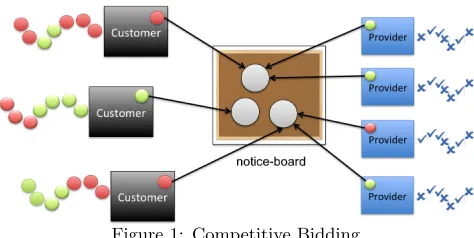
Figure 1: Competitive Bidding
providers lose the bid.
Figure 1 shows a diagram containing customers, providers and a global notice-board that contains the public invita-tions to tender. In this simple scenario, each customer rep-resents their internal requirements as a colour: either red or green. When the tender is made public on the notice-board, the providers do not know the private colour that the customer requires. Each provider chooses to bid red or green. After a period of time the customer inspects the bids and chooses one that matches their required colour. Each provider is shown with a history of successes and bid-failures.
Although each provider does not know the required colour of the published tender, they can inspect the history of each customer in terms of their required colours over time. It is reasonable to expect that a customer repeatedly issues invitations of a particular colour and that there is a small probability that this colour will change at any time.
In such a situation we may take the role of a provider and aim to determine a strategy that will improve our chance of winning a bid. In this case the strategic options are the levers: (1) simply take a random chance; (2) stick with the same colour over time; (3) monitor the behaviour of one or more customers via their history and predict the next requirement. Given that competitors may be using similar strategies, it is attractive to use a simulation-based approach to measure the outcomes for each option.
In the simple case we use the simulation from the per-spective of a distinguished providerpin order to determine a bidding strategy. Therefore the simulation measure is the number of wins byp and the levers of the simulation vary the provider’s behaviour in order to maximise the number of wins.
4.
ESL
ESL and its associated development and run-time environ-ment is a language that has been designed to support our thesis that simulation and emergent behaviour can be used to support organisational decision-making. ESL together with a supporting toolset is currently in development3. All
ESL code in this paper is taken from running examples.
4.1
Syntax
The syntax of ESL is shown in figure 2. It is statically typed and includes parametric polymorphism, algebraic types and recursive types. Types start with an upper-case letter. An ESL program is a collection of mutually recursive
bind-3The current version of ESL is available at https://github.
com/TonyClark/ESL
t y p e ::= Var t y p e v a r i a b l e | Act { export dec * Mes * } a c t o r t y p e | ( t y p e *)→t y p e λ- t y p e | tt t e r m t y p e | Int | Bool | Str c o n s t a n t t y p e | Void u n d e f i n e d | [ t y p e ] l i s t s
| Fun( N a m e *) t y p e p a r a m e t r i c t y p e | ∀( N a m e *) t y p e p o l y m o r p h i c t y p e | rec N a m e . t y p e r e c u r s i v e t y p e tt ::= N a m e ( t y p e *) t e r m t y p e exp ::= var v a r i a b l e s | num | b o o l | str c o n s t a n t s | s e l f a c t i v e a c t o r | null u n d e f i n e d | new n a m e [ t y p e *] ( exp *) c r e a t e a c t o r | become n a m e [ t y p e *] ( exp *) c h a n g e b e h a v i o u r | exp op exp b i n a r y exp | not exp n e g a t i o n | λ( dec *)::t y p e exp λ- a b s t r a c t i o n | l e t b i n d * in exp l o c a l b i n d i n g s | l e t r e c b i n d * in exp l o c a l r e c u r s i o n | case exp * arm * p a t t e r n m a t c h i n g | f o r pat in exp { exp } l o o p i n g
| { exp * } b l o c k | i f exp then exp e l s e exp c o n d i t i o n a l | [ exp * ] l i s t | [] e m p t y l i s t | exp ( exp *) a p p l i c a t i o n | N a m e ( exp *) t e r m | exp←exp m e s s a g e | n a m e := exp u p d a t e | exp . n a m e n a m e r e f e r e n c e | probably( exp )::t y p e exp exp u n c e r t a i n t y | exp [ t y p e *] t y p e l i m i t a t i o n b i n d ::= dec = exp v a l u e b i n d i n g
| n a m e ( pat *)::t y p e = exp when exp λ- b i n d i n g | type N a m e [ N a m e *] = t y p e t y p e d e c l a r a t i o n | data N a m e [ N a m e *] = tt * a l g e b r a i c t y p e | act n a m e ( dec *)::t y p e { b e h a v i o u r def
export n a m e * i n t e r f a c e b i n d * l o c a l s →exp i n i t i a l a c t i o n
arm * b e h a v i o u r }
dec ::= n a m e [ N a m e *] :: t y p e d e c l a r a t i o n arm ::= pat *→exp when exp g u a r d e d exp pat ::= dec b i n d i n g
[image:4.628.314.533.56.437.2]| dec = p a t t e r n n a m i n g | num | b o o l | str c o n s t p a t t e r n | pat : pat c o n s p a i r | [ pat * ] l i s t | [][ t y p e ] e m p t y l i s t | N a m e [ t y p e *]( pat *) t e r m p a t t e r n
Figure 2: ESL Syntax
ings. The variables Var andvar start with upper-case and lower-case letters respectively. Pattern matching is used in arms that occur in case-expressions and message handling rules. Uncertainty is supported by probably(p) x y that evaluatesxinp%of cases, otherwise it evaluatesq.
4.2
Evaluation
A minimal ESL application defines a single behaviour calledmain, for example:
1 type M a i n = Act{ T i m e (Int) }; 2 act m a i n::M a i n {
3 T i m e ( 1 0 0 )→s t o p A l l () ; 4 T i m e ( n::Int)→{} 5 }
An ESL application is driven by time messages. The listing defines a behaviour type (line 1) for any actor that can pro-cess a message of the formTime(n)wherenis an integer. In this case, the mainbehaviour defines two message handling
rules. When an actor processes a message it tries each of the rules in turn and fires the first rule that matches. The rule on line 3 matches at time100and calls the system func-tion stopAll()which will halt the application. Otherwise, nothing happens (line 4).
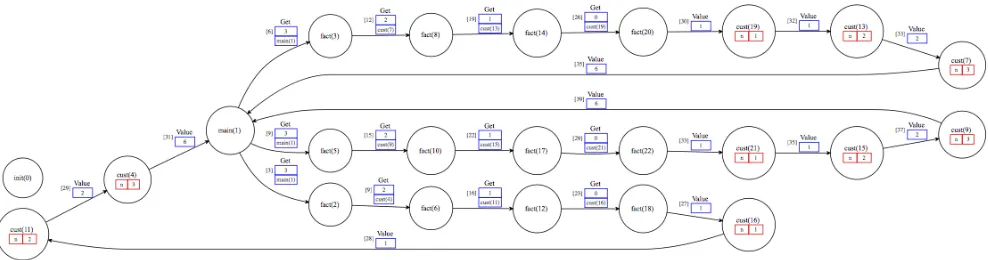
Figure 3: Concurrent Factorial
An actor that is at rest selects a new message and processes it in a thread that is independent of other actor threads. When the thread terminates, the actor is ready to process the next message. Consider the concurrent processing of factorials:
type C u s t o m e r = Act { V a l u e (Int) ; T i m e (Int) };
type F a c t = Act{ Get (Int, C u s t o m e r ) };
act f a c t::F a c t {
Get (0 , c::C u s t o m e r )→c←V a l u e (1) ; Get ( n::Int, c::C u s t o m e r )→{
new f a c t←Get ( n -1 ,new c u s t ( n , c ) ) }
};
act c u s t ( n::Int, c::C u s t o m e r )::C u s t o m e r { V a l u e ( m::Int)→c←V a l u e ( n * m ) ; T i m e ( n::Int)→{}
};
act m a i n::C u s t o m e r {
V a l u e ( n::Int)→p r i n t [Int]( n ) ;
T i m e ( n::Int) when n < 15→new f a c t←Get (3 ,s e l f) }
Themainactor sends a request for !3 to a new factorial actor at times 1 and 15. Instead of using traditional stack-based recursion, the fact actor dynamically creates a new fact
actor to handle the recursive call and acustactor to process the results. This allows multiple requests on the original
factactor to be processed concurrently as shown in figure 3 (generated by ESL) where the nodes are actors and the edges are labelled with[t]m where t is the time when the messagemis sent. The trace shows that 14 calculations of !3 are processed concurrently eventually leading back to the
mainactor.
4.3
Simple Monitors
Consider the definition of a simple monitor for a class of behaviours M[T] where each actor in the class has a value of type T. A monitor observes a monitored object until a given condition is satisfied at which point it fires an action provided by the monitored object by sending it a message. The type of a monitored actor is:
type M [ T ] = Act{
export v a l u e::T ; // The v a l u e to be m o n i t o r e d .
T i m e (Int) ; // T i m e d r i v e s the a p p l i c a t i o n .
A c t i o n () // An a c t i o n a v a i l a b l e to o t h e r s .
};
An example monitored actor manages a single integer value that is incremented or decremented randomly each time unit. The cell prints a message when the action is performed:
act c e l l::M [Int] {
export v a l u e ; v a l u e::Int = 0
A c t i o n→p r i n t [Str]( ’ A c t i o n P e r f o r m e d ’) ; T i m e ( n::Int)→
probably( 5 0 )::Int {
v a l u e := v a l u e + 1 } e l s e v a l u e := v a l u e - 1 }
A simple monitor is constructed using a predicate that is checked against the exported value. When the predicate is satisfied, an action message is sent to the monitored actor:
act m o n i t o r [ T ]( p::( T )→Bool, m::M [ T ])::M a i n { T i m e ( n::Int) when p ( m . v a l u e )→
m←A c t i o n ; T i m e ( n::Int)→{} };
The monitormis applied to the monitored cellcand invokes the action when the value is increased to10:
c::M [Int] = new c e l l ;
m::M a i n = new m o n i t o r [Int](λ( v::Int)::Bool v >10 , c ) ;
4.4
ESL Execution
ESL compiles to a virtual machine code that runs in Java. Each actor is its own machine and thereby runs its own thread of control. Figure 4 shows the ESL executive that controls the pool of actors. When the executive is called, the global poolACTORScontains at least one actor that starts the simulation. Global time and the current instruction count are initialised (lines 3 and 4) before entering the main loop at line 4; the loop continues until one of the actors executes a system call to change the variablestop.
Lines 6 – 7 copy the global pool ACTORS so that freshly created actors do not start until the next iteration. If an actor’s thread of control has terminated (line 9) then a new thread is created on the actor’s VM by scheduling the next message (line 10) if it is available.
The executive schedules each actor forMAX_INSTRSVM in-structions. This ensures that all actors are treated fairly. Once each actor has been scheduled, the existing actors are merged with any freshly created actors (line 14).
The executive measures time in terms of VM instructions. Each clock-time in the simulation consists of INSTRS_PER_ TIME_UNIT instructions performed on each actor. When ac-tors need to be informed of a clock-tick (line 15), global time is incremented (line 17), the instruction counter is reset (line 18) and all actors are sent a clock-tick message.
5.
MONITORING HISTORY
are repeatedly losing bids and then adapt their behaviour accordingly. A more sophisticated mechanism for encoding monitors is required that handles temporal features. This section defines a simple language, outlines its semantics
5.1
History Formulas
Figure 5 shows a language that can be used to express predicates over the history of an actor. In each case the language construct is defined on the left and a definition of satisfactionis given on the right. Satisfaction of a formula is defined with respect to a history, for exampleseq(p,q)is satisfied with respect to a historyh1+h2when the prefixh1
satisfies p and the suffixh2satisfies q. The language is to be viewed operationally because an action may cause a side-effect. The difference betweenaltandxoris thataltwaits to determine thatpis not satisfied before tryingq whereas
xorexpects one of the sub-formulas to fail and tries both at the same time.
A history can be thought of as a list of public state infor-mation and as such each history formula is defined as being satisfied in terms of a list of data. For example, suppose that we want to express a history formulafff that causes actiona to be performed every time a sequence of 3 fails,
000, is detected:
1 anF (0)::Bool = t r u e
2 anF (1)::Bool = f a l s e
3 aT ( n::Int)::Bool = not( anF ( n ) )
4 any ( n::Int)::Bool = anF ( n ) or aT ( n )
5 6 pxn [ T ]( n::Int, p::( T )→Bool)::Mtr [ T ] =
7
case n {
8 0→i d l e [ T ]
9
e l s e seq [ T ]( is [ T ]( p ) , n e x t [ T ]( pxn [ T ]( n -1 , p ) ) )
10 }
11 12 fff::Mtr [Int] =
13 a l w a y s [Int]( alt [Int]( pxn [Int](3 , anF ) , is [Int]( any ) ) ) The predicates anF and any are defined to detect the ap-propriate state elements. The history formulafffuses the operatorseqto compose threeFdetectors one after another in the history. The operatornextis used to advance through the history. Finally, the history predicatefffcombines the threeF detector with an alternative detector is(any) that skips a state value. The monitoralt(p,q)checks pfirst, if
p fails then q is checked, so line 13 will use three F’s as a guard on the action a, if the guard fails then the head of the history is skipped. The monitoralways(p) continually
1 s t o p := f a l s e ; 2 e x e c () { 3 t i m e := 0; 4 i n s t r s := 0; 5 w h i l e (! s t o p ) {
6 a c t o r s := c o p y ( A C T O R S ) ; 7 c l e a r ( A C T O R S ) ;
8 f o r a c t o r ∈ a c t o r s { 9 i f t e r m i n a t e d ( a c t o r ) 10 then s c h e d u l e ( a c t o r ) ; 11 run ( actor , M A X _ I N S T R S ) ; 12 }
13 i n s t r s := i n s t r s + M A X _ I N S T R S ; 14 A C T O R S := A C T O R S + a c t o r s ; 15 i f i n s t r s > I N S T R S _ P E R _ T I M E _ U N I T 16 then {
17 t i m e := t i m e + 1; 18 i n s t r s := 0; 19 f o r a c t o r ∈ A C T O R S 20 s e n d T i m e ( actor , t i m e ) 21 }
22 } 23 }
Figure 4: The ESL Executive
checkspthroughout the history.
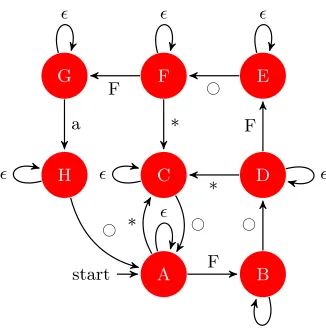
The history of an actor is produced incrementally over time. Therefore an expression written in the language de-fined in figure 5 must continually monitor the actor’s history. The expression can be thought of as a state machine whose nodes correspond to monitor states and whose transitions consume parts of actor histories. Each transition is trig-gered by a clock-tick and can proceed when there is some history to consume, otherwise the machine must stay in its current state and try again when the next tick occurs.
Figure 6 shows the machine corresponding tofff. Each transition is triggered by a clock-tick, the labels on the tran-sitions are: when no history is available;Foccurs when the next state element in the history is anF;#occurs when there is at least one element at the head of the history and causes the element to be consumed; * denotes the situation when the next state element in the history is anything butF.
5.2
Monitor Types
A monitor for histories over type T is aa actor of type
Mtr[T]:
type F a i l = ()→Void type Mtd [ T ] = Act {
export h i s t o r y::[ T ]; T i m e (Int)
}
type Mtr [ T ] = rec M . Act { C h e c k ( Mtd [ T ] ,Int, M , F a i l ) ; T i m e (Int)
}
whose behaviour supports two messages: Time(t)drives the state machine;Mtr(a,c,s,f)activates the monitor and con-tains a monitored actora, an integercthat indexes the next element ofa.history, a monitors that is used as asuccess continuation, and a functionfthat is used as afail contin-uation. The key idea is that ifm ← Mtr(a,c,s;s’,f)then at some future clock-tick, if mis able to consume the cth ele-ment froma.historythens ← Mtr(a,c+1,s’,f)otherwise if
mrejects thecth element thenf()tries an alternative.
5.3
ESL Monitors
The monitor behaviours are defined in figure 7, note that where the clock-tick handler isTime(n::Int) → {}it is omit-ted. The simplest monitor has the behaviour nothing that directly activates the success continuation without modify-ing any of the supplied data. Since the nothmodify-ing behaviour is always the same, it makes sense to create a distinguished actoridle.
An actionaction(c)performs the commandc when it is activated. A sequence monitor seq(p,q) will be satisfied when p is satisfied followed by q. Note that p may have consumed some of the history and so q is supplied as part of the success continuation top.
There are two forms of alternatives:alt(p,q), ifpis satis-fied then so isalt(p,q)andqis ignored, otherwiseqis tried.
p , q ::= n o t h i n g n o t h i n g ( h )
| a l w a y s ( p ) p ( h1 ) , p ( h2 ) ,. . . ⇒a l w a y s ( p ) ( h1 + h2 +. . .) | rec (λ( n ) p ) q ( h ) w h e r e q =[ q / n ] p⇒q ( rec (λ( n ) p ) ) | seq ( p , q ) p ( h1 ) & p ( h2 )⇒seq ( p , q ) ( h1 + h2 ) | alt ( p , q ) p ( h ) or q ( h )⇒alt ( p , q ) ( h ) | xor ( p , q ) p ( h ) or q ( h )⇒alt ( p , q ) ( h ) | n e x t ( p ) p ( h )⇒n e x t ( p ) ( x : h ) | is ( c ) c ( x )⇒is ( c ) ( x : h ) | a c t i o n ( a ) a c t i o n ( a ) ( h )
A
start B
C D
E F
G
H
F
*
# #
F
*
#
F
*
a
[image:7.628.92.255.52.217.2]
#
Figure 6: A Monitor State Machine
The alternativexor(p,q)assumes that only one ofpand q
will be satisfied and tries them concurrently.
Recursive monitors are created usingrecwhich is supplied with a functiong whose argument is a cyclic monitor. For example:
rec[Int](λ( f S t a r::Mtr [Int])::Mtr [Int] seq [Int]( isF , n e x t ( f S t a r ) ) )
is a monitor that will expect a history to contain an infinite sequence of0s.
5.4
Example Traces
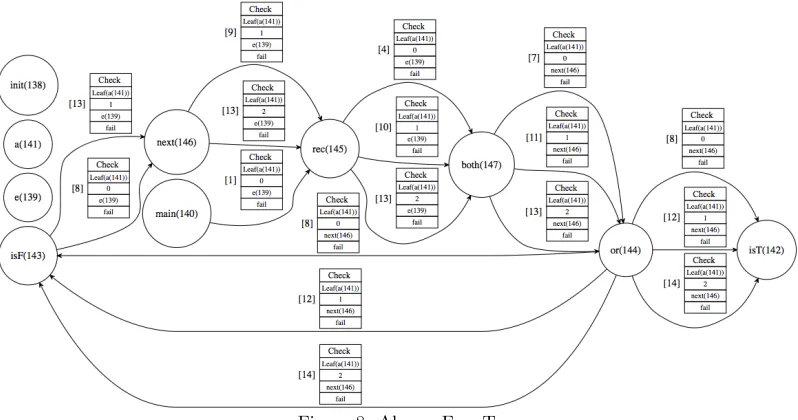
ESL provides a visualisation of execution traces that can be used to check our understanding monitor behaviours. Consider the case of a monitored actora that produces a trace of true and false encoded as integers1and0. To check that the trace is correctly formed we might construct the following monitor:
isT::Mtr [Int] = new is [Int]( aT ) isF::Mtr [Int] = new is [Int]( anF )
a l w a y s F o r T::Mtr [Int] = a l w a y s [Int](new xor [Int]( isT , isF ) ) Figure 8 shows the trace (up to time[14]) produced by ESL as a result of evaluating:
a l w a y s F o r T←C h e c k ( L e a f [Int]( a ) ,0 , i d l e [Int] ,λ() {})
The actorinit(138)is just the initialisation actor and can be ignored. The trace starts at main(140) which sends a
Checkmessage at time [1]to rec(145) that is responsible for setting up a loop. Each loop sends aCheckmessage to the
both(147)actor which in turn sends the message to theisT (142)andisF(143)actors. We deduce from the trace thata
produces0as the first two elements of its history since the
isF(143)actor invokes its success continuation in response to checking the history at index0and index1, whereas actor
isT(142)does not send any messages.
It may be necessary to check the histories of two or more actorsat the same time. This is achieved by encoding the actors using the constructorPair[T]::(MTree[T],MTree[T]) → MTree[T]. Given two actors that produce histories of0and
1the following monitor checks that the first actor produces
1and the second produces0on the next two occasions:
t w i c e [ T ]( m::Mtr [ T ])::Mtr [ T ] = new seq [ T ]( m ,new n e x t [ T ]( m ) ) t f X 2::Mtr [ T ] = t w i c e [Int](new s p l i t [Int]( isT , isF ) ) p a i r::M T r e e [Int] = P a i r [Int]( L e a f [Int]( a1 ) , L e a f [Int]( a2 ) ) t f X 2←C h e c k ( pair ,0 , i d l e [Int] ,λ() {})
data M T r e e [ T ] = L e a f ( Mtd [ T ]) | P a i r ( M T r e e [ T ] , M T r e e [ T ]) ;
act n o t h i n g [ T ]::Mtr [ T ] {
C h e c k ( a::M T r e e [ T ] , c::Int, s::Mtr [ T ] , f::F a i l )→ s←C h e c k ( a , c ,s e l f, f ) }
i d l e [ T ]::Mtr [ T ] = new n o t h i n g [ T ]()
act a c t i o n [ T ]( c o m m a n d::()→Void)::Mtr [ T ] { C h e c k ( a::M T r e e [ T ] , c::Int, s::Mtr [ T ] , f::F a i l )→{
c o m m a n d () ;
s←C h e c k ( a , c , i d l e [ T ] , f ) } }
act seq [ T ]( p::Mtr [ T ] , q::Mtr [ T ])::Mtr [ T ] { C h e c k ( a::M T r e e [ T ] , c::Int, s::Mtr [ T ] , f::F a i l )→
p←C h e c k ( a , c ,new seq [ T ]( q , s ) , f ) }
act alt [ T ]( p::Mtr [ T ] , q::Mtr [ T ])::Mtr [ T ] { C h e c k ( a::M T r e e [ T ] , c::Int, s::Mtr [ T ] , f::F a i l )→
p←C h e c k ( a , c , s ,λ()::Void q←C h e c k ( a , c , s , f ) ) }
act xor [ T ]( p::Mtr [ T ] , q::Mtr [ T ])::Mtr [ T ] { C h e c k ( a::M T r e e [ T ] , c::Int, s::Mtr [ T ] , f::F a i l )→{
p←C h e c k ( a , c , s , f ) ; q←C h e c k ( a , c , s , f ) } } a l w a y s [ T ]( p::Mtr [ T ])::Mtr [ T ] =
new rec[ T ](λ( q::Mtr [ T ])::Mtr [ T ]
new seq [ T ]( p ,new n e x t [ T ]( q ) ) )
act n e x t [ T ]( p::Mtr [ T ])::Mtr [ T ] {
C h e c k ( a::M T r e e [ T ] , c::Int, s::Mtr [ T ] , f::F a i l )→ p←C h e c k ( a , c +1 , s , f ) }
act is [ T ]( p r e d::( T )→Bool)::Mtr [ T ] {
C h e c k ( t::M T r e e [ T ] , c::Int, s::Mtr [ T ] , f::F a i l )→
case t {
L e a f ( a::Mtd [ T ])→
i f l e n g t h [ T ]( a . h i s t o r y ) > c
then {
i f p r e d ( nth [ T ]( a . history , c ) )
then s←C h e c k ( t , c , i d l e [ T ] , f )
e l s e f ()
} e l s e s e l f ←C h e c k ( t , c , s , f ) } }
act rec[ T ]( g::( Mtr [ T ])→Mtr [ T ])::Mtr [ T ] { C h e c k ( a::M T r e e [ T ] , c::Int, s::Mtr [ T ] , f::F a i l )→
g (new rec[ T ]( g ) )←C h e c k ( a , c , s , f ) }
act s p l i t [ T ]( p::Mtr [ T ] , q::Mtr [ T ])::Mtr [ T ] { C h e c k ( t::M T r e e [ T ] , c::Int, s::Mtr [ T ] , f::F a i l )→
case t {
P a i r [ T ]( t1::M T r e e [ T ] , t2::M T r e e [ T ])→
l e t j::Mtr [ T ] = new j o i n [ T ]( t , s , f )
in {
p←C h e c k ( t1 , c , j , f ) ; q←C h e c k ( t2 , c , j , f ) } } }
act j o i n [ T ]( t::M T r e e [ T ] , s::Mtr [ T ] , f::F a i l )::Mtr [ T ] { d o n e::Bool = f a l s e
C h e c k ( a::M T r e e [ T ] , c::Int, s::Mtr [ T ] , f1::F a i l )→
i f not( d o n e )
then d o n e := t r u e
e l s e s←C h e c k ( t , c , s , f ) }
Figure 7: ESL Monitor Behaviours
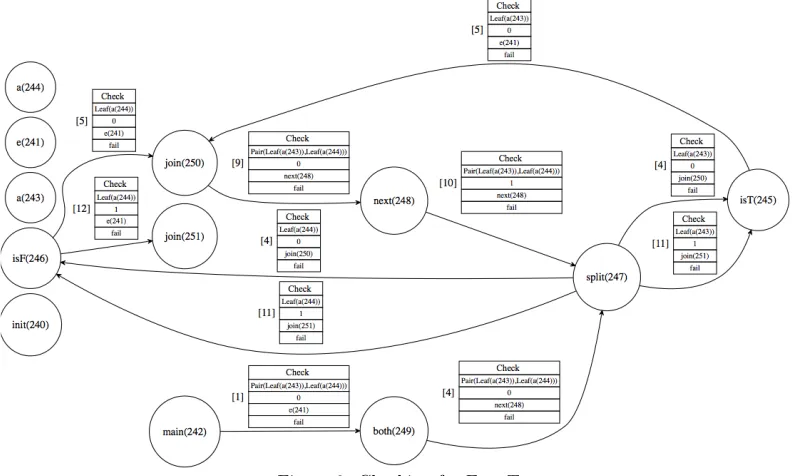
Figure 9 shows a trace of execution for tfX2. The two monitored actors are a(243) and a(244). The trace shows that, as required, a(243)produces1 anda(244)produces 0
as the first element in their respective histories. However, both actors produce 0on the next round causing the trace to halt atjoin(251).
6.
DEVELOPING A SIMULATION
Figure 8: Always F or T
used in an ESL-based simulation in section 6.2 producing results in section 6.3.
6.1
Specification
Each ESL simulation is based on an execution model that creates a sequence of states of type [Σ]. The starting point for developing a simulation is a black-box model that iden-tifies the key features of the histories that will be measured and that can be affected via levers. Refinement of the initial specification introduces detail necessary for adaptation.
Figure 10 shows a constructive approach in terms of a set of customersC, a set of providersP and a set of offers O. The set∅∗
denotes the set of all traces of arbitrary length. The set of tracesBo contains all possible offeringsc(o,t) by
customerc, of offering owith colourtand defines them to be available foraclock-ticks. The set of tracesBa contains
awardsp(o)of offeringoto providerp. TracesBbdefine bids p(o,t) by providerpfor opportunityo.
The operator⊕freely combines traces with the expecta-tion that predicates hold for all traces. The predicates are not defined here but are outlined as follows: offerholds for traces where each customer can offer, and each provider can bid for, at most one opportunity at any given time, and bids must be concurrent with offers.awardholds for traces where an award occurs at the end of the offer perioda and when the colour of the bid matches that of the offer; no award can be made when no bids are present and at most one award can be made.
The goal of the bidding simulation is to achieve a be-haviour that is specified by ∆. ESL can be used to construct a system of interacting actors withemergent behaviour. Mon-itors can be used to detect when the behaviour diverges from the specification and take corrective action.Leversthat con-trol the monitors can help inform strategicdecisions.
6.2
Implementation
The specification given in section 6.1 defines a sequence of system states that must be refined to produce an ESL sim-ulation model of the system whose levers can be modified and whose goals can be measured. The refinement must pro-duce a system that is consistent with the specification, but
that may introduce more detail. The result is an implemen-tation defined in terms of five types of behaviour customer
generating opportunities,opportunitymanaging the bidding and awarding process for opportunities, a notice-boardnb,
providergenerating bids and receiving their outcome, and a monitor forprovideradaptive behaviour. This section gives the key elements of the implementation.
Thecustomerbehaviour is supplied with a colour, a per-centage chance of changing the colour, the frequency at which the opportunities are created and the availability of the opportunity:
1 data C o l o u r = Red | G r e e n
2 opp ( Red )::C o l o u r = G r e e n
3 opp ( G r e e n )::C o l o u r = Red
4
5 type C u s t o m e r =Act {
6 // A c u s t o m e r is a m o n i t o r e d a c t o r .
7 export h i s t o r y::[ C o l o u r ];
8 T i m e (Int) ; // T i m e g e n e r a t e d o p p o r t u n i t i e s .
9 D o n e ( C o l o u r ) // R e c o r d o p p o r t u n i t y c o m p l e t i o n .
10 }
11
12 act c u s t o m e r ( c::Colour , cng::Int, f r e q::Int, a v a i l::Int)::C u s t o m e r {
13 // C r e a t e o p p o r t u n i t i e s c o l o u r e d c , w i t h f r e q u e n c y
14 // freq , a v a i l a b i l i t y a v a i l w i t h a cng % c h a n c e of
15 // c h a n g i n g c o l o u r .
16 export h i s t o r y ;
17 n e x t::Int = 0;
18 h i s t o r y::[ C o l o u r ] = [][ C o l o u r ];
19 o f f e r () = nb←Add (new o p p o r t u n i t y (s e l f, c , a v a i l ) )
20 T i m e ( n::Int)when n e x t = f r e q→{
21 n e x t := 0;
22 probably( 9 0 ) {
23 o f f e r () ;
24 probably( cng ) c := opp ( c ) else {}
25 } else {}
26 };
27 T i m e ( n::Int)→ n e x t := n e x t + 1;
28 D o n e ( c::C o l o u r )→h i s t o r y := c : h i s t o r y
29 }
A customer detects clock-ticks on lines 20 and 27. Every
freq clock-ticks (line 20) there is a 90% chance (line 22) that an offer is created (line 23) and acngchance that the colour changes. A new opportunity is created in line 19 by sending anAddmessage to the global notice-boardnb.
An opportunity behaviour is supplied with a customer, the colour of the opportunity and the length of time the opportunity should be available:
1 type O p p o r t u n i t y =Act{
2 export c u s t o m e r::C u s t o m e r ;
3 T i m e (Int) ; // C h e c k w h e t h e r to m a k e a w a r d .
4 Bid ( Colour , P r o v i d e r ) // R e c e i v e bid f r o m p r o v i d e r .
[image:8.628.307.550.407.586.2]Figure 9: Checking for F or T
T ={r, g}
Bo, Ba, Bb, B,∆ : [Σ]
⊕ : [Σ]×[Σ]→[Σ] offer,award: [Σ]→ {t, f}
Bo={+ [{c(o,t)} a
] +r|c∈C, o∈O, t∈T, ∈ ∅∗
, r∈Bo} Ba={+ [{p(o)}] +r|p∈P, o∈O, ∈ ∅∗, r∈Ba} Bb={+b+r|p∈P, o∈O, t∈T, b∈ {p(o,t)}
∗
, ∈ ∅∗
, r∈Bb} B={t1⊕t2⊕t3|t1∈Bo, t2∈Ba, t3∈Bb}
σ1:t1⊕σ2:t2=σ1∪σ2: (t1⊕t2)
∆ ={b|b∈B, offer(b)∧ award(b)}
Figure 10: Specification of Bidding Behaviours ∆
6
7 act o p p o r t u n i t y ( c::C u s t o m e r , k::Colour , a v a i l::Int)::O p p o r t u n i t y {
8 // O p p o r t u n i t y c r e a t e d by c , for p r o c e s s i n g k . A f t e r a v a i l
9 // t i m e u n i t s the o p p o r t u n i t y w i l l be a w a r d e d to w i n n i n g
10 // p r o v i d e r s e l e c t e d at r a n d o m .
11 export c u s t o m e r ;
12 c u s t o m e r::C u s t o m e r = c ;
13 t r y A w a r d ( Bid ( c::Colour , v::P r o v i d e r ) , t r u e )::Bool = {
14 v←F a i l e d ;
15 t r u e
16 };
17 t r y A w a r d ( Bid ( c::Colour , v::P r o v i d e r ) , f a l s e )::Bool= {
18 v←A w a r d ;
19 t r u e
20 }when c = k ;
21 t r y A w a r d ( Bid ( c::Colour , v::P r o v i d e r ) , f a l s e )::Bool= {
22 v←F a i l e d ;
23 f a l s e
24 };
25 b i d s::[ Bid ( Colour , P r o v i d e r ) ] = [][ Bid ( Colour , P r o v i d e r ) ]
26 b::Bid ( Colour , P r o v i d e r ) = Bid ( k::Colour , v::P r o v i d e r )when avail >0
→b i d s := b : b i d s ;
27 Bid ( c::Colour , p r o v i d e r::P r o v i d e r )→p r o v i d e r←F a i l e d ;
28 T i m e ( n::Int)when( a v a i l = 0)and ( b i d s < > [])→{
29 a v a i l a b i l i t y := a v a i l - 1;
30 let won::Bool= f a l s e
31 in for b::Bid ( Colour , P r o v i d e r )
32 in s h u f f l e [ Bid ( Colour , P r o v i d e r ) ]( b i d s )
33 do won := t r y A w a r d ( b , won ) ;
34 b i d s := [][ Bid ( Colour , P r o v i d e r ) ];
35 nb←R e m o v e (s e l f) ;
36 k i l l [ O p p o r t u n i t y ](s e l f) ;
37 c u s t o m e r←D o n e ( c o l o u r )
38 };
39 T i m e ( n::Int)when( a v a i l a b i l i t y = 0)→{
40 nb←R e m o v e (s e l f) ;
41 c u s t o m e r←D o n e ( k ) ;
42 k i l l [ O p p o r t u n i t y ](s e l f)
43 };
44 T i m e ( n::Int)→a v a i l := a v a i l - 1
45 }
An opportunity receives bids from providers (26-28). If the opportunity is available then the bid is saved (27) other-wise the provider has missed the deadline and is informed that the bid has failed (28). Clock-ticks reduce the avail-ability count (45), when the opportunity closes and there are bids (29), the bids are taken in a random order (33) and awarded (34). An opportunity is terminated by removing it from the global notice-board (36) and informing the cus-tomer that the colour was processed (38). The actor is killed (37) meaning that is can perform no further computation.
A provider is created with a colour that controls the bids: 1
data R e s u l t = S | F ;
2
type P r o v i d e r =Act{
3
export h i s t o r y::[ R e s u l t ];
4
T i m e (Int) ; // Bid for o p p o r t u n i t i e s .
5
A w a r d () ; // We got it !
6
F a i l e d () ; // It w e n t to s o m e o n e e l s e .
7
C h a n g e ( Colour , C u s t o m e r ) // C h a n g e c o l o u r .
8
}
9 10
act p r o v i d e r ( c o l o u r::C o l o u r )::P r o v i d e r {
11
// A p r o v i d e r i n i t i a l l y b i d s u s i n g c o l o u r . It p u b l i s h e s
12
// a h i s t o r y if s u c c e s s e s and f a i l u r e s . It can be
13
// i n s t r u c t e d to c h a n g e bid - c o l o u r for p a r t i c u l a r
14
// c u s t o m e r s .
15
export h i s t o r y ;
16
h i s t o r y::[ R e s u l t ] = [][ R e s u l t ];
17
b i d d i n g::Bool= f a l s e ;
18
r e c o r d ( r::R e s u l t )::[ R e s u l t ] = h i s t o r y := r : h i s t o r y ;
19
bid ( o::O p p o r t u n i t y : l::[ O p p o r t u n i t y ])::Bool = {
20
o←Bid ( g e t C o l o u r ( history , o . c u s t o m e r ) ,s e l f) ;
21
b i d d i n g := t r u e
22
};
23
g e t C o l o u r ( l::[ R e s u l t ] , c1::C u s t o m e r )::C o l o u r =
24
// g e t C o l o u r t a k e s i n t o a c c o u n t any c h a n g e s of bid
25
// c o l o u r for the s u p p l i e d c u s t o m e r .
26
case l {
27
[][ R e s u l t ]→c o l o u r ;
28
C h a n g e d ( k::Colour , c2::C u s t o m e r ) : l::[ R e s u l t ]→kwhen c1 = c2 ;
29
r::R e s u l t : l::[ R e s u l t ]→g e t C o l o u r ( l , c1 )
30
};
31
T i m e ( n::Int)when( nb .data < > [][ O p p o r t u n i t y ])→
32
// Try for an o p p o r t u n i t y ( a s s u m e t h e r e is one ) .
33
bid ( s h u f f l e [ O p p o r t u n i t y ]( nb .data) ) ;
34
A w a r d→{
35
r e c o r d ( S ) ;
36
b i d d i n g := f a l s e
37
};
38
F a i l e d→{
39
r e c o r d ( F ) ;
40
b i d d i n g := f a l s e
41
[image:9.628.106.502.58.296.2]Figure 11: Example Actor Configuration
42
C h a n g e ( c o l o u r::Colour , c u s t o m e r::C u s t o m e r )→
43
r e c o r d ( C h a n g e d ( colour , c u s t o m e r ) )
44
}
A provider checks the opportunities on the notice-board and makes a bid (131–33,19–22) based on the history (20). A monitor (defined below) may request that a provider changes colour for a particular customer (42–43) that is subsequently used to determine the colour of a bid (23–30) for that cus-tomer.
A bidding simulation has the following levers: the number of providers, the number of customers, the likelihood that the customer changes the colour of their opportunities, the duration of the simulation and the monitors.
A monitor is created for each provider and customer pair. Our levers are three different types of monitor: nonethat does not change a provider,randomthat changes a provider’s colour at random, and adaptive that changes a provider’s colour based on its failure rate:
n o n e ( p::P r o v i d e r , c::C u s t o m e r )::Mtr [Int] =
// Do n o t h i n g. . .
i d l e [Int]
r a n d o m ( p::P r o v i d e r , c::C u s t o m e r )::Mtr [Int] =
// R a n d o m l y c h a n g e the c o l o u r for the s u p p l i e d // p r o v i d e r w h e n b i d d i n g for an o p p o r t u n i t y f r o m // the s u p p l i e d c u s t o m e r. . .
l e t g e t C o l o u r ()::C o l o u r =
probably( 5 0 )::C o l o u r Red
e l s e G r e e n ;
c h a n g e ()::Void = p←C h a n g e ( g e t C o l o u r () , c )
in a l w a y s [Int](new a c t i o n [Int]( c h a n g e ) )
a d a p t i v e ( k::Colour , p::P r o v i d e r , c::C u s t o m e r )::Mtr [Int] =
// Use a g u a r d to c h e c k w h e t h e r the c o l o u r s h o u l d // c h a n g e . The g u a r d c h e c k s t h a t :
// (1) P r o v i d e r p has f a i l e d 3 t i m e s ; and
// (2) C u s t o m e r c has o f f e r e d the o p p o s i t e c o l o u r 3 x. . . l e t c h k O p p ( v::C o l o u r )::Bool = v = opp ( k ) in
l e t i s O p p::Mtr [ C o l o u r ] = is [ C o l o u r ]( c h k O p p ) in l e t op3::Mtr [ T ] = pxn [ C o l o u r ](3 , i s O p p ) ;
c h a n g e ()::Void = { k := opp ( k ) ; p←C h a n g e ( k , c ) } in
l e t g u a r d = s p l i t [Int]( fff , op3 )
[image:10.628.53.289.455.671.2]in a l w a y s [Int]( seq [Int]( guard , a c t i o n [Int]( c h a n g e ) ) )
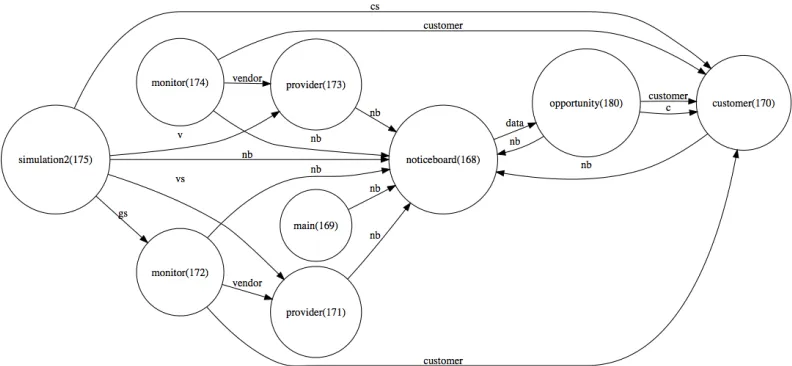
Figure 11 shows a configuration of actors involving two providers and a single customer. Note that both providers have their own monitor. Figure 12 shows the initial part of a trace for a situation involving a single customer and a single
provider. Four opportunities are created during the simula-tion. The provider bids for the first three opportunities at times [5], [12] and [17]. All bids fail at which point the monitor detects the failing situation and changes the colour to Red at [21]. After the provider has been influenced by the monitor it makes a successful bid for an opportunity at time[22].
6.3
Results
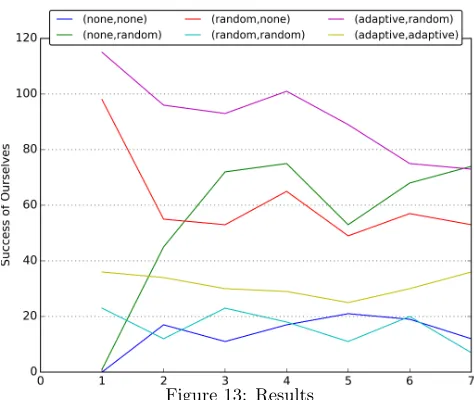
Figure 13 shows the results of the simulation given 2 cus-tomers and two categories of service provider: competitors (10) and ourselves (1). Each category of service provider can have three different adaptor types:
none No adaptive behaviour: the provider will not change the colour of the bid.
random The provider changes its bid colour at random. adaptive The provider uses a monitor on all customer
his-tories in order to change bid colour when it has failed to be awarded an opportunity 3 or more times.
The simulation was executed for 1000 clock-ticks for each configuration of service service provider category and adap-tor type. The number of successful bids for ourselves and the maximum number of successful bids for competitors was recorded for each configuration. Figure 13 shows results for a selection of configurations: the legend labels each result line in terms of configuration strategies (ourselves, competi-tors) and shows the number of successes for ourselves.
The simulation is intended to aid decision making with respect to whether a particular strategy is cost effective, and although we would need to know the cost of monitoring historical records, the results indicate that it is clearly in our favour to implement the adaptive strategy if we believe that our competitors are behaving randomly. Also, it would appear that no strategy at all is of similar value to random choice. Where all categories are behaving strategically, there is a benefit to us, however this is significantly less that when our competitors are not strategic.
Figure 12: Example Trace
Figure 13: Results
This paper has proposed an approach to organisational decision-making using emergent behaviour expressed as ac-tor models. We are in the process of developing technology to support this approach in the form of a language called ESL. Part of the approach depends on monitors that detect patterns of behaviour and influence actors by sending them messages. The contribution of the paper is to show how a language of monitor combinators can be defined in ESL and used to implement a simple case study. All the code in the paper has been implemented in the ESL language which runs on a VM written in Java and all actor configurations and message traces have been generated from EDB and vi-sualised using GraphViz.
Further work is planned in the following areas: Although we have identified an approach to specification of a simu-lation given in section 6.1, no attempt has been made to verify properties of the ESL program; research in this area [31] will be investigated. ESL has been designed with the aim of expressing patterns of organisational behaviour, and with the expectation that results from Multi-Agent Systems
research will be relevant to constructing organisational sim-ulation models. We intend to investigate how to extend ESL with abstractions that are specific to organisations and to encode features such as negotiation and collaboration. ESL is supported by a development environment called EDB that performs syntax checking and type checking. EDB also supports debugging and exporting simulation traces such as those shown in this paper. We aim to use EDB as a basis for research into debugging and visualising actor systems.
References
[1] Gul A Agha. Actors: A model of concurrent compu-tation in distributed systems. Technical report, DTIC Document, 1985.
[2] Jamie Allen. Effective akka. ” O’Reilly Media, Inc.”, 2013.
[3] Joe Armstrong. Erlang - a survey of the language and its industrial applications. InProc. INAP, volume 96, 1996.
[4] Mark Astley. The actor foundry: A java-based ac-tor programming environment. University of Illinois at Urbana-Champaign: Open Systems Laboratory, 1998. [5] Balbir S Barn, Tony Clark, and Vinay Kulkarni. Can
organisational theory and multi-agent systems influence next generation enterprise modelling? InInternational Conference on Software Technologies, pages 202–216. Springer, 2014.
[6] Howard Barringer, Allen Goldberg, Klaus Havelund, and Koushik Sen. Rule-based runtime verification. In International Workshop on Verification, Model Check-ing, and Abstract Interpretation, pages 44–57. Springer, 2004.
[7] Andrei Borshchev. The big book of simulation model-ing: multimethod modeling with AnyLogic 6. AnyLogic North America Chicago, 2013.
[image:11.628.54.291.283.483.2]Modeling & Simulation: DEVS Integrative M&S Sym-posium, pages 85–90. Society for Computer Simulation International, 2015.
[9] Ian Cassar and Adrian Francalanza. Runtime adapta-tion for actor systems. InRuntime Verification, pages 38–54. Springer, 2015.
[10] Ian Cassar and Adrian Francalanza. On implement-ing a monitor-oriented programmimplement-ing framework for ac-tor systems. InInternational Conference on Integrated Formal Methods, pages 176–192. Springer, 2016. [11] Feng Chen and Grigore Ro¸su. Mop: an efficient and
generic runtime verification framework. InACM SIG-PLAN Notices, volume 42, pages 569–588. ACM, 2007. [12] Christian Colombo, Adrian Francalanza, and Rudolph Gatt. Elarva: A monitoring tool for erlang. In In-ternational Conference on Runtime Verification, pages 370–374. Springer, 2011.
[13] Paul S Dodd and Chinya V Ravishankar. Monitoring and debugging distributed real-time programs. Softw., Pract. Exper., 22(10):863–877, 1992.
[14] Adrian Francalanza. A theory of monitors. In Interna-tional Conference on Foundations of Software Science and Computation Structures, pages 145–161. Springer, 2016.
[15] Alwyn E Goodloe and Lee Pike. Monitoring distributed real-time systems: A survey and future directions. 2010.
[16] Philipp Haller and Martin Odersky. Scala actors: Uni-fying thread-based and event-based programming. The-oretical Computer Science, 410(2):202–220, 2009. [17] Klaus Havelund and Grigore Ro¸su. Synthesizing
mon-itors for safety properties. InInternational Conference on Tools and Algorithms for the Construction and Anal-ysis of Systems, pages 342–356. Springer, 2002. [18] M.E. Iacob, Dr. H. Jonkers, M.M. Lankhorst,
E. Proper, and Dr.ir. D.A.C. Quartel. Archimate 2.0 specification: The open group. Van Haren Publishing, 2012.
[19] J. Krogstie. Using eeml for combined goal and process oriented modeling: A case study.CEUR Workshop Pro-ceedings, 337:112–129, 2008.
[20] Vinay Kulkarni, Souvik Barat, Tony Clark, and Bal-bir Barn. Toward overcoming accidental complexity in organisational decision-making. In Model Driven Engineering Languages and Systems (MODELS), 2015 ACM/IEEE 18th International Conference on, pages 368–377. IEEE, 2015.
[21] Tom McDermott, William Rouse, Seymour Goodman, and Margaret Loper. Multi-level modeling of complex socio-technical systems. Procedia Computer Science, 16:1132–1141, 2013.
[22] Donella H Meadows and Diana Wright. Thinking in systems: A primer. chelsea green publishing, 2008. [23] Grigore Ro¸su, Feng Chen, and Thomas Ball.
Synthesiz-ing monitors for safety properties: This time with calls and returns. In International Workshop on Runtime Verification, pages 51–68. Springer, 2008.
[24] Koushik Sen, Abhay Vardhan, Gul Agha, and Grig-ore Rosu. Efficient decentralized monitoring of safety in distributed systems. In Proceedings of the 26th In-ternational Conference on Software Engineering, pages 418–427. IEEE Computer Society, 2004.
[25] Oleg Sokolsky, Usa Sammapun, Insup Lee, and Jesung Kim. Run-time checking of dynamic properties. Elec-tronic Notes in Theoretical Computer Science, 144(4): 91–108, 2006.
[26] Sriram Srinivasan and Alan Mycroft. Kilim: Isolation-typed actors for java. In European Conference on Object-Oriented Programming, pages 104–128. Springer, 2008.
[27] Tom Van Cutsem, Stijn Mostinckx, Elisa Gonzalez Boix, Jessie Dedecker, and Wolfgang De Meuter. Am-bienttalk: object-oriented event-driven programming in mobile ad hoc networks. InChilean Society of Computer Science, 2007. SCCC’07. XXVI International Confer-ence of the, pages 3–12. IEEE, 2007.
[28] Carlos Varela and Gul Agha. Programming dynam-ically reconfigurable open systems with salsa. ACM SIGPLAN Notices, 36(12):20–34, 2001.
[29] Fran¸cois Vernadat. Ueml: towards a unified enterprise modelling language. International Journal of Produc-tion Research, 40(17):4309–4321, 2002.
[30] Stephen A White.BPMN modeling and reference guide: understanding and using BPMN. Future Strategies Inc., 2008.
[31] Shohei Yasutake and Takuo Watanabe. Actario: A framework for reasoning about actor systems. In Work-shop on Programming based on Actors, Agents, and De-centralized Control (AGERE, 2015.