Creating meaningful bodily expression in virtual worlds :
Inquiring methods for designers.
CHEN, Yen-Fu.
Available from Sheffield Hallam University Research Archive (SHURA) at:
http://shura.shu.ac.uk/19453/
This document is the author deposited version. You are advised to consult the publisher's version if you wish to cite from it.
Published version
CHEN, Yen-Fu. (2014). Creating meaningful bodily expression in virtual worlds : Inquiring methods for designers. Doctoral, Sheffield Hallam University (United Kingdom)..
Copyright and re-use policy
See http://shura.shu.ac.uk/information.html
Learning and information Services I Adsetls Centre, City Campus I Sheffield Si 1VVD I
WW I M i J
1 0 2 0 4 0 8 30 8
Sheffield Hallam University Learning and Information Services
Adsetis Centre, Ciry Campus Sheffield S1 1WD
ProQuest Number: 10694334
All rights reserved
INFORMATION TO ALL USERS
The quality of this reproduction is dependent upon the quality of the copy submitted.
In the unlikely event that the author did not send a com plete manuscript and there are missing pages, these will be noted. Also, if material had to be removed,
a note will indicate the deletion.
uest
ProQuest 10694334
Published by ProQuest LLC(2017). Copyright of the Dissertation is held by the Author.
All rights reserved.
This work is protected against unauthorized copying under Title 17, United States C ode Microform Edition © ProQuest LLC.
ProQuest LLC.
789 East Eisenhower Parkway P.O. Box 1346
Creating meaningful bodily expression in virtual worlds: Inquiring methods for designers
Yen-Fu Chen
A thesis submitted in partial fulfilment of the requirements of Sheffield Hallam University
for the degree of Doctor of Philosophy
Abstract
This research develops a co-design framework, co-design methods and generative
tools for new creation of expressive behaviour by avatars. Influenced by Argyle’s (1990)
encoding-decoding paradigm of nonverbal communication, a
decoding-encoding-decoding paradigm for co-design was proposed. This co-design
framework consists of four stages: 1. designers and users decode (analyse) existing
examples of nonverbal communication; 2. designers and users encode (co-create) new
nonverbal communication; 3. designers reflect on the process of co-creation and
encodes (designs) new non-verbal communication in avatar behaviours; 4. the new
non-verbal communication is decoded by end-users in decoding.
The detail of the co-design framework, including co-design methods and
generative tools, has been developed and evaluated in the two workshop studies that
were conducted in Sheffield and Taipei. Workshop Study 1 aimed to look into and refine
the co-design methods and generative tools in working with designers and users.
Workshop Study 2 aimed to evaluate the effectiveness of two novel generative tools (the
video experience note and the video self-recording device) I developed in Workshop
Study 1. The result of the two workshop studies indicates that the co-design process
appeared to be helpful and suitable for designers of avatar behaviours. In particular, the
activity of encoding stage enables designers to learn about users’ needs and experience
for designing new creation.
The contributions in this thesis to knowledge are: l.a co-design framework for the
creation of expressive behaviours by avatars, supported by 2.methods for the selection
of stimulus film clips and non-design participants; 3.two novel generative tools for the
Acknowledgements
My deep appreciation is to Professor Chris Rust, my first director of study, for his
valuable discussions, suggestions and great support during my PhD study. I would like
to express my deep gratitude to Dr. Nicola Wood, my second director of study, for her
valuable comments and suggestions throughout my research and thesis. I would like to
thank both of them for their encouragement and trust in my academic performance.
I gratefully acknowledge my friends’ support, in particular Sam Yap and Jade Lee,
for their invaluable friendships and their treatment of me as one of their family members
in Sheffield.
I would like to thank all the participants in my practical work for giving their time
and providing their opinions willingly.
Most of my deepest gratitude to my parents, Cheng-Chiuan Chen and Mei-Chu Lo,
for all their unconditional love, support and patience. I would not have been able to
complete this thesis without them.
Last, but not least, I would like to express my gratitude and appreciation to people
Table of Content
Abstract...i
Acknowledgements...ii
Table of Content...iii
List of Figures...vi
List of Tables... x
1 Introduction...1
1.1 Overview...1
1.2 Background...2
1.3 Motivation...4
1.4 Focus of the Research... 4
1.5 Aims and Objectives... 7
1.6 Definition of Terms... 8
1.7 Scope of the Thesis...10
1.8 Structure of the Thesis...11
2 Literature Review... 14
2.1 Introduction... 14
2.2 Avatar Design...14
2.3 Face-to-Face Communication in Social Interaction...32
2.4 User Involvement in the Design Process...45
2.5 Research Problem: Generatvie Tools and Methods...59
2.6 Chapter Summary... 61
3 Methodology...63
3.1 Introduction...63
3.3 Data Collection...69
3.4 Data Logging and Analysis...88
3.5 Chapter Summary...96
4 Workshop Study 1: Developing Generative Tools... 98
4.1 Introduction...98
4.2 Workshop Study Aims... 99
4.3 The Workshop Setting... 100
4.4 The Orientation Workshop...108
4.5 The Design Workshop...119
4.6 The Design Review Workshop...137
4.7 The Evaluation Workshop... 144
4.8 Summary and Conclusions... 148
5 Workshop Study 2: Evaluating Generative Tools...150
5.1 Introduction... 150
5.2 Workshop Study Aims... 151
5.3 The Setting of the Workshop Study... 151
5.4 The 1st Workshop...159
5.5 The 2nd Workshop...167
5.6 The Designers’ Feedback... 171
5.7 Summary and Conclusions... 173
6 Discussion... 175
6.1 Introduction... 175
6.2 A Framework for Co-creating Expressive Behaviour...175
6.3 Developing the Generative Tools... 180
6.4 Evaluating the New Generative Tools...183
6.6 Chapter Summary...186
7 Conclusion... 188
7.1 Summary of this Research... 188
7.2 The Co-design methods and the Generative Tools...191
7.3 Limitations and Future Work...196
Reference...198
Bibliography... 211
Appendix I Questionnaire for Stimulus Film Clips...224
Appendix II Sample respondents’ on the Questionnaire for Stimulus Film Clips 225 Appendix III Consent Form for the Workshops... 227
Appendix IV The Video Experience Note for Co-designing... 228
Appendix V Sample Participants’ Records on the Video Experience Note 229 Appendix VI Sample Event Logs... 232
Appendix VII Coder Training Sheet... 236
Appendix VIII Intercoder Reliability Result...237
Appendix IX Interaction Process Analysis Record by Coder A ...238
List of Figures
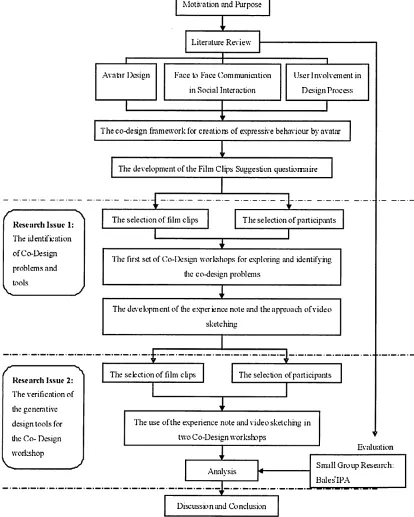
Figure 1 Interaction among avatars in virtual world (taken from Second Life of Linden Research, Inc)... 3 Figure 2 The avatars’ appearance are taken from MU of Nintendo (Left), The Sims of Electronic Arts (Middle), and World ofWarcraft of Blizzard Entertainment (Right)...10 Figure 3 The research process flowchart in this research...13 Figure 4 The history of popularisation of Avatar... 15 Figure 5 The cover art (Right) and screenshot (left) of Ultima IV: Quest o f the Avatar
(taken from IGN
-http://www.ign.com/articles/2010/01/16/the-reason-i-became-a-gamer-ultima-iv)... 16 Figure 6 The screenshot of Habitat (taken from Gamasutra
-http://www.gamasutra.com/php-bin/news_index.php?story=21883)...16 Figure 7 Trade Wars lunched on Bulletin Board System in 1984 (taken from Fields and Cotton, 2011 :p. 10)...17 Figure 8 A graphic character and graphic artefacts in the virtual world (taken from
SmallWorlds) ...18 Figure 9 A representational schematic of avatars and embodied agents (taken from Bailenson and Blascovich, 2004)...19 Figure 10 The dimensions of avatar appearance design (The upper right and the upper left are taken from World ofWarcraft of Blizzard Entertainment; the lower right and the lower left are taken from Concerto Gate of Square Enix)... 21 Figure 11 Avatars used in Tromp et al study (taken from Tromp et al, 1998)...22 Figure 12 The illusion of the ‘Squash and Stretch’ (taken from Thomas and Johnston,
1984: p. 51)...25 Figure 13 The illusion of the ‘Anticipation’: Donald Duck draws back with raised leg in anticipation of running (taken from Thomas and Johnston, 1984: p. 52)... 26 Figure 14 The illustration of ‘Straight Ahead Action and Pose to Pose’ (taken from Webster, 2005: p.25)... 26 Figure 15 The illustration of ‘Follow Through and Overlapping Action’: the feather and other parts give a feeling of weight and living form (taken from Thomas and Johnston,
Figure 18 The illustration of the ‘Secondary Action’: One dwarf shows he is flustered through his actions. The primary action is the body jumping up and down, but his confusion is shown by having his arms follows a different pattern from his body (taken
from Thomas and Johnston, 1984: p. 63)... 28
Figure 19 The illustration of ‘Exaggeration’: Donald Duck is hit in the face with a scoop of ice cream (taken from Thomas and Johnston, 1984: p. 64)...29
Figure 20 Plutchik’s three-dimensional circumplex model of emotion (taken from Plutchik, 2001)... 33
Figure 21 Millenson’s three-dimensional model of emotional intensity (taken from Strongman, 1995)...35
Figure 22 The paradigm ofNVC (taken from Argyle, 1990)...37
Figure 23 The goal-directed and non-goal-directed paradigm (taken from Mackay, 1972) ...38
Figure 24 Designers, researchers and users are merging in the design process through participatory design (adopted from Sanders and Stappers, 2008)...47
Figure 25 The role of users, researchers and designers are in the classic user-centred design approach (adopted from Sanders and Stappers, 2008)...50
Figure 26 Topography of design research (taken from Sanders, 2006)... 51
Figure 27 A mock-up of a laser printer (taken from Ehn and Kyng, 1991)...54
Figure 28 Designers and potential future users envisioning the future of page make up playing with the UTOPIA mock-up (taken form Ehn and Kyng, 1991)... 54
Figure 29 Generative techniques used in practice by SonicRim (taken from Sleeswijk Visser et al, 2005)... 56
Figure 30 The decoding-encoding-decoding paradigm for co-design...61
Figure 31 The basic routine of Action Research (modified from Stringer, 1999)... 68
Figure 32 Parallel processes in this research (modified from Wood, 2006)...69
Figure 33 Full shot (taken from ‘Forrest Gump’, 1994)...76
Figure 34 Medium shot (taken from ‘Mr. Bean’s Holiday’, 2007)...77
Figure 35 Close-up (taken from movie ‘Forrest Gump’, 1994)... 77
Figure 36 Basic framing heights for the human figure (taken from Katz, p. 122)... 77
Figure 37 A sample of trimmed clip... 79
Figure 38 Completed questionnaires from respondents...82
Figure 39 Two digital cameras with tripods used in Workshop Study 1... 85
Figure 40 Two digital cameras with tripods used in Workshop Study 2...86
Figure 41 A iPod Classic with an external microphone used for sound recording... 86
Figure 42 The workshop space for the 1st workshop study...87
Figure 43 The workshop space for the 2nd workshop study... 87
Figure 44 Managing documentary sources of this research through NVivo... 92
Figure 46 The setting of the Orientation workshop...109
Figure 47 The procedure of the Orientation workshop...110
Figure 48 Participants observed and discussed on actors’ performances (Left: taken from Camera 1; Right: taken from Camera 2 )...Ill Figure 49 The designers sketched expressive behaviours (Left: taken from Camera 1; Right: taken from Camera 2)...116
Figure 50 Two users left the space when designers sketched (Left: taken from Camera 1; Right: taken from Camera 2)...116
Figure 51 The designers presented the sketch of body movements (Left) and discussed with users (Right)... 116
Figure 52 The setting of the Design workshop... 120
Figure 53 The video experience note...121
Figure 54 The video self-recording device (iPad 2 with iMovie software)... 122
Figure 55 The iPad 2 with iMovie was used for discussing participants’ expressive behaviour...122
Figure 56 The procedure of the Design workshop... 123
Figure 57 Participants took notes while watching the film clip (Left: taken from Camera 1; Right: taken from Camera 2 )...124
Figure 58 Participants’ initial ideas on the video experience notes...124
Figure 59 Participants discussed their observation and indicated specific body movements (Left: taken from Camera 1; Right: taken from Camera 2)...125
Figure 60 some participants used the video self-recording device (Left: taken from Camera 1; Right: taken from Camera 2)...125
Figure 61 Two participants’ records on the note when analysing film clip SF13...126
Figure 62 One participant read his note and presented specific movements... 127
Figure 63 The three users’ sketches for the topic of ‘lose temper’...129
Figure 64 One user used iPad 2 to record her expressive behaviour...130
Figure 65 Two users’ video-sketches for the topic of ‘relief’ ... 131
Figure 66 Participants’ sketches for the topic of ‘lose temper’... 132
Figure 67 The frames of the first animation - ‘lose temper 1 ’ (http://b54.in/98nb)... 133
Figure 68 Participants’ sketches and videos for the topic o f ‘relief’ ...133
Figure 69 The frames of the second animation - ‘relief 1’ (http://b54.in/98nf)...134
Figure 70 The video self-recording device as a mirror used for video sketching...137
Figure 71 The setting of the Design Review workshop...138
Figure 72 The procedure of the Design Review workshop...139
Figure 73 The ‘lose temper’ animation was played on the on the projection screen.... 139
Figure 74 The participant recording her body movements by herself...140
Figure 75 Participant used the camera to film their partners...140
Figure 77 The frames of ‘lose temper 3’ (http://b54.in/98nj)... 142
Figure 78 The frames of ‘relief 2’ (http://b54.in/98nk)...142
Figure 79 Peter presented his expressive behaviour when he really lost temper...143
Figure 80 Mai showed her expressive behaviour when she felt anger... 143
Figure 81 The setting of the Evaluation workshop...145
Figure 82 One animation was played on the projection screen... 146
Figure 83 The space and equipment for workshops...152
Figure 84 The setting of Workshop Study 2 ... 153
Figure 85 The procedure of the first workshop... 160
Figure 86 Participants observed and discussed on actors’ performances (Left: taken from Camera 1; Right: taken from Camera 2 )... 161
Figure 87 Two users’ sketches for the topic o f ‘indignation’... 161
Figure 88 One user used the video self-recording device for video sketching...162
Figure 89 One user’s video sketch for expressive behaviour of ‘can’t believe it ’... 162
Figure 90 Participants discussed one user’s video sketch...162
Figure 91 The procedure of the second workshop...167
Figure 92 Two users’ sketches for the topic of ‘pleasant surprise’ ...168
Figure 93 One user used the video self-recording device for video sketching...168
Figure 94 One user’s video sketch for expressive behaviour o f ‘shock’ ...169
Figure 95 Participants discussed one designer’s video sketch... 169
List of Tables
Table 21 The overview of this workshop study... 154
Table 22 The detail of respondents (As explained in 3.3.3, to preserve the anonymity of participants, aliases have been used instead of their real names.)...154
Table 23 The list of suitable non-design participants (As explained in 3.3.3, to preserve the anonymity of participants, aliases have been used instead of their real names.).... 155
Table 24 The designers invited in Workshop Study 2 (As explained in 3.3.3, to preserve the anonymity of participants, aliases have been used instead of their real names.).... 155
Table 25 Four film clips used in Workshop Study 2 ...156
Table 26 Interpretation of Kappa... 159
Table 27 ‘Decoding’ in the ‘control’ session (Workshop TF1)... 163
Table 28 ‘Decoding’ in the ‘tool-use’ session (Workshop TF2)...163
Table 29 ‘Deciding’ in the ‘control’ session and the ‘tool-use’ session (Workshop TF1 and TF2)...164
Table 30 ‘Encoding’ in the ‘control’ session (Workshop TF1)... 164
Table 31 ‘Encoding’ in the ‘tool-use’ session (Workshop TF2)... 165
Table 32‘Encoding’ in the ‘control’ session and the ‘tool-use’ session (Workshop TF1 and TF2)...165
Table 33 ‘Decoding’ in the ‘control’ session (Workshop TF3)... 169
Table 34 ‘Decoding’ in the ‘tool-use’ session (Workshop TF4)... 170
Table 35 ‘Deciding’ in the ‘control’ session and the ‘tool-use’ session (Workshop TF3 and TF4)...170
Table 36 ‘Encoding’ in the ‘control’ session (Workshop TF3)... 170
Table 37 ‘Encoding’ in the ‘tool-use’ session(Workshop TF4)... 170
1 Introduction
1.1 Overview
Avatars are the human-like images (either 2D or 3D graphics) used by avatar users
to represent themselves in virtual worlds. Photographic realism and behaviour realism
are two important factors to enable avatars to resemble human beings. However,
behaviour realism seems to be more important than photographic realism when
considering social interaction in virtual worlds (Swinth and Blascovich, 2002). Avatars’
expressive behaviours created by avatar designers are supposed to support avatar users
to deal with unpredictable online interaction. Creating expressive behaviour appropriate
for avatar-based interaction seems to be not easy because body movement has high
variability.
To deal with the situation, this research proposes that avatar designers may look at
the field of nonverbal communication when creating the expressive behaviour by
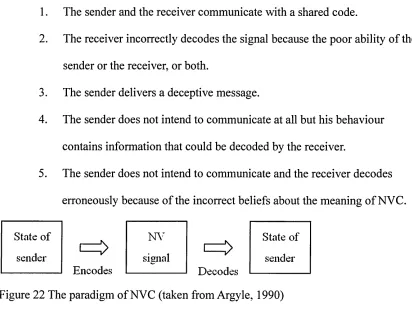
avatars. Based on the description of Argyle (1990), nonverbal communication (NVC)
consists of encoding and decoding of nonverbal signals. This research supposes that
avatar designers may interpret expressive behaviours in the physical world then create
expressive behaviour in the virtual world. The interpretation and performance of
expressive behaviour are highly related to personal knowledge.
This research also proposes that people who have insight into nonverbal
communication and share their insights with willingness could be seen as co-creators
and involved in the generative phase of co-design. In terms of the notion of co-creation,
this research sets out to develop methods to enable avatar designers and suitable people
generative tools would support the co-creation process and tests their efectiveness.
This research firstly reviews literature and previous studies; and then establishes a
co-design framework. The research process includes two sets of co-design workshops
with these aims:
1. to identify problems which obstruct co-creation by the participants;
2. to develop generative tools for the co-creation process;
3. to evaluate the effectiveness of the generative tools.
By using the co-design framework and methods, participants were able to share
their personal knowledge to identify meaning in expressive behaviour and create new
animations of expressive behaviour which enhanced the insight of interaction designers
and supported their subsequent professional work. The use of generative tools enabled
this shared understanding among participants.
The contributions in this thesis to knowledge are:
• a co-design framework for the creation of expressive behaviours by avatars,
supported by
• methods for the selection of stimulus film clips and non-design
participants;
• two novel generative tools for the co-creative work;
• a quantified evaluation of the generative tools in action.
1.2 Background
With the development of interactive media technology, the medium of
interpersonal communication has been extended to computer-mediated communication
(CMC). CMC can be considered broadly as any form of information exchanged via
computer-mediated formats between two or more participants. Spitzberg (2006) has
defined CMC as “any human symbolic or text-based interaction conducted or facilitated
through digitally-based technologies” because individuals participate in a computerized
process of message interchange (p.630-631).
In terms of operation, CMC can be divided into synchronous and asynchronous
modes. In synchronous communication, all participants are online at the same time
while asynchronous occurs without time restrictions and participants may be online at
different times.
The circumstances of this new type of interaction are different from face-to-face.
Face-to-face participants adopt verbal and nonverbal approaches while the
computer-mediated participants have generally employed only a verbal approach in
early computer-mediated exchanges. As Boberg et al (2008) explained
“Avatars are currently a central part o f digital environments because they define how the users can act and express themselves. Avatars are not only familiar to players o f online games, but are also flourishing in many online
applications, mailing systems, 3D Chat rooms, online communities, and web forums. One could imagine that they would become soon part o f everyday mobile phone usage as well (p.232).”
Avatars are increasingly employed for enhancing nonverbal interaction in
computer-mediated communication. They are often created to be like humans and
appear to use similar cues to face-to-face communication (Figure 1).
1 Bem-vindo Ho leoIUptr
Avatars are characters created using either 2D or 3D graphics and they have moved
from statics to animated or more richly animated. The use of avatars seems to give
avatar users the opportunity to build a feeling of being there, a form of presence within
a multi-user virtual world (Schroeder, 1996). Therefore, avatars might be seen as
interactive, social representations of users, aiding users to develop and keep
interpersonal relationships in virtual worlds.
1.3 Motivation
My early research experience at Tatung University in Taiwan was concerned with
the development of online learning software for students learning design software. This
led me to an interest in online communication. In my MA project at Sheffield Hallam
University, I focused on an investigation on emotional expression in CMC and created
animated emoticons for men’s conversation1. From this project, I identified that users’
online communication was a challenge for designers of software. I also found that
people were using animated emoticons to express themselves. Reflection on this MA
project led me to this PhD research to consider how designers can support
self-expression in online environments.
1.4 Focus of the Research
This research is focused investigating how ‘co-design’ might be applied usefully to
the design of avatars, in particular the design of avatars’ behaviour.
Photographic realism and behaviour realism appears to be two important factors to
aid projection and identity of avatar users in virtual worlds. Tromp et al (1998), in a
study of avatars’ behaviour experiments in online group discussions, found that the
great realism of avatars’ bodies in online interaction is not appropriate to the lack of
body movement. When comparing these two factors, researchers such as Blascovich
(2002), Swinth and Blascovich (2002) indicated that behaviour realism seems to be
more important than photographic realism when considering social interaction in virtual
worlds.
In order to create vivid expressive behaviours, the avatar designer seems to share
knowledge and techniques with the animator. However, each has a different purpose for
their creations. The avatar designer aims to support avatar users to deal with
unpredictable online interaction but the animator aims to present a particular story to
audiences. Becker and Mark (2002) found that social behaviour in virtual worlds mirror
those in the physical world. Researchers such as Salem and Earle (2000),
Guye-Vuilleme et al (1999), and Gillies et al (2004) suggest that avatar designers should
look into the field of NVC when creating the expressive behaviour of avatars.
According to Argyle’s (1990) description, the paradigm of NVC2 consists of
encoding and decoding of nonverbal signals. Thus we may say that avatar designers
encode signals in behaviour by avatars for viewers to decode. In order to do this
encoding, designers may observe and interpret expressive behaviour in the physical
world. Then they create expressive behaviour in virtual worlds. Encoding by individual
designers appears to be insufficient because emotional expression may vary from person
to person and context to context. People may have different interpretations of the same
expressive behaviour. In addition, people may perform different nonverbal signals for
the same expression of emotions, attitudes, or status.
Co-design is a design approach that enables designers and people from diverse
backgrounds such as researchers, (potential) customers and users come together for the
activity of co-creation. Sanders and Sappers (2008) took the term ‘co-creation’ to refer
to “any act o f collective creativity, i.e. creativity that is shared by two or more people
(p.6)”, and used the term ‘co-design’ in a more narrow sense to refer to the “collective
creativity as it is applied across the whole span o f design process (p.6)”. For some
people, co-design refers to “the collective creativity o f collaborating designers (ibid,
p.6).” Therefore, Sanders and Sappers (2008) used co-design in a broader sense to refer
to “the creativity o f designers and people not trained in design working together in the
design development process (p.6).”
In co-design, participants are empowered and encouraged to create artefacts for
expressing their thoughts, feelings and ideas (Sleeswijk Visser et al, 2005). Sanders
(2002) indicated that ‘say’, ‘do’ and ‘make’ are three different approaches to access
people’s experiences during a design process, where ‘make’ is associated with co-design.
In interviews, designers focus on what people say and think. Through observation,
designers look at what people do and use. In the activity of co-creation, designers could
focus on what people make to use in expressing their thoughts, feelings and dreams
(Sanders, 2002). Sanders and Sappers (2008) noted that the participant in co-design
“who will eventually be seiwed through the design process is given the position o f
‘expert o f his/her experience and plays a large role in knowledge development, idea
generation and concept development (p. 12).” Through the activity of co-creation,
people seem to not only jointly explore and articulate their latent needs but also jointly
explore and develop solutions.
To encode and decode nonverbal signals for interpersonal communication is highly
related to personal knowledge and experience. From this aspect, people who have
insight into nonverbal communication and share their insights with willingness could be
brought in encoding and decoding nonverbal behaviour. In addition, these people could
be empowered in proposing and creating their expressive behaviours to enable designers
a suitable approach for the creation of expressive behaviour by avatars because this
approach offers an inclusive, democratic way to draw the experience of participants into
the design process. Sanders (1999) suggested that the generative tools in co-designing
are projective and they are a new language for designers and uses. In this research I
have investigated methods and tools for using co-design in developing avatar behaviour,
particularly in the generative stages of a project.
1.5 Aims and Objectives
As discussed above, to encode and decode nonverbal signals for interpersonal
communication is highly related to personal knowledge and experience. People who
have insight into nonverbal communication and share their insights with willingness
could be valuable co-creators in encoding nonverbal behaviour. Their participation
might enable enable avatar designers to visualise useful expressive behaviour.
In this research, I set out to discover how users might be involved in the generative
phase of the creation of expressive behaviour by avatars. So the focus of this research is
on generative tools and methods for co-design. Two workshop studies were conducted
systematically to address a single research question as follows:
What methods and tools might be used to enable successful co-design
collaborations between designers and users in creating useful new expressive
behaviours for online avatars?
The overall objectives guiding this research were:
1. to investigate the state of the art and current knowledge of avatar design
including the creation of avatar’s expressive behaviour;
2. to investigate the role of expressive behaviour in social interaction;
3. to review previous practical works in the field of participant involvement in
4. to establish a co-designing framework for generating expressive behaviour;
5. to conduct practical work for a practical exploration of generative tools and
methods appropriate for avatar designers working with avatar users in the
generative phase of the design development process;
6. to evaluate the validity of the generative tools and methods identified in the
research.
There are three novel parts to this research. Firstly, although avatar designers have
professional techniques and accepted conventions to create avatars’ expressive
behaviour so far, the participation of users in the creation of avatars’ expressive
behaviour is not well explored. This research focuses on the participation of users in the
generative phase of the design process. Secondly, a co-design framework of methods
and tools for avatar designers working with users for creation of expressive behaviour is
developed and evaluated. Thirdly, as part of the tools, the research developed and and
evaluated the use of video-sketching by self-recording as a method for participants
without drawing or animation skills to participate in co-design sessions focused on the
production of animations.
1.6 Definition of Terms
This section provides definitions of key terms used in this thesis. Fuller
explanations are provided in following chapters.
Avatar in this research refers to the human-like images (either 2D or 3D graphics)
used by avatar users to represent them in virtual worlds. These humanoid avatars are
animated so avatar users can show their emotions, status, and attitudes through the
facial expression and body movements of the human-like images.
Virtual worlds in this research refer to the environments in which such avatars
exist depicted in the form of 2D or 3D graphics although virtual worlds can be
text-based. These environments may be instant message software, web-forums, online
conferences, video games etc. The general feature of these platforms is allowing for
multiple users so that avatar users from different locations can interact with each others.
Bodily expression is expressive behaviour and refers to people’s physical
behaviour used to convey information such as emotions, status, or attitudes in
interpersonal communication. These behaviours include facial expression, eye gaze,
postures, and gestures.
Meaningful bodily expression refers to expressive behaviour with meanings tacitly
agreed by a group of people. The interpretation and performance of expressive
behaviour are highly related to personal knowledge.
Users in this research refer to avatar users participating in workshops. End-users
mean people who use and interact with avatars in online environments.
Generative tools refers to tools used in the generative phase of a co-design process.
The function of generative tools is facilitating exchange of participants’ ideas in the
creation of new material for expressive behaviour by avatars. Typical generative tools
include drawing, role play or mockups. This research resulted in the development and
evaluation of two generative tools, are the video experience note and the video
sketching device.
Interaction Process Analysis (IPA) is a method for analysing communication
processes among small team members, proposed and developed by Bales (1950, 1970).
In this research Bales IPA is used to analyse interactions in co-design workshops to
evaluate the effect of specific generative tools.
Stimulus film clips in this research are the stimulus in the generative phase of the
co-design process. They are selected from popular movies and TV dramas by the
co-design participants who are asked to identify clear examples if expressive behaviour
Film clip suggestion Questionnaire is a designed questionnaire (Appendix I) with
three open-end questions and three closed-end questions used to acquire the possible
idea of films and scenes from codesign participants. This questionnaire is also used to
identify those participants who are most suitable to participate in the co-creation work.
The video experience note is a paper form (Appendix IV) with two tasks for each
individual participant to record their impressions of expressive behaviours in film clips
at the start of a co-design workshop. This note enables participants to retain their own
ideas during group discussion and ensure that group discussion includes all views of the
group, not just the most confident members.
The video sketching device is a tablet computer with a front camera and softwareJ
for self-recording used in the co-design workshop. It allows participants to record ideas
about expressive behaviour without the embarrassment of performing for other people
or for a video camera.
1.7 Scope of the Thesis
Figure 2 The avatars' appearance are taken from Mii of Nintendo (Left), The Sims of Electronic Arts (Middle), and World ofWarcraft of Blizzard Entertainment (Right).
The range of avatars' appearance can be from abstract to animal to humanoid, and
from cartoonish to photorealistic (Figure 2). This research is concerned exclusively with
humanoid avatar’s expressive behaviour appropriate for online interaction. The research
is concerned with providing stimulus and ideas for designers through the co-design
process, not with the final design or application of expressive behaviours. The main aim
of the research is to identify and assess generative tools appropriate for a co-design
process to give designers a wider range of insights and creative thinking. I am not
approaching this as an animator but as a design researcher who has discovered this
problem from other research. Therefore, this research is not concerned with techniques
involved in creating or animating realistic avatars.
In this research, participants were taken from a variety of cultural backgrounds,
several nationalities and different professions. However, the focus was on the
effectiveness of tools regardless of the cultural variations of the participants. Besides,
the aim was not to generate data for animators but tools that might be used in a variety
of cultural settings. In practice, participants were able to participate and collaborate in
similar ways regardless of backgrounds.
1.8 Structure of the Thesis
Based on the notion of co-design, this research focuses primarily on the
development and evaluation of generative tools for the creations of expressive
behaviours by avatars in the generative phase of the co-design process. A brief synopsis
of each chapter is provided as follows:
Chapter 2 sets out the contextual background of the research, including avatar
design, social interaction and user involvement in the design process.
Chapter 3 describes the methods used to address the research questions. This
chapter introduces the features of experimental design common to two workshop studies,
as well as the method of small group research used to analyse the group communication
analysis with particular reference to Bales’ (1950) Interaction Process Analysis (IPA).
Chapter 4 presents the procedure and findings of Workshop Study 1 that was
conducted in Sheffield. In the beginning, it focuses on the identification of co-design
problems occurring in the interaction between participants. Having identified some
problems in the co-design process, the video-experience note and the video-sketching
device as generative tools were tested to facilitate information exchange between
participants. Discussion with participating designers indicated that these tools could be
productive in enabling co-design workshops in the generative phase of designing
avatar’s expressive behaviour.
Chapter 5 presents the procedure and analysis of Workshop Study 2 that was
conducted in Taipei. This practical work focuses on the verification of the
video-experience note and the video-sketching device applied in the co-designing. In
order to evaluate the effectiveness of the generative tools, Bales’ IPA was used to
quantify and analyse the group communication process.
Chapter 6 discusses the overall findings and the implications that can be drawn
from them. In the end, Chapter 7 draws conclusions and gives suggestions for
Evaluation
Analysis Literature Review
The selection of film clips
Motivation and Purpose
The selection o f film clips The selection o f participants
The selection of participants
Discussion and Conclusion
User Involvement in D esign Process
Small Group Research: Bales’IPA
Face to Face Communication in Social Interaction
The development o f the Film Clips Suggestion questiomaire The co-desgn framework for creations o f expressive behaviour by avatar
The use o f the experience note and video sketching in two Co-Design workshops
Research Issue 1: The identification o f Co-Design problems and tools
Research Issue 2: The verification of the generative design tools for the Co- Design workshop
The first set o f Co-Design workshops for exploring and identifying the co-design problems
[image:28.612.85.499.21.538.2]The development o f the experience note and the approach o f video sketching
2 Literature Review
2.1 Introduction
This chapter contextualises the research by discussing relevant literature and it is
divided into four main sections. Section 2.2 presents the methods and techniques of
avatar design. Avatar designers share many creative methods with animators so it
focuses on how animators create the appearance and expressive performance of avatars.
Section 2.3 discusses how humans use various channels to communicate non-verbally in
social interaction. The influence of emotion in nonverbal communication is explored,
and the components of nonverbal behaviour (facial expression, eye gaze, gesture and
posture) are discussed. Section 2.4 reviews participatory design and user-centred design
for user involvement in design process. The advantages and disadvantages of both are
weighed up. Also, the technique of mock-ups and generative tools for the investigation
of the user is reviewed. According to these fields of knowledge, the research problem is
contextualised by discussing the need for co-designing expressive behaviour by avatars
with diverse people in section 2.5. In this section, a co-design framework for this
research is also proposed.
2.2 Avatar Design
Virtual worlds are computer-based simulated environments capable of supporting
human-to-human communication. These environments allow online users to interact
with the space and with others via the representation of avatars. Thalman (2001) noted
that avatars have three outstanding functions including “the visual embodiment o f the
world (p.24).” Avatars are considered as interactive, social representations of users,
aiding users to develop and keep interpersonal relationships in virtual worlds.
The origin of avatar is a Sanskrit word in Hinduism meaning an incarnation of an
immortal being. Hindus believe that God takes birth in a human body when it comes to
this world. Similarly today the term ‘avatar' is used to describe a virtual character that
represents a person when they enter a computer-generated virtual world. Figure 4 shows
the history of popularisation of avatar.
Sanskrit word In Hinduism
O O
£ <
C urrent G a m e s su ch a s S e co n d Life & World o t W arcraft
2010
1972 1978
1985 1992
'Snow Crash' P opularised Avatar Avatar Used First In
role-play g o m e 'Ho&itat Single User text G am e
D ungeons a n d D ragons MUDMulti User Text G a m e
Figure 4 The history of popularisation of Avatar
It is believed that the first practical Avatar-like construct, in 1972, was in role-play
in the text game Dungeons and Dragons. In 1978. Roy Trubshaw and Richard Bartle
developed the first computer-based multi user-game (MUD) at Essex University. It was
the first time that players could control their 4characters' to interact with others. One of
the first references of avatars as digital representations was in the 1985 game U l t i m a
IV: Qu e S t o f t h e Av a t a r (Figure 5). The goal of this game is to focus on the main
character's development in virtuous and become an ‘Avatar’ - a spiritual leader and an
example to the people of the world of Britannia. In this game it was not until later
Figure 5 The cover art (Right) and screenshot (left) of Ultima IV: Quest o f the Avatar
(taken from IGN
-http://www.ign.com/articles/201Q/01/16/the-reason-i-became-a-gamer-ultima-iv). The first use of the term avatar in its current incarnation is possibly the computer
game LucasfilnTs Ha b i t a t in 1986. The development of this game began in 1985 and
sketched out a virtual world where each player had an in-game ‘avatar’ - a word
defining a graphical character for the on-screen representation of the player. As shown
as Figure 6, these graphical characters in the same region (denoted by all objects and
elements shown on a particular screen) could see, speak (through onscreen text output
from the players), and interact with one another.
i C athi
Figure 6 The screenshot of Habitat (taken from Gamasutra - http://www.gamasutra.com/php-bin/news index.php?story=21883)
Following Habitat, the visual persona of players became well established in later
an online virtual person, possibly the first example of this usage. In the last 20 years, the
term ‘avatar' then has been applied to videogame, computer-mediated communication
(CMC) and related fields.
As shown as Figure 7, these created characters and virtual worlds were depicted in
the form of text initially. The rise of graphic processing technology has enabled
increasingly complex 2D and 3D characters and artefacts in virtual worlds (Figure 8).
They play an essential role in virtual environments and enable avatar users to use
empathy put themselves into the experience.
B TWCC - Trade Wars lo ca l
Game 1 G:\T wgAGameMwl
ifT
File F ont
into w arp in g to s e c t o r 308
K e e t o i* : 3 0 8 in C l o n t a r f < u n ex j> lo i
W arps t o S e c t o r < s > : 4 5 4
d « t o W a r p in g t o s e c t o r 4 5 4
S e c t o r : 4 5 4 in
: Hew H ecto r, 5 SBS
Warps t o S e c t o r < s > : 30 8
h u t o Warping to s e c t o r 978
S e c t o r : 9 7 8 to Tlie F e d e r a t i o n .
s S t a r g a t o A lpha I , 9 S p e c i a l <StarDoch> Federal*;; Adm iral N e ls o n , n/* 6 5 ,0 0 0 f t »-• .
in T lie IJ . S . S . l.-exington '"Martin Ind F e d e r a t i o n S t a r S h i p Harps to S e c to r < e > : 454
A r r i v i n g s e c t o r ;978 A u t o p i l o t d i s e n g a g i n g . C a p ta in Z y r a in warp-. in fo th e s e c t o r .
Figure 8 A graphic character and graphic artefacts in the virtual world (taken from
Small Worlds)
In order to enable avatar users to immerse themselves in diverse virtual worlds,
avatar designers have methods and techniques to create vivid and distinctive characters.
Below I will discuss the relationship between avatar users and avatars. Then, the
appearance and the expressive behaviour of avatars will be contextualised. Finally, I
will discuss creative methods and techniques that avatar designers use to create
compelling characters.
2.2.1 Projection and Identity
The appearance of graphic characters in virtual worlds can range from animal to
humanoid. These characters are divided into two terms - avatars and embodied agents
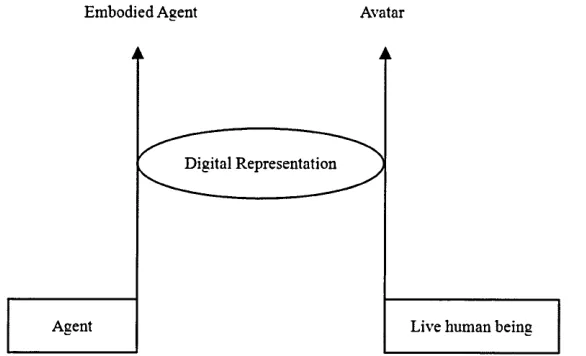
(Gerhard, 2003). Bailenson and Blascovich (2004) gave a clear schematic (Figure 9) to
describe the difference between avatars and embodied agents. Avatars are directly
controlled by human beings but embodied agents are controlled by a computational
algorithm (ibid). Visually, avatars and embodied agents may not be distinguishable.
interactions, responsiveness and simply the psychological effect of conversing with a
human.
Embodied Agent Avatar
Digital Representation
[image:34.612.82.375.74.252.2]Live human being Agent
Figure 9 A representational schematic of avatars and embodied agents (taken from Bailenson and Blascovich, 2004).
Schell (2008) discussed that projection is the extent to which storytellers compel
the audience to use their powers of empathy and imagination to put themselves into the
experience. He explained that characters created by storytellers are strangers to the
audience in the beginning. When the audience get to know these characters, the
audience begins to care about what happens to these characters. Then the audience
might even mentally put themselves in the place of these characters, bringing them to
the height of projection. When avatars are controlled by users in virtual worlds,
projection appears to be important to connect the relationship between users and avatar
(ibid). As noted by Schell (2008)
“There are times when the player is distinctly apart from the avatar, but other times when the player s mental state is completely projected into the avatar, to the point that the player gasps if the avatar is injured or
threatened. This should not be completely surprising - after all, we have the ability to project ourselves into just about anything we control (p.312).” The power of empathy is important to establish projection into an avatar (ibid).
Besides projection, identity seems to be another key to establish the relationship
might convey identity at four distinct levels of recognition. Firstly, it is perhaps easy to
recognise at a glance that the digital representation is representing a human being as
opposed to some other kind of object. Secondly, it is possible to distinguish between
distinct users in online interaction, even if avatar users don’t know who they are.
Thirdly, avatar users might be able to recognise other avatar users again if they have
learned others’ identities. Finally, users might be able to get to know someone through
an avatar’s body image. When avatar users identify with their avatars, invest time on
them, create relationships, and establish reputation in virtual worlds, the avatars become
very important for them.
Bailenson and Blascovich (2004) stated that photographic realism and behaviour
realism are two facts to enable avatars to resemble human beings. Photographic realism
and behaviour realism are important to projection and identity of avatar users in virtual
worlds. Therefore, the appearance and the expressive behaviour of the avatar will be
discussed in the following subsections.
2.2.2 The Appearance of an Avatar
In terms of appearance of an avatar, Schroeder (1996) indicated that “it is not only
the shape o f virtual bodies that matters in the experience o f virtual worlds, but also the
level o f detail with which they are represented (p.64).” Schroeder (ibid) suggested that
the appearance of an avatar may provide information for others to better understand the
identity of the avatar user. It also may give the opportunity to build a feeling of being
there, a form of presence within a multi-user virtual world (ibid).
In general, the appearance of avatar concerns two dimensions: morphology and
photorealism (Garau, 2003). Avatar morphology in virtual worlds ranges from
humanoid to anthropomorphised animals to abstract shapes. As for photorealism,
avatars can range from cartoonish forms to highly realistic forms. Figure 10 illustrates
two dimensions of avatar appearance design. Avatar morphology and photorealism
influence an avatar user's perceptions and their interaction in virtual worlds. However,
as will be seen below, the appearance of avatars seems to be less significant for, their
success in social interaction, than their behaviour.
Realistic
(Photorealism)
Non-humanoid
(M orphology)
1
Humanoid
(M orphology)
Cartoonish
(Photorealism)
Figure 10 The dimensions of avatar appearance design (The upper right and the upper left are taken from World ofWarcraft of Blizzard Entertainment; the lower right and the lower left are taken from Concerto Gate of Square Enix)
2.2.3 The Expressive Behaviour of an Avatar
Besides the appearance, expressive behaviour in virtual environments is another
important consideration for users because avatar users engaged in online interaction
imitate face-to-face rules for spatial behaviour. After looking for the presence of social
conventions in several virtual environments, Becker and Mark (2002) found that many
social behaviours in the virtual environment mirror those in the physical environment.
They also claimed that socializing in virtual worlds is indeed affected by nonverbal cues.
By using the expressive behaviour of an avatar, virtual social encounters could be
Machado and Paiva (2000), investigated children's role-playing in a collaborative
virtual environment - Teatrix. They did not initially focus on emotional expression.
However, they later found that avatar's poor emotional expression, in particular facial
expression, was the main obstacle for effective interaction. They claimed that
interaction in virtual environments needs rich expressive behaviour.
Tromp et al (1998) used three different simple avatars labelled Red, Blue, and
Green (Figure 11) to investigate small group interaction in a collaborative virtual
environment. The Red and Blue avatars were lower-realism but the Green avatar was
higher-realism. Apart from colour and appearance, the avatars had limited movements
and no capability for any kind of emotional expression. Participants from different
locations used these avatars and met in a virtual environment to perform a
puzzle-solving task.
Figure 11 Avatars used in Tromp et al study (taken from Tromp et al, 1998)
According to participants' feedback, the Green avatar was described as a zombie
although it was like a realistic human. As for the Red and Blue avatars, participants
assumed both of them were robots rather than real people. Tromp et al (ibid) pointed out
that “the greater realism o f the Green body wasn ) appropriate to the lack o f body
movement and this was disconcerting (p.61).'’ They concluded that an avatar's realistic
indicates that more expressive behaviour will be needed if avatars become more
photoreal.
Other researchers indicate that behavioural realism seems to be more important
than photographic realism when considering social interaction in virtual worlds. As
Blascovich (2002) noted,
“we typically build digital IVEs4, including interpersonal ones, using visual media, we tend to think o f realism in terms ofphotographic realism.
Although important, photographic realism does not equate with behavioural realism and is, in fact, less important (p. 131).” Swinth and Blascovich (2002) also explained that
“more important than photorealism, and perhaps even anthropomorphism, is an avatar s behavioural realism. Behavioural realism refers to the extent to which avatars and other objects in a virtual environment behave like their counterparts in the physical world (p.329).”
From this point, behavioural realism appears to be the higher priority for
communication purposes. Avatar designers seem to deal with avatars’ behavioural
realism carefully.
Isbister (2006) reported an interview with Ryoichi Hasegawa and Roppyaku
Tsurumi of Sony Computer Entertainment Japan. Ryoichi Hasegawa described how
Disney animators’ techniques influence Japanese game designers for the creation of
game characters’ behaviours in 1990s. As he said
“Long ago, there was a game for the Sega Genesis called Aladdin (1993). From what I know, that was the first time that an American production company used a Disney animator to develop a game. Before then, when we animated a 2D character swinging a sword, we were drawing several pages o f the animated motion o f the arm at equal intervals throughout the whole movement.
But with Aladdin, they used the same devices as Disney animation to make the arm movements look good, so they shortened the animated sections when an arm starts to move, and lengthened them for when an arm is extended. This is the same technique as those used to make real animated
cartoons in the studio. This was shocking for a lot o f the Sega creators. At the time, I was in charge o f localizing Aladdin, and a lot o f designers from the arcade-game machine development team were coming to study these animation patterns.
That was a time when 3D CG was being used for arcade games, and 3D fighting-games projects like Virtual Fighter (1993) were being developed.” Avatar designers have creative methods to address the issue of behavioural realism
in virtual worlds. Ryoichi Hasegawa’s interview indicates that avatar designers’ creative
methods for addressing the issue of behavioural realism in virtual worlds seem to be
mainly drawn from animators’ techniques. Therefore, animators’ techniques for the
creation of human movements will be discussed in the following subsection.
2.2.4 Animators’ Techniques for Realistic Movements
Walt Disney said “Animation can explain whatever the mind o f man can conceive
(Thomas and Johnston, 1984; p. 13).” Because animators create the characters’ performance in
the animation, Thomas and Johnston (ibid) stated that “Basically, the animator is the
actor in animated fdms (p. 18).” Although the animator could be viewed as an actor in this
way, the two roles are visibly distinct in their practices. Hooks (2003) explained the
distinction between animators and actors as below: “... When creating a character, an
actor tends to work from the inside out; animators, by contrast, tend to work from the
outside in(p.45).”
The actor is taught characters’ emotion and body movement that are appropriate to
the moment. Then the actor has to consider how to show internal feelings through
movement. However, the animator has to consider how to display external evidence that
indicate characters’ emotion and status to the audience. Thomas and Johnston (1984)
also pointed out that the actor and the animator are standing on two different situations
to deal with characters’ performance: 1. the actor can interrelate with other actors to
animator directs all the characters and their interactions. From this point of view, the
challenge of the animator seems to be more complex than the actor.
2.2.4.1 Basic Principle of Animation
The animator and the actor’s considerations of a character’s performance are
different. Most professional animators use a simple set of standard techniques to present
characters’ expressive behaviour. Thomas and Johnston, two senior Disney animators,
writing about the methods developed in the Disney studios, stated
“The animators continued to search for better methods o f relating drawings to each other and found a few ways that seemed to produce a predictable result. They could not expect success eveiy time, but these special
techniques o f drawing a character in motion did offer some security. As each o f these processes acquired a name, it was analysed and perfected and talked about, and when new artists joined the staff they were taught these practices as if they were the rules o f the trade (1984, p.47).”
Thomas and Johnston (1984, pp.47-69) outlined what they called the “twelve basic
principles of animation”. Nearly every book on animation mentions these basic
principles.
1. Squash and Stretch are used to give the illusion of weight and flexibility
to a character’s movement. Thomas and Johnston took a bouncing ball as
an example (Figure 12): 1. the ball is squashed when it hits the ground; 2.
the ball is stretched is falling and rebounding in the air.
o
2. Anticipation is achieved by preceding each main action with a specific
movement that prepares for the audience understanding what is happening.
Before running, for example, a man shifts backward and sinks his weight
onto the back foot (Figure 13).
Figure 13 The illusion of the ‘Anticipation’: Donald Duck draws back with raised leg in anticipation of running (taken from Thomas and Johnston, 1984: p. 52)
3. Staging refers to communicating the character’s attitude, mood, idea or
action clearly. Animators have to concern how characters relate to each
other, how a character moves, when actions happen in relation to other
events, and how the scene is viewed clearly. These can help animators
telling the story.
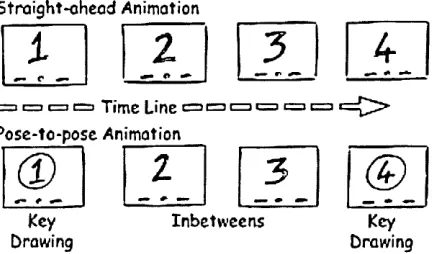
4. Straight Ahead Action and Pose to Pose are two different approaches to
animation (Figure 14). Straight ahead action is starts at the first drawing
and works frame by frame to the end of a scene. Pose to pose is more
planned out and starting with few key frames then filling in the intervals.
Straight-ahead Animation
i
2
3
c=i t=j c=j c=3 Time Line c=t=3iz3c=j c=je=» c
Pose-to-pose Animation
=o
(D
2
3
©
Key
[image:41.612.85.301.549.676.2]Drawing Inbetw eens DrawingKey
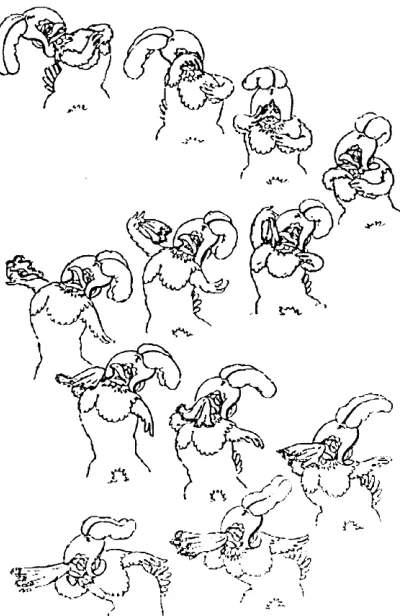
5. Follow Through and Overlapping Action deal with the character’s
movements more realistic when the character stops main body and other
parts continue to move (shown as Figure 15).
-it
/ # 7
Figure 15 The illustration of ‘Follow Through and Overlapping Action’: the feather and other parts give a feeling of weight and living form (taken from Thomas and Johnston,
1984: p. 59)
6. Slow In and Slow Out are used to soften the action because both of them
change the speed of an object when it is moving (Figure 16).
I o
Path of "action
t
o ®
[image:42.612.88.288.96.404.2]7. Arcs refer to the visual path of movement showing an arc (shown as
Figure 17 ). Animators need to concern action in the arc path because “the
movements o f most living creatures will follow a slightly circular path (ibid,
p.62).”
Figure 17 The illustration of the ‘Arcs’: the action of a hand gesture with a pointing finger follows a circular path (taken from Thomas and Johnston, 1984: p. 62)
8. Secondary Action is used to support and enrich the main action so a scene
is given more life. In addition, the character’s emotion and status is
actually emphasized because of secondary action (shown as Figure 18).
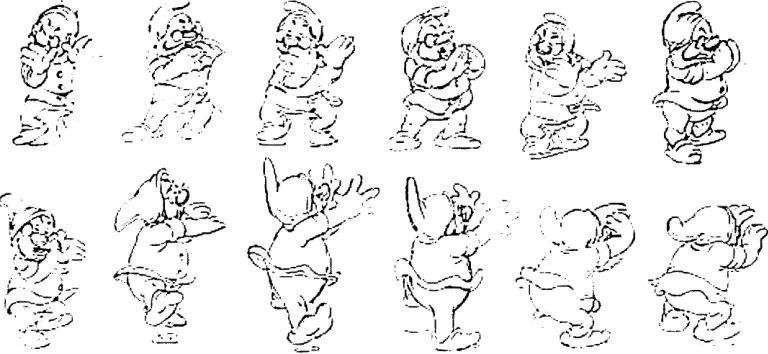
Figure 18 The illustration of the ‘Secondary Action’: One dwarf shows he is flustered through his actions. The primary action is the body jumping up and down, but his confusion is shown by having his arms follows a different pattern from his body (taken from Thomas and Johnston, 1984: p. 63)
9. Timing refers to the place in which actions occur. Animators use the
number of drawings or frames for a given action to present the speed of the
[image:43.612.86.470.390.567.2]10. Exaggeration is used to dramatize a character’s motion through the
extreme of natural movement (Figure 19).
Figure 19 The illustration of ‘Exaggeration’: Donald Duck is hit in the face with a scoop of ice cream (taken from Thomas and Johnston, 1984: p. 64)
11. Solid Drawing refers to the consideration of forms in three-dimensional
space. Animators need to understand the basics of three-dimensional shape,
weight and balance. A character’s shape, weight and balance is always
changed when it moves in space.
12. Appeal is used to capture and involve the audience’s interest in characters.
Appeal in a character of animation corresponds to charisma in an actor. In
animation, a character’s appeal can be presented through its design,
drawing or personality so the audience can understand and enjoy watching.
The above twelve principles support an illusion of characters adhering to the basic
laws of physics on the screen. On the other hand, they are used to address more abstract
issues such as emotional timing and characters’ appeal. Although the basic principles
are applied to traditional hand-drawn animation originally, they still are essential
guidelines for today’s prevalent computer animation (Liverman, 2004).
2.2.4.2 How Animators Address Expressive Behaviour
Walt Disney said “7n our animation we must show not only the actions or reactions
o f a character, but we must picture also with the action...the feeling o f those characters
(Thomas and Johnston, 1984; p.473).” The animator is concerned about how to convey
[image:44.613.84.535.70.142.2]story (ibid). In this respect, the animator might be thought of as a kind of actor, sharing
the actor’s interest in conveying feeling through performance.
For aiding the animator to understand acting, Ed Hook’s book Ac t in g f o r
An im a t o r s (2003; ppl-10) provides seven “essential concepts
• Thinking tends to lead to conclusions; emotion tends to lead to action.
• Acting is reacting. Acting is doing.
• The character needs to have an objective.
• The character should play an action until something happens to make him
play a different action.
• All action begins with movement.
• Empathy is the magic key. Audience empathize with emotion.
• A scene is a negotiation.
The animator and the actor should create empathy with the audience so the
character is real in the audience’s mind. Each of them has a comparable knowledge of
acting, Thomas and Johnston (1984) pointed out that the animator has three special and
noticeable issues in acting: 1. understanding the character’s reaction in a particular
condition; 2. skilful drawing to capture that understanding; 3. retaining the ‘fleeting,
delicate thought’ of the moment over the several days it may take to animate the scene.
Thomas and Johnston (ibid) stated that when the actor feels right in their emotion and
action, they perform it within the moment. The animator needs to stop the time to
capture subtle expressive movement, dissects it, recreate it, sketch it on the paper and
discuss it in a group discussion (ibid).
As discussed in 2.2.3, Ryoichi Hasegawa of Sony Computer Entertainment Japan
indicated that game designers use animators’ techniques for the creation of characters’
behaviour. In the aspect of creating characters’ realistic movements, the avatar designer
virtual worlds could be supported by animators’ techniques. However, animators and
avatar designers have different purposes to create realistic movements. The animator
aims to tell a particular story but the avatar designer aims to support users to address
unpredictable online interaction.
2.2.5 Section Summary
Photographic realism and behaviour realism seem to enable humanoid avatars to
resemble human beings. However, behaviour realism appears to be more important than
photographic realism when considering online interaction. Social behaviours in the
virtual environments seem to mirror those in the physical environment. To create
expressive behaviour by avatars, researchers such as Salem and Earle (2000),
Guye-Vuilleme et al (1999), and Gillies et al (2004) suggested that avatar designers
should focus on the field of nonverbal communication. Salem and Earle (2000)
discussed that
“With a human-like avatar, it is possible to exploit some o f the non-verbal communication (NVCs) capabilities, facial expressions, hand gestures and, body postures. At the same time these NVCs will be perceived and easily understood by the other participants in the CVE5 (pp.94-95).”
The real world communication involves other nonverbal channels of
communication such as face expression, eye gaze, duration of glances and facial
expressions, postures and gestures. These nonverbal channels play an important part in
social interaction and could be applied in online interaction. Therefore, nonverbal cues
in face-to-face communication and relevant theory will be discussed below.
2.3 F
ace-to-Face Communication in Social Interaction
Expressive behaviour in face-to-face communication serves two important
functions in social interaction: the communication of emotion and conversation
management. As Picard (1997) stated, “emotions not only contribute to a richer quality
o f interaction, but they directly impact a person s ability to interact in an intelligent way
(p.2).” The communication of emotion is integral to the regulation of communication
and interaction. Garau (2003) explained that conversation management concerns the use
of body movements to ensure the smooth flow of social interaction. Body movements
such as facial expression, gesture and posture give structure and rhythm to the
conversation. They are essential to maintaining a sense of mutual understanding (ibid).
2.3.1 Emotion
Emotions are our natural instincts and every factor in our life may arouse these
natural instincts. As Lupton (1998) discussed “...emotions are phenomena that are
shaped, experience and interpreted through social and culture processes (p.2).”
Emotions, which include emotional mental states and emotional bodily processes, arise
from highly negative or positive appraisals (O’Shaughnessy and O’Shaughnessy, 2003:
p21). Our daily life has been weightily influenced by emotions and they are reflected in
physiology, expression and behaviour.
Emotions are an important part of social communication and play a significant role
in interpersonal interaction. From Plutchik’s perspective, emotions have two main
functions: the first function is to provide information about intentions or probable