A study into recruitment and selection for the built
environment disciplines
LAYCOCK, Elizabeth <http://orcid.org/0000-0003-3758-6829>
Available from Sheffield Hallam University Research Archive (SHURA) at:
http://shura.shu.ac.uk/21878/
This document is the author deposited version. You are advised to consult the publisher's version if you wish to cite from it.
Published version
LAYCOCK, Elizabeth (2015). A study into recruitment and selection for the built environment disciplines. Sheffield Hallam University Built Environment Research Transactions, 7 (1), 46-71.
Copyright and re-use policy
See http://shura.shu.ac.uk/information.html
A STUDY INTO RECRUITMENT AND
SELECTION FOR THE BUILT ENVIRONMENT
DISCIPLINES.
Liz Laycock.4
Liz graduated with a Distinction in Building Surveying in 2015. This work was undertaken in 2013 while studying for this qualification part time at Sheffield Hallam University.
Recruitment and selection is a complex process attempting to meet the future needs of a company within the current operating parameters and facilitated by human interactions. The literature studied identified no definitive description of ‘employability' in the Built Environment disciplines, only a linkage between certain discrete attributes which correlate with an applicant successfully gaining employment. Certain methods of recruitment and selection target particular individual attributes, but those qualities which are valued are difficult to systematically assess, indeed methods used for graduate recruitment and selection in the Built
Environment disciplines were more complex than
anticipated. As graduate employees are expected to continue to be developed by the company many methods assess the graduate's potential fit into a team. A mismatch in the perception of the relative importance of skills or competencies was found between recently employed
graduates and industry recruiters. Recruiters actively sought candidates who demonstrated that they had 'client readiness'. Graduates do not necessarily see that the struggle to gain employment is a consequence of the difficult economy or how they project themselves during selection. The
publication of graduate employability statistics and the increased levels of student indebtedness will no doubt act to enhance the importance given to employment outcomes.
4
Key Words: Education, Skills, Recruitment, Personnel
INTRODUCTION
The subject of employability of graduates is debated currently within literature, which has highlighted differential strategies for recruitment and selection within the UK. There is general consensus that certain methods of recruitment and selection target certain individual attributes. There is evidence of a country wide shift in selection methods driven by IT
facilitated communication. What is currently less well known is the means of recruitment and selection specifically used for built environment
students and the underlying rationale for these. The research aim was to determine the chronological application and examine the rationale for utilisation of recruitment and selection procedures applied by a number of employers. This was achieved by outlining the requirements of graduate skills both generally and specifically in terms of the built environment disciplines. The relative importance of the skills was then examined within the context of the selection procedures, as applied to recent graduates from the perspective of both employers and graduates. This allowed the
examination of the methodologies of selection and their application to the identification of a candidate's alignment to the employer's required skills, or competencies of graduates within the specified subject areas.
LITERATURE REVIEW
graduate unemployment and employee dissatisfaction, particularly in the built environment disciplines.
Overview of Graduate Key Skills
Purcell et al. (2012:64) suggest that recruiters continue to state that there is an inability to recruit appropriate talent in particular graduate vacancies; 54% of recruiters stated that they found it increasingly difficult to find graduates with the right skills. The Confederation of British Industry reported that half of their surveyed companies had a lack of confidence in their ability to fill graduate-level posts in the following years. Yet many graduates still report that they are unable to find graduate vacancies and thus there is a net underutilisation of skills (ibid:66).
The challenges in the graduate market can be summarised as follows; challenges of UK economic requirements (UK Commission for
Employment and Skills 2009:7-9)
changes in the undergraduate HE market leading to student led course demand (Lambert Review 2003:107),
the requirements to meet future challenges, incorporating flexibility in workforce skills (Witt & Lill 2010),
uncertainty related to curriculum and delivery (Pegg et al. 2012: 20; Tibby, 2012:3; Poon et al. 2011: 484; Corominas 2010:43; Newman 2009:1),
the transition of graduates to work (Wilson Review 2012:2l; Purcell et al. 2012:xxii; Pegg et al. 2012: 35; Lambert Review 2003:7),
student expectations of the qualification as a means to work in the face of rising debt (Pegg et al. 2012: 6; Purcell et al. 2012:xviii; Confederation of British Industry 2011:7UK Commission for Employment and Skills 2009:36). Several authors have highlighted a shift in the views of the external stakeholders including increased comparison between institutions
(Howarth & Stafford 2005:3; Beer 2012:4) increased competition between Higher Education Institutes (HEIs) to engage with industry (Heesom et al.
entering work and the need to have the capacity to develop these further over time.
The UK Construction Industry
The Fairclough Report (2002:15) identified issues with the supply of professional skills for the built environment and that these needs for the sector had not been met. Amaratunga et al. (2010:31) confirmed the significant changes experienced by the UK construction industry over the past decade, with new forms of procurement, partnering arrangements, increased use of design and build with more integration between design and production, more specialisation and a new culture of health and safety and suggested that this compounds with the skills shortages of people with the necessary technical and managerial skills to work within the industry to reduce construction output. Atfield & Purcell (2010:6) found that students entering the fields of architecture, building and planning showed a strong alignment between taught subjects and long-term career plans, with vocational students looking for work earlier in their final year (ibid:2). Purcell et al. (2012:76) reported that graduates in Building would be expected to be employed primarily as 'experts' where their specialist HE knowledge was of direct use in the course of their daily work, followed by employment as a 'communicator' or finally as a 'strategist' with an
evaluative or co-ordinator role. This finding is echoed in the work of Bhattacharjee et al. (2013) which demonstrated that construction employers valued oral and written communication of graduates. The labour market requirements of the construction industry are dynamic in nature, relating to population demographic fluctuations, and the nature of the market; the introduction of new technologies; the fragmentation of the industry and the economic recession (Amaratunga et al. 2010:36). In 2010/2011 the Higher Education Careers Services Unit (2012) reported that 65.90% of graduates in Architecture and Building entered employment six months after graduation, for 2011/2012 a figure of 65.6% was reported (Higher Education Careers Services Unit, 2013).
According to Unistats (2014) 80% of SHU Built Environment graduates in Building Surveying (BS), Construction Project Management (CPM) and Quantity Surveying (QS) graduates were in employment in a professional or managerial job within 6 months of the completion of the course.
The Confederation of British Industry (2009:8) defined employability skills as: “a set of attributes, skills and knowledge that all labour market participants should possess to ensure that they have the capability of being effective in the workplace, to the benefit of themselves, their employer and the wider economy.” Butcher et al. (2011:39) state that there is a key difference between 'employability’ and ‘employment’ and that employers need to be involved in order to make the best use of graduate talent for the benefit of students, employers and the economy. According to Higher Education Academy (2012) an accepted definition of employability is "a set of achievements, skills, understandings and personal attributes, [which] make graduates more likely to gain, implement and be successful in their chosen occupations, which benefits themselves, the workforce, the community and the economy." Alternately it is seen by Pegg et al (2012: 5) as “… not about lists of categories of skills.. [It refers to]… ‘Skilful practices in context’… and an approach to personal development and career planning that is included within the notion of employability.”
While many of these generic graduate skills are required across the built environment subject areas, TargetJobs (2013a:33-41 and TargetJobs 2013b:22-52) identify that those graduate professional roles which fall under the category of 'Built Environment' need different skills. An employer needs to be able to select the optimum match of a candidate to meet the business needs of the organization and this has led to the
development of a number of practical measures being applied, which allow value judgments to be made in the face of increased applicant numbers (Tomkins 2012:2). For recruitment to industry some form of
communication of desired skills is still commonly used by companies in the information circulated to undergraduates, Such skills are given by Kibler (2013:10-11) in Table 1.
Amaratunga et al. (2010:34) state that employers seek individuals with both specific and generic skills. The specific skills relate to the job
factors outlined by Murphy (2012:31) encompass the four domains of individual differences; ability (mainly cognitive, although physical abilities are often important); personality; interests; and self-evaluations, which are established in a biological base although the reasons behind these are not always well understood.
Skill Evidence by
Communication Application forms and CVs. Use of positive words to highlight energy and enthusiasm during interview. Teamwork Demonstrate understanding of effective teamwork for
example membership of society or club, previous positions of responsibility
Commercial awareness Ability to answer questions about current industry affairs, discussions on commercial issues may occur at interview Time management Demonstrate that you have successfully juggled academic
work, part-time employment, or society membership Problem solving Demonstrate the ability to adopt common sense approaches
to problem solving under pressure
Enthusiasm Demonstrate proactivity by finding practical experience and keeping up to date
Table .1 Six essential skills for construction jobs (modified after Kibler 2013:10-11)
There are many recent models of graduate employability which go beyond the simple listing of skills. One such model is that proposed by Hinchliffe & Jolly (2011:563), who suggest that the traditional model of graduate employability comprising skills, competence and attributes may no longer be valid as a fixed identity. They propose a four stranded concept of graduate identity comprising value, intellect, social engagement and performance and highlight that different employers will value different facets of this identity to a differential extent. They opine that a simple skills approach cannot do justice to the complexity of graduates mostly because this requires an assumption that performance is always measurable and observable. Graduate recruitment is however an exploration of current identity, with a view to judging whether a person is capable of both
particular specialist skills were required at appointment (ibid. 2011:570). The expectation of employers that newly hired graduates would become self-directed learners was also found by Bhattacharjee et al. 2013.
A further model is the ‘CareerEDGE’ (Sewell & Pool, 2012: this 1) which considered Career (development, learning) Experience (work and life), Degree Subject (knowledge, skills and understanding), Generic Skills and Emotional Intelligence which all feed into a reflective and evaluative cycle which underpins their self-efficiency, self confidence and self-esteem which in turn leads to employability.
The Recruitment Process
Recruitment is the process which precedes selection in which new talent is attracted to the position and then screened to determine their likely fit to the organisation. The key objective of HR is adaptation of a strategic approach to recruitment and retention of staff to produce an effective and competitive organisation (Taylor 2010:2). Obtaining information about the job requirements prior to candidate selection is a very common (perhaps universal) practice (McPhail & Jeanneret 2012:417). Ployhart & Schneider (2012:49) state that the classic model personnel selection requires the identification of KSAOs which are deemed important for effective individual job performance. These are then used in personal selection. However, job analysis using this methodology is seen as giving a relatively fixed description of the job at a particular time which may not necessarily meet future employer objectives (ibid:51). Amaratunga et al. (2010:34 cites Gilleard 2010) that when recruiting graduates employers mainly look for a good degree; specific skills; generic transferable skills; experience; and personal attributes, whereas Hinchliffe & Jolly (2011:582) believe that “underpinning the employability specifics is the generation of evidence of a ‘capability set’ which is a combination of functionings.”
Taylor (2010:159) states that “the terms recruitment and selection are… distinct human resource management activities” and that recruitment involving the seeking of applications from potential employees and
the validity of the procedures which enable the identification of people with an appropriate fit to the job requirements in terms of their knowledge, skills and abilities (Ostroff & Zhan, 2012:252). Increasingly literature highlights the importance of the so-called 'soft skills' for example Benhart & Shaurette (2014) discussed the need of industry for graduates who could communicate in person, to an audience and over the telephone which are attributes difficult to assess by paper application. Job analysis using this methodology, however, is seen as giving a relatively fixed description of the job at a particular time, which may not necessarily meet future needs (Ployhart & Schneider, 2012:51).
The Selection Process
The selection process follows from recruitment and is required to use a variety of methods to allow matching the requirements of the organisation, using the application processes to meet the required resource outcome (Taylor, 2010:132). McPhail & Jeanneret (2012:420) summarised a variety of variables which influence the assessment design within an organisational context as follows:-
“business needs/objectives, culture/climate/values, mission/business strategies, change initiatives,
position competencies, assessment history”
Personnel selection researchers use a variety of methods to assess individual difference, which invariably use several different constructs. There is significant variation in the measure and understanding of validity of methodologies such as interview, biodata, simulations and individual assessments (Schmitt & Ott-Howard 2012:944).
Assessment may be considered in order to establish the following; “fit job/role,
fit with manager/executive leadership, fit to team/peers,
fit to organisation (unit/whole)” (McPhail & Jeanneret 2012:417)
The status and reputation of the institution attended may alter
Purcell et al. (2012:28 ) who found there was a clear link between graduate employment and degree classification, with only 20% of graduates gaining a first class degree in non-graduate jobs compared with 50% those of graduates with a third class degree. The exponential expansion of web-based assessment over the past decade (Scott & Lezotte, 2012:485) allows the use of online algorithms which filter against a specified candidate description, for example rejecting all 2:2 or below degree classifications (TargetJobs 2013a:14). Both Hinchliffe & Jolly (2011:577) and Lowden et al. (2011:17) suggested that the main attributes and skills stressed by stakeholders included a good degree from a good university for verifying intellectual ability and quality assurance; work experience to aid
realignment to their new job and in addition participating in extracurricular activities. Lowden et al. (2011:17) considered reflective skills of
awareness of how their experience contributes to the overall learning and how these skills are transferable, where Hinchliffe & Jolly (2011:577) stress the importance of broad-based experience possessed by graduates who had made the most of all the opportunities available to them including volunteering, societies and events, which demonstrated values.
Research Method
The approach to a research problem inevitably involves certain
philosophical assumptions both to allow comprehension of the subject and suggest that the research is constructed in a certain way (Gill & Johnson 2010:187). The researcher is not a passive observer, but is actively
responding to the stimuli and utilising their own 'social construct,' based on their own view of reality, to organise and interpret the data to produce meaning (Gill & Johnson 2010:195-198).
The research paradigm adopted was that of Realist research which accepts that an objective truth may be derived while recognising that there is a subjective influence even on knowledge collected systematically (Fisher et al. 2010: 17). As data would be collected from human participants by both interview and survey it was important to understand the theoretical
researcher, that analysis is time-consuming and risks oversimplification (Denscombe 2010: 304).
Sheffield Hallam University (SHU) Research Ethics Policy and Procedures state that research involving human participants is subject to ethical review (Sheffield Hallam University, 2013). Adherence with the SHU Ethical procedures is a pre-requisite to research dealing with human subjects and is subject to agreement by peers.
Aims
To determine the chronological application and examine the rationale for utilisation of recruitment and selection procedures as applied by a number of employers, within the Built Environment subject disciplines.
Objectives
To outline the requirements of graduate skills generally and specifically in terms of the Built Environment disciplines To describe theories on employability and early career
development
To illustrate the selection procedures as applied to recent graduates from the perspective of both employers and graduates.
To examine whether there is a perception of skill or competence mismatch between recent graduates and the requirements of industry and how these skills or competencies are
identified/quantified during recruitment
To evaluate emerging methodologies of selection and their application to the identification of a candidate's alignment to the employer's required skills, or competencies of graduates within the Built Environment disciplines
reviewed. Sample frames for the graduates were established and the questionnaire was distributed. Initially social media was used to request data from graduates in an attempt to widen the sample population but this was not successful and the greatest response was from Alumni from the 3 previous years. One of the key issues encountered was in the expiry of e-mail accounts on file. Following the return of the questionnaires the resulting data was analysed using SPSS. In all there were 88 returns, 81 from SHU and 7 from other universities with respondents reflecting on 176 applications. Emerging themes were identified and a semi-structured interview schedule was created, piloted and revised and a number of recruitment specialists approached. Ultimately 11 interviews were carried out, audio recorded and transcribed where possible or extensive notes taken. Notes or transcriptions were returned to participants for review and to allow any corrections or redactions and then the data was Data analysed in Nvivo.
RESEARCH FINDINGS - SURVEY
Statistical analysis showed a strong skew in respondents towards employed respondents, greater than expected based on KIS data which states that 80% of graduates would be employed within 6 months. While the sample population was drawn predominantly from 3 year of graduate students this could be expected and was seen as important in subsequent data analysis, as the experiences reflect the views of students who have ultimately been successful in the recruitment process and not the views of the students who have failed to be selected. The data suggests that respondents generally considered the process which resulted in their current appointment and up to two other assessments at which they had been rejected. Perhaps
unsurprisingly the SHU alumni responses dominated the sample population and therefore data analysis focussed on these. The results are not therefore necessarily generalisable to the whole population of UK built environment graduates.
Statistical analysis isolated the following significant outcomes from the data analysis.
In terms of the value placed by certain degree disciplines on named KSAOs;
QS (Quantity Surveyors) value numeracy, customer
BS and CM value creativity and resilience more than QS, BS place higher value on specialist IT skills than CPM or QS, CPM place higher value on leadership than BS or QS.
Graduates highlighted the following aspects as being perceived to be key to gaining graduate employment:
Fit within the company, Having a positive attitude, Writing skills,
Having contacts, Qualifications, Experience,
University they graduated from, Professional body recognition, Application of course skills.
Statistical analysis highlighted significant differences within graduate perceptions for the listed KSAOs (see Table 2)
KSAOs given statistically significant lower values
KSAOs given statistically significant higher values
creativity achievement
customer care analytical skills
emotional intelligence business focus
enterprise communication
leadership planning
specialist IT skill team skills
time management
Table 2 Differences in perception of graduates to listed KSAOs
The findings demonstrate that graduates recognise the benefits of their own qualification classification, their work experience history, the links that their institution has with industry on a formal basis, and the importance of their extracurricular activities.
Additionally graduates identified the following in open questions: The alignment of personal skills and values to the business, Confidence,
RESEARCH FINDINGS - INTERVIEW
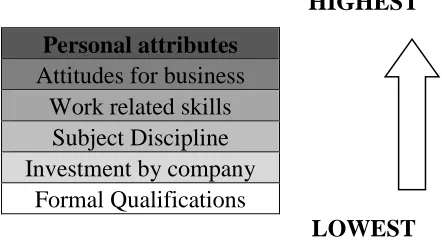
Detailed interviews were carried out in person with 8 individuals involved in recruitment and selection of built environment graduates, and additional interviews by electronic means brought the total to 11. All transcripts were returned to participants for verification and then responses were coded within NVIVO to create categorised nodes. Ranking these according to the number of sources highlighted within each node, the number of coding references and the number of words was used to give a measure of relative importance, verified by analysis of the textural content as shown in Figure 1.
HIGHEST Personal attributes
Attitudes for business Work related skills
Subject Discipline Investment by company
Formal Qualifications
[image:14.525.72.293.231.351.2]LOWEST
Figure 1 Final ranking of categories of skills and attributes which are considered most important during selection
Personal attributes
Communication skills have been considered to be a combination of personal attributes. However recruiters also considered under 'work related skills' some aspects of communication as evidenced by formal qualifications. There is also a strong correlation with personal attributes which are seen as beneficial to the business (flexibility, adaptability,
Attitudes for business
Certain personal attributes were deemed to be important for business, namely the ability to communicate, team working and being flexible. The specific 'fit' of attitude has been separately identified as knowledge, skills or behaviours which are expected specifically within a working
environment and are actively sought. In some cases this is so important that employers ask candidates to spend a week in the office as a final selection method to see if the 'fit' to the company or team is appropriate. Seeing opportunities for business, having a career focus with realistic expectations and understanding the company were identified, but ‘client readiness’ was particularly stressed and examples of graduate behaviour at interview which encouraged a candidate to be rejected were given
including failure to evidence external facing ‘client readiness’ for example by inappropriate personal presentation (including items such as jeans and piercings) or having a blasé or arrogant attitude. Personal presentation at the interview was viewed as important "Have they come to the assessment suited and booted? …it doesn't matter where you get your suit from, you can get it from the local charity shop, but there's no excuse for not turning up in a suit. Or smart."
Some specific examples of what recruiters said they looked for included candidates who were ‘clued up’ about themselves and their subjects; who could look for business opportunities and implement them; would be able to deal with clients over the phone or in person in a professional manner; and most importantly would ‘Fit’ with the team and with the company ethos as the “Pace of work is much faster. It is about people and
engagement". One recruiter particularly looked for graduates who were honest about both their leadership and group working skills “while industry wants some leaders…they don't all want leaders ..[recruits] have to be able to facilitate others.”
Work related skills
competencies at graduate recruitment level, although companies looked for cognate graduates to come from an appropriately accredited course.. Findings indicate that IT skills are now expected of employees as standard and are not specifically verified. Networking skills were seen as “key to getting a good work placement, which in turn may assist them to get a graduate job” and may be linked to perceptions of applicant motivation and tenacity.
Subject Discipline
Subject discipline related topics are largely associated with the
expectations of alignment of subject specialism to future role. In the case of cognate degree holders the named disciplines were sought for specified roles. Where non-cognate degree holders were accepted (notably in the Real Estate disciplines) specific skills or attributes linked to their degree subject were targeted which related directly to business specific
requirements. Examples given were Law or Economics students or English graduates for their report writing skills. Employers in the Construction sector focussed on identifiable discipline specific skills far more than Real Estate employers. In both Construction and Real Estate, candidates were expected to have knowledge of the industry and some recruiters stated that they were often unpleasantly surprised by the low level of knowledge and understanding of some candidates.
Investment by company
Recruitment techniques
The large numbers of applicants necessitates sifting of application
forms/CVs followed by informing successful candidates that they will pass to the next stage. There may then be a further sift, for example by phone interview, or by a second read of the forms by business managers to decide who to call to interview, or assessment centre where senior managers may become involved. The interview was used to gauge skills which could not be fully assessed by application form or CV but is also seen as more personal and thus assessment of personality fit may override other positive attributes. Differentiation was said to be easier to assess at interview than from a CV or application form. Interviewers say that they attempt to understand the candidate in a deeper way which may include assessment of how a candidate thinks or breaks down thought processes, for example by using hypothetical questions, asking for examples of managing conflict and of being resilient. Assessment centres were commonly used where there were higher numbers of candidates, interviews where candidate numbers were smaller.
This data represents a very small set – so results are indicative rather than generalisable and will need to be confirmed with further research work, however the initial indications are as follows.
KSAOs identified in the work which may be looked for at CV or application form then not assessed further:
Resilience,
Specialist IT skills, Tenacity,
Time/self-management.
KSAOs looked for at CV or application form which may then be verified by further selection processes:
Ability to continue to develop, Client readiness,
Differentiation, Team working, Work ethic, Work experience.
KSAOs identified as not looked for at CV or application form but only during later selection processes:
Communication skills - verbal, Fit,
Personality,
Relevant technical knowledge for their discipline, Written skills.
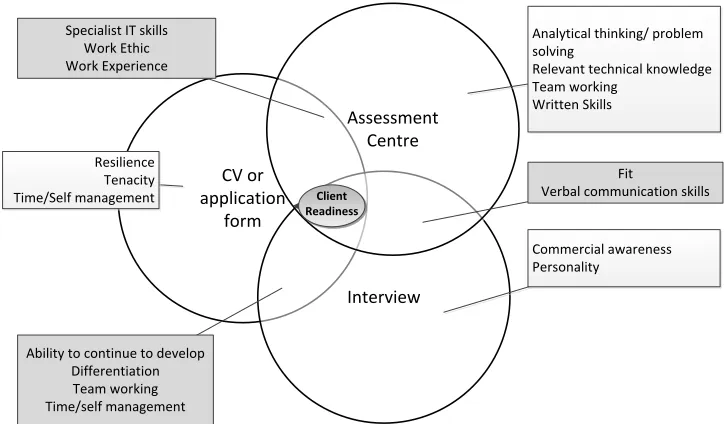
Identifiers used at CV or application form level are useful from an initial filter point of view but the ones verified by two or more methods indicate higher importance. The assessment of ‘Client readiness’ can be seen to be placed centrally to the selection process. Adaptability and flexibility were commonly excluded, as it was said to be difficult to judge in advance of hiring, as graduates say what they think interviewers want to hear. Figure 2 gives a diagram of which KSAOs are assessed by each selection method.
CV or application
form
Interview Assessment
Centre
Client Readiness
Specialist IT skills Work Ethic Work Experience
Fit
Verbal communication skills
Ability to continue to develop Differentiation Team working Time/self management
Commercial awareness Personality
Resilience Tenacity Time/Self management
Analytical thinking/ problem solving
Relevant technical knowledge Team working
[image:18.525.72.435.268.480.2]Written Skills
Figure 2 Venn diagram showing where interviewees identify the
assessment of applicant skills and attributes may occur (source: Author)
The importance of good performance in all stages of the selection process was summed up by two of the interviewees "An application is really answering the employers question of ‘are you worth meeting?’ …"an impressive and persuasive CV … bodes well” but [at interview ].. “there is still a sense that … [graduates] are owed a job.. they come..[across as].. far too arrogant … and can be quite… disrespectful of the assessment
DISCUSSION & CONCLUSION
This initial work focused on the experiences of Sheffield Hallam
University Alumni and their employers. The findings were compared to the literature relating to recruitment in general to establish any emerging trends.
KSAOs identified in the literature and in which both questionnaire and interview agreed and rated highly were
Commercial awareness, Verbal communication
KSAOs where the ratings were moderately high in the Questionnaires and Interviews were;
Achievement/results orientation, Literacy/Written communication, Personality/positive attitude, Planning/organising,
Problem solving/analytical thinking, Time/Self-management.
KSAOs identified in the literature and in which both questionnaire and interview agreed and rated moderate were;
Customer care/business focus, Flexibility/adaptability, Resilience,
Team skills/Teamwork, Work experience.
A number of KSAOs were rated moderately low by both sets of respondents;
Creativity, Enterprise skills, Numeracy.
Finally the following KSAOs were rated consistently low by both Interviews and questionnaire;
Emotional Intelligence, IT skills,
RICS / CIOB competencies.
was commonly not currently assessed by the techniques used, IT skills were ‘expected’ and therefore not formally assessed and professional body competencies were expected to be gained during early career years. Additionally graduates identified that the alignment of their skills to the business, confidence, flexibility and use of initiative were important which appears to strongly align with the requirement of 'client readiness'
highlighted by the recruiters.
Literature stressed the requirements of flexibility and adaptability, the student desire to improve their employability during their time at University, and a perceived lack of linkage between students/employers and HE with reported skills shortages in several areas. The study indicated that while flexibility may be important it was difficult in practice to judge at selection, and therefore other skills were considered to be of greater value for the execution of the selection process. There is no single common view on what constitutes employability generally and there is a measurable (statistically significant) difference in perception between recruiters and graduates regarding the relative values of identified KSAOs.
May be Underestimated by Graduates Achievement/results orientation
Creativity
Literacy / Written communication Commercial awareness
Enterprise skills May be Overestimated by Graduates
Emotional Intelligence
IT skills (general e.g. MS office) IT skills (specialist e.g. CAD) Numeracy
Planning/organising
Problem solving / analytical thinking Resilience
RICS / CIOB competencies Team skills/Teamwork Time/Self-management
Graduates and Employers agree on importance (no significant difference)
More important Moderate Lower Importance Verbal communication
Personality/positive attitude
Commercial awareness
Customer care / business focus Work experience
[image:20.525.67.442.315.577.2]Flexibility/adaptability
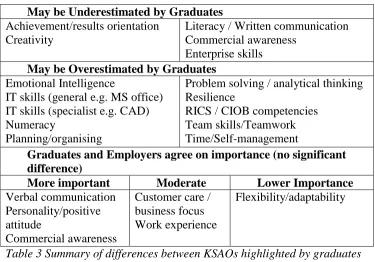
Table 3 Summary of differences between KSAOs highlighted by graduates and recruiters
There was also agreement on the importance of interpersonal skills,
act as evidence for several underlying KSAOs which are deemed desirable (Table 3).
Key points arising from this work are summarised as follows;
Value placed on course;
Literature states that graduates feel that the difficulty in getting a job is due to deficiencies in their course,
Qualification alone (grade or institution) is not necessarily a deciding factor in gaining employment,
Personal and interpersonal skills were valued by recruiters. Student attributes from outside course;
Some desirable aspects were difficult to judge during recruitment and selection process,
Work experience whether relevant or general was valued as an indicator and as evidence of having of several other positive attributes.
Recruitment
A combination of written and personal interactions were the most commonly used to assess graduates.
Subsequent development;
There was evidence of the expectation of recruiters to invest in their graduates post recruitment,
Both specific and generic skills are valued to a lesser, or greater, extent dependent on the role in the company.
This work identified the following themes;
Literature and recruiters state that skilled graduates are currently in surplus,
There is little literature on how Built Environment discipline graduate skills and competencies are specifically assessed by the recruitment process,
Graduates from Built Environment courses generally enter employment within this sector,
During recession there is enhanced competition for jobs and a commensurate low success rate for applications,
Different graduate roles require different skills and competencies and knowledge bases, values or other attributes,
The recruitment methods available allow discrimination of different factors between candidates, to aid selection. There is much
emphasis on assessing fit, which may account for the favouring of interviews as a key component of the selection process where numbers are low enough to facilitate this,
RICS competencies are developed post-employment and therefore may not form part of recruitment and selection criteria,
Graduates are expected to continue to develop. Graduate identity or adaptability may form part of the recruitment requirements, Graduates need to understand the industry, and be able to
demonstrate this.
Candidate knowledge, skills or attributes particular to the industry role, were identified to understand how graduate recruitment and selection was rationalised and undertaken, and to what extent the graduate skill
requirements were met. Recruitment and selection is a complex and personal process which involves the interaction of several individuals within a framework defined by company requirements and ethos, and overlain by the financial climate.
There is no definitive description of ‘employability' in the Built Environment disciplines but there is a linkage between identifiable attributes which tend to correlate with success in gaining employment. Recruiters in the Built Environment disciplines try to assess the way in which an applicant would ‘fit’ into the team, business unit or company. Some of the aspects identified in the literature as desired by the company (for example flexibility and adaptability) are difficult to assess during selection procedure and can only be judged fully when the candidate is in post. Where attributes are difficult to assess, indirect methods are used which include looking at past employment or exam track record.
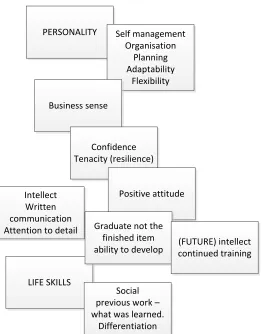
Further training after employment is expected by employers and graduates especially where a professional qualification is advantageous. In terms of the KSAOs which were identified and the linkages which may be drawn from analysis of the data, Figure 3 shows the linkages of these and their overlap with each other to simplify the key aspects informing recruitment of a built environment graduate.
PERSONALITY Self management Organisation
Planning Adaptability
Flexibility
Business sense
Confidence Tenacity (resilience)
Positive attitude Intellect
Written communication Attention to detail
LIFE SKILLS
Social previous work – what was learned.
Differentiation Graduate not the
finished item
[image:23.525.95.357.90.424.2]ability to develop (FUTURE) intellectcontinued training
Figure 3. Interrelated skills and attributes (source: Author)
In summary this initial work indicates that the processes of selection utilised by companies within the construction industry does not always target candidate knowledge, skills or attributes particular to the industry role, but seeks an optimal package where deficit in one characteristic may be compensated by another positive aspect. The full picture of the
REFERENCES
Amaratunga, R.D.G., Pathirage, C.P., Keraminiyage, K.P. and Thayaparan (2010)
Advancement of Built Environment Higher Education through Lifelong Learning. International research conference on sustainability in built environment, 18th - 19th June 2010, Colombo, Sri Lanka. 31-39 [online at] http://goo.gl/HLTkY3 Last accessed 08/06/2014
Atfield, G. & Purcell, K. (2010) Working Paper 2. Job search strategies and
employment preferences of higher education students HECSU 29pp
[online at] http://goo.gl/QXxeuI Last accessed 08/06/2014
Bellcurve (2009) Built Environment Lifelong Learning Challenging University
Responses to Vocational Education BELLCURVE
504588-LLP-1-2009-1-UK-ERASMUS-EMHE [online at] http://goo.gl/Dz1WkB Last accessed
08/06/2014
Bhattacharjee, S., Ghosh, S., Young-Corbett, D.E. & Fiori, C.M. 2013 Comparison of Industry Expectations and Student Perceptions of Knowledge and Skills Required for Construction Career Success
International Journal of Construction Education and Research Volume 9,
Issue 1, 2013 pages 19-38 [online at] http://goo.gl/1spllh Last accessed
23/09/2014
Benhart, B. L. & Shaurette, M. 2014 Establishing New Graduate Competencies: Purdue University's Construction Management Curriculum Restructuring
International Journal of Construction Education and Research Volume
10, Issue 1, 2014 pages 19-38[online at] http://goo.gl/6lr0Co Last
accessed 23/09/2014
Boudreau, J.W. (2012) "Retooling" Evidence-Based Staffing: Extending the Validation Paradigm Using Management Mental Models In Schmitt, N. The Oxford handbook of personnel assessment and selection Oxford: Oxford University Press 978-0-19-973257-31 793-813
Brannick, M.T., Cadle, A. & Levine, E.L. (2012) Job Analysis for Knowledge,
Skills, Abilities, and Other Characteristics, Predictor Measures and Performance Outcomes In Schmitt, N. The Oxford handbook of
personnel assessment and selection Oxford: Oxford University Press 978-0-19-973257-12 119-146
Butcher, V., Smith, J., Kettle, J. & Burton, L. (2011) Review of good practice in employability and enterprise development by Centres for Excellence in Teaching and learning A report for HEFCE Higher Education Academy January 2011 [online at] http://goo.gl/O1pNOS Last accessed
Confederation of British Industry (2011) Working towards your future. Making the most of your time in higher education. Confederation of British Industry's and National Union of Students CBI ISBN: 978-0-85201-739-5
pp 1-44 [online at] http://goo.gl/lMBQ46 Last accessed 08/06/2014
Confederation of British Industry (2009) Future fit: preparing graduates for the world of work. CBI ISBN: 978-0-85201-698-5 pp 1-64 [online at]
http://goo.gl/wexRkd Last accessed 08/06/2014
Corominas, C.E., Saurina, C. & Vilar, E. (2010) The Match Between University
Education and Graduate Labour Market Outcomes (Education-Job Match). An analysis of three graduate cohorts in Catalonia. Studies on Higher Education and Graduate Employment. Barcelona: Agència per a la Qualitat del Sistema Universitari de Catalunya. 137pp [online at]
http://goo.gl/2vwVIv Last accessed 08/06/2014
Fairclough report, The (2002) Rethinking Construction Innovation and Research -
A review of Government R&D Policies and Practices. Department of Trade and Industry -Department Transport Local Government Regions pp
1-50 [online at] http://goo.gl/8EcR3I Last accessed 08/06/2014
Higher Education Academy (2012) HEA - Employability [online at]
http://goo.gl/U1m2Ds Last accessed 08/06/2014
Higher Education Careers Services Unit (2013) What do Graduates do? ©
HECSU/AGCAS 2013 [online at] http://goo.gl/aedhDp Last accessed
08/06/2014
Higher Education Careers Services Unit (2012) What do graduates do? 2012
p28-31 [online at] http://goo.gl/x3xxnf Last accessed 08/06/2014
Heesom, D., Olomolaiye, P., Felton, A., Franklin, R. & Oraifige, A. (2008) Fostering Deeper Engagement between Industry and Higher Education:
Towards a Construction Knowledge Exchange Approach. Journal for
Education in the Built Environment, (Online) Vol. 3, Issue 2, December 2008 Copyright© 2008 CEBE ISSN: 1747-4205 pp. 33-45 [online at]
http://goo.gl/2Ouadt Last accessed 08/06/2014
Hinchcliffe, G. and Jolly, A. (2011) Graduate identity and employability. British
Educational Research Journal. 37 (4), Higher Education Research and Developments ISSN 0729-4360 pp. 31 - 44 [online at]
http://goo.gl/A8hk3Y Last accessed 08/06/2014
Howarth, T. & Stafford, J. (2005) Programme Planning, Design and Approval in
the Built Environment: A Model for Practitioner Guidance. CEBE Briefing guide series no 5. Dec-05 1744-9839 [online at]
Kibler, N (2013) In TargetJobs 2013 Construction, QS & Civil Engineering. Edition 3. Wallingford: GTI Media pp 10-11
Lambert Review, The (2003) Lambert Review of Business-University
Collaboration HMSO, Crown copyright 2003 Dec-03 pp 1-142 [online at] http://goo.gl/Dg6xyV Last accessed 08/06/2014
Leitch Review, The (2006) Prosperity for all in the global economy - world class
skills HMSO, Crown copyright 2006 Final report December 2006 pp
1-154 [online at] http://goo.gl/f0M3kf Last accessed 08/06/2014
Lowden, K., Hall, S., Elliot, D. & Lewin, J. (2011) Employers’ perceptions of the employability skills of new graduates. Research commissioned by the Edge Foundation ISBN 978-0-9565604-3-8 pp 1-42 [online at]
http://goo.gl/sxDQGO Last accessed 08/06/2014
McPhail, S.M. & Jeanneret, P.R. (2012) Individual Psychological Assessment In
Schmitt, N. The Oxford handbook of personnel assessment and selection Oxford: Oxford University Press 978-0-19-973257-21 411-442
Murphy, K.R (2012) Individual Differences In Schmitt, N. The Oxford handbook
of personnel assessment and selection Oxford: Oxford University Press 978-0-19-973257-9 31-47
Ostroff, C. & Zhan, Y. (2012) Person-Environment Fit in the Selection Process In
Schmitt, N. The Oxford handbook of personnel assessment and selection Oxford: Oxford University Press 978-0-19-973257-17 252-273
Pegg, A., Waldock, J., Hendy-Isaac, S. & Lawton, R. (2012) Pedagogy for
Employability Higher Education Academy [online at]
http://goo.gl/qAMEqb Last accessed 08/06/2014
Ployhart, R.E. (2012) Multilevel Selection and the Paradox of Sustained
Competitive Advantage In Schmitt, N. The Oxford handbook of personnel assessment and selection Oxford: Oxford University Press 978-0-19-973257-28 667-686
Ployhart, R.E. & Schneider, B (2012) The Social and Organisational Context of
Personnel Selection In Schmitt, N. The Oxford handbook of personnel assessment and selection Oxford: Oxford University Press 978-0-19-973257-10 48-67
Poon, J. Hoxley, M. & Fuchs, W. (2011) Real estate education: an investigation
of multiple stakeholders Property Management, Vol. 29 Iss: 5 pp.468 -
487 [online at] http://goo.gl/MntQJK Last accessed 08/06/2014
Purcell, K., Elias, P., Atfield, G., Behle, H., Ellison, R., Luchinskaya, D., Snape,
J., Conaghan, L. & Tzanahou, C. (2012) Futuretrack Stage 4: transitions
into employment, further study and other outcomes HECSU November
Schmitt, N. & Ott-Howard, C. (2012) Theoretical and Practical Issues: Research Needs. In Schmitt, N. The Oxford handbook of personnel assessment and selection Oxford: Oxford University Press 978-0-19-973257-36 939-958
Scott, J.C. & Lezotte, D.V. (2012) Web-Based Assessments In Schmitt, N. The
Oxford handbook of personnel assessment and selection Oxford: Oxford University Press 978-0-19-973257-23 485-513
Sheffield Hallam University (2013) Research Ethics at Sheffield Hallam
University [online at] http://goo.gl/uN3VIk Last accessed 14/03/2013 (*)
Sewell, P. & Pool, L.D. (2012) CareerEDGE: A Practical Model of Graduate
Employability Link 27 - Graduates with Impact Hospitality, Leisure, Tourism & Sport Network Higher Education Academy [online at]
http://goo.gl/OKrDoj Last accessed 08/06/2014
TargetJobs (2013a) Construction, QS & Civil Engineering ©TargetJobs3
Wallingford: GTI Media Ltd ISSN 2044-0626 / ISBN 1 84318 748 5 pp1-80
TargetJobs (2013b) Property. ©TargetJobs25 Wallingford GTI Media Ltd ISSN
1757-4129 / ISBN 1 84318 749 3 pp1-56
Taylor, S (2010) Resourcing and talent management. 5th ed. London: Chartered
Institute of Personnel and Development 978-1843982517
Tomkins, A (2012) Dare to be Different, the Story so far! Developing a Personal
Brand in Preparation for Graduate Recruitment. Link 27 - Graduates with Impact Hospitality, Leisure, Tourism & Sport Network Higher
Education Academy [online at] http://goo.gl/t5WzKB Last accessed
08/06/2014
UK Commission for Employment and Skills (2009) Ambition 2020: world-class
skills and jobs for the UK. UK Commission for Employment and Skills
pp 1-164 [online at] http://goo.gl/U7y09a Last accessed 08/06/2014
Unistats (2014) Sheffield Hallam University. [online at] http://goo.gl/th3XZj Last accessed 08/06/2014
Wilson Review, The (2012) A Review of Business–University Collaboration
Crown copyright 2012 [online at] http://goo.gl/FNcSmr Last accessed
08/06/2014
Witt, E. & Lill, I. (2010) The mismatch between graduate competences and