DEMIR, Erdem and DESMET, Pieter M. A.
Available from Sheffield Hallam University Research Archive (SHURA) at:
http://shura.shu.ac.uk/504/
This document is the author deposited version. You are advised to consult the
publisher's version if you wish to cite from it.
Published version
DEMIR, Erdem and DESMET, Pieter M. A. (2009). The roles of products in product
emotions an explorative study. In: Undisciplined! Design Research Society
Conference 2008, Sheffield Hallam University, Sheffield, UK, 16-19 July 2008.
Copyright and re-use policy
The roles of products in product emotions
an explorative study
Erdem Demir, Department of Industrial Design, Delft University of Technology, Landbergstraat 15, 2628 CE Delft, The Netherlands
Pieter. M. A. Desmet, Department of Industrial Design, Delft University of Technology, Landbergstraat 15, 2628 CE Delft, The Netherlands
Abstract
Although several theoretical frameworks that aim to explain the emotional impact of product design have been introduced in design research literature, none of these frameworks clearly specifies the role of the product in these emotions. This paper reports a study that was designed to explore the variety of roles that products can play in emotional experiences. In a three staged experience sampling study, 29 participants produced 170 records of emotions experienced while interacting with products. Each case was examined in order to identify the antecedent event (the event triggering the emotion) and the mental object (what the emotion is about). The results indicated that several types of events involved in the user-product interaction can elicit an emotional experience: noticing a product; an event occurring during product usage; an entire usage episode; an external agent mentioning the product; and a change in the relationship between a user and a product . It was also found that the resulting emotional responses can be about (can be attributed to) several types of mental objects: a physical object, such as the particular product involved; the user or some other person; the actions of the user or the designer; the antecedent event itself. The results are used to identify and discuss eight distinct roles that products can play in the experience of
emotions. In addition, examples are provided to illustrate how these roles can facilitate a structured approach to design for emotion.
Keywords:
Design and emotion, user-product interaction.
Emotions involved in product usage, largely discarded in modernist
three most influential are the process-level, the pleasure, and the appraisal framework (for a review, see Desmet, 2007). These frameworks have in common that they are based on theories that describe variables involved in the emotion elicitation process. The process-level perspective, introduced by Norman (2004) identifies three different levels of processing responsible for affect in the user-product interaction: the reactive, the routine, and the reflective level. The pleasure perspective of Jordan (1999) distinguishes four sources of pleasure in user-product interactions: physical, psychological, social, and ideological. The appraisal perspective, introduced by Desmet (2002), focuses on relational meaning: the appraised personal significance of
products for one’s well being. This perspective highlights the role three types of underlying concerns in the emotion process: attitudes, standards, and goals.
An important application value of such theoretical perspectives is that they can be used to structure attempts to design for emotion. A general limitation for this application, however, is that they do not clarify the actual role of the product, and therefore the role of design, in the emotional process. The variety of examples used by the authors who introduced the perspectives illustrate that there is a variety of possible roles, but none of the frameworks discusses these roles explicitly. We will use some of the examples used by Jordan (1999), Desmet (2002), and Norman (2004) to illustrate the variety. In some examples the product plays a direct role: pleasure experienced in response to the taste of candy, or fascination experienced in response to a novel and complex product. In other examples the role of the product is more indirect: pleasure experienced in response to the social interaction which is facilitated by an office coffee corner, or melancholy experienced in response to a childhood teddy bear, or inspiration experienced in response to the activity of dancing represented by a pair of dancing shoes. And in other cases the role of the product is an anticipated facilitator: desire experienced in response to imagining the compliments generated by wearing a dress seen in a boutique.
Our main position is that attempts to use the theoretical perspectives in design processes, i.e. “emotional design”, will be facilitated by a clear overview of the possible roles of products in the users’ emotional experiences. The study discussed in the current paper was therefore designed to explore the role of products in emotions that users experience while interacting with products. The next section introduces concepts borrowed from psychology that were used to structure the exploration.
The antecedent event and the mental object
The concepts used in this paper are (1) the antecedent event, and (2) the mental object of an emotion. To begin with the first: every emotion involves an antecedent event, i.e. a perceived change in the situation (Frijda, 1986) Examples of perceived changes are smelling a fire or seeing a photo of a past holiday. It is important to stress that the word event is used to denote a
perceived change. This perceived change can be a real change (e.g., someone calls your name; you use a product), but also an imagined change (e.g. remembering your marriage day; anticipating winning a lottery).
the term ‘antecedent event’ because the term stimulus has associations of a physical object instead of a change.
The second concept used in the analysis, the mental object of the emotion, is whatever the emotion is attributed to: all emotions imply and involve a
relation between the person who experiences them and a particular object (Frijda, 1986). One is not just angry, but angry at someone, afraid of something, proud of something, in love with someone, and so on. So we are angry at our printer for a bad quality print, satisfied with our toaster for making the perfect toast, and bored by our telephone for its tedious ring tone. The distinction between antecedent event and mental object is important because they are not necessarily the same. For instance, receiving a compliment may activate an experience of pride. In that case, the antecedent event is the event of receiving the compliment, and the mental object is the individual’s self and his/her qualities. The object is whatever one believes is making him or her experience the emotion, and that in some cases we can misattribute an emotion (see Schwarz & Clore, 1983). One can, for example, be angry at a colleague for some mistake that he was actually not responsible for. Note that the mental object is not necessarily a physical object, but can also be a person, an animal, a company, etcetera. For instance, one can admire a successful designer. Furthermore, the mental object can be the
representation of an actual event as well as an imaginary or a remembered one (Russell, 2003). One can get sad about a loss of a cherished object. In this example, the emotion is attributed to the event of losing the cherished object (i.e. mental object of the emotion), and not to the cherished object per se.
With the use of these antecedent event and mental object concepts, the general goal of the study, to explore the role of the product in product emotions, can be specified: The goal of the study is to identify possible (1) antecedent events of and (2) mental objects involved in emotions
experienced in user-product interaction.
The study
An explorative study with three phases was conducted: a sensitizing phase, a self-report phase, and an interview phase. Participants (N=29) were master students at the industrial design engineering department of Delft University, and were paid for their contribution.
In the sensitizing phase, participants, using a questionnaire, reported their emotional experiences in their daily lives. Each participant received a set of 10 emotions that were randomly selected from a list of 33 affective concepts groups developed by Scherer (2005). Then participants reported examples of cases in which they had previously experienced these ten emotions. For each report, they were also asked to describe what had happened, and to explain why they had experienced the particular emotion.
signaled by an SMS. The basic question was to report the last emotion
experienced while interacting with a product. To overcome the difficulties in labeling and communicating the emotional experiences, the list used in the first phase was also used in the second phase. The participants either picked one of the listed emotions or reported some additional emotion that was not included in the list. Then, they were asked to report the product that had been involved in the experience, to describe the events that took place and to provide a causal explanation for the emotional activation. The participants were also asked to take a photo of the product that they reported.
The second phase was carried out in two different ways. For the first 19 participants, the study lasted for three days. Each of these participants
received one to three SMS’s in random times of the day, summing up to six for the entire study period. The reports of these respondents showed a
disproportional high number of cases of irritation and anger. To ensure variability, the remaining participants were asked not to report examples of anger and irritation. Based on the low return rate for the first 19 participants, the signaling schedule was changed to cover ten days and each day only one SMS was sent. The signaling times were randomized over participants and days, in an attempt to cover a variety of different daily activities that may take place throughout the day.
The third step was an interview that was designed to identify possible causes of the reported emotional experiences, the objects of the emotion and the participants’ appraisals of the situation. After an explanation of the procedure, the participants first read their own reports to recall the experiences. Then the interviewer asked several open-ended questions that aimed to disclose the details of the experience, such as the activity the participant was involved in when experiencing the emotion, the responses of the product, and the presence or absence of other people. During the session, the photographs of the products were shown, which facilitated recalling the experience and communicating about the experience with the interviewer. An average
interview session lasted for 45 minutes. All phases of the study were conducted in English.
Results
The study yielded 204 emotion records for 32 emotions. For several reasons, 34 of these reports were discarded: reports that (a) did not refer to an emotional experience (e.g. company, masculine, confusion), (b) referred to products that are not consumer products but art, such as books and music CD’s, or (c) referred to experiences that had happened earlier than one day before the participant received an SMS.
Antecedent events in product related emotional experiences:
The results of the study indicated a wide variety of antecedent events in the context of user product interactions. Within this variety, five main groups of events were identified: noticing events, an event during a usage episode, usage episode as an event, external information opinion events, and change in the relationship events. Below, these events are described in detail.This type of events involved a shift of one’s attention to the product while not in physical contact with the particular product. The results indicated various situations in which the product caught the attention while not in use, e.g. noticing the damaged condition of a lamp while tidying up the place.
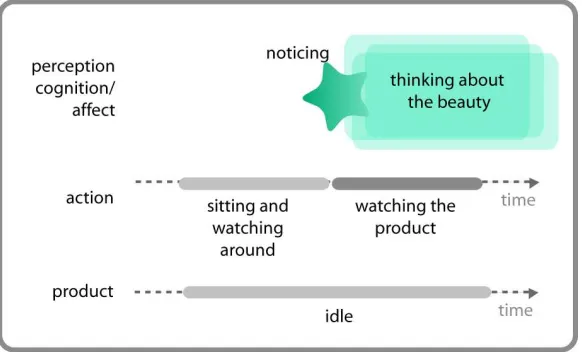
Figure 1. Interaction storyline for a noticing event
Figure 1 schematizes an example report of fascination with a handbag. The experience was triggered in an idle moment of drinking coffee and gazing around in the room. The attention of the user was caught by the intricate detailing and the beauty of the handbag.
b. A simple event during a usage episode
The results indicated that the user’s action and/or the product’s reaction (e.g. product’s spontaneous feedback, or its reaction to the user, or its reaction to other things) could act as an antecedent event. These events had relatively clear beginnings and ends, demarcated by the beginnings or ends of the actions and/or reaction making up the event. Several types of simple events can be identified in the reports.
Encountering events: During the physical interaction in product usage, one can discover hidden features or qualities of the product. A
participant reported an event of exploring a shortcut in navigation system of an mp3 player. This type of events can trigger emotions such as surprise, fascination, or in general contentment or disappointment.
Malfunction, brake-down, inappropriate response events: These events are characterized by improper responses of the product to the user’s actions. Reported examples of this type of events are a coffee vendor that poured only half full of coffee, a computer that crashed, or a washing machine that waited too long to let the tap open.
Completion of usage episodes: When one completes a usage, or repair, or upkeep session with the product, the results can be emotionally
evocative. A participant reported a case where she felt happiness when completed the installment of a tent as a marker of the start of fun times.
[image:7.595.121.414.283.459.2]Communication events: Receiving an SMS or an e-mail through communication devices can be emotionally evocative as well. Depending on the content of the message, these moments can be pleasant or unpleasant.
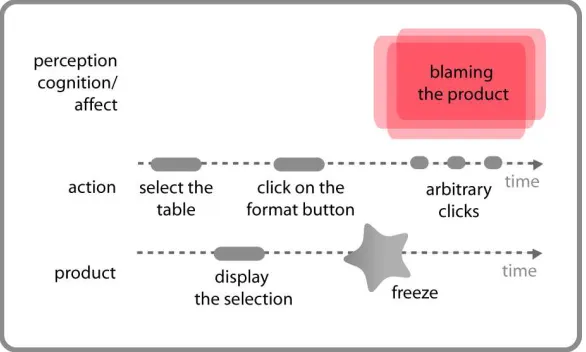
Figure 2, illustrates an example of a malfunction event, an irritating experience of a not responding computer program. The user attempted to format a table in a word processor, however, the computer ceased responding to the
actions of the user.
Figure 2. Interaction storyline for a malfunction event.
c. A usage episode as an event
An antecedent event can also be the total episode consisting of a series of interactions between the user, the product, and other products. An example is the enjoyment one experienced during a bike trip. It was basically a process of user’s actions (such us stepping the wheel, keeping balance on the bike, watching the scene) and perceptions (the feeling of the warmth of the sun, the stimulating feeling of speed).
Figure 3. Interaction storyline for a usage episode event
d. External information/opinion events
An external source of information can direct our attention towards a product. Examples include a stranger making a compliment about one’s sunglasses, or a salesman showing a particular feature of a product.
e. Change in the relationship events
A change in the relationship between the product and user can elicit an
emotion. These changes can be the start or reestablishment of the relationship, or the end of the relationship. The reports included events of purchase of a long-wanted dress, finding a cherished pen after losing.
Mental objects in product related emotional experiences:
The study showed that emotional experiences in user-product interaction can be attributed to a number of different types of mental objects. These objects can be people or objects, actions of people, the antecedent events
themselves, or some other remembered or imagined events.
a. People and objects
The most direct product related emotional experiences were the ones, where the object of the emotion was product itself or one of its properties. In many records (50/170) the product was the object, covering a varied emotion range including interest, fascination, jealousy, satisfaction, disappointment, surprise, hatred. In some other reports, the objects of the emotions were the users themselves, i.e. self-conscious emotions. With the aid of the products one can have some qualities such as beauty, and physical or social strength. These qualities can be displayed and expressed by our possessions. Other people also reported to be the object of the emotion in some reports. The examples are provided in Table 1.
Table 1. Objects/persons as mental objects of emotions
Product “… Today I bought an X (a computer mouse) and
mechanism to protect the lens and to switch off the mouse. When I turn it on (by opening) it automatically reconnects to my laptop…” (Jasper; fascination; mouse)
Self “…Jewels are like a small piece of “pride”, how to say to wear something beautiful, in general, makes me feel a bit more secure…” (Natalia; pride; bracelet)
Other people “…we tried communicating with our webcams.. so my grand father…It was really emotional seeing him so amazed and happy… I realized how much I missed him…” (Ana Laura; longing; web-cam)
b. Actions of people:
In some emotional experiences, one can focus on a person’s action as he/she finds the agent to be responsible for the change in the environment (and for the affect). If one focuses on the self’s actions, the resulting emotion can be pride, shame. Focusing on the actions of others can result in admiration or contempt. The reports showed that using a product itself can be considered as a praiseworthy or blameworthy action. In addition, a
successful/unsuccessful usage action, especially when the resultsof the action are not expected, can evoke pride/shame. Some of the reports involve
emotions attributed to the actions of other parties represented by the product, such as the actions of the designer and or other parties such as marketing strategies. The examples are provided in Table 2.
Table 2. Actions as mental object of emotions
Self’s action of usage
“… I used the box to keep the Chinese food for tomorrow. I was proud that I used this box to keep the food fresh… It is important to be sustainable for me…” (Yoeri; pride; plastic food box)
Self’s action in usage
“…they (friends) came to say hi. I tried to open the door but I couldn’t.... I felt so embarrassed not being able to open my own house door…we waved from the window and they left…” (Aybike; shame; door handle)
Action of designer, producer.
“…it was different from all the ones I used. The old ones are normally the typical “button” that you have to press but in this one there was no button… I really admired the designer of this because of this mechanism solution…” (Beatriz; admiration; deodorant tap)
c. Antecedent events and other events
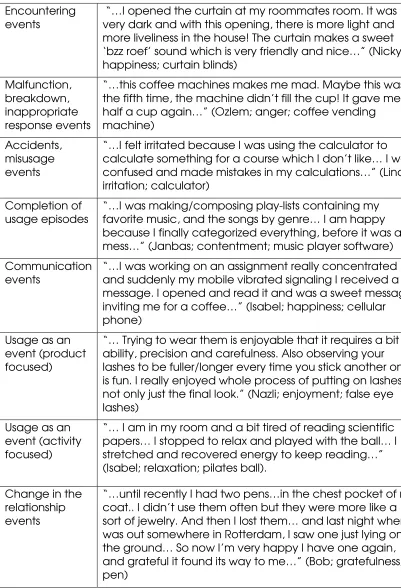
Table 3, different types of object-events and an example from the participant reports for each type are provided.
Table 3. Antecedent events as mental objects of emotions
Encountering events
“…I opened the curtain at my roommates room. It was very dark and with this opening, there is more light and more liveliness in the house! The curtain makes a sweet ‘bzz roef’ sound which is very friendly and nice…” (Nicky; happiness; curtain blinds)
Malfunction, breakdown, inappropriate response events
“…this coffee machines makes me mad. Maybe this was the fifth time, the machine didn’t fill the cup! It gave me half a cup again…” (Ozlem; anger; coffee vending machine)
Accidents, misusage events
“…I felt irritated because I was using the calculator to calculate something for a course which I don’t like… I was confused and made mistakes in my calculations…” (Lindy; irritation; calculator)
Completion of usage episodes
“…I was making/composing play-lists containing my favorite music, and the songs by genre… I am happy because I finally categorized everything, before it was a mess…” (Janbas; contentment; music player software)
Communication events
“…I was working on an assignment really concentrated and suddenly my mobile vibrated signaling I received a message. I opened and read it and was a sweet message inviting me for a coffee…” (Isabel; happiness; cellular phone)
Usage as an event (product focused)
“… Trying to wear them is enjoyable that it requires a bit ability, precision and carefulness. Also observing your lashes to be fuller/longer every time you stick another one is fun. I really enjoyed whole process of putting on lashes, not only just the final look.” (Nazli; enjoyment; false eye lashes)
Usage as an event (activity focused)
“… I am in my room and a bit tired of reading scientific papers… I stopped to relax and played with the ball… I stretched and recovered energy to keep reading…” (Isabel; relaxation; pilates ball).
Change in the relationship events
Table 4. Life events as mental objects of emotions
Remembered or current life events
“Not very happy with the room I rent through X (a renting agency). Using the stove in the kitchen always reminds me of this…” (Erik; disappointment; stove)
Discussion
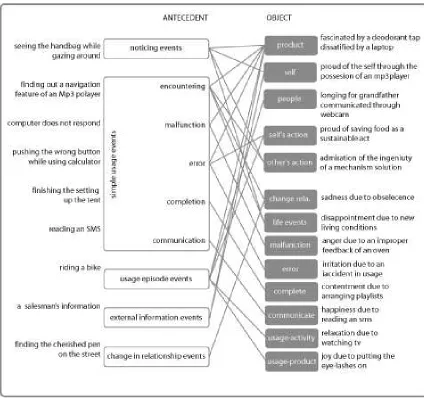
[image:12.595.121.545.334.732.2]The results indicated that it is possible to identify various types of antecedent events and various types of mental objects in cases of emotional experiences in user-product interactions. In each case, a particular combination of event and object type can be identified. Figure 4 summarizes these findings. The left side of the figure represents the 9 main types of antecedent events, with an example for each type, and the right side represents the 13 main types of mental objects. The lines represent event-object combinations identified in the reported cases. Different combinations involve different actors – user, other people, the product, other products, and etcetera. An important finding is that in some combinations the involvement of the product is more prominent than in some other combinations.
An analysis of the mental object enabled us to identify eight distinct ways in which the product could be involved in the emotion process, or, eight ‘roles of the product.’ The product (1) is the object of emotions; (2) represents the self of the user; (3) provides a context for praiseworthy or blameworthy actions; (4) represents the actions of the designer or producer; (5) serves as a tool for attaining immediate usage goals; (6) influences or enables of pleasant or unpleasant activities; (7) acts as a tool for emotional communication; (8) acts as a reminder of life events. In Figure 5 you can see these roles and the
[image:13.595.119.554.210.412.2]regarding mental objects.
Figure 5. Mental objects and roles of the products in product emotions
Products as objects of emotions.
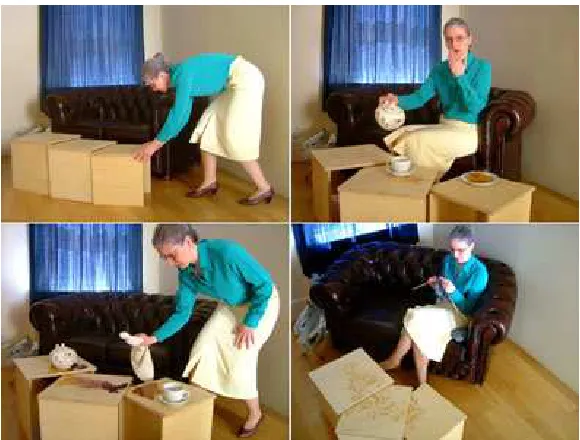
The most central role a product can play in an emotion is to be the object of the emotion. The users may get emotional due to apparent or hidden qualities, features, or properties of products. emotional design in this context means designing for these qualities, features, or properties. An example to design with hidden product qualities is a coffee table designed by Grimaldi (2004)
Figure 6. Coffee table of Grimaldi (2004)
Products as possessions representing self
The material possessions represent our personal qualities, values, interests, and our position in the social context (Belk, 1988, Dittmar, 1992).The study showed that those qualities symbolized by the possessions could evoke self-conscious emotions, such as pride and shame. Designing for the expressive qualities of the products can be one of the ways for designing for this role. A fit or mismatch between users’ self-ideals and the expressive qualities of the products owned by them may be a key issue.
Products as contexts for praiseworthy or blameworthy actions:
In product related emotional experience, individuals can also experience self-conscious emotions, due to their achievements in interacting with products. Actions made with the products and using the product itself, can beappraised as praiseworthy or blameworthy. The attempts of design for emotion may include these self-conscious emotions and may focus on
Figure 7. Power Flower of Gustav Landberg
Products presenting designer’s/producer’s actions
The designer’s and producer’s actions in shaping the product are usually observable in the appearance of the product. These actions may be the object of admiration or contempt experiences, based on the value portrayed with the product.
Products as tools for attaining usage goals
In goal-oriented behavior during usage, the attainment /blockage of an usage goal can be emotionally evocative. In these types of situations, the objects are usually simple usage events, such as accidents or completion of the usage episodes, and the role of the products are merely tools to attain those usage goals. In these cases, one can get irritated or angry at the product if the product is found responsible for the occurrence of this unpleasant event or can get disappointed with the situation without any responsibility attribution to the product.
Products enabling and influencing pleasant or unpleasant activity
The product related emotions can be attributed to the activities of product usage. The properties of the products that the designers can play anFigure 8. Dutchtub of Floris Schoodenbek
Products representing life events
Events happening in the life of the user can be the object of emotions in interacting with products. Products may represent those significant events in user’s lives. Some of these emotions are triggered by the remembrance of personal life events, like the happiness evoked when looking at holiday photos. Designers’ influence on evoking these types of emotional experiences seems to be little. However, the products may also refer to the collective memory with readable metaphors, e.g. New Baghdad table (see Figure 9). The table, with a hollow structure of Baghdad map, has the potential to evoke thoughts about what is going on in the Middle East nowadays and the emotional tones of those thoughts.
[image:16.595.120.376.496.687.2]Products as tools for emotional communication:
Interpersonal communication is another source for emotional interaction with products. Obviously, the emotional tone of these experiences depends on the content of the messages carried during the communication, and therefore the designer’s influence may seem restricted. Nevertheless, as a design for emotion strategy, designers may choose to enrich the communicational domain of the products. Rosella (2004) illustrates an innovative way to
[image:17.595.124.375.245.482.2]communicate emotions through products. F+R Hugs system (see Figure 10) is a smart jacket that simulates a hug by recreating the physical pressure of a hug through inflation and deflation of cushions embedded in the jacket. The system can be activated, by an SMS coming from a distant loved one.
Figure 10. F+R Hugs of Rosella (2004)
The study presented here involved several limitations. The first limitation was the self-report method used in the study. As mentioned before, individuals’ assessments about the causes and objects of their own emotional
experiences may be biased or incomplete. This study is basically a self-report study and therefore may involve self-reporting related problems. In the study, it is attempted to minimize these problems by adopting a combination of on-line experience capturing and in-depth questioning. Another limitation of the study is related to the sample of participants. The study involved a very specific participant group, i.e. design students. Therefore, there is a possibility that the framework presented in this study may not be complete. However, in future, the framework can be tested and may be improved by repeating the same study with different participant groups, especially with those who may have different concerns in relation to product possession and use, such as elderly.
situations can trigger emotional experiences in interaction, sets the ground for the further experimental research. This refinement basically provides a more controlled experimental setting, which is necessary to get a grip on the rich and complex domain of user emotions. Furthermore, through identifying the mental objects, it was possible to provide a structure for the variety of roles that a product can play in an emotional experience. This refinement was particularly helpful in clarifying the different aspects of “emotional design”. Designing for these different roles obviously require different approaches, research questions, tools and techniques, which can be set forth by the help of the structure provided by this study.
References
Demir, E., Desmet, P., & Hekkert, P. (2006). Experiential concepts in design research: A (not too) critical review. In M. Karlsson (Ed.) Proceedings of the 5th
International Conference on Design and Emotion [CD ROM]. Gothenburg:Chalmers University Press.
Desmet, P.M.A. (2002). Designing Emotions (Doctoral Dissertation, Delft University of Technology, 2002). Dissertation Abstracts International, 64/01, 5.
Desmet, P.M.A. (2007) Product emotion In Schifferstein, H.N.J. & Hekkert, P. (Eds.) Product Experience (pp. 379-397). London: Elsevier Science Publishers.
Belk, R. W. (1988). Possessions and the extended self. Journal of Consumer Research, 15, 139–168.
Buchanan, R. (1989). Declaration by design: rhetoric, argument, and demonstration in design practice. In V. Margolin (Ed.), Design Discourse: History, Theory, Criticism (pp. 91–109). Chicago: University of Chicago Press.
Dittmar, H. (1992).The social psychology of material possessions: to have is to be. New York, NY: St Martin’s Press.
Frijda, N. H. (1986). The emotions. Cambridge: Cambridge University Press.
Grimaldi, S. (2006). The Ta-Da Series: presentation of a technique and its use in generating a series of surprising designs. In M. Karlson (Ed.), Proceedings of the 5th International Conference on Design and Emotion [CD ROM]. Gothenburg: Chalmers Press.
Hektner, J.M., Schmidt, J.A., & Csikzentmihalyi, M., (2007). Experience Sampling Method: Measuring the Quality of Everyday life. Thousand Oaks: Sage
Publications.
Jordan, P. W. (1999). Pleasure with products: human factors for body, mind and soul. In W. S. Green & P. W. Jordan (Eds.), Human Factors in Product Design: Current Practice and Future Trends (pp. 206-217). London: Taylor & Francis.
Norman, D. (2004). Emotional design: Why we love (or hate) everyday things. New York: Basic Books.
Rosella, F. (2004). F+R Hugs: How to Communicate Physical and Emotional Closeness to a Distant Loved One? In A. Kurtgozu (Ed.), Proceedings of the 4th International Conference on Design and Emotion [CD ROM]. Ankara: METU Press.
Russell, J. A. (2003). Core Affect and the Psychological Construction of Emotion. Psychological Review, 110(1), 145–172.
Scherer, K. R. (2001). Appraisals considered as a process of multilevel
sequential checking. In K. Scherer, A. Schorr & T. Johnstone (Eds.), Appraisal processes in emotion: Theory, methods, research (pp. 92-120). New York: Oxford University Press.
Scherer, K. R. (2005).What are emotions? And how can they measured? Social Science Information, 44(4), 695-729.
Schwarz, N. &Clore, G. L. (1983). Mood, misattribution, and judgments of well-being: Informative and directive functions of affective states. Journal of Personality and Social Psychology, 45, 513-523.
Erdem Demir
Erdem Demir is currently a PhD. student in Industrial Design Department of Delft Univeristy of Technology. The main focus of his research is on emotional product experiences and cognitive processes underlying these experiences. His research interests also include how to design for emotions, i.e. emotional design.
Pieter M. A. Desmet
Pieter Desmet is an Assistant Professor in the Department of Industrial Design of Delft University of Technology. Desmet is interested in why and how