Experiential learning: The development of a pedagogic
framework for effective practice.
BEARD, Colin <http://orcid.org/0000-0002-3836-3072>
Available from Sheffield Hallam University Research Archive (SHURA) at:
http://shura.shu.ac.uk/13095/
This document is the author deposited version. You are advised to consult the
publisher's version if you wish to cite from it.
Published version
BEARD, Colin (2008). Experiential learning: The development of a pedagogic
framework for effective practice. Doctoral, Sheffield Hallam University.
Copyright and re-use policy
See
http://shura.shu.ac.uk/information.html
Experiential learning:
The Development of a
Pedagogic Framework for Effective Practice.
Colin Beard
Sheffield Hallam University
2008
1. Introduction.
This paper details the background to a research programme that presents new theorising concerning the pedagogy of experiential learning (EL). The paper shows how a milieu of practical ‘themes’ are developed from case material published predominantly within journals, and through a reflective and transformational process of writing textbooks (Beard and Wilson, 2002, 2006). The result is a configuration of emergent themes into significant categories to form a new theoretical framework that informs the pedagogy of EL.
This research is firstly contextually located (Heron, 1981) within a broad church of existing theories found in the mainstream, predominantly Western, literature on EL. This exploration is from four perspectives: the significance of lineage, the limitations of practical teaching models, a critical review of the most widely used pedagogic EL model from the work of David Kolb (1984) and finally the principal debates that identify areas for further development (Murray, 2006) as ‘sensitizing concepts’ (Blumer, 1954) that simultaneously destabilise the hegemonic constructivist paradigm and signpost fieldwork directions.
By addressing a number of neglected areas and responding to a unifying call to provide a richer, more integrative conception of EL, this paper outlines the extensive fieldwork that results in an interpretation of EL that extends ‘beyond the usual definitions and arguments’ (Rickards, 2007: 430) and attempts to bring theory and practice closer together. The paper presents illustrative case material, as ‘snapshots’ of fieldwork across a number of disciplines. It is from this illustrative material that themes and categories are tracked in the paper: they are drawn out, coded, developed and located within an overarching framework. The paper also highlights the problems inherent in publishing such a compact representation of a lengthy journey of applied research, in both depth and breadth of fieldwork, as part of a PhD by publication.
2. Experiential Learning: Meanings, Boundaries and Lineage.
2.1. Meanings and the significance of lineage
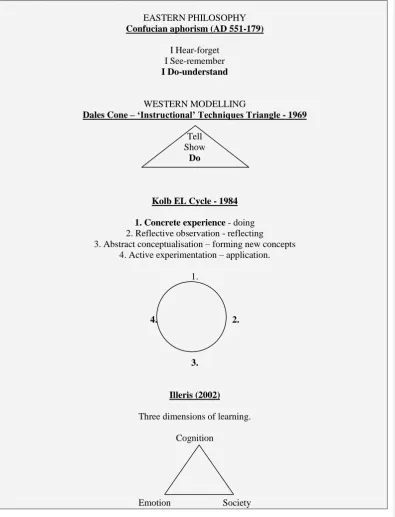
EL has a history dating back to Eastern, Confucian philosophy, with the aphorism (AD 551-179) ‘I hear I forget, I see I remember, I do I understand’. This laid the very early foundations for subsequent Western interpretations and many writers have contributed to the debate about the notion of learning from experience or learning from doing (Dewey, 1938; Rogers, 1969; Kolb, 1984; Revans, 1980; Boud and Walker, 1993). This research revisits the debate about the primacy of experiencing by
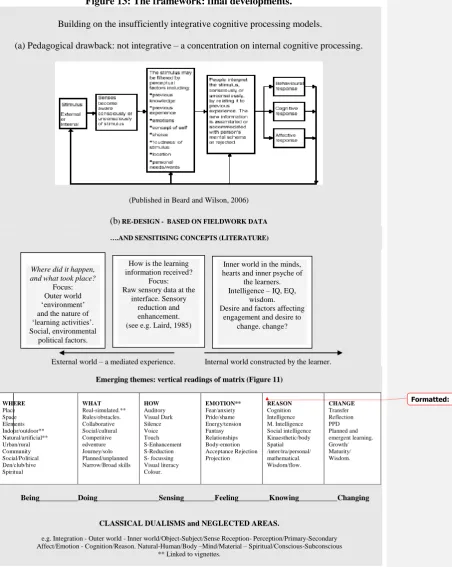
doing and presents a contemporary discourse about EL, suggesting that the experience of learning involves learning from being, doing, sensing, feeling, thinking and changing.
2.2. Problematic boundaries
the concept has moved on to the point where the ‘distinction between experience and non-experience becomes absurd’ (Fenwick: ix). As an evolving and constructed term the search for unanimity might be considered impracticable: ‘one set of meanings of it is the meanings of all those who have contributed to the literature’1
(Moon, 2004: 107) but ‘the views of experiential learning differ widely’ (Moon, 2004: 110) within and across disciplines. This thesis responds to calls within a range of disciplines for the definitional parameters to provide greater synergy between the interaction of the inner world and the outer world experiences. My definition of EL, adapted from Beard and Wilson (2006: 2) is that:
EL is a sense making process of learning that actively and reflectively engages the inner world of the learner as a whole person (physical-bodily, intellectually, emotionally and spiritually) with the intricate ‘outer world’ of the learning environment (nature, place, social, political).
3. A brief introduction to the new framework.
Pedagogic mediation of these complex interactions of the primary and secondary experiences of the learner is the central concern of this research. I now explore the extent to which educators and trainers can impact upon and influence these multiple dimensions of the experience and offer a new pedagogic framework as tentative modelling2. The pedagogic framework is first briefly presented below. A detailed explanation will follow later.
3.1 The framework: a visual metaphor
The framework is shown in Figure 1, as an abstract, visual metaphor representing a combination lock
with several categories or cogs that can all be independently rotated producing several million possible permutations. The left side of the framework represents the outer, public world of learning. The central, lighter shaded cog, represents the sensory modes, as conduits between the outer world and the inner, private world of the individual learner. The framework is much more than a set of categories: it built upon a distinctive grounded synthesis of theory and fieldwork, and uses a substantive body of data, emerging from personal interactions, from significant stakeholders and informants, and from the learner’s environment to build a milieu of themes that present limitless possible combinations for the design and management of EL.
Figure 1: A Framework for Design of Experiential Learning:
1
Moon acknowledges my contribution made in Beard and Wilson in 2002, and quotes an early definition.
2
For the purpose of this paper the term framework is used as a cautious interpretation. The framework is designed as a prompt for practitioners to use in practice, for the design and management of learning. A
3.2 A brief introduction to the origins of the framework
The early foundations of the framework were initially shaped by information processing theories (Gibson, Ivancevich and Donelly, 1985; Massaro and Cowan, 1993) and sensory stimulation theory (Laird, 1985), with further development resulting from the identification of a array of themes within a number of ‘areas for development’ (Murray, 2003) identified within a vast body of literature that, whilst briefly explored later, is covered in detail within a range of publications (see Figure 5).
Significant periods of reflection, during nearly twenty years of extensive UK and international fieldwork, have played a major part in the development of this framework. Reflection has occurred through a number of lenses (Brookfield, 1995), including the maintenance of a personal portfolio, the production of intrinsic and instrumental case material (Stake, 2003)within numerous journal articles, and long periods of transformational synthesis during the writing of two textbooks that generated added meaning (Coffey and Atkinson, 1996).
A continuous interrogation of the empirical grounding of causal propositions occurred (Denzin, 1971), and all fieldwork was subject to continuous reflexive questioning about where learning occurred (labelled learning environment in the model), what kind of activities the learners were ‘doing’ (labelled learning activities), how the senses received the primary experience (labelled senses), and how I engaged hearts and minds (cognitive-affective). Significant themes continuously surfaced and details of how this occurred are developed in later sections.
In explaining the development of the new framework a selective body of literature will first be critically explored so as to identify specific tension fields that require further development in the understanding of EL. Commencing with the claim that current models of EL have limited pedagogic value for trainers and educators, as designers and managers of learning experiences, the seminal work of Kolb (1984) is then critically reviewed. Areas for further development are then identified to highlight where attention has been directed in this research project: the integration of theory and practice, and the interconnectedness of outer and inner world experiences relating to the role of nature, the body, and the emotions.
4. Design and management roles and the need for a new model.
This research makes a contribution that goes beyond less sophisticated modelling from a pedagogic perspective, such as that of Dale (1969) and Kolb (1984), and beyond simplistic cataloguing of
4.1. The central role of the educator in the construction of the learning experience.
Although some consensus exists as to the roles that educators perform, Tennant (1997: 140) argues that there is ‘ironically, an unnecessary dichotomous conceptualisation of teacher and taught in much adult education literature’. This research recognises the inextricably interlinked processes of learning and teaching and adopts a co-constructive approach to learning in direct opposition to Moon (2004: 12), who regards ‘learning and teaching as separate operations’. The terms educator, designer, architect, choreographer, animateur, trainer, and facilitator all indicate a range of roles and identities and there is a tension at the boundaries of these meanings pertaining to the extent to which they are
aiding or providing, for and of learning. The titles and role descriptions (Miller and Boud, 1996, 1997; Beard and Wilson, 2006) posit a crisis of identity. Located within hegemonic constructivism the learner is seen as the central actor, fundamentally separate from his or her environment in the meaning making process, and this intimates a curbing of the educators’ voice and ability to influence this external experience, though all roles involve, to some degree, an intentionality of design (Andreson et al., 2000), an ‘approach or procedure, an acknowledged practice by a trainer or educator as a way of teaching or promoting learning’ (Beard, 2005b: 342). Caffarella et al., (1994) portray educative roles as programming, philosophy, learning activity and assessment. Learning activities, they say, involve methods and techniques to engage learners. Similarly Knowles (1980) regards teaching as the designing and managing of learning, with seven stages: structures for mutual planning, diagnosing learning needs, formulating directions for learning, designing a pattern of learning experiences, managing their execution, evaluating results and re-diagnosing learning needs (Jarvis, 2004). Notably, Knowles (1980) suggests that educators should be sound procedural technicians and resource providers, advocating that learners should also be active explorers in the design and management process.
4.2. The pedagogic limitations of existing models.
Many educators are unable to articulate a coherent view of what it is that informs and shapes their design of teaching, though typically this involves the application of certain models. Objective setting, as an early stage of the process, is a problematic (Hussey and Smith, 2002;Watson, 2002), but nevertheless valuable approach to a question based needs analysis, beyond, as Fenwick notes (2003: 5) ‘the usual “what” and “how”’. Questions of where, when, what, why, and how of and about learning, as demonstrated later, form the fundamentally reflexive basis of my fieldwork.
Despite the ‘vast literature on experiential learning’ (Moon, 2004: 105), there is little evidence of EL in the British educational literature prior to 1980 (Mulligan and Griffin, 1992) and that which exists appears to be concerned with a range of principal themes: efficacy, the degree to which it might contribute to wider mainstream educational reform, (e.g. Lindsay and Ewert, 1999), how we learn from experience, and how it can be best facilitated (Edwards, 1994). Significant contributors to the field such as Boud and Walker (1993: 19) note that ‘whilst there has been extensive discussion of models in theory-building and research, less emphasis has been given to the development of models to aid teaching and learning’. Similarly Brooks and Brooks (1993:3) in presenting a case for constructivist classrooms, note that many promising educational propositions fail to address the core ‘processes of teaching and learning that occur daily, relentlessly, inexorably’. My research contribution responds to these concerns about the lack of functional pedagogic modelling. Fieldwork has been conducted in the daily activities of teaching and learning. The limitations of models is covered elsewhere in Beard and Wilson (2006) and so given the limited space here, a brief critical review on the theoretical work that has most influenced the pedagogy of EL through models or frameworks.
5. A critical examination of the experiential model of David Kolb.
5.1. Popular models in use
Some models or theories are more frequently drawn on by educators and trainers than others. Illeris (2002) argues that all learning occurs in sequences of action that are, to some extent, built on each other, and he offers a critical review of circular, spiral and sequential models. The cyclical, sequential training cycle, as developed by Boydell (1970, 1971), appears in numerous educational texts to support the design processes, and has become the ‘orthodoxy of the training profession’ (Taylor, 1991: 258), as does the triangular, instructional techniques model by Edgar Dale (1969). However it is the work of David Kolb (1984), also presented as a sequential cyclical model, which is most ubiquitous. Building on and expanding the centrality of doing as a concrete experience, Kolb creates three additional stages: reflection, abstraction and application. The model, a constructivist learner focused model, emerges from experiential learning theory (ELT) and is variously described as aiding the design process (Brant, 1998), as ‘part of the terrain of learning’ (Usher and Edwards, 1994: 1992), ‘the most widely adopted pedagogic method’ (Rea, 2007: 122). It remains popular as an aide to education and training design, partly because of the logical sequencing of the learning activities (Moon, 2004). Simple four stage learning cycles are very common and Juch (1983) presents seventeen such models.
5.2. The experiential learning cycle
Whilst the work of Kolb is both practically and theoretically problematical, it remains highly influential in a pedagogic sense: the learning cycle receives both widespread acceptance and extensive criticism as a pedagogic approach3and it is for this reason that I now explore this learning process modelling in more detail, and outline how my contribution will address a number of critical issues.
Some argue that this famous circle, whilst extremely influential in management education in the USA and the UK, is rarely seen as problematic (Reynolds, 1997; Holman et al., 1997; Jarvis, 2004). These authors variously advocate that the learning cycle overlooks, mechanically explains and divorces people from the social, historical and cultural aspects of self, thinking and action. They maintain that the research basis of the model is small, lacking in fieldwork with people from different cultures, gender, ages, socio-economic, and education4. From a pedagogic perspective, the cyclical model is regarded as simplistic, overly mechanistic and formulaic (Rowland, 2000; Moon, 2004) and is limited in its pedagogic efficacy in terms of the design and management of teaching and learning.
When Kolb produced this work it was seen as a new, more integrative theory: it certainly combines other theories. The intellectual origins of this work, as Kolb himself states, are rooted in the ‘foremost intellectual ancestors of experiential learning theory’ (Kolb, 1984: 15), that is, the
philosophical pragmatism of Dewey with an educational focus, Lewin’s social psychology with its training focus, and Piaget’s cognitive-developmental genetic epistemology with its focus on child development. Illeris (2002) however argues that ELT is essentially cognitivist, focusing on internal learning processes, and presented as a linking and transposition of these three contributions rather than his own fieldwork findings. Kolb (1984: 20) argues that ELT ‘offers a fundamentally different view of the learning process’, differing from ‘rationalist and other cognitive theories of learning that tend to give primary emphasis to acquisition, manipulation and recall of abstract symbols, and from behavioural learning theories that deny any role for consciousness and subjective experience in the learning process’. Kolb claims that ELT present a more ‘integrative perspective on learning that combines experience, perception, cognition, and behaviour’ (Kolb, 1984: 21): his work however focuses on a significant cognitive dualism, which he traces from the early psychological writings of James (1890), involving the dialectic tension of grasping versus embedding, of prehension versus
transformation.
3
A critical account is found in Beard and Wilson (2006).
4
In accepting that ELT remains arguably one of the most influential theories of management learning, Kayes (2002) suggests that the concept of experience should be revisited to account more clearly for the relationship between the personal and the social. Heron (1992) considers that the work of Kolb is weak and underdeveloped, with the philosophical justification and phenomenal base in psychological modes being restricted and arranged so as to support Kolb’s preferred paradigm of scientific enquiry. Heron (1992) and Illeris (2002) both express concern that Kolb’s model downplays the importance of feelings and intuition. Holman et al., (1997) argue that social interactions are important to the development of self, thought and learning and that ELT theory is an individual based model, and that the four cyclical stages are presented as independent, thus creating dialectic opposites, with the reflective part of the cycle receiving by far the most attention. Despite the attention given to the reflective stage, some (e.g. Rea, 2007)5 argue that the practical application to reflection processes are also questionable.
The work of Kolb has undergone a considerable range of critical reviews by a number of commentators, and Greenaway (2007) presents a useful synopsis of these critiques from separate perspectives of lifelong learning, psychology, outdoor education, informal education, management education, adult education, pedagogy, learning theory, reflection, learning styles, feminism and training. This synopsis reinforces the concerns over the lack of fieldwork and the impact of this on the validity of the theory, the mechanistic and simplistic limitations of the sequential cycle, with its cognitive, sequential focus on the learning process, and its limited application to pedagogy.
The pedagogic framework presented in this thesis responds to these critical issues, particularly the need to ground new modelling in practitioner fieldwork, the problematic nature of a range of dualisms, the degree to a new model might offer pedagogic functionality and the need for both simplicity and complexity in the efficacy of new modelling. The central focus of this research is pedagogic mediation: examining in some detail, the ability of educators and trainers to influence the
construction of inner and outer world learning experiences.
The next section makes the case for drawing on a broad body of literature from an eclectic range of disciplines within contemporary debates about constructivist interpretations and mediations of learning so as to identify and elucidate upon what Murray (2006) calls areas for further development.
6. A critical reading of the learning experience: constructivism and the
implications for the creation of a new framework.
This section selects a necessarily small body of literature within the vast range associated with EL to further explore the tension fields of ‘interconnectedness and interdisciplinarity drawing on both the social and natural sciences’ (Nicol, 2003: 16). Within the notion of interconnectedness key ‘sensitizing concepts’ (Blumer, 1954) concerning the experience of place and space, the body, the senses and the emotions in the outer and inner world learning experience will be highlighted to demonstrate their significance to theorising about EL and the development of the combination lock framework6.
6.1. Interdisciplinarity: the rationale and implications for fieldwork.
My everyday practice occurs in the diverse fields of higher and further education, outdoor learning, management education, environmentalism and environmental awareness training, organisational
5
Rea (2007) makes several references to the contribution made by Beard and Wilson (2002) to the processes of reflection.
6 These areas are more extensively dealt with in the body of published work, e.g. a publication in the
development, trainer development, adventure learning and nature therapy. Drawing on the work of Dillon (2007) I now make the case for conducting fieldwork and exploring the literature, at, between, and across the many contributing disciplinary boundaries of EL. Dillon (2007) suggests that the examination of boundary transactions across disciplines can generate creative and integrative activity. My research seeks to open up a new theoretical space and create an integrative framework by conducting fieldwork across and between many fields of study and disciplines: it is grounded in inter
(breaking out of the disciplinary boundaries), multi (combination/researching in more than one simultaneously/juxtaposition) and trans (across/beyond/unity of knowledge) disciplinary (Dillon, 2007) fieldwork. Transdisciplinary as beyond, generates a creative co-presence, a mutual respecting of disciplines, moving towards a greater unity of knowledge using tools of ‘comparison, association, analogy, metaphor, mapping and blending’ (Dillon, 2007: 6) which ‘cannot be accomplished within a framework of disciplinary research’ (Dillon, 2007: 3). I return to this issue later within the research methodology.
6.2. Constructivism: alternative orientations.
Fenwick (2003) makes a significant contemporary contribution to the debate about the limitations of the dominant theory of constructivism that asserts that individuals reflect upon their concrete experience in order to construct meaning. The principal debates, Fenwick argues, centre around the treatment of learner surroundings, the nature of meaningful interaction, the exclusion of feelings and desires, the issues of power, and that reflection cannot be separated from the experience. Fenwick contributes to these debates by presenting five alternative orientations: situative theory, psychoanalytic theory, critical cultural orientations, and complexity-systems theories. These orientations collectively appeal for more integrative interpretations, and in doing so highlight the areas for development requirement of my framework. These concerns appear to be similarly voiced within literature from other fields of study and disciplines: they are explored further in sections 6.5. to 6.7.
6.3. The estrangement of theory from grounded practice.
Fenwick (2003) presents practical methods chosen purportedly to illustrate alternative theoretical orientations of constructivism. Whilst conceding that these examples are ‘highly selective, intended to offer sketches rather than a manual’ (2003: 139) these practical examples are awkwardly categorised: adventure learning and environmental education are regarded as ‘constructivist’, and service learning, which can clearly include environmental projects, is surprisingly regarded as an example of a situative orientation (Fenwick, 2003: 107). Placing learning methods within such theoretical orientations is problematical and such theoretical orientations have little practical efficacy: practice and theory appear somewhat estranged. My research contribution corrects this disconnectedness of theory from interdisciplinary practice.
6.4. ‘Social’ hegemony in the construction of the outer world experience.
It is suggested that the issues pertaining to interconnectedness and interdisciplinarity might best be approached by drawing on both the social and natural sciences (Nicol, 2003): a central debate in constructivism is the extent to which knowledge is socially, culturally, psychologically or otherwise constructed. Fenwick (2003: 22) calls for learning to be ‘envisioned within broader perspectives’, and ‘embedded in all aspects of the system, not just in the minds of individual people’: here Fenwick alludes to the limitations of cognitive processing models.
reflected to an extent in the terminology of learners as ‘actor’ and ‘agents’. In concurring with this notion of social over-determinism, this issue is now addressed within other disciplinary contexts, firstly by defining it in terms of the lack of recognition of the natural order, then how it affects our understanding of the role of the body, the senses and emotions in EL. This research gives specific fieldwork attention to these themes as they emerge from the raw data to inform the new framework development.
6.5. Interconnectedness: environment/nature and the construction of the outer world experience.
Sensitising to critical concepts (Denzin, 1971) has implications for fieldwork in that a ‘profound respect for the character of the empirical world’ is necessary (Denzin, 1971: 3). The pedagogic challenge facing EL is the acquisition of a deeper multi-disciplinary understanding of ‘terms like ‘environment/nature, experience and place’ (Stewart, 2003: 311). Social over-determined constructivist interpretations of EL might usefully be explored within the literature boundaries between sociology, environmentalism and outdoor learning. By drawing on specific bodies of work that critically articulate the tension between the natural and the social sciences I now address the issues expressed by Nicol (2003) and those of Fenwick (2003) concerning the need for theorising, and therefore theoretical modelling, to be envisioned with broader perspectives so that it embeds in all aspects of the system and not just in the minds of people.
Macnaghton and Urry (1997), in ‘Towards a sociology of nature’, contend that social scientists should decipher the social implications of the fact that nature has always been elaborately entangled and fundamentally bound up with the social. This cultural filter is said (Pepper, 1984: 6) to present the ‘world’ as synonymous with ‘social’, ‘experience’ synonymous with ‘environment’ as though ‘they were the same wherever one happens to be’. Benton and Redclift similarly critically examine the heritage of social theory in relation to the natural environment arguing that sociology has made a slender contribution to the study of the environment:
culture, meaning, consciousness and intentional agency differentiated the human from the animal, and effectively stemmed the ambitions of biological explanation…..In one move the opposition between nature and culture (or society) made room for social sciences as autonomous disciplines distinct from the natural sciences, and undercut what were widely seen as the unacceptable moral and political implications of biological determinism. (Benton and Redclift, 1994: 3).
Pepper (1984) similarly provides an important historical, philosophical and ideological contribution to this debate. Significantly for this fieldwork, Pepper, a geographer, also argues that the deeper experience of place has largely been ignored in education, including outdoor learning. Recent literature emanating from the fields of outdoor learning, adventure learning and nature therapy, similarly voices concern about the homocentric splitting and elevation of the learner from the substantive ‘pedagogy’ of construction of the experience and the unifying call (e.g. Loynes, 2002; Payne, 2002; Beringer and Martin, 2003; Friese et al, 1998; Burns, 1998; Berger, 2007) is for more integrative interpretations of spaces and places for learning. Payne (2002: 19) suggests a reconciliation of the inner and outer world experiences as worthy or pursuing for critical outdoor learning and recommends a ‘sorely needed reparation of first, human-environment, second, community/society-land/sea/town/cityscapes, and, third, culture-nature relations’.
Learning can occur in many spaces such as libraries, schools, universities, organisations, mountains, urban and rural environments. Some spaces for learning can be natural7, or artificial, physically real or virtual8, yet the literature fails to explore such diverse spaces and their implications for learning in
7 See publication 9 in figure 5 for a consideration of this contested term. 8
any depth. The role of spaces for learning, and their relationship to learning activities, has received considerable attention within my research9, with a detailed exploration of the implications for the development of the new framework found in Beard and Wilson (2006: 79-106). The where of learning is the leading category of the new framework.The early publications submitted (see Figure 5) demonstrate how fieldwork ‘reflects the ecological values’ of the researcher (Denzin and Lincoln, 2003: 286), addressing a range of concerns about learning experiences in the natural environment.
6.6. Interconnectedness: Being and space and the construction of the outer world experience.
Established EL theories tend to reduce the complexity of the external world experience to material
status: the immediate, non-cognitive, and tangible supposedly provides the outer world ‘raw materials’ upon which knowledge is socially constructed. Internalised through the senses, primary experiences are made sense of, and become the secondary experience (Hunt, 1995: 26). The concern for this research is the extent to which the experience of being, and the denial of the social self as part of nature, is being masked by concerns with doing. Descartes’ legacy remains: plants, animals, and the human bodyare seen as unthinking, mechanical matter, as mere objects in the external world. Recent work by Illeris (2002: 119) similarly discounts nature, claiming that it is difficult to find ‘untouched nature’, and so the ‘material is under submission to the more dominant social’. Environmental10 and feminist literatures are particularly critical of these views, as homocentric misrepresentations11, and Kidner (2001) calls for a re-integration of nature and psyche in ‘Nature and Psyche’ and opens up a radical debate about psychology’s betrayal of the natural world. The implications for a new and more integrative pedagogic framework for EL, are that the sense of self, as a being in nature, is problematic due to the existence of a fundamental disconnectedness that separates the social and psychological “human” from the “natural”, resulting in:
interlocking system of overlapping dualisms that guide our thought and actions in environmentally significant ways; and these include civilised/wild, modern/primitive, culture/nature, mind/body, and so on. In each case, the first term of each pair represents a preferred state or entity, whereas the second indicates something that we try to distance ourselves from, composing a value system that gives the impression of being based on ‘factual’ distinctions. (Kidner, 2001: 10)
Kidner (2001: 9) calls for a reconfiguration of selfhood that is not solely constructed by discourse, and argues that many theories ‘exist within a space that is already separate from the natural order, and the nature they refer to is, all too often, the cultural artefact they theorise about rather than the natural order whose existence they are oblivious to’. I concur with Kidner who notes (2001: 20) that nature is ‘prior to human existence or activity – historically, ontologically, and materially' – and is a condition
of social life rather than a consequence of it’. This objectivist-realist commitment is a key ontological
issue that will be explored in the methodology section.
6.7. Interconnectedness: the role of the senses, the body and emotions in the construction of the learning experience.
Educators have ‘expressed concern for disembodiment’ due to a ‘concentration on talk and reflection’ (Fenwick, 2003: 63). This erasure of knowledge centred in the body or generated through the body’s interaction with the world was addressed by Husserl. He recognised the embodied, intersubjective
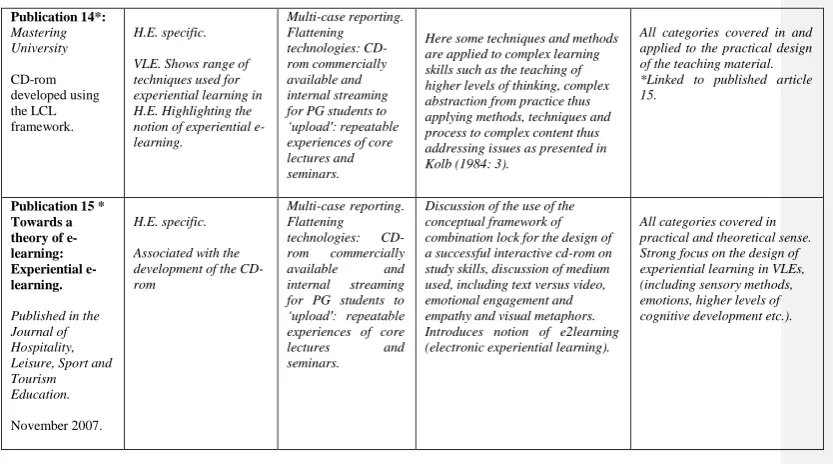
‘e2-learning’ in the Journal of Leisure, Hospitality, Sport and Tourism Education concerning the production of an educational cd-rom called Mastering University.
9
The full publications list offers some insight into the extent of fieldwork in this area.
10
See for example the 20th century philosophical work on ecosophy (or ecophilosophy) a term coined by Naess, the Norwegian philosopher, that questions the evolutionary view that ‘man’ is at the top.
11 For example the feminist literature expressing concerns about the lack of attention given to emotion
nature of experiencing as a counter to the charge of solipsism (Abram, 1997: 45). Merleau-Ponty radically developed these ideas from Husserl, conceiving of a ‘perceptual reciprocity’ that recognises, at the heart of even our most abstract cognitions, the sensuous and sentient life of the body itself’ (Abram, 1997: 45-47). Co-emergent conceptions of EL (Davis and Sumara, 1997) contend that learning does occur through both cognitive and sensory analysis, and that the mind and the environment work in conjunction to support learning. From a feminist perspective, Michelson (1998) argues for the return of the body, and a recognition that experience is located within the body and the social and material locations that the body occupies. She comments that Western knowledge practices necessitate a rejection of the experiencing body, creating a self-dismemberment. Michelson (1998: 218) notes the ambivalent relationship of EL to this rejection of the body as a site of knowledge: she refers to the dualisms of skill-knowledge, reflection-experience and theory-practice as ‘versions of the mind-body split and the privileging of mind over body’. She offers an alternative interpretation of knowledge construction, involving the ‘sensate, emotionally laden body as a site of learning rather
than as raw data or sensory apparatus’ (225).
The debate concerning the problematic oppositional relationship of affect and reason limits integrative thinking about the construction of the learning experience. Emotions are often regarded as ‘inappropriate territory’ and Tennant comments that ‘this is difficult to understand, especially given the importance that adult educators attach to the emotional climate of the classroom and the anxieties, fears and hopes of learners’ (1997: 22). Illeris (2002) contributes to this debate, positing the learner between the tension fields of cognition, emotion and society. Recent work by Mortiboys (2002) examines the case for developing emotionally intelligent lecturers. His work touches on social control and power relations, and he notes that whilst it would be disturbing if universities were emotion-free zones ‘curiously, so much of the culture in higher education implies that they are’ (2002: 7). Feminist writers such as Boler (1999) develop this issue of the splitting and privileging of the rational over the affective.
Despite the central underpinnings of emotions in outdoor education in the early 1900s, and the broader influence on emotionality in learning and teaching by educational thinkers (Bloom et al., 1964; Habermas, 1988; Knowles, 1980)12, and more recently Boud and Miller (1996), the practicalities of emotions in learning and teaching receives little or no attention in contemporary higher education texts (e.g. Light and Cox: 2001; Ramsden: 2003; Biggs: 2003). An implied recognition of the role of emotions exists within the debate concerning the shift from transmission to engagement (e.g. Light and Cox, 2001), transformational learning (Marton et al., 1993) and learning climates (Mortiboys, 2002). My fieldwork research has focussed on emotions in learning (Beard and Wilson, 2006) with one case study in higher education reported in the British Educational Research Journal. This research makes a contribution to the debate about the importance of the effective dimensions in pedagogic encounters.
6.8. Interconnectedness: bridging the dualisms.
In order to develop a broader approach to the design of EL the most basic philosophical controversies concerning how humans know the world must be confronted. The neglected areas described above appear to be deeply rooted in philosophy. As Bhaskar suggests ‘for most of its recognised history, the philosophy of the human sciences has been dominated by dichotomies and dualisms (1998: xiii). Furthermore, research in the human sciences is ‘characterised by a confused, misused and inconsistent lexicon of key terms and components of research, made worse by the lack of agreement and use across academic disciplines’ (Grix, 2004: 100). Synonymy and homonymy abound: indeed
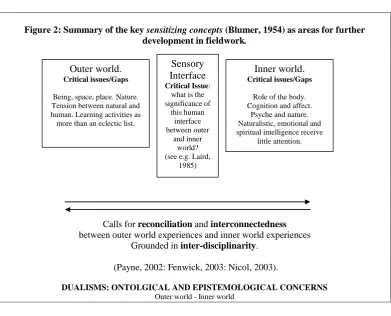
experience might be considered a synonym for learning. Experience and learning have occupied a central position in philosophical deliberations about being and knowing for centuries, and these neglected areas are rooted in a broader set of dualisms inherent in classic philosophical debates shown in Figure 2 below. Such dualisms inevitably influence the development of integrative models about learning and teaching. Concerns about oppositional thinking serve to sensitise this research to
12
the tension that exists between in vivo and sociologically constructed coding, analysis and transformation of data (Thomas, 2006). This research seeks to transcend these dualisms that can pervade ontology, epistemology, methodology, methods and everyday practice.
6.9. A summary of the critique of constructivism
[image:12.595.50.442.413.729.2]Within the limited space available here section six has identified a range of neglected areas prevalent within constructivist interpretations of learning. In summary, my line of reasoning in section four and five is that educators and trainers are important ‘actors’ in the construction of the experience: the homocentric splitting and elevation of the learner from the substantive ‘pedagogy’ of the construction of the experience is impractical. Furthermore models currently in use to support the pedagogic work of design and delivery of education and training have limited practical value: lacking in interconnectedness and interdisciplinarity. Section six critically explores the problematic nature of interconnectedness and interdisciplinarity for pedagogic modelling: such models need to link theory with everyday practice and in addition acknowledge that the learning experience ‘involves us physically, emotionally, sensually, mentally and perhaps spiritually’ (Fenwick, 2003: 13). Thus the focus of this fieldwork is centred on the pedagogic interventions possible in the mediation and construction of external and internal world experiences highlighted in this section, that is: that the place and space where learning occurs are more significant than hitherto realised and comprise more than the social and material, that the body and the senses are important sources of learning, and that, with few notable exceptions (e,g. Boud and Miller, 1996: Heron, 1982, 1992) emotions and feelings are undervalued. All these issues are pivotal to the research methodology and to the advance of the new framework.
Figure 2: Summary of the key sensitizing concepts (Blumer, 1954) as areas for further development in fieldwork.
Calls for reconciliation and interconnectedness between outer world experiences and inner world experiences
Grounded in inter-disciplinarity.
(Payne, 2002: Fenwick, 2003: Nicol, 2003).
DUALISMS: ONTOLGICAL AND EPISTEMOLOGICAL CONCERNS
Outer world - Inner world
Outer world.
Critical issues/Gaps
Being, space, place. Nature. Tension between natural and human. Learning activities as more than an eclectic list.
Inner world.
Critical issues/Gaps
Role of the body. Cognition and affect.
Psyche and nature. Naturalistic, emotional and spiritual intelligence receive
little attention.
Sensory Interface
Critical Issue: what is the significance of
this human interface between outer
and inner world? (see e.g. Laird,
Object-Subject Sense Reception-Perception
Primary-Secondary Affect/Emotion - Cognition/Reason
Natural-Human Material –Spiritual
Body –Mind Conscious-Subconscious
Sources include for example Kidner (2001), Michelson (1998) and Bhaskar (1998).
In order to show how themes and categories have been developed two vignettes will be illustratively tracked throughout the subsequent methodological section: firstly the altering of the construction of reality in learning activities as part of the outer world experience as developed by Binstead and Stuart (1979), and secondly the experience of emotions within the inner world of the learner.
7. Research methodology: the development of the theoretical framework.
A more detailed explanation of the development of my framework now follows. I describe the methodology and highlight the range of methods used to collect and analyse data samples from case material. The use of General Inductive Analysis (GIA) (Thomas, 2006) to identify and describe the themes and major categories that result in the formation of the framework is also described.
7.1. The problematic paradigm foundation: constructivism
Whilst the social construction of reality forms the core paradigm foundation for this research, as the dominant theoretical orientation (Fenwick, 2003: 21) of EL, and most ‘prevalent ontological vision within experiential learning practice, if not in the research in this field’ (Allison, 2000: 17), ontological and epistemological concerns inherent in constructivism were expressed in the previous section highlighting the problematic interpretations of the human in the world. Whilst constructivism is predicated on an anti-foundationalist, relativist ontology this research argues that there are multiple realities: complex, but not wholly ‘socially and discursively constructed’ (Grix, 2004: 61). My argument is that reality also exists externally to the individual and can be constructed by environmental context. Tranfield and Starkey (1998: 343) highlight the sociological contradiction inherent in the ‘focal assumption that society makes man’, and the ‘tacit assumption that man makes society’. This reductionism views the social world as being synonymous with the (including the natural) world, assigning passive and inert meanings to the ‘natural’ due to a fundamentally ‘limited interpretation of the natural sciences’ (Benton, 1998: 298, quoted in Archer at al.,) as ‘mainly, though not exclusively, (with)physics and chemistry’ (Benton, 1998: 310 quoted in Archer at al., 2000). The epistemological position adopted for this research is naturalistic, transactional and inter-subjectivist, with findings read as significant when accounts of reality converge within naturalistic settings (naturalistic in the fullest sense – see previous section). In adopting inductive, hermeneutic methodological procedures, with the use of language grounded in the shared experiential context, this enquiry acknowledges the ‘many and different claims made within constructionist research for what can be known about reality’ (Robson, 2002: 27). This presents a more realist focussed approach to constructionism, as located in a contemporary debate that is said to provide ‘encouragement for the view ….that a sophisticated realist approach can provide a framework not only for post-positivists but also for constructionists’ (Robson, 2002: 28).
Whilst the methodology for this research is hermeneutic-dialectic, placing the researcher at the centre of the research act, it also exhibits characteristics typical of collaborative enquiry within the
participatory paradigm recently adopted by Lincoln and Guba (2003)13. This advocates a degree of interdependence between ‘experiential knowing (face to face knowing an entity or encounter with a person, place, thing, or process), propositional knowing (claims/assertions), and practical knowing
13 The notions of blurred boundaries and paradigms in transition are used by Lincoln and Guba (2003:
(proficiency/skill)’ (Heron, 1981: 27): the integration of these dimensions of knowing receives
careful consideration throughout the research. The participatory paradigm uses trustworthiness and authenticity to partially replace the usual positivist criteria of internal and external validity, reliability and objectivity: several factors related to validity are accommodated in this research, and are described in Figure 4.
The research draws on the work of Denzin (1971) on naturalistic inquiry, acknowledging the tension between the personal non generalizing ‘everyday models’ and the abstract ‘sociological model’ (here termed a framework), the need for repeatable regularities, and the need to take seriously other stakeholders and those studied as informants and ‘natural resources’ and ‘panels of judges’. Multiple mediation and judgement has occurred throughout the research journey, from academic audiences, course participants, commissioning clients, research collaborators and other peers, reviewers of journals and books, and conference abstracts to name but a few. These are significant for a Mode Two research approach (Tranfield and Starkey, 1998) on which I elaborate below.
7.2. A Mode Two research approach
In resonance with this research Tranfield and Starkey (1998: 347) call for recognition of the distinctiveness of management research, principally because of its applied nature and its ‘broad church of ideologies and values….and a high tolerance of a wide range of ontological and epistemological views’. They suggest that improvements in the relationship between theory and practice developed by Mode Two (M2) research collapses some of the binary divisions inherent in the traditional, more academic agenda that creates a ‘distinction between what is fundamental and what is applied’ (p. 347) in Mode One (M1) research approaches. M2 encourages the translation of theories into the applied generating ‘creativity and novelty in both scope and approach’ (p. 348), and is associated with trans-disciplinary work, using more socially distributed and socially and politically accountable forms of knowledge production, with shorter time to dissemination, typified by the constant flow between theory and practice. For this research knowledge dissemination within practitioner journals had a number of benefits: to open up developing propositions to elicit feedback from practitioners within disciplines and to further develop subsequent scholarly writing (see figure 5)14.
Many case reports in Figure 5 predominantly address the general engineering and craft problem of
design rather than general scientific problems of explanation and prediction: ‘craft knowledge is acquired by practice and example and so is experiential’ (Long and Dowell, 1989, quoted in Tranfield and Starkey, 1998: 346). M2 is also adopted because this work is suited to the ‘soft’ paradigm existence, where the degree to which a body of theory is subscribed to by all members in the field dictates the degree of hardness. It is applied as opposed to pure research, as both a practice and theory of knowing how not what, building up theoretical and conceptual material ‘bottom up’
from case law, and is divergent-rural rather than convergent-urban (Tranfield and Starkey, 1998):
pedagogy is moving ‘from a field of study to a discipline’ (Canning, 2007: 394) whereas EL remains a complex field of study across and within many disciplines.
7.3. An overview of the Mode Two research journey: from fieldwork to abstraction.
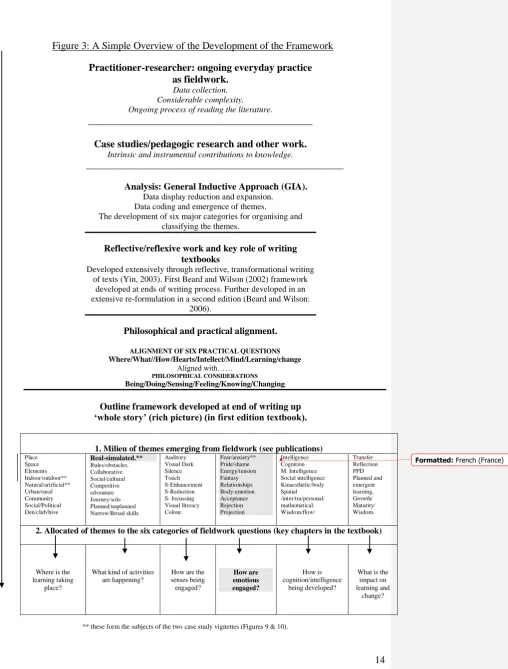
To summarise the complex journey that underpins this ongoing framework development a composite depiction is presented in Figure 3 below, showing the multiple layers from everyday fieldwork to the development of the framework as an abstraction. These layers are then explored in more detail.
Figure 3: A Simple Overview of the Development of the Framework
Practitioner-researcher: ongoing everyday practice as fieldwork.
Data collection. Considerable complexity. Ongoing process of reading the literature.
____________________________________________
Case studies/pedagogic research and other work.
Intrinsic and instrumental contributions to knowledge.
_______________________________________________________
Analysis: General Inductive Approach (GIA).
Data display reduction and expansion. Data coding and emergence of themes.
The development of six major categories for organising and classifying the themes.
Reflective/reflexive work and key role of writing textbooks
Developed extensively through reflective, transformational writing of texts (Yin, 2003). First Beard and Wilson (2002) framework
developed at ends of writing process. Further developed in an extensive re-formulation in a second edition (Beard and Wilson:
2006).
Philosophical and practical alignment.
ALIGNMENT OF SIX PRACTICAL QUESTIONS
Where/What//How/Hearts/Intellect/Mind/Learning/change
Aligned with……
PHILOSOPHICAL CONSIDERATIONS
Being/Doing/Sensing/Feeling/Knowing/Changing
Outline framework developed at end of writing up ‘whole story’ (rich picture) (in first edition textbook).
1. Milieu of themes emerging from fieldwork (see publications) Place Space Elements Indoor/outdoor** Natural/artificial** Urban/rural Community Social/Political Den/club/hive Real-simulated.** Rules/obstacles. Collaborative Social/cultural Competitive edventure Journey/solo Planned/unplanned Narrow/Broad skills Auditory Visual Dark Silence Touch S-Enhancement S-Reduction S- focussing Visual literacy Colour. Fear/anxiety** Pride/shame Energy/tension Fantasy Relationships Body-emotion Acceptance Rejection Projection Intelligence Cognition M. Intelligence Social intelligence Kinaesthetic/body Spatial /inter/tra/personal/ mathematical. Wisdom/flow/ Transfer Reflection PPD Planned and emergent learning. Growth/ Maturity/ Wisdom.
2. Allocated of themes to the six categories of fieldwork questions (key chapters in the textbook)
Where is the learning taking
place?
What kind of activities are happening?
How are the senses being engaged? How are emotions engaged? How is cognition/intelligence being developed?
What is the impact on learning and
change?
** these form the subjects of the two case study vignettes (Figures 9 & 10).
7.4. Knowledge production, validity and reliability.
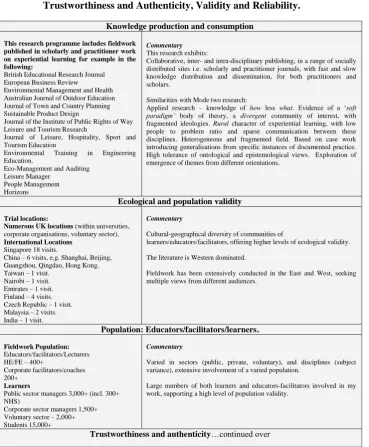
[image:16.595.73.443.265.713.2]Additional commentary concerning the adoption of a M2 is provided by Figure 4 below, which highlights aspects of population and ecological validity, trustworthiness and authenticity, showing fieldwork operations in multiple contexts and settings, with significantly high levels of repeatability. Lincoln and Guba (1985) refer to four types of trustworthiness: credibility, transferability, dependability, and confirmability, and Thomas (2006) considers the most applicable of these in data analysis include the use of peer debriefings, informant and stakeholder checks. Data checking processes also included occasional independent or confidential reports, the use of research collaborators for independent coding of data, and the use of focus group work with students so as to feedback other forms of data analysis results in an iterative way.
Figure 4: Mode Two Research: Knowledge Production and Dimensions linked to Trustworthiness and Authenticity, Validity and Reliability.
Knowledge production and consumption
This research programme includes fieldwork published in scholarly and practitioner work on experiential learning for example in the following:
British Educational Research Journal European Business Review
Environmental Management and Health Australian Journal of Outdoor Education Journal of Town and Country Planning Sustainable Product Design
Journal of the Institute of Public Rights of Way Leisure and Tourism Research
Journal of Leisure, Hospitality, Sport and Tourism Education
Environmental Training in Engineering Education.
Eco-Management and Auditing Leisure Manager
People Management Horizons
Commentary This research exhibits:
Collaborative, inter- and intra-disciplinary publishing, in a range of socially distributed sites i.e. scholarly and practitioner journals, with fast and slow knowledge distribution and dissemination, for both practitioners and scholars.
Similarities with Mode two research:
Applied research – knowledge of how less what. Evidence of a ‘soft paradigm’ body of theory, a divergent community of interest, with fragmented ideologies. Rural character of experiential learning, with low people to problem ratio and sparse communication between these disciplines. Heterogeneous and fragmented field. Based on case work introducing generalisations from specific instances of documented practice. High tolerance of ontological and epistemological views. Exploration of emergence of themes from different orientations.
Ecological and population validity
Trial locations:
Numerous UK locations (within universities, corporate organisations, voluntary sector).
International Locations
Singapore 18 visits.
China – 6 visits, e.g. Shanghai, Beijing, Guangzhou, Qingdao, Hong Kong. Taiwan – 1 visit.
Nairobi – 1 visit. Emirates – 1 visit. Finland – 4 visits. Czech Republic – 1 visit. Malaysia – 2 visits. India – 1 visit.
Commentary
Cultural-geographical diversity of communities of
learners/educators/facilitators, offering higher levels of ecological validity.
The literature is Western dominated.
Fieldwork has been extensively conducted in the East and West, seeking multiple views from different audiences.
Population: Educators/facilitators/learners.
Fieldwork Population:
Educators/facilitators/Lecturers HE/FE – 400+
Corporate facilitators/coaches 200+
Learners
Public sector managers 3,000+ (incl. 300+ NHS)
Corporate sector managers 1,500+ Voluntary sector – 2,000+ Students 15,000+
Commentary
Varied in sectors (public, private, voluntary), and disciplines (subject variance), extensive involvement of a varied population.
Large numbers of both learners and educators-facilitators involved in my work, supporting a high level of population validity.
Practitioner recognition contributes towards the constructivist paradigm criteria of trustworthiness and authenticity. This includes a National Teaching Fellowship, University Fellowships, Faculty Teaching Fellow, Chartered Fellow status of the Institute Personnel and Development, Fellowship of the Royal Society of Arts for educational and environmental work in society, government research contract awards, government advisory positions on education and training for the Countryside Agency, a Lloyds Register Quality Assurance prize for research, and an ANBAR publication award for innovation. Client awards are significant, such as Kent Council UN award for their environmental achievements. Member of the Editorial Advisory Board of The International Journal of Sustainability in Higher Education. Member of the Editorial Panel of the Journal of Adventure Education and Outdoor Learning. Reviewer for the Journal of Experiential Education. Visiting Professor (experiential learning): Capital Normal University Beijing, China.
7.5. The case studies.
The interdisciplinary nature of the publications is reflected in article and journal titles. The fieldwork, conducted within the spirit of ‘blurred genres’ (Geertz, 1983), uses multi-disciplinary case material in order to generate a broad matrix of understanding. In adopting GIA (Thomas, 2006) for analysing the qualitative data the research did not focus on a priori expectations or models, or what critics call ‘gimmicky methods and techniques’ (Kolb, 1984: 3): fieldwork sought to highlight key attributes of design and delivery, such as place, thing, event or process (Heron, 1981: Stake, 2003) within the published and unpublished data. Single and multiple cases describe intentionally designed education and training methods from a large range of programmes that actively engaged different types of learners from different cultures in different settings with consistent high appraisal15.
7.6 Case selection
Case studies are acknowledged as the underappreciated, weak sibling among social science methods, and said to have insufficient objectivity or rigour (Yin, 2003). Case material is however particularly suited to this kind of interpretive, subjective research as an ‘instance in action’ (Cohen et al., 2000: 181; Allison, 2000: 25), and the subject of rigour is addressed in section eight below.
Single case instances initially exhibit limited petite generalisations, but ultimately the accumulation of material shapes the development of instrumental data (Stake, 2003). Case studies were selected for their value in highlighting real life complex social phenomena where the boundaries with context are not clearly evident (Yin, 2003). Case material was usually selected for intrinsic value, making a contribution to knowledge from the specific case. Some early publications were accepted because of their uniqueness, or innovation. They were exploratory ‘realist matter-of-fact portraits with methods left mostly undescribed’ (Miles and Huberman, 1994: 300). They were designed to persuade (Murray, 2006), but information about for example people, places, objects, activities was, with exceptions16, absent from a few reports.
Emerging themes were developed over a long period of rigorous and systematic readings and scrutiny of a much wider mass of raw data drawn from both published and unpublished material (see Figures 7 and 8). Particularly significant was the transformational mode of reflective analysis that occurred in the writing a key text in 2002, which resulted in an alignment of significant themes by locating clusters of case material within six specific chapters that ultimately gave rise to six major category descriptors in the framework. The framework was then extensively reworked in the second edition (2006). The two texts are shown as shaded areas below.
15 See Figure 4 for a brief illustration of this type of appraisal. 16
Figure 5: Core Data: Fifteen Diverse Case Reports.
1992- 2007
First research contract was also a thesis for an M.Ed (Distinction). Start of formal interest in research:
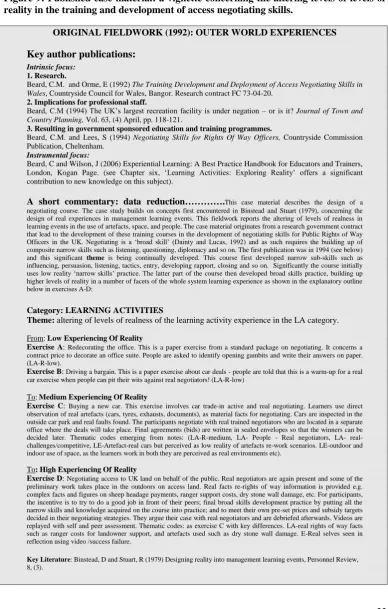
(1) Beard, C.M. and Orme, E (1992) The Training Development and Deployment of Access Negotiating Skills in Wales, Countryside Council for Wales, Bangor. Research contract FC 73-04-20.
(2) Beard et al., (1995) 'Earthwise - a computer simulation environmental toolkit for managers', Integrated Environmental Management, Issue 38, April. ISSN 0962-1113.
(3) Beard, C.M. (1996) ‘Environmental training: emerging products’, Industrial and Commercial Training, Volume 28, Number 5, November 1996, pp 18-23. ANBAR award for innovation in writing.
(4) Beard, C.M. and Hartmann, R (1997) 'Naturally Enterprising - eco-design, creative thinking and the greening of business products, European Business Review, The Greening Of Industry, Special Edition, Volume 97, Number 5, Nov. 97, MCB University Press, ISSN 0995-534X.
2000 onwards:
(5) Beard, C and McPherson, M (1999) Design of Group Based Training Methods, pp: 285-304, in Wilson, J. P., (ed) Human Resource Development, London, Kogan Page.
(6) Beard, C M and Rees, S (2000) 'Green teams and the management of environmental change in a UK County Council', Environmental Management and Health, Volume 11, Number 1, ISSN 0956 6163.
(7) Beard, C and Rhodes, T (2002) Experiential learning: Using Comic Strips as 'reflective tools' in Adult Learning, Australian Journal Of Outdoor Education, Volume 6, No 2, pp 58-65.
______________________________________________________________________________________ 2002:
Initial transformational synthesis: three years of reflective synthesis and writing.
(8) Beard, C and Wilson, J (2002) The Power of Experiential Learning: A Handbook for Educators and Trainers, London, Kogan Page. ___________________________________________________________________________________________________________
(9) Beard, C (2003) ‘The Circle and the Square – Natural and Artificial Adventure Environments’, pp: 187-198, in Humberstone, B., Brown, H., and Richards, K (eds) Whose Journeys? Where and Why? The ‘Outdoors’ and ‘Adventure’ as a Social and Cultural Phenomena: Critical Explorations of relations between individuals, ‘others’ and the environment, Fingerprints, Barrow in Furness.
(10) Beard, C and Wilson, J (2005) ‘Ingredients for Effective Experiential Learning: The Learning Combination Lock’, in Enhancing Learning in Higher Education, Hartley, P., Woods, A and Pill, M (Eds), London, Kogan Page.
(11) Beard, C (2005) Student Achievement: The Role of Emotions in Motivation to Learn – Emotional Maps, Pedagogic Research Report, Higher Education – Hospitality, Leisure, Sport and Tourism Network Research Contract, Oxford Brookes University, Oxford.
___________________________________________________________________________________________________________ 2006:
Substantive re-write of first edition. Transformational reflective synthesis: one year.
(12) Beard, C and Wilson, J (2006) Experiential Learning: A Best Practice Handbook for Educators and Trainers, London, Kogan Page. ___________________________________________________________________________________________________________
2007 publications:
(13) Beard, C., Smith, K., and Clegg, S (2007) ‘Acknowledging the Affective in Higher Education’, British Educational Research Journal, Volume 33, No.2., April.
(14) A CD-rom – Mastering University - Gower – product site:www.studentskills.org .
One of six case studies selected and published on ‘Using Video in Learning and Teaching’ in Higher Education: www.videoaktiv.org/index.php?id=198 -
(15) Beard, C (2007) Towards a Theory of E-learning: Experiential e-learning, Journal of Hospitality, Leisure, Sport and Tourism Education, Volume 6, No. 2, November 2007.
7.7. The matrix of breadth and depth: an extended research journey
Breadth and depth were critical issues in this lengthy experiential research journey: high levels of practitioner experience, and long periods of reflexive analysis have extended the incubation of innovative ideas and the shift from practitioner to practitioner-researcher involves the development of scholarly practice. Initial research interest focussed on environments for learning (category LE), and on learning activities (category LA). This led to a concentration on the primary experiences of the outer world of the learner.
Many themes, such as perceived realness of the learning experience continue to be investigated fifteen years on. Ecological and population validity, elaborated on earlier, is enhanced by the case methods being repeated continuously over a number of years, in a variety of locations and durations with different learners. The case material occurs within a range of cost allocations, as well as different levels of complexity. For example one simple published technique called ‘coffee and papers’, lasts less than two hours, and has been trialled on over 5,000 participants from senior executives to young F.E. students in many different cultural and geographical settings.This illustrates the considerable diversity of case publications, and highlights the milieu of descriptive, explanatory and or exploratory material (Yin, 2003) over the fifteen year search for the pedagogic attributes of effective EL programmes.
7.8. Case material: intrinsic contributions to knowledge.
A number of case studies provide significant intrinsic contributions to knowledge in a variety of disciplines. The environmental awareness computer based training programme called Earthwise
(Beard, Frascina et al, 1995)17, was a £120,000 project funded by the Department of Trade and Industry and ICI, and this along with the Developing People programme, were firsts of their kind in the UK in the field of management training, reported together in a journal (Beard, 1996)18 as multiple case material, and gaining an ANBAR five star award for innovative writing.
One government research contract in 1992 (Beard, and Orme, 1992)19 involves a year of research into the theory and practice of training for legal rights of way negotiating. A consultancy project with the largest UK County Council to develop Voluntary Green Teams across departments (Beard and Rees, 2000)20 lasted over six years, presenting distinctive case material that contributed new knowledge concerning the assertion that ‘successful management of environmental problems requires a participatory organisational environment and a multi-disciplinary team – a green team’ (Moxen and Strachan, 1998: 19). Smaller derivative activities continue to be developed from larger projects, such as a Higher Education Academy funded Education for Sustainable Development
(http://academic.shu.ac.uk/o/cb/colin%20New/index.htm), describing methods derived from environmental awareness work reported in the European Business Review publication ten years earlier (Beard and Hartmann, 1997)21.
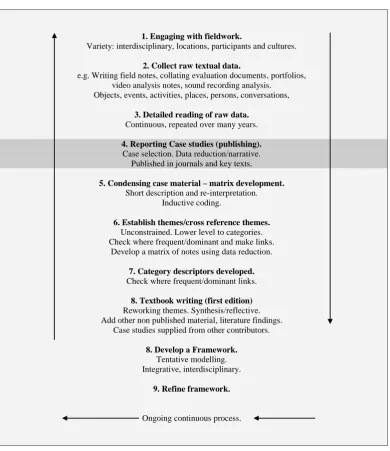
The publishing of case reports is positioned within the wider research process in Figure 6 below, and the research steps from two to eight will now be detailed.
17
Publication 2 in Figure 5.
18
Publication 3 in Figure 5.
19 Publication 1 in Figure 5. 20
Publication 6 in Figure 5.
21
Figure 6: GIA and the research process.
1. Engaging with fieldwork.
Variety: interdisciplinary, locations, participants and cultures.
2. Collect raw textual data.
e.g. Writing field notes, collating evaluation documents, portfolios, video analysis notes, sound recording analysis.
Objects, events, activities, places, persons, conversations,
3. Detailed reading of raw data.
Continuous, repeated over many years.
4. Reporting Case studies (publishing).
Case selection. Data reduction/narrative. Published in journals and key texts.
5. Condensing case material – matrix development.
Short description and re-interpretation. Inductive coding.
6. Establish themes/cross reference themes.
Unconstrained. Lower level to categories. Check where frequent/dominant and make links.
Develop a matrix of notes using data reduction.
7. Category descriptors developed.
Check where frequent/dominant links.
8. Textbook writing (first edition)
Reworking themes. Synthesis/reflective. Add other non published material, literature findings.
Case studies supplied from other contributors.
8. Develop a Framework.
Tentative modelling. Integrative, interdisciplinary.
9. Refine framework.
Ongoing continuous process.
7.9. Complex data: description, interpretation, enhancement and the emergence of themes.