The evolution and structure of internet-based consumer
research : a citation analysis
COOMBES, Philip <http://orcid.org/orcid.org/0000-0002-1174-5652> and
AL-ABDIN, Ahmed
Available from Sheffield Hallam University Research Archive (SHURA) at:
http://shura.shu.ac.uk/12588/
This document is the author deposited version. You are advised to consult the
publisher's version if you wish to cite from it.
Published version
COOMBES, Philip and AL-ABDIN, Ahmed (2016). The evolution and structure of
internet-based consumer research : a citation analysis. In: 4th International
Conference on Contemporary Marketing Issues, Heraklion, Crete, Greece, 22-24
June 2016. (Submitted)
Copyright and re-use policy
See
http://shura.shu.ac.uk/information.html
Sheffield Hallam University Research Archive
The evolution and structure of internet-based consumer research: a citation analysis
P. Coombes*
Sheffield Business School, Sheffield Hallam University, City Campus, Howard Street, Sheffield S1 1WB, UK
A. Al-Abdin
University of Liverpool Management School, University of Liverpool, Chatham Street, Liverpool L69 7ZH, UK
*
Corresponding author email: [email protected]
Abstract
The purpose of this paper is to present a systematic literature review into the evolution and structure of internet-based ethnographic consumer research during the twenty-year period between 1996 and 2015. The results of a quantitative citation analysis and a qualitative synthesis are presented which demonstrate the limited engagement that marketing researchers have had with the discipline and the limited degree to which the discipline has influenced that literature. This hitherto lack of research presents a significant lacuna and a significant opportunity for marketing scholarship to engage further with that literature. Similarly, there are particular thematic areas where knowledge is currently lacking. Taken together, the quantitative citation analysis and qualitative synthesis demonstrate that netnography is very much an emerging trend in the consumer research literature and there are many theoretical, empirical and practical bases upon which it may be applied, especially in the context of future studies.
Keywords: citation analysis, consumer research, netnography, systematic literature review
1. INTRODUCTION
The development of Web 2.0 and interactive applications offer numerous opportunities for consumer researchers undertaking qualitative research. These researchers may use virtual communities (blogging, chat rooms, microblogging and social networking websites) to conduct interviews and focus groups. Ethnographic-based research that is conducted entirely using the internet appears to have attracted increasing attention from scholars in recent years. The aim of this paper is to analyse the evolution and structure of internet-based ethnographic consumer research during a twenty-year period between 1996 and 2015. To achieve the aim of the paper, a citation analysis is undertaken. Citation analysis is used to identify the number of citations a particular article has gained over a period of years in other published research resulting in the identification of the most influential publications and scholars in the field. This paper contributes to the literature by advancing extant knowledge of internet-based consumer research and by way of qualitative synthesis, identifies prominent themes and illustrates a roadmap for future research directions. The structure of this paper is as follows: first a review of some of the leading contributions to the field of internet-based ethnographic consumer research is presented; second a description of the methodology used in this paper is presented; third the findings from the study are presented; and finally the conclusions drawn from the study are discussed.
2. LITERATURE REVIEW
method of ethnography from the observation of co-located, face-to-face interactions to the observation of computer-mediated interactions. According to Kozinets (2010: p. 1), netnography is a qualitative and interpretative research methodology that adapts the traditional in-person ethnographic research techniques of anthropology “to the unique computer-mediated contingencies of today’s social worlds.” Netnography as a method can be less expensive, faster and simpler than ethnography, and more naturalistic and unobtrusive than focus groups or interviews (Kozinets, 2010). However, in the context of internet-based ethnographic consumer research, a search of the Thomson Reuters’ Web of Science Core Collection citation index revealed only 188 articles published in 118 inter-disciplinary journals in the twenty-year period between 1996 and 2015. These 118 inter-disciplinary journals ranked according to the Chartered Association of Business Schools (2015) demonstrate that internet-based ethnographic consumer research has not hitherto been published exclusively within the marketing or management disciplines respectively. However, a contention in this paper is that there is much to be learned from a conducting a systematic review of the body of work discussing internet-based ethnographic consumer research. The next section of the paper will outline the methodology through which this analysis was achieved, before progressing to present the central findings of the analysis.
3. METHODOLOGY
The bibliometric approach of citation analysis has been deployed for this paper. During January 2016, a database search using the Thomson Reuters’ Web of Science citation index was undertaken for four multi-year periods of five years duration (1996-2000, 2001-2005, 2006-2010 and 2011-2015). The Web of Science citation index was selected for this study because it has an inherent focus on scholarly journals, specific selection standards (e.g. impact factor, timeliness and peer review) and also tends to rank the more highly ranked journals. Web of Science is one of the main academic databases for studying research contributions and indexes more than 15,000 journals and 50,000,000 articles. Therefore the database can be considered as having high quality and authenticity (Merigo et al., 2015). We focused on research publications written in English, but acknowledge that there was also internet
marketing research increasingly published in other languages. The four multi-year periods cover a wide range of years because bibliometric ‘snapshots’ for analysis are inadequate, even periods of five years are not long enough (Van Raan, 1996). The search criteria used were based on three search strings relating to each of these four multi-year periods. The first search criterion contained the words ‘market research’ and ‘ethnography of the internet’ or ‘cyberethnography’ or ‘ethnography on the internet’ or
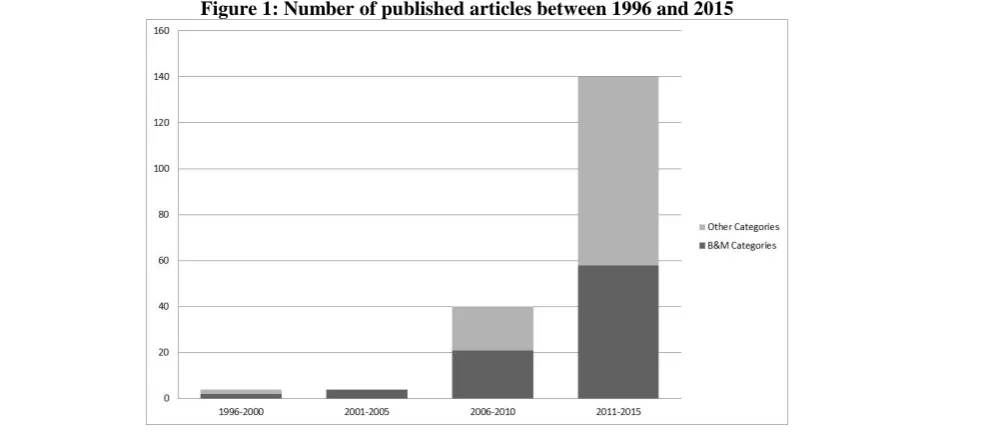
[image:3.595.39.532.484.700.2]‘netnography’ or ‘online ethnography’ or ‘virtual ethnography’ or ‘webethnography’ or ‘webnography’ in the topic of the article. The second search criterion repeated the first but replaced the initial word ‘market research’ with the word ‘marketing research’. The third search criterion repeated the second but replaced the initial word ‘marketing research’ with the word ‘consumer research’. These three searches revealed a total of 257 documents which included published articles, book reviews, editorial material and letters to editors. The three searches were then refined to include only journal articles. These searches revealed only 188 journal articles published in 118 inter-disciplinary journals between 1996 and 2015. There was no evidence of any research published prior to 1996. Following these searches, the search criterion for the data obtained was further refined to include only intra-disciplinary ‘business’ and ‘management’ journal articles in the Web of Science citation index. The outcome of this search revealed just 85 journal articles published in 39 journals between 1996 and 2015. Figure 1 presents a histogram demonstrating the category distribution of published interdisciplinary articles for each of the four multi-year periods.
Figure 1: Number of published articles between 1996 and 2015
4. FINDINGS AND DISCUSSION
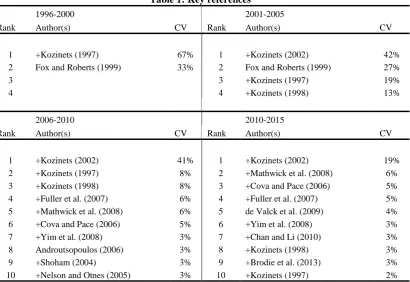
two periods between 1996 and 2000 and between 2001 and 2005 only saw 2 published articles. The period between 2006 and 2010 saw 19 published articles, but the final period between 2011 and 2015 saw the beginning of substantial growth for the discipline with 82 published articles. In relation to both categories of articles, the total number of references cited out of journal articles by other scholars amounted to 1,770. The three periods between 1996 and 2000, between 2001 and 2005, and between 2006 and 2010 only saw 414 references cited out of journal articles by other scholars, but the final period between 2011 and 2015 saw 1,356 references cited out of journal articles by other scholars, which witnessed the beginning of the growth in references cited in other publications. First, Table 1 presents a snapshot of the top ten most cited scholars’ journal articles for each of the four multi-year periods. A citation value (CV), calculated as the ratio of individual citations to the total citations has been applied to each cited article in each individual multi-year period. The first of the four multi-year periods (1996-2000) saw Kozinets (1997) and Fox and Roberts (1999) appear with a CV of 67% and 33% respectively. The second period (2001-2005) saw Kozinets and Fox and Roberts appear again but with Kozinets (1997, 1998, 2002), with a combined CV of 74%, appearing to have had a major influence on the discipline during the period with three journal articles appearing in the top ten. It was the third period (2006-2010) that revealed a significant increase in the number of journal articles being cited. This period saw Kozinets (1997, 1998, 2002), with a combined CV of 57%, feature strongly, however the same period also saw substantial growth in a number of other scholars’ journal articles being cited.
Table 1: Key references
1996-2000 2001-2005
Rank Author(s) CV Rank Author(s) CV
1 +Kozinets (1997) 67% 1 +Kozinets (2002) 42%
2 Fox and Roberts (1999) 33% 2 Fox and Roberts (1999) 27%
3 3 +Kozinets (1997) 19%
4 4 +Kozinets (1998) 13%
2006-2010 2010-2015
Rank Author(s) CV Rank Author(s) CV
1 +Kozinets (2002) 41% 1 +Kozinets (2002) 19%
2 +Kozinets (1997) 8% 2 +Mathwick et al. (2008) 6%
3 +Kozinets (1998) 8% 3 +Cova and Pace (2006) 5%
4 +Fuller et al. (2007) 6% 4 +Fuller et al. (2007) 5%
5 +Mathwick et al. (2008) 6% 5 de Valck et al. (2009) 4%
6 +Cova and Pace (2006) 5% 6 +Yim et al. (2008) 3%
7 +Yim et al. (2008) 3% 7 +Chan and Li (2010) 3%
8 Androutsopoulos (2006) 3% 8 +Kozinets (1998) 3%
9 +Shoham (2004) 3% 9 +Brodie et al. (2013) 3%
10 +Nelson and Otnes (2005) 3% 10 +Kozinets (1997) 2%
+ Marketing journal
The fourth period (2010-2015) also continued to reveal a significant increase in the number of journal articles being cited. Kozinets (1997, 1998, 2002), with a combined CV of 24%, is still revealed to have had a major influence on the discipline with three
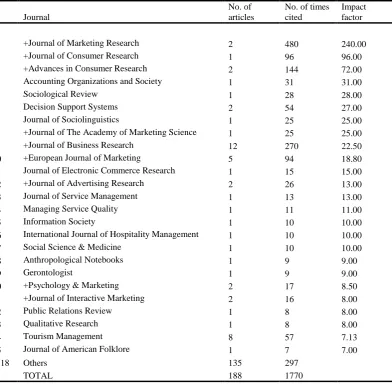
articles having been published in 118 inter-disciplinary journals between 1996 and 2015. Over 95% of this literature has been published during the two periods between 2006 and 2010 and between 2011 and 2015 thereby indicating the formative, but growing nature of the field. However, only 45% of the literature appears in the ‘business’ and ‘management’ categories in the Web of Science citation index with the remaining 55% having been published in other extra-disciplinary publications. The dominance of ‘marketing’ journals, as classed by the Chartered Association of Business Schools (2015), within the ‘business’ and ‘management’ search categories in the Web of Science citation index is evidenced in terms of the number of journal articles cited in other journals with nine marketing journals appearing within the top 25 inter-disciplinary journals in the Web of Science citation index ranked according to their impact factor. In particular, the Journal of Marketing Research demonstrated the highest impact factor resulting mainly from an article by Kozinets (2002), whose research appears to have had a significant impact on the development of the field in the literature hitherto.
Table 2: Top 25 inter-disciplinary journals’ citation impact
Rank Journal
No. of articles
No. of times cited
Impact factor
1 +Journal of Marketing Research 2 480 240.00
2 +Journal of Consumer Research 1 96 96.00
3 +Advances in Consumer Research 2 144 72.00
4 Accounting Organizations and Society 1 31 31.00
5 Sociological Review 1 28 28.00
6 Decision Support Systems 2 54 27.00
7 Journal of Sociolinguistics 1 25 25.00
8 +Journal of The Academy of Marketing Science 1 25 25.00
9 +Journal of Business Research 12 270 22.50
10 +European Journal of Marketing 5 94 18.80
11 Journal of Electronic Commerce Research 1 15 15.00
12 +Journal of Advertising Research 2 26 13.00
13 Journal of Service Management 1 13 13.00
14 Managing Service Quality 1 11 11.00
15 Information Society 1 10 10.00
16 International Journal of Hospitality Management 1 10 10.00
17 Social Science & Medicine 1 10 10.00
18 Anthropological Notebooks 1 9 9.00
19 Gerontologist 1 9 9.00
20 +Psychology & Marketing 2 17 8.50
21 +Journal of Interactive Marketing 2 16 8.00
22 Public Relations Review 1 8 8.00
23 Qualitative Research 1 8 8.00
24 Tourism Management 8 57 7.13
25 Journal of American Folklore 1 7 7.00
26-118 Others 135 297
TOTAL 188 1770
+ Marketing journal
The conclusions of this paper are twofold: first, although the quantitative citation analysis identifies the limited engagement with internet-based ethnographic consumer research both within business and management and non-business and management category publications, this limited engagement appears to present a very significant lacuna and just as significant an opportunity for marketing scholarship to engage further with internet-based ethnographic consumer research literature in the future. Second, the qualitative synthesis of articles from this review suggests that there are particular thematic areas where knowledge is currently lacking. For example, transformative consumption practices in the context of online/virtual communities are underexplored. Taken together, the citation analysis and qualitative synthesis demonstrate that netnography is very much an emerging trend in the consumer research literature and there are many theoretical, empirical and practical bases upon which it may be applied, especially in the context of future studies.
5. LIMITATIONS
‘snapshot’ of data on the database during the short period of data collection. Different keyword searches when undertaking the database searches might have also resulted in different findings. However, the researchers suggest that is reasonable to assume that the journal articles analysed in this paper represent the main research efforts in the field of internet-based ethnographic consumer research. The second constraint relates to the citation analysis of the data sets. Citation analysis is retrospective in nature so developments in the field of internet-based ethnographic consumer research (as with any discipline) appear in the citation data only after some time has passed. A journal article must be exposed to the academic community for a certain period of time before it will be cited enough times to appear in the journal databases. The researchers suggest this was a limitation in the data collection especially for the fourth multi-year period. This study also leaves the need for possible further co-citation analyses to reveal the evolution and structure of the internet-based ethnographic consumer research field (e.g. Acedo and Casillas, 2005) as this formative discipline evolves and further research becomes published in the future.
Figure 2: A roadmap of netnography themes and future research questions
Main themes
Future Research Questions and
Directions Multiple Consumption
Interests in Online Communities
Consumer Engagement and Online Communities
Use of Consumer Meanings within Online
Communities
Transformative Consumption Practices
Virtual Communities
Consumer Responses and Consumption Meanings
RQ1
RQ2
RQ3
RQ4
To examine the extent to which consumer engagement affects online
communities
To explore the interplay between online communities’ innovative potential and
their willingness to participate in making symbolic consumer meanings
To assess transformative consumption practices
RQ5
RQ6
To combine ethnographic methods in studying consumer responses and lived
meanings
How reliable are virtual communities in consumer decision making models To investigate multiple consumption interests in online communities.
REFERENCES
Acedo, F. J., and Casillas, J. C. (2005), “Current paradigms in the international management field: An author co-citation analysis”,
International Business Review, Vol. 14, Issue 5, pp. 619-639.
Androutsopoulos, J. (2015), “Networked multilingualism: Some language practices on Facebook and their implications”,
International Journal of Bilingualism, Vol. 19, No. 2, pp. 185-205.
Brodie, R. J., Ilic, A., Juric, B., and Hollebeek, L. (2013), “Consumer engagement in a virtual brand community: An exploratory analysis”, Journal of Business Research, Vol. 66, Issue 1, pp. 105-114.
Chartered Association of Business Schools (2015), “Academic Journal Quality Guide 2015”, available at http://charteredabs.org/academic-journal-guide-2015/ (accessed 10 January 2016).
Beaulieu, A. (2004), “Mediating Ethnography: Objectivity and the Making of Ethnographies of the Internet”, Social Epistemology, Vol. 18, No. 2-3, pp. 139-163.
Bryman, A., and Bell, E. (2003), Business Research Methods, Oxford, Oxford University Press.
Carter, D. M. (2005), “Living in Virtual Communities: an Ethnography of Human Relationships in Cyberspace”, Information, Communication & Society, Vol. 8, No. 2, pp. 148-167.
Cova, B., and Pace, S. (2006), “Brand community of convenience products: new forms of customer empowerment - the case ‘my Nutella The Community’“, European Journal of Marketing, Vol. 40, No. 9-10, pp. 1087-1105.
De Valck, K., Van Bruggen, G. H., and Wierenga, B. (2009), “Virtual communities: A marketing perspective”, Decision Support Systems, Vol. 47, Issue 3, pp. 185-203.
Fox, N., and Roberts, C. (1999), “GPs in Cyberspace: The Sociology of a Virtual Community”, The Sociological Review, Vol. 47, Issue 4, pp. 643-671.
Fuller, J., Jawecki, G., and Muhlbacher, H. (2007), “Innovation creation by online basketball communities”, Journal of Business Research, Vol. 60, Issue 1, pp. 60-71.
Garfield, E. (1972), “Citation analysis as Tool in Journal Evaluation”, Science, Vol. 178, No. 4060, pp. 471-479.
Hine, C. (2008), “Virtual Ethnography: Modes, Varieties, Affordances”, in Fielding, N., Lee, R. M. and Blank, G. (Eds), The Sage Handbook of Online Research Methods, London, Sage Publications, pp. 257-271.
Kozinets, R. V. (2010), Netnography: Doing Ethnographic Research Online, London, Sage Publications.
Kozinets, R. V. (2002), “The field behind the screen: using netnography for marketing research in online communities”, Journal of Marketing Research, Vol. 39, Issue 1, pp. 61-72.
Kozinets, R. V. (1999), “E-Tribalized Marketing?: The Strategic Implications of Virtual Communities of Consumption”, European Management Journal, Vol. 17, No. 3, pp. 252-264.
Kozinets, R. V. (1998), “On netnography: Initial reflections on consumer research investigations of cyberculture”, Advances in Consumer Research, Vol. 25, pp. 366-371.
Kozinets, R. V. (1997), “I Want to Believe: A Nethnography of the ‘X-Philes’ Subculture of Consumption”, Advances in Consumer Research, Vol. 24, pp. 470-475.
Lugosi, P., Janta, H., and Watson, P. (2012), “Investigative management and consumer research on the internet”, International Journal of Contemporary Hospitality Management, Vol. 24, Issue 6, pp. 838-854.
Mathwick, C., Wiertz, C., and De Ruyter, K. (2008), “Social Capital Production in a Virtual P3 Community”, Journal of Consumer Research, Vol. 34, No. 6, pp. 832-849.
Merigo, J. M., Mas-Tur, A., Roig-Tierno, N., and Ribeiro-Soriano, D. (2015), “A bibliometric overview of the Journal of Business Research between 1973 and 2014”, Journal of Business Research, Vol. 68, Issue 12, pp. 2645-2653.
Nelson, M. R., and Otnes, C. C. (2005), “Exploring cross-cultural ambivalence: a netnography of intercultural wedding message boards”, Journal of Business Research, Vol. 58, Issue 1, pp. 89-95.
Pincott, G., and Branthwaite, A. (2000), “Nothing new under the sun?”, International Journal of Market Research, Vol. 42, No. 2, pp. 137-155.
Prior, D. D., and Miller, L. M. (2012), “Webethnography: Towards a typology for quality in research design”, International Journal of Market Research, Vol. 54, No. 4, pp. 503-520.
Puri, A. (2007), “The web of insights - The art and practice of webnography”, International Journal of Market Research, Vol. 49, No. 3, pp. 387-408.
Rheingold, H. (2000), The Virtual Community: Homesteading on the Electronic Frontier, London, The MIT Press.
Shoham, A. (2004), “Flow experiences and image making: An online chat-room ethnography”, Psychology & Marketing, Vol. 21, Issue 10, pp. 855-882.