study
MAZUMDAR, Suvodeep <http://orcid.org/0000-0002-0748-7638>,
CIRAVEGNA, Fabio, IRESON, Neil, READ, Jennifer, SIMPSON, Emma and
CUDD, Peter
Available from Sheffield Hallam University Research Archive (SHURA) at:
http://shura.shu.ac.uk/16914/
This document is the author deposited version. You are advised to consult the
publisher's version if you wish to cite from it.
Published version
MAZUMDAR, Suvodeep, CIRAVEGNA, Fabio, IRESON, Neil, READ, Jennifer,
SIMPSON, Emma and CUDD, Peter (2016). Communicating with citizens on the
ground: A practical study. International Journal of Information Systems for Crisis
Response and Management (IJISCRAM), 8 (2), 50-69.
Copyright and re-use policy
See
http://shura.shu.ac.uk/information.html
Sheffield Hallam University Research Archive
Communicating with Citizens
on the Ground:
A Practical Study
Suvodeep Mazumdar, Department of Computer Science, University of Sheield, Sheield, UK Fabio Ciravegna, University of Sheield, Sheield, UK
Neil Ireson, University of Sheield, Sheield, UK
Jennifer Read, School of Health and Related Research, University of Sheield, Sheield, UK Emma Simpson, Sheield Teaching Hospital NHS Foundation Trust, Sheield, UK Peter Cudd, University of Sheield, Sheield, UK
ABSTRACT
Availability and access to information is critical for a highly effective response to an ongoing event however, information reported by citizens is based on their context, bias and subjective interpretation, and the channel of communication may be too narrow to provide clear, accurate reporting. This can often lead to inadequate response to an emergency, which can in turn result in loss of property or even lives. Excessive response to an emergency can also result in a waste of highly resources. The authors’ solution to address this problem is to make the citizen act as a camera for the control room by exploiting the user’s mobile camera. The system is designed to provide a live view of the citizen’s immediate surroundings, while control room personnel can provide instructions. In this paper, the authors introduce their approach and share initial insights from a focus group validation session and then four evaluations with users within a separate but closely related domain. They discuss their observations, evaluation results and provide a set of recommendations for the Emergency Response domain.
KeywoRdS
Camera, Citizen Camera, Control Room Technologies, Emergency Response, Live Video Communication, Occupational Therapy
INTRodUCTIoN
someone comprehends a situation is essential in crisis responder’s sensemaking processes (Bergstrand & Landgren, 2009)1,2. Citizens and observers will use subjective interpretation and generic terminology
to report events, which Emergency Responders must translate into the appropriate object assessment and specific terminology. Citizens, for example may interpret surface water as severe flooding, which can be discounted by knowledgeable responders. Also citizens may not have the expertise to provide critical information, such as their exact location or access restrictions for emergency vehicles, particularly if they are unfamiliar with the area. Furthermore, several limits are introduced in verbal communication that can contribute to an inaccurate representation in communication of a disaster (Bergstrand & Landgren, 2011). However local residents may possess useful local knowledge, e.g. concerning local geography and regular or recent events, which are not available to those unfamiliar with the locality. For example, a visitor unaware of the regular depth of a river may not realise the presence of an impending danger and hence may not report to authorities. Hence, certain situations need decision makers to observe for themselves to formulate a better understanding of an evolving situation, thereby resulting in the most appropriate response. In light of this need of situation-specific information, videos are an excellent means to provide a clearer picture of the situation, avoiding some of the biases involved in purely verbal communication (Bergstrand & Landgren, 2009).
We present a real-time live platform ‘Eyes on the Ground’, that aims at providing a flexible way for operators and decision makers to view an area and communicate with citizens. Communication is initiated either by citizens or control room operators using several approaches such as clicking on URLs sent via texts and emails or dedicated mobile applications. The mobile application can be extended to provide a geolocation-based capability that can alert the user when he/she arrives at a particular location3 (Szczytowski, 2015; Mazumdar et al., 2015). The alert can then trigger a
call to the control room, which can then initiate a live video feed. This system was developed in the WeSenseIt4 project, originally aimed at understanding how citizens and authorities can communicate
during emergencies to help improve situation awareness, deriving requirements from user studies, evaluations and discussions as we discuss in Ciravegna et al. (2016). In this paper, we first describe our approach and then initially validate it with a focus group involving Occupational Therapists in Sheffield Northern General Hospital5. Following the focus group validation and a subsequent iteration
of re-design and improvements, we conducted a user evaluation within the Occupational Therapy domain in a variety of settings. We believe our findings are highly significant and can inform a variety of aspects that solution developers need to consider while creating solutions for the Emergency Response (ER) domain. We conclude our paper with a set of high-level points that are critical to the ER domain, based on lessons learned, evaluation results and discussions with users.
ReLATed woRK
traditional authoritative information from agencies and corporations, particularly during emergencies (Goodchild & Glennon 2010; Meier 2015; Pavkovic et al., 2014). There are several international research projects6 aimed at exploring how citizens can collaborate with authorities to develop a
shared understanding of the environment and local areas. The Horizon 2020 Space Advisory Group’s advice on potential priorities for research and innovation in the Work Programme 2016-17 notes the importance of crowdsourcing and citizen science and public involvement7.
The role of citizens in providing and processing information is ever increasing and has been explored in a variety of settings – citizens can act as sensors, generating raw data; as social computers via social networks; as reporters by providing first-hand reports as events unfold; or as micro-taskers by performing tasks over data (Poblet et al., 2014; Ludwig et al., 2014). The latter can be immensely helpful in dealing with large volumes of data, which are typically difficult to process by machines e.g. classification/annotation of images. Tomnod8 provides an excellent example of such tasks by
crowdsourcing object and place annotation from satellite imagery and has engaged volunteers in several large scale emergencies9. Citizens can also contribute to emergency response by analysing
large datasets generated by citizens on the ground (Poblet et al., 2014). This approach has been used in various emergencies such as the Haiti (Caragea et al., 2011; Zook et al., 2010; Munro, 2010) and Nepal Earthquakes10. In this respect, a combination of human and machine intelligence is also a
promising area being explored (Imran et al., 2014a; Imran et al., 2014b). The use of social media in disaster response has been a field of much research (Imran et al. 2015) in the last few years, where automated and semi-automated approaches have been used to understand evolving situations on the ground and where response is needed (Huang & Xiao, 2015; Abel et al., 2012).
The potential of citizens contributing to situation awareness by generating data and providing reports is immense, and several initiatives explore how citizens can be actively involved in collaborating with authorities via mobile and desktop applications (Reuter et al, 2014) in a variety of application areas such as medical care (Besaleva & Weaver, 2013), fire (Vivacqua & Borges, 2012), flooding (Lanfranchi et al., 2014), mobility (Gunawan et al., 2012) earthquake and so on (Horita et al., 2013). Research into emerging technologies beyond social media has been limited thus far (Schwarz et al., 2016). While the use of audio, video and images have been explored in many of such initiatives, most of such cases have relied upon citizens recording their observations and uploading them via apps or forms. With the emergence of high-speed Internet and smartphones, the possibility of exploiting mobile video communication has considerably increased. In the field of emergency telehealth and telecare, the use of mobile technology for remote presence has been explored for over two decades (Shimizu, 1999; Chu & Ganz, 2004) -generally this has involved bespoke devices but more recently via mobile applications11 (Mosa et al., 2012), as an economic alternative of providing health services
via real time video conferencing (Wade et al., 2010).
citizens. This study goes beyond video surveillance and sharing to consider how citizens can interact with authorities in real-time via live video in a variety of settings to share observations and perform operations. This has the potential of providing emergency responders with a remote presence on the ground, significantly improving their understanding of complex, evolving situations, and thus the likelihood of an appropriate response.
eyes on the Ground
‘Eyes on the Ground’ is a cross-platform application that turns a citizen’s phone into a live-camera for the Emergency control room. The system facilitates connecting with citizens via mobile devices (Android and iOS) and personal computers running a web-browser. Control Room operators can see through the camera of the citizens while simultaneously communicating with them via audio and on-screen messages (e.g. to give instructions or ask questions). Control room operators can take notes, screenshots and record videos, as well as fully control the citizen camera (displaying alternatively front or back camera), hide themselves to reduce bandwidth or show themselves to clarify instructions, provide reassurance or facilitate trust with face-to-face interactions and body language (Bekkering & Shim 2006).
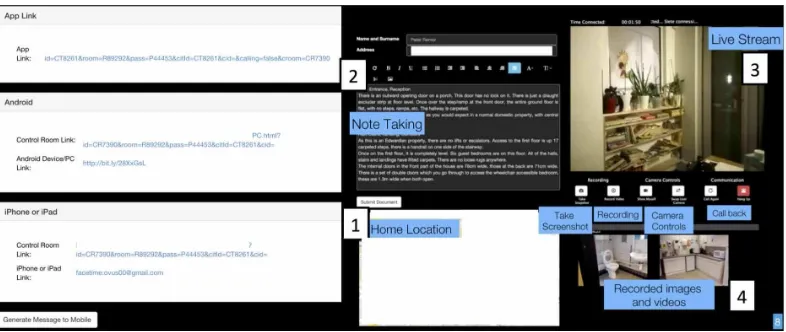
The responder, being alerted to an event by a volunteer citizen (for example being called via the emergency number 999, 112 or 911) decides to initiate video-communication to see in-person the situation. They log into the system via a Web-browser; and are provided with a scripted message to send to the citizen, including a URL that will – with the agreement of the citizen – activate the camera and provide the phone location by accessing its GPS. (Figure 1, Left bottom). Clicking the link opens the communication. The responder in the Control Room (CR) will receive a callback and a session is opened.
[image:5.504.65.458.507.673.2]The CR session is analogous to a one-directional video chat-room where a one-to-one link between the responder and the citizen is established. The use of https protocols and strict control over the participants in the call to provide confidentiality against intrusion by external parties. The CR session runs on a web browser and contains four major sections (Figure 1, Right-Top): (1) map referring to the exact location of the caller; (2) a logging/notes section to capture any relevant details; every entry is time stamped and every communication with the citizen is geolocated (3) a live feed of the user’s camera (Figure 1, Right-Bottom) with controls that allow the responder to: show/hide themselves, reload the feed or toggle between the front/back camera, take screenshots, record audio/ video and hang-up the call; and (4) the screenshots and videos stored for future reference. While not presented in the Figure 1, the CR session also provides additional features such as approximately
measuring the distance between two objects or the dimensions of objects the citizen displays via their phone (starting from objects of known length shown in the image – e.g. a car of known brand and model or a specific size of shoe)12.
All conversations and information shared between the responder and citizen is preserved within the context of the session and can only be accessed by the responder (using their own login credentials). The session can also be saved to automatically generate a report of the conversation, and any audio/ video recording can be attached to the report (see Figure 2). The audio/video communication is initiated in multiple ways: (a) control room responders can pro-actively contact citizens with a link via email or text messages; (b) a mobile application designed in the WeSenseIt project (made available to volunteers and citizens) facilitates two-way communication that can be started from the control room; (c) Web URLs can also be shared and advertised by authorities.
Clicking on the link opens the phone’s browser and loads the relevant page generated by the CR. This page connects to a server used to open a streaming feed via HTML5 WebRTC13, a recent open
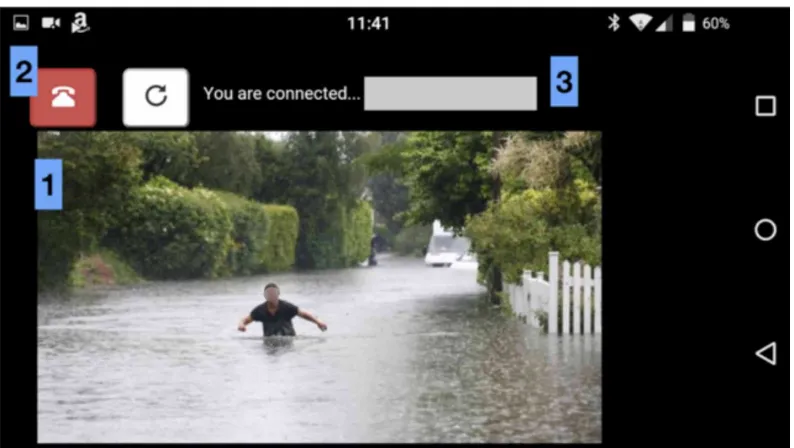
standard for video communication. The citizen can view on-screen the video being streamed to the control room (1) and can choose to toggle streaming from the front/rear camera (2, Right button). The user is also provided with the option of disconnecting the call if needed (2, Left button). The control room responder will normally communicate with the citizen via audio but should the need emerge to show themselves (e.g. to show how to perform an operation and even to soothe and calm the citizen); in this case the image in (1) is replaced with the image from the control room. We discuss some further technical details on the implementation at Ciravegna (2016).
FoCUS GRoUP VALIdATIoN
[image:6.504.46.443.444.668.2]The system has been developed in the WeSenseIt project, aimed at exploring how citizens can collaborate to establish shared situation awareness during emergencies. In this section, we discuss a focus group validation session conducted with personnel of the Sheffield Northern General Hospital.
This evaluation served as an initial validation to understand if the approach would be feasible to serve under various conditions and application scenarios including ER.
The occupational Therapy domain
Given the need of preliminary validation before performing a fully-fledged evaluation in a crisis response setting, a decision was taken to identify a proxy domain that can usefully inform the technological functioning, approaches to service implementation and subsequent evaluation protocol. The distinctive value in live video communication is in its potential for dynamic situation-led communication where the remote viewing enables the professional live objective observation. Occupational Therapy services send their staff to visit patient’s homes to ensure the patient can safely and effectively live there (see below for fuller explanation). Getting lay people to carry out the visit(s) under remote guidance of an Occupational Therapist is being explored. Similarity at least in some ways between the emergency scenario and remote home visiting were identified as: the need to have a command and control structure instructing citizens and volunteers to carry out tasks; professionals working with a pressure of needing to be efficient and effective; that the citizens/volunteers are local, potentiating local knowledge and cost reductions; unfamiliarity with at least some specific features of the visited scenario including whether it is accessible; varied needs of human beings at the location; consideration of what human beings at the remote location could do; a need for simplicity of tasks required; capacity to guide tasks and communication between the control room and the casual citizen. It is to be noted that the use of remote volunteer visitors in occupational therapy home visits was completely novel to the professionals and the visitors involved the communication was similar to that our perceived Emergency response scenario. Issues of professional to professional, professional to lay person, simplicity of operation of the system, simplicity of tasks, broad indications of levels and types of training needed etc. can reasonably be expected to be similar. Home visits is a scenario that can be related to the Emergency Response domain due to (a) the barrier(s) between trained experts and citizens; (b) distance and limited interaction; (c) challenges of network connections in remote and random locations; (d) allows testing with casual users and trained volunteers.
Though similarities exist between ER and OT, it is also important to acknowledge the way these domains are different. Emergencies are typically very stressful events and require immediate action from responders – the time line for such actions are varied, ranging from seconds to a day, depending on tasks, resources involved and scale of the emergency. Our use case (as discussed in the next section) within the OT domain does not involve such a stressful emergency response scenario (although out of scope in this paper, our focus groups identified several target use cases in the OT domain that require very quick responses from OTs). The Emergency Response domain involves a varied number of affected citizens (from one citizen to millions for the, fortunately rare, global disasters), while the OT domain mostly focuses on care for individual patients. While there are differences between the two domains, we believe the OT domain provides with an excellent test bed to help understand and validate our approach before full-fledged tests in an emergency response scenario are carried out. Our findings substantiate this and several key points were identified despite the experiments being conducted without the stressful conditions and temporal urgency exhibited for Emergency Response.
occupational Therapy Home Visits
such as bathrooms or living spaces that may cause confusion and require more complex consideration for interventions. As a result, the domain provided an excellent early stage proxy for an Emergency Response scenario.
experiment Setting
The evaluation involved twelve OTs at the Sheffield Northern General Hospital over a period of several hours in one day. Two volunteer citizens (C1, C2) were personnel of the University of Sheffield that had never seen the mobile app or the system before. Participants were initially briefed about the project in general, and the system. Control room operators were shown how the system works and how to make calls, add notes, view video-stream and give instructions to the citizen ‘on the ground’. Once briefed about the evaluation, all the OTs were grouped in one room (control room). One observer (OT1) was physically present with two ‘citizens on the ground’ (C1, C2), observing how instructions were followed in a room designed as a kitchen, bathroom and bedroom in a standard home (without intervening). C1 performed actions that were instructed, while the C2 held the mobile-camera. One participant (OT2) from the control room was then invited to use the system to contact the group (C1, C2, OT1) remotely and offer instructions to perform specific actions. Typical actions were:
Show me the kitchen sink
Leave the kitchen and move along the corridor to show me the entrance door Measure the height of the bed behind you
Measure the door width
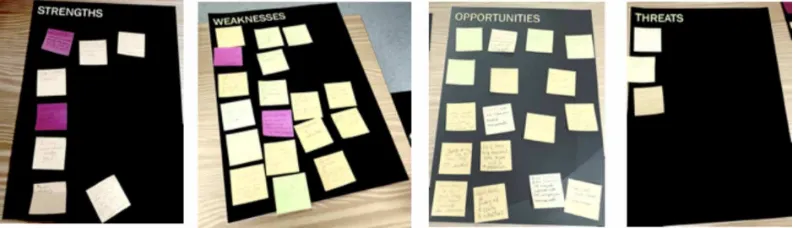
[image:8.504.45.442.551.665.2]C1 performed the actions and OT2 took notes while this was done, also recording videos and taking screenshots. The task of measurement involved C1 to first position a known length (in this case, a standard A4 sheet of paper) next to the object in question (e.g. a bed, doorway or cupboard). Once the sheet of paper was placed in position, OT1 used the measurement tool in the CR session (Figure 3) to get an approximate measurement. The result was then later compared with actual measurements. Finally, all participants in the experiment were asked to join the group in the control room and a brief discussion was conducted to understand how the system performed overall from the perspective of the CR. In addition, a SWOT analysis (Leigh & Pershing, 2006) was conducted where empty marked sheets were laid out. Participants were provided with post-it notes to stick to the relevant sheets. At this point, those present were asked to use post-its to report their views about the usefulness of the system via SWOT analysis (Figure 3). It is an analytical tool that can help critically analyse and evaluate the positive and negative aspects of situations or decisions in four factors: Strengths, Weaknesses, Opportunities and Threats. Such an approach can also be used in HCI research to understand how
interfaces and tools can be helpful to new domains (Sener & Wormald, 2007). A final discussion summarised the impressions of all attendees, from the four perspectives.
The majority of the discussions were relevant to the ER domain; however, some are omitted as out of scope: e.g. the process by which such technology could be introduced within the Healthcare Trust. Overall, the participants were satisfied with the technology and noted that such an approach can drastically reduce the need for a physical presence at remote locations as they felt that the remote visit effectively provided the information needed in most cases. The quality of the picture and audio was appreciated; participants noted that this could help save time and money instead of an expert requiring traveling and visiting locations. The citizens could follow the instructions precisely. One participant pointed out that recording the visit was helpful as it can help them re-visit areas several times if they had any doubts regarding a section of the patient home. The relation with ER is clear: the system can be used to assess the situation to decide if physical support is needed and in case what support. Another participant felt that a set of required steps (e.g. measurements) should be scripted in advance to support the CR personnel in choosing the right vocabulary and even to describe in advance to the citizen what was going to happen. This is expected to speed up the process and reduce possible misunderstandings during the process. All participants agreed that such an approach could help immensely toward providing a rough idea of a location/home before any visit is made, so any necessary preparations can be made. This was an encouraging outcome and promises significant opportunities for the domain. All users found the system easy to use and appropriate to the task.
On the other hand, while an overall high quality of communication was experienced, the system had intermittent connection issues, owing to the unavailability of the connection at specific ‘dark-spots’ in the home due to interference with equipment and shielded zones such as near lift areas. Several issues were therefore discovered during such events as a result, which had not been identified in earlier tests. The participants noted this disruption and pointed the need for the solution to be more robust and able to cope with such incidents. In terms of threats, three main points were noted that require careful attention: security, confidentiality and trust. Although technical implementation is in place for a secured, confidential and trustworthy communication, the participants need to be alerted to risks and must be informed that necessary precautions have been taken.
Two main weaknesses were noted: (a) the measurement tool was not highly accurate (results varying between 70-90% accuracy when compared with actual measurements) – this indicates that the tool could be used for cases where accuracy is not essential; (b) a clear and unambiguous vocabulary must be studied to avoid misunderstandings – e.g. “measure the door width” was understandable interpreted as measuring the width of the door, while what is required is measuring the doorway, i.e. the open access space between the door frame. Measuring objects was primarily inaccurate owing to the object being 3D, while a 2D screen and sheet was used as references. Moreover, the angle of view often distorted the dimensions of objects (e.g. a standing user measuring a box on the ground vs. on a raised table). An interesting point that is also relevant to the ER domain is that sometimes the volunteer may not be physically capable of acting on instructions, and this needs to be understood by the responder (Conclusions and Recommendations Section).
USeR eVALUATIoNS
activity at hand. Given the challenge in understanding vocabularies as identified in the focus group, the types of users who would be using the application on the ground were also varied – OTs, trained volunteers and member of the public. Both of these conditions (variability in network communication and user types) were included in the evaluation strategy since they were highly representative of ER scenarios – a high-speed Internet communication with operators and highly trained volunteers or experts cannot be guaranteed. Following the focus group session, a few minor aspects of the system were improved, which included cosmetic changes, re-wording and realignment of a few on-screen items. A significant amount of effort was also focused on improving the robustness and security of the video communication – e.g. implementation of automated redials, user and organisation account management, reducing server crashes, etc. Following this re-design, several individuals were contacted and were requested to make themselves available to evaluation sessions. The sessions were planned to ensure that trained OTs would be able to provide instructions, while (untrained) citizens or trained volunteers could perform tasks in a variety of conditions.
evaluation design and Methodology
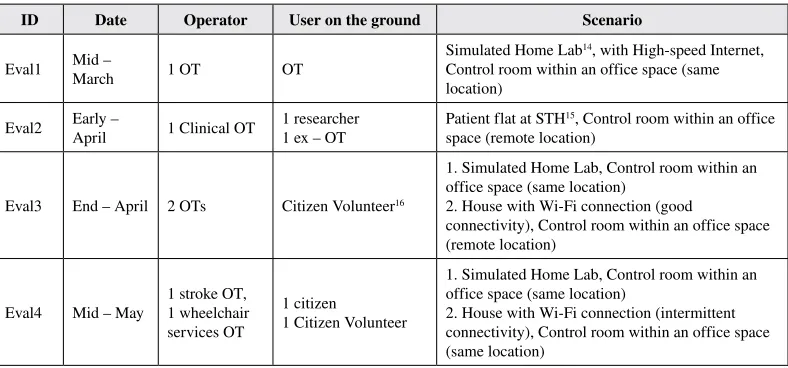
[image:10.504.47.441.466.650.2]Four evaluations were conducted, over a period of two months (March – May) in multiple sessions – Table 1 shows how they were organised. Each evaluation session lasted around two hours, with the first 15 minutes spent on explaining the process and the system. Following this, the home visit is conducted where participants are separated into operators and citizens on the ground. The citizens on the ground are then moved to the locations for home visit, while operators are moved to either on-site or remote office spaces to serve as control rooms. Once the home visit is concluded (typically 30 – 45 minutes), all participants are invited to a one-hour discussion session to share their experience in using the technology and how it can improve existing processes within the Occupational Therapy domain. The discussion was also aimed at understanding new applications and use cases for the technologies. Finally, the participants were provided with a questionnaire including subjective and objective questions aimed at understanding the usability, learnability and user experience in using different features of the system. Several questions in the questionnaire were already discussed in the discussion session, but provided a way for participants to highlight the most important points they felt about the system.
Table 1. Four evaluations conducted over a three-month period with varying network connectivity and users on the ground
ID Date Operator User on the ground Scenario
Eval1 Mid –
March 1 OT OT
Simulated Home Lab14, with High-speed Internet,
Control room within an office space (same location)
Eval2 Early –
April 1 Clinical OT
1 researcher 1 ex – OT
Patient flat at STH15, Control room within an office
space (remote location)
Eval3 End – April 2 OTs Citizen Volunteer16
1. Simulated Home Lab, Control room within an office space (same location)
2. House with Wi-Fi connection (good
User Types
Home visits, as explained earlier are complicated processes that need expert evaluation. A home visit, for instance involves recording depressed (while seated) bed heights, toilet heights, power socket locations, door widths etc. All of these questions are essential to understand what are the needs of the patient when they are released from treatment facilities. For example, door width measurement is essential to assess if specially designed beds can be easily carried and installed in the patient home. Depressed bed heights are required to understand if patients can safely and independently get up from bed while sitting down. Toilet height measurements are necessary to understand if the toilet unit would need modifications to adapt to patient conditions. As mentioned in the previous section, three types of users were involved in the evaluation of the systems. First, users who are experts in the OT domain had a significant understanding of the different aspects of Home visits and why they are necessary. Such users know how each process is important and exactly how they would contribute to the Home Visit evaluation. Second, SCCCC17 volunteers are trained citizens who visit elderly
citizens and patients who are in need of assistance. The volunteers are trained in spotting potential health and safety risks to patients, evaluating living conditions and so on. However, they are not trained in OT home visits and hence may not be familiar with all the needs of the domain. Citizens, on the other hand, are not experts in understanding health and safety risks as well as not familiar with the process of home visits. The three types of users followed instructions that were delivered to them via OTs in simulated control rooms. Overall, 9 users (as control room operators or users on the ground) participated in the evaluations. The process of evaluating the system and approach under different conditions and constraints is an expensive process, requiring several hours of volunteer and expert time. This is further complicated with the need to organise efforts of volunteers and experts together to ensure the availability of the necessary participants in the control room as well as on the ground. Hence, while not fully representative of all users and usage scenarios, the evaluation and nine participants provide a reasonably realistic scenario with a set of users that could be practically organised given the constraints of OT domain
Results
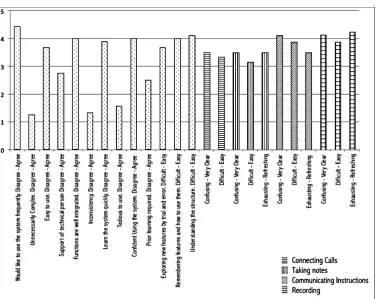
The questionnaires presented to the participants included general usability questions (5-point Likert scale objective questions for computing SUS scores (Brooke, 1996)) and subjective questions which were open-ended and aimed at assessing user impressions of the system. SUS scores are standard questions for determining a user’s perception toward usability aspects of the system. The questions incorporate a diversity of aspects such as the need for support, training and complexity. Several questions were additional to typical SUS questions (only first ten in Figure 4 are SUS questions) as it was important to judge different aspects of the system such as connecting calls, taking notes, communicating instructions and recording media. Interactive features of the system (taking notes, communicating instructions and recording) were provided with three questions to judge if the users found the interactions confusing/clear, difficult/easy or exhausting/refreshing. The objective questions assessed different parameters of the system (e.g. how easy was it to learn to use the system? how easy was the system to use?). It is to be noted that some of the questions were not applicable for some users for e.g. questions about taking notes or recording were only intended for the participants who were based on the control room. We discuss our evaluation results from the perspective of questionnaire responses, observations while conducting the evaluations and discussions with users following the evaluations.
Overall, most users agree that they would like to use the system more frequently, while most users feel that the system was fairly simple to use and would be able to learn the system quickly and easily. Most users also felt fairly confident using the system and feel the system is consistent. Although, most users indicated that it would be nice to have the support of a technical person. During the evaluations, our observations indicated that most often technical support was required when users faced network issues and where awaiting calls to be reconnected after being disconnected. It was often observed that during these times, the need for a technical person was to reassure that network disconnections were expected and was not due to a mistake by the users. At times, users prompted questions that the technical person would be required to answer e.g. Where is the data being stored and how do I access it at a later stage? We believe many of these questions are not applicable to the evaluation setting and can be answered as a part of a training protocol.
[image:12.504.56.433.85.384.2]While users noted that the process of making calls was fairly clear and easy (Clear 3.5, Easy 3.3), there is a need for improving the process. This was primarily observed to be due to the occasions when calls would be disconnected upon entering connection dark-spots within houses and home visit locations. During these occasions, the connection would be abruptly disconnected and the
identifying risks, taking notes, recording screenshots and video. While the scores are fairly positive, the operators were faced with challenges while conducting these tasks at the same time. The process of communicating instructions (Clear 4.11, Easy 3.9, Refreshing 3.5) and recording screenshots and videos (Clear 4.1, Easy 3.9, Refreshing 4.3) were scored positively overall.
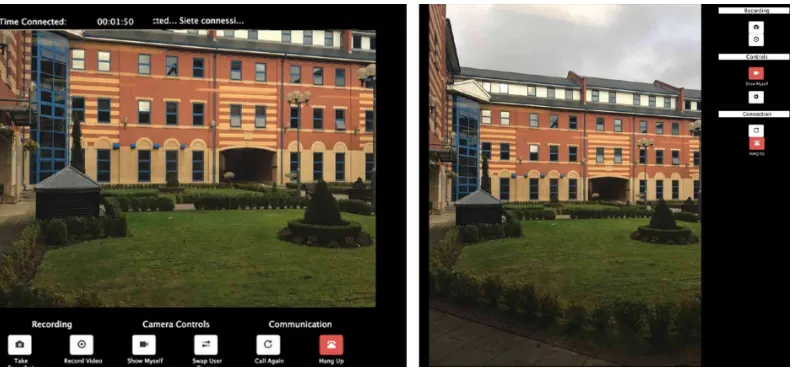
The users were noted to be comfortable in instructing the user on the ground and taking screenshots and videos at the same time. We believe this is due to the seamless integration of the recording feature in the system – during the process of relaying information to users, the recording can be achieved by a very simple click action. The control interface was earlier placed on the screen below the position of the live video feed (as shown in Figure 1). However, certain displays with lower resolution resulted in the recording interface being pushed beyond the visible region of the screen and hence, users needed to scroll down to have a visible interface for recording. Continuously scrolling to focus on the video stream and then to the control interface, finally switching back to video streams was identified as a difficult task (in the focus group) for most users. Hence it was decided to move the control interface to the right of the video stream to be accessible at all times. Figure 5 illustrates this and shows that the control interface is much more accessible following the change in interface elements.
The questionnaire also included four subjective, open-ended questions that were aimed at understanding perception of the system as a whole.
• Q1: What are the things that you like about the system? • Q2: What are the things that you didn’t like about the system?
• Q3: Are there any other comments you would like to make about your experience? • Q4: Would you consider using this system for your job? How useful would it be?
[image:13.504.64.460.476.660.2]As mentioned earlier, while the discussion session may have expected to already highlight some of the points captured in these questions, it was important to provide participants with the ability to share their impressions without being identified as well as list some of their views more concretely. Several positive aspects of the system were highly appreciated by most of the users – simplicity of use, capturing media during home visits (for future investigations or further inspection), the ability to remotely visit locations and the potential impact of being able to conduct remote visits and highlight issues and evaluate locations. A few comments summarised their positive experience as:
The ability to take snapshots and record speeds the process up as further investigation can be made into rooms without the need for the other person to stay on the call. Amount of features meant a lot had been considered
Simplicity of use, capturing images and the ease of two-way interaction Potentially saving clinical time and speeding up discharge
Users also noted the need for a formalised vocabulary (e.g. “Good instructions are fundamental to the success of the tool”) – this was however, a much less prominent issue as compared to the previous focus group. Unlike the focus group, these evaluations had a much clearer set of tasks with descriptions that required the operators to explain why the users would be required to perform a particular task. Upon receiving an explanation, it was found to be much easier for users to perform tasks, as they would have a better idea of how to carry out the instructions.
Participants highlighted several important negative aspects of the system that are also essential to be considered such as IT and communication issues and user constraints. Participants noted that during instances where there was a break in communication, they were anxious and unsure how to recover from such issues – this was particularly common with users having lower levels of expertise using IT solutions. For example, a participant mentioned “anxiety about using IT / lower confidence in using IT; worry if IT breaks down and user gets into difficulties”. The same user mentioned the possibility of using landline as a backup plan to alleviate their concerns. One participant also notes “Ability to carry out measurements and have equipment is assumed, an individual may have impaired vision meaning they cannot do measurements.” This was an extremely important point that needs to be kept in consideration while using such mechanisms for communicating with users on the ground. Discussions with participants have provided some insight into how we could help address these issues, and are discussed in the next section.
All relevant users (OTs and wheelchair services) noted that they would consider using the system in their jobs as this can provide an “extremely cost/time effective” means to conduct surveys and assess patient homes. Most users were very positive in their assessment of the system and noted that there were a lot of elements of the home visit that were already considered in the system – “I found it enjoyable. Well-designed too! Needs a few tweaks as discussed but all in all really good.” Our evaluations were conducted on a backdrop of a different setting as compared to an emergency response scenario, however, as explained earlier there are several aspects of the application that are generic and highly applicable in most scenarios where there is a need for citizen-authority communication.
CoNCLUSIoN ANd ReCoMMeNdATIoNS
While conducting our evaluations and focus group, it was well established that our findings would be highly generic and are most relevant in scenarios involving experts and lay-users. In addition to the well-understood language barrier between the two communities, there are several practical aspects that were highlighted as a part of these user studies. We discuss each of these issues in this section and provide recommendations that emerged from our discussions with participants and experts, applied in the context of Emergency Response.
comfortable with the company of another user who could assist while performing instructions. Within the OT domain developing a clear set of instructions and protocols that can be easy to understand and unambiguously interpreted was identified as an important aspect to ensure a more effective use of the system. In addition, the issues and concerns could be alleviated with pre-visit consultations, either online face-to-face video conference over Skype, Facetime or preferably, the Eyes on the Ground system; or an offline video and instructions link that highlights the necessary instructions and why they are needed. These instructions can be differ based on the variety of use cases (e.g. wheelchair services require to only understand access spaces, while OT home visits require a more thorough assessment). In the ER domain, overcoming this linguistic barrier is likely to require the expert ensuring that their instructions are given clearly and in common parlance, for example using entry/exit point in place of the more technical terms ingress/egress. However one of the fundamental reasons for adopting a camera-based system is to decrease ambiguity and inaccuracy, via the guiding and validation of citizen observations with video evidence.
Cost to Citizens
One of the most important practical considerations that were unanimously raised was to understand the cost implications to citizens. While the costs of mobile Internet are always reducing, it is still an amount significant enough to cause concerns to citizens. Home Wi-Fi installed at home visit locations could provide data services for citizens but it is to be understood that many users may not have unlimited broadband connections. The alternative option would be 3G or 4G connections that are provided by mobile service providers – this can be a considerably expensive option. Several possible solutions were identified that could help address these concerns of citizens – vouchers or refunds to users availing the remote visit service seemed to be the most common solutions. However, the possibility of availing a quick remote service in exchange of citizens bearing the cost of data seemed to be a viable prospect, as it would eventually be beneficial citizens themselves (as opposed to waiting for personnel to be available to physically conduct a home visit). This concern is also significantly relevant in the Emergency Response scenario since it can be a barrier to citizen participation.
Citizen Constraints
Another important aspect that was highlighted was the need to consider the physical and cognitive abilities and limitations of citizens participating as users on the ground. It is also important to ensure that the different tasks have varied levels of activity and dexterity needed to perform. The OTs identified pre-visit consultation as the best way to mitigate this issue, where the operator could go through a few tests and example tasks in a controlled setting to evaluate if the user can perform the tasks necessary. If, in any case the users are identified to be unable to perform the tasks, a remote walk-through of the user location could provide sufficient information to prepare for a physical visit. In the Emergency Response domain the engagement with citizens of unknown ability is a primary concern. However, in its basic form, the Eyes on the Ground system requires little from the citizen; simply showing the current situation using the camera. Beyond this it will be dependent on the expert’s interpretation of the interaction with the citizen to determine the extent of their ability to provide further information.
Task Constraints
the call – a potential way of this could be asking the caller a few short questions to ensure they are aware of any potential hazards and risks. This process is a challenging one, requiring the operator to quickly assess the potential risks that the citizen may be facing and adapt to evolving conditions. Emergency responders and operators are trained personnel with skills in quickly identifying potential risks and hazards, and hence we believe with the help of training, established standard protocols (discussed further) and familiarisation with systems will be able to identify such risks rapidly. Finally, it is important to note that only tasks that can be performed by the citizen from a safe distance and location (considering the citizen’s health and abilities) should be requested. We believe developing such standard approaches toward soliciting information from citizens would be a significant contribution that can help alleviate these concerns.
User Consent and Privacy
It was immediately identified that patient homes are personal spaces, where respecting privacy and personal information, behaviour and way of life is paramount. Hence, pre-visit consultations are essential to allay any privacy concerns, clarify exactly what information is needed and recorded, and which areas of homes are available and necessary for visits. At the same time, it is important to use these consultations to explain that any information recorded will be stored in a highly-secured database within the premises of the University, and available to be permanently deleted if any concerns are raised. During this consultation, operators can also be informed if certain areas of the home are unavailable for visits. In a typical ER scenario, this needs to be handled with care – the privacy of citizens is important to be ensured. Although informed consent is an aspect that needs to be embedded in communication protocols, we believe that this is an area where a lot of research needs to be conducted, particularly considering the implications of privacy in live video communication and recording.
Standard Practice
during emergencies - citizens could potentially learn essential/key terminologies for depicting events or situations. Teaching such principles and terminologies could be extensively done as part of the curriculum in schools, particularly with the technological (learning on mobile, computer, tablets) training young students receive. A second approach could be to investigate adaptive systems to guide control room operators through a series of very short tasks or questions to gauge the situations on the ground. This can be developed by applying rule based techniques or machine learning to adapt prompts based on historical data and models. The final approach could be to develop training modules for authorities to familiarise themselves with different types of incidents and live video communication under simulated conditions.
Our lessons learned during the simulated home visits identified a lot of interesting points, without the need for an ER scenario. This is an important aspect to note as we expect the stressful situations experienced in emergencies will introduce a level complexity in how participants respond – identifying these points without a stressful scenario can be immensely valuable while designing emergency response solutions. We plan to evaluate the tool in the near future within the context of an emergency, however, as noted earlier such conditions are expensive and require months of planning and personnel time. At the same time, the simulated conditions in the OT domain are highly relevant where citizens and volunteers communicate with experts within a variety of testing conditions such as variable network connectivity, unfamiliar locations and environments, and remote/local control room locations. In the near future, we plan to address some of the points mentioned such as setting up pre-visit procedures, creating training manuals and videos and template based interfaces. We will also be evaluating the next version of the Eyes on the Ground system in a simulated ER scenario.
ACKNowLedGMeNT
ReFeReNCeS
Abel, F., Hauff, C., Houben, G. J., Stronkman, R., & Tao, K. (2012, April). Twitcident: fighting fire with information from social web streams. Proceedings of the 21st International Conference on World Wide Web
(pp. 305-308). ACM. doi:10.1145/2187980.2188035
Allan, S. (2007). Citizen journalism and the rise of “Mass Self-Communication”: Reporting the London bombings.
Global Media Journal, 1(1), 1–20.
Bekkering, E., & Shim, J. (2006). Trust in videoconferencing. Communications of the ACM. Communications of the ACM, 49(7), 103–107. doi:10.1145/1139922.1139925
Bergstrand, F., & Landgren, J. (2009). Using live video for information sharing in emergency response work.
International Journal of Emergency Management, 6(3-4), 295–301. doi:10.1504/IJEM.2009.031567
Bergstrand, F., & Landgren, J. (2011, August). Visual reporting in time-critical work: exploring video use in emergency response. Proceedings of the 13th International Conference on Human Computer Interaction with Mobile Devices and Services (pp. 415-424). ACM. doi:10.1145/2037373.2037436
Besaleva, L. I., & Weaver, A. C. (2013, September). CrowdHelp: application for improved emergency response through crowdsourced information. Proceedings of the 2013 ACM conference on Pervasive and ubiquitous computing adjunct publication (pp. 1437-1446). ACM. doi:10.1145/2494091.2496040
Brooke, J. (1996). SUS-A quick and dirty usability scale. Usability evaluation in industry, 189(194), 4-7. Caragea, C., McNeese, N., Jaiswal, A., Traylor, G., Kim, H. W., Mitra, P., & Yen, J. et al. (2011, May). Classifying text messages for the Haiti earthquake. Proceedings of the 8th international conference on information systems for crisis response and management (ISCRAM ‘11).
Castells, M. (2007). Communication, power and counter-power in the network society. International Journal of Communication, 1(1), 29.
Chu, Y., & Ganz, A. (2004). A mobile teletrauma system using 3G networks. IEEE Transactions on Information Technology in Biomedicine, 8(4), 456–462. doi:10.1109/TITB.2004.837893 PMID:15615036
Ciravegna, F., Mazumdar, S., Ireson, N., & Cudd, P. (2016). Seeing through the Eyes of the Citizens during Emergencies. Proceedings of the 12th International Conference on Information Systems for Crisis Response and Management, Rio de Janeiro, Brazil.
Comfort, L. K., & Haase, T. W. (2006). Communication, coherence, and collective action the impact of Hurricane Katrina on communications infrastructure. Public Works Management & Policy, 10(4), 328–343. doi:10.1177/1087724X06289052
Elwood, S. (2008). Volunteered geographic information: Future research directions motivated by critical, participatory, and feminist GIS. GeoJournal, 72(3-4), 173–183. doi:10.1007/s10708-008-9186-0
Engström, A., Juhlin, O., Perry, M., & Broth, M. (2010, April). Temporal hybridity: footage with instant replay in real time. Proceedings of the SIGCHI Conference on Human Factors in Computing Systems (pp. 1495-1504). ACM. doi:10.1145/1753326.1753550
Foresti, G. L., Farinosi, M., & Vernier, M. (2015). Situational awareness in smart environments: Socio-mobile and sensor data fusion for emergency response to disasters. Journal of Ambient Intelligence and Humanized Computing, 6(2), 239–257. doi:10.1007/s12652-014-0227-x
Horita, F. E. A., Degrossi, L. C., de Assis, L. F. G., Zipf, A., & de Albuquerque, J. P. (2013). The use of volunteered geographic information (VGI) and crowdsourcing in disaster management: a systematic literature review. Huang, Q., & Xiao, Y. (2015). Geographic situational awareness: Mining tweets for disaster preparedness, emergency response, impact, and recovery. ISPRS International Journal of Geo-Information, 4(3), 1549–1568. doi:10.3390/ijgi4031549
Imran, M., Castillo, C., Diaz, F., & Vieweg, S. (2015). Processing social media messages in mass emergency: A survey. [CSUR]. ACM Computing Surveys, 47(4), 67. doi:10.1145/2771588
Imran, M., Castillo, C., Lucas, J., Meier, P., & Vieweg, S. (2014a). AIDR: Artificial intelligence for disaster response. Proceedings of the 23rd International Conference on World Wide Web (pp. 159-162). ACM. doi:10.1145/2567948.2577034
Imran, M., Castillo, C., Lucas, J., Patrick, M., & Rogstadius, J. (2014b). Coordinating human and machine intelligence to classify microblog communications in crises. Proc. of ISCRAM.
Lanfranchi, V., Ireson, N., When, U., Wrigley, S. N., & Fabio, C. (2014, May 18-21). Citizens’ observatories for situation awareness in flooding. Proceedings of the 11th International Conference on Information Systems for Crisis Response and Management (ISCRAM ‘14) (pp. 145-154).
Leigh, D., & Pershing, A. J. (2006). SWOT analysis. In The Handbook of Human Performance Technology (pp. 1089-1108).
Longueville, B. D., Luraschi, G., Smits, P., Peedell, S., & Groeve, T. D. (2010). Citizens as sensors for natural hazards: A VGI integration workflow. Geomatica, 64, 41–59.
Ludwig, T., Siebigteroth, T., & Pipek, V. (2014, November). CrowdMonitor: Monitoring physical and digital activities of citizens during emergencies. Proceedings of theInternational Conference on Social Informatics
(pp. 421-428). Springer International Publishing.
Mazumdar, S., Wrigley, S. N., Ireson, N., & Ciravegna, F. (2015). Geo-fence driven crowd-sourcing for Emergencies. Proceedings of the 12th International Conference on Information Systems for Crisis Response and Management.
Meier, P. (2015). Digital humanitarians: how big data is changing the face of humanitarian response. CRC Press. doi:10.1201/b18023
Mosa, A. S. M., Yoo, I., & Sheets, L. (2012). A systematic review of healthcare applications for smartphones.
BMC Medical Informatics and Decision Making, 12(1), 1. doi:10.1186/1472-6947-12-67 PMID:22781312 Munro, R. (2010, October). Crowdsourced translation for emergency response in Haiti: the global collaboration of local knowledge. Proceedings of theAMTA Workshop on Collaborative Crowdsourcing for Translation (pp. 1-4). Palen, L., Starbird, K., Vieweg, S., & Hughes, A. (2010). Twitter‐based information distribution during the 2009 Red River Valley flood threat. Bulletin of the American Society for Information Science and Technology, 36(5), 13–17. doi:10.1002/bult.2010.1720360505
Pavkovic, B., Berbakov, L., Vrane, S., & Milenkovic, M. (2014, September). Situation Awareness and Decision Support Tools for Response Phase of Emergency Management: A Short Survey. Proceedings of the 2014 25th International Workshop on Database and Expert Systems Applications (pp. 154-159). IEEE. doi:10.1109/ DEXA.2014.43
Perry, M., Juhlin, O., Esbjörnsson, M., & Engström, A. (2009, April). Lean collaboration through video gestures: coordinating the production of live televised sport. Proceedings of the SIGCHI Conference on Human Factors in Computing Systems (pp. 2279-2288). ACM. doi:10.1145/1518701.1519051
Poblet, M., García-Cuesta, E., & Casanovas, P. (2014). Crowdsourcing tools for disaster management: a review of platforms and methods. In AI Approaches to the Complexity of Legal Systems (pp. 261–274). Springer. doi:10.1007/978-3-662-45960-7_19
Procopio, C. H., & Procopio, S. T. (2007). Do you know what it means to miss New Orleans? Internet communication, geographic community, and social capital in crisis. Journal of Applied Communication Research,
Quarantelli, E. L. (1997). Problematical aspects of the information/communication revolution for disaster planning and research: Ten non-technical issues and questions. Disaster Prevention and Management: An International Journal, 6(2), 94–106. doi:10.1108/09653569710164053
Reuter, C., Ludwig, T., & Pipek, V. (2014). Ad hoc participation in situation assessment: Supporting mobile collaboration in emergencies. ACM Transactions on Computer-Human Interaction, 21(5), 26. doi:10.1145/2651365 Schwarz, A., Binetti, J. C., Broll, W., & Mitschele‐Thiel, A. (2016). New Technologies and Applications in International Crisis Communication and Disaster Management. The Handbook of International Crisis Communication Research (Ch. 42). doi:10.1002/9781118516812.ch42
Sener, B., & Wormald, P. (2008). User evaluation of HCI concepts for defining product form. Design Studies,
29(1), 12–29. doi:10.1016/j.destud.2007.06.003
Shimizu, K. (1999). Telemedicine by mobile communication. IEEE Engineering in Medicine and Biology Magazine, 18(4), 32–44. doi:10.1109/51.775487 PMID:10429900
Sweetser, K. D., & Metzgar, E. (2007). Communicating during crisis: Use of blogs as a relationship management tool. Public Relations Review, 33(3), 340–342. doi:10.1016/j.pubrev.2007.05.016
Szczytowski, P. (2015). Geo-fencing based Disaster Management Service. In Agent Technology for Intelligent Mobile Services and Smart Societies (pp. 11–21). Springer Berlin Heidelberg.
Vivacqua, A. S., & Borges, M. R. (2012). Taking advantage of collective knowledge in emergency response systems. Journal of Network and Computer Applications, 35(1), 189–198. doi:10.1016/j.jnca.2011.03.002 Wade, V. A., Karnon, J., Elshaug, A. G., & Hiller, J. E. (2010). A systematic review of economic analyses of telehealth services using real time video communication. BMC Health Services Research, 10(1), 1. doi:10.1186/1472-6963-10-233 PMID:20696073
Zook, M., Graham, M., Shelton, T., & Gorman, S. (2010). Volunteered geographic information and crowdsourcing disaster relief: A case study of the Haitian earthquake. World Medical & Health Policy, 2(2), 7–33. doi:10.2202/1948-4682.1069
eNdNoTeS
1 Communications Broke Down on 9/11. Retrieved from
http://www.firehouse.com/news/10519316/report-communicationsbroke-down-on-9-11
2 The 9/11 commission repor t. Retr ieved from http://news.bbc.co.uk/nol/shared/bsp/hi/
pdfs/22_07_04911Report.pdf
3 http://irevolutions.org/2011/08/21/geo-fencing-crisis-mapping/
4 The WeSenseIt (http://wesenseit.eu/) project is aimed at developing Citizens’ Observatories for Water 5 http://www.sth.nhs.uk/our-hospitals/northern-general-hospital
6 Several Citizen Observatories projects have been funded by the EU FP7 (http://www.citizen-obs.eu/) and
Horizon 2020 programmes.
7 http://ec.europa.eu/transparency/regexpert/index.cfm?do=groupDetail.groupDetailDoc&id=15249&no=1 8 https://www.tomnod.com/
9 2.3 million Internet users submitted 18 million tags for over 745,000 images in search for the missing
Malaysian Airlines (https://www.theguardian.com/world/2014/mar/14/tomnod-online-search-malaysian-airlines-flight-mh370)
10
Suvodeep Mazumdar is a researcher at the OAK Group in the University of Sheffield. His research involves employing data and visual analytic techniques to interpret large volumes of dynamic data in near real time. The techniques are used for developing solutions in the context of Organisational Knowledge Management, Emergency Response and Decision Support Systems. He has recently successfully coordinated the Crowd4Sat project, a ESA funded project aimed at understanding different facets of how crowdsourcing can impact on validation, use and enhancement of ESA observations from Satellites products and services.
Fabio Ciravegna is Professor of Language and Knowledge Technologies and Head of OAK Group in the Department of Computer Science. His research concerns large-scale data acquisition and management. Since 2005, he was Director of the European Integrated Project IST X-Media on large-scale knowledge management across media (€9.9M, 14 partners, 2006-2010), Director of the European Project WeSenseIt on Citizen Observatories of Water (€5.2, 15 partners, 2012-2016), Director of the EU project SETA on big data for mobility (€5.5M, 13 partners, 2016-2019) and principal investigator in another 8 projects (4 European, 3 EPSRC, two industrial and three TSB/ Innovate UK funded). Previously he was director of the EU project Dot.Kom on designing Information Extraction for Knowledge Management. He has published more than 130 papers. In 2009 he was General Chair of the European Semantic Web Conference. He has a patent on terminology recognition in the aerospace domain that has lead to the creation of a tool currently in use to thousands of employee at a major aerospace company. He has co-created two companies: K-now Ltd who commercialise the large-scale analysis tools for social media analysis developed by his group through several EU and UK projects - and The Floow who is a global player in the area of data acquisition and modelling for car telematics. He is in the process of creating a third one in the area of data acquisition and modelling for lifestyle tracking via mobile phones.
Neil Ireson is a senior researcher at the OAK Group in the University of Sheffield. His current research interests can broadly be defined as an exploration of Collective Intelligence, and specifically the extraction of information from social media streams.
Jennifer Read (MSc, Clin. Res., Sheffield) is a Research Associate at the School of Health and Related Research (ScHARR) and state registered Occupational Therapist (OT). Clinically, she qualified in 1997 and specialised in Stroke(acute and rehabilitation settings). As a researcher, she has worked on a number of complex evaluation projects investigating the impact of health services infrastructure (YH CLAHRC & YH HIEC), collaborative health service re-design (Doncaster Cancer Survivorship Programme) and collaborative health service technology deployment (Perfect Patient Pathway Sheffield Test Bed). In addition she has worked on collaborative ScHARR/ NHS research projects to increase research capacity within the Occupational Therapy profession.
Emma Simpson is a Specialist Orthopaedic Occupational Therapist at Sheffield Teaching Hospitals Foundation Trust. She is also part of service development within the Trust. Her previous experience as an Occupational Therapist includes Acute Medicine, Head Injury, Cardio-Thorasics and Respiratory Medicine whilst at Sheffield Teaching Hospitals.
Peter Cudd is currently a Senior Research Associate and most of his work is focused around innovation in electronic Assistive Technology (AT), mHealth and teleservices for health and social care. This is currently supported via two routes. The NIHR funded “Collaboration for Leadership in Applied Health Research and Care, South Yorkshire” (CLAHRC-SY). In CLAHRC_SY we are identifying innovative telehealth technologies that are needed, or, need to be evaluated because they do not yet have enough evidence to be used within the UK health service. In the rest of his time he leads in short term Knowledge Transfer or research and development projects. This work means he has developed experience and expertise in working with individuals or small and medium enterprises with ideas for new AT technology. Peter’s research interests include open and closed innovation as topics and across health electronic technology, electronic AT design and evaluation – including intelligent/robotic AT. His particular interests include: simplifying the users experience of sophisticated digital systems – bringing the philosophy of `Use of IT without understanding it´; so called mHealth – use of mobile technologies for any health and social care purposes; the role of patient information within tele-interventions; user centred design methodologies in the health and social care context; patient and public involvement; lay research participants views on research ethics and dementia.
15 Sheffield Teaching Hospitals Princess Royal Spinal Cord Injuries Centre provide patients with facilities
for acute, rehabilitation and continuing care http://www.sth.nhs.uk/services/a-z-of-services?id=277
16 Citizen Volunteers from http://www.scccc.co.uk/ participated in our evaluation. SCCCC is a local charity
organisation that provides care and support to elderly and disabled patients.