An Analysis on Virtual Machine Migration Issues and
Challenges in Cloud Computing
K. K. Goyal, PhD
RBS MgmtTechCampus Agra, India
Vivek Jain
PhD Scholar Bhagwant Univ., Ajmer
Ajmer (Raj), India
Pushpneel Verma,
PhDBhagwant Univ, Ajmer Ajmer ( Raj), India
ABSTRACT
Virtualization gives the new dimension to internet computing. Cloud computing extended the concept of virtualization and innovative computing opportunities are evolved. Most of the organizations shifted their work platforms towards internet based cloud computing environments. Presently cloud servers are loaded with the jobs of multiple tenants and we call such environment as Multi-tenant cloud environments. We may be not satisfied with the services of the cloud servers in terms of incurred cost, CPU utilization, its virtual environment, etc. For such reasons, VM migration takes place between Cloud Servers. Before VM migration takes place lots of optimization should be done either cost of migration, operating cost, performance on running these VMs, memory consumption, resource utilization, load aware forecasting, network traffic, etc. In this paper, we have presented an analysis on VM migration issues and challenges. This analysis will cover the latest work on VM migration, important contributions, and the future direction in this research area.
General Terms
VM, Migration, Virtualization, Cloud servers, VM clusters, resource allocation, resource pooling.
Keywords
Virtual Machine, VM Migration, Cloud Server, virtualization, serial migration, parallel migration.
1.
INTRODUCTION
Virtualization technology changes the world of internet based computing. It gives the power to execute complex applications on less capable user’s machine. Users are now more focused on the execution of application rather to purchase or arrange the resource requirements.
Virtualization means multiple virtual machines on a single physical machine. Migration refers to the process of moving a virtual machine or application between different physical machines. A Virtual Machine is a complete computer system that is simulated in software and has complete hardware system functions and runs in an isolated environment. In cloud computing Physical machines hosts several Virtual machines from different customers to enable resource sharing that allows customers to use infinite computing resources on-demand. Virtual machine migration is a decision making process of selecting a destination server to full fill the customers requirement and provide efficient services.
Virtualization means abstracting an implementation of an object through different software techniques in order to run multiple instances of that object in the same environment, preferably with minimal overhead [21].
VM migration mechanisms can be divided into two categories : (1) Offline Migration: This migration mechanism has to first
stop the currently running VMs, and then migrate the virtual machine’s memory and status, and finally restart the virtual machine at the new destination server. (2) Online Migration: Also refer as Live Migration, in the live migration mechanism the services keeps running without interruption during most of the migration process.
2.
NEED OF VIRTUAL MACHINE
MIGRATION
VM migrations are fundamental for resource management in cloud environments. There are also different goals for VM placement and migration which can be considered, such as energy saving and cost reduction; load balancing, reduction of SLA violations, network delay, congestion, service downtime etc[ 22]. VM migration can help service providers to achieve the goals of saving energy, enhancing resource efficiency and quality of service (QoS). Migration can improve the resource utilization of data centers also.
VMs are migrated to improve the reliability of the data centers, when there are failures or faults occurs in the previously hosted data center.
To optimize the resource (storage, networks, servers, applications and services) utilization VMs are migrated.
As the scale of datacenters has grown, more and more research has focused on saving energy and improving the resources utilization. In addition, cloud providers have to comply with the service level agreements (SLAs) that have been agreed upon with the customers or users. To maintain and/or improve the SLAs, researchers have proposed virtual machine (VM) migration technologies [3,4]. When there are failures or faults in the datacenter, we can migrate VMs to improve the reliability of the datacenter. A VM is a complete computer system that is simulated in software and has complete hardware system functions and runs in an isolated environment. The working of a VM is akin to the working of a real computer system, for example, we can install operating systems and applications in the VM, access network resources through the VM, and so on. Large computers or servers may run various different VMs providing different services. VM migration technologies enable the migration of VMs from one server to another, so as to guarantee quality of service (QoS) and maintain SLAs. Thus, VM migration technologies have received much attention in recent years.
overlooked. Network communication consumes a large portion of the total operational costs of data centers.
[image:2.595.51.261.208.341.2]The report suggested that data centers suffered from long-lived congestion caused by core network overcommitment and unbalanced workload placement. A good VM migration algorithm can greatly improve network performance and scalability. However, only a few studies presently focus on the network-aware VM migration (NetVMM) problem. Most of them have focused on only one factor of a network, i.e., communication costs, migration costs, or energy consumption.
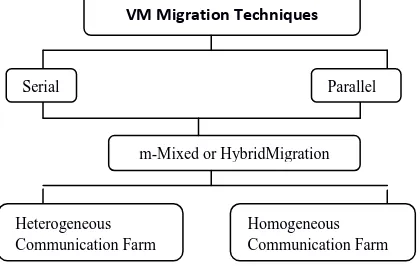
Figure 1 : VM Migration Techniques and communication environments
The VM migration techniques can be either serial, parallel, or m-Mixed or Hybrid migration. These m-Mixed migration of VMs may be in homogeneous communication farm, or heterogeneous communication farm. The possible types of m-Mixed VM migrations in homogeneous communication farms are Precopy or Postcopy. The present research issues are security during VM migration, network traffic because bandwidth is a scarce and a limited resource always on communication networks, obtaining the combined forecast Load-Aware techniques, etc.
3.
LITERATURE SURVEY
Improved serial migration technique for migrating multiple Virtual machines is introduced by Gang Suna, Dan Liao. They introduce the post-copy migration scheme with the m mixed migration strategy that is based on the improved serial migration strategy and the parallel migration strategy. The performance of the proposed migration strategy is evaluated by conducting mathematical analysis, the numerical results show that the proposed strategy outperforms the existing approach. This work focus on evaluation based on numerical-analysis that cannot capture all the factors in real world, it does not consider network transmission failure [1].
A comprehensive survey and analysis of the various state of the art the VM placement solutions have been proposed for the various cloud computing environments and data centers. According to survey most of the VM placement schemes are aimed to improve the performance and energy related issues in the cloud systems and have neglected the security related objectives in the VM placement operations [2].
A focus on VM cluster migration based on SDN(Software Define Networking) architecture to reduce static end points and allow dynamic connectivity of VMs and focus on migration of VM clusters among clouds without losing network connection [3].
To minimize network traffic costs by considering the inherent dependencies among VMs that comprise a multi-tier
application and the underlying topology of physical machines and to ensure a good trade-off between network communication and VM migration costs. It proposed a Genetic algorithm and Artificial Bee Colony algorithm for minimize network traffic in VM migration [4].
GA-ETI produces its own scheduling configuration and uses a work-flow manager system only as a middleware to execute scheduling decisions and revealed that, despite the general impression, optimal execution of workflows does not require a high number of resources (compared to the number of
parallel nodes) in most cases. They aim to
develop/incorporate cloud pricing models to consider fluctuation of the hiring cost of VMs during scheduling and to focus on performance switching in cloud environments and its impact on execution of applications [6].
An algorithm that aims to optimize the data transfer delay between VMs based on triangular inequality(the sum of two sides must be greater than or equal to the remaining side) and an optimize algorithm for VM allocation in data centers where the distance of VMs do not satisfy triangular inequality for homogeneous cloud based on mapreduce platforms. It cannot apply on heterogeneous environments [7].
The cloud resource allocation is done by converting it to the multi-capacity vactor bin packing. Two genetic algorithms COFFGA (Combinatorial Ordering First- Fit Genetic Algorithm) and CONFGA (Combinatorial Ordering Next Fit Genetic Algorithm) introduced for resource allocation. The algorithm shall deal with all Cloud resources allocation problems like load balancing, energy consumption, and Make span [8].
A novel cloud infrastructure based on lightweight high performance hypervisor named as nOSV to serve the High Performance computing applications and normal applications concurrently. In this the high performance VM manage all resources by itself without interference of nOSV [9].
Stelios Sotiriadis, Nik Bessis , Rajkumar Buyya presents an allocation strategy which determines the number, type, price schema and the optimal allocation of the VMs required by a service to minimize cost in a multi-cloud environment. It monitor the VM usage in real time and train different machine learning models to calculate the prediction of the VM resource usage per server, to place VMs accordingly [11]. A novel greedy-based MapReduce application scheduling algorithm (MASA) that considers the user’s constraints in order to minimize cost of renting Cloud resources while considering Service Level Agreements (SLA) in terms of the user given budget and deadline constraints. It do not consider that the interaction of proposed approach with Software Define Networking (SDN). The interaction can benefit of optimizing data transfer delays between distributed file system, mappers and reducers. It also not considers the geo distributed system for optimizing the mapreduce application [12].
A method, for virtualized cloud environment for optimizing the scheduling of resources through virtual machines called Moving Average-based Fuzzy Resource Scheduling (MV-FRS) proposed. MV-FRS improves the resource scheduling efficiency and reduces the total waiting time during resource scheduling in cloud environment. MV-FRS method offers better performance with an improvement of average success rate by 11% and reduction the total waiting time by 36% when compared to state-of-the-art works [13].
Authors focused on the problem of VM scheduling in OpenStack systems (is a free and open-source software palteform for cloud computing mostly deployed as IaaS) and VM Migration Techniques
Serial Parallel
m-Mixed or HybridMigration
Heterogeneous Communication Farm
present a cloud CPU resource management system for VM hosting. They include a real time hypervisor, VM scheduler (to allow VMs to share hosts without interfering performance) and VM to host mapping strategy. The experimental results show high CPU resource utilization when co-hosting Vms [14].
The performance models based on CPU frequency alone are less accurate in HC environments, particularly if the Hybrid Cloud has CPUs with comparable instruction sets but different cycle penalties for floating point operations focused on hybrid cloud with power saving with small compute farms [15]. VMs are run at the source host during the migration using pre-copy migration technique. VM applications with primarily outbound traffic struggle with outgoing migration traffic at source host. Similarly when post-copy migration of VMs run at the destination host, VM application with primarily inbound traffic struggle with incoming migration traffic at destination host. Such conditions increase the total migration time and degrade the VM performance. A combination of pre-copy and post-pre-copy techniques are used for the migration of the co-located (located on the same source host) VMs[16]. Selection of suitable destination server for the virtual machine during migration is an important concern. A suitable target server is selected based on the resource utilization and job arrival rate of the destination server. The resource aware virtual machine migration technique can reduce the migration time and downtime in cloud perspective and end to end delay in application perspective [17].
In many cases, the scheduling and placement processes are computational expensive and affect performance of deployed VMs. In order to schedule VMs the already running VMs resource usage are analysed. A new VM placement algorithm based on past VM usage experience introduced. The traditional (OpenStack) use a filtering and weighing method to select Physical machine based on specific time, without considering actual VM's resource usage of the selected PMs [18].
A queuing model is introduced to manage and schedule a large set of VMs. Once a VM is scheduled for placement the meta-heuristic crow search (CSAVMP) algorithm selects a server among the available servers for placement. The algorithm tries to optimize both resources wastage and power consumption and obtained result compared with grouping genetic algorithm (GGA) and first fit decreasing (FFD) algorithm [19].
Combined Forecast Load-Aware technique is used to predict the resource requirement of any virtual machine, live migration performed based on current and predicted resource utilization. The approach minimized the number of migration, energy usage, and the message overhead. The combined forecasting technique is used to predict the future CPU, memory and disk utilization of every server in cloud Data centers, and VMs are categorized on the basis of prediction. Migration increases network bandwidth consumption[20].
Mihai Carabaş, Pantelimon George Popescu, discussed the state of the art for the virtualization techniques and means to reducepower consumption using it. Virtualization allows us to answer all the requirements with many-coreservers and thus eliminate the one size does not fit all issue. The resulting pool of resources is beneficialfrom an economic as well as environmental point of view. It brings benefits of scale to all logisticelements of the problem: power supply, cooling, floor space. When talking about virtualization andpower consumption, one important aspect to be taken into account is data center’s heterogeneity fromthe hardware architecture
point of view (e.g., X86, PowerPC). Mapping virtualized operating systems onhardware nodes in order to minimize power consumption is still an open issue that will be addressedthroughout this paper: given a number of physical machines, we try to map on them the available virtualmachines (called virtual machine assignment) in order to have an efficient system when relating to powerconsumption.Weexpose new general bounds for the power consumption of a virtual machine assignmentbased on Jensen inequality. The lower bound has been previously obtained and used into literature, sohere we only rediscover it in a simplified and more clear manner. The upper bound is new and general.Furthermore we practically evaluate some discrete cases and we proposed some graphics with the powerconsumption and its bounds for some particular real cases [21].
Manoel C. Silva Filho, Claudio C. Monteiro, and his team presented a survey on optimizing Virtual Machine Placement and Migration inCloud Environments. Cloud computing is a model for providing computing resources as a utility which faces several challengeson management of virtualized resources. Accordingly, virtual machine placement and migration are crucialto achieve multiple and conflicting goals. Regarding the complexity of these tasks and plethora of existingproposals, this work surveys the state-of-the-art in the area. It presents a cloud computing background, areview of several proposals, a discussion of problem formulations, advantages and shortcomings of reviewedworks. Furthermore, it highlights the challenges for new solutions and provides several open issues, showingthe relevancy of the topic in an increasing and demanding market [22].
Fei Zhang, Xiaoming Fu, Ramin Yahyapour proposed LayerMover, a Fast virtual machine migration over WAN withthree-layer image structure.Live Virtual Machine (VM) migration across data centers is an important technology to facilitate cloudmanagement and deepen the cooperation between cloud providers. Without the support of a sharedstorage system between data centers, migrating the storage data (i.e. virtual disk) of a VM becomes thebottleneck of live VM migration over Wide Area Network (WAN) due to the contradiction between thelow bandwidth of the Internet and the comparatively large size of VM storage data. According to previousstudies, many inter- and intra-VM duplicated blocks exist between VM disk images. Therefore, datadeduplication is widely used for accelerating VM storage data migration. However, it must make a tradeoffbetween computation cost and transmission benefit. Existing approaches are fragile as they exploreonly the static data feature of image files without much consideration on data semantics. They mayadversely influence on migration performance when the benefit resulting from data deduplication cannotremedy its computation overhead. In this paper, we propose a new space-efficient VM image structure—three-layer structure. According to different functions and features, the data of a VM are separated into anOperating System (OS) layer, a Working Environment (WE) layer, and a User Data (UD) layer. Based on thisstructure,wedesign a novelVMmigration system—
LayerMover. It mainly focuses on improving
especially when multiple VMs which share base images are migrated [23].
Anis Yazidi, F. Ung , H. Haugerud, K. Begnum proposed an Effective live migration of virtual machines using partitioning and affinity aware-scheduling. During maintenance and disaster recovery scenarios, Virtual Machine (VM) inter-site mi- grations usually take place over limited bandwidth— typically Wide Area Network (WAN)—which is highly affected by the amount of inter-VM traffic that becomes separated during the migration process. This causes both a degradation of the Quality of Service (QoS) of inter-communicating VMs and an increase in the total migration time due to congestion of the migration link. We consider the problem of scheduling VM migration in those sce- narios. In the first stage, we resort to graph partitioning theory in order to partition the VMs into groups with high intra-group communication. In the second stage, we devise an affinity -based scheduling algorithm for controlling the order of the migration groups by considering their inter-group traffic. Comprehensive simulations and real-life experimental results show that our approach is able to decrease the volume of separated traffic by a factor larger than 30% [24].
4.
IMPORTANT FINDINGS
VM migration enables servers to bereconsolidated orreshuffled to reduce the operational costs of data centers. The network traffic costs forVM migration currently attract limited attention.However, traffic and bandwidth demands among VMs in a data center account for considerabletotal traffic. VM migration also causes additional data transferoverhead, which would also increase thenetwork cost of the data center.
The mechanism that the swarm intelligence algorithm aims to find is an approximate optimal solutionthrough repeated iterations to make it a good solution for the VM migration problem.Whereas,genetic algorithm (GA) and artificial bee colony (ABC) are adopted and changed to suit the VM migrationproblem to minimize the network cost. Results show that GA has low network costs whenVM instances are small. However, when the problem size increases, ABC is advantageous to GA. Therunning time of ABC is also nearly half than that of GA.
Live Virtual Machine (VM) migration across data centers is an important technology to facilitate cloudmanagement and deepen the cooperation between cloud providers.According to previousstudies, many inter- and intra-VM duplicated blocks exist between VM disk images. Therefore, datadeduplication is widely used for accelerating VM storage data migration. Existing approaches are fragile as they exploreonly the static data feature of image files without much consideration on data semantics. They mayadversely influence on migration performance when the benefit resulting from data deduplication cannotremedy its computation overhead.
A novelVMmigration system, LayerMover proposed by Fei Zhang, Xiaoming Fu, and Ramin Yahyapour. It mainly focuses on improving migrationperformance through optimizing the data deduplication technique. The tests for LayerMover indicate that it can be significantly beneficial to VMmigration across data centers, especially when multiple VMs which share base images are migrated.
Datacenter virtualization technologies have attracted a lot of attention to enable various cloud computingservices and to facilitate virtual machine (VM) migration. VM migration can help service providers toachieve the goals of saving energy,
enhancing resource efficiency and quality of service (QoS). In order toensure the QoS, the migration time and the downtime of VM should be considered while implementingthe VM migration. Most researches focus on the issue of single VM migration by using the post-copymigration strategy or pre-copy migration strategy.Gang Suna, Dan Liao presented the improved serialmigration strategy and the m mixed migration strategy to enablethe live migration of multiple VMs.The m-mixed migrationstrategy divides the performance of the improved serial migrationstrategy and the parallel migration strategy into different grades.Thus, when the maximum downtime is given, service providerscan find a strategy with shorter migration times.
The concept of the Virtual Machine(VM) cluster migration is introduced by Stelios Sotiriadis and his team. Since cloud services areinstantiated as VMs, an application can be seen as a cluster of VMs that integrate its functionality. They have focused on the VM cluster migration by exploring a more
sophisticated method with regards to VM
networkconfigurations.This work focused on designing cloud applications using anSDN architecture to eliminate static endpoints and to allowdynamic connectivity among VMs. A cloud application cancommunicate with third party services in order to integrate itswhole functionality. Thus, in case of moving the application to adifferent platform (e.g. due to new requirements or better SLAs)the migration process becomes a hurdle. Another similar case is themigration of multi cluster deployment of a system (e.g. distributeddatabases) in a cloud provider. The migration of such systemsrequires re-configuration of the network settings (e.g. interfaces,MAC addresses etc.) of the VMs, an action that decomposes theVM cluster.
Stelios Sotiriadis, Nik Bessis, Rajkumar Buyya introduced the Self managed virtual machine scheduling in Cloud systems. They presented a Cloud VM scheduling algorithm that takes into account already running VM resource usage over time by analyzing past VM utilization levels in order to schedule VMs by optimizing performance. We observe that Cloud management processes, like VM placement, affect already deployed systems (for example this could involve throughput drop in a database cluster), so we aim to minimize such performance degradation.
5.
CONCLUSION
Virtual machine migration refers to moving Virtual machines from one data center to another data center for performance enhancement and efficient use of resources. There are lots of migration technologies or algorithms are introduced. The migration can be of live or non-live. While migrating VMs, the key factors like CPU utilization, memory consumption, resource utilization, load aware forecasting, network traffic, migration costs, and kind of adaptiveness are main concerns. Many algorithms focused on VM migration cost aspects.
The algorithm by Gang Suna, Dan Liao introduced an improved serial and parallel migration technology as m-mixed migration strategy. Serial and Parallel migration technology used pre-copy and post-copy migration methods that the struggle with incoming and outgoing traffic. While transferring memory pages from source to destination host and it also not consider network transmission failure.
there can be lacuna in security while transferring data from one Physical machine to another.
The algorithms based on CPU utilization alone are less efficient for High Computing applications. While selecting a suitable target server for virtual machine during migration is an important concern. Selection is based on resource required by the VM, CPU capacity to manage the application, arrival time of the destination server etc. The resource aware algorithm can reduce migration time but the execution of the application based on the destination CPU capacity. Getzi Jeba Leelipushpam Paulraj, SharmilaAnandJohn Francis, J. Dinesh Peter, Immanuel Johnraja Jebadurai, introduced the combined forecast load aware algorithm performs live migration based on current and predicted resource utilization. It used to predict the future CPU, memory and disk utilization of every server and these servers are categorized based on prediction. The open stack based algorithm uses Past VM usage experiences before migrating the VM to destination server. But it do not concern about the destination server computing capacity.
Hence, Live Virutual Machine (VM) migration with minimal cost on hetrogeneous data centres may be the future research objective for the researchers. There is lot of scope of innovative development of algorithms to reduce the incurred cost and estimated time of migrating a set of VMs.
6.
ACKNOWLEDGMENTS
The authors are thankful to all the contributors directly or indirectly for the preparation of this research paper.
7.
REFERENCES
[1] Gang Sun, Dan Liao, Vishal Anand, Dongcheng Zhao, Hongfang Yu, “A new technique for efficient live migration of multiple virtual machines”, Future Generation Computer Systems 55 (2016), pp. 74–86
[2] Mohammad Masdari, Sayyid Shahab Nabavi, Vafa Ahmadi, “An overview of virtual machine placement schemes in cloud computing”, Journal of Network and Computer Applications, vol. 66 (2016), pp. 106–127
[3] Stelios Sotiriadis, Nik Bessis, Euripides G.M. Petrakis, Cristiana Amza, Catalin Negru, Mariana Mocanu, “Virtual machine cluster mobility in inter-cloud platforms”, Future Generation Computer Systems, vol. 74 (2017), pp. 179–189
[4] Weizhe Zhang, Shuo Han, Hui He, Huixiang Chen, “Network-aware virtual machine migration in an overcommitted cloud”, vol 76, 2017, Future Generation Computer Systems, pp 428-442
[5] A.J. Rubio-Montero, E. Huedob, R. Mayo-García, “Scheduling multiple virtual environments in cloud federations for distributed calculations”, Future Generation Computer Systems, vol. 74 (2017), pp. 90– 103
[6] Israel Casas, Javid Taheric, Rajiv Ranjanb,e, Lizhe Wangd, Albert Y. Zomayaa, “GA-ETI: An enhanced genetic algorithm for the scheduling of scientific workflows in cloud environments”, Journal of Computational Science (2016), pp. 1-14
[7] TP Shabeera, SD Madhu Kumar , Priya Chandran, “Curtailing job completion time in MapReduce clouds through improved Virtual Machine allocation”, Computers and Electrical Engineering, vol. 58 (2017), pp. 190–202
[8] Huda Hallawi, Jörn Mehnen, Hongmei He, “Multi-Capacity Combinatorial Ordering GA in Application to Cloud resources allocation and efficient virtual machines consolidation”, Future Generation Computer Systems, vol. 69 (2017), pp. 1–10
[9] Jianbao Ren, Yong Qi, Yuehua Dai, Yu Xuan, Yi Shi, “ Nosv: A lightweight nested-virtualization VMM for hosting high performance computing on cloud”, The Journal of Systems and Software, vol. 124 (2017), pp. 137–152
[10] José Luis Díaz, Joaquín Entrialgo, Manuel García, Javier García, Daniel Fernando García, “Optimal allocation of virtual machines in multi-cloud environments with reserved and on-demand pricing”, Future Generation Computer Systems 71 (2017) 129–144
[11] Stelios Sotiriadis, Nik Bessis , Rajkumar Buyya, “Self managed virtual machine scheduling in Cloud systems, “Information Sciences (2017) , pp. 1–20
[12] Xuezhi Zenga, Saurabh Kumar Gargb, Zhenyu Wenc, Peter Strazdinsa,Albert Y. Zomayad, Rajiv Ranjane- Cost efficient scheduling of MapReduce applications on public clouds' 07,2017
[13] Priya Va, C. Nelson Kennedy Babub, “Moving average fuzzy resource scheduling for virtualized cloud data services”, Computer Standards & Interfaces, vol. 50 (2017), pp. 251–257
[14] Sisu Xi, Chong Li, Chenyang Lu, Christopher D. Gill, Meng Xu, Linh T.X. Phan, Insup Lee, Oleg Sokolsky- RT-OpenStack: CPU Resource Management for Real-Time Cloud Computing' 2015
[15] Muhammad Atif , Peter Strazdins, “Adaptive parallel application resource remapping through the live migration of virtual machines'”, Future Generation Computer Systems 37 (2014), pp. 148–161
[16] Umesh Deshpandea, Kate Keaheyb, “Traffic-sensitive Live Migration of Virtual Machines”, Future Generation Computer Systems 72 (2017), pp. 118–128
[17] Getzi Jeba Leelipushpam Paulraj, Sharmila Anand John Francis, J. Dinesh Peter, Immanuel Johnraja Jebadurai, “Resource-aware virtual machine migration in IoT cloud”, Future Generation Computer Systems 85 (2018), pp. 173–183
[18] Stelios Sotiriadis , Nik Bessis, Rajkumar Buyya, “Self managed virtual machine scheduling in Cloud systems”, 'Information Sciences 433–434 (2018), pp. 381–400
[19] Anurag Satpathy, Sourav Kanti Addya, Ashok Kumar Turuk, Banshidhar Majhi b , Gadadhar Sahoo, “Crow search based virtual machine placement strategy in cloud data centers with live migration”, Computers and Electrical Engineering 69 (2018), pp. 334–350
[20] Getzi Jeba Leelipushpam Paulraj, SharmilaAnandJohn Francis, J. Dinesh Peter, Immanuel Johnraja Jebadurai, “A combined forecast-based virtual machine migration in cloud data centers”, Computers and Electrical Engineering 69 (2018), pp. 287–300
[22]Manoel C. Silva Filho, Claudio C. Monteiro, Pedro R.M. Inácio, Mário M. Freire, Approaches for optimizing virtual machine placement and migration in cloud environments: A survey”, Journal of Parallel Distrib. Comput. Vol. 111 (2018), pp. 222–250
[23]Fei Zhang, Xiaoming Fu, R. Yahyapour, “LayerMover : Fast virtual machine migration over WAN with three-layer image structure”, Future Generation Computer Systems 83 (2018), pp. 37–49