A Systematic RDF-based Approach for Structuring
Government Open Data to Enhance Accessibility
Wilson Ambale Amutsama
School of computing and Informatics,
University of Nairobi, Kenya
Isaiah Mulang Onando
School of Computing and Information Technology Jomo Kenyatta University of Agriculture and Technology, Kenya
Andrew Mwaura Kahonge
School of computing and Informatics,
University of Nairobi, Kenya
ABSTRACT
Open government data publishing is considered complete when the data is machine-readable, which is achieved through the Linked Open Data Standards. Although most governments around the world are launching e-government systems for better service delivery, most developing countries are yet to implement the use of the semantic web in their knowledge sharing approaches and Kenyan isn’t an exception. This research presents an approach that employs Resource Description Framework to generate structured data from open government data. This paper details the systematic steps followed from data selection to the development of an ontology and user interfacing modes of access using a case study of the Kenyan government open data portal. The approach makes use of ontology to structure some domain of the government data in the open data portal for easy, access and retrieval. Software evaluation metrics (precision, recall, and f-measure) for retrieval systems was employed as the evaluation approach. A set of sample queries are designed together with their expected outputs, then the queries are run and the outcomes are compared. Results of the evaluation indicate that the approach achieves viable outcomes. The systematic approach thus described fosters a bidirectional flow of knowledge by using state of the art Semantic Web technologies and allows for a wider scope of knowledge contributors.
Keywords
Linked Data, Open Data, Linked Open Government Data, E-government, Semantic Web, Web 3.0.
1.
INTRODUCTION
We are on the verge of an era in which everyone is moving data online and government entities aren’t an exception to this. The government public administration and operation area is a large, heterogeneous and distributed environment where information, services and processes have previously been stored and produced in each specific department with no central control, no common models, holds minimal or no knowledge representation lacks the concept of domain knowledge sharing and thus has no service definitions. This lack has made it hard for exchange and cooperation of information between the different departments .Much of this push came in the wake of open data movement that sprung around the world with the earliest initiative launched in the US by President Obama in 2009 [12] as key in advocating for linked data to prove the value of structured data on the web in standards such as RDF, OWL and SKOS. The experience from the UK and US government was that the structured data community was not quite ready for a major government to
start creating a web of linked and structured government data [16]. According to [3] and with an example given of Digital Morocco, 2013, building an efficient e-Government for
purposes for presenting information and electronic services (e-services) through web as portals to citizen and enterprises is the key to filling that gap within governments around the globe and Kenya is not an exception to this. Semantic Web technologies have surfaced showing a potential solution to these issues [2], [4], [20]. These tools as much as enhancing data and services description with additional semantic information do facilitate the building of common models which describe the information available and disintegrate it into domain knowledge with a purpose of achieving a given user task. Certainly, the information therein will be for both human consumption and interpretable to the machines. Developing the models requires deep knowledge of the domain; vision of the domain and experts. Moreover, suitable tools, standards, methodologies of semantic techniques are necessary [9]. It’s within this paper that such a model has been suggested to structure into semantically acceptable format the data available in the Kenyan open data portal. The aims of this study are; (1) show the importance of centralizing government data from several domain into one portal as e-government projects which can easily be accessible to the citizens for retrieval of knowledge and (2), strengthening the embracing of semantic technologies in e-government. The study would also be of interest to beginner Semantic Web developers who might use it as a beginning point for advanced investigations. The goal was to come up with a prototype of a solution for bringing together all government projects into one system that can enable easy access and retrieval of knowledge form them by its citizens. The solution is an innovation using existing technologies and it is in two modules, namely; the knowledge based system (Ontology) and the access interface for the end user.
1.1. Data
There is already existent open data available to the public in the Kenya Open Data portal. This data, however, exists only in semi-structured or unstructured form making access and utilization by programmers and analysts much complicated. For our work, we sample a section of this data and use the same to demonstrate our approach. Our sampling technique is based on three aspects:
(i) To develop ontology, we first need data that can be described in form of concepts and their relationships as opposed to data which may not be represent able as a graph based Knowledge Base.
(ii) We filter out data which is only present as images and thus may not be easily interpreted into text or may require long span of time and computational resources.
The Kenyan open data portal contains various datasets of agriculture, education, environment, energy, finance, infrastructure, governance, government accounts, health, population, and census etc. The major format of the data is in spreadsheet format (Microsoft Excel) which is a semi-structured form of data that provides full comprehension to humans but does not lend itself to machine interpretation as opposed to the general principle that open government data should be in a form that is understandable both by humans and machines. Otherwise, to convert the data as is into some useful knowledge, a collection of several chunks of data is required then merged and thus will be hectic to the users.
According to our review of the data this topic had the most sizable number of documents. In addition, these documents
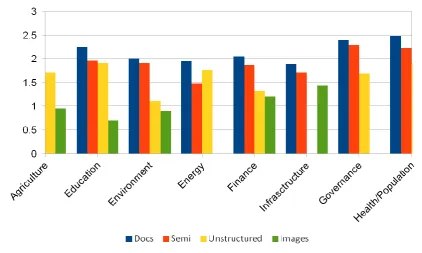
[image:2.595.75.498.235.488.2]were either in semi-structured form or textual, meaning that this could easily be employed in our work to identify required Knowledge Base entities. The approach is employed to build Ontology with specific features of interest from the governance dataset. Some of these features identified from the government development projects include information about project financiers, stakeholders, counties, supervisor, title, start and end date and addresses. This formed classes of ontology. These projects are coverage of several government departments with information about the location they are taking place at, its financiers, and beneficiaries (stakeholder) etc. Fig 1 shows the review of the data from the Kenya government portal and their qualities based on each topic:
Fig 1. Graphical representation of data and its properties from Kenya government open portal
1.2
.Research Design
The study was divided into three parts; the first part is literature review whereby an assessment of existing materials in the field under research was done. Its purpose was to form the background of the research, to gain insights into semantic web and its techniques and to identify the success attributes of using semantic web by highlighting the existing case studies all over the world.
Secondly, an exploratory research design as defined by Burns and Groove (2001:374) will be conducted to gain new insights, and discover new ideas from literature and existing similar projects. This enhanced in understanding of tasks required and fosters appropriate selection of task implementation and evaluation tools. Our findings in the exploratory stage thus included, a listing of tried and tested approaches, tools and frameworks, reusable vocabulary definitions, terms and complete.
Subsequently, we adopted a descriptive research approach that would entail identification of representational attributes from our data. The attributes such as entities and their relationships that can be mapped into RDF triple representation are
identified and described, other valuable annotations on these elements including labels and comments for metadata are also included in the description. The result of this description was a complete ontology to be used as a prototype for the research. Lastly, an experimental evaluation of the functionality of the developed application was conducted.
2
.PREVIOUS EFFORTS IN
Since exchange of tacit knowledge involves direct interaction (socializing) between individuals, the only way to share it in virtual environments is through the interactive tools provided by web 2.0 [7], [11].Web 2.0 supports tools like
announcement, chat room, calendar, group mail, resource and wiki which have been used to create online project site for group work activities[11].Even though web 2.0 techniques have been found to be useful in supporting collaboration in an interactive environment, web 3.0 techniques (Semantic Web) have been found useful in structuring of content for easy machine interpretation and thus seem best suited technique for knowledge sharing and retrieval.
Even though web 2.0 techniques have been found to be useful in supporting collaboration in an interactive environment, web 3.0 techniques (Semantic Web) have been found useful in
structuring of content for easy machine interpretation and thus seem best suited technique for knowledge sharing and retrieval.
3
.THE MODEL
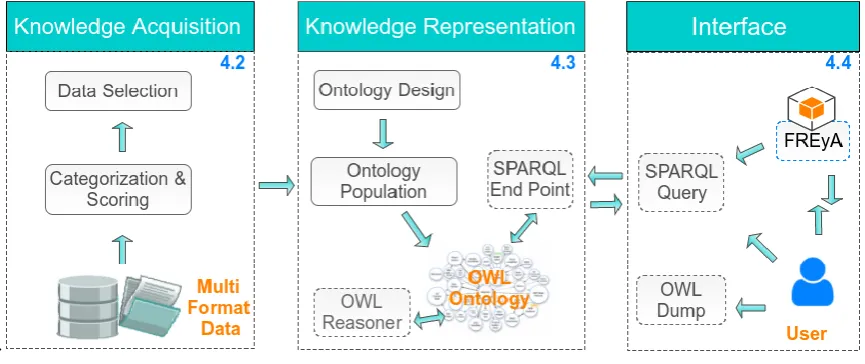
This work fosters a framework for open government data publishing that combines the three-stage process described by [11]: Knowledge acquisition, knowledge representation, and semantic querying, with elements acquired from the Open Government Data Life-Cycle [5]. Of specific interest in the knowledge acquisition phase, is the data selection, publishing, interlinking and exploration stages of the life-cycle. The adaptive framework employed in this research is shown in fig 2
[image:3.595.55.488.243.425.2].
Fig 2. The Model
4. ONTOLOGY DEVELOPMENT
The rationale of the proposed ontology driven approach is to facilitate users who in this case majority are citizens to successfully achieve their objective of their holding the government to transparency and accountability through efficient use of the knowledge resources they have access via a centralized system. The ontology is used to structure the shared government information on development projects ongoing and ended so that machines can easily interpret the information and provide meaningful results to the end users.
4.1. Knowledge Acquisition
To represent data in a KG through ontology, we need to have considerable amount of data to derive terms for representing the ontology. In Knowledge acquisition, we extract shared information from a repository, in this case, the Kenya open data portal1. In this work, we give specific attention to the data selection process which begins by the description given in Section 3.1 of the nature, frequency, and texture of data, as revealed by our analysis of the data retrieved from the open data portal Kenya. Data acquisition requires more than just describing the data but rather a selection process that would provide appropriate data for representation. We notice that the data we considered already meets the first conditions mentioned by [5] of excluding private data, on the other hand, to specify what conditions the data will be published according to the open data principles, we reckon that the data
already meets most principles by virtue that it is in the open data portal. We sort out a necessary portion of the data by applying a basic weighted average score (Se) over predefined features of interest as shown below:
Where the total number of features is,
is the value of a given feature (e.g. the number of semi-structured documents or frequency of seed terms) and is the weight of that feature. Were w for the four features ( number of docs,number of semi-structured docs, number of unstructured documents and number of images ) are arbitrarily fixed to 3, 5, 2 and 0 respectively, and for seed features
TFIDF values obtained from terms of interest on each topic. We define for each topic a set of seed terms with example for the three topics of governance, Agriculture and Education. Following out sampling, 114 files were selected from a pool of existing records providing a total of 821 records. These documents were inherently on the topic of governance which indicates all government projects held between the years 2013 to 2017.
4.2. Knowledge Representation
individuals from the data source after it has been loaded into the java application.
4.2.1 Introduction
Ontologies are normally developed using graphical and integrated ontology authoring tools such as Ontolingua, swoop, and protégé and each has features which are exhibited below:
Swoop: It is an OWL ontology editor that contains OWL validation and offers several OWL presentation syntax views [1]. Supports pellet and RDFS reasoning and provides multiple ontology environments. It has hyperlinked interface for easy navigation.
Ontolingua: Ontolingua enables users to manage, reuse and share ontologies stored on a remote ontology server. Unlike other ontology editors that support limited translations, ontolingua supports many translations. It easily imports and exports ontologies constructed using DAML+OIL, OWL etc [1].
Protégé: Protégé is an open source and most used development tool that supports rich knowledge models. It provides a development environment that makes use of various plug-in that support specific knowledge domains [1]. Its advantage is in its scalability and extensibility [1]. Protégé can be changed and extended to suit user needs by accommodating a number of graphical components. These components include images, video, graphs and tables among others.
4.2.2 Owl Classes
The ontology built for this thesis is made up of several classes just as described in the design phase earlier on. We have a number of classes namely; address county, date, financier, objective, project, stakeholder, supervisor, title. Relation between classes (concepts) is formed using object properties (roles).
4.2.3 Properties and Relations
Properties and relations as used in the ontology are described in this section. Object properties (roles) related different classes (concepts) as earlier stated. The object properties include; hasTitle, hasAddress, hasCounty, hasEndDate, hasStakeholder, and hasSupervisor etc. Each object properties has an inverse property (inverse role). For example, the relation between the classes project and county is such that a project is run in a certain county: represented by the hasCounty object property. Conversely, a project if supervised by someone: represented by the inverse of IsSupervised, Datatype properties are used in ontology design to describe the characteristics of the instances of a class. In this design they include; city, email, mailbox, name and zipcode.
4.3. The Interface
In this section, we describe our approach to accessing the knowledge represented in the Ontology. To enhance ease of access to multiple classes of users namely: technical, e.g. application programmers and academics and non-technical e.g. government officials and citizens, three methods of access are provided. First, an OWL data dump of the ontology is provided for any user interested in extending the vocabulary and structure of the Ontology. Secondly, most users would have no knowledge of SPARQL query language required for querying the data; a web-based application is provided which avails the users with menu items which they can click to make
requests. Consequently, answers to a query depend on the menu item selected by the user. This simple user interface application created using Netbeans editor. For example, if a user desires to get all currently on-going projects within Nairobi county, they would select these two parameters: current Project and Nairobi county so that the system can build a query. The user interface with a sample of query to achieve the stated task this may look like figure 3.
SELECT
DISTINCT ?title ?county
WHERE { ?p a :project ; :hasTitle ?t ; :hasCounty ?y. ?t :name ?title . ?y :name ?county.
FILTER regex (?county, '(?=.*?(Nairobi))', 'i' ) } group by ?title ?county
Figure 3: Sample query
Alternatively, a SPARQL endpoint for directly writing the queries would be developed using Virtuoso 2 .The third access to the user interface is an attempt to enhance natural language questions. Since Question Answering systems over Knowledge Graphs is an entire research area, we make no attempt to build a question answering system or our ontology, but rather we adopt an existing natural language user interface tool that was developed for Question Answering on DBpedia [6], [7].The system FREyA [8] available on Github . The tool which participated in the first edition of the QALD challenge uses simple natural language questions with user interactions to answer natural language questions
5. DEVELOPMENT PROJECT
ONTOLOGY
A screenshot of the Protégé version of the ontology is shown in Fig 4 with several relating information about several projects being run by several entities of the Kenyan government as per the information we obtained from the open data portal. The ontology shows the relationship between several projects and the target users who are amongst others; government authorities, civil servants, donor organizations’ and citizens.
Fig 4. Protégé version of the ontology
6. VALIDATION SETUP
To evaluate our approach, we design a set of queries one according to the evaluation model of [11]. The set of questions are designed to measure the performance of the system based on retrieval accuracy.
6.1. Retrieval Evaluation
A set of queries were prepared as shown in the tables 1, 2, and 3. Table 1 shows general evaluation queries according to specification fields. The general queries were;
All projects running in specific county i.e Nairobi County, Supervisor of those projects,
All project financiers and their addresses.
Table 2 shows specific queries. They represent search of documents using topics or titles. The queries raised and tested in this section include;
Get financier of a specific project title
Get projects with construction as a title
Lastly, table 3 on the other hand, contains specific queries that represent search by supervisor names. With raised and tested queries being;
Query by one name i.e of a supervisor
Query by both names i.e of a supervisor
6.2. Evaluation of Retrieval Task
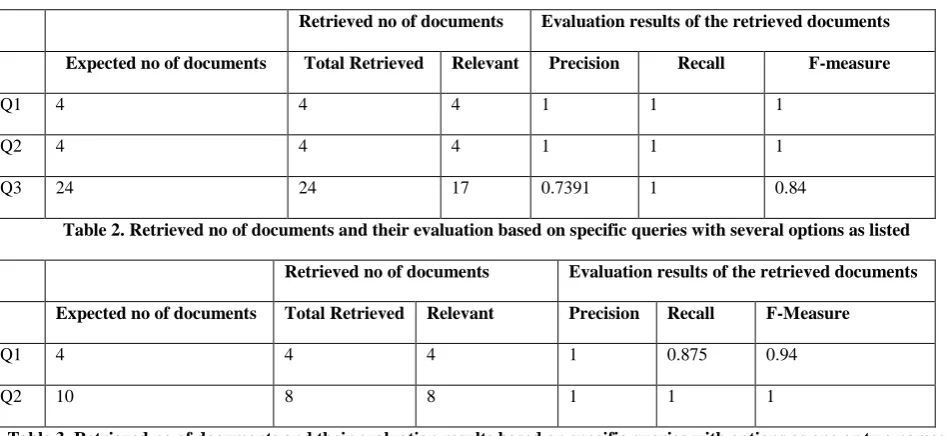
This section has a set of queries that was prepared as shown in the tables 1, 2, and 3. Table 1 shows general evaluation queries according to specification fields and their evaluation results. Table 2 shows specific queries their calculated performance results. They represent search of documents
using topics or titles. Table 3, on the other hand, contains specific queries their evaluation results representing search by supervisor names. The queries are run and the performance calculated using Precision, Recall and F-measure.
Table 1. Retrieved no of documents and their evaluation based on generic queries with several options as listed
Retrieved no of documents Evaluation results of the retrieved documents
Expected no of documents Total Retrieved Relevant Precision Recall F-measure
Q1 4 4 4 1 1 1
Q2 4 4 4 1 1 1
Q3 24 24 17 0.7391 1 0.84
Table 2. Retrieved no of documents and their evaluation based on specific queries with several options as listed
Retrieved no of documents Evaluation results of the retrieved documents
Expected no of documents Total Retrieved Relevant Precision Recall F-Measure
Q1 4 4 4 1 0.875 0.94
[image:5.595.54.529.471.689.2]Q2 10 8 8 1 1 1
Table 3. Retrieved no of documents and their evaluation results based on specific queries with options as one or two names as listed
Retrieved no of documents Evaluation results of the retrieved documents
Expected no of documents
Q1 4 4 4 1 1 1
Q2 10 8 8 0.8 0.8 0.8
7. DISCUSSION
Our evaluation results for the retrieval task show comparable performance to the work by [11].To be able to calculate precision and recall, relevant documents have to be identified from the total number of documents retrieved as per the earlier mentioned queries. The F-score or F-measure is the commonly used measures in Natural Language Processing, Information Retrieval and Machine Learning applications. It is a weighted harmonic mean of Precision and Recall e.g. all questions return a precision of 1, meaning that the SPARQL queries were able to retrieve only relevant documents. After the search and hence calculation different results are posted with varying impact to the recall, precision and f-measure. Q1 of table 2, Search by a specific title increases the precision and recall of the approach hence more accuracy. However, narrowing the search to specific topic specifying the category
of documents required, constricts the search scope thus decreasing recall and increasing precision. Recall, on the other hand, decreased in some instances such as in Q2 of table 2.
This can be attributed to the queries being specific. Firstly, specifying the category of documents required, in Q2, limited the search scope to financiers of specific projects. Secondly,
limiting the search scope to documents that contained the words “construction” in the title locked out other documents on the same topics that used other words such as “constructing”. In return, the two limitations decreased the chances of all relevant documents being retrieved. This is evident in Q2 of table 2 where recall when the category of documents is not specified is higher than when the category is specified. In Q1 of table 3, using a single name widens the search scope thus decreasing precision and increasing recall. A wider search scope increases retrieval of irrelevant documents thus the low precision. Likewise, wider search scope increases chances of relevant documents being retrieved thus the high recall. Last, in cases where full names of authors are used, an increase both precision and recall is observed thus increased accuracy as shown in Q2 of table 3. Though specificity reduces the probability of all relevant documents being retrieved, it increases the probability of only relevant documents being retrieved. This is clearly shown in the high precision and low recall rates depicted in table 2.The accuracy of this approach is evaluated using f-measure. High precision and recall evaluated to high F-measure. The approach, therefore, proves to be more accurate since the evaluation results recorded high rates of f-measure. Generally, the approach is precise and accurate. The more specific a query is, the higher the probability of only retrieving relevant documents. Recall values have seen a steep increase in our evaluation since the number of required return values is fewer and more constrained within our ontology. With continued expansion of the ontology, this value should be expected to slightly reduce.
8. CONCLUSION
This paper presented an ontology driven approach for structuring government data. This brought about easy and centralized access to data in one portal as an e-government
strategy of sharing and retrieval of knowledge. First, a look at existing cases indicated that most of the techniques used in sharing of knowledge are web 2.0 and web 3.0 (semantic web). While web 2.0 techniques have more of proven to support collaboration, the new technique web 3.0 (semantic web) structures the shared content for easy processing by machines and also for human consumption. It’s with this reason that semantic web has been widely used in areas such as medicine, engineering and e-learning among others to structure knowledge for easy access and retrieval. We concluded that it’s therefore the most appropriate technique to use to structure government data for easy access and retrieval by various entities including donors, citizens etc.. Ontology is developed and its performance evaluated based on precision and recall. The design of the ontology works well when it’s limited to specific data from the domain to populate the ontology; in this case we used data from governance domain. Connectivity of data from several domains can be done using the URI for information that doesn’t exist and population of ontology for new data thus achieving the objectivity of semantic web. The wide scope of data from the chosen domain makes the approach more interactive and allows bidirectional flow of knowledge in analyzing details existing projects within the country .Currently, the query construction is restricted to selection boxes on the interface. Even though this limits the expressiveness of resulting queries and therefore a natural language user interface FREyA has been suggested which requires customization to query the SPARQL endpoint.
9. FUTURE WORK
Currently, we restrict querying of the database to selection boxes via the developed user interface. In essence, this limits the expressiveness of the resulting queries. Natural language processing approach can be used as an extension to this and linked to the ontology database to improve expressivity of queries. For instance, with NLP, a sentence such as “projects in Nairobi county with title construction can be used to construct a query. The example above would give results as instances of “projects” with specification field “construction” that are running within the county of “Nairobi”. Again, semantic techniques combined with natural language processing will also help automate the search and make it free of human intervention. This will mean provision of a window where users will input search details and click on the search button to initiate the process of retrieving document.
10. REFERENCES
[1] Alatrish, E. (2013). Comparison Some of Ontology Editors. International Scientific Journal of Management Information Systems, 8(2), 018–024.
[2] Álvarez Sabucedo, L. M., Anido Rifón, L. E., Corradini, F., Polzonetti, A., & Re, B. (2010). Knowledge-based platform for eGovernment agents: A Web-based solution using semantic technologies. Expert Systems with Applications, 37(5), 3647–3656. https://doi.org/10.1016/j.eswa.2009.10.026
[4] Apostolou, D., Stojanovic, L., Lobo, T. P., Miró, J. C., & Papadakis, A. (2005). Configuring E-Government Services Using Ontologies. In M. Funabashi & A. Grzech (Eds.), Challenges of Expanding Internet: E-Commerce, E-Business, and E-Government (Vol. 189, pp. 141–155). Boston: Kluwer Academic Publishers. https://doi.org/10.1007/0-387-29773-1_10
[5] Attard, J., Orlandi, F., Scerri, S., & Auer, S. (2015). A systematic review of open government data initiatives. Government Information Quarterly, 32(4), 399–418. https://doi.org/10.1016/j.giq.2015.07.006
[6] Auer, S., Lehmann, J., & Ngonga Ngomo, A.-C. (2007). Introduction to linked data and its lifecycle on the web. In Reasoning Web. Semantic Technologies for Intelligent Data Access.
[7] Auer, S., Lehmann, J., Ngonga Ngomo, A.-C., & Zaveri, A. (2013). Introduction to Linked Data and Its Lifecycle on the Web. In S. Rudolph, G. Gottlob, I. Horrocks, & F. van Harmelen (Eds.), Reasoning Web. Semantic Technologies for Intelligent Data Access (Vol. 8067, pp. 1–90). Berlin, Heidelberg: Springer Berlin Heidelberg. https://doi.org/10.1007/978-3-642-39784-4_1
[8] Damljanovic, D., Agatonovic, M., & Cunningham, H. (2010). Natural Language Interfaces to Ontologies: Combining Syntactic Analysis and Ontology-Based Lookup through the User Interaction. In L. Aroyo, G. Antoniou, E. Hyvönen, A. ten Teije, H. Stuckenschmidt, L. Cabral, & T. Tudorache (Eds.), The Semantic Web: Research and Applications (Vol. 6088, pp. 106–120). Berlin, Heidelberg: Springer Berlin Heidelberg. https://doi.org/10.1007/978-3-642-13486-9_8
[9] Lamharhar, H., Chiadmi, D., & Benhlima, L. (2015). Ontology-based knowledge representation for e-government domain (pp. 1–10). ACM Press. https://doi.org/10.1145/2837185.2837203
[10]Marijan, R., & Leskovar, R. (2015). A library’s information retrieval system (In)effectiveness: case study. Library Hi Tech, 33(3), 369–386. https://doi.org/10.1108/LHT-07-2015-0071
[11]Matasyoh, N., Okeyo, G., & Cheruiyot, W. (2016). Ontology-driven Approach for Knowledge Sharing and Retrieval. International Journal of Computer Science
Issues, 13(4), 59–67.
https://doi.org/10.20943/01201604.5967
[12] Mutuku, L., & Mahihu, C. (2014). A Suggested Framework for Impactful Open Data Applications in Developing Countries. In Proceedings of the 8th International Conference on Theory and Practice of Electronic Governance (pp. 498–499). New York, NY,USA:ACM.
https://doi.org/10.1145/2691195.2691274
[13] Nahon, K., & Peled, A. (2014). Data Ships: An Empirical Examination of Open (Closed) Government Data (SSRN Scholarly Paper No. ID 2505872). Rochester, NY: Social Science Research Network. Retrieved from http://papers.ssrn.com/abstract=2505872
[14] Rudolph, S. (2011). Foundations of Description Logics. In Proceedings of the 7th International Conference on Reasoning Web: Semantic Technologies for the Web of Data (pp. 76–136). Berlin, Heidelberg: Springer-Verlag.
Retrieved from
http://dl.acm.org/citation.cfm?id=2033313.2033315
[15] Sengupta, K., & Hitzler, P. (2014). Web Ontology Language (OWL). Encyclopedia of Social Network Analysis and Mining. Retrieved from http://corescholar.libraries.wright.edu/cse/184
[16] Shadbolt, N., O’Hara, K., Berners-Lee, T., Gibbins, N., Glaser, H., Hall, W., & Schraefel, m. c. (2012). Linked Open Government Data: Lessons from Data.gov.uk. IEEE Intelligent Systems, 27(3), 16–24. https://doi.org/10.1109/MIS.2012.23
[17] Shamsi, K. N., & Khan, Z. I. (2012). Development of an E-Learning System Incorporating Semantic Web. International Journal of Research in Computer Science, 2(5), 11–14. https://doi.org/10.7815/ijorcs.25.2012.042
[18] Sunitha, A., & Suresh, B. (2013). Survey on Ontology Construction Tools, Volume 4(Issue 6). Retrieved from IJSER.org
[19] Taye, M. M. (2010). Understanding Semantic Web and Ontologies: Theory and Applications. arXiv:1006.4567 [Cs]. Retrieved from http://arxiv.org/abs/1006.4567
[20] Xiao, Y., Xiao, M., & Zhao, H. (2007). An Ontology for e-Government Knowledge Modeling and Interoperability
(pp. 3600–3603). IEEE.