1
Language testing in the ‘hostile environment’: The discursive
construction of ‘secure English language testing’ in the
United Kingdom
Abstract
In parallel with an increased focus on border security in immigration and citizenship policy in the United Kingdom (the so-called ‘hostile environment’ policy), Government-approved English language tests for visa and immigration purposes were officially labelled ‘Secure English Language Tests’ (SELTs) in 2010. The proximity of security concerns in language testing with broader national immigration policy objectives suggests a complex role for language tests as gatekeeping devices. This paper draws on critical discourse studies to explore this issue. Documents provided in the 2014 tender round for selecting Secure English Language Tests (acquired through a Freedom of Information request) were analysed through a discourse-historical lens (Reisigl & Wodak 2016) to map salient topics and identify discursive strategies used to construct ‘secure English language testing’. Findings show that security is a prominent topic in the tender; prospective bidders are required to meet detailed security requirements and to police sub-contractors, and social actors, spaces, objects, policies and procedures are routinely described in securitized terms. Implications are drawn for understanding the role of language tests within broader securitization processes.
Introduction
It has long been recognised that language tests are routinely used to help implement and enforce government policies on immigration and citizenship (Extra, Spotti and Van Avermaet 2009; Hogan-Brun, Mar-Molinero and Stevenson 2009; McNamara, 2009; McNamara and Ryan 2011; Shohamy & McNamara 2009; Shohamy 2001). What is less well-understood, however, is how language tests – and language testing professionals – may become situated, both
discursively and in practice, within broader processes related to the production of (in)security (Khan 2017).
2 also be understood against the background of UK immigration policy since 2010 which has been designed to reduce net migration figures ‘from the hundreds of thousands to the tens of
thousands’ (May 2010). In support of this goal, drastic immigration policies have been implemented with the aim of extending ‘border work’ to a range of professionals. Within this context, the label ‘secure’ language testing holds symbolic meaning suggesting a conflation between understandings of security both in a more traditional language testing sense and in relation to border and immigration control.
This paper aims to explore the construction of ‘secure English language testing’ by a political institution, the UK Home Office, in a particular set of salient documents – the tender information for bidders to provide SELTs – by drawing on the discourse-historical approach (DHA) within the field of critical discourse studies (CDS). First, we chart the development of language testing policy in the UK from 2001 until 2016, and situate the focus on secure language testing within this broader historical context of the ‘hostile environment’ policy. Then, using an adapted discourse-historical methodology, we analyse the papers which comprise the most recent (2014) tender round for SELTs, with a view to establishing how language tests, the practice of language testing, and the social actors involved in language testing are being discursively constructedi against the background of broader issues related to security both at
the micro (textual) and macro (extra-textual) level.
The emergence of Secure English Language Tests
Since 2010, SELTs have been used by the Home Office to determine levels of language
proficiency deemed appropriate for its five-tier ‘points-based’ immigration system for non-EU nationals who wish to enter Britain. This introduction of ‘Secure English Language Tests’ as both a specific label and an instrument of policy, however, should be understood against the background of wider debates in the UK around immigration and citizenship.
While immigration has been a key issue in British politics for decades, Cooke (2009) describes the publication of a 2002 white paper Secure Borders, Safe Haven: Integration with Diversity in Modern Britain as a turning point for immigration- and citizenship-related language policy. Published in the wake of the September 11th, 2001 attacks in the USA, and following
3 foundation for the inclusion of language testing within the broader policy spectrum of
immigration and citizenship.
A five-year strategy paper followed in 2005 - Controlling our borders: making migration work for Britain – where an ‘Australian-style’ points-based system was suggested for
determining visa eligibility for non-EU nationals who wished to work, study, or join family in the UK. A key point was that migrants would have to demonstrate their English language
proficiency at a pre-determined Common European Framework of Reference (CEFR) level. The system was phased in from 2008 to 2010, and a range of language tests were accepted as ‘approved English language tests’ by the UK Border Agency (UKBA, later called the UK Visa and Immigration Authority). There was some criticism of the range of tests approved at that time (see e.g. Schmitt 2010) as these included a large number of tests produced by small-scale education providers, with little validity evidence to support score interpretations and use.
A watershed moment in the emergence of SELTs was the election of the Conservative-Liberal Democrat coalition in 2010, and the implementation of what has come to be known as the ‘hostile environment policy’ (Consterdine 2018; Yuval-Davis, Wemyss and Cassidy 2018). In an effort to meet a Conservative Party election promise to cut immigration numbers from the hundreds of thousands to the tens of thousands, Theresa May – the then Home Secretary – implemented a range of restrictions on different migration pathways through, for example, increased language proficiency requirements and higher income thresholds (Consterdine 2018). As well as attempting to restrict the number of people migrating to Britain at the point of entry, national policy also focused increasingly on identifying and controlling those residing in the country without correct documentation. One particular target was student visas issued for below-level degree courses, which were viewed as ‘alternative work routes’ leading to
overstays. May’s stance was made explicit in 2012 when she stated: ‘The aim is to create here in Britain a really hostile environment for illegal migration’ (Kirkup and Winnett 2012). Border security came to the fore as immigration became the subject of intense public debate, often presented through a frame of criminality (Bowling and Westenra 2018). Following the passing of the 2014 Immigration Act, the hostile environment policy was further characterised by the involvement of a range of professionals in enforcing immigration controls, with documentation checks required to be performed by NHS (National Health Service) workers and landlords, for example.
4 We recognise that there is a greater risk of abuse by those seeking to come to the UK to undertake lower level courses of study. Secure English language testing will ensure that we have independent evidence that all education institutions are ensuring their students are capable of following a course delivered in English. [our emphasis]
In August 2010, still early in its first term, the Coalition government turned its attention to the management of SELTs, reducing the list of approved tests for student visas to just 12. The list of SELTs, however, received criticism from language testing academics in the national press who felt that the test selection had been guided primarily by concerns over cheating and fraud prevention rather than by considerations of test quality or rigorous CEFR mapping (see de Lotbinière 2010). Whether as a response to this public questioning, or as the enactment of an existing plan, a tender process was opened, running from November 2010 until January 2011, to select providers to deliver SELTs from April 2011. The outcome was a reduction of SELTs to those produced by five test providers.
In 2013, a re-tender process began, aiming to ‘… ensure all approved providers offer a high quality service, with secure and consistent tests and testing arrangements. It [would] also enhance the security requirements and establish more robust criteria for the administration of English language tests’ (Home Office 2013). However, in February 2014, mid-way through the process, an incident of test fraud was reported by Panorama (a national current affairs
television program), involving a test centre in London where test-takers were secretly filmed being told answers to the TOEIC exam, and then allowing ‘fake sitters’ to conduct a computer-based speaking test in their place. Educational Testing Service (ETS), which held a joint SELT licence for administration of the TOEIC and TOEFL iBT tests, was suspended by the Home Office, and the tender procedure was temporarily stopped in order to provide further guidelines for SELT provision in the tender round. The tender documents which form the subject of this paper are the result of a ‘detailed and robust review’ of the tender approach following this
interruption (UK Government 2014).
Research on immigration, citizenship and security in language
testing
Scholarly interest in the connection between language testing, immigration and citizenship has been growing since the early 2000s, largely in response to the increased prominence of
5 and the Middle-East. A special issue of Language Assessment Quarterly has also been devoted to the topic of language tests for immigration, citizenship and asylum (Shohamy and McNamara 2009). This interest has intersected with increased explorations of fairness and justice in language testing research (McNamara and Ryan 2011; Kunnan 2013) and, more broadly, with the paradigm of critical language testing (Shohamy 2001) which seeks to understand the social role played by language tests.
The UK has provided fertile ground for research into language testing and
immigration/citizenship owing to the salience of language tests within the ‘managed migration’ program introduced after 2008 (see above). Blackledge (2009), for example, analysed the policy on English language requirements for spouse visas, concluding that discourse around language testing for this purpose constructs a (false) argument that English language proficiency at point of entry is fundamental for social cohesion. His fundamental critique – that language proficiency is not central to national unity – is echoed in critical accounts of language testing for citizenship in other European countries (Van Avermaet 2009). Saville (2009) presents a more pragmatic critique, mapping out the steps of the immigration/citizenship ‘journey’ where language testing is relevant, and proposing various ways in which the process could be better managed.
Consequences of language testing policies for immigration/citizenship have also been traced (e.g. by McNamara, Khan and Frost 2015).
Secure English Language Testing in the UK, however, has not been a specific focus of research thus far, even though the emergence of SELTs within the macro-level policy context of the ‘hostile environment’ presents a unique opportunity to examine the construction of
language tests, and language testers, as key elements of ‘border work’ processes. Specifically, an analysis of SELTs within the hostile environment policy can be usefully explored through the lens of security studies; an area of enquiry which has become more prominent in other fields of the social sciences, and where connections are beginning to emerge with the field of
sociolinguistics (e.g. Charalambous, Charalambous, Khan and Rampton 2015, 2016) and in pioneering sociology-oriented work on citizenship testing (Khan 2017).
The concept of ‘securitization’, which was initially theorised in the influential work of the Copenhagen school (Buzan, Wæver and de Wilde 1998), and the more recent emergence of security studies, as advanced by Bigo (2002) and Huysmans (2006, 2014) among others, are apposite to a consideration of the connection between border security and language testing policy and practice. A security perspective, in fact, provides a strong rationale for exploring the discursive construction of SELTs in two ways. First, we can understand the hostile environment policy as primarily underpinned by a politics of insecurity. Buzan et al. (1998) defined
6 behaviour (similar to the concept of a ‘state of exception’ described by Agamben [2005]ii). In
contexts of national security, this object – the source of ‘insecurity’ (Huysmans 2006) – is
typically ‘the immigrant’ (Bigo 2002: 77). Huysmans (2014) argues that insecurity has become a key organising principle of governance in liberal democracies, particularly with respect to issues of mobility across borders, a notion that is heightened within the context of the ‘hostile environment’ policy.
Additionally, newer conceptualisations of securitization, drawing largely on Foucault (e.g. 1982, 2007) see the role of ‘the state’ as more dispersed, and instead theorise,
a growing body of ‘security professionals’ engaged in ‘border work’ – police with military status, border guards, customs agents, immigration officers, intelligence officers, private security companies, specialist lawyers, academics and others. Their interests and specialisms form a complicated, interconnected but also relatively disorganised transnational field which often operates outside the auspices of the nation-state, but which nevertheless converges “towards the same figure of risk and unease management, the immigrant” (Bigo 2002: 77).
(Charalambous et al. 2016: 5)
This application of Foucault’s notion of governmentality entails changing assumptions about the role of the state. Rather than straightforwardly exercising power over individuals, for instance through the threat of physical violence or imprisonment, government is a form of power that entails acting on the actions and conduct of social actors, and thereby creating multiple forms of social control, often realised through institutions. Security studies theory, therefore, provides an impetus for considering the role of language test developers, examiners and administrators within this network of security professionals given the gatekeeping role that SELTs play in the UK immigration system.
These issues have been explored with reference to language requirements for
citizenship in the UK and to UK language policy more broadly (Khan 2017; Charalambous et al. 2015), however few connections with security studies have been made in the language testing literature despite the clear role played by language tests in enforcing immigration restrictions. Indeed, within the field of language testing ‘security’ has mostly been discussed with reference to the practical problems of detecting cheating and fraud (see for example IELTS’ test security measures on https://www.ielts.org/about-the-test/test-security). There is room, however, for a clearer understanding of how security in language testing functions more broadly in the
7 In sum, while there is important research on the role of language testing in citizenship and immigration processes, and a critical examination of the assumptions around language proficiency and social cohesion, there is a lack of research on how language testing is positioned with respect to security concerns, and the way in which language testing as a process, language testers as professionals, and test-takers as learners are constructed through discourse around security in official documentation. The aim of this study was therefore to investigate how secure language testing is conceptualised in the extensive documentation produced by the UK Home Office for SELT bidders.
Theoretical and methodological framework
The discourse-historical approach
To provide a theoretical and methodological framework for the study, we draw on Reisigl and Wodak’s (2016) discourse-historical approach. In this sense, we follow the small number of studies which have applied similar approaches to language testing-related policy texts (e.g. Blackledge 2009; Milani 2009), and the more extensive CDS literature on broader language policy issues (e.g. Ricento 2003; Johnson 2011; Krzyżanowski and Wodak 2011). It is evident why scholars who follow critical discourse studies approaches, which start with a social wrong (Fairclough, 2016), are drawn to language tests; their role as gatekeeping devices in
international mobility means they can be used to control access not only to physical locations, but also to labour and education opportunities, diasporic families, and in some cases freedom from persecution. Security/securitisation have also attracted some interest, e.g. Chilton’s (1996) analysis of metaphors of security around the Cold War, or more recently following the so-called ‘war on terror’ (e.g. McDonald 2005). CDS approaches draw extensively on the work of Foucault (see Wodak and Meyer 2016), particularly in terms of how they theorise power and society, discourse, and critique. Foucault’s theorisation of security (see e.g. Foucault 2007), however, has not been widely taken up within CDS. Therefore, by combining these perspectives from diverse research contexts but focussing specifically on language testing policy and security together, we address a gap in both language testing and CDS literature.
8 methods, as well as background information, into account’ allows for analysis, comprehension and explanation of complex social phenomena. This is the unique characteristic of the
discourse-analytic approach, and fits well with Foucault’s multifaceted understanding of technologies of power and control by the state.
Specifically, Reisigl and Wodak (2016: 34) propose a series of methodological steps for a discourse-historical investigation, which include iteratively moving between theoretical
knowledge, contextual information and preliminary data, and then ultimately conducting a rigorous analysis of specifically selected salient data. Therefore, in our study, we followed a general direction of travel, moving from more ‘macro’ contextual and topic analysis to ‘micro’ linguistic text analysis, before returning to draw conclusions about the wider context. More specifically, we adapted Reisigl and Wodak’s methodological framework to comprise the following steps:
1. Establishing common ground between different research traditions, language testing and critical discourse studies, and making links to relevant existing theoretical
frameworks (e.g. around securitization, genre, etc.);
2. Collection of data and context information about SELTs in the UK, finding a variety of relevant texts such as parliamentary debates, newspaper articles, and press releases from test providers. Context here comprises different levels – from the broadest, sociopolitical context, such as the political events that have led to a current policy, via institutional contexts, to the most micro-level of co-text, i.e. which other texts a
particular text is alongside and in what relation. Understanding these different levels of context is crucial, as this leads to a better understanding of the texts themselves – for instance, the genre-specific features of a tender document (related to the institutional context) will have a considerable impact on the contents (for instance, use of field-specific jargon/vagueness);
3. Selection and preparation of data for analysis, careful reading of data, choosing main texts for analysis and identifying salient sections, i.e. all passages in the tender document with instances of ‘security’ and related concepts. These tasks were carried out independently by the different researchers involved in this study before comparing results, to attempt to minimize personal biases;
9 5. Qualitative text analysis focussing on how SELTs are discursively constructed, taking
into account the most salient discourse strategies, i.e. nomination and predication – see Table 1;
6. Formulation of a critique, interpreting and explaining results of analysis with reference to socio-political and institutional contexts. This can include: critique of the text itself (e.g. are there any logical inconsistencies or unsubstantiated claims in the text); socio-diagnostic critique (e.g. what power imbalances are maintained or challenged through a particular policy); and prospective critique, which entails using the knowledge gained from the study to try to effect positive social change by for instance sharing it in accessible ways, advising policymakers or other stakeholders.
Analytic framework
Once we had examined our data in their broader context (step 2) and narrowed down to a volume that would allow qualitative analysis (step 3), we started our more detailed analysis by identifying discourse topics (step 4). These allow consideration of what a text is about, how this changes over the course of the text, and thus help to map out the development of different topics and how the text brings them into relation. We endeavoured to make our analysis as trustworthy as possible by ensuring that at least two of the three researchers independently looked at all the data, selected the relevant material, and identified topics.
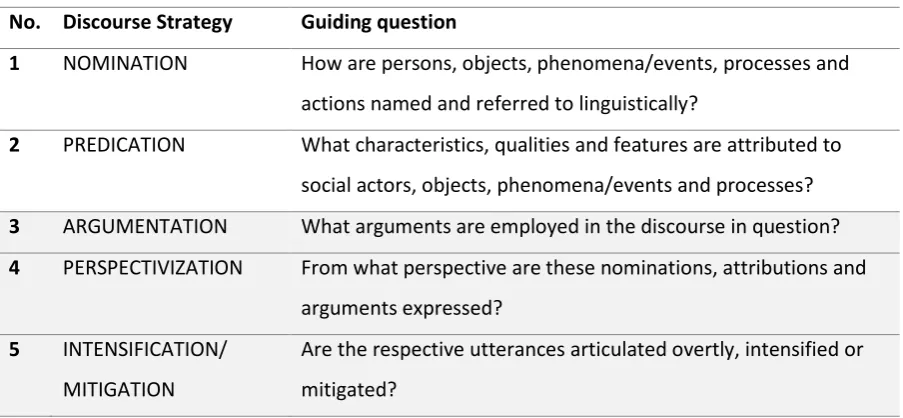
We then proceeded to conduct qualitative text analysis on selected extracts from our data. Reisigl and Wodak (2016: 32f) suggest that five questions arise when conducting a qualitative text analysis (step 5), each linked to a specific discourse strategy, as shown in Table 1.
[TABLE 1 HERE]
10 specific social purpose in a specific social context’. It is thus a useful indicator of which
strategies are likely to be present at all, and which are most salient to security-related discursive constructions. Strategies 3-5 (argumentation, perspectivization,
intensification/mitigation) are particularly salient in texts which are hortatory (persuasive) in nature, such as election campaign speeches or parliamentary debates. This is however not the case for a typical tender document; rather, tender calls lead to responses which need to be persuasive, and there is relatively little argumentation, perspectivisation and
intensification/mitigation (i.e. strategies 3-5) in tender documents themselves. Thus, in our systematic analyses we focused on strategies 1 and 2 – nomination and predication – while we make some more general observations on the remaining three strategies in the concluding sections of the paper.
Reisigl and Wodak (2016) state that nomination of persons, objects, phenomena and events is usually linguistically realised through nouns or noun phrases, while processes or actions are realised through verbs, though more abstract representations such as metaphors may also occur. Nomination is particularly important in establishing how something in a text is framed, in other words which associations are likely to be made by readers of the text due to the particular choice of words. An example of nomination from our study is the term Secure English Language Tests itself, which serves to frame a set of phenomena, processes and events in a particular way. Predication, on the other hand, can be realised via a wide variety of linguistic means, including adjectives, various subsidiary clauses, predicative nouns, and other rhetorical techniques. Analysis of predication can help establish how something that is represented in a text is evaluated (positively or negatively). A prediction strategy example is found in the phrase ‘there is a greater risk of abuse by those seeking to come to the UK to undertake lower level courses of study’, quoted in an article in The Guardian (de Lotbinière 2010), as this associates students (‘those seeking to come to the UK’) with ‘risk of abuse’, arguably a negative
representation.
Data
11 assessment into a single set of documents. However, when we began our study, the tender process had finished and the documents were no longer available online. Attempts to acquire them directly from the Home Office were initially unsuccessful, but following a Freedom of Information (FoI) request lodged in May 2015, the Home Office sent us 51 annexes in August 2015 which comprised a partial release of the tender documents. Within the documents we received, some parts had been redacted by the Home Office for different reasons (e.g. because ‘disclosure would prejudice the prevention and detection of crime’, could affect ‘the operation of immigration controls … or commercial interests’, or because it failed the ‘public interest’ test (UK Home Office, personal communication, 2015)). We were nevertheless left with a substantial collection of texts, also including tender guidelines, previously published documents, and presentation slides, which could be analysed further.
Results
In presenting the findings of our detailed case study of the 2014 tender document, we first report our macro-level analysis, in which we identified the main discourse topics in the tender documents as well as the specific security-related requirements that bidders must conform to and the intertextual links within the document. A more general discussion of the genre
conventions of the tender document is available as supplementary online material. Second, we show how the texts discursively construct security through particular lexicogrammatical realisations, specifically focusing on the nomination and predication strategies.
Topics, content and intertextuality
Topics
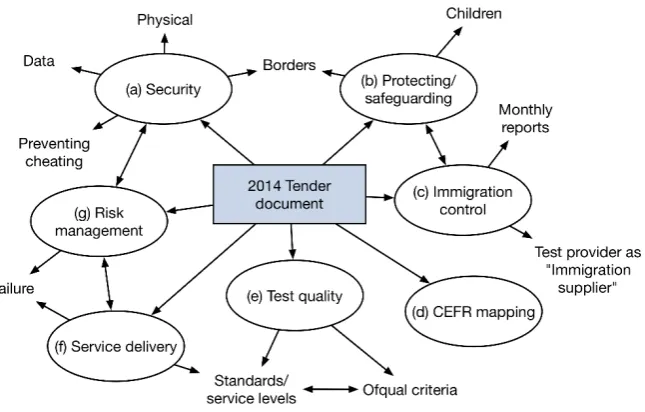
A content analysis of the tender document was undertaken to identify the topics covered across the various annexes, and to map the connections between these. Figure 1 shows that the range of topics was diverse, though falling within seven macro-categories ((a)–(g), given in ovals in the figure along with links to subsidiary topics).
[FIGURE 1 HERE]
12 ‘accredited by Ofqual’ (the Office of Qualifications and Examination Regulations), and
specifically that tests should:
[Meet] … Ofqual conditions: test research and development, test question writing
guidelines, test question quality assurance and quality assurance overall and randomised questioning. [Annex G: 46]
This intertextual outsourcing of test quality considerations to another government body is likely to be the reason that there are very few references throughout the tender document to more specific aspects of test quality such as the provision of technical reports, reliability estimates, fairness and impact evidence, etc. The phrase ‘randomised questioning’ implies a specific focus here on fraud-prevention techniques, which may or may not be applicable to prospective testing organisations depending on the extent of their use of discrete-point testing techniques. Since Ofqual currently regulates over 300 English language tests (Ofqual 2017), it may be inferred that SELT testing requires no special threshold of validity evidence or quality assurance beyond that which is routine for the conditions of recognition.
The tender also stipulated that tests should be formally connected with the CEFR (d):
The Concessionaire shall ensure that all facets of the Test match the relevant bandings of the CEFR and the CEFR standards throughout the Term. This matching shall be reviewed annually and shall be made available to the Authority at its request. [Annex I: 3]
Beyond these brief mentions, however, there is very little further information on test quality or standard setting procedures throughout the 51 annexes. Rather, the remainder of the tender documents contain extensive detail on the tender process, and relate to the topics of security (a), protection and safeguarding (with specific reference to the safeguarding of children) (b), immigration control (c), service delivery (f), and risk management requirements (g), as well as the consequences of failure to meet such requirements.
Security requirements
With reference to the topic of security (the main focus of this study), the documents describe an extensive list of security requirements which the bidder must adhere to:
13 Monitoring the security systems of any sub-contractors (‘flow-down security
obligations’)
Appointing a ‘Security Lead’ to act as liaison on security matters between test provider and the Home Office
Providing monthly reports on security matters Sharing data on:
o Number of tests taken for UK immigration purposes
o Nationalities of test-takers (arranged most common to least common)
o Score patterns across test centres (and irregularities) Co-operating with the Home Office in any security investigations
Ensuring that all personnel involved in SELT testing have the appropriate ‘security clearance’ with personnel in key roles overseas required to ‘undergo relevant Home Office security checks into their background and immigration history before they are permitted to commence work on the Concession’ [Annex AG: 8]
Providing ‘relevant security education and awareness’ at six-monthly intervals
‘consistent with the security education and awareness provided by the [Home Office] to its own staff … to ensure that all Concessionaire Personnel understand their security responsibilities’ [Annex AG: 8-9]
Maintaining biometric equipment in test centres Meeting physical security requirements at test centres:
o Preventing unauthorised personnel and vehicles
o Monitoring test centres during closure times (e.g. through alarm systems)
o CCTV surveillance of public in the test centre and of registration procedures
o Controls over entry to secure areas within test centres
o Secure storage of personal documents (e.g. passports)
At a macro level, then, the requirement/obligations set-out in the tender position the bidder – a testing agency – as needing to be fully compliant with a broader security policy, fully
co-operative with the Home Office in investigating security incidents, transparent in reporting and data-sharing, and accountable for policing their own security and surveillance systems
(physical/data security) and also the security systems of their sub-contractors (e.g. test centres).
Intertextuality
14 texts the tender is replete with intertextual references to existing Home Office, Government or international policy documents. More specifically, Table 2 demonstrates that the colony of texts stretches out into other associated documentation principally around security (physical and information security) as well as other legislative texts using a small sample of intertextual references. In certain cases the referenced texts are included in the tender documentation (e.g. the HMG Security Policy Framework). The intertextual references occur in a wide range of places within the tender documentation, including in more general texts (e.g. Annex B: Instructions to Bidders) and highly specialised technical specifications (e.g. Annex AL: Data Room Contents List).
[TABLE 2 HERE]
Intertextual references thus show that this particular information for bid is associated with other key legislative and regulatory documents on security, and provide evidence that the tender document discursively positions the requirements for language tests and language testing organisations within a broader national security framework.
Nomination and predication strategies in the tender documents
While it is clear that the security-related obligations on test providers are onerous, and position the test provider as a ‘player’ in the security policy of the Home Office, we can also identify how security is constructed in the document through micro level linguistic strategies – specifically through nomination and predication strategies.
Nomination
The most overt nomination strategy relevant to our focus is the use of the term SELT itself to indicate a language test which meets the requirements of the tender. This is, in effect, a nominalization of a complex set of processes. We find reference to ‘Secure English Language Tests’, ‘Secure Testing’, and ‘SELT(s)’ throughout the document.
15 The Authority shall have the right to inspect any and all security aspects of the
Concessionaire's operations in accordance with Schedule 8.4 [Annex J: 12]
All Concessionaire providing services to the Authority are required to put in place appropriate counter fraud and security management arrangements [Annex J: 14]
The Concessionaire shall ensure that the Authority is allowed access, to all of the Concessionaire Test Centres [Annex J: 15]
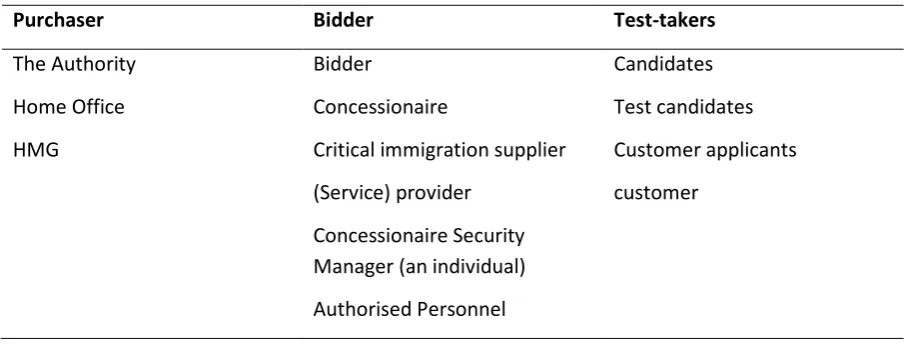
For bidders, the phrase ‘Concessionaire’ is a frequent label, although an interesting and rather telling example is found in one of the appendices to the tender – a set of PowerPoint slides from a SELT information day – where prospective bidders are described as ‘Critical immigration suppliers’. Test-takers are included in terms of their role as test candidates, but also as
‘customers’ of immigration/testing services. An overview of the nomination strategies for social actors is provided in Table 3.
[TABLE 3 HERE]
These nomination strategies indicate that the roles constructed for different social actors in the SELT process are complex. While the genre constraints dictate certain nomination strategies (Bidder, Concessionaire, Customer) and give rise to a frame of ‘customer service’, the Bidder is positioned as providing the conduit service through which customer-candidates must pass for immigration purposes. This duality between service and gate-keeping roles is discussed further with reference to ‘predication’ below.
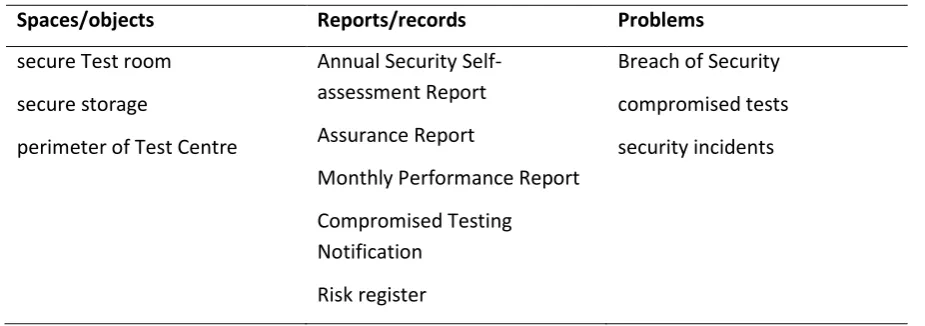
Particularly within the security-related sections of the tender, we also see noteworthy labels of spaces/objects, reports/records, and anticipated problems (see Table 4).
[TABLE 4 HERE]
Labelling of spaces and objects reflects the strong focus on security and boundary-marking (e.g. references to the ‘perimeter’). Labelling of reports and records carry connotations of anticipated threat or breach (e.g. ‘Compromised Testing Notification’). Security problems are nominalised, with capitalisation (‘Breach of Security’), reinforcing both the legalistic quality of the discourse and the importance of the seriousness of the anticipated breach.
16 Predication strategies related to the three main social actors – the Home Office/Authority, testing organisations/Concessionaires, and test-takers – are explored below through three illustrative examples.
The Home Office/Authority
Tender Excerpt 1 provides a useful basis for analysing the characteristics, qualities and features attributed to the Home Office/Authority – the body responsible for overseeing the SELT policy.
[EXCERPT 1 HERE]
The Authority is demonstrated here to in fact operate at three levels: the Home Office (a superordinate Governmental structure), UK Visas and Immigration (part of the Home Office), and the Immigration and Border Policy Directorate (a team within UKVI). Each level of the hierarchy is provided unique, though related, characteristics in terms of their aims and objectives:
Home Office: to lead; to be visible, responsive and accountable
UKVI: to be globally trusted; to deliver excellent customer service
The Directorate: to help protect (the border/UK); to help control and reduce
(immigration); to provide policy that removes ‘illegal immigrants’ and denies citizenship rights;
All of these characteristics include processes or adjectives with positive connotations. However they relate to different general characteristics. Attributes of the Home Office and the UKVI revolve around service delivery and accountability; attributes of The Directorate, in contrast, relate to managing threat, controlling immigration and restricting citizenship. There is a tension here between the ‘customer-focused’ orientation of the Home Office and UKVI attributes, and the security/border-protection orientation of the Directorate attributes. This duality is evident in the discourse of the tender document as a whole, which switches, from
document-to-document, from a focus on service delivery concerns to immigration control and applications of security frameworks.
Bidder/test-provider
17 expect providers to demonstrate’, explicitly sets out the desirable attributes of the successful test provider.
[EXCERPT 2 HERE]
Future bidders are here constructed as good managers, efficient, high-capacity, and providing good service. The prioritising of security/risk at the top of this list does not appear to be
accidental. Elsewhere in the tender documents we see security/risk management expressed as a key characteristic of successful SELT providers:
deliver greater rigour, with more responsibility for security taken by the SELT providers [Volume 1: 9]
Notably, the text uses comparison to suggest a time in the past where rigour and responsibility was not optimal. This may be a reference to the Panorama investigation, but is also a common feature of the marketised, externally directed discourse of many public institutions and companies, for instance in mission statements or advertising slogans (see e.g. Saunston and Morrish 2010 on how this applies in the University sector). Therefore, successful suppliers are viewed as exceeding expectations around security. This view is reinforced in the opening to the Security section:
This schedule describes the Authority’s security requirements that the Concessionaire is required to meet or exceed during the Term [Annex J: 4]
The desirable characteristic of the potential bidder then is enhanced security management.
Test-takers
Test-takers are largely backgrounded in the documents, and when they are referred to it is through their role as candidates or ‘customers’. However we can locate predication strategies through more implicit references throughout the document to the need for robust security measures. For example, Excerpt 3 – drawn from the Security section – explains the various potential security threats which warrant the Security Plan.
18 In this passage, an existential threat is constructed of a (backgrounded but inferable) group or individuals who would wish to attack, steal, disclose, access, or be involved in corruption. This group must be understood to include some candidates or those wishing to unlawfully help candidates. This predication strategy is made clearer later when stated that:
the Concessionaire shall use appropriate protection … to ensure that Test Candidates and other members of the public cannot access non-public areas of the Test Centres or the Technical Infrastructure. [Annex J: 9]
Again, Test Candidates are construed here as potential transgressors. The notion that such transgressions are at the frontline of national security is alluded to in other parts of the document. For example, this discussion of ‘service levels’ specifies that:
The objectives of the Service Levels are to: […] enable the Parties quickly to identify and remedy failures that will, or could, impact on the security of the UK Border. [Annex K: 4]
In contrast, other elements of the tender documents make reference to ‘protecting’ test candidates (from those same threats, or – in extensive documentation – the protection of children as part of safeguarding procedures). Once again, we see the duality of perceiving the candidate as a customer to whom there is a duty of care, and as a potential transgressor or threat. Notably, there is no construction of the candidates as language learners, future contributors to society, potential students, or family members of UK citizens.
Discussion
19 accountable for policing one’s own security systems and networks of sub-contractors. At the intertextual level, multiple connections to other policy and legal documents concerned with security, risk management and safe guarding were identified, situating language tests and the activity of testing within a broader framework of security and risk. Analysis of nomination and predication strategies illustrated that this securitized discourse was also evident at the
linguistic level through naming and attributes associated with the three main social actors: the Home Office, test providers, and test-takers.
[FIGURE 2 HERE]
These findings are illustrated in Figure 2, which summarises the attributes and relationships between social actors and the Secure English Language Test, and with the construction of the SELT within broader immigration policy. The figure highlights that SELTs, as objects, are constructed as secure barriers or checkpoints at the border through which prospective
immigrants must pass. Importantly, these barriers are crucial elements of a wider approach to border security; SELTs must be in harmony with the broader government security policy framework around border protection, with similar focus on the security of the perimeter – both actual and metaphorical. At the same time, professionals and organisations involved in language tests are positioned in a relationship with the Home Office where they are required to be
compliant, to co-operate, and to share data, thus effectively turning them into instruments of the state. Additionally, they have responsibilities to enforce security policy at their own ‘part’ of the border. While the test provider is constructed as a compliant enforcer, the Home Office itself has a dual role: customer-service focused and responsible for protecting the border. In a mirror image, the test-taker also has a binary construction: as a customer and an existential threat to border security.
We can also connect the discursive construction of secure English language testing in the tender with processes of ‘securitization’, defined as a process through which a state
20 bank clerks, universities, landlords and employers’ [Bowling and Westenra 2018: 7]) in ways which go beyond administering and examining language assessments and involve policing their own systems, and those of sub-contractors, in accordance with mandated security frameworks. Language test providers, and the professionals who work for them, are not coerced or forced into patrolling the border, and yet via governmentality (in Foucault’s sense), the state seeks to position them as border guards all the same.
Language testing is also the instrument of securitization because security measures in language tests can be appropriated to support broader discourses of ‘threat’ and ‘security’ around immigration policy; helping to underpin the criminalising of migrants. In a context where security breaches in the narrow sense (e.g., cheating on the test) can be construed simultaneously as breaches of border security, what might seem extreme measures to prevent cheating (such as requiring security clearance for language testing professionals) are
normalised and justified by the creation of something approaching Agamben’s (2005) state of exception. This can be seen in the quote above where a government spokesperson assured that Secure English Language Tests would protect the immigration system from abuse. In this sense, the very term ‘secure English language tests’ serves to feed into a topos (an argumentative shortcut that obviates the need to clearly spell out premises and assumptions) of threat, which is drawn on to justify further regulation and restriction (e.g. around language testing for university entrance), linking the threat of cheating and fraud with the threat of border security and immigration control. By asking test providers to comply in their test security methods with the wider border control framework, the more traditional concept of ‘secure testing’ becomes intertwined with a broader and more politically-motivated discourse, and with security practices themselves.
Implications
This study has implications at the theoretical, methodological and practical level. At the
theoretical level, the study is among only a small number of studies which have sought to draw together the concerns of security and securitization with language testing. While a great deal of important work on the role of language testing in immigration and citizenship policy has been conducted, including focusing on how language tests may function as instruments of
21 and to incidences of violence, understanding the role of language tests as key components in broader national security frameworks – both as subject and instruments of policy – is vital. Therefore the connection between language testing and security policy becomes a prime area for research interest as applied linguistics researchers must turn a critical eye upon the involvement of language professionals of any kind within increasingly complex systems of border work.
Methodologically, this research makes a contribution in bringing a discourse-historical approach to the study of language testing policy. While critical discursive approaches have been applied in the context of citizenship testing, our analysis of a tender document is novel. Indeed, the Invitation for Bid genre overall is under-researched, and our analysis has provided a template for exploring IFBs through a discourse-historical lens, taking into account the very rigid genre conventions that these types of documents must comply with.
Finally, the study has practical implications for the field of language testing, and applied linguistics more broadly. In the specific case of test providers involved in bidding for SELTs, language testers must be cautious of the effects on our professional practice and ethical positions. For example, the blurring of boundaries between professional responsibilities towards on the one hand maintaining test security through the collection of biometric data (a key step in rigorous test security processes which help guarantee validity), and on the other sharing of such data with the Home Office (at which point the tester becomes responsible for performing border work) is concerning as it suggests a subtle shift from routine security obligations to a role which is much more ethically problematic. Testers should therefore resist the positioning of language testing as a crucial aspect of border security, and the construction of test providers as key personnel in enforcing this security framework. Language testers also need to be vigilant against being forced to adopt extraordinary measures in terms of security and surveillance, which may shift our own practices so that they align with the aims and
22
References
Agamben, G. 2005. State of Exception. University of Chicago Press.
Barakos, E. and J.W. Unger. 2016. ‘Introduction: Why Are Discursive Approaches to Language Policy Necessary?’ in Barakos, E. and J.W. Unger (eds.): Discursive Approaches to Language Policy. Palgrave Macmillan.
Barbara, L. and M. Scott. 1999. ‘Homing in on a genre: Invitations for bids’ in Bargiela-Chiapini, F. and C. Nickerson (eds.): Writing Business: Genres, media and discourse. Longman.
Bigo, D. 2002. ‘Security and immigration: Toward a critique of the governmentality of unease,’ Alternatives: Global, Local, Political 27/1: 63-92.
Blackledge, A. 2009. '"As a country we do expect”: The further extension of language testing regimes in the United Kingdom,' Language Assessment Quarterly 6/1: 6–16.
Bowling, B and S. Westenra. 2018. ‘ “A really hostile environment”: Adiaphorization, global policing and the crimmigration control system’ Theoretical criminology [OnlineFirst].
Buzan, B., O. Wæver and J. de Wilde. 1998. Security: A New Framework for Analysis. Lynne Rienner Publishers.
Charalambous, C., P. Charalambous, K. Khan and B. Rampton. 2015. ‘Sociolinguistics and security,’ Working Papers in Urban Language & Literacies 177.
Charalambous, C., P. Charalambous, K. Khan and B. Rampton. 2016. ‘Security and language policy,’ Working Papers in Urban Language and Literacies 194.
Chilton, P. 1996. Security Metaphors: Cold War Discourse from Containment to Common House. Peter Lang.
23
Cooke, M. 2009. ‘Barrier or entitlement? The language and citizenship agenda in the United Kingdom,’ Language Assessment Quarterly 10/1, 2009: 71-77.
de Lotbinière, M. 2010. ‘UK Tightens English Language Test Rules for Foreign Students,’ The Guardian, 3 August 2010. <https://www.theguardian.com/education/2010/aug/03/uk-student-test> (accessed 31 July 2017).
Extra, G., M. Spotti and P. Van Avermaet. 2009. Language Testing, Migration and Citizenship: Cross-National Perspectives on Integration Regimes. A&C Black.
Fairclough, N. 2016. ‘A dialectal-relational approach to Critical Discourse Analysis in social research’ in Wodak, R. and M. Meyer (eds.): Methods of Critical Discourse Studies. Sage.
Foucault, M. 1982. ’The subject and power,’ Critical Inquiry 8/4: 777-795.
Foucault, M. 2007. Security, Territory, Population, 1977-78: Lectures at the College de France, 1977 - 78. Palgrave.
Hoey, M. 1986. ‘The discourse colony: A preliminary study of a neglected discourse type’ in Coulthard, M. (ed.): Talking about Text. English Language Research.
Hogan-Brun, G., C. Mar-Molinero, and P. Stevenson. 2009. Discourses on Language and Integration: Critical Perspectives on Language Testing Regimes in Europe. John Benjamins.
Home Office. 2013. ‘Retendering exercise announced for secure English language test providers’ UK Border Agency Website, 15 April 2013. <
https://web.archive.org/web/20130419072244/http://www.ukba.homeoffice.gov.uk/sitecont ent/newsarticles/2013/april/27-selt-procure> (accessed 15 August 2017)
Huysmans, J. 2006. The Politics of Insecurity. Routledge.
Huysmans, J. 2014. Security Unbound: Enacting Democratic Limits. Routledge.
24
Khan, K. 2017. ‘Citizenship, securitization and suspicion in UK ESOL policy’ in Arnaut, K., M. Sif Karrebaek, M. Spotti and J. Blommaert (eds.): Engaging
Superdiversity: Recombining Spaces, Times and Language Practices. Multilingual Matters.
Kirkup, J and R. Winnett. 2012. ‘Theresa May interview: We’re going to give illegal migrants a really hostile reception,’ Telegraph [online], 25 May 2012.
<https://www.telegraph.co.uk/news/uknews/immigration/9291483/Theresa-May-interview-Were-going-to-give-illegal-migrants-a-really-hostile-reception.html> (accessed 3 September 2018).
Krzyżanowski, M. and R. Wodak. 2011. ‘Political strategies and language policies: The
European Union Lisbon strategy and its implications for the EU's language and multilingualism policy,’ Language Policy 10/2: 115–136.
Kunnan, A. J. 2013. ‘Fairness and justice in language assessment,’ in Kunnan, A.J. (ed.): The Companion to Language Assessment. John Wiley & Sons.
May, T. 2010. ‘House of Commons Hansard Debates, 23 Nov 2010, Column 169’. Available at https://publications.parliament.uk/pa/cm201011/cmhansrd/cm101123/debtext/101123-0001.htm
McDonald, M. 2005. ‘Constructing insecurity: Australian security discourse and policy post-2001,’ International Relations 19/3: 297-320.
McNamara, T. 2009. ‘Australia: The dictation test redux?’ Language Assessment Quarterly 6/1: 106–111.
McNamara, T., and K. Ryan. 2011. ‘Fairness versus justice in language testing: The place of English literacy in the Australian Citizenship Test,’ Language Assessment Quarterly 8/2: 161– 178.
McNamara, T., K. Khan and K. Frost. 2015. ‘Language tests for residency and citizenship and the conferring of individuality’ in Spolsky, B., O. Inbar-Lourie and M. Tannenbaum (eds.): Challenges for Language Education and Policy: Making Space for People. Routledge.
25
Milani, T. M. 2009. ‘At the intersection between power and knowledge: An analysis of a Swedish policy document on language testing for citizenship,’ Journal of Language and Politics 8/2: 287–304.
Ofqual. 2017. The Register [website], https://register.ofqual.gov.uk/ (accessed 21 July 2017).
Reisigl, M. and R. Wodak. 2016. ‘The discourse-historical approach (DHA)’ in Wodak, R. and M. Meyer (eds.): Methods of Critical Discourse Studies. Sage.
Ricento. 2003. ‘The discursive construction of Americanism,’ Discourse & Society 14/5: 611– 637.
Saunston, H. and L. Morrish. 2010. ‘Vision, values and international excellence: the 'products' that university mission statements sell to students’ in Molesworth, M., R. Scullion and E. Nixon (eds.): The Marketisation of Higher Education and the Student as Consumer. Routledge.
Saville, N. 2009. ‘Language assessment in the management of international migration: A framework for considering the issues,’ Language Assessment Quarterly 6/1: 17–29.
Schmitt, D. 2010. The Place of English Language in UK Immigration Policy. British Association of Applied Linguistics Testing, Evaluation & Assessment SIG event on government immigration policy proposals and changes for students/spouses, University of Nottingham.
Shohamy, E. 2001. The Power of Tests: A Critical Perspective on the Uses of Language Tests. Routledge.
Shohamy, E. and T. McNamara. 2009. ‘Language tests for citizenship, immigration, and asylum,’ Language Assessment Quarterly 6/1: 1–5.
UK Government. 2014. Continuity and Integrity of Home Office Secure English Language Test Providers, 22 October 2014. [website].
26
Van Avermaet, P. 2009. ‘Fortress Europe? Language policy regimes for immigration and citizenship’ in Hogan-Brun, Mar-Molinero and Stevenson (eds.).
Yuval-Davis, N., G. Wemyss and K. Cassidy. 2018. ‘Everyday bordering, belonging and the reorientation of British immigration legislation,’ Sociology 52/2: 228-244.
27
Table 1. Discourse strategies and guiding questions
No. Discourse Strategy Guiding question
1 NOMINATION How are persons, objects, phenomena/events, processes and actions named and referred to linguistically?
2 PREDICATION What characteristics, qualities and features are attributed to social actors, objects, phenomena/events and processes?
3 ARGUMENTATION What arguments are employed in the discourse in question?
4 PERSPECTIVIZATION From what perspective are these nominations, attributions and arguments expressed?
5 INTENSIFICATION/ MITIGATION
28
Table 2: Sample of intertextual references to texts What is being referenced (and where):
Borders, Citizenship and Immigration Act 2009 (Annexes G, I, AG, AL)
Equality Act 2010 (Annexes G, I, AL)
HMG Security Policy Framework (Annexes B, C, J, W, AL, AU, AV)
CESG information assurance standards and guidance and successor documents (Annexes J, W, AU, AV)
ISO/IEC 27001 (Information Security standards) (Annexes J, Q)
HMG Information Assurance Standards (Annexes B, J, W, AU, AV, AZ)
Titles of tender documents
Annex B: Instructions to Bidders
Annexes C & G: RFP [Request for Proposal] Evaluation Criteria
Annex I: Authority’s Requirements Annex J: Security
Annex Q: Mobilisation and Permit To Operate
Annex W: Definitions
Annex AG: Personnel Clearance Procedure Annex AL: Data Room Contents List
Annex AU: HMG Security Policy Framework Annex AV: Understanding Security Policy Framework
29
Table 3. Nomination strategies - social actors
Purchaser Bidder Test-takers
The Authority Home Office HMG
Bidder
Concessionaire
Critical immigration supplier (Service) provider
Concessionaire Security Manager (an individual) Authorised Personnel
30
Table 4. Nomination strategies – spaces/objects, reports, problems
Spaces/objects Reports/records Problems
secure Test room secure storage
perimeter of Test Centre
Annual Security Self-assessment Report Assurance Report
Monthly Performance Report Compromised Testing
Notification Risk register
31
i We wish to distinguish here between constructing a test in the sense of designing/creating a test (most familiar to
scholars in the field of language testing) and discursively constructing a test, which refers to how a test is talked and written about in texts in their social context.
iiAgamben (e.g. 2005), who developed Foucault’s work on governmentality, argues that governments may invoke a ‘state of exception’, which allows them to suspend normal laws and take extreme action in defiance of citizens’ constitutional or human rights. In turn, this is reminiscent of the extraordinary counter-measures involved in securitization.
1
2
3
Excerpt 1: Instructions for bidders [Volume 1: 6]
© Crown copyright. This information is licensed under the Open Government Licence v3.0. To view this
4
Excerpt 2. What we expect providers to demonstrate [Annex AZ]
© Crown copyright. This information is licensed under the Open Government Licence v3.0. To view this
5
Excerpt 3 [Annex J: 5]
© Crown copyright. This information is licensed under the Open Government Licence v3.0. To view this
Supplementary section:
Genre features of tender documents
As the genre conventions of a text can influence the ways in which objects, procedures and social actors are named and described, first we identified the genre conventions of the text under study. The tender document matched many of the characteristics of the ‘invitation for bid’ (IFB) genre as identified by Barbara and Scott (1999). IFBs are described by Barbara and Scott as ‘colony texts’ (Hoey 1986): texts composed of multiple documents which may function independently. Colony texts are typified by: (1) meaning not being derived from sequencing; (2) interpretation relying heavily on framing from titles/sub-titles; (3) numerical sequencing (e.g. numbered sections, sub-sections); (4) the potential to add, alter or remove information to the text; (5) authorial anonymity; (6) independent use; and (7) intertextuality, which effectively draws other texts into the colony. The SELT tender document fits these criteria as it is a collection of 51 documents which are inter-related and mostly non-linear, and which may be used independently. There is also a range of formats, including tender-specific official guidelines, previously published documents (i.e., existing government reports/policies), and PowerPoint presentations (from supplier information sessions).
IFBs are also characterised as having a particular rhetorical function, and a set of distinctive textual and linguistic features; Barbara and Scott (1999: 231) state they are ‘regulative documents’ which serve to ‘specify rights and duties’ of those bidding for goods or services and those purchasing. Instructions are typically modalised, with the purchaser associated with modals of possibility such as ‘may’, and the bidder with modals of obligation, most frequently ‘shall’. Examples from the tender document are:
Ex. 1
The Authority, acting reasonably, may at any time, notify the Concessionaire that it requires the Concessionaire to replace any Concessionaire Personnel … [Annex F: 5]
Ex. 2
The Concessionaire shall offer SELT Tests for UK immigration purposes … [Annex I: 9]
This encodes a power imbalance where the purchaser maintains control and the bidder has to meet the purchaser’s requirements to be eligible. The nature of specific