© 2019, IRJET | Impact Factor value: 7.34 | ISO 9001:2008 Certified Journal
| Page 256
Material Optimization for Knuckle Joint by Using FEA
Somase Anil R
1, Dhole Sumit M
2, Bhavsar Urvesh P
3, Shinde Tejas P
4, Bhavsar Pritesh C
51,2,3,4
BE Student, Mechanical, SND COE & RC, Yeola, Maharashtra, India
5
Professor, Mechanical, SND COE & RC, Yeola, Maharashtra, India
---***---Abstract -Nowadays growth in competition and innovation it is needed to modify the existing products or replace old and outdated products by newly innovated and advanced material products. The aim of the project is to study and calculate the stresses in Knuckle joint using finite element method for different material and out of that one material which satisfy the objective of project is selected as a optimize material. The knuckle joint is analyzed for structural steel, stainless steel, aluminum alloy, Teflon, gray cast iron. It is found that aluminum alloy is best optimizing material out of the selected material. FEA results for tensile loading then validated with tensile testing results at UTM. It has been observed that stresses developed for knuckle joint made of magnesium are least and the knuckle joint made of aluminum can sustain maximum tensile load without failure.
Key Words: CATIA, ANSYS, UTM, FEA, Knuckle Joint, CAD etc.
1. INTRODUCTION
nuckle joint is one of the most important type of mechanical joint which is used in structures, to connect two intersecting cylindrical rods. These rods axes will lie on the same plane. It permits angular movement between the cylindrical rods. It is specially designed to withstand tensile loads. Knuckle joint is free to rotate about the axis of a knuckle pin.
It is basically a tensile joint. However, if the joint is guided, it may support a compressible load. This joint can be readily disconnected for adjustments or repairs. The common examples of the knuckle joints are link of a roller chain, tension link in a bridge structure, tie rod joint of roof truss, tie rod joint of jib crank, etc. A typical knuckle joint consists of three parts: an eye, a fork, and a knuckle pin. The end of one rod is formed into an eye and the end of other rod is formed into fork with an eye in each of the fork leg. The eye is inserted into the fork and after aligning the holes in the eye and fork, the knuckle pin is inserted through them. The knuckle pin has a head at one end and at the other end it is secured by a collar and a taper pin or split pin. The simple definition of stress is that force divided by area. If the force is perpendicular to the area and pulling away from it, the stress is tensile. If the force is perpendicular to area and pushing towards it, the stress is compressive. Coaxial holes are provided in the fork end, eye end and collar. The fork end and the eye end are held together in position by means of a knuckle pin. The knuckle pin is held in its position with the help of a collar and a taper pin. The assembled view of a knuckle joint is shown in the image below. Both the fork end
and the eye end are capable of rotating in their planes about the axis of the knuckle pin.
A knuckle joint is used to connect two rods which are under the action of tensile forces, when a small amount of flexibility or angular moment is necessary. When the joint is guided, it supports to a compressive load. This joint readily disconnected for adjustments or repairs. The common examples of the knuckle joints are found such as link of a roller chain, tension link in a bridge structure, tie rod joint of roof truss, tie rod joint of jib crank, etc. A typical knuckle joint consists of three parts. Its name is an eye, a fork, and a knuckle pin. The end of one rod is formed into an eye and the end of other rod is formed into fork with an eye in each of the fork leg. The eye inserted into the fork and after aligning the holes in the eye and fork, the knuckle pin is inserted through them. The knuckle pin, it has a head at one end and at the other end it is secured by a collar and a taper pin or split pin. The knuckle joint has number of applications such as bicycle chain, Tractors, Automobile wipers, cranes, robotic joints structural members etc.
2. LITERATURE REVIEW
In this chapter the contribution made by different researchers and authors in the field of manufacturing were enlist in short. It consist the methods, mathematical modeling, different input parameters well as their output result.
© 2019, IRJET | Impact Factor value: 7.34 | ISO 9001:2008 Certified Journal
| Page 257
a result of multiple failure mechanisms or root causes. A failure analysis always provides the information to identify the appropriate root cause of the failure. Not only Varying load on pin and load on trailer can increase stress but sudden impact due to unevenness of road can also cause the failure of pin. After studying knuckle joint used in tractor-trailer and analysis on knuckle pin following conclusion can be drawn. According to our study Theoretical calculation and FE analysis having around same results on 35 mm Diameter at 50 KN. Secondly, we also find that material also plays a very important role in stress reduction acting on joint especially on pin. As we change material like grey cast iron (ASTM grade 20 (EN-JL 1020), ASTM grade 35 (EN-JL1040), ASTM grade 60 (EN-JL 1070)), Stainless steel and Titanium alloy; deviations in Equivalent stress (von misses), shear stress and total deformation occurs at same load and diameter in which it has maximum stresses. As we increase the force the von misses stress get increased on pin and can lead to bending of pin but if we increase pin diameter , it will sustain maximum stress at same force at which it has bend.
Bhokare Kiran et.alhas predicted the fatigue of steering knuckle arm of a sport utility vehicle while deploying analytical techniques using CAE. Automobile components and structures are subjected to cyclic loading and they are consequently prone to fatigue damage. The steering knuckle, being a part of the vehicles steering and suspension systems, undergoes time-varying loading during its service life. This work shall be consisting of analyzing the steering knuckle for the main operating conditions. The Finite Element methodology would be adopted to solve the problem while determining the fatigue life of the steering knuckle.
Prof. Nipun Kumar et.al explains in paper study the different material. A knuckle joint made of various materials magnesium alloy, aluminum alloy, stainless steel, structural steel and gray cast iron is subjected to tensile load of 50 KN. The stresses which is developed are found to be least for knuckle joint made of magnesium alloy (170.6 MPa) while the maximum stresses are found in knuckle joint made of gray cast iron (176.77 MPa). It is observed that knuckle joint of aluminum alloy has highest factor of safety (1.641) among considered materials and hence is best suited for 50 KN loading condition.
Shankar Majhi et.alexplained about Tractor and trailer. It is a very useful component in agriculture field and transportation the goods in rural and urban area. A knuckle joint is used to connect the tractor and trailer. It consists of eye forks and pin .The effective design of the component which is attached to the trailer and tractor. In the knuckle pin stresses are developed always during its operation. When the vehicle is motion the forces is acting on the joint is tensile and it’s opposite it is compressive. In the knuckle pin stresses are developed always during its operation. Force acting on the fork and pin will be calculated by the theoretical study and analytical method. Subjected to high
stresses in pin going to be study by operating CATIA V5 and finite element method to be used in analysis.
Sanjay Yadav et.al explained about the steering knuckle joint. The Steering Knuckle component is the most important part of vehicle which is connected to front wheel with the help of suspension system, wheel hub and these are also connected to steering system and brake to the chassis. The Steering Knuckle component provides motion to desire directions with the help of steering system. It undergoes various types of varying load under different conditions. In Automobile industry low fuel consumption and light weight are the two main demands for the vehicle because the lighter steering knuckle resulting greater power and less vibration because of inertia is less. In this Paper we have done static analysis of steering knuckle component.
3. PROBLEM IDENTIFICATION
To suggest appropriate material for Knuckle joint with cost effectiveness and to increasing the life of knuckle joint used for Mahindra tractor.
3.1 Need of Study
To decide the best suitable material for Knuckle joint from available materials for same load carrying capacity.
To modify the geometry if necessary
To reduce cost of knuckle joint.
To analyze the stresses using ANSYS software calculations.
To improve the life of knuckle joint.
3.2 Aim
To find out Alternative Material to minimize cost and weight of knuckle joint and also increase the life of joint and for that the study of different type of material is carried out.
4. MATERIAL SELECTION FOR ANALYSIS
© 2019, IRJET | Impact Factor value: 7.34 | ISO 9001:2008 Certified Journal
| Page 258
The engineering tension test is used to provide basic design information on the strength of materials and as an acceptance test for the specification of materials. In the tension test a specimen is always subjected to a continually increasing uniaxial tensile force while simultaneous observations are made of the elongation of the specimen. The parameter, which is used to describe, the stress- strain curve of a metal, are the tensile strength, yield strength or yield point, percent elongation, and reduction of area.
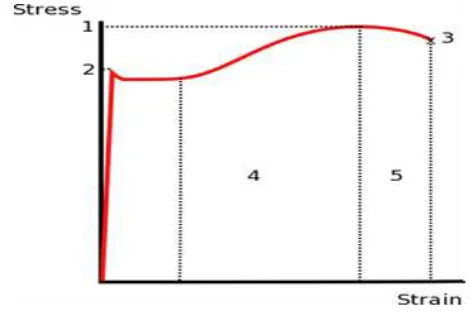
The stress-strain curve characterizes the behavior of the material which is to be tested. It is mostly plotted using engineering stress and strain measures, because the reference length and cross-sectional area are easily measured. Stress-strain curves generated from tensile test results helps for engineers gain insight into the constitutive relationship between stress and strain for a particular material. The constitutive relationship can be thought of as providing an answer of the following question after given a strain history for a specimen, what is the state of stress? As we see, even for the simplest of materials, this relationship may be very complicated. In addition to provide quantitative information that is useful for the constitutive relationship, the stress-strain curve can be used to qualitatively describe and classify the material. Typical regions observed in a stress-strain curve are
[1] Elastic region [2] Yielding
[3] Strain Hardening [4] Necking and Failure
A stress-strain curve with each region will be identified is shown below. The curve has sketched using the assumption that the strain in the specimen is monotonically increasing - no unloading occurs. It would also be emphasized that a lot of variation from what's shown is possible with real materials, and each of the above regions will not be so clearly delineated. It will be emphasized that the extent of each region in stress-strain space is material dependent, and that not all materials exhibit all of the above regions.
Fig -1: Stress vs. strain diagram
4.1 Yield Strength
The yield point defined as the stress at which a material will try to begin to plastically deform. Prior to the yield point the material will be deformed elastically and will return to its original shape when the applied stress is removed. Once the yield point is passed some amount of the deformation will be permanent and non-reversible. Knowledge of the yield point is very important when designing a component since it generally represents an upper limit to the load that can be applied. It was very important for the control of many materials production techniques such as forging, rolling, or pressing. In structural engineering, yield is the permanent plastic deformation of a structural member when it goes under stress. This is a very soft failure mode which does not normally cause catastrophic failure unless it accelerates buckling. It is difficult to precisely define yield due to the wide variety of stress-strain behaviors’ exhibited by real materials. In addition there is other possible ways to define the yield point in a given material. Yield occurs when dislocations first begin to move.
4.2 Elastic Limit
The lowest stress at which permanent deformation can be measured this requires a complex iterative load-unload procedure and is critically dependent on the accuracy of the equipment and the skill of the operator.
4.3 Proportional Limit
There is a point at which the stress-strain curve may be nonlinear in most metallic materials the elastic limit and proportional limit are essentially the same.
4.4 Yield Point
When the stress is too large, the strain deviates from being proportional to the stress. Yield point is the point at which this happens is because there the material yields, deforming permanently.
4.5 Yield stress
Hooke's law is not valid beyond the yield point. The stress at yield point is always called yield stress, and is an important measure of the mechanical properties of materials. In practice, the yield stress is chosen as that causing a permanent strain of 0.002, which called as proof stress.
4.6 Steel
[image:3.595.41.278.577.733.2]© 2019, IRJET | Impact Factor value: 7.34 | ISO 9001:2008 Certified Journal
| Page 259
Steel has a large number of variants which possess large range of properties. Hence, selection of most appropriate type of steel is very important. Medium-carbon steel alloys are composed of predominantly the element iron, and contain a small percentage of carbon (0.25% to 0.45%, described as 25 to 45 points of carbon), along with combinations of several alloying elements, the mix of which has been carefully designed in order to produce specific qualities in the target alloy, including harden ability, Nitride-ability, surface and core hardness, UTS, yield strength, endurance limit (fatigue strength), ductility, impact resistance, corrosion resistance, and temper embrittlement resistance. The alloying elements usually used in these carbon steels are manganese, chromium, molybdenum, nickel, silicon, cobalt, vanadium, and sometimes aluminum and titanium. Each of those elements adds specific properties in a given material. The carbon content is the main factor to decide of the ultimate strength and hardness to which such an alloy can be heat treated.
4.7 Aluminum
Aluminum is an excellent machinability metal. It is light weight and can take complex shapes easily. Moreover, it can absorb vibration very efficiently. The history of the industry such as light metal as that of many other industries in this century is one of notable and ever accelerating expansion and development. There are few people today who are not familiar with at least some modern application of aluminum and its alloys. The part it plays in our everyday life is such that it is difficult to realize that a century ago the metal was still a comparative misty. The excellent corrosion resistance of pure aluminum was large due to its affinity for oxygen; this results in the production of a very thin but tenacious oxide film which covers the surface as soon as a freshly-cut piece of the metal is exposing to the atmosphere. This oxide coating has great significance in the production of practically every type of surface finish for the metal. It was, of course, the basis of what was probably the most corrosion-resistant finish of all, namely, that group of finishes which involves the technique of anodic oxidation in its varied forms. Here, the natural film is, in effect, greatly thick and strength due to electrochemical means. On the other hand, the tenacity of the natural oxide film is a serious adverse factor in the production of other finishes, such as those based on electrodepositing, and also, but to a lesser extent, the organic finishes, as it must be removed or transformed before the alternative coating can be successfully applied. Special techniques have had to be evolved to affect this.
5. MATERIAL SELECTION BY FINITE ELEMENT ANALYSIS
5.1 Tool Used
Here Ansys 16.0 is used for analyzing natural frequencies and static deflection. CAD modeling is done in Catia software and .stp file were imported in ANSYs for analysis. Ansys Mechanical software is a very comprehensive FE analysis
(finite element) tool for structural analysis, including linear, nonlinear and dynamic studies. The engineering simulation product always provides a complete set of elements behavior, material models and equation solvers for a wide range of mechanical design problems. In addition, ANSYS Mechanical always offers great thermal analysis and coupled-physics capabilities involving acoustic, piezoelectric, thermal–structural and thermo-electric analysis. With a solid foundation of element and material technology, ANSYS structural analysis software offer different type of advanced modeling methods for different kinds of applications. In addition, ANSYS finite element analysis (FEA) tools offers great advanced capabilities that enable simulation of a variety of physics phenomena, such as thermal–stress, electromechanical, structural–acoustics, mass diffusion and simple thermal–fluid analysis.
5.2 Static Analysis
A static structural analysis always determines the displacements, stresses, strains, and forces in structures or components caused by loads that do not induce significant inertia and damping effects. Steady loading and response conditions are to be assumed; that is, the loads and the structure's response are assumed to vary slowly with respect to time. A static structural load can be performed using the ANSYS solver.
5.3 Geometry Details
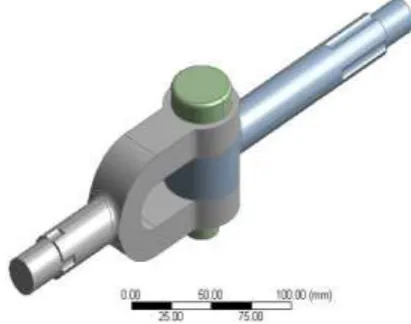
CAD Modeling of any project is very time consuming process. One can’t shoot directly from the form sketches to Finite Element Model. CAD (Geometry) Modeling is the base of any project. Finite Element software will be considered for shapes, whatever is made in CAD model. CAD modeling of the knuckle joint is performed by using Catia.
[image:4.595.343.549.532.694.2]© 2019, IRJET | Impact Factor value: 7.34 | ISO 9001:2008 Certified Journal
| Page 260
5.4 Contact
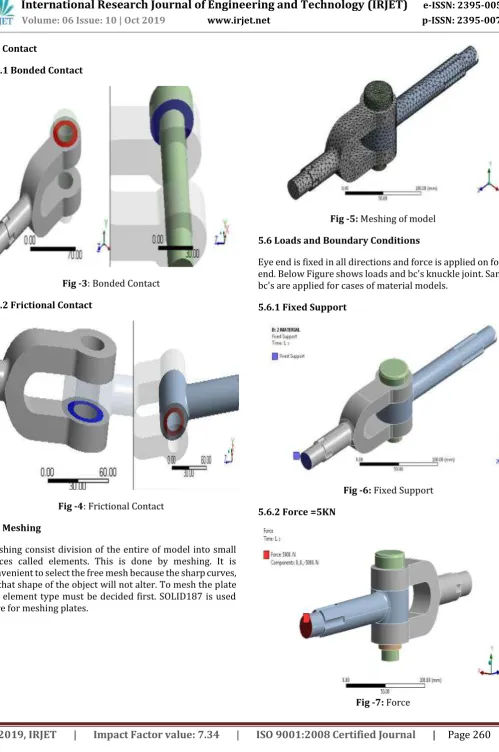
5.4.1 Bonded Contact
Fig -3: Bonded Contact
5.4.2 Frictional Contact
Fig -4: Frictional Contact
5.5 Meshing
Meshing consist division of the entire of model into small pieces called elements. This is done by meshing. It is convenient to select the free mesh because the sharp curves, so that shape of the object will not alter. To mesh the plate the element type must be decided first. SOLID187 is used here for meshing plates.
Fig -5: Meshing of model
5.6 Loads and Boundary Conditions
Eye end is fixed in all directions and force is applied on fork end. Below Figure shows loads and bc's knuckle joint. Same bc's are applied for cases of material models.
5.6.1 Fixed Support
Fig -6: Fixed Support
[image:5.595.50.550.51.804.2]5.6.2 Force =5KN
[image:5.595.40.323.72.554.2] [image:5.595.312.558.354.780.2]© 2019, IRJET | Impact Factor value: 7.34 | ISO 9001:2008 Certified Journal
| Page 261
[image:6.595.41.564.69.338.2]5.6.3 Force =50KN
Fig -8: Force
6. RESULT
6.1 Von Mises Stress Plot
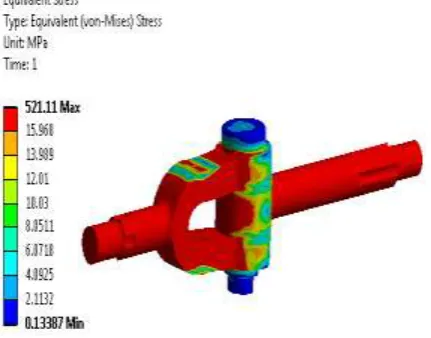
In figure 9 shows Von mises stress plot of Aluminum alloy. Here red color indicates maximum stress, while blue color indicates minimum stress. From the above figure it is clear that maximum stress in single eye is at inner face where we select bonded contact and hence we are not select that stress for analysis.
Fig -9: Von Mises Stress Aluminum
6.2 Total Deformation
Table -1: Stresses in knuckle joint
Sr.
No. Material Von Mises Stress (MPa) Material Yield Strength Eye Fork Pin
1 Structural
Steel 80 33 63 250
2 AL Alloy 79 32 62 280
[image:6.595.237.552.93.309.2]3 Teflon 79 33 58 105
Table -2: Total deformation of selected material
Sr. No. Material Total Deformation(mm) 1 Structural Steel 0.053
2 AL alloy 0.144
3 Teflon 20.537
7. CONCLUSIONS
Aluminum alloy and Teflon shows very less weight as compare to other material but Teflon have a less strength. Hence FOS is less as compare to aluminum alloy so that we choose aluminum alloy as a best optimize material by using FEA. The total deformation is aluminum alloy is less as compare to Teflon material. The von misses stresses is less aluminum alloy as compare to Teflon and material strength is high.
Knuckle joint was analysis for five different materials.
[image:6.595.50.266.457.626.2]© 2019, IRJET | Impact Factor value: 7.34 | ISO 9001:2008 Certified Journal
| Page 262
Steel FOS are higher than min requirement of 3, however the material cost and mass of steel is higher compared all other material.
Steel and CI having similar FOS and mass of knuckle also seems comparative and hence both materials were not recommended.
AL material is sustaining tensile loading of 50KN with min FOS of 3.5
Deformation of steel and AL material are very less co pared to Teflon and CI.
Material cost of Teflon is less compared all other material along with FOS and hence Teflon will not be good material even having less mass.
AL is having highest FOS and less mass compared to steel and CI and hence based FEA study we recommended to manufacture knuckle joint in future with AL material.
8. REFERENCES
1. B.D. Shiwalkar, (2011), Design of Machine Element, S Chand Publishers, Delhi.
2. Prof. Swati Datey, Amit A. Rangari, Adarsh A. Dongre, Kunal A. Paraskar, Sanket V. Lidbe, Analysis of Knuckle Joint used in Mahindra 575 DL, IJARIIE-ISSN(O)-2395-4396, Vol-3 Issue-2 2017.
3. “DIAMETER AND SPIRAL THICKNESS OPTIMIZATION OF KNUCKLE JOINT USING NEURAL NETWORK” Pankaj Dulani, Rungta College of Engineering & Technology, Bhilai, Chhattisgarh, India S. A. K. Jilani Professor, Rungta College of Engineering & Technology, Bhilai, Chhattisgarh, India Vol-3 Issue-2 2017 IJARIIE-ISSN(O)-2395-4396
4. “EVALUATION OF USING HIGH STRENGTH LOW ALLOY STEEL FOR DESIGN OF KNUCKLE JOINT” Engr. Dr. Fathi Abusa, Associate Professor, Department of Mechanical Engineering, AL-Zaytona University, Libya Engr. Dr. Fuzi Abusa A lecturer, Department of Mechanical Engineering, AL-Murgab University, Libya
5. “FE ANALYSIS OF KNUCKLE JOINT PIN USEDIN TRACTOR TRAILER” Dinesh Shinde and Kanak Kalita Department of Mechanical Engineering, MPSTME, SVKM’s NMIMS, Shirpur Campus, Dhule, Maharashtra, India.
6. “STUDY AND ANALYSIS OF PIN OF KNUCKLE JOINT IN TRAIN” Ravindra S. Dharpure, M. Tech.,PCE, Prof D. M. Mate, PCE, Nagpur.
7. “MODELING AND ANALYSIS OF KNUCKLE JOINT” Shaik .John Bhasha M.Tech Student,Department of Mechanical Engineering, Visakha Technical Campus, Narava. Hari Sankar Vanka Asst. Professor, Department of Mechanical Engineering, Visakha Technical Campus, Narava.
8. “STUDY & ANALYSIS OF KNUCKLE JOINT WITH THE REPLACEMENT OF MATERIAL BYUSING TEFLON” Nishant Vibhav Saxena Assistant Professor, Department of Mechanical Engineering, MITS, Bhopal, MP Dr. Rohit Rajvaidya Professor, Department of Mechanical Engineering, BUIT, Bhopal,MP.
9. Kiran S.Bhokare, G.M.Kakandikar, Swapnil S. Kulkarni, Predicting the fatigue of steering knuckle arm of a sport utility vehicle while deploying analytical techniques using cae, International Journal of Scientific Research and Management Studies(IJSRMS) , Volume 1 Issue 11, pg: 372-38.
10. Nipun Kumar, Dr. GianBhushan, Dr. Pankaj Chandna, Analysis of Knuckle Joint of Various Materials using CAE Tools, International Journal of Engineering Technology, Management and Applied Sciences, January 2017, Volume 5, Issue 1, ISSN 2349-4476.
9. BIOGRAPHIES
Mr. Somase Anil Ramesh B E Student S.N.D C.O.E. & R.C Yeola
Mr. Dhole Sumit Madhukar B E Student S.N.D C.O.E. & R.C Yeola
Mr. Bhavsar Urvesh Pramod B E Student
S.N.D C.O.E. & R.C Yeola
Mr. Shinde Tejas Pravin B E Student S.N.D C.O.E. & R.C Yeola
© 2019, IRJET | Impact Factor value: 7.34 | ISO 9001:2008 Certified Journal
| Page 263
Prof. Bhavsar Pritesh C Asst. Professor S.N.D C.O.E. & R.C Yeola