Power, data and knowledge in
development sector impact evaluation
activities: critically engaging with the
impact iceberg
Paul Kelly
HighWire Centre for Doctorial Training
Lancaster University, UK
This thesis is submitted for the degree of Doctor of Philosophy
Dedicated to
“My point is not that everything is bad, but that everything is dangerous, which is not exactly the same as bad … If everything is dangerous, then we always have something to do. So my position leads not to apathy but to a hyper- and pessimistic activism.”
Declaration
I declare that the content of this thesis is my own work and that this has not been submitted in any form for the award of a higher degree elsewhere.
Excerpts
Excerpts from this thesis have been used in the following publications, presentations, conference manuscripts and academic publications.
Simeonova, B., Karanasios, S., Galliers, R. D., Kelly, P., & Mishra, J. (2018b). Where is Power in Information Systems Research? Towards a Framework. International Conference on Information Systems (ICIS), 13-16 December 2018, San Francisco, US.
https://aisel.aisnet.org/icis2018/behavior/Presentations/10/
Simeonova, B., Karanasios, S., Galliers, R. D., Kelly, P., & Mishra, J. (2018a). New ways of organising in collaborative knowledge sharing: examining the effects of power. European Group for Organizational Studies Colloquium (EGOS), 5-7 July 2018, Tallinn, Estonia. Kelly, P. (2018). An activity theory study of data, knowledge, and power in the design of an international development NGO impact evaluation. Information Systems Journal, 28(3), 465-488. https://doi.org/10.1111/isj.12187
Hayes, N., Introna, L. D., & Kelly, P. (2017). Institutionalizing Inequality: Calculative practices and regimes of inequality in international development. Organizational Studies, 39(9), 1203-1226. https://doi.org/10.1177%2F0170840617694067
Kelly, P. & Larner, J. (2016). Using activity theory to understand the design patterns visible in circulations of knowledge and data in the 3rd sector. Invited presentation at the Centre for Research, Activity & Learning (CRADLE), 21 April 2016,University of Helsinki, Finland. Kelly, P. (2016). Impact knowledge supply chains and activity theory: A story of power, knowledge, a philanthropy and a small NGO. European Group for Organizational Studies Colloquium (EGOS), 7-9 July 2016, Naples, Italy.
Kelly, P. (2015). Our need to talk about power & knowledge in evaluation & policy cultures.
Secker, E. & Kelly, P. (2015). Quick and Dirty M&E: Co-designing and co-evolving for engaged impact. Youth | Participation | Impact Conference, 2-4 September 2015, University of Manchester, UK.
Kelly, P. (2015). Evaluating impact, or the impact of evaluations? NGOs, donors and ontological politics in an activity theory study of power dynamics in international development.
European Group for Organizational Studies Colloquium (EGOS). 2-4 July 2015, Athens, Greece.
Kelly, P. & Cowen, M. (2014). CHAT & Governmentality: The uniform in the management and activities of migrant workers. European Group for Organisational Studies Colloquium (EGOS), 3-5 July 2014, Rotterdam, Netherlands.
Hayes, N. & Kelly, P. (2014). Impact Assessment in the Development Sector and Sociomaterial Rankings. Invited presentation at the Information Systems and Innovation Group, London School of Economics, London, UK.
Abstract
The study opens with a simple observation: International Development is now a digitally data/knowledge intensive sector. This mundane remark suggests development has also become a rich domain for studying how power, data and knowledge are related. In data/knowledge intensive development, our ideas about impacts may appear empirical and objective, based on data and expertise, and often digitally immaterial. However, these ideas involve power and politics which shape data desires and data cells, knowledge products, packaging and pitching, governing processes and digital systems. Such dynamics place demands upon agents like non-government organisations (NGOs), transforming them from an old emphasis on tangible and physical relief, such as providing medicine, food, or clothes to those in need, to constructing and exchanging digital data and expert impact products in diverse development markets and bureaucracies. Processes, like impact evaluation are caught up in this shift to data/knowledge intensity and the power relations, inequalities and silences that accompany the shift. This study elucidates these power/data/knowledge relations, specifically with regard to impact evaluation itself, but more broadly regarding data/knowledge intensive development, or what some observers have christened “development 2.0”.
Two bodies of literature are relevant to the study. Firstly, the normative discourse on how-to-do evaluation, and secondly, critical perspectives which acknowledge power and politics, and
exchangeable, legitimate impact products. The expert NGO case shows how this is effectively and instrumentally done, but the novice NGO case reveals the struggles and transformations required to become expert evaluators in development 2.0. Both cases reveal a range of silences, inequalities, assumptions, omissions, priorities, and opportunities which are part of contemporary impact evaluation mechanics.
Three contributions are offered in response to impact power/data/knowledge problems. The first contribution, to evaluation literature, is the “impact iceberg”. This is a diagnostic, big picture tool which describes contemporary legitimate impacts, and amplifies the illegitimate edited-out impacts, those silenced or submerged under the iceberg waterline. The second contribution is a set of four provocative conceptual devices which audit evaluation practice and power, namely: “data/knowledge networks”, the “6P sensitivities”, the “impact spectrum”; and the “datamentality/datamateriality” oppositions. These concepts contest conventional audit cultures which align evaluation power and control towards managerial, commercial, digital, and expert domains. The final contribution is “critical engagement”, a methodological proposition, which tests and brokers critiques in engagements with research partners to see if and how they are accepted, rejected, or adapted in NGO evaluation practices.
Acknowledgements
This work is funded by the Digital Economy programme (RCUK Grant EP/G037582/1), which supports the HighWire Centre for Doctoral Training (http://highwire.lancs.ac.uk).
I would like to express gratitude to the following people, organisations and groups that have supported the research with feedback, guidance, financial and emotional support. The Lancaster University William Ritchie Award, Erasmus Fund, and the Faculty of Science and Technology Graduate School supported my conference attendances and presentations. The conference communities at LAEMOS, three EGOS Colloquia, Lancaster Sociology Conference, and the Youth Participation Impact conference provided me with quality feedback and positional pointers. I received excellent input and ideas when I visited the London School of Economics Information Systems and Innovation Group, and my trip to the Centre for Research on Activity, Development and Learning (CRADLE) at the University of Helsinki was a pivotal experience shaping the thesis story.
Furthermore, I have been inspired by the work of all the non-profit organisations I encountered between 2012-2017. These included an arts centre in Cumbria (UK), a credit union (UK), a child rights NGO (UK and Nigeria), a Christian NGO (UK and Uganda), a sustainable development initiative in the Mekong region of Southeast Asia, a design-oriented NGO (Myanmar), and the two NGOs in the thesis: Rural India and HTSG Thailand (pseudonyms).
Advice, conversation and inspiration from friends, colleagues and staff at Lancaster University’s HighWire Centre and the Management School encouraged and sustained me.
Special gratitude is reserved for Tish Brown, and my supervisors: Dr Daniela Sangiorgi, Dr Stephen Clune, Professor Mike Chiasson, Dr Mark Rouncefield, and especially Professor Niall Hayes. Thank you for your guidance. Sincere thanks is also due to Professor Gordon Blair.
Contents
List of Tables 14
List of Figures 15
List of thesis terms and abbreviations 18
List of Appendices 21
1 Introduction: Power in data/knowledge intensive impact evaluation 23
1.1 Development 2.0 impact evaluation 23
1.2 Motivation 26
1.3 Research approach and themes 29
1.4 Contributions 32
1.5 Study context: history and demands 33
1.6 Structure 38
2 Literature: From technical to critical impacts 41
2.1 Introduction to the review 41
2.2 Technical impact evaluation knowledge (TIEK) 43
2.3 Critical configurations 53
2.3.1 Critical configurations of evaluation 53 2.3.2 Critical configurations of NGOs 59 2.3.3 Critical configurations of governing and anti-politics 68 2.4 Sharpening the focus on evaluation practices 78
3 Theory: Evaluation foundations - from DIKW to the 6Ps 83
3.1 The conceptual foundations of impact evaluation 83 3.2 Power as part of data/knowledge intensity 86 3.2.1 Power in IS, KM and Development Studies 86 3.2.2 Positioning practice and power in data/knowledge construction 89
3.3 Dislodging the DIKW foundation 91
3.3.2 Data, information and knowledge as assets and products 92 3.3.3 From products to processes 95 3.3.4 Criticisms of the DIKW legacy in Knowledge Management 99 3.4 The 6P Sensitivities: an alternative perspective 102
3.4.1 Reviewing the assumptions, omissions and configurations 102 3.4.2 An alternative – the 6P sensitivities 105 3.5 Towards the 6Ps for critical engagement 114
4 Approach and Design: critical engagement 116
4.1 Introduction 116
4.2 Critique, engagement and a middle ground 118 4.3 CHAT as a framework for critical engagement 123
4.3.1 Introduction to CHAT 123
4.3.2 CHAT and engagement 124
4.3.3 CHAT and practice: activities and contradictions 128 4.3.4 CHAT and power: temporal chains, submerging and elevating 134
4.3.5 CHAT’s role in the study 136
4.4 Research Design 137
4.4.1 Research aims and the CHAT perspective 137 4.4.2 Research questions, NGO cases, and case selection criteria 138 4.4.3 NGO Case 1: context, access, timeline, methods and data 141 4.4.4 NGO Case 2: context, access, timeline, methods and data 144
4.4.5 Data analysis 148
4.4.6 Limitations, generalisations, ethics, security and anonymity 149 4.4.7 Reflecting on CHAT as part of critical engagement 150
4.5 Learning about critical engagement 153
5 NGO Case 1: Rural India and Imagine UK, expert impact-makers 155
5.1 Introduction 151
5.2 Case setting 156
5.3 Empirical section 157
5.3.2 Early-cycle activities: Assembling an impact machine 159 5.3.3 Mid-cycle activities: Making cells, making clamour 162 5.3.4 Late-cycle activities: Packaging data, bundling expertise 170 5.3.5 Late-cycle activities: Pitching impact data/knowledge 174
5.4 Analysis section 177
5.4.1 Activity systems and two contradictory impacts 173 5.4.2 Temporal activity chains, submerging and elevating 180 5.4.3 Re‐embedding power and practice in evaluation 184
5.5 Summary of implications 185
6 NGO Case 2: HTSG Thailand, novice impact-makers 190
6.1 Introduction 190
6.2 Case setting 191
6.3 Empirical section 192
6.3.1 Early-cycle activities: Needing to learn many impacts 192 6.3.2 Early-cycle activities: Struggling to assemble a machine 196 6.3.3 Mid-cycle activities: Learning to make cells and stories 207 6.3.4 End-cycle activities: Learning to package for audiences 213 6.3.5 End-cycle activities: Learning to pitch what to who 217
6.4 Analysis section 221
6.4.1 Activity systems and two contradictions 222 6.4.2 Temporal activity chains, submerging and elevating 227
6.5 Summary of implications 231
7 Discussion 236
7.1 Introduction 236
7.2 Contribution 1: The impact iceberg 238
7.2.1 Configuring the iceberg 238
7.2.2 Above the waterline 240
7.2.3 Below the waterline 246
7.2.4 From critique to engagement 262
7.3 Contribution 2: Audit 2.0 devices 262
7.3.2 Data/knowledge dyads, chains and networks 264
7.3.3 The 6P sensitivities 274
7.3.4 The impact spectrum 279
7.3.5 Datamentality and datamateriality 282 7.4 Contribution 3: Critical engagement 285
7.4.1 CHAT tensions and responses 287
7.4.2 Critical engagement: tensions and responses 290 7.4.3 Eight tactics for critical engagement 293
7.5 Stepping back to see broad impacts 295
8 Conclusion 296
8.1 Introduction 296
8.2 Review of argument 298
8.3 Limitations 303
8.4 Further research 305
8.5 The impact of evaluation 309
References 313
List of Tables
Chapter 3
Table 3.1: DIKW / KM assumptions and omissions, and critical configurations 103
Chapter 4
Table 4.1: Description of kinds of activity system contradictions 132 Table 4.2: Overview of Rural India / Imagine Case 1 data, August 2013 - March 2014 143 Table 4.3: Overview of HTSG Case 2 data, May 2014 - December 2016 146
Chapter 6
Table 6.1: Plans drafted in final workshop for 2015 evaluation activities 202 Table 6.2: Excerpt from 2013 December Report 217
List of Figures
Chapter 1
Figure 1.1: Development 2.0 demands for impact data/knowledge 38
Chapter 2
Figure 2.1: Evaluation in results-based management (UN Women, 2015: 7-8) 50 Figure 2.2: Impact chain from inputs to impacts (UN Women, 2015: 8) 51 Figure 2.3: Groves’ model for impact evaluation results sharing (2015: 2) 51
Chapter 3
Figure 3.1: Development impact evaluation foundations align with DIKW 85 Figure 3.2: Typical DIKW model, with data as the foundation for knowledge 92 Figure 3.3: The DIKW view of data as processed to make information and knowledge 96 Figure 3.4: Inverse DIKW, where knowledge is required before making data 97 Figure 3.5: Where are power or politics in DIKW and Knowledge Management? 102 Figure 3.6: Where are power or politics in impact evaluation practices? 103
Chapter 4
Chapter 5
Figure 5.1: Questions to be included in the 2013-2014 household survey 160 Figure 5.2: The cell, a basic and bounded container for impact data 163 Figure 5.3: Data rearranged into mundane columns (left) and rows (right) 164 Figure 5.4: Example of data captured and stored in spreadsheet software 165 Figure 5.5: Data on specific agricultural practices of female farmers 166 Figure 5.6: Example of qualitative profile from Rural India project report 168 Figure 5.7: Transcript excerpt showing pitching activities 175 Figure 5.8: Activity system and contradictions in the Rural India evaluation process 179 Figure 5.9: Evaluation illustrated as a temporal chain of activities 181 Figure 5.10: Submerging and elevating along the temporal activity chain 183
Chapter 6
Figure 6.1: Healthcare Project stakeholder map. Thai photograph and English translation 200 Figure 6.2: Notes on survey and interview plans. Thai photograph, English translation 201 Figure 6.3: Stakeholder question cards. Thai photograph, English translation 201 Figure 6.4: Healthcare Annual Report (2014) - figures not used to show impacts 204 Figure 6.5: Report showing parent volunteer self-assessment performance metrics 205 Figure 6.6: Healthcare data used for monitoring, but not for demonstrating impacts 207 Figure 6.7: Data in 2011 report used to describe general context, not impacts 208 Figure 6.8: Excerpt from 2011 Healthcare report show outcomes, but not impacts 209 Figure 6.9: House fire fund request memo. Site photographs, English translation 211 Figure 6.10: HTSG project profile of two local teachers 216 Figure 6.11: HTSG-1 activity system. Focus on engagement and project management 224 Figure 6.12: The activity system of HTSG-2, a data/knowledge intensive NGO 226 Figure 6.13: HTSG’s temporal chain of impact evaluation activities 229 Figure 6.14: Submerging and elevating in HTSG’s evaluation activity chain 230
Chapter 7
Figure 7.2: DIKW and TIEK prescribe data to make results for decision-making 265 Figure 7.3: Basic evaluation dyad of two agents constructing impact data/knowledge 266 Figure 7.4: The aid chain involves further actors and activities 267 Figure 7.5: Generic temporal activity chain showing kinds of evaluation activities 269 Figure 7.6: Network of agents related to development impact evaluation 272 Figure 7.7: Network of agents and indications of their activities and outcomes 273 Figure 7.8: The 6Ps shape impact data, information, knowledge and wisdom 276 Figure 7.9: The impact spectrum showing solid versus messy qualities 280 Figure 7.10: What has been learned about critical engagement from the study? 286 Figure 7.11: Critical engagement requires critical brokering tactics 294
Chapter 8
List of thesis terms and abbreviations
Audit 1.0 / Audit Culture – a form of auditing that has spread in managerialist approaches to development work, which classifies and monitors organisational inputs and outputs to re-distribute control towards managerial stakeholders, often using statistical metrics.
Audit 2.0 – a form of auditing, novel to this thesis, which refocuses auditing processes on multi-stakeholder dialogue, power relations and closer understandings of practices, away from distal standardisation, decision-making, data capture and surveillance frames.
Critical Configurations – a term used to analyse evaluation processes from a broad socio-political perspective. The term “configurations” speaks to patterns and relations rather than linear causes and effects. The term “critical” highlights concerns about power and inequality.
CDS – Critical Development Studies, an academic sub-discipline, highlighting mainstream development omissions, particularly around power, post-colonialism and inequality.
CHAT – Cultural Historical Activity Theory (also Activity Theory), a broad range of related approaches to social science research and development, with shared roots in 1920-1930s Soviet social psychology, particularly work by Lev Vygotsky and Aleksei Leontyev.
Critical engagement – a research approach adopted in this thesis, which focuses on how critical perspectives are interpreted, adopted, adapted or rejected by research partner practitioners as part of their own work practices.
Development 2.0 – a phrase originally denoting data intensive and social media impacts in development, and here explicitly extended to indicate increasing data/knowledge intensity, digital representations, and globally scaled circulations of development data/knowledge products in the sector.
Data/knowledge – a term used to denote data/knowledge intensity, and to foreground the demand for empirical and digital data sets and professional technical knowledge as key components of these intensities.
DS –Development Studies, an academic discipline focused on development in global and local contexts; emerged in 1950s-1960s after the Second World War and during postcolonial shifts.
E-development – a term used in academic and practitioner communities to denote the use of information systems in managing development interventions, programs, and projects.
HTSG Thailand – pseudonym used to label the NGO in the second case study, chapter 6.
ICT4D – Information and Communications Technology for Development, a relatively new discipline with parentage in Information Systems and Development Studies.
ICT4D 1.0 – term used by observers to denote 1990s approaches to using ICTs in development, to make development more effective, or efficient, but not to radically change development.
ICT4D 2.0 – term used by observers to denote uses of ICTs from the 2000s, which support participatory, grassroots and locally owned development processes using digital technologies.
Impact Governing – term used to denote the application of technical evaluation methods and results in framing or explicitly controlling the work of development agents, such as NGOs.
Impact Iceberg – a term and contribution to evaluation literature, which outlines which kind of impact concerns and products are rendered audible, above the waterline in contemporary impact evaluation, and which are rendered silent, under the waterline
Impact Marketing – term used to denote the use of impact data/knowledge, in reports, arguments, visualisations and other media, to highlight success, win funding and improve reputational status
IS – Information Systems an academic discipline focused on the design, use and impact of diverse information systems in the contemporary world, involving technical and social concerns.
Input/output meta-model – terms used to focus on how technical impact evaluation methods have come to highlight managerial and expert definitions and intervention inputs and outputs, which frame evaluation concerns, results, relationships and practices.
Knowledge Management / KM – academic and practitioner field which focuses on models and ways of capturing, storing, sharing and using knowledge, predominantly within contemporary organisations.
KM4D – Knowledge Management for Development, an emerging sub-field of largely development sector professionals, consultants and academics doing Knowledge Management in or focusing on development contexts.
NGO – Non-Government Organisation, part of the third sector, an organisation not privately or publicly owned.
Power/data/knowledge – a term used to indicate the interrelations between power, data and knowledge during their construction, application and circulation in the development sector.
Rural India – pseudonym used to label the Indian NGO in the first case study, chapter 5.
TIEK – Technical Impact Evaluation Knowledge, a term used to denote technical, professional and expert, often scientific or participatory, definitions, methods and prescriptions on how to do evaluation. A largely normative discourse.
List of Appendices
Appendices 362
Appendix 1: Participant Information Form 363
Appendix 2: Participation Agreement Form 364
1
Introduction: Power in
data/knowledge intensive
impact evaluation
1.1 Development 2.0 impact evaluation
practice and power in development. They shape what data is captured, edited and discarded, and what knowledge is packaged, ignored, exchanged or pitched, in pervasive development processes, such as impact evaluation.
Impact evaluation is one of many pervasive development processes that illustrates these power/data/knowledge relations well. Development evaluation discourse, like development finance, is dominated by relatively few large knowledge producers such as The World Bank, the United Nations, USAID, DIFD, large international NGOs (INGOs), and universities. This contrasts with the thousands, or millions, of small NGOs working around the globe (Lewis & Kanji, 2009), who come to consume aid finance, data/knowledge prescriptions, and demands for impact results. They exchange impact results for funding and reputation opportunities (Wallace et al, 2006). Development impact evaluation is particularly problematic because of these uneven data/knowledge edits and flows, and the evaluation discourses that regulate what impacts can or should be, from far away.
Yet mainstream discourses, such as technical impact evaluation knowledge (hereafter “TIEK”), ignore such inequalities, and instead continue to prescribe rigorous methods and robust result frames for NGOs to adopt. Such prescriptions presume access to digital technologies and the often ideological benefits of embracing TIEK. Normative technical evaluation discourse has become part of the wider data/knowledge1 shift, evident in calls for a new, modern and
emancipatory view of development based on digital technologies. This call has been characterised as “development 2.0”. It is founded on the integration of diverse information and communications technologies (ICTs) into development processes at the level of state funding and specific initiatives (Thompson, 2004: 2; Thompson, 2008). With these technology foundations, development 2.0 appears to widen our knowledge of poverty and marginalisation, making development faster, more efficient, more impactful, and somehow digitally immaterial.
Diverse benefits are claimed in this modernist, technology-centric discourse. Development 2.0 increases connectivity, participation, co-creation, collaboration, pluralism, involvement in governance, and policy-making (Leadbetter & Cottam, 2007; Thompson, 2008), and
1 The terms “data and knowledge” or “data/knowledge” are used regularly to highlight digitisation and
challenges old development (Thompson, 2008: 825-826). Heeks (2008; 2010) highlights how the assumptions, structures and processes of development are changing. Development 2.0 will connect the excluded, support collective power and bring new opportunities for work, entrepreneurs and businesses (ibid, 2010). Quaggiotto (2007) claims traditional aid i.e. “development 1.0”, is in crisis, in need of renewal, new intelligence, and aid equivalents of digital organisations like Amazon or eBay. Quaggiotto advocates freeing data, failing quickly (2009), and overcoming the already apparent development 2.0 inertia of “cultural resistance” to modern technology (2010).
Transitions towards such data/knowledge intensity and development 2.0 are paralleled in the promise of e-development and consulting models, focused on more efficient, effective understanding of aid problems and solutions because of technologies, private sector solutions and digital data (Brigham & Hayes, 2013: 112). In these often uncritical views, modern technologies, data analytics, and knowledge management have become instrumental for progressive impact. They fix where old development failed. Such promises are part of the latest wave of development modernisation discourse, following shifts from colonial to technical discourses in the 1950s and 1960s (Kothari, 2005a), and NGO shifts from grassroots innovation to global service providers in the 1980s and 1990s (Wallace et al, 2006). Now is the turn of digitisation and data/knowledge intensity.
Critical voices have already warned against neglecting the power relations and inequalities generated in shifts towards increasing dependence on digital data, information and knowledge (Avgerou, 2002: 55; Hayes & Westrup, 2014: 20; Walsham, 2001: 56; Feldman and March, 1981; Orlikowski and Baroudi, 1991). But these voices have often been marginal in academic fields, and all but ignored in practitioner-oriented literatures. These concerns span Development Studies (DS), Information Systems (IS), Information and Communications Technology for Development (ICT4D), Knowledge Management (KM), and Knowledge Management for Development (KM4D). This thesis, in an effort to critique the technical or modernist promise, elucidates how data/knowledge-intensive practices can generate power relations, inequalities, omissions, and assumptions, and how they can marginalise different kinds of knowledge, knowing, and knowers (Blackler, 1995).
agents, NGOs, and evaluators, from big data to crowdsourcing, e-development to mobile for development (M4D), each involving complex architectures, specialisms, and new practices. Many of the specialisms are new, but some reach back into previous decades. The history of evaluation dates back to the 1950s (Barrow, 2000), and today’s varieties focus heavily on the impact of policies, programs, projects and interventions (Roche, 1999; Wallace et al, 2006; Mohr, 1995). Impact evaluation is data/knowledge intensive, one process among many that contributes to the broader development 2.0 shift. It features diverse kinds of data - empirical, raw, processed, and cleaned. It also features information, knowledge, and evidence of diverse kinds: statistics, cells, formulas, methods, principles, graphs, stories, vignettes, narratives, voices, claims and representations of all kinds. Robust representations are demanded in an often vicious (Roche, 1999: 2) or volatile (Picciotto, 2012: 213) aid sector. And competing paradigms prescribe diverse practices from scientific to participatory, democratic, neoliberal, bureaucratic or autocratic evaluations (Picciotto, 2015; Duflo and Kremer, 2005; Macdonald, 1993; Norris, 2015).
Addressing the power/data/knowledge winners and losers, silences and sounds, assumptions and omissions in development impact evaluation is the focus of this study. Given that established institutional voices, from the World Bank, to the IMF, large International NGOs and so forth, are already loud, there is a need to find quieter voices that enunciate the realities of diverse evaluation practices, rather than global or institutional impact agendas. This need led to a study focus on small, local NGOs who were doing evaluation work. It turns out, that small NGOs doing impact evaluation, sometimes succeeding, sometimes struggling, tell us much about power, data, knowledge dynamics in development 2.0.
1.2 Motivation
a third and fitting justification for this study concerns how development evaluation work is itself made up of impactful practices and governing relations, regardless of documented representations or published results. This study looks at the impact of (doing) evaluation, rather than the evaluation of impact, at what evaluations do, not what they say. The everyday practices of impact evaluation are not traditionally the subject of documentation, representations, reports, immaterial digital data or expert knowledge exchanges. However, this everyday evaluation work is where power relations and inequalities are generated.
This justification for the study implicates the critical importance data/knowledge intensive work practices. For example, how new information systems can generate organisational conflicts (Markus, 1983: 438), or how information behaviours, of individuals and organisations, are not limited to decision-making alone (Feldman & March, 1981: 175). Although such decision-making may be seen as intellectual, rational or immaterial, it requires diverse performances and practices, people carrying, hiding or showing information, organisations hoarding gluts of information to demonstrate capabilities, and many uses of information, such as justifying actions in retrospect. In ICT4D, Walsham (2001: 57–58) highlighted the importance of studying power in these diverse practices. Brigham and Hayes (2013: 27) described how a mix of technologies and conceptual models in e-development shape evaluation and perceptions of NGOs from a distance. They argue that what appear to be professional values and efficiencies can function in practice as Trojan horses for neoliberal exploitation. Such works suggest one cannot fully understand power in data/knowledge intensive work without looking at work practices.
In fact, ignoring power and practice obfuscates evaluation issues around politics, inclusion, effectiveness, efficiency and equality. Thus, it is vital to incorporate power and practice in understanding processes like impact evaluation. Data and knowledge in this view are particular, physical, unequal, social, political and material parts of processes, embedded in databases, heads, laptops and papers, circulating in aid organisations and networks. They are not immaterial, purely digital, apolitical or universal. Therefore, this study looks at the ways in which data and knowledge are material and narrow, as opposed to broad or immaterial in popular techno-determinist views and development 2.0 promises.
borrows from Foucauldian inspired literatures on governmentality (Foucault, 1979/2000; Ferguson, 1990; Escobar, 1995/2011; Li, 2007) and developmentality (Lie, 2015a; Ilcan and Philips, 2010; Hayes et al, 2017), related concerns around audit cultures (Strathern, 2000; Harper, 1998; Porter, 1996; Power, 1996; Townley, 1995), new public management and new development management (Hood, 1995; Kerr, 2008; Dar & Cooke. 2008), and critiques of information, data and knowledge models (Blackler, 1995; Tuomi, 1999; Lambe, 2011; Fricke, 2009; Beer, 2018; O’Neill, 2016). These literatures are important because they help us shed light on the politics of knowledge, evidence, evaluation and development today (Eyben et al, 2015; Gardner & Lewis, 2015: 179; Parkhurst, 2017). The study goes on to highlight the assumptions and omissions often excluded in TIEK literature, particularly normative scientific or participatory literatures. As we shall see, evaluation machines generate not just legible results showing scientific causes of impact, but also evaluation silences, changes to agents like small NGOs, and diffused power relations in evaluation networks.
Thus, the motivation and justification for the study is that during the shift to data/knowledge intensive process like evaluation, and development 2.0 more broadly, important literatures (e.g. ICT4D, KM4D, Evaluation and Development Studies) have not fully addressed the unequal, silent, power dynamics of such work. Why should researchers, managers, evaluators, NGOs, donors, beneficiaries, or activists be concerned about such lacunas? The answer is because our work contributes to the silences, politically and actively, our mundane, everyday, professional activities, from selling impacts in reports or on websites, to analysing data sets. The study advocates an alternative view of evaluation, which contrasts with expert led TIEK and widespread data/knowledge management models. This is because such prescriptions and models fail to identify or respond to the diffused power dynamics inherent in networks of evaluation practices.
1.3 Research approach and themes
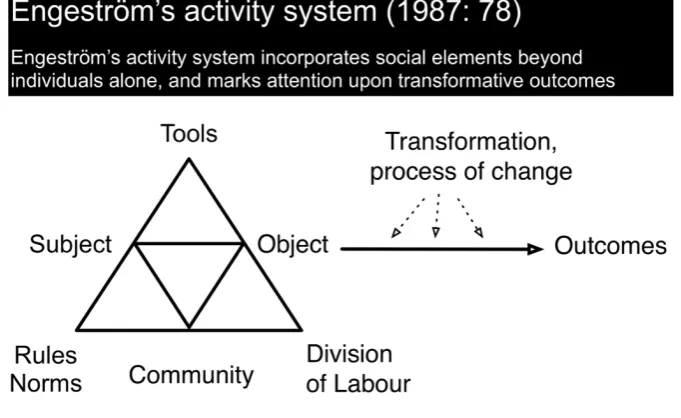
The approach taken involved understanding what small NGOs did when they performed evaluations, describing their activities and analysing how their actions generated unequal data, knowledge and power relations. Cultural Historical Activity Theory (CHAT) (Engeström, 1987; Blackler, 1993; Karanasios and Allen, 2013) was selected as an approach that could support both engagement with NGOs, and critical analysis of their activities. The approach stemmed from a need to both consult and research, via an exchange of evaluation advice and research access between the partner NGOs and the author. This approach shares some similarities with action research. It is termed Critical Engagement in the study, outlined in chapter 4 and reviewed in chapter 7.
total of fifteen days which included six workshops. Workshops were led by the author to train the novice NGO on impact evaluation. This case ran from May 2014 to December 2016.
One early question guided the start of the first NGO case collaboration in 2013. This early question was: How is development NGO impact evaluation shaped and performed in practice?
By early 2014, as the research matured in terms of the literature, empirical cases, and the theoretical and methodological frame, a more specific view emerged concerning NGO impact data/knowledge construction and the simultaneous generation of power dynamics. This resulted in a more precise problem space, a single overarching question, and three more specific research questions. These were:
• Overarching question: Does development impact evaluation include power relations? Under this, the three specific questions were:
1. How is impact evaluation data/knowledge constructed at small development NGOs, in practice?
2. Are / how are power relations generated during impact evaluation data/knowledge construction at small development NGOs?
3. Can / how can power relations be addressed and responded to in impact evaluation data/knowledge construction practices at small development NGOs?
The approach, questions and first case NGO engagement shaped a number of core themes in the thesis. These were: the adoption of a socio-political perspective on evaluation; practice as the unit of analysis; and power as the object of study.
A second theme is the foregrounding of social or organisation practices. In order to understand the relationships between power, data and knowledge as they are constructed or generated in situ with study participants, the practice-oriented view was essential. Practice-based views focus on rich descriptions of everyday activities, of participant lifeworlds, actions, routines or performances, not logical deductions, economic models, or sociological categories (Reckwitz, 2002: 244-247). In this view, knowledge and data in cases are not considered as verbal, textual or statistical representations alone (Miettinen et al, 2009: 1312), but as elements within people’s activities, as tools to be used to do something. This meant the research paid attention to what NGOs do with evaluation knowledge and data, rather than whether this data is scientifically valid, or that knowledge empowering.
Finally, a third theme is power. Power can be understood in diverse ways, as hierarchical, as restrictions or power over, as productive or power to (Clegg, 1989; Clegg et al, 2006), or as relational (Foucault, 1980; Escobar, 2011; Avgerou, 2002; Walsham, 2000: Blackler, 2011; Simeonova et al, 2018b). In this study, power is viewed as relational, as potentially productive and destructive, as relations that are enacted in specific practices, rather than as economic or cultural resources, held by some individuals, but lacking in others. Power in this study is also seen as inextricably related to data, knowledge, prescriptions and results. This view of power as part of professional evaluation practices means power is often silent or unobtrusive (Blackler, 2011), not recognised as power by participants. This contrasts with views of power as resistance, or part of open conflicts, (Korpelo, et al, 2004), or development battlefields (Long & Long, 1992).
1.4 Contributions
There are three principal contributions in the study. These are the “Impact Iceberg” diagnostic tool, “Audit 2.0” devices for understanding power and practice in data/knowledge intensive work, and “Critical Engagement” as an approach to exploring critical insights with research partners.
The Impact Iceberg is a big picture, diagnostic tool, which conveys sector wide impact evaluation challenges. The iceberg positions evaluation within wider sector data/knowledge flows in order to make explicit how current evaluations elevate some kinds of knowledge (e.g. efficiencies, cause/effect attributions, policy influence), yet submerge or silence other kinds of impact knowledge e.g. how NGOs are being transformed, how evaluation is becoming more technical, digital and market oriented, and how professional norms enact governing controls over evaluations. The iceberg is a contribution to the body of evaluation literature.
The second contribution comprises four novel auditing concepts, or Audit 2.0 devices. These devices contrast with “Audit 1.0”, defined in the discussion chapter as audit culture perspectives which exert control and surveillance functions over those audited. In contrast, audit 2.0 focuses squarely on power and practice, to make these controlling functions visible and actionable. The four audit 2.0 devices are: data/knowledge chains and networks; the 6P data/knowledge sensitivities; the impact spectrum; and datamentality/datamateriality. These are conceptual contributions to evaluation and data/knowledge management theory and practice. They contrast with TIEK and widespread data/knowledge management legacy models, discussed in the theory chapter, that submerge power and practice. Tools, checklists and discussions can draw on the audit 2.0 devices to inform and scaffold more reflective, critical or sensitive evaluation processes.
The three contributions collectively speak to a view of “as-Practice”. Evaluation-as-practice contrasts with mainstream views of evaluation as scientific endeavours or participatory intent. Evaluation-as-practice offers alternative ways of thinking about impacts and data/knowledge products that circulate in development 2.0, seeing them not just as results or products, but as process and practices in which power and politics are key features and concerns. The literature, theory and approach chapters outline the foundations for each of the contributions respectively – the impact iceberg, audit 2.0 devices, and critical engagement. Each contribution is then fully articulated in the discussion chapter. The thesis contributions elevate power and practice back above the iceberg waterline as legitimate and uncomfortable concerns for those involved with development impact evaluation work specifically, and data/knowledge intensive work more broadly.
In terms of key thesis literatures and audiences, Thompson’s (2008: 833) research agenda for development 2.0 is insightful because it highlights the need for interdisciplinary collaboration across Information Systems and Development Studies communities. Following Thompson, key audiences for the thesis and contributions are: Development Studies and Evaluation researchers and practitioners; Information Systems and Knowledge Management researchers and practitioners, particularly Information and Communications Technology for Development (ICT4D) and Knowledge Management for Development (KM4D); Cultural Historical Activity Theory researchers and others using approaches to social practice and power relations; Development sector practitioners, observers, or activists who wish to collaborate with, develop alternatives to, or contest evaluation processes and claims.
1.5 Study context: history and demands
The historical context of increasing data/knowledge intensity in development, NGO work, and impact evaluation, as well as examples of the contemporary demands for impact knowledge, are sketched below. These are indicative accounts, not exhaustive, but they show the growing intensities and set in motion the thesis focus on how evaluations are configured by more than scientific searches for impact causes or participatory zeal, as claimed in much TIEK.
parades of new knowledge arise, often attempting to de-centre an apolitical economic narrative and promising to open up issues of power and participation. Leal’s waves feature 1960s post-colonial community development, Cold War modernisation discourse, 1970s integrated rural development, 1990s participatory development, capacity building and human rights, poverty reduction in the 2000s, and today’s sustainability discourse2. Leal concludes that the “five
glorious decades of development” since the world wars illustrate how “development has failed to fix underdevelopment and has maintained the status quo” (Leal, 2007: 539-540). A key problem is that such knowledge fashions don’t recognise one of their recent ancestors, empire (Kothari, 2005a). The fashions all feature a need-to-know the other, performed in distinct ways. For example, in Malinowski’s colonial policy advice (Lewis, 2005); British government financed anthropology in East Africa (Peacock & Dosser, 1958)3; the establishment post World
War Two of Development Studies courses and journals4 (Sumner, 2006: 649); modern
management’s roots in imperial command and control (Prasad, 2003); how national economies have origins in colonial economics (Mitchell, 2002: 6); how research methods like action research can be tainted with colonizing intents (Cook, 2005); and how even technology design can reinforce colonial relations (Irani et al, 2010). However, as new fashions emerge and data/knowledge intensities spread, recognising such continuities means dealing with uncomfortable relations of power, data and knowledge.
Secondly, NGO data/knowledge intensity is historically growing, unequal, and concentrated in large, northern NGOs (De Haan, 2008: 69)5. During the period of World Bank structural
2 Other examples include De Haan (2009: 69-88) who describes a 1950-1960s focus on “kickstarting economies”,
1970s resource redistribution, 1980s structural adjustment, 1990s governance and poverty reduction, and a broadening results agenda since 2000; or Moyo (2009) who depicts the rebuilding of European infrastructure in the aftermath of World War Two, 1960s industrialisation, 1970s poverty reduction, 1980s stabilisation and structural adjustment, a 1990s buttress for democracy, and the “present day obsession with aid as the only solution to Africa’s myriad of problems” (ibid: 10).
3 See the British funded Colonial Development and Welfare Act 1925 that influenced East Africa operations
(Peacock & Dosser, 1958); also National Income Accounting (Sumner, 2006: 645, footnote 6)
4 Titles: Economic Development and Cultural Change (1952), Development (1957), Journal of Development
Studies (1965), Development and Change (1970), World Development (1973) (Sumner, 2006: 649).
5 There are over 47 types of NGO (Najam, 1996: 206; Lewis & Kanji, 2009: 9) and 85% of funding goes to large
adjustment, the Washington Consensus, and the opening up of global markets in the 1980s (Williamson, 1990), NGOs were donor’s “favoured child” because of their grassroots innovations (Bebbington et al, 2008). However, in the mid 1990s development refocused on state service provision, and governance (Banks & Hulme, 2010: 6). By the mid 2000s, criticisms grew concerning NGO roles in wider institutional structures (Gill, 1997; Bebbington, 2004: 732), how aims bent towards donors, compliance, reporting, service models, and away from community interests. Successful NGOs expanded, hiring professionals and specialists, applying business, marketing and capacity building models, often at the expense of participatory goals6 (Flyvie & Ager, 1999: 1395; Korten, 1990). Such shifts towards
compliance, professionalisation and business orientation mean that NGOs, particularly successful INGOs, have become data/knowledge intensive, through increased reporting, capacity building, advocacy, business management, global networks, communications and evaluation. Yet the data/knowledge inequalities and power relations within such historical shifts remain marginal and uncomfortable to deal with.
Thirdly, similar data/knowledge intensities have accelerated in impact evaluation itself. The discipline dates back to 1950s predictive techniques which evolved into formal approaches, such as Environmental Impact Assessment (EIA), Social Impact Assessment (SIA) and Social Cost Benefit Analysis (SCBA) (Barrow, 2001; Roche, 1999: 18). By the 2000s, there was an explosion in new approaches, from inductive or process accounts, to community dynamics, utilisation-focused evaluations and impact pathway analysis (e.g. Patton, 1997; Coffman, 2002; Estrella, 2000; Springer-Heinze et al, 2002)7. These featured alternatives to pre-set indicators,
such as network analysis, outcome mapping (Earl et al, 2001), or mixed-methods (Picciotto,
6 One example in terms of data/knowledge intensity and business orientation is the Red Cross, founded in 1863,
originally to send rations, medicine and tobacco to soldiers (Bugnion, 2009: 3). It is now a $3 billion plus global federation. Similarly, CARE originally sent millions of packages containing “staples such as butter, dried milk, canned meat, and sometimes even chocolate and chewing gum” (CARE, 2016) to Europe after World War Two. Then, CARE saw poverty as a need for “basic goods, services and healthcare”. Today, their understanding is much more conceptual: “… poverty is often caused by the absence of rights, opportunities and assets, largely due to social exclusion, marginalization, and discrimination” (ibid).
7 Between the 1970s and the 2000s, a great many evaluation models evolved, for example: the “logframe” as
2012). Importantly however, donors remained largely unaware of the benefits of participatory or qualitative evaluation (Norrish & Sayce, 2004: 152-153), instead favouring experimental designs, such as randomised control trials (RCTs) (Picciotto, 2012: 215).
Many have applauded the increasing method diversity and increasing use of ICTs and digital data, as part of “new routes” for evaluation (Norrish & Sayce, 2006: 146-7; also, Lefebve and Lefebve, 1996; Heeks, 2002a, 2002b; Stoll et al, 2002). However, Jerven (2014) estimated the Sustainable Development Goals (SDGs) will cost $15 billion to evaluate, and the Millennium Development Goals (MDGs) would have cost $27 billion. Such figures led Jerven (ibid: 16) to question the need for more and more digital data, and UN’s data revolution claims (e.g. UN IEAG, 2014).
Accompanying these historic data/knowledge intensity trajectories are diverse contemporary demands for development impact data/knowledge. These are rarely seen as problematic in technical evaluation discourse. Seven examples are indicated below, and each suggests impact evaluation involves more dynamics than scientific or participatory claims alone.
A first set of demands is direct results. Since the 1990s, NGOs have had to show increasing results, outputs, outcomes and impacts (Roche 1999; Wallace et al, 2006; Norrish & Sayce, 2006). Such results focus on “accounting for funds and highlighting achievements” (Wallace et al, 2006: 40). Governments also mandate evaluations (e.g. DFID, 2003: 139-140; 2002).
Second, demands follow the emergence of technical development discourse in the 1950s-1960s (Escobar, 2011; Kothari, 2005a; 92), and increasing subspecialisms today, from UN cluster systems8 to specific sub-field evaluation forms, such as evaluation in Communications for
Development (C4D) (Lennie & Tacchi, 2013), Gender Responsive evaluation (UN Women, 2015; UNDP, 2006; Bustelo & Espinoza, 2015) or ICT4D (Heeks & Molla, 2009).
Third, demands concern how impacts must align with specific project and programme aims and goals. Project data and knowledge are routinely benchmarked to specific funder niches, global standards such as the 17 Sustainable Development Goals (SDGs) and their
8 UN cluster systems prescribe fine grained specialisations, separating emergency management tasks into
accompanying 169 subtargets (United Nations, 2016a, 2016b), or to any of the thousands of predefined, often highly complex, data indicators available (e.g. World Bank, 2016a, 2016b). Such goals shape impacts, despite the lack of evidence on the ability of targets to guarantee progressive impacts (Stiglitz, 1999: 587-8; Sandbrook, 2011; 421; Puri, Sahay & Lewis 2009; Walsham, Robey & Sahay, 2007).
Fourth, demands to manage risk. UK government aid budgets have been used to manage national risks such as refugees (BBC News, 2015) or to deliver lucrative trade agreements (Swinford, 2016). Leading aid agencies also fight global health risks, such as Ebola (USAID, 2016). Further risks include terrorism, corruption, climate threats, and military conflicts. One problem that results is that more data, information and knowledge collected to manage risk can counter-intuitively lead to new risks and less control (e.g. Ciborra, 2006: 1354) 9.
Fifth, technological demands relate to the increasing importance and visibility of information systems in development (Avgerou, 2002; Walsham & Sahay, 2006: 7). This involves the need to adopt new software systems (e.g. Kenny, 2014: 12), e‐development (Brigham & Hayes, 2013), mobile for development (M4D), big data for development (BD4D), or other diverse ICT innovations in development (Karanasios, 2014; Walsham, 2001), and thus in evaluations.
Sixth, narratives demonstrating participatory impacts have also become more important in aid communications. Participation conveys moral concern and democratic engagement, and adds value to positive media messages (Kontinen, 2007; Wallace et al, 2006: 31). Even those who call for qualitative, contextual data, human centred design or community empowerment, are therefore demanding more evaluation data/knowledge10.
Seventh, and most significantly, are demands to show successes in aid funding markets. After the turn to market liberalism to deliver development in the 1980s (Mohan & Stokke, 2000:
9 A further risk problem is how professionals and resources are mobilised to fix “over there” challenges when
risks are identified as belonging to developing nations. For Dean (2010: 202), such operations leads to reconfiguring societies as “quasi-markets” using risk management, mitigation, and expertise. The role of such expertise may not be to empathise, cure or care, but to measure and reduce risk (Miller & Rose, 2008: 107-108).
10 There is little consensus on defining participation (Long, 2001), however a key concern is whether it is authentic
248), NGOs had to “learn the new paradigm” (Wallace et al, 2006: 163), even though observers suggested that NGOs had become “too close for comfort” with funders (Banks, Hulme & Edwards, 2015: 707; Hulme & Edwards, 1996). This means NGOs remain under pressure to demonstrate impacts to funders in order to survive, often on overtly commercial terms (Davies, 1997a: 616; 1997b: 5).
Figure 1.1: Development 2.0 demands for impact data/knowledge
These diverse sets of sector demands all contribute to increasing development 2.0 data/knowledge intensity. However, they do not foreground or provide responses to the unequal power relations that are generated by the emergence and acceleration of such data/knowledge intensities.
1.6 Structure
This section orients the reader to the structure and main points of each of the thesis chapters.
motivation, approach, core themes and research questions are described. Key audiences and final contributions are outlined, and the historical and contemporary context is sketched, before this thesis structure preview.
Chapter 2: Literature review - describes two contrasting areas of development impact evaluation literature. The first literature domain is normative “technical impact evaluation knowledge” or TIEK. This literature concerns goals, methods and prescriptive discourse to support aid organisations in performing impact evaluations. The second domain concerns critical perceptions on development evaluation. This literature contrasts with TIEK, and deals with problems related to prescriptive discourse, how evaluations, NGOs and power relations unfold in practice and change over time. These issues are termed “critical configurations”.
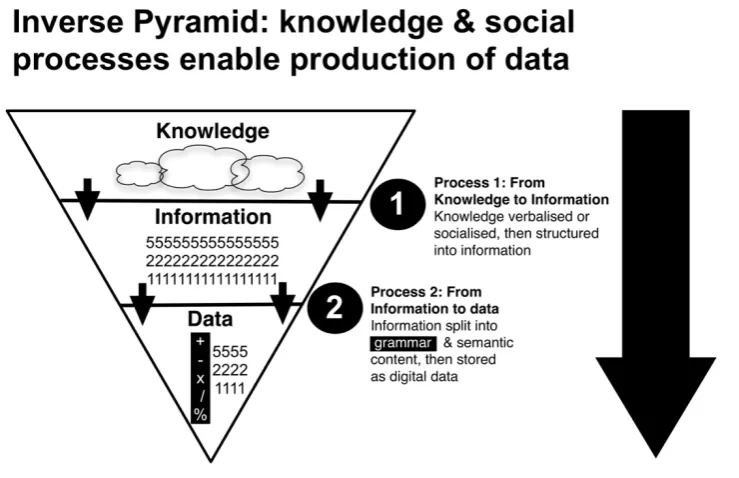
Chapter 3: Theory - builds on problems identified in the literature around the lack of theoretical grounding for power, data and knowledge relations in TIEK. The “DIKW Pyramid”, a widespread and implicit model of data, information, knowledge and wisdom is found to implicitly underpin contemporary evaluation models. An alternative view of impact data/knowledge relations involving products, processes, power, political participation and practice, the “6P Sensitivities”, is proposed because DIKW and TIEK elide the diffusion of power and practice in evaluation networks, aid chains and critical configurations.
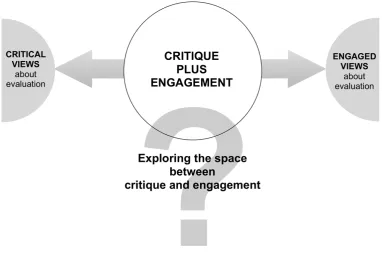
Chapter 4: Approach and Design - outlines a critical and engaged research stance, explains the rationale, and justification for using Cultural Historical Activity Theory (CHAT) to operationalise critical engagement in the study. CHAT’s framework for engaging research partners and for critiquing power and practice via activity systems, contradictions and temporal chains of activities is described. The chapter explains the research design, why the author selected two NGO cases for the study, access to research partners, and how data was analysed. The result is a comparative and qualitative CHAT study of two NGO case collaborations between 2013 – 2016, and a framework for exploring the ground between scholarly critique and pragmatic engagement.
associated with farmer lifeworlds (Impact-1), and one digitally documented and represented kind of impact deployed in marketing efforts (Impact-2). Power relations are generated as impact data/knowledge is incrementally edited along a temporal chain of evaluation activities, with illegible local voices and contexts edited out or submerged, and managerial, marketing and data management concerns expertly elevated by the NGO and philanthropy.
Chapter 6: NGO Case 2 HTSG Thailand - features the second NGO as a novice impact evaluator, lacking guidance and resources. The empirical section describes the NGOs learning, struggling and transformations. The analysis section articulates the activity systems, contradictions and temporal chains. However, in this case two contradictions are pertinent, between two kinds of impact as in the first case, and two forms of the NGO. HTSG are transforming from an old version of themselves into a new data/knowledge intensive NGO. The temporal chain illustrates the changes, elevations and submerging of different notions of impact, and the transformation towards, but not reaching yet, impact expertise. HTSG’s confusion and lack of data/knowledge capacity are key case results.
Chapter 7: Discussion –this chapter builds on the CHAT analysis and results concerning how power is generated in small NGO evaluation data/knowledge construction activities, to arrive at three contributions. The first contribution is to the evaluation body of literature and concerns the big picture narrative of the Impact Iceberg, where certain impact results become legitimate, and others illegitimate, silent, submerged under the waterline. The governmental and developmental processes in todays’ development 2.0 landscape identified in the literature are revisited, and seen to configure the iceberg. The second contribution is conceptual and pragmatic, labelled as Audit 2.0 devices, and challenges TIEK models and the DIKW legacy. The devices are: firstly, data/knowledge chains and networks; secondly, the 6P Sensitivities; thirdly, the Impact Spectrum; and fourthly, the contrasting notions of Datamentality and Datamateriality. The third contribution is Critical Engagement. This is reviewed as a way of taking critiques of power into the wilds of evaluation practice. Together, the contributions are advocated are elements in seeing evaluation-as-practice, which contrasts with scientific, business pragmatic, technology-centric, or participatory views of evaluation.
Chapter 8: Conclusion - reviews the key goals and core arguments of the study, describes a series of limitations, and lists future research options. It recaps how the study has articulated
2
Literature: From technical to
critical impacts
2.1 Introduction to the review
Firstly, section 2.2 describes TIEK through illustrative examples of prescriptions, specifications, evaluation methods, and impact results as part of organisational information flows. This literature concerns how to evaluate impact, how to evaluate well, and how to define what impacts are or can be (e.g. Mohr, 1995; Roche, 1999; Earl et al, 2001; Picciotto; 2012; 2015; Duflo & Kramer, 2005; Davies & Dart, 2005; Chambers, 1994; Pattern, 2014; Heeks & Molla, 2009). TIEK is a technical and professional discourse which incorporates a wide range of normative or prescriptive claims. It concerns approaches, methods and models, on how to ensure methods are rigorous and data is robust. This literature is a resource from which development sector organisations draw on, in order to know how to make legitimate impact data/knowledge, when to do it, who can do it, and how to define it. The section concerns what works in impact evaluation, for impact evaluators.
Secondly, section 2.3 explores how development impact evaluation is more broadly configured (e.g. Wallace et al, 2006; Norrish & Sayce, 2004; Anderson et al, 2004; Mosse, 2004a; Eyben et al, 2014; Gardner & Lewis, 2015; Banks & Hulme, 2012; Sumner, 2006; Ilcan & Phillips, 2008; Long & Long, 1992; Lie, 2015; Ferguson, 1994). These critical configurations speak not to the normative prescriptions of TIEK, but its circulations, the affects and drivers, the consequences of using, adopting, applying and mobilizing TIEK in development. The configurations concern not how best to evaluate, but what happens when we do evaluate. It is about the impact of evaluation in contrast to TIEK’s focus on the evaluation of impact. The section covers configurations related to evaluation itself, to NGOs, and to the political governing processes of impact evaluation.
2.2 Technical impact evaluation knowledge (TIEK)
The word impact may convey a brutal image of a “hammer hitting a surface” (PARC, 2004; Norrish & Sayce, 2006: 1), but impact evaluation is much more subtly and technically shaped through academic discourse and industry publications. Roche’s important work with development NGOs in the late 1990s, led him to consider different definitions of impact assessment, foregrounding systemic analysis and the attribution of causes as central concerns:
“Impact assessment is the systematic analysis of the lasting or significant changes - positive, negative, intended or not - in people’s lives brought about by a given action or series of actions” (Roche, 1999: 21).
In contrast, Earl’s Outcome Mapping, published by the Canadian International Development Research Centre (IDRC), highlighted learning and accountability as central (Earl et al, 2001). The International Food Policy Research Institute (IFPRI, 2002) based in Washington D.C. prescribed eight considerations: a) scale, attribution and time, b) supply versus demand approaches, c) importance of surprise, d) indicators, e) methodological issues, f) time lags, g) ex ante assessments, and h) ex post assessments
The Organisation for Economic Co-operation and Development (OECD), Development Assistance Committee (DAC), a global body promoting development evaluations11, published the influential “Glossary of Key Terms in Results Based Management” in 2002, and the “Principles for Evaluation of Development Assistance” in 1991. Their definitions became the “most widely shared” and the “best” according to Stern (Stern et al, 2012: 5; Stern, 2015: 4). DAC defined impact as: “positive and negative, primary and secondary long-term effects produced by a development intervention, directly or indirectly, intended or unintended” (OECD DAC Glossary, 2002). The principles stated:
“An evaluation is an assessment, as systematic and objective as possible, of an on-going or completed project, programme or policy, its design, implementation and results. The aim is to determine the relevance and fulfilment of objectives, developmental efficiency, effectiveness, impact and sustainability. An evaluation
11 DAC became part of OECD on 23 July 1961. It is an international forum of large aid funders, with 29 members
should provide information that is credible and useful, enabling the incorporation of lessons learned into the decision-making process of both recipients and donors.” (OECD DAC, 1991: 5)
The principles also stipulated that evaluations should: “improve future aid policy, programmes and projects through feedback of lessons learned and provide a basis for accountability, including the provision of information to the public” (OECD DAC, 1991: 5)
The International Initiative for Impact Evaluation (3ie) is another prominent voice in development impact evaluation, founded in 2008 and funded by the Bill & Melinda Gates Foundation, the William & Flora Hewlett Foundation and UKAID (3ie, 2016). 3ie have traditionally focused their definition on the use of experimental research designs to attribute changes to program interventions. They state impact evaluations constitute: “A study of the attribution of changes in the outcome to the intervention. Impact evaluations have either an experimental or quasi-experimental design” (3ie Impact Evaluation Glossary, 2012: 5).
These formations are primarily concerned with two key issues: firstly, the need to produce impact data and knowledge, and secondly how to primarily use impact data and knowledge to inform organisational decision-makers. Underlying these definitions is a view of evaluations as delivering knowledge as “products” (Mosse, 2004a: 81), as granulated chunks of data, information or knowledge, passed on to decision-makers such as policy makers, programme managers, and sometimes the general public.
Along with defining impacts, prescribing evaluation specifications is another way of framing how to plan, design or conduct robust evaluations and collect empirical data. Specifications speak to the number of people in evaluation teams and required credible evaluator skills and professional experience (UNDP, 2002: 55; Roche, 1999: 61). Recent studies have attended to who is involved and to what extent, such as in how to include commissioners, managers or beneficiaries in evaluation processes (Stern, 2015; Groves, 2015).
important evaluation specifications that frame what kind of approach to take, what data becomes available, and how legitimate the data may be.
Evaluation thinking and concepts are also targets of technical discourse. Publications prescribe requirements for making evaluations empirically robust, and for applying theories of change (Vogel, 2012: Anderson, 2006). TIEK includes guides for conducting formative research to understand context, establishing counterfactual scenarios, contrasting baselines with end line studies, defining beneficiaries, specifying outcome variables, and deploying quantitative methods (e.g. White, 2009: 7; Puri et al, 2014: 6).
Furthermore, impact evaluation includes temporal prescriptions too, with specific practices deployed at different times or in different sequences. Feasibility and predictive studies are done ex-ante, before interventions commence (Roche, 1999; Barrow, 2000). Baseline studies are done either before or at the beginning of projects to capture inception data for later comparisons (Roche, 1999; Puri et al, 2015). Monitoring is continual, through a project lifecycle (Puri et al, 2015). Mid-term impact evaluations are formative and enable reviews for changes to plans and indicators. Ex post facto evaluations are summative, done at the end, soon after, or even years after project completion.
It may appear that such technical specifics relate to a methodological mythology (Norrish & Sayce, 2004), however these complex specifications constitute real results, interactions and effects. For example, one temporal aspect is the sensitivity of indicators to often rapidly changing measures such as in humanitarian emergencies where dehydration or diarrhea can become a matter of life and death for a child (Puri et al, 2015: 21). Technically therefore, the right activity at the right time with the right data aligns with prescriptions and contributes to real impacts on real lives. As such, people, teams, experience, independence, concepts, thinking, approaches, and timing are all important technical elements that have consequences, results and influence evaluation configurations.