SLO-ML: A Language for
Service Level Objective Modelling in Multi-cloud Applications
Abdessalam Elhabbash
[email protected] School of Computing and Communications
Lancaster University, UK
Assylbek Jumagaliyev
[email protected] Zühlke Engineering Ltd., UK
Gordon S. Blair
School of Computing and Communications Lancaster University, UK
Yehia Elkhatib
School of Computing and Communications Lancaster University, UK
ABSTRACT
Cloud modelling languages (CMLs) are designed to assist customers in tackling the diversity of services in the cloud market. While many CMLs have been proposed in the literature, they lack practical sup-port for automating the selection of services based on the specific service level objectives of a customer’s application. We put forward
SLO-ML, a novel and generative CML to capture service level require-ments and, subsequently, to select the services to honour customer requirements and generate the deployment code appropriate to these services. We present the architectural design ofSLO-MLand the associated broker that realises the deployment operations. We rigorously evaluateSLO-MLusing a mixed methods approach. First, we exploit an experimental case study with a group of researchers and developers using a real-world cloud application. We also as-sess overheads through an exhaustive set of empirical scalability tests. Through expressing the levels of gained productivity and ex-perienced usability, we highlightSLO-ML’s profound potential in enabling user-centric cloud brokers. We also discuss limitations as application requirements grow.
CCS CONCEPTS
•Computer systems organization→Cloud computing; •
Soft-ware and its engineering→Domain specific languages.
KEYWORDS
Cloud Computing, Cloud Modelling Languages, Domain Specific Language, Service Level Agreements, Service Level Objectives
ACM Reference Format:
Abdessalam Elhabbash, Assylbek Jumagaliyev, Gordon S. Blair, and Yehia Elkhatib. 2019. SLO-ML: A Language for Service Level Objective Modelling in Multi-cloud Applications. InProceedings of the IEEE/ACM 12th Inter-national Conference on Utility and Cloud Computing (UCC ’19), December 2–5, 2019, Auckland, New Zealand.ACM, New York, NY, USA, 11 pages. https://doi.org/10.1145/3344341.3368805
Permission to make digital or hard copies of all or part of this work for personal or classroom use is granted without fee provided that copies are not made or distributed for profit or commercial advantage and that copies bear this notice and the full citation on the first page. Copyrights for components of this work owned by others than ACM must be honored. Abstracting with credit is permitted. To copy otherwise, or republish, to post on servers or to redistribute to lists, requires prior specific permission and/or a fee. Request permissions from [email protected].
UCC ’19, December 2–5, 2019, Auckland, New Zealand
© 2019 Association for Computing Machinery. ACM ISBN 978-1-4503-6894-0/19/12. . . $15.00 https://doi.org/10.1145/3344341.3368805
1
INTRODUCTION
The growth of the cloud market poses a challenge to its customers who are already overwhelmed with a wide choice of services [8]. The scale as well as heterogeneity of the range of offerings and their real time performance variation are adding more complexity to the de-cision of cloud service selection [22, 26], particularly in multi-cloud applications [27].
Firstly, thescaleof cloud services is rapidly growing as more services are offered in the market. A survey of the number of the main cloud providers showed that 198 instance types were offered in 2017 compared to 134 in 2015 [13]. The number of instance types on offer from Microsoft Azure alone increased more than three times between 2015 and 2017.
Secondly, providers adoptheterogeneousways to describe in-stance specifications, pricing, and service level objectives (SLOs). For instance, Microsoft Azure Cosmos DB and AWS DynamoDB are largely equivalent NoSQL cloud services. They both express the availability SLO1in terms of the error rate, i.e. the percentage of failed requests during a billing month. However, Cosmos DB error rate is calculated in one-hour intervals whereas DynamoDB measures it in five minute intervals.
Thirdly,unexpected performancemay result in substantial financial losses. Recent analysis of some cloud instances shows that performance levels are inconsistent with the promised offer-ings [3, 15, 19, 24]. For example, as reported in [27], the performance of a standard workload on an AWSc4.xlargeinstance is quite the same as that ofc4.largealthough the former is twice both in specification and cost of the latter.
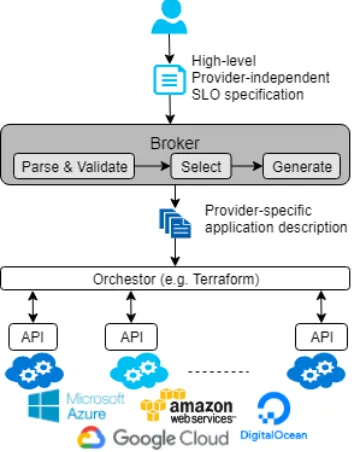
In view of the above challenges, the process of manually select-ing the optimal service can overwhelm a human decision maker. In order to make it easier for customers to select services and deploy applications, cloud modelling languages (CMLs) were proposed (e.g. [6], [23], [17],[25],[20], [28]). They provide means for composing a high level description of a cloud application topology, then auto-mate their deployment accordingly. Such description, also known as Infrastructure as a Code (IaC), declaratively represents the ap-plication architecture, interactions, and the types of required cloud services. An orchestrator can then utilise the IaC model to deploy the application on the cloud, as illustrated in Fig. 1.
Figure 1: The general architecture of an IaC-based system for semi-automated cloud application deployment.
There are, however, two main drawbacks with current CMLs. First, they lack the support for automated cloud service selection. Cus-tomers first need to identify the service(s) they need, which is chal-lenging due to scale and heterogeneity as discussed. Second, there is a lack of support for modelling SLOs of cloud applications. Customers need to manually compare cloud provides service level agreements (SLAs) in order to select a service based on the required SLOs. A few of the current CMLs support such modelling but through standards that are designed primarily for web service providers to specify their services levels, which is unsuitable for use by cloud customers.
In this paper, we aim to address the aforementioned challenges of scale and heterogeneity in addition to the SLO modelling gap. Our aim is to assist cloud customers in selecting cloud services by achiev-ing interoperability between the provider SLAs and the CMLs. Our approach is to base the selection on provider guarantees regarding service performance. That is, we aim to make selection decisions based on a set of SLOs that are part of the SLAs. However, this re-quires a customer-oriented language for SLO specification and an engine that realises a SLO-driven selection of cloud services.
Therefore, we propose a design of a new language for SLO mod-elling,SLO-ML, that provides a comprehensive syntax for capturing service level requirements, supporting all SLOs currently used by IaaS providers and those specified in industry standards. Through theSLO-MLapproach, we aim to raise the level of abstraction pro-vided to cloud customers. We adopt a generative language approach whereby customers specify SLOs (i.e. developSLO-MLscript) for required cloud services regardless of the low level details of those services. Then, theSLO-MLscript will be translated into deployment code that is utilised by the orchestrator to deploy.
In addition, we present the architecture of a cloud brokerage sys-tem (CBS) that realises theSLO-MLapproach [12]. The customer will provide an SLO model to the CBS. The CBS will then parse the models, select the cloud services, and generate the deployment model. The broker can also deploy the application on the selected cloud services.
This paper makes the following contributions:
(1) A novel SLO modelling language,SLO-ML, that supports a com-prehensive setof SLOs for all types of cloud applications and covering all SLAs in the current IaaS market;
(2) An architecture of a brokerage system that utilisesSLO-MLfor cloud service selection; and
(3) A mixed-methods evaluation of the applicability ofSLO-ML us-ing a real commercial application. Specifically, we assess the added value through a case study experiment with a group of developers of different backgrounds, and we also quantitatively examine the overheads ofSLO-ML.
The rest of the paper is organised as follows. §2 motivates the research through a real world application. §3 and §4 present the pro-posed approach. §5 evaluatesSLO-MLthrough an experimental user study where real developers are asked to utiliseSLO-MLfor cloud service selection, while §6 evaluates the scalability of the broker architecture. §7 discusses the findings, limitations, and future work. §8 comments on related works and §9 draws conclusions.
2
MOTIVATING EXAMPLE
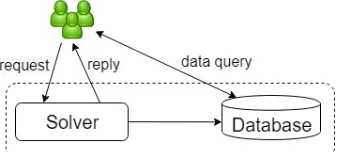
SolveEngine2is a cloud-based problem-solving service. It aggregates thousands of optimisation algorithms and uses artificial intelligence to choose the best ones to solve optimisation problems. Users format their problems in a supported input format and use the SolveEngine API to call the service. SolveEngine then applies the suitable solvers by using Machine Learning techniques, returning the results in JSON format. SolveEngine is a container-based application that consists of two main components,SolverandDatabase(see Fig. 2). The Solver processes user requests while the Database stores the processing results. Users can also query the Database to obtain certain data of interest.
Figure 2: The architecture of the SolveEngine application.
To deploy such 2-component application in the cloud, the appli-cation operator (a cloud customer in this case) needs to manually look into different cloud provider SLAs and assess whether or not they satisfy the application’s SLOs. This is a time-consuming and challenging task due to the scale and heterogeneity of service offer-ings as already highlighted. Consider for example an SLO ofMonthly Bandwidth Cost, which specifies the customer’s budget for data trans-fer between components. The cost calculation depends on several factors such as which provider to use, which service, and in which region. Taking also into account that the cost will be different for different permutations of services, the search space will make the selection decision very challenging for the customer.
3
SLO-ML
DESIGN AND CONCEPTS
The key aim ofSLO-MLis to provide a comprehensive syntax to cap-ture all possible SLOs that customers may require to specify service
[image:2.612.354.525.397.473.2]Figure 3: The architecture of usingSLO-MLwith the broker. Compared to the general IaC architecture that is common in industry (Fig. 1), the proposed architecture provides much more abstraction and transparency.
levels of their applications. For this purpose,SLO-MLenables cus-tomers to specify SLOs for each application component. Moreover,
SLO-MLsupports SLO specification on both single- and multi-cloud deployments.
3.1
Design principles
The design ofSLO-MLis based on the following principles:
(1) Customer-oriented.SLO-MLis designed to enable customers
to specify their high-level operational requirements in a simple declarative syntax.SLO-MLdifferentiates between two classes of SLOs, namely the service-level SLOs and the application-level SLOs. A service-level SLO represents a quantitative characteris-tic of the cloud service regardless of the hosted application. Some of the service-level SLOs are specified in the provider SLAs with penalties paid to the customer in case of violation. On the other hand, an application-level SLO represent a quantitative character-istic of the cloud application as perceived by the application client. This kind of SLO cannot be specified in the SLAs as it depends on many aspects of the application such as the application architec-ture, implementation choices, among other. This implies that the responsibility on satisfying the application-level SLOs is outside of the service provider. This requires an intelligent intermediary system that is able to capture knowledge about the performance of the application when hosted on a certain cloud service and utilise that knowledge to inform the service selection decision.
(2) Independence. In order to prevent vendor lock-in, SLO
spec-ification needs to be independent of cloud service specspec-ification. Furthermore, it needs to be independent of cloud application development technology and implementation details. This is to impose no restrictions on the customer choice of programming
models, and to minimise SLO specification changes when adapt-ing the application. In fact, the SLO specifications need to be adapted only when the architecture of the application changes, as the SLOs can be specified per application components.
(3) Abstraction. Customers should be able to specify SLOs
regard-less of the required type of cloud service, such as SaaS, PaaS, FaaS, etc.
(4) Separation of concerns. It should be possible to maintain and
adapt isolated SLO specification at an application component level. For example, a load-balancing component’s SLOs should be separate from those of a data storage element.
(5) Mapping SLOsA high-level SLOs which specified by users
should be broken down to low-level ones, and then further mapped to the application component level. For example, the response time of a three-tier application consists of processing time for each layers.
(6) Extensibility. Extending capability should be simple. In other
words, adding a new SLO concept should not require re-engineering of the CML but just adding a human- and machine-readable SLO name along with the appropriate unit and value type, if needed. Obviously, this requires slightly amending the engine that pro-cesses the specified model.
3.2
Key elements
At this stage of designingSLO-ML, we adopt textual syntax to repre-sent SLOs. The main elements of the current syntax are:name,type,
unit,operator,application, anddata_flow.
• name: A unique keyword is used to refer to each SLO. The key-words are self-explanatory, making it simple for developers to understand. For example, the keywordResponse_Timeis used to refer to the response time SLO.
• value:SLO-MLsupports three types of the SLO values: scalar, interval, and categorical. The scalar type is used to specify a nu-merical value (e.g. availability = 0.99). The interval type is used to specify an upper- and lower-bound of SLO value (e.g. response time between 5ms and 10ms). Categorical types provide a higher level of abstraction for SLO value specification. It allows customers to specify a category (e.g. low, medium, high) instead of specific values or a predefined range, relieving customers from specify-ing an exact value in case they are not certain. For example, for memory-intensive application, a customer can specify the cate-gory high for theMemory_SizeSLO.
• unit:SLO-MLuses a set of keywords that specify the units of mea-surement of each SLO. For example, theMigration_TimeSLO is specified using the hours unit. In addition,SLO-MLcontains rules for unit-to-unit conversion between units of the same kind. • operator:SLO-MLdefines a set of operators that are used to
spec-ify the SLO values. This set includes the operators: less than (<), less than or equal (≤), greater than (>), greater than or equal (≥), equal (=), and in (in). For instance,incan be used to indicate that
response_timeshould be in the interval[5ms,10ms]. • application: This is to specify the application-level SLOs. • data_flow: This is to specify the directions of data transfer among
Listing 1ASLO-MLfile example
{
"database_comp": { //component 1 "SLOs": [
//service-level SLO { "unit":"",
"name":"Monthly_uptime_percentage", "value":"0.9999",
"operator":">=" },
//service-level SLO { "unit":"GB",
"name":"Monthly_egress_bandwidth", "value":"2000",
"operator":"<=" }
], "config": {
"type":"database" }
},
"solver_comp": {//component 2 ...
},
"application": { "SLOs": [
//application-level SLO { "unit":"\$",
"name":"Monthly_bandwidth_cost", "value":"20",
"operator":"<" }
] },
"data_flow": [{
"from":"solver_comp", "to":"database_comp" }]
}
3.3
Grammar
We adopt JSON syntax [9] for structuring theSLO-MLfile (.slo) that defines the required SLO. This definition is structure as a Map<key,value> where the key is an application compo-nent identifier that is defined in the IaC description, while
value is an array of maps representing the SLOs required for that component. Each map is a Map<key,value> where the
keyis one of the elements described in §3.2 andvalueis the corresponding value. Listing 1 shows an example of the SLO specification of a cloud application that consists of two components,
database_comp and solver_comp. The listing shows that data-base_comprequires two SLOs,Monthly_uptime_percentageand
Monthly_egress_bandwidthat the service-level. The application also requires theMonthly_bandwidth_costwhich specifies the budget for data transfer of the application. Thedata_flowpart shows that data will be transferred from thesolver_compcomponent to thedatabase_comp. The use of an invalid element key, invalid element value, or invalid SLO unit will produce a parsing error.
4
BROKER ARCHITECTURE
We provide an architecture for a cloud broker that realises deploy-ment based on user-providedSLO-MLdescriptions.
4.1
Overall approach
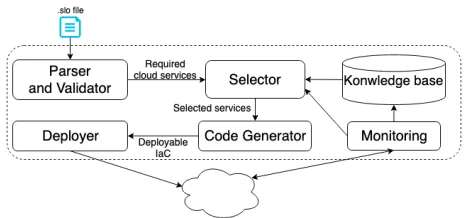
[image:4.612.321.554.84.193.2]Our approach views the cloud application as a set of components, each of which requires a set of SLOs to be specified. The approach
Figure 4: The design of the Realisation Engine.
builds on existing approaches of modelling cloud applications such as Terraform HCL3, TOSCA4, etc. We assume that the customer request consists of SLO model defined usingSLO-MLand the broker will parse the model, select satisfying services, and then generate the CML deployment code (HCL, TOSCA, etc.). The broker will then execute the deployment code to deploy the application.
4.2
Components
Our proposed broker architecture consists of the following main components, as illustrated in Fig. 4.
Parser and Validatorparses both the SLO and IaC models to
ex-tract the required SLOs for each component. The validation intends to evaluate the SLO specification by checking the correctness of the (i) syntax, (ii) units, and (iii) consistency of the configuration. Syn-tax validation aims at inspecting the synSyn-tax for any errors in using
SLO-MLkeywords. Unit validation aims to check for any improper use of units. For instance, the unitdayscannot be used with the
BandwidthSLO. Consistency validation ensures that component references in the SLO file correspond to the application components described in the IaC model.
Knowledge Baseis a repository that stores information of the
cloud instances such as their type, provider, and the service levels. The Knowledge Base also contains monitoring data that represent the real time performance of the cloud services.
Selectorselects services that match the required SLOs for each
component of the application. In its simplest implementation, the selection is based on provider SLAs. More sophisticated implemen-tations may include intelligent selection using monitoring data and consequent predictions of performance. The selection approach adopted in this paper is founded on quantifying the extent to which each service SLO satisfies the required SLO by assigning a utility value to each SLO. These utilities are aggregated to calculate a utility for each cloud service. The utilities are then maximised to select the optimal service(s).
In order to assign utilities for each service SLO, we use the func-tion shown in eq. (1), which are adapted from a utility model for quantifying volunteer services [11]. The function assigns a minimum utility of 0 to SLOs that satisfy the corresponding required SLO. The service SLOs that do not satisfy the required one receive a utility of −1. The SLOs utilities are then summed up using eq. (2) to calculate the service utility. For each combination of services, an application-level utility is calculated using eq. (3), where corresponding SLOs are aggregated using suitable aggregation functions (e.g.sumfor
3https://www.terraform.io/docs/configuration/syntax.html
cost andminfor availability). The application-level utilities are then maximised to select the optimal service(s).
Ui(Sj)=
(
1−eS LOr−S LOj i,ifS LOj i≥S LOr
−1,otherwise (1)
whereSLOjiis theith SLO of servicej,SLOris the corresponding required SLO, andUi(Sj)is the utility ofSLOji.
U(Sj)= n
Õ
i=1
Ui(Sj) (2)
whereU(Sj)is the utility of servicej.
Ui(comb)=
(
1−eAP Pr−AGG(S LOi),ifAGG(S LO
i) ≥AP Pr
−1,otherwise (3)
whereAGG(SLOi)is the aggregate ofith SLO of the services,APPr is the corresponding required application-level SLO, andUi(comb) is the utility of the combination of services.
IaC Code Generatorgenerates the deployment code of the
ap-plication based on the selected instances. This deployment code is readily deployable with default settings of the selected cloud services, but customers can customise it as they wish.
Deployerreceives the deployment code and automates the
de-ployment of the application on the selected cloud instances.
Monitoringrecords the low level performance metrics of the
selected cloud services. The collected data are stored in the Knowl-edge Base. The metrics are then mapped to the high level SLOs. If the mapping results in violation of an SLO, the violation is reported to the selector to re-select new instances and adapt the application accordingly. It is worth mentioning that the details of monitoring and adaptation are out of this paper’s scope as we focus on presenting the modelling language and the realisation architecture.
5
QUALITATIVE EVALUATION
In this section, we evaluateSLO-MLusing an experimental case study. We first present the experiment setup and the selected case study, then comment on the results.
5.1
Experiment design
Objectives.The experiment aims at evaluating users productivity,
in terms of the time required to select cloud services, and accuracy, in terms of the optimally of SLO offerings of the selected service.
Strategy.We compareSLO-MLapproach against the manual
se-lection of cloud services where users need to manually inspect and compare the service specification and SLA offerings in order to se-lect suitable services for the given use cases. We adopt a controlled experiment approach where participants are given three user cases. The use cases are designed to be simple so that they can conveniently doable by the participants within reasonable experimental time. This controlled experiment strategy design is leveraged to evaluate the interaction of the users withSLO-ML. The analysis of this interaction enables the identification of advantages and limits ofSLO-MLin addition to improvements that can be introduced.
Procedure.The experiment procedure lasts for a maximum of an
hour per participant. Each participant is assigned three use cases to select cloud services first manually then by developing and executing
SLO-MLscripts for each case. All participants performed the same
use cases and used the same powerful PC. At the end of the exper-iment, the participant fills a questionnaire about their experience in programming languages, cloud service selection, cloud application deployment and application modelling languages and tools. Then, each participant is asked to respond to a simple questionnaire us-ing a 5-point Likert scale, to provide feedback about usability and productivity ofSLO-MLand things to improve.
Task: Participants were given three simple architectures of cloud applications along with their SLO requirements. Each application consists of one or more components, where every component can be deployed on a cloud service that should satisfy the functional and non-functional requirements. Participants are given a list of services that functionally satisfy the components along with the services’ SLAs. They need to find services that match the SLO requirements by: i) following the current approach where provider SLAs are
man-ually inspected to find matching services, and
ii) writing aSLO-MLscript to be utilised for automated search.
Assistance: Before the experiment commences, participants are
introduced to the relevant SLAs of the considered cloud providers, namely, Amazon Web Services, Microsoft Azure, Google cloud, and RackSpace. They are also introduced toSLO-MLwith a brief quick-start guide (2-3 minutes) and a sample script. During the experiment, additional guidance is provided to any participant requiring assis-tance for interacting with either the service SLAs and offerings or withSLO-ML.
Recruitment: Participants were recruited from Computer
Sci-ence researchers and students at Lancaster University, as well as from software developers at local startups and incubators. An incen-tive for participation was offered in the form of an online shopping voucher (value of £10). Overall, 20 participants with varying ex-pertise levels in programming and cloud systems were recruited. These were broken down as 8 researchers, 8 graduate students, and 4 professional developers. Further, 11 of them self-reported high experience (above 5 of a scale from 1 to 7) in JSON, 4 with medium experience (3-4) and 5 with low experience (1-2). Regarding expertise in programming, 8 reported high programming experience (more than 7 years), 5 of medium experience (4-6 years), and 7 with low experience (3 or less years). Finally, 8 self-reported knowledge of cloud application deployment and/or cloud service selection, with AWS and Google Cloud being the most used providers.
5.2
The SolveEngine case study
We exploit the SolveEngine application (introduced in §2) as a real-world case study. We ask the participants to use it under the following three experimental use cases:
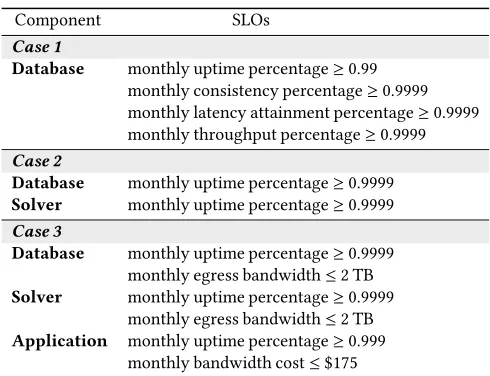
5.2.1 Single component:In this case, the SolveEngine application is to be deployed on a hybrid cloud where the Solver component is hosted locally whereas the database component is deployed on a cloud service. The customer needs to select a cloud database service to host the database component. Case 1 in table 1 lists the required SLOs of the database components.
5.2.2 Case 2.In this case both components need to be hosted on the cloud. The customer needs to select a cloud database service to host thedatabasecomponent and a compute service to host thesolver
5.2.3 Case 3.This scenario is similar to the previous one. The dif-ference is that the user has application-level SLOs. The participant needs to ensure the aggregate SLOs of the selected services satisfy the application level SLOs. Table 1 shows the bandwidth required between the components and required availability of the application. The customer needs to select a cloud service for each component taking into account the bandwidth budget constraint and needs to aggregate theMonthly uptimeof the services.
Table 1: SLO requirements of SolveEngine
Component SLOs
Case 1
Database monthly uptime percentage≥0.99
monthly consistency percentage≥0.9999 monthly latency attainment percentage≥0.9999 monthly throughput percentage≥0.9999
Case 2
Database monthly uptime percentage≥0.9999
Solver monthly uptime percentage≥0.9999
Case 3
Database monthly uptime percentage≥0.9999
monthly egress bandwidth≤2 TB
Solver monthly uptime percentage≥0.9999
monthly egress bandwidth≤2 TB
Application monthly uptime percentage≥0.999
monthly bandwidth cost≤$175
5.3
Accuracy results
The accuracy of the selection is evaluated by calculating the distance between the utility of the selected services and the optimal one. For this, the above utility functions (§4) are used to calculate the utility of the selected services.
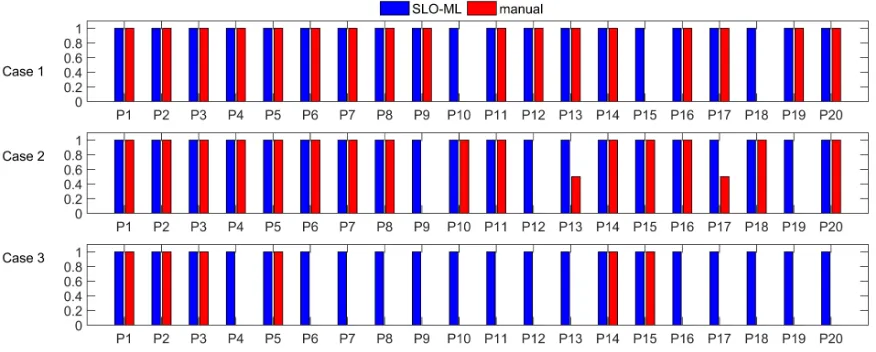
Fig. 5 compares the accuracy of each participant’s selection in both theSLO-MLand manual approaches. In all the three use cases, the results demonstrate thatSLO-MLimproves selection accuracy. In case 1, which is the simplest case, most of the participants manually selected the optimal service, Microsoft Azure Cosmos DB. This service is the only one with SLA support of the required SLOs (see table 1). Despite the simplicity of the case, three of the participants (P10, P15, and P18) selected wrong services, i.e. services that do not support the required SLOs (namely,monthly consistency attainment percentage, monthly latency attainment percentage, and monthly throughput percentage); hence, these 3 participants scored an accuracy level of 0 for this use case.
The improvement in accuracy is more notable as the complexity increases in case 2, and even more so in case 3. In order to highlight the improvement, we plot the average accuracy in the three cases in Fig. 7. This figure reveals that there has been a sharp decline in accuracy using the manual approach as the complexity of the case increases. This is in contrast to theSLO-MLapproach where optimal accuracy is maintained throughout the use cases.
5.4
Productivity results
The productivity of participants is evaluated by calculating the time spent to make a decision of service selection. In the case ofSLO-ML,
productivity is calculated as the time spent to develop and execute a validSLO-MLscript whereas in the manual approach case it is calculated as the time from the beginning of inspecting the SLA information until deciding on a service.
Fig. 6 compares the productivity of each participant in both ap-proaches. In all three use cases,SLO-MLsignificantly reduces selec-tion time. More importantly, the more complex the use case is the more significant the improvement is. To better demonstrate this, we plot the distributions of the time spent by participants in the three cases in Fig. 8. What can be clearly seen in this figure is the rapid growth of the completion time of the manual approach as the complexity of the case increases. On the other hand, the growth is much slower in theSLO-MLcase, indicating its ability to assist devel-opers in tackling cloud deployment scenarios of complex selection decisions without a high tax on their time.
5.5
Exit interview responses
After the completion of the three cases, the participants were inter-viewed in order to survey their experience of usingSLO-ML. They were asked to answer seven question, four of which aimed to assess productivity and three to assess usability. Responses were collected using a 5-point Likert scale with anchors from ‘Strongly disagree’ to ‘Strongly agree’.
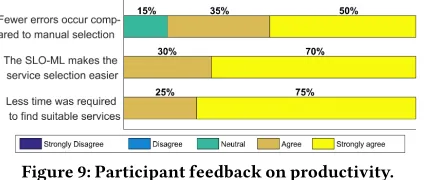
Productivity.Fig. 9 shows the participant feedback on their
pro-ductivity when usingSLO-ML. All the participants agreed that less time would be required when usingSLO-MLespecially with com-plex cases of service selection. All of them also agreed thatSLO-ML
makes service selection easier by automating it as opposed to man-ual inspection of SLAs. Furthermore, 85% of the participants agree thatSLO-MLreduces the possibility of selecting services that do not satisfy the SLO requirements or services that are less optimal.
Usability.Fig. 10 shows the participant feedback on the usability
ofSLO-ML. The majority of participants foundSLO-MLand its con-cepts and notations easy to use and flexible. A few of the participants (15%) foundSLO-MLlacks some features they might need, such as support for other SLOs. One participant (5%) found thatSLO-ML
restricts their freedom as a cloud customer as it does not leave the final decision of selection to them.
6
SCALABILITY EVALUATION
We now turn our attention to evaluating the feasibility and over-heads of our approach. Specifically, we aim through experimental means to identify the factors that contribute to the end-to-end time of generating the deployment code. For this purpose, we evaluate the time required to parse theSLO-MLscript, select services, and generate deployment code at different scales. From this, we extract conclusions about the ability of and the requirements for using the
SLO-MLapproachat scale. The used platform is an Intel Core i7 with 16GB RAM running Linux Ubuntu v16.04 and Java SE v1.8.0. Each ex-periment is repeated 100 times to obtain representative mean values.
6.1
Parsing time
Figure 5: Accuracy of service selection of each case using manual andSLO-MLapproaches.
Figure 6: The time spent by participants to complete each case using either approaches.
dimensions affecting the scalability of parsing are the number of components, the number of SLOs and the degree of connectivity. Specifically, we inspect three degrees of application connectivity that correspond to varying application topologies [7]: ‘low’ represents ap-plications such as Riak with a ring-like topology where a component only connects to one or two other components; ‘mid’ is analogous to hierarchical hub-and-spoke and other cliquey structures, e.g. Mon-goDB and Ceph; while ‘high’ embodies complex applications with highly connected components such as the microservice architecture of the Netflix or Facebook infrastructures.
Fig. 11 plots the average parsing time in milliseconds. We notice that the parsing time increases with the increase of both the number of SLOs and the number of components. In both cases the increase exhibits a linear trend. We notice also that the parsing time increases with the increase in the connectivity degree between the compo-nents. However, in all cases the parsing time is practically acceptable,
the maximum being≈1s in a very-large scale deployment of 1000 components and 100 SLOs.
6.2
Deployment code generation time
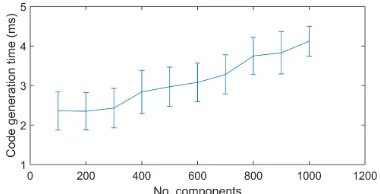
The next experiment focuses on assessing the time required for the step that follows parsing, i.e. generating application deployment code. The generator is written as a Java program that receives info-rmation of the selected services and writes to a file CML-specific lines of code. In this paper, we generate code for Terraform deployer, i.e. the generated code is HCL code5. The only dimension affecting the scalability of code generation is the number of components in an application. We vary this dimension between 100 and 1,000 appli-cation components – see Fig. 13. We observe a linear trend between code generation time and the number of components. Nevertheless, as the figure depicts, the code generation time is quite insignificant
Figure 7: Box-plot and mean accuracy of service selection in each experimental case using either approaches. The traditional manual approach creates selection decisions that are further away from the optimum as application
SLOs increase in complexity. Meanwhile,SLO-MLmaintains
optimal selection inallcases.
Figure 8: Box-plot and mean time spent by participants to complete each case using either approaches. Using the traditional manual approach, developers needed increas-ingly more time as application complexity grew. In contrast,
SLO-MLallows them to focus only on SLO specification
[image:8.612.61.292.90.199.2]re-sulting in significantly reduced time, by a factor of4.5–7.7x.
Figure 9: Participant feedback on productivity.
even in the case of a high number of components (e.g.≈4ms for 1,000 components), underliningSLO-ML’s practicality in this regard.
6.3
Selection time
[image:8.612.58.292.289.396.2]The third experiment focuses on evaluating service selection time, defined as the time required to find a single or set of services that satisfy the application SLO requirements. The main dimensions af-fecting the scalability of selection are the number of components (i.e. required services), the number of candidate services for each component, and the number of required SLOs. We vary each of these dimensions, plotting the average selection time in milliseconds in Fig. 12. Selection time increases significantly with an increase in the
Figure 10: Participant feedback on usability.
number of components, and increases at an exponential rate with the number of candidate services. This implies that the service selection time is the bottleneck of the process especially in the case of a high number of components and/or services. This issue is discussed more in the following section.
7
DISCUSSION
Reflecting on our experiences in developing and evaluatingSLO-ML, we draw the following observations and concerns.
7.1
Diversity-induced complexity
During the experimental case study with SolveEngine, many par-ticipants tend to ignore (intentionally or mistakenly) some of the options when selecting the services. For example, some participants made decisions based on a subset of the required SLOs, ignoring the effect of others. This led to the selection of services that either do not satisfy the requirements or do but are less optimal ones. This observation was obvious in case 3 where, perhaps due to its com-plexity, many participants ignored bandwidth price offerings. We observed that this oversight is due to two reasons. The first reason is the difficulty of finding the relevant SLA documents of the required services. Some participants tended to select services the SLAs of which are easily found. The second reason is the diversity in band-width pricing schemes, as several cloud providers charge differently based on region and availability zone. This seemed to confuse some participants as they were not able to determine which offering is best to use, while others did not want to spend time to inspect all of the offerings and opted for randomly selected one. Although complexity is clearly to blame for such behaviour, it clearly can lead to wrong or sub-optimal decision making.
Furthermore, some participants made wrong decisions (i.e. they selected services that do not satisfy the required SLOs) due to lack of knowledge. They either looked into irrelevant SLAs or they were confounded by the heterogeneous terminology adopted by different providers to express the same SLOs.
7.2
Scalability
[image:8.612.70.282.481.571.2]Figure 11: Parsing time ofSLO-MLscript with varied scales and connectivity degrees between components.
Figure 12:SLO-ML’s selection time as the complexity of an application and the number of its SLOs grow.
Figure 13:SLO-MLcode generation time for applications with
different numbers of components.
algorithms are required. This is beyond the scope of this paper, but luckily the web service selection literature is rich of such selection algorithms [10].
7.3
Experimental validity
As is common with experimental case study designs, external va-lidity (i.e. the ability to generalise the results) is naturally impaired to an extent in order to attain higher internal validity (i.e. validat-ing the cause-effect inference). However, by choosvalidat-ing a real-world application that is representative of a range of user-facing cloud applications, we are satisfied that our results are indicative of the significant value added bySLO-ML.
7.4
Future directions
Currently,SLO-MLonly caters to SLOs that are supported by provider SLAs. For even more abstract support of application needs, this needs to be extended to include application-specific SLOs that cannot be guaranteed by the provider. An example is theCompletion time
SLO that specifies a deadline for a certain job. Such extension, how-ever, requires run-time monitoring of the application and continuous assessment of the SLO’s satisfaction. This also requires the devel-opment of adaptation techniques to adapt service selection in case the current selection fails to satisfy the SLOs. In turn, this also re-quires the accumulation of knowledge about services and application performance, and the utilisation of such knowledge to predict per-formance before making the selection decision. These issues are the focus of our ongoing work to extend theSLO-MLapproach.
8
RELATED WORK
[image:9.612.79.269.418.515.2]cloud resources provisioning, application migration to the cloud and re-configuration of provisioned cloud services.
A prominent example is the Topology and Orchestration Spec-ification for Cloud Applications (TOSCA) [2], an OASIS standard for describing the structure of cloud applications (i.e. components and relationships) in XML format. Similar efforts include GENTL [1], CloudML-UFPE [16], and CloudML-SINTEF [5].
Blueprint [23] provides concepts for representing service-based applications to facilitate deployment and migration on cloud services. The provided concepts also allow for the representation of different cloud service offerings. MULTICLAPP [17] introduces a UML-based profile to model components that can be annotated with deployment information. StratusML [18] adopts a similar approach. CAMEL [25] can be viewed as a ‘superset’ CML as it integrates and extends existing DSLs. ARGON [28], addresses the issue of abstracting the complexity of using CMLs by enabling users to specify infrastructure resources then generating deployment code, similar to the SLO-ML approach. CadaML [21] is used to manage multi-tenant architecture evolution by transforming an abstract model into the appropriate code for different cloud data storage types.
There are two main shortcomings of the above and other CMLs. First, they require the customer to develop a service-specific IaC model, which means customers need to manually select the cloud services. Such IaC model can be complex to develop from scratch, especially for large-scale applications. Second, they provide limited support for modelling customer SLOs. Instead, they seem to have been designed with a simplistic representation of the provider’s per-spective not that of the customer. For instance, Blueprint assumes the presence of a marketplace where providers can publish their service descriptions as WS-Policy files. WS-Policy is intended to specify non-functional properties of unary web services, not the complex cloud services customers use today. Furthermore, such assumed market-place does not exist [13, 14], so such CMLs are of little practical value in real-world deployments. SLO-ML addresses the above shortcom-ings and raises the level of abstraction provided to cloud customers.
9
CONCLUSION
We presentedSLO-ML, the first cloud modelling language to auto-mate the selection of cloud services to satisfy customer service level objectives (SLOs) and generate the appropriate deployment code.
SLO-MLis specifically designed to capture a wide range of SLOs from customers. Our findings from an experimental case study suggest that the raised level of abstraction provided bySLO-MLresults in sig-nificant improvements in both developer productivity and optimal service selection. We also identified the limitations ofSLO-ML, which poses a number of research questions for future work in this area.
ACKNOWLEDGMENTS
This work was supported by the Adaptive Brokerage for the Cloud (ABC) project, UK EPSRC grant EP/R010889/1.
REFERENCES
[1] Vasilios Andrikopoulos, Anja Reuter, Santiago Gómez Sáez, and Frank Leymann. 2014. A GENTL Approach for Cloud Application Topologies. InService-Oriented and Cloud Computing. 148–159.
[2] Ankita Atrey, Hendrik Moens, Gregory Van Seghbroeck, Bruno Volckaert, and Filip De Turck. 2015.An overview of the OASIS TOSCA standard: Topology and
Orchestration Specification for Cloud Applications. Technical Report. IBCN-iMinds, Department of Information Technology.
[3] Matt Baughman, Ryan Chard, Logan Ward, Jason Pitt, Kyle Chard, and Ian Foster. 2018. Profiling and Predicting Application Performance on the Cloud. In
IEEE/ACM 11th International Conference on Utility and Cloud Computing (UCC). 21–30. https://doi.org/10.1109/UCC.2018.00011
[4] Alexander Bergmayr, Uwe Breitenbücher, Nicolas Ferry, Alessandro Rossini, Arnor Solberg, Manuel Wimmer, Gerti Kappel, and Frank Leymann. 2018. A Systematic Review of Cloud Modeling Languages. ACM Comput. Surv.51, 1, Article 22 (Feb 2018), 38 pages. https://doi.org/10.1145/3150227
[5] Alexander Bergmayr, Alessandro Rossini, Nicolas Ferry, Geir Horn, Leire Orue-Echevarria, Arnor Solberg, and Manuel Wimmer. 2015. The Evolution of CloudML and its Applications. InWorkshop on MDE on and for the Cloud. [6] Tobias Binz, Uwe Breitenbücher, Oliver Kopp, and Frank Leymann. 2014.TOSCA:
Portable Automated Deployment and Management of Cloud Applications. Springer, 527–549. https://doi.org/10.1007/978-1-4614-7535-4_22
[7] Simon Bouget, Yérom-David Bromberg, Adrien Luxey, and François Taiani. 2018. Pleiades: Distributed Structural Invariants at Scale. InIEEE/IFIP In-ternational Conference on Dependable Systems and Networks (DSN). 542–553. https://doi.org/10.1109/DSN.2018.00062
[8] Cloud Standards Coordination (CSC). 2016.CSC Phase 2: Cloud Computing Users Needs - Analysis, conclusions and recommendations from a public survey. Special Report 003 381 V2.1.1. The European Telecommunications Standards Institute (ETSI). 12–19 pages. http://csc.etsi.org/phase2/UserNeeds.html
[9] Douglas Crockford. 2006.The application/json Media Type for JavaScript Object Notation (JSON). Internet RFC 4627.
[10] Schahram Dustdar and Wolfgang Schreiner. 2005. A survey on web services composition.International journal of web and grid services1, 1 (2005), 1–30. [11] Abdessalam Elhabbash, Rami Bahsoon, Peter Tino, and Peter R. Lewis. 2014. A
Util-ity Model for Volunteered Service Composition. InInternational Conference on Util-ity and Cloud Computing (UCC). IEEE/ACM. https://doi.org/10.1109/UCC.2014.43 [12] Abdessalam Elhabbash, Yehia Elkhatib, Gordon Blair, Yuhui Lin, and Adam Barker. 2019. A Framework for SLO-driven Cloud Specification and Brokerage. In19th IEEE/ACM International Symposium on Cluster, Cloud and Grid Computing (CCGRID). 666–667. https://doi.org/10.1109/CCGRID.2019.00085
[13] Abdessalam Elhabbash, Faiza Samreen, James Hadley, and Yehia Elkhatib. 2019. Cloud Brokerage: A Systematic Survey.Computing Surveys51, 6, Article 119 (Jan 2019), 28 pages. https://doi.org/10.1145/3274657
[14] Yehia Elkhatib. 2016. Mapping Cross-Cloud Systems: Challenges and Oppor-tunities. InConference on Hot Topics in Cloud Computing (HotCloud). USENIX Association, 77–83.
[15] Nadir Ghrada, Mohamed Faten Zhani, and Yehia Elkhatib. 2018. Price and Performance of Cloud-hosted Virtual Network Functions: Analysis and Future Challenges. InPVE-SDN.
[16] Glauco Estacio GonÃğalves, Patricia Endo, Marcelo Santos, Djamel Sadok, Judith Kelner, Bob Melander, and Jan-Erik Mangs. 2011. CloudML: An Integrated Language for Resource, Service and Request Description for D-Clouds.CloudCom
(2011).
[17] Joaquín Guillén, Javier Miranda, Juan Manuel Murillo, and Carlos Canal. 2013. A UML Profile for Modeling Multicloud Applications. InService-Oriented and Cloud Computing. 180–187.
[18] Mohammad Hamdaqa and Ladan Tahvildari. 2015. Stratus ML: A Layered Cloud Modeling Framework. InIEEE International Conference on Cloud Engineering. [19] K. Hwang, X. Bai, Y. Shi, M. Li, W. G. Chen, and Y. Wu. 2016. Cloud Performance
Modeling with Benchmark Evaluation of Elastic Scaling Strategies.Trans. Parallel Distrib. Syst.27, 1 (2016), 130–143. https://doi.org/10.1109/TPDS.2015.2398438 [20] Assylbek Jumagaliyev and Yehia Elkhatib. 2019. CadaML: A Modeling Language
for Multi-Tenant Cloud Application Data Architectures. InIEEE International Conference on Cloud Computing (CLOUD).
[21] Assylbek Jumagaliyev and Yehia Elkhatib. 2019. A Modelling Language to Support Evolution of Multi-Tenant Cloud Data Architectures. InIEEE/ACM International Conference on Model Driven Engineering Languages and Systems (MODELS). [22] Cinar Kilcioglu, Justin M. Rao, Aadharsh Kannan, and R. Preston McAfee. 2017.
Usage Patterns and the Economics of the Public Cloud. In26th International Conference on World Wide Web. 83–91. https://doi.org/10.1145/3038912.3052707 [23] Dinh Khoa Nguyen, Francesco Lelli, Yehia Taher, Michael Parkin, Mike P. Papazoglou, and Willem-Jan van den Heuvel. 2011. Blueprint Template Support for Engineering Cloud-Based Services. InTowards a Service-Based Internet. 26–37. [24] Zhonghong Ou, Hao Zhuang, Jukka K. Nurminen, Antti Ylä-Jääski, and Pan Hui.
2012. Exploiting Hardware Heterogeneity within the Same Instance Type of Amazon EC2. InConference on Hot Topics in Cloud Computing (HotCloud). USENIX. [25] Alessandro Rossini, Kiriakos Kritikos, Nikolay Nikolov, JÃűrg Domaschka,
[26] Maria Salama, Amir Zeid, Ahmed Shawish, and Xiaohong Jiang. 2014. A novel QoS-based framework for cloud computing service provider selection.
International Journal of Cloud Applications and Computing4, 2 (2014), 48–72. [27] Faiza Samreen, Yehia Elkhatib, Matthew Rowe, and Gordon S. Blair. 2016.
Daleel: Simplifying cloud instance selection using machine learning. In
IEEE/IFIP Network Operations and Management Symposium (NOMS). 557–563. https://doi.org/10.1109/NOMS.2016.7502858